Archives for February 2023

IRS Clarifies Federal Taxation of Special State Relief Payments

In 2022, 21 states issued special relief payments to eligible residents in 2022. The Tax Foundation has a partial list of state rebate checks.

But do these state relief checks count as taxable income at the federal level? After taking a bit to think about it, the IRS has issued official guidance on how to account for these payments while filing your federal income taxes. Please see the full details there, but here is a quick summary below. For most people, the payments will not be taxable.

Filers in the following 17 states do NOT need to report “general welfare and disaster relief payments” from their state on their 2022 tax return:

  • Alaska*
  • California
  • Colorado
  • Connecticut
  • Delaware
  • Florida
  • Hawaii
  • Idaho
  • Illinois*
  • Indiana
  • Maine
  • New Jersey
  • New Mexico
  • New York*
  • Oregon
  • Pennsylvania
  • Rhode Island

For individuals in the remaining 4 states listed below, state payments will not be included for federal tax purposes if the payment is a refund of state taxes paid and either the recipient claimed the standard deduction or itemized their deductions but did not receive a tax benefit.

  • Georgia
  • Massachusetts
  • South Carolina
  • Virginia

(* For Alaska, this applies only for the supplemental Energy Relief Payment received in addition to the annual Permanent Fund Dividend. Illinois and New York issued multiple payments and in each case one of the payments was a refund of taxes, which should be treated as noted above, and one of the payments is in the category of disaster relief payment.)

For example, in California, residents who received a California Middle Class Tax Refund (MCTR) of $600 or more received a 1099-MISC form. I am not a tax advisor, but based on this IRS guidance, you should not have to report this income on your federal taxes. If you already filed, you may need to file an amended return.

Capital One VentureOne Rewards Credit Card: 20,000 Bonus Miles + 0% Intro APR Offer w/ No Annual Fee

card_name

The card_name is their no-annual-fee travel rewards card with 1.25x miles on all purchases. There are bigger rewards and bonuses from the premium Capital One Venture and ultra-premium Capital One Venture X cards, but this card still offers a 20,000 mile bonus with a lower spending requirement and no annual fee. 20,000 miles can be redeemed for $200 in travel, offsetting any travel purchase made with the card (any airline, any hotel, AirBNB stays, Uber rides, no blackout dates). This is also the rare card that allows your points to transfer to airline miles without an annual fee. Here are the highlights:

  • For a limited time, enjoy a $100 credit to use towards flights, stays and rental cars booked through Capital One Travel during your first cardholder year. Plus, earn 20,000 bonus miles once you spend $500 on purchases within the first 3 months from account opening.
  • Earn unlimited 1.25X miles on every purchase.
  • Enjoy 0% intro APR on purchases and balance transfers for 15 months; reg_apr,reg_apr_type APR after that; balance transfer fee applies
  • Miles won’t expire for the life of the account and there’s no limit to how many you can earn
  • 5X miles on hotels, vacation rentals and rental cars booked through Capital One Travel.
  • Use your miles to get reimbursed for any travel purchase – or redeem by booking a trip through Capital One Travel
  • Transfer your miles to your choice of 15+ travel loyalty programs.
  • No foreign transaction fees.
  • $0 annual fee.

Travel statement credit redemption details. Capital One “miles” can be redeemed directly for a cash statement credit on a 1 mile = $0.01 basis when offsetting any travel purchase made on the card within the past 90 days. In other words, 40,000 miles = $400 toward travel. That means you can fly on any airline or stay at any hotel, pay with this card, and then “erase” that purchase using your miles balance later. This even includes AirBnB vacation rentals, car rentals, and Uber rides.

This means that earning 1.25 miles on on every $1 in purchases essentially makes this a flat 1.25% back card when applied towards travel. You also have the option of booking travel through their travel portal, similar to Chase Ultimate Rewards, but you are not required to do so. You have the flexibility of booking through them or making the purchase directly through the airline, hotel, car rental counter, etc.

Miles transfer options. Capital One now allows you to transfer your “miles” into select airline miles programs as well. Here are the airline transfer partners:

  • Aeromexico
  • Air France/KLM
  • Air Canada Aeroplan
  • Cathay Pacific Asia Miles
  • Avianca Lifemiles
  • British Airways Avios
  • Emirates Skywards
  • Etihad
  • EVA
  • Finnair
  • Qantas
  • Singapore Airlines Krisflyer
  • TAP Air Portugal
  • Turkish Airlines
  • Virgin Red

Hotel partners

  • Accor Live Limitless
  • Choice Hotels

If you are willing to do some research on how to best leverage these international airline miles programs, this can be a very valuable option. (My personal favorite is Air Canada Aeroplan points.) Otherwise, it’s nice to know you can always get a certain level of value by redeeming against any travel purchase.

Comparison with other travel cards. This VentureOne Rewards credit card earns 1.25x miles on all purchases with no annual fee, and has the capability on its own to transfer to airline miles. The Chase Freedom Unlimited card earns 1.5 Ultimate Rewards (UR) points per dollar spent with no annual fee, but it does not allow you to transfer the points to airline mile partners on its own. You must first transfer the UR points to another Chase Sapphire card that has an annual fee. You may also consider this VentureOne card as a downgrade option for other Venture cards, given its no annual fee and ability to keep your miles redeemable and transferrable (but with lower earning rates and fewer features).

Capital One’s “premium” card is the Venture Rewards credit card, which is more directly competitive with the Chase Sapphire Preferred.

Capital One’s “ultra-premium” card is the Venture X Rewards credit card, which has more perks including Priority Pass airport lounge access and a $300 annual travel credit through Capital One Travel, but also a higher $395 annual fee. The Venture X competes more directly with the Chase Sapphire Reserve.

Bottom line. The card_name earns 1.25x miles on all purchases, which you can either redeem against any travel purchase or transfer to one of their airline/hotel partners. Right now, there is a 20,000 bonus miles offer for new sign-ups, worth $200 towards travel.

Also see: Top 10 Best Credit Card Bonus Offers.

Vanguard: 401(k) Balances Dropped by 20% in 2022, But Few Panicked

Vanguard has released some preview numbers from its 2023 America Saves report, which covers the nearly 5 million 401k, 403b, and other retirement plans that Vanguard administrates. More stats in this CNBC article.

Even though the average balance dropped by 20% in 2022, there wasn’t widespread panic or account changes. In fact, nearly 40% increased their deferral rate:

While average account balances decreased by 20% in 2022, primarily driven by negative market performance, participant behaviors mostly remained positive. Nearly 4 in 10 participants increased their deferral rate (either on their own or as part of an automatic annual increase), in line with previous years.

[…] And against a challenging market environment with increased volatility, only 6% of nonadvised participants traded, the lowest point in 20 years.

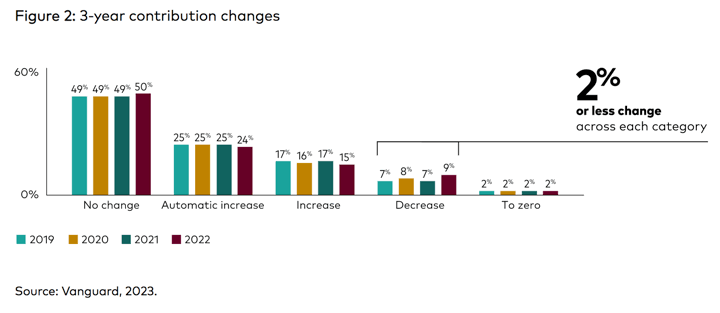
The table below goes into more detail. 50% of people kept their deferral rate the same, 24% of people allowed the auto-escalate feature to kick in, 15% manually increased their deferral rate, and 11% either manually decreased their deferral rate or set it to zero.

That means 89% of people kept their deferral rate the same or higher. 11% decreased. That 11% number is only a couple percentage points higher than in past years when the stock market went up.

Charlie Munger Daily Journal Annual Meeting 2023 Video, Transcript, and Highlights

Charlie Munger is now 99 years old and still answering blind questions on the fly at the 2023 Daily Journal Annual Shareholder Meeting. CNBC has posted the full 2+ hour interview with Becky Quick on YouTube. You’ll miss out on his snarky tone, but you may prefer to read the transcript, kindly provided at Steady Compounding (looks to be computer-generated… psst – the name is Rick Guerin!).

Munger remains refreshing in that he doesn’t filter everything into bland nothingness. He’s not afraid to offend with his opinions. I’ve included a few of my personal highlights below.

Only 5% of money managers have the skill required to consistently beat the index averages after costs.

And if you want an example of how denial is affecting things, take the world of investment management. How many managers are going to beat the indexes? All costs considered, I would say maybe 5% could consistently meet the averages.

Everybody else is living in the state of extreme denial. They’re used to charging big fees and so forth for stuff that isn’t doing their clients any good. It’s a deep moral depravity. If some widow comes to you with $500,000 and you charge her 1 point a year for, and you could put her in the indexes, but you need the 1 point. And so people just charge somewhat a considerable fee for worthless advice. And the whole profession is full of that kind of denial. It’s everywhere.

Crypto is (still) crap.

…when you’re dealing with something as awful as crypto sh*t, it’s just unspeakable. It’s an absolute horror. And I’m ashamed of my country that so many people believe in this kind of crap and the government allows it to exist is totally, absolutely crazy, stupid gambling with enormous house odds for the people on the other side.

And they cheat — in addition to cheating and like betting, it’s just crazy. So that is something. There’s only one correct answer for intelligent people there, just totally avoid it and avoid all the people that are promoting it.

Charles Munger is a billionaire, but rarely ever gambles in a casino or at a sports book. In terms of percent of net worth, Munger has bet the equivalent of the average person betting less than 5 bucks in their entire life.

Q: How do you feel about the gambling that took place at the Super Bowl and surrounding that and the legalized gambling taking place in this country at this point?

A: Well, it’s not as bad as crypto s***. I don’t think there’s much harm in betting a modest amount you can afford on a Super Bowl game. That strikes me as a pretty — thing if you do it with a friend and not with a bookie. So I don’t have the same feeling — I obviously don’t think you should have a gambling impulse around betting against odds. If you take all the money that I have bet against odds in my whole life, I don’t think it’s more than a few thousand dollars.

I’m all in favor betting with the odds.

Big picture thoughts on the future long-term performance of Berkshire and stocks in general:

Everybody that bought Berkshire and held it for 20 years has done well. I think that will be true for those who buy at the current price. I don’t think it will be as good in the future as it was in the past, but it will be okay considering how poorly everything else is going to do. Because the valuations start higher now and because government is so hostile to business.

I would say it will fluctuate naturally between administrations and so on. But I think basically, the culture of the world will become more and more anti-business in the big democracies. And I think taxes will go up, not down. So I think the investment world is going to get harder for everybody. And — but it’s been almost too easy in the past for the investment class. It’s natural that it would have a period of getting harder. I don’t worry about it much because I’m going to be dead.

The Daily Journal’s employee 401(k) plan has only one investment option: index funds.

…look at the Daily Journal Corporation. We just put in a 401(k) plan. What are the investment options for the people at work? Zero. It’s all index funds.

What percentage of American 401(k)s have our plan, index funds required? About zero. Am I right or am I wrong? Of course, I’m right. It’s a logical thing to do.

If you can afford to self-insure, you should do so. Insurance protects you against catastrophe, but there many extra costs built into the premiums (fraud, commissions, etc). Medical insurance is an exception because the insurance-negotiated cost is often much lower than the direct-consumer-pay cost.

In my own life, I’m a big self-insured and so is Warren. It’s ridiculous for me to carry fire insurance on my house because I could easily rebuild a house if burned down. So why would I want to bother fooling around with the claims process and all kinds of things.

So if insurance — you should insure against things you can’t afford to pay for yourself. But if you can afford to take the bumps, so unusual expense coming along doesn’t really hurt you that much. Why would you want to fool around with some insurance company. If your house burned down, I would just write a check and rebuild it. And all intelligent people do that way. I don’t say all, but — maybe I should say, all intelligent people should do it my way.

There should be way more self-insurance in life. There’s a lot of waste. You’re paying when you buy insurance for the other fellows frauds, and there’s a lot of fraud in life. And you can afford to take the risk yourself and not fool around with claims and this and that and commissions and time. Of course, you self insure, it’s simpler and so forth.

Think of what I’ve saved in my life. I narrowed it. I don’t care. I never carried — never. I think once — but with one exception, I never carried collision insurance on a car. And once I got rich, I stopped carrying fire insurance on houses. I just self insure.

Past years:

Sports Betting vs. Investing: Slight Edges Adding Up in Very Different Ways

According to CNBC, over 100 million bets were placed over Super Bowl weekend. Sports gambling is becoming more and more accepted as a casual part of the entertainment, but right now people are hiding from their spouses and partners the fact that they lost hundreds, thousands, or more. They are already planning their next bets to “just break even” and “just get back to zero” whereupon they promise themselves they will stop. But the more they bet, the deeper the hole gets.

A quick lesson on sports gambling odds. The standard odds on a basic spread bet are -110. Let’s take Super Bowl 54 as an example, where the betting line is Chiefs favored to win by 1.5 points over the 49ers. You can either bet on the Chiefs to win by 2 or more points (since 1.5 is impossible), or the 49ers to either win outright or lose by 1 point or fewer. Simple bet, only two outcomes. However, you must bet $110 in order to win $100. If you lose, you lose the entire $110. Feels very similar to a coin flip. However, the slight house edge is actually quite enormous over time.

Let’s say two people bet. $110 on one side, and $110 on the other side. One winning side will win, so they end up with $110 + $100 = $210. The other losing side ends up with nothing. The sports casino took zero risk and gets $10. $10 out of $220 is 4.5%. The casino got 4.5% of the total amount bet with essentially zero risk (the line moves to equalize both sides).

This “small” ~5% edge happens every single time, grinding you down to zero at a fast pace. If you bet $100 each time and lost $4.54 on average every bet, you’d have lost the entire $100 in 22 bets. In reality, the spread of possibilities is much wider, but with each bet, you are that much farther away from ever “breaking even” again. You keep playing, and the only inevitable result is broke. The only way to avoid catastrophe is to stop and accept the loss.

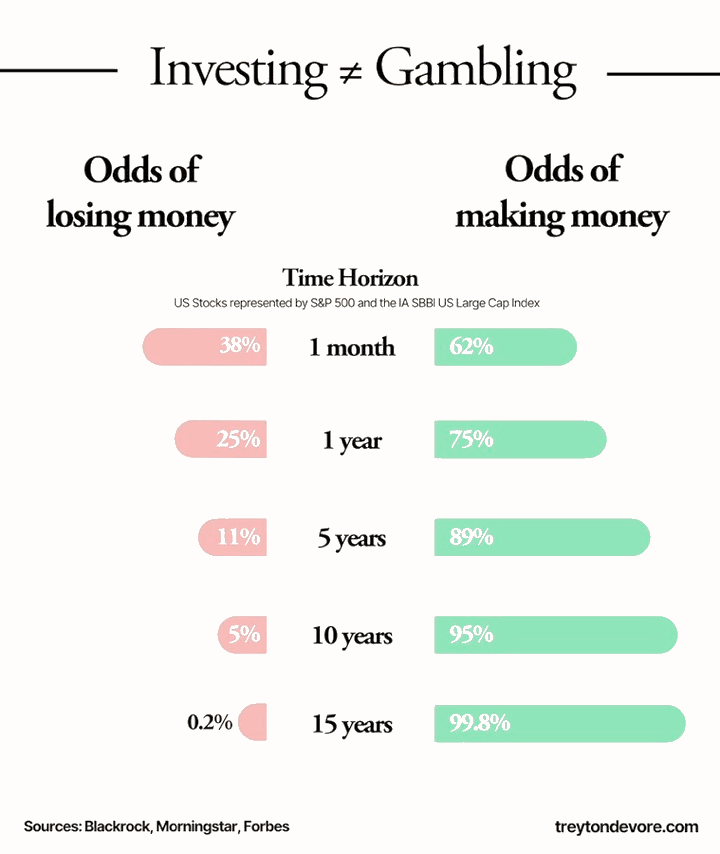
I am always disappointed when intelligent investing and gambling are confused. Here’s a timely tweet from @QCompounding:

Too many people focus on the first row above. 60% win and 40% lose? It looks too much like a coin flip. I put in money and my balance is lower after a year. Why bother?! Investing is the same as gambling, right? No! Over time, the fundamentals will win out. Investing directly in a basket of profitable companies with growing earnings is betting with the odds in your favor. Similarly, if you consistently buy real estate with conservative cashflow numbers, the odds are in your favor.

Investing with the edge in your favor adds up in a good way. The current price/earning ratio for companies in the S&P 500 index is about 20. That means if you buy $100 worth an S&P 500 ETF, that basket is earning $5 of profit every year. That $5 may be sent to you as a dividend check or used to reinvest into the business for future profits. It is a different “5%” edge”, but one that makes me excited instead as those earnings tend to keeping growing bigger over time. As you can see above, that edge adds up and will eventually overwhelm short-term market swings.

I recently read in a Warren Buffett biography that he once bought a slot machine and installed it in his house. He allowed his children to play with it, hoping that they would quickly learn a valuable lesson once their allowance kept disappearing into the machine. I wonder if that really worked.

I used to read up on various gambling strategies, but I have since personally decided to never bet on sporting events or casino games in the hopes that my children will never find interest in it. I want them to think – Why would I ever waste my time on things that virtually guarantee me to lose my hard-earned money? Instead, I hope to teach them to be excited when they see a good investment with positive expected returns.

Ally Invest and Ally Bank: Access High-Yield Vanguard and Fidelity Money Market Funds

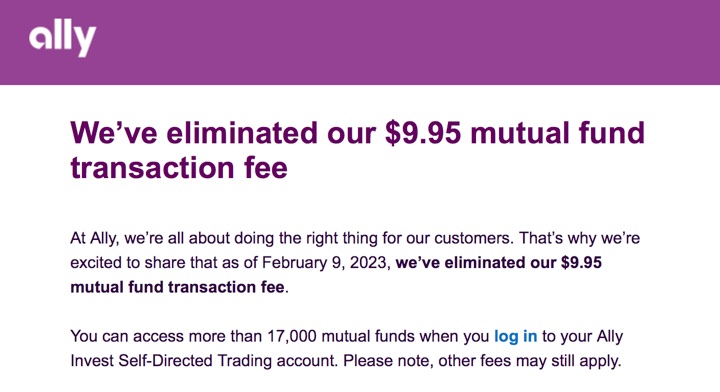
Ally Invest is the self-directed brokerage arm of Ally Financial, and you may have an account from previous TradeKing and/or Zecco mergers. Ally Invest just removed their $9.95 mutual fund transaction fee, including for money market funds:

At Ally, we’re all about doing the right thing for our customers. That’s why we’re excited to share that as of February 9, 2023, we’ve eliminated our $9.95 mutual fund transaction fee.

You can access more than 17,000 mutual funds when you log in to your Ally Invest Self-Directed Trading account. Please note, other fees may still apply.

First of all, the default cash sweep for Ally Invest pays zero interest. In addition, this change may be of interest to customers who also use Ally Bank, given that their online savings account only pays 3.40% APY (as of 2/15/23). Meanwhile, here are the 7-day SEC yields (as of 2/14/23) of top money market funds:

  • Vanguard Cash Reserves Federal Money Market Fund Admiral Shares (VMRXX) – 4.51% ($3,000 min)
  • Vanguard Federal Money Market Fund (VMFXX) – 4.50% ($3,000 min)
  • Vanguard Municipal Money Market Fund (VMSXX) – 3.43% ($3,000 min)
  • Gabelli U.S. Treasury Money Market Fund (GABXX) – 4.43% ($10,000 min)
  • Fidelity Government Money Market Fund (SPAXX) – 4.19% ($100 min*)

* The Fidelity fund does not have a minimum itself, but Ally has a $100 minimum order size for online mutual fund orders.

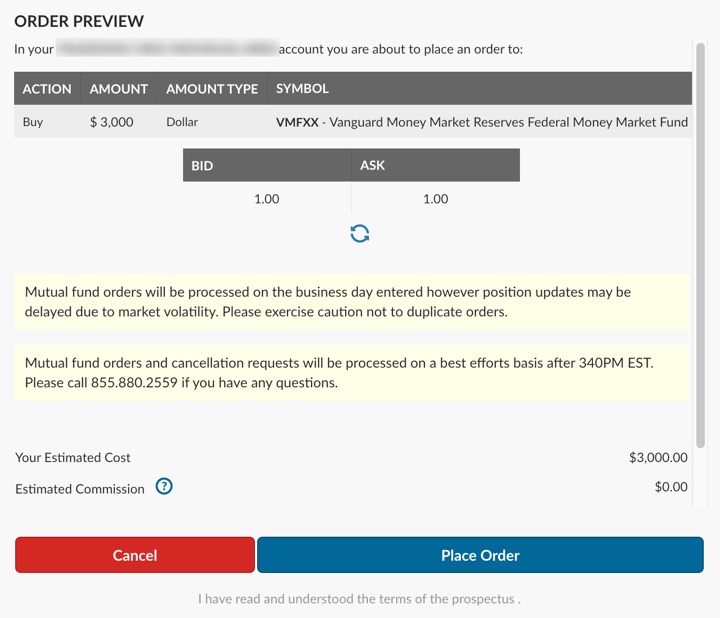
I have gone into my Ally Invest account and manually tested all of the money market mutual funds listed above, and it let me put in the order at the minimum amounts shown. Ally Invest also does not charge a short-term redemption fee. I was able to make an instant transfer of funds from my Ally Bank deposit accounts to my Ally Invest brokerage account. Therefore, if you have an Ally Bank account and don’t want to look too far elsewhere, you may consider this option to increase the yield on your cash holdings.

Best Interest Rates on Cash – February 2023

Here’s my monthly roundup of the best interest rates on cash as of February 2023, roughly sorted from shortest to longest maturities. We all need some safe assets for cash reserves or portfolio stability, and there are often lesser-known opportunities available to individual investors. Check out my Ultimate Rate-Chaser Calculator to see how much extra interest you’d earn by moving money between accounts. Rates listed are available to everyone nationwide. Rates checked as of 2/12/2023.

TL;DR: 5% APY available on liquid savings. 5% APY available on multiple short-term CDs. Compare against Treasury bills and bonds at every maturity (12-month near 4.89%). 6.89% Savings I Bonds can be bought with 2023 annual limits now.

Fintech accounts
Available only to individual investors, fintech companies often pay higher-than-market rates in order to achieve fast short-term growth (often using venture capital). “Fintech” is usually a software layer on top of a partner bank’s FDIC insurance.

  • 5% on up to $25,000, then 4% up to $250k. Juno now pays 5% on all cash deposits up to $25,000 and 4% on cash deposits from $25,001 up to $250,000. No direct deposits required. $10 referral bonus. Please see my Juno review for details.
  • 4.00% APY on $6,000. Current offers 4% APY on up to $6,000 total ($2,000 each on three savings pods). Must maintain a direct deposit of $200+ every 35 days. $50 referral bonus for new members with $200+ direct deposit with promo code JENNIFEP185. Please see my Current app review for details.

High-yield savings accounts
Since the huge megabanks STILL pay essentially no interest, I think every should have a separate, no-fee online savings account to accompany your existing checking account. The interest rates on savings accounts can drop at any time, so I list the top rates as well as competitive rates from banks with a history of competitive rates. Some banks will bait you with a temporary top rate and then lower the rates in the hopes that you are too lazy to leave.

  • The leapfrogging to be the temporary “top” rate continues. Primis Bank at 5.03% APY for both checking and savings. All America/Redneck Bank is at 4.25% APY for balances up to $75,000 ($500 to open, no min balance).
  • SoFi Bank is now up to 3.75% APY + up to $275 new account bonus with direct deposit. You must maintain a direct deposit of any amount each month for the higher APY. SoFi has their own bank charter now so no longer a fintech by my definition. See details at $25 + $250 SoFi Money new account and deposit bonus.
  • There are several other established high-yield savings accounts at 3.40%+ APY that aren’t the absolute top rate, but historically do keep it relatively competitive for those that don’t want to keep switching banks.

Short-term guaranteed rates (1 year and under)
A common question is what to do with a big pile of cash that you’re waiting to deploy shortly (plan to buy a house soon, just sold your house, just sold your business, legal settlement, inheritance). My usual advice is to keep things simple and take your time. If not a savings account, then put it in a flexible short-term CD under the FDIC limits until you have a plan.

  • No Penalty CDs offer a fixed interest rate that can never go down, but you can still take out your money (once) without any fees if you want to use it elsewhere. CIT Bank has a 11-month No Penalty CD at 4.10% APY with a $1,000 minimum deposit. Ally Bank has a 11-month No Penalty CD at 3.85% APY for all balance tiers. Marcus has a 13-month No Penalty CD at 3.85% APY with a $500 minimum deposit. You may wish to open multiple CDs in smaller increments for more flexibility.
  • BMO Harris has a 12-month certificate at 5.00% APY. $1,000 minimum. Early withdrawal penalty is 180 days of interest.
  • Capital One Bank has a special 11-month certificate at 5.00% APY. No minimum deposit, early withdrawal penalty of 3 months of interest.

Money market mutual funds + Ultra-short bond ETFs*
Many brokerage firms that pay out very little interest on their default cash sweep funds (and keep the difference for themselves). * Money market mutual funds are regulated, but ultimately not FDIC-insured, so I would still stick with highly reputable firms. I am including a few ultra-short bond ETFs as they may be your best cash alternative in a brokerage account, but they may experience short-term losses.

  • Vanguard Federal Money Market Fund is the default sweep option for Vanguard brokerage accounts, which has an SEC yield of 4.50%. Odds are this is much higher than your own broker’s default cash sweep interest rate.
  • Vanguard Ultra-Short-Term Bond Fund currently pays 4.33% SEC yield ($3,000 min) and 4.43% SEC Yield ($50,000 min). The average duration is ~1 year, so there is some term interest rate risk.
  • The PIMCO Enhanced Short Maturity Active Bond ETF (MINT) has a 4.62% SEC yield and the iShares Short Maturity Bond ETF (NEAR) has a 4.62% SEC yield while holding a portfolio of investment-grade bonds with an average duration of ~6 months.

Treasury Bills and Ultra-short Treasury ETFs
Another option is to buy individual Treasury bills which come in a variety of maturities from 4-weeks to 52-weeks and are fully backed by the US government. You can also invest in ETFs that hold a rotating basket of short-term Treasury Bills for you, while charging a small management fee for doing so. T-bill interest is exempt from state and local income taxes.

  • You can build your own T-Bill ladder at TreasuryDirect.gov or via a brokerage account with a bond desk like Vanguard and Fidelity. Here are the current Treasury Bill rates. As of 2/10/23, a new 4-week T-Bill had the equivalent of 4.61% annualized interest and a 52-week T-Bill had the equivalent of 4.89% annualized interest.
  • The iShares 0-3 Month Treasury Bond ETF (SGOV) has a 4.18% SEC yield and effective duration of 0.10 years. SPDR Bloomberg Barclays 1-3 Month T-Bill ETF (BIL) has a 4.11% SEC yield and effective duration of 0.08 years.

US Savings Bonds
Series I Savings Bonds offer rates that are linked to inflation and backed by the US government. You must hold them for at least a year. If you redeem them within 5 years there is a penalty of the last 3 months of interest. The annual purchase limit for electronic I bonds is $10,000 per Social Security Number, available online at TreasuryDirect.gov. You can also buy an additional $5,000 in paper I bonds using your tax refund with IRS Form 8888.

  • “I Bonds” bought between November 2022 and April 2023 will earn a 6.89% rate for the first six months. The rate of the subsequent 6-month period will be based on inflation again. More on Savings Bonds here.
  • In mid-April 2023, the CPI will be announced and you will have a short period where you will have a very close estimate of the rate for the next 12 months. I will have another post up at that time.
  • See below about EE Bonds as a potential long-term bond alternative.

Prepaid Cards with Attached Savings Accounts
A small subset of prepaid debit cards have an “attached” FDIC-insured savings account with exceptionally high interest rates. The negatives are that balances are severely capped, and there are many fees that you must be careful to avoid (lest they eat up your interest). There is a long list of previous offers that have already disappeared with little notice. I don’t personally recommend nor use any of these anymore, as I feel the work required and the fees charged if you mess up exceeds any small potential benefit.

  • Mango Money pays 6% APY on up to $2,500, if you manage to jump through several hoops. Requirements include $1,500+ in “signature” purchases and a minimum balance of $25.00 at the end of the month.
  • NetSpend Prepaid pays 5% APY on up to $1,000 but be warned that there is also a $5.95 monthly maintenance fee if you don’t maintain regular monthly activity.

Rewards checking accounts
These unique checking accounts pay above-average interest rates, but with unique risks. You have to jump through certain hoops which usually involve 10+ debit card purchases each cycle, a certain number of ACH/direct deposits, and/or a certain number of logins per month. If you make a mistake (or they judge that you did) you risk earning zero interest for that month. Some folks don’t mind the extra work and attention required, while others would rather not bother. Rates can also drop suddenly, leaving a “bait-and-switch” feeling.

  • Genisys Credit Union pays 5.25% APY on up to $7,500 if you make 10 debit card purchases of $5+ each, and opt into receive only online statements. Anyone can join this credit union via $5 membership fee to join partner organization.
  • Pelican State Credit Union pays 5.11% APY on up to $10,000 if you make 15 debit card purchases, opt into receive only online statements, and make at least 1 direct deposit, online bill payment, or automatic payment (ACH) per statement cycle. Anyone can join this credit union via partner organization membership.
  • The Bank of Denver pays 5.00% APY on up to $15,000 if you make 12 debit card purchases of $5+ each, receive only online statements, and make at least 1 ACH credit or debit transaction per statement cycle. Thanks to reader Bill for the updated info.
  • All America/Redneck Bank pays 4.50% APY on up to $15,000 if you make 10 debit card purchases each monthly cycle with online statements.
  • Presidential Bank pays 4.25% APY on balances between $500 and up to $25,000 (3.00% APY above that) if you maintain a $500+ direct deposit and at least 7 electronic withdrawals per month (ATM, POS, ACH and Billpay counts).
  • Find a locally-restricted rewards checking account at DepositAccounts.

Certificates of deposit (greater than 1 year)
CDs offer higher rates, but come with an early withdrawal penalty. By finding a bank CD with a reasonable early withdrawal penalty, you can enjoy higher rates but maintain access in a true emergency. Alternatively, consider building a CD ladder of different maturity lengths (ex. 1/2/3/4/5-years) such that you have access to part of the ladder each year, but your blended interest rate is higher than a savings account. When one CD matures, use that money to buy another 5-year CD to keep the ladder going. Some CDs also offer “add-ons” where you can deposit more funds if rates drop.

  • Navy Federal Credit Union has a special 15-month CD at 5% APY. Open now with just $50, but you can still add on more deposits later. You must have a military relationship to join NavyFed.
  • Sallie Mae Bank via SaveBetter has a 27-month CD at 4.85% APY. $1 minimum. Early withdrawal penalty is 180 days of simple interest.
  • Seattle Bank has a 5-year certificate at 4.70% APY ($1,000 min), 4-year at 4.65% APY, 3-year at 4.60% APY, 2-year at 4.55% APY, and 1-year at 4.50% APY. The early withdrawal penalty for the 5-year is a very reasonable 180 days of interest.
  • Lafayette Federal Credit Union has a 5-year certificate at 4.63% APY ($500 min), 4-year at 4.58% APY, 3-year at 4.52% APY, 2-year at 4.47% APY, and 1-year at 4.42% APY. They also have jumbo certificates with $100,000 minimums at even higher rates. The early withdrawal penalty for the 5-year is very high at 600 days of interest. Anyone can join this credit union via partner organization ($10 one-time fee).
  • You can buy certificates of deposit via the bond desks of Vanguard and Fidelity. You may need an account to see the rates. These “brokered CDs” offer FDIC insurance and easy laddering, but they don’t come with predictable early withdrawal penalties. Right now, I don’t see any competitive 5-year non-callable CDs. Be wary of higher rates from callable CDs, which means they can call back your CD if rates drop later.

Longer-term Instruments
I’d use these with caution due to increased interest rate risk, but I still track them to see the rest of the current yield curve.

  • Willing to lock up your money for 10 years? You can buy long-term certificates of deposit via the bond desks of Vanguard and Fidelity. These “brokered CDs” offer FDIC insurance, but they don’t come with predictable early withdrawal penalties. You might find something that pays more than your other brokerage cash and Treasury options. Right now, I see a 10-year CDs at (none available, non-callable) vs. 3.80% for a 10-year Treasury. Watch out for higher rates from callable CDs where they can call your CD back if interest rates drop.
  • How about two decades? Series EE Savings Bonds are not indexed to inflation, but they have a unique guarantee that the value will double in value in 20 years, which equals a guaranteed return of 3.5% a year. However, if you don’t hold for that long, you’ll be stuck with the normal rate, currently 2.10% for EE bonds issued November 1, 2022 to April 30, 2023. As of 2/10/23, the 20-year Treasury Bond rate was 3.96%.

All rates were checked as of 2/12/2023.

Tiicker: Shareholder Perks: New $100 Amazon GC Offer

Update: Tiicker has added a few new Perks for Real Good Foods, the most direct one being a $100 Amazon gift card for holding 50 shares of RGF with no minimum holding period. There are also other bigger perks for holding a lot more shares for at least a week. The bid/ask spread was about 10 cents, so it cost about $5 to buy/sell 50 shares quickly. You can get this even if you already got the previous $50 gift card from owning RGF (now expired). Limited quantities.

Original post:

TiiCKER is a new app that helps promote certain brands and companies by encouraging people to become shareholders and investors. (They say “ii” stands for individual investor.) In the past, Wrigley used to give out free packs of gum to shareholders, Dial used to give out soap coupons, Colgate-Palmolive gave out discounts on toothpaste, and so on. Shareholder perks are still somewhat popular in Japan, from baseball tickets to bags of rice. Found via DoC. Here are the perks currently available:

  • Link a brokerage with $100 worth of ANY stocks held inside, get $11 Amazon gift card or Visa virtual prepaid debit card.
  • (EXPIRED?) Link a brokerage with $50 worth of Amazon (AMZN) stock held inside (partial shares allowed), get $10 Amazon gift card or Visa virtual prepaid debit card.
  • (EXPIRED) Link a brokerage with $50 worth of Real Good Foods (RGF) held inside, get $50 Instacart gift card. Limited quantities.
  • (There are other perks available, please see Tiicker site for current list.)

Sometimes they require a minimum holding period, but the perks above currently do not. A few screenshots of an expired perk:

In order to prove your ownership, you must link your existing brokerage account via the Plaid service. Plaid says it does not save nor share your username and passwords with anyone, and with many brokerages, you now log in directly on your brokerage website for authentication.

I can report that I was able to sign-up, link my account via Plaid, and grab the first two bonuses in under 5 minutes. Since this is not a brokerage account, no SSN was required. Gift card redemption was instant and easy. You may need to refresh or unlink/relink your brokerage account after buying the shares for it to recognize a new purchase, or possibly wait up to 24 hours. In many cases, the perk is quite valuable compared the cost of buying and selling the shares, although this can get tricky when the holding period is longer. In addition, I have noticed this “RealGood” brand at Whole Foods and may try it now, so hey, this marketing may actually work…

Tiicker has a referral program, although the reward is vague: “Spread the word and help others discover investor perks. Refer 5 friends and receive a free TiiCKER perk!” If you wish, you can use my my referral link. Thanks if you do.

Alliant Credit Union $400 Banking Bonus ($300 For Existing)

Alliant Credit Union has a new FastPass promo worth up to $400 total, broken up as follows:

  • $100 for Savings Account. Open a savings account by March 31, 2023 plus have a minimum $1000 savings average daily balance on April 30, 2023 to earn a $100 bonus.
  • $100 for Checking Account. Open a checking account by March 31, 2023 plus have a minimum $100 checking average daily balance on April 30, 2023 to earn a $100 bonus
  • $100 for Certificate Account. Open a certificate by March 31, 2023 plus maintain a minimum $1000 certificate balance on April 30, 2023 to earn a $100 bonus
  • $100 for $10,000 in total deposits. Deposit a minimum of $10,000 total across any of these three accounts by March 31, 2023 and maintain this minimum balance until April 30, 2023 to earn a $100 bonus.

Useful fine print from the promo FAQ:

Did I open my account(s) correctly to be eligible for the promotion?
If you opened your Alliant account(s) by clicking on the link within a promotional email you received or the myalliant.com/fastpass webpage, you will be eligible for the promotion.

Are current Alliant members eligible for this promotion?
Yes, current Alliant members can still be eligible by opening a checking account and/or certificate and meeting the balance requirements, and/or by incrementally adding $10,000 to their total balance by April 30, 2023.

When is the payout for the promotion?
Accounts will be reviewed after April 30, 2023 to determine eligibility. If all requirements have been met, the bonus payment you earned will automatically be deposited into your savings account within 4-6 weeks after April 30, 2023.

When do I need to make my deposit(s) to qualify for the balance requirement?
For the savings account, the deposit should be made by March 31, 2023 and maintained through April 30, 2023. For Checking and Certificate products, balance should be met by April 30, 2023. Please ensure you allow enough time to open account and receive approval (accounts may be in pending status for 2-5 business days depending on pending reason or documentation needed).

There is a mention later on that “This promotion is for new and existing members of Alliant Credit Union (“Alliant”) who are current or retired employees from one of the many businesses and organizations Alliant partners with in the U.S.” However, this conflicts somewhat with their FAQ, which suggests that as long as you apply through the correct page and use the FASTPASS promo code, you are eligible.

Alliant CU membership eligibility. Alliant CU is one of the top 10 largest US credit unions by assets and their membership eligibility is very open. If you start the online membership application, it will walk you through their various eligibility options. Here are their membership groups:

Any employee or retiree of a Qualifying Company.
Any member of a Qualifying Organization.
Any immediate family member of an existing Alliant member.
Anyone who lives or works in a Qualifying Chicagoland Community.
Anyone who is a member of the Foster Care to Success charity group.

When I applied previously, I found not only does it only cost $5 to join Foster Care to Success, but Alliant will pay that fee on your behalf.

If you are not eligible through another option you can become a member of Foster Care to Success (FC2S) and become eligible for Alliant membership. FC2S serves thousands of foster teens across the United States, focusing on those who are aging out of the foster care system. FC2S awards grants and scholarships for higher education and provides care packages, mentoring and internships. (Alliant will pay the one-time $5 membership fee to FC2S on the member’s behalf.)

Quick thoughts. This is a solid bonus. $100 for a $1,000 deposit to a certificate is a 10% bonus. Even holding $10,000 there for a couple of months for another $100 is not bad, since it is on top of their interest rates. Their High Yield Savings pays 2.95% APY as of 2/4/23. A 12-month certificate pays 4.60% APY as of 2/4/23.

Free Investing Book PDF – Two Funds For Life (Merriman and Small Value)

Paul Merriman is a long-time financial advisor known for his “Ultimate Buy-and-Hold Portfolio” that utilized a more complex 10-fund version of a low-cost index fund portfolio that includes additional exposure to certain asset classes. Although now retired from advising, he continues to add new content to his website for the Merriman Financial Education Foundation that is geared more towards to DIY investors.

More recently, he has been pushing the idea of a more simple “Two Funds for Life” portfolio that is essentially holding mostly an all-in-one Vanguard Target Retirement Fund (or a similarly low-fee alternative) and the rest in US Small Cap Value ETF or mutual fund. This concept is described in detail in the book 2 Funds for Life: A quest for simple & effective investing strategies by Chris Pedersen, Director of Research at The Merriman Financial Education Foundation. (Amazon links on the website.)

Right now, you can download the PDF for free if you sign up for their free e-mail newsletter. You also get a free PDF download of their other book, We’re Talking Millions!: 12 Simple Ways to Supercharge Your Retirement by Paul Merriman and Richard Buck. I would recommend downloading it now and saving it to read later. Both books also contain a lot of general personal finance advice, but if you want to understand why you hear the term “small cap value” (SCV) a lot in DIY investment circles, this book may be of interest.

2 Funds for Life strategies augment target-date funds to reduce risk with age, increase expected returns, raise safe withdrawal rates, and achieve higher overall survival rates.

Small Cap Value has long periods of severe underperformance, but also many periods of outperformance against the overall total US market and S&P 500. The hard part is to keep holding SCV through those years of consecutive underperformance. Here is a chart of asset class returns by decade that illustrates this point:

Capital One 360: 11-Month CD at 5.00% APY

Capital One 360 has a new special 11-month CD at 5.00% APY. Note that unlike many other 11-month CDs, this one does have an early withdrawal penalty of 3 months of interest, and it looks like they will eat into principal if you withdraw in the first 3 months. There are also no partial withdrawals:

Can I withdraw my money before the CD term is over?

You can always decide to withdraw your money early. However, like with any CD account, there is a penalty for withdrawal prior to the end of your CD term. For 12 month CD accounts (or less), the penalty for withdrawing early is 3 months of interest. For CD accounts longer than 12 months, the penalty for withdrawing early is 6 months of interest. You also cannot make a partial withdrawal during your CD term.

Can I lose money in a CD account?

CD accounts like a 360 CD grow at a fixed rate over a set period of time called a term. This “set it and forget it” approach, and the fact that your money is FDIC-insured up to allowable limits, make CD accounts among the lowest-risk investments and they will not lose value. The only risk of losing money is if you make an early withdrawal from your 360 CD, where you would face a penalty of 3 to 6 months of interest depending on the term of your account.

I don’t know what the future holds for interest rates, up or down, but right now it is a top rate for a CD where you are locked in for about a year. For comparison:

Thanks to the readers that sent this one in. Rates quoted as of 2/2/23.

$6,000 IRA Contribution Goal 2022 Final Results: $6,259+ in Total Bonuses

2022 Year-End Update. Each year, I have a side goal of earning the equivalent of the maximum annual IRA contribution limit ($6,000 for 2022) using the profits from various finance promotions alone. In 2021, I reached $5,592 in bonuses and $2,500+ in extra interest. If you had put $6,000 into your IRA every year for the recent 10 year period (2013-2022) and invested in a simple Target Date retirement fund, you would have turned small, weekly deals into a $87,000+ nest egg.

That’s worth repeating: An extra 87 grand has been the real-world result of regularly investing $500 a month for 10 years! A couple could double these numbers.

Ground rules: Real-world results for one real person only. Following with My Money Blog tradition, this will track my personal, real-world results. It would be quite easy to list a bunch of random promotions that add up to $6,000, but these will be promotions that I personally sign up for and complete the requirements (even though I’ve already opened so many bank accounts, credit cards, and brokerage accounts over the years). I will track my individual results only, although my partner does also participate on a more selective basis. Nearly all of them have been documented in real-time in the Deals and Offers category, Top 10 credit cards list, and brokerage bonus list.

Note: I am also excluding the $900 bonus from Chase Ink Business Cash card, since it is meant for small businesses.

2022 bonuses and promotions list. The 💵 symbol means I have received and/or cashed out the bonus successfully. The ⌛ symbol means the promo is still in progress.

Bonuses that required significant assets to max out (but not necessarily participate)

2022 final results. The total tally for bonuses not requiring significant assets was $6,259 total for 2022, which was 104% of the $6,000 annual IRA contribution limit for 2022. This excludes the three bonuses (Public, SoFi, and Ally) that paid out bigger bonuses for larger asset transfers or cash deposits. I acknowledge not everyone has enough assets to max those out, but they were certainly an efficient use of time if you did. If you add in the $3,500 that I received from those bonuses, the total would be $9,759.

Additional background stuff. This is a personal challenge/game that I like to play. I enjoy trying out new apps and services. I look for the best payoff/effort ratio for my situation; your choices won’t look like my choices. In addition, some things I will skip simply because I’ve already done them. For those new to this hobby, I would first grab the low-hanging fruit like the Chase Sapphire Preferred or the Chase Sapphire Reserve and build up a nice stash of flexible Ultimate Rewards points. After that, I would recommend looking at the Citi Premier (ThankYou points), Capital Venture X (Capital One Miles), and American Express Gold (AmEX Membership Rewards points) to jumpstart your points stashes.

These numbers included fixed bonuses for short-term asset transfers, but ignore higher interest rates overall from buying US Treasury bonds or savings bonds. They also ignore ongoing credit card purchase rewards like 2% to 2.6% cash back on all credit purchases (or airline miles or hotel points) and 5% cash back on specific categories or 1% or better cash back on rent.

This is an enjoyable and profitable hobby for me, but I don’t like to waste my time either. I look for a solid return based on the time commitment required. I tend to avoid speculative bets, bonuses that are hard to convert to real value, and anything that requires driving to stores where things may or may not be in stock. The deals that I post usually last at least a few days, but it’s a bit like value investing where you have to be ready to get off your butt and take decisive action when an opportunity shows up, because they won’t last forever.