Archives for July 2024

Free Instacart+ & Credits with Select Credit Cards (Expired)

Update: This offer is expired. The last day to activate this benefit was July 31st, 2024. You can add multiple eligible Chase Sapphire/Slate/Freedom flavors and they will stack to extend your free membership further and further. Just keep going back to Instacart.com/chase to activate all your cards before the deadline. For example, I added both a Freedom Flex and Freedom Unlimited.

Original post:

Chase has partnered with Instacart to offer a free memberships and credits to Instacart+. Instacart+ usually costs $9.99 a month (or $99 a year) and includes free delivery on $35+ orders and reduced service fees. They claim the average savings is $7 per order. Here are the eligible cards and perks:

Get free delivery with Instacart+:

– 12 free months with Sapphire Reserve® and J.P. Morgan Reserve®
– 6 free months with Sapphire® and Sapphire Preferred®
– 3 free months with Freedom®, Freedom Flex?, Freedom Unlimited®, Freedom Rise?, Freedom® Student, Slate® and Slate Edge?

Earn statement credits*

– $15/month for Sapphire Reserve® and J.P. Morgan Reserve®
– $15/quarter for Sapphire® and Sapphire Preferred®
– $10/quarter for Freedom®, Freedom Flex?, Freedom Unlimited®, Freedom Rise? and Freedom® Student

Tip #1: Turn off auto-renewal immediately after activation. When you activate this offer, it will be set to auto-renew after the end of the free membership. However, you can cancel this auto-renew now and it will still keep your free membership until the end of the gift period.

Tip #2: Keep the Instacart app installed on your phone with notifications on. Instacart reliably sends me new coupons via app notifications. (I don’t get the same coupons via e-mail.) Stacked with other benefits, it can make it worthwhile to use Instacart even with their inflated prices, especially if you value the time saved. I actually prefer shopping via an app nowadays for meal planning purposes, but usually directly with a grocery store for lower prices.
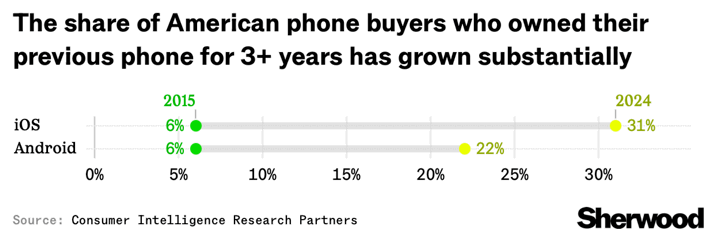
Americans Are Keeping Their Cars and iPhones Longer Than Ever

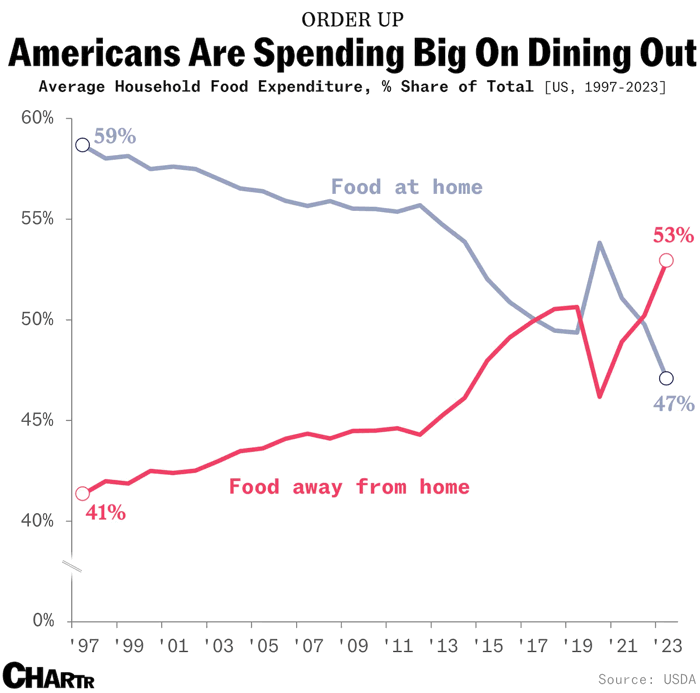
Even though we as Americans like dining out a lot more than cooking at home, even if it costs more, we’re not totally crazy spenders. From Sherwood News:

We are keeping our cars for longer.

We are keeping our iPhones for longer.

Dang, looks like I have to keep the 2015 minivan around at least three more years in order to keep my frugal cred. (Minivans are classified as light trucks!)

Americans Spend More Money Dining Out than Eating at Home (Again)

Like everyone else, we’ve been hit with inflation both at the grocery store and while dining out. Eating at a sit-down restaurant with our family of five has been a $100+ affair for a while now (gotta tip 20% with the chaos that we bring!), but nowadays even fast casual meals are inching towards the $100 mark. This had led us to cook at home as much as we can, schedule permitting. It’s been probably a year since we’ve used Uber Eats or DoorDash.

So I’m actually a bit surprised by the chart above that says that Americans (again) spend more of their food budget dining out than at the grocery store. I know that we were there already before COVID hit, but I figured that the inflation spike would have kept a damper on things. Image credit to Sherwood News. Data is from the USDA Economic Research Service (ERS) which separates Food-Away-From-Home (FAFH) and Food-At-Home (FHA).

  • Food-Away-From-Home (FAFH) includes meals and snacks supplied by commercial food service establishments (like all restaurants, bars, and hotels) and by eating facilities in non-commercial institutions (like schools, offices, and hospitals).
  • Food At Home (FAH) includes food bought at grocery stores, convenience stores, warehouse clubs and supercenters, mail order, and online orders delivered to home.

This means that all those rotisserie chickens, half-baked pizzas, taco kits, and salads that I buy at the grocery store and Costco are still considered food-at-home. Nowadays, 1/3rd of Whole Foods is prepared foods from sushi to rice bowls to salad bar.

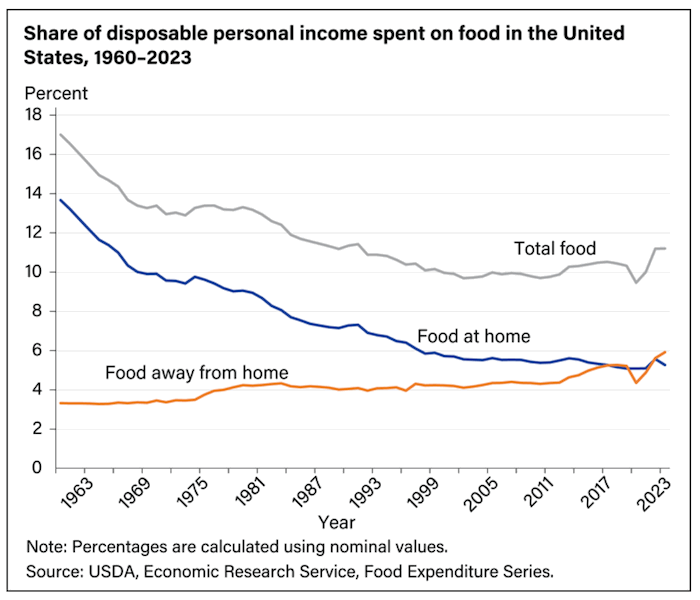
Here’s the same data set looking all the way back to 1960 that includes total spending on food as a percentage of personal disposable income. (source).

The trend is clear: We love to dine out at restaurants, even if it costs more than food from the grocery store, and even if it starts to cut into the rest of our overall budget.

To buck this trend, I’ve started watching meal prep videos on YouTube and hoping to get better at cooking multiple meals at once. I don’t know if it’ll work out.

Charles Schwab Brokerage: Up to $6,000 New Deposit / Transfer Bonus (New & Existing Customers)

Update: Schwab has suspended/ended this “Up to $6,000” transfer promotion as of October 2024. The referral offer appears to still be available, which is up to $1,000.

Brokerage firms constantly compete for “assets under management”, and many are willing to give you cash to move over your existing portfolio from your existing broker over to them. Unfortunately, many of these offers are for new app startups with questionable customer service. How about a traditional firm with telephones connected to knowledgable humans working inside physical branches in major metro areas?

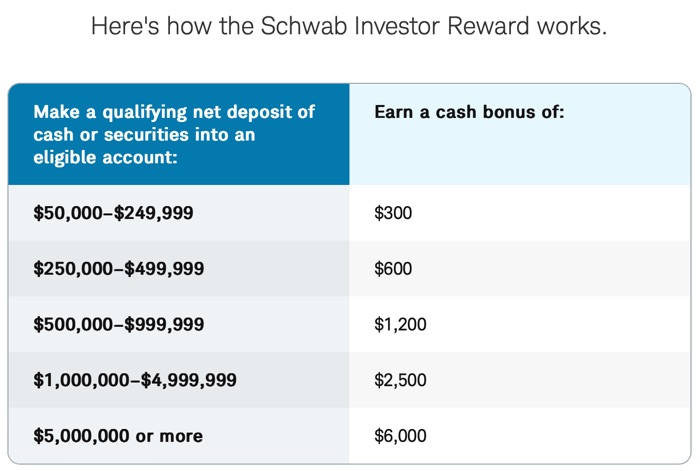
Charles Schwab is currently offering up to a $6,000 cash bonus depending the value of assets that you move over (qualifying net deposit of cash or securities) within 45 days of enrollment. The minimum hold period is one year for taxable brokerage accounts. The percentages aren’t the best, and the tiers are relatively high, but this is actually a brokerage I wouldn’t mind leaving my assets at for the long run. It’s also available to existing Schwab customers.

  • $200 with $50,000–$99,999 in new assets
  • $300 with $100,000–$249,999 in new assets
  • $600 with $250,000–$499,999 in new assets
  • $1,200 with $500,000–$999,999 in new assets
  • $2,500 with $1,000,000-$4,999,999 in new assets
  • $6,000 with $5,000,000+ in new assets

Note: New-to-Schwab clients should compare this with the Schwab Referral Offer, which may offer a slightly higher bonus at specific asset levels (ex. $100 bonus on $25k in new assets, $300 bonus on $50k in new assets, $500 bonus on $100k in new assets). At the higher tiers, the offer above is better. That’s my referral link, thanks if you use it (although please let me know if you have issues with it; I’ve never actually gotten a bonus from Schwab so I’m not sure if it really works).

The easiest option is often to perform an in-kind ACAT transfer of existing securities, which takes less than a week and all of your tax basis information should also move over after another few days. Your old broker may charge you an outgoing ACAT fee about about $75, although you should ask Schwab if they will reimburse you for
this fee.

Both taxable and IRA accounts are eligible. From the fine print and FAQ:

Accounts that are eligible for the Schwab Investor Reward include: Schwab retail brokerage accounts and individual retirement accounts (IRAs), including accounts enrolled in Schwab-sponsored investment advisory programs such as Schwab Intelligent Portfolios®, Schwab Managed Portfolios™, Schwab Managed Account Select®, Schwab Managed Account Connection®, and Schwab Wealth Advisory™.

Schwab Bank Investor Checking™ accounts do not qualify for this promotion whether they are linked to a brokerage or are stand-alone. If you make a deposit in a Schwab Bank Investor Checking™ account, you will not receive the award. The offer also does not apply to the Schwab Global Account™, ERISA-covered retirement plans, certain tax-qualified retirement plans and accounts, education savings accounts, Schwab Bank accounts, or accounts managed by independent investment advisors.

Can two clients in the same home get the award?

Yes. As long as both clients have individual accounts and separately qualify for the Reward, provided that each makes a qualifying net deposit.

Schwab appears to still be offering their $101 Starter Kit promo. But the FAQ says “Can this offer be combined with other offers? No. This offer can’t be combined with other offers.” I’m not sure if it counts as combining if you first open the new account for the Starter Kit bonus, wait, and then participate in this transfer offer.

One major drawback with Schwab is that the default cash sweep is not good. Still just 0.48% APY as of 7/16/24! Boo. You need to take proactive steps to avoid lost interest if you plan to keep significant amounts of cash in their default sweep account. Consider buying Treasury bills, brokered CDs, or Treasury Bill ETFs like GBIL (still possible to lose value). See my separate post on the best alternative Schwab cash sweep options.

American Express® Business Gold Card Review: 100,000 Bonus Points, 4X and 3X Rewards, $240 Flexible Business Credit, $155 Walmart+ Credit Annually

card_name

Updated with increased 100k offer. The card_name is a premium card for small businesses with excellent features like purchase price protection, travel accident insurance, car rental coverage, and the famous AMEX extended warranty that actually pays out. The card features have been changed as of October 2023 to include new rewards categories and perks. Here are the highlights:

  • Welcome Offer: 100,000 Membership Rewards(R) points after you spend $15,000 on eligible purchases within the first 3 months.
  • 4X Membership Rewards(R) points on the top 2 eligible categories where your business spends the most each month from 6 eligible categories. Your top 2 categories are allowed to change each billing cycle, and you will earn 4X points on the first $150,000 in combined purchases from these categories each calendar year (then 1X thereafter). Only the top 2 categories each billing cycle will count towards the $150,000 cap.*
  • 3X Membership Rewards(R) points on flights and prepaid hotels booked on amextravel.com using your Business Gold Card.*
  • $240 Flexible Business Credit. Earn up to $20 in statement credits monthly after you use the Business Gold Card for eligible U.S. purchases at FedEx, Grubhub, and Office Supply Stores. This can be an annual savings of up to $240. Enrollment is required.
  • Up to $155 Walmart+ Credit annually. Get up to $12.95 back in statement credits each month when you pay for a monthly Walmart+ membership (subject to auto-renewal) with your Business Gold Card. $12.95 plus applicable taxes on one membership fee. Enrollment is required.
  • The Business Gold Card now comes in three metal designs: Gold, Rose Gold and Limited Edition White Gold. The new White Gold design is only available while supplies last.
  • Annual fee is $375.
  • See Rates and Fees

The six eligible categories for the 4X Membership Rewards(R) points are:

  • Transit purchases including trains, taxicabs, rideshare services, ferries, tolls, parking, buses, and subways
  • Purchases at US media providers for advertising in select media (online, TV, radio)
  • U.S. purchases made from electronic goods retailers and software & cloud system providers
  • U.S. purchases at gas stations
  • U.S. purchases at restaurants, including takeout and delivery
  • Monthly wireless telephone service charges made directly from a wireless telephone service provider in the U.S.

Membership Rewards points can be converted to the following airline and hotel programs (there are more, this is just a selection):

  • Delta SkyMiles
  • Hawaiian Airlines
  • JetBlue
  • ANA Mileage Club (partner of United Airlines)
  • Air Canada (partner of United Airlines)
  • British Airways (partner of American Airlines)
  • FlyingBlue (Air France/KLM)
  • Singapore Airlines
  • Virgin Atlantic
  • Choice Privileges
  • Hilton Honors
  • Marriott Bonvoy

Business card eligibility. Many people aren’t aware that they can apply for business cards, even if they are not a corporation or LLC. Sole proprietors are a small business. If you received a 1099-MISC tax form and filled out a Schedule C, that means you have business income, you pay self-employment taxes, and you’re a sole proprietorship. This is the simplest business entity, but it is fully legit and recognized by the IRS. On a business card application, you should use your own legal name as the business name, and your Social Security Number as the Tax ID.

This card will require you to personally guarantee that you’ll pay them back what you purchase with the card, which means they’ll check your personal credit score like any other consumer card. However, as the card is a business card, American Express won’t have it show up on your personal credit report, so it won’t change things like your credit limits, average account age, or credit utilization ratio.

Bottom line. The card_name is a premium business card that includes the classic American Express features like excellent customer service and customer-friendly protections. The card now offers the ability to earn 4X Membership Rewards® points on the 2 categories where your business spent the most each month, on up to $150,000 in combined purchases from these categories each calendar year. There is also a welcome offer for new applicants.

I will add this card to my list of Top 10 Best Business Card Offers.

(See Rates and Fees)

529 College Savings Plans: All 50 States Tax Benefit Comparison (Updated 2024)

Updated for 2024. Morningstar is a great resource for research on 529 college savings plans, and they have recently updated their annual deep dive on 529 plans: The 2024 529 Savings Plan Landscape (e-mail required).

When choosing a 529 college savings plan, you can open a 529 plan from any state (not just your own). However, each state can vary widely in what they offer in terms of tax deductions and/or tax credits. So how to do you choose?

  • No state tax? ➡ Just pick the best overall plan.
  • No special tax benefits (deduction or credit)? ➡ Just pick the best overall plan.
  • Home state offers tax parity? (the same tax benefits no matter which state’s plan you pick) ➡ Just pick the best overall plan.
  • Home state requires you to contribute to your home state plan to get the tax perk? ➡ Technically, you should compare the annual tax savings against any potential perks from the best overall plan (lower annual expenses, superior investment options). In most cases, I have found that if a state cares enough to offers a state tax deduction or tax credit, and you are contributing an amount under or around the max limit (ex. under $200 a month), then the in-state plan is most likely good enough and you should stick with it. The main exception is if you plan on funding your plan with a large upfront contribution, where a lower expense ratio would really matter.

If you are in the last situation in which you have to do some math, this Morningstar article also runs the numbers for a theoretical couple filing jointly with a gross annual income of $100,000 that deposits $3,000 a year (or $250 a month) into one beneficiary’s 529 account. The chart is useful to provide a quick idea of your state’s tax benefits at a glance, but I would make sure to run the numbers for your income and your expected annual contribution. This Vanguard state deduction calculator tool may be helpful to double-check your calculations.

Finally, note that some states will also recapture any tax benefits if you perform an outbound 529 rollover, or otherwise do not conform with federal tax laws regarding 529 distributions.

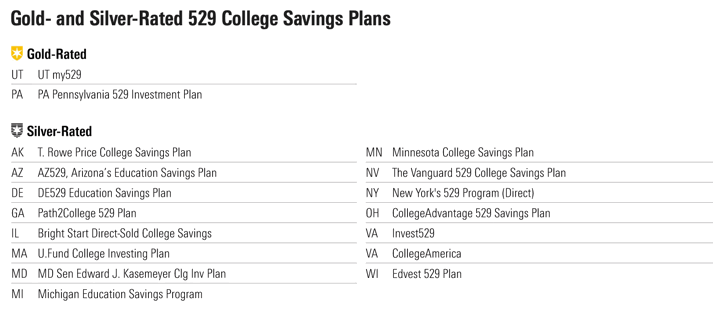
Top plans quick recap. Here are Morningstar’s top Gold and Silver-rated plans as of Summer 2024.

I personally invest in the Utah My529 Plan for my children due to their DIY glide path feature and DFA fund access, but my second choice would be the Vanguard Nevada 529 Plan if you want something that is more “set-and-forget”, especially if you already have other accounts at Vanguard. I wouldn’t spend too much time splitting hairs – taking action and starting an automatic savings plan is the most critical decision.

Opening a plan and making any contribution also starts the 10-year clock on potential future 529-to-Roth IRA rollovers.

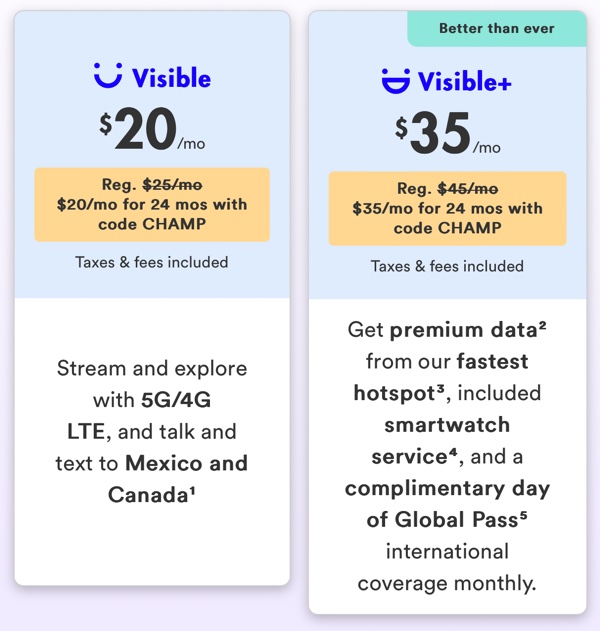
Visible Wireless Discount: $20/Month for 2 Years, Visible+ $35/Month for 2 Years ($240 Savings)

Visible Wireless is one of multiple discount MVNOs that use the Verizon network, but they are the only one directly owned by Verizon. Right now, they have a new offer with promo code CHAMP that discounts their standard plan by $5 a month ($20/mo instead of $25/mo) and their premium Visible+ plan by $10 a month ($25/month instead of $35/month) for two years. That’s a total savings of $120 or $240, and also makes it cheaper than their annual pay-upfront plans. In addition, the Visible+ plan includes a free connected Apple Watch or Galaxy Watch, which costs $10 a month on many other plans. Here is a quick comparison of their two plan tiers.

Visible Plan (standard version)

  • $25/month ($20/month for 2 years with promo code CHAMP). Government taxes and fees included in price.
  • Unlimited data, talk & text on Verizon’s 5G & 4G LTE networks. Data speeds may be throttled during high traffic times. Typical 5G & 4G LTE download speeds are 9-149 Mbps. Video streams in SD.
  • Unlimited mobile hotspot (5 Mbps max).
  • Automatically blocks high-risk spam and robocalls.
  • No contract.
  • Unlimited talk & text to Mexico & Canada.

Visible+ Plan Details (standard version)

  • $45/month ($35/month for 2 years with promo code CHAMP). Government taxes and fees included in price.
  • 5G Ultra Wideband Access + 50 GB/mo of premium (un-throttled) data on Verizon’s 5G & 4G LTE networks. Unlimited talk and text. Data speeds may be throttled after the 50 GB/mo.
  • Connected Smartwatch (Apple Watch, Galaxy Watch) included (up to $10/mo value).
  • Unlimited mobile hotspot (10 Mbps max).
  • Automatically blocks high-risk spam and robocalls.
  • No contract.
  • Unlimited talk & text to Mexico & Canada.
  • Save $10/mo on Verizon Home Internet.

Sequence Money Map: Flowchart Your Income, Expenses, and Savings with Conditional Logic

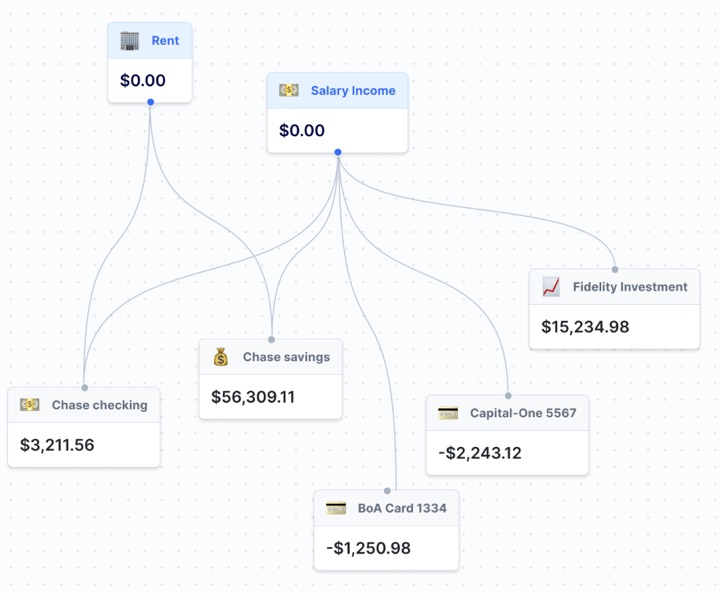
Here’s a new idea that I haven’t seen yet: GetSequence.io lets you apply a flowchart system with simple If/Then conditional statements to your cashflow. Imagine a visual map connecting your financial accounts and being able to manage the flow of money between them using preset rules. They call it a “financial router”.

For example, you would first have your paycheck routed to Sequence. Then a rule says “If the balance at Chase Checking is at least $5,000 (perhaps enough to pay your monthly bills), then transfer 50% to savings and 50% to your Fidelity investment account”. But then add “If the savings already has $5,000 in it (maxed out your emergency fund), then transfer all of the funds to Fidelity account”. Or you could always have 10% taken off the top into your Fidelity account, no matter what.

This type of things sounds neat in theory, but I am concerned that reality is too messy to have all these fixed rules. It also seems to rely heavily on accurate aggregation of third-party providers like brokerage and credit card accounts. Some people really like having several “envelopes” or “buckets” for budgeting and savings, so perhaps this would work for them.

Unfortunately, this is all a non-starter for me because Sequence is a fintech. Their banking services are provided by Thread Bank, Member FDIC. But as the FDIC and every other US regulator has told us after ongoing Fintech/Synapse/Evolve debacle, if somehow Sequence or Thread Bank gets confused while routing all your money around and doesn’t keep proper records of all the balances on their ledger, then the consumer is out of luck. With no protection if this start-up fails, I am unwilling to try Sequence myself. I have no other affiliation with them, either. Anyone else out there try this new tool?

Fintechs Missing $100 Million of Deposits Gets More Mainstream Media Attention

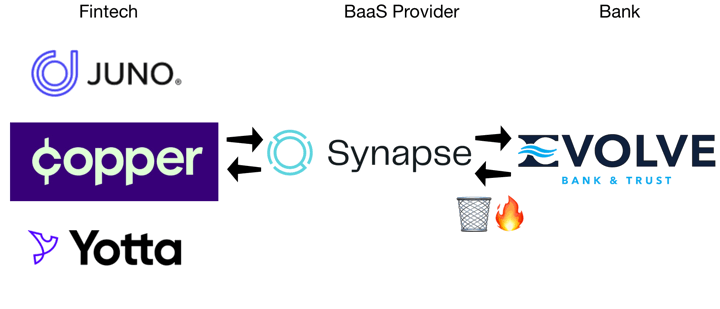
Here’s an update on the Yotta/Juno/Synapse/Evolve Bank situation that I wrote about back in June. Unfortunately, nothing really new has happened to help the consumers affected, but perhaps because of that plus the fact that nearly $100 million is missing, there has been some additional coverage in the major financial media outlets about this problem. I’m glad there is finally more attention to this matter.

From the NY Times article What Happens When Your Bank Isn’t Really a Bank and Your Money Disappears? (gift link)

For close to a century, putting your savings into a federally insured bank has been a sure thing: If the institution fails, up to $250,000 of your money will be protected.

What if it isn’t anymore?

The promise of bank insurance — a tenet of U.S. consumer protection since the Great Depression — is now being tested by a crisis swirling around online-only lenders with hundreds of millions of dollars of deposits between them. Customer accounts have been frozen, preventing people from cashing out their life savings. Most depositors have little clue where their money has gone, and whether they will get any of it back.

The turmoil was set off this spring with the bankruptcy of Synapse Financial Technologies, the kind of company you’ve probably never heard of unless you suffered through all the fine print of your account statements. It operated banking software for fast-growing online lenders with names like Juno, Yieldstreet and Yotta.

Backed by some of Silicon Valley’s bigger venture capitalists, the start-ups offer accounts that charge lower fees and pay far higher interest rates than traditional brick-and-mortar banks. Their slick websites advertise insurance from the Federal Deposit Insurance Corporation, the U.S. agency that pledges to pay back lost funds.

[…] The bankruptcy court judge has said that he suspects that tens of millions of dollars will never be found, but is powerless to compel regulators to get involved. “This is a very, very unusual situation,” Judge Martin R. Barash said at a hearing last week.

From the WSJ article Why the Synapse Bankruptcy Has the Fintech World on Edge (archive)

For months now, thousands of consumers have been unable to access money they thought was safely deposited at banks.

They are victims of the bankruptcy of a little-known venture-backed startup called Synapse Financial Technologies, whose shutdown is harming not only consumers but also fintech startups that worked with it, as well as the broader fintech sector. […]

Starting in May, banks including Evolve Bank & Trust and Lineage Bank froze access to accounts associated with Synapse, citing discrepancies in ledgers kept by Synapse. […]

The banks said they don’t know who is owed what. There is a dispute between the banks and Sankaet Pathak, founder and former chief executive of Synapse, about who is responsible for ledger irregularities.
Accounting reconciliation is continuing in the Synapse case, according to a trustee managing the Synapse estate. However, more than $100 million hasn’t been distributed, as of early July, according to the trustee’s reports. Most of that is in pooled accounts held by Evolve and Lineage, where figuring out how much capital is owed to whom appears to be especially difficult.

There is also a shortfall of up to $96 million between cash held at partner bank accounts and Synapse’s ledger balance, according to the trustee.

From Bloomberg article A Fintech’s Collapse Raises Questions About a Hot Business Model (gift link):

Over the past decade, dozens of financial-technology companies have linked up with small and midsize banks across the country. The idea: The fintechs would create slick smartphone apps and offer useful new services to lure customers, and banks would hold on to the deposits, generating lucrative fees from transactions. Importantly, the arrangement allowed the fintechs to tout protection from the Federal Deposit Insurance Corp.

But now, as millions of dollars’ worth of deposits remain frozen months after the collapse of a company called Synapse Financial Technologies, that supposed FDIC protection has come into clearer focus. And those partnerships are facing tough questions.

The reason customer deposits are in limbo is because Synapse was bad at recordkeeping. The firm acted as an intermediary between fintech apps including Yotta and Juno and their banking partners. When Synapse went bankrupt in April, it left behind a tangled mess: The trustee put in charge of Synapse said it was difficult to make sense of its ledgers, as the trustee was trying to resolve a shortfall of as much as $96 million in its accounts.

There is also Techcrunch, this CNBC TV report and follow-up CNBC article.

This was a known hole in the bank regulatory system, but nobody was incentivized to close it. These fintechs have been using “FDIC-insured” in their marketing for years. The FDIC never stopped them. Meanwhile, the banks made money holding the funds. The fintech and BaaS founders made money and were showered with venture capital. Nobody complained while the music kept going. All they had to do was keep a clean ledger of transactions. But somehow they didn’t, whether by accident or on purpose. (Anyone remember the movie Office Space? Missing fractions of pennies can add up…)

As time drags on, Synapse is just trying to walk away quietly without anyone making a fuss out of tens of millions of dollars in missing money. “We’re bankrupt! Nobody’s home! Sorry! Definitely don’t bother the CEO Sankaet Pathak about those missing millions!” Yotta and Juno just appear helpless and incompetent. “We had no idea! Update: We still have no idea! Update 2: We still have no idea!” Evolve has polished up their version of the story, even though they don’t exactly have a spotless reputation either (inadequate compliance practices, huge data breach). Disruption brings about change, so here we are.

$7,000 IRA Contribution Bonus Challenge: $4,673 in Bonuses (2024 YTD Edition)

Each year, I challenge myself to earn the equivalent of the maximum annual IRA contribution limit ($7,000 for 2024 if under 50) using the profits from various finance promotions alone. I earned $5,592 in 2021, $6,259 in 2022, and $5,444 in 2023 (plus another $2,500 in stock special situations). Here’s a progress update after the end of the first quarter of 2024.

If you combined these hobby profits and steady investing, this CAN create enough for a house downpayment (unlike perhaps spare change roundups). If you had put $6,000 into your IRA every year for the recent 10 year period (2014-2023) and invested in a simple Target Date retirement fund, you would have turned small, weekly deals into a $95,000+ nest egg.

That’s worth repeating: An extra 100 grand has been the real-world result of playing this game and investing $500 a month in proceeds for the last 10 years! I have the brokerage statements to prove it. Not to mention, a couple could double these numbers. Focus + Long attention span = Surprising results.

Ground rules: Real-world results for one person only. Following with My Money Blog tradition, this will track my personal, real-world results. It would be quite easy to list a bunch of promotions that add up to $6,000, but these will be promotions that I personally sign up for and complete the requirements (even though I’ve already opened 100+ bank accounts, credit cards, and brokerage accounts over the years). I will track my individual results only, although my partner does also participate on a more selective basis. Nearly all of them have been documented in real-time in the Deals and Offers category, Top 10 credit cards list, and brokerage bonus list.

2024 bonuses and promotions list. The 💵 symbol means I have received and/or cashed out the bonus successfully. The ⌛ symbol means that the promo is still in progress. “Still live” means the offer is still available but the values may have gone up or down.

I chose the Alaska and Hawaiian Airlines cards because I already had planned trips within the next 12 months and knew I could take advantage of the free checked bags, companion fare savings, and redeem the miles. I valued the miles at a simple and conservative $0.01/mile. The Alaska Companion fare on its own saved us nearly $700. The LFCU credit card was something out of the ordinary since I have gotten most of the mainstream cards already, and I was already an LFCU member from their checking account bonus and sometimes-competitive CD rates. They did give me a very low credit line ($2,000).

Total for 2024 YTD: If I assume that all bonuses for which I have completed the required activity will eventually post, the total tally so far is $4,673, which is 67% of the $7,000 annual IRA contribution limit for 2024.

Honorable mention #1: Cummins / Atmus Odd Lot Tender Offer. I did make a $4,819 profit over only 23 calendar days from the expired Cummins / Atmus Filtration odd lot tender offer. This did require a $26,000 commitment to buy 99 shares (the max allowed as an individual small investor) before the odd lot tender, but the lockup time was short with an annualized rate of return of 1,528%.

Honorable mention #2: Robinhood 3% IRA Transfer / 401k Rollover Bonus. After some hesitation, I went for this expired 3% of assets transfer offer using my largest Roth IRA account from Vanguard. The size of this bonus will depend on the size of your assets, and there is a 5-year hold period, so I won’t include this bonus in my annual sums. My bonus was roughly $8,000.

Honorable mention #3: Webull 2% Taxable ACAT Transfer Bonus. I am in the middle of this 2% of assets transfer offer with a portion of my buy-and-hold stocks. Again, the size of this bonus will depend on the size of your assets, so I won’t include this bonus in my annual sums. My expected bonus value is $4,000 on $200,000 of assets transferred.

This is a personal challenge/game that I like to play (and have played for a long time now). It’s not for everyone. I happen to enjoy trying out new apps and services. I also like my hobbies to be profitable – not gonna lie – but I don’t like to waste my time either. I look for a solid return based on the time commitment required. I try to avoid speculative bets, bonuses that are hard to convert to real cash-equivalent value, and anything that requires driving to stores where things may or may not be in stock. The deals that I post often last only a few days, but it’s a bit like value investing where you have to be ready to get off your butt and take decisive action when an opportunity shows up, because they won’t last forever.

Many things I have to skip simply because I’ve already done them. For those new to this hobby, I would first grab the best overall cards like the Chase Sapphire Preferred or the Chase Sapphire Reserve and build up a nice stash of flexible Ultimate Rewards points. After that, I would recommend looking at the Citi Premier (ThankYou points), Capital Venture X (Capital One Miles), and American Express Gold (AmEx Membership Rewards points) to jumpstart your points stashes.

This list also ignores the additional interest earned from otherwise optimizing my existing cash balances, as well as everyday credit card rewards like 2% to 2.6% cash back on all purchases and 5% cash back on specific categories or 1% or better cash back on rent.

Finally, I am also excluding small-business deals like huge $1,000+ value business card bonuses, big business checking bonuses, and so on. Even you can apply as a sole proprietorship using your name and Social Security number, without having to file for any special ID numbers or licenses…

Photo was generated by Adobe’s Firefly tool (AI).

Amazon Prime Day 2024: 20% Off Gift Cards, Amazon/Apple/Samsung/YETI Deals, Music/Audible/Kindle Free Trials, Link Credit Cards for Discounts

Amazon Prime Days are here: July 16th and 17th, 2024. I’m the boring one trying to score a deal on toilet paper and kid snacks. I like to check this “Buy Again” tab where you can see if there is a discount on the stuff that you already bought and liked. Just scroll down and look for the red “Prime Day Deal” box.

(Note: If you are reading this in an email/RSS reader, unfortunately I am not allowed to include any Amazon affiliate links in e-mails, so they have been removed. Please click here to view the links.)

As the name suggests, most deals require a Prime membership. New members can sign up for a 30-day free trial. Amazon Prime Student (age 18-24) has a 6-month free trial or 50% off the paid membership. If you’ve already done the trial, you can simply buy a month of Prime for $14.99 ($6.99 with SNAP, EBT or Medicaid card).

Deals and Offers

Link Credit Card to Amazon Wallet

Amazon-related Services

Stuff I Own

  • Amazon Eero mesh WiFi router system (3-pack). I bought this from a previous Prime Day and I would definitely buy it again. Just makes WiFi something you don’t worry about anymore. No more dead spots around the house.
  • Bose QC 45 Wireless Noise Canceling Headphones. I’m not an audiophile, but these feel great, work well on planes, and are built solid and reliable. Still own the QC 25 wired headphones as well which are now several years old.
  • Beco Gemini Baby Carrier. Used this for all three kids. Solidly built and comfortable.
  • COSORI Air Fryer 5 Qt. Love this air fryer. We use it just like a microwave, except it keeps things crispy instead of soggy. Easy to clean.
  • Vitamix 5200 blender. Had it for many years. Kitchen staple, sometimes we use it a lot, sometimes rarely, but it’s always there ready and powerful.
  • OXO Cold Brew Coffee Maker. I love my smooth cold brew coffee. Simple, easy to clean, works well as long as you have course ground coffee. Fine grind will clog up the filter. I use the Vitamix for a coarse grind from whole beans.
  • Infrared Forehead Thermometer. Bought a lot of thermometers the past few years. This model is the best. No contact. Consistent readings. Must have pulled that trigger a million times now.

“Shop with Points” Promos (Check again if targeted)

Laurel Road Loyalty Checking: $20/Month Perks

Update January 2025: The offer below has expired. Laurel Road has discontinued the upfront bonus for their Loyalty Checking account at this time.

EXPIRED and outdated post:

Laurel Road is a digital brand of KeyBank (not a fintech) that reminds me of SoFi in that they are building a relationship that starts with student loan refinances when you are young, and then expands as you grow older and need new services. They have special products targeted at doctors and nurses including student loan refinances, personal loans, mortgages, bank accounts, and other products like a credit card that earns 2% cashback towards student loans.

The Laurel Road Loyalty Checking Account is available to the general public and has a few interesting features:

  • $300 welcome bonus when you open a Laurel Road Loyalty Checking account and make one or more qualifying direct deposits via an Automated Clearing House (ACH) transaction into the Laurel Road Loyalty Checking account totaling at least $2,500 within the first 60 days after account opening.
  • $20 cash reward for every month you make qualifying ACH direct deposits of $2,500+ each statement period during the first 12 months ($240 total), and $10 for every month after that – for as long as your account is open.
  • No minimum to open. No minimum balance. No monthly fees.

Here is the fine print on the $20 monthly bonus:

Primary account holder is eligible to earn monthly rewards of $20/month from the second through thirteenth statement periods, which is considered your “first year.” From the fourteenth statement period onward, the eligible reward will be $10/month for as long as the Laurel Road Loyalty Checking account (“Account”) is open. To earn monthly rewards, you must make qualifying Automated Clearing House (ACH) direct deposits into the Account totaling at least $2,500 during the statement period. Qualifying ACH direct deposit transactions include most payroll, Social Security, pension and government benefits deposits. Rewards will be deposited into your Account in the statement period after they are earned. Only one Loyalty Checking account per primary account holder. Cannot be combined with other checking bonus, reward, or rate discount offers, excluding any promotional offer for opening the Account. The value of the monthly rewards will be reported to the IRS on Form 1099-INT. Accounts closed within first 180 days will be charged a $25 early closure fee. Accounts closed at the time of monthly rewards payment are not eligible. Offer is subject to change without notice.

I appreciate the simple bonus structure, and it works great if you can easily adjust your work direct deposit through your payroll provider. “Alternative” methods have also worked in the past, but they might be more picky as to what counts as direct deposit than in the past. Note that this checking account pays essentially zero interest, but you don’t have to keep your $2,500+ direct deposit there after it arrives in your checking account.

Qualifying Direct Deposits – A pre-arranged electronic direct deposit through the Automated Clearing House (“ACH”) Network from most employer payrolls, payroll provider (excluding third-party advance payroll service providers), benefits payer such as Social Security or Military Pay, or pension. Non-Qualifying Deposits – Including but not limited to: Point-of-sale (POS) and internet-initiated mobile entry (WEB) ACH transactions; incoming Person-to-Person (P2P) payments made via the ACH Network such as Zelle, PayPal, Cash App, or Venmo (including payroll-related transactions made via P2P providers); mobile check deposits; wire transfers; cash deposits; one-time direct deposits such as tax refunds and corporate reimbursements; internal transfers between Laurel Road or KeyBank accounts; external transfers from another financial institution; and insurance payments and other similar transactions.

In fact, you should actually first consider the Laurel Road High Yield Savings Account $200 Bonus first, as that offer says that the “Referred cannot be an existing or prior Laurel Road member in the last twelve (12) months.”. Therefore, I would do the High Yield Savings bonus first, and then this checking bonus offer second, as it does not includes such language (it only excludes prior *checking* account holders).

You are not eligible for the bonus if you were the primary owner on any Laurel Road checking account within the prior 24 months before opening the new checking account.