Archives for July 2024

Best Interest Rates on Cash Roundup – July 2024

Here’s my monthly roundup of the best interest rates on cash as of July 2024, roughly sorted from shortest to longest maturities. There are lesser-known opportunities available to individual investors, often earning more money while keeping the same level of safety by moving to another FDIC-insured bank or NCUA-insured credit union. Check out my Ultimate Rate-Chaser Calculator to see how much extra interest you could earn from switching. Rates listed are available to everyone nationwide. Rates checked as of 7/9/2024.

TL;DR: Very minor changes since last month. Still 5%+ savings accounts and short-term CDs, with long-term CD rates holding roughly steady since last month. Compare against Treasury bills and bonds at every maturity, taking into account state tax exemption. I no longer recommend fintech companies due to the possibility of loss of permanent capital loss, or at the minimum access to cash for months in the event of a company or middleman failure.

High-yield savings accounts
Since the huge megabanks STILL pay essentially no interest, everyone should have a separate, no-fee online savings account to piggy-back onto your existing checking account. The interest rates on savings accounts can drop at any time, so I list the top rates as well as competitive rates from banks with a history of competitive rates and solid user experience. Some banks will bait you with a temporary top rate and then lower the rates in the hopes that you are too lazy to leave.

  • The top rate at the moment is at My Banking Direct at 5.55% APY . Poppy at 5.50% APY (3-month rate guarantee). I have no personal experience with them, but they are the top rates at the moment. CIT Platinum Savings at 5.00% APY with $5,000+ balance.
  • SoFi Bank is at 4.60% APY + up to $325 new account bonus with direct deposit. You must maintain a direct deposit of any amount each month for the higher APY. SoFi has historically competitive rates and full banking features. See details at $25 + $300 SoFi Money new account and deposit bonus.
  • Here is a limited survey of high-yield savings accounts. They aren’t the top rates, but a group that have historically kept it relatively competitive such that I like to track their history. Sad to see Ally Bank falling even further behind.

Short-term guaranteed rates (1 year and under)
A common question is what to do with a big pile of cash that you’re waiting to deploy shortly (plan to buy a house soon, just sold your house, just sold your business, legal settlement, inheritance). My usual advice is to keep things simple and take your time. If not a savings account, then put it in a flexible short-term CD under the FDIC limits until you have a plan.

  • No Penalty CDs offer a fixed interest rate that can never go down, but you can still take out your money (once) without any fees if you want to use it elsewhere. Marcus has a 13-month No Penalty CD at 4.70% APY with a $500 minimum deposit. Also available at 7- and 11-months. Consider opening multiple CDs in smaller increments for more flexibility.
  • NexBank has a 1-year certificate at 5.40% APY ($25,000 min). There is a 180-day interest penalty if you withdraw your CD funds before maturity.
  • CFG Bank has a 12-month CD at 5.36% APY ($500 min). 90-day interest penalty if you withdraw your CD funds before maturity.

Money market mutual funds + Ultra-short bond ETFs
Many brokerage firms that pay out very little interest on their default cash sweep funds (and keep the difference for themselves). Note: Money market mutual funds are highly-regulated, but ultimately not FDIC-insured, so I would still stick with highly reputable firms. I am including a few ultra-short bond ETFs as they may be your best cash alternative in a brokerage account, but they may experience losses.

  • Vanguard Federal Money Market Fund is the default sweep option for Vanguard brokerage accounts, which has an SEC yield of 5.27% (changes daily, but also works out to a compound yield of 5.40%, which is better for comparing against APY). Odds are this is much higher than your own broker’s default cash sweep interest rate.
  • The PIMCO Enhanced Short Maturity Active Bond ETF (MINT) has a 5.33% SEC yield and the iShares Short Maturity Bond ETF (NEAR) has a 5.09% SEC yield while holding a portfolio of investment-grade bonds with an average duration of ~6 months.

Treasury Bills and Ultra-short Treasury ETFs
Another option is to buy individual Treasury bills which come in a variety of maturities from 4-weeks to 52-weeks and are fully backed by the US government. You can also invest in ETFs that hold a rotating basket of short-term Treasury Bills for you, while charging a small management fee for doing so. T-bill interest is exempt from state and local income taxes, which can make a significant difference in your effective yield.

  • You can build your own T-Bill ladder at TreasuryDirect.gov or via a brokerage account with a bond desk like Vanguard and Fidelity. Here are the current Treasury Bill rates. As of 7/9/24, a new 4-week T-Bill had the equivalent of 5.37% annualized interest and a 52-week T-Bill had the equivalent of 5.02% annualized interest.
  • The iShares 0-3 Month Treasury Bond ETF (SGOV) has a 5.27% SEC yield and effective duration of 0.10 years. SPDR Bloomberg Barclays 1-3 Month T-Bill ETF (BIL) has a 5.22% SEC yield and effective duration of 0.08 years.

US Savings Bonds
Series I Savings Bonds offer rates that are linked to inflation and backed by the US government. You must hold them for at least a year. If you redeem them within 5 years there is a penalty of the last 3 months of interest. The annual purchase limit for electronic I bonds is $10,000 per Social Security Number, available online at TreasuryDirect.gov. You can also buy an additional $5,000 in paper I bonds using your tax refund with IRS Form 8888.

  • “I Bonds” bought between May 2024 and October 2024 will earn a 4.28% rate for the first six months. The rate of the subsequent 6-month period will be based on inflation again. More on Savings Bonds here.
  • In mid-October 2024, the CPI will be announced and you will have a short period where you will have a very close estimate of the rate for the next 12 months. I will have another post up at that time.

Rewards checking accounts
These unique checking accounts pay above-average interest rates, but with unique risks. You have to jump through certain hoops which usually involve 10+ debit card purchases each cycle, a certain number of ACH/direct deposits, and/or a certain number of logins per month. If you make a mistake (or they judge that you did) you risk earning zero interest for that month. Some folks don’t mind the extra work and attention required, while others would rather not bother. Rates can also drop suddenly, leaving a “bait-and-switch” feeling.

  • OnPath Federal Credit Union pays 7.00% APY on up to $10,000 if you make 15 debit card purchases, opt into online statements, and login to online or mobile banking once per statement cycle. Anyone can join this credit union via $5 membership fee to join partner organization. You can also get a $100 Visa Reward card when you open a new account and make qualifying transactions.
  • Genisys Credit Union pays 6.75% APY on up to $7,500 if you make 10 debit card purchases of $5+ each per statement cycle, and opt into online statements. Anyone can join this credit union via $5 membership fee to join partner organization.
  • Credit Union of New Jersey pays 6.00% APY on up to $25,000 if you make 12 debit card purchases, opt into online statements, and make at least 1 direct deposit, online bill payment, or automatic payment (ACH) per statement cycle. Anyone can join this credit union via $5 membership fee to join partner organization.
  • Andrews Federal Credit Union pays 6.00% APY on up to $25,000 if you make 15 debit card purchases, opt into online statements, and make at least 1 direct deposit or ACH transaction per statement cycle. Anyone can join this credit union via partner organization.
  • Pelican State Credit Union pays 6.05% APY on up to $20,000 if you make 15 debit card purchases, opt into online statements, log into your account at least once, and make at least 1 direct deposit, online bill payment, or automatic payment (ACH) per statement cycle. Anyone can join this credit union via partner organization membership.
  • Orion Federal Credit Union pays 6.00% APY on up to $10,000 if you make electronic deposits of $500+ each month (ACH transfers count) and spend $500+ on your Orion debit or credit card each month. Anyone can join this credit union via $10 membership fee to partner organization membership.
  • All America/Redneck Bank pays 5.00% APY on up to $15,000 if you make 10 debit card purchases each monthly cycle with online statements.
  • Find a locally-restricted rewards checking account at DepositAccounts.

Certificates of deposit (greater than 1 year)
CDs offer higher rates, but come with an early withdrawal penalty. By finding a bank CD with a reasonable early withdrawal penalty, you can enjoy higher rates but maintain access in a true emergency. Alternatively, consider building a CD ladder of different maturity lengths (ex. 1/2/3/4/5-years) such that you have access to part of the ladder each year, but your blended interest rate is higher than a savings account. When one CD matures, use that money to buy another 5-year CD to keep the ladder going. Some CDs also offer “add-ons” where you can deposit more funds if rates drop.

  • Grow Financial FCU has a 5-year CD at 4.75% APY. 4-year at 4.02% APY. 3-year at 4.02% APY. 2-year at 4.33% APY. 1-year at 4.75% APY. $500 minimum. The early withdrawal penalty (EWP) for CD maturities of 12 months or more is 180 days of interest. Membership to this credit union is open to members of Friends of U.S. Military Families ($5).
  • Credit Human has a 59-month CD at 4.65% APY. 48-month at 4.65% APY. 35-month at 4.75% APY. 23-month at 5.10% APY. 1-year at 4.95% APY. $500 minimum. The early withdrawal penalty (EWP) for CD maturities of 36 months or more is 365 days of interest. For CD maturity of 1 year, the EWP is 270 days of interest. This is actually a credit union, but is open nationwide with a American Consumer Council (ACC) membership. Try promo code “consumer” when signing up at ACC for a free membership.
  • First Internet Bank has a 5-year CD at 4.50% APY. 4-year at 4.45% APY. 3-year at 4.61% APY. 2-year at 4.76% APY. 1-year at 5.26% APY. $1,000 minimum. The early withdrawal penalty (EWP) for CD maturities of 2 years or more is 360 days of interest. For CD maturity of 1 year, the EWP is 180 days of interest.
  • BMO Alto has a 5-year CD at 4.80% APY. 4-year at 4.70% APY. 3-year at 4.60% APY. 2-year at 4.65% APY. 1-year at 5.05% APY. No minimum. The early withdrawal penalty (EWP) for CD maturities of 1 year or more is 180 days of interest. For CD maturities of 11 months or less, the EWP is 90 days of interest. Note that they reserve the right to prohibit early withdrawals entirely (!). Online-only subsidiary of BMO Bank.
  • You can buy certificates of deposit via the bond desks of Vanguard and Fidelity. You may need an account to see the rates. These “brokered CDs” offer FDIC insurance and easy laddering, but they don’t come with predictable early withdrawal penalties. Right now, I see a 5-year non-callable CD at 4.45% APY (callable: no, call protection: yes). Be warned that now both Vanguard and Fidelity will list higher rates from callable CDs, which importantly means they can call back your CD if rates drop later.

Longer-term Instruments
I’d use these with caution due to increased interest rate risk (tbh, I don’t use them at all), but I still track them to see the rest of the current yield curve.

  • Willing to lock up your money for 10 years? You can buy long-term certificates of deposit via the bond desks of Vanguard and Fidelity. These “brokered CDs” offer FDIC insurance, but they don’t come with predictable early withdrawal penalties. You might find something that pays more than your other brokerage cash and Treasury options. Right now, I see a 10-year CDs at [n/a] (callable: no, call protection: yes) vs. 4.30% for a 10-year Treasury. Watch out for higher rates from callable CDs where they can call your CD back if interest rates drop.

All rates were checked as of 7/9/2024.

Photo by micheile henderson on Unsplash

US stocks 500% vs. International Stocks 100% Gain Over Last 16 Years

If you’ve looked at your portfolio and wondered exactly how much US stocks have outperformed the rest of the world, Charlie Bilello shares in his July 4th post USA! USA! USA!:

Over the last 16 years, US stocks have gained 502% vs. 104% for International stocks and 65% for Emerging Markets. This is by far the longest cycle of US outperformance that we’ve ever seen.

Will the gap continue to grow? I still don’t know, which is why I will continue to hedge my bets. Sometimes you shell out for insurance and it doesn’t pay out a claim. That doesn’t necessarily mean you should complain. I’m satisfied with my portfolio performance over the last 16 years. I couldn’t predict what happened, and I can’t predict how the next 16 years will go. I’d happily take another 16 years of the same, even if it means lagging the S&P 500 by a lot.

Walmart+ Annual Membership 50% Off ($49 Savings)

Walmart is offering 50% off an annual Walmart+ membership (a $49 savings). Look for various Walmart+ Deals to compete with the Amazon Prime and Target Circle bonanzas.

*Pay $49 for one year of annual membership. Exclusions apply. Promotion ends 7/18/2024. Other restrictions apply.

Walmart+ membership gets you the following perks:

  • Free Paramount+ Essential streaming subscription. Regular price is $5.99 per month.
  • Free same-day delivery of cold Groceries & more from your local Walmart ($35 minimum purchase). No markup from in-store prices. Where available.
  • Free next-day and 2-day shipping from Walmart.com (no minimum purchase). Excludes most Marketplace items, location & freight surcharges.
  • Scan & Go in-store. Use the Walmart app to scan barcodes as you shop in-store and skip the cashier line.
  • Save 10 cents per gallon on fuel at 14,000+ locations nationwide including Exxon, Mobil, Walmart & Murphy stations. You also get access to member prices at Sam’s Club fuel centers (even without a Sam’s Club membership).

I have since tried the same-day grocery delivery, but I don’t think they are fully up to speed on my area and they have cancelled my orders without much warning, which is inconvenient if you are depending on the delivery to make dinner. My guess is staffing issues. Their parking lot pickup system works more reliably, although things tend to be out-of-stock much more often than Target or Whole Foods. Overall, I find that the Walmart prices are good but the service is also a notch lower.

Target Circle Week 7/7-7/13: 50% off Circle 360, Check for Targeted $15 Offer

Target is running another Target Circle Week from July 7th-13th with various discounts and deals. Here are the highlights:

  • Each day will have a special Deal of the Day along with various sales.
  • Look for a special Target Circle Bonus offer added to your account. I see a $15 reward after any $50 purchase by 7/13 in my account. Yours may be different. Must activate offer first.
  • Target Circle Card $50 new cardholder bonus. Save $50 on a future qualifying purchase of $50 or more when approved for a Target Circle™ Credit or Debit Card. 5% back at Target.
  • $50 off Target Circle 360 membership. $49 instead of $99. This paid membership gets you free same-day delivery of Target items (including grocery) using Shipt on $35+ orders. The items will be same price as in-store (no markup). You can also order from other Shipt Marketplace retailers. No Shipt fees, but tipping is still expected. You also get the free 2-day shipping and extended return policy that comes with the Target Circle credit card, but not the 5% back.

Disclosure: I am member of the Target affiliate program. This post contains affiliate links and I will be compensated if you make a purchase after clicking on my links.

Amazon: Pay with American Express Membership Rewards Points, Get up to 40% Off (Targeted)

Check AmEx link again to see if eligible again for this new round. You may also find an Amazon offer under your “AmEx Offers” in your account. Note that Amazon links may not show up on RSS/email, please click here to visit the website directly.

If you have an American Express card with Membership Rewards (MR) points, you can redeem them to buy eligible items at Amazon.com. The redemption rate is 1 MR points = 0.7 cents to spend at Amazon, which unfortunately is less than a cent per point and thus not really the ideal use of MR points. (My base redemption is 1 cent per point minimum toward any Delta flight.) However, here are targeted promotions where you can save money after redeeming as little as 1 single MR point (the minimum required can vary). Check below:

Here are some additional tips:

  • If you haven’t linked yet, first check if you are eligible for a bonus here. Otherwise, you can link your Membership Rewards points balance to your Amazon account here.
  • If you have already linked your cards and aren’t targeted, you may consider removing your American Express card from your account completely, and then linking it again after a day, and then checking the offer page(s) again after another day.
  • Items must be marked as both sold AND shipped by Amazon.com.
  • Be sure to select your American Express as your payment method and redeem the minimum required amount of Membership Rewards points.
  • Savings should be reflected on the final order checkout page, before you commit to purchase.

This is a recurring perk for existing American Express cardholders, which is why one of my two “keeper” consumer American Express cards is the Amex EveryDay Card (keeps my Membership Rewards points active with no annual fee, helps qualify for various Amazon promotions). The other is the Blue Cash Preferred from AmEx (6% cash back on US supermarkets, up to $6,000 annually).

You can also earn and keep Membership Rewards points active with a small business card. My favorite business American Express card is the Blue Business Plus Card – Earn 2X Membership Rewards points on all purchases, of up to $50,000/year. There is also the Blue Business Cash Card that earns a flat 2% cash back on up to $50,000 in purchases each year. Both have no annual fee.

Might also want to check for similar “Pay with Points” offers if you haven’t in a while: Chase Ultimate Rewards, Citi ThankYou, or Discover cash back.

MMB Portfolio Dividend & Interest Income Update – July 2024 (Post Q2)

Here’s my quarterly income update as a companion post to my July 2024 asset allocation & performance update. I prefer to track the income produced as an alternative metric to performance. The total income goes up much more gradually and consistently than the number shown on brokerage statements (market price), which helps encourage consistent investing. Here’s a related quote from Jack Bogle (source):

The true investor will do better if he forgets about the stock market and pays attention to his dividend returns and to the operating results of his companies. – Jack Bogle

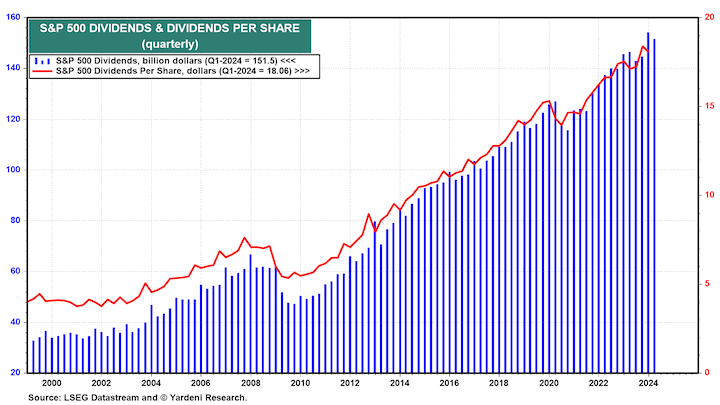
Here is the historical growth of the S&P 500 total dividend, which tracks roughly the largest 500 stocks in the US, updated after 2024 Q1 (via Yardeni Research):

That is a much smoother ride than the price index. I imagine my portfolio as a factory that churns out dollar bills, or a tree that gives dividend fruit.

Why I like tracking dividends in general. Stock dividends are a portion of profits that businesses have decided to distribute directly to shareholders, as opposed to reinvesting into their business, paying back debt, or buying back shares. They have explicitly decided that they don’t need this money to improve their business, and that it would be better to distribute to shareholders. The dividends may suffer some short-term drops, but over the long run they have grown faster than inflation.

In the US, the dividend culture is somewhat conservative in that shareholders expect dividends to be stable and only go up. Thus the starting yield is lower, but grows more steadily with smaller cuts during hard times. There is also a growing trend towards buybacks, partially because they are easier to discontinue. Here is the historical growth of the trailing 12-month (ttm) dividend paid by the iShares Core S&P 500 ETF (IVV) via StockAnalysis.com.

European corporate culture tends to encourage paying out a higher (sometimes fixed) percentage of earnings as dividends, but that also means the dividends move up and down with earnings. The starting yield is currently higher but may not grow as reliably. Here is the historical growth of the trailing 12-month (ttm) dividend paid by the Vanguard Total International Stock ETF (VXUS).

The dividend yield (dividends divided by price) also serve as a rough valuation metric. When stock prices drop, this percentage metric usually goes up – which makes me feel better in a bear market. When stock prices go up, this percentage metric usually goes down, which keeps me from getting too euphoric during a bull market.

In the case of REITs, they are legally required to distribute at least 90 percent of their taxable income to shareholders as dividends. Historically, about half of the total return from REITs is from this dividend income.

Finally, the last component comes from interest from bonds and cash. This will obviously vary with the prevailing interest rates, the real rates on TIPS, and the current rate of inflation. In 2024, we are finally back to getting paid a small percentage more than inflation on our cash.

Dividend and interest income from my specific asset allocation. To estimate the income from my portfolio, I use the weighted “TTM” or “12-Month Yield” from Morningstar (checked 7/1/24), which is the sum of the trailing 12 months of interest and dividend payments divided by the last month’s ending share price (NAV) plus any capital gains distributed (usually zero for index funds) over the same period. My TTM portfolio yield is now roughly 2.65%.

What about the 4% rule? For big-picture purposes, I support the simple 4% or 3% rule of thumb, which equates to a target of accumulating roughly 25 to 33 times your annual expenses. I would lean towards a 3% withdrawal rate if you want to retire young (closer to age 50) and a 4% withdrawal rate if retiring at a more traditional age (closer to 65). Too much time is spent debating this number. It’s just a quick and dirty target to get you started, not a number sent down from the heavens!

During the accumulation stage, your time is better spent focusing on earning potential via better career moves, improving your skillset, networking, and/or looking for asymmetrical entrepreneurial opportunities where you have an ownership interest.

As a semi-retired investor that has been partially supported by portfolio income for a while, I find that tracking income makes more tangible sense in my mind. Our dividends and interest income are not automatically reinvested. They are simply another “paycheck”. As with our other variable paychecks, we can choose to either spend it or invest it again to compound things more quickly. You could use this money to cut back working hours, pursue a different career path, start a new business, take a sabbatical, perform charity or volunteer work, and so on. You don’t have to wait until you hit a huge magic number. FIRE is Life!

MMB Portfolio Asset Allocation & Performance Update – July 2024 (Post Q2)

Here’s my 2024 Q2 update for our primary investment holdings, including all of our combined 401k/403b/IRAs and taxable brokerage accounts but excluding our house and side portfolio of self-directed investments. Following the concept of skin in the game, the following is not a recommendation, but a sharing of our real-world, imperfect, low-cost, diversified DIY portfolio.

“Never ask anyone for their opinion, forecast, or recommendation. Just ask them what they have in their portfolio.” – Nassim Taleb

How I Track My Portfolio
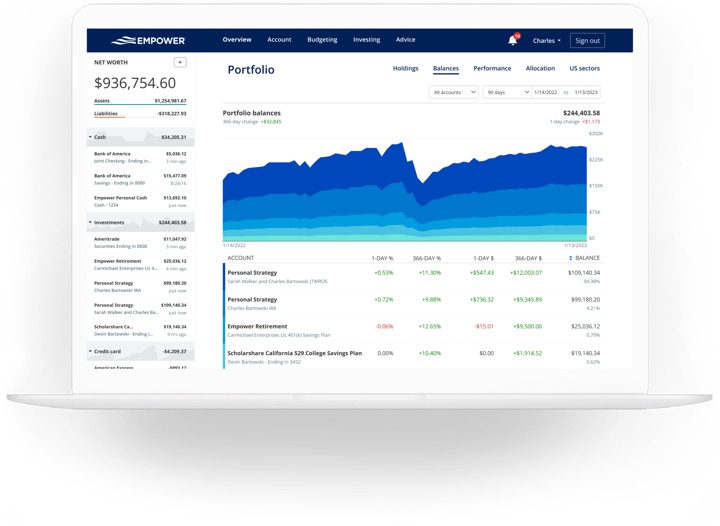
Here’s how I track my portfolio across multiple brokers and account types. There are limited free advanced options after Morningstar discontinued free access to their portfolio tracker. I use both Empower Personal Dashboard (previously known as Personal Capital) and a custom Google Spreadsheet to track my investment holdings:

  • The Empower Personal Dashboard real-time portfolio tracking tools (free) automatically logs into my different accounts, adds up my various balances, tracks my performance, and calculates my overall asset allocation daily. Formerly known as Personal Capital.
  • Once a quarter, I also update my manual Google Spreadsheet (free to copy, instructions) because it helps me calculate how much I need in each asset class to rebalance back towards my target asset allocation. I also create a new tab each quarter, so I have a personal archive of my holdings dating back many years.

2024 Q2 Asset Allocation and YTD Performance
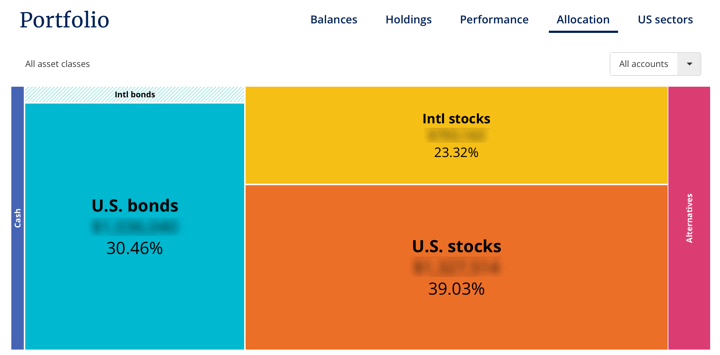
Here are updated performance and asset allocation charts, per the “Holdings” and “Allocation” tabs of my Empower Personal Dashboard.

I own broad, low-cost exposure to productive assets that will provide long-term returns above inflation, distribute income via dividends and interest, and finally offer some historical tendencies to balance each other out. I have faith in the long-term benefit of owning businesses worldwide, as well as the stability of high-quality US Treasury debt. My stock holdings roughly follow the total world market cap breakdown at roughly 60% US and 40% ex-US. I do add just a little “spice” to the broad funds with the inclusion of “small value” factor ETFs for US, Developed International, and Emerging Markets stocks as well as diversified real estate exposure through US REITs. But if you step back and look at the big picture, my target portfolio is quite boring.

By paying minimal costs including management fees, transaction spreads, and tax drag, I am trying to essentially guarantee myself above-average net performance over time.

The portfolio that you can hold onto through the tough times is the best one for you. Every asset class will eventually have a low period, and you must have strong faith during these periods to earn those historically high returns. You have to keep owning and buying more stocks through the stock market crashes. You have to maintain and even buy more rental properties during a housing crunch, etc. A good sign is that if prices drop, you’ll want to buy more of that asset instead of less. I don’t have strong faith in the long-term results of commodities, gold, or bitcoin – so I don’t own them.

I do not spend a lot of time backtesting various model portfolios, as I don’t think picking through the details of the recent past will necessarily create superior future returns. You’ll usually find that whatever model portfolio is popular at the moment just happens to hold the asset class that has been the hottest recently as well.

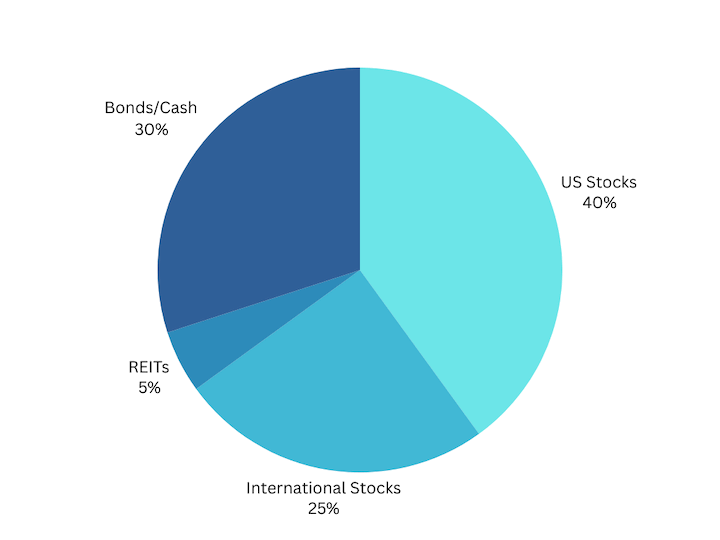
I have settled into a long-term target ratio of roughly 70% stocks and 30% bonds within our investment strategy of buy, hold, and occasionally rebalance. My goal has evolved to more of a “perpetual income portfolio” as opposed to a “build up a big stash and hope it lasts until I die” portfolio. My target withdrawal rate is 3% or less. Here is a round-number breakdown of my target asset allocation along with my primary ETF holding for each asset class. The reality is of course a bit more messy.

  • 35% US Total Market (VTI)
  • 5% US Small-Cap Value (VBR)
  • 20% International Total Market (VXUS)
  • 5% International Small-Cap Value (AVDV)
  • 5% US Real Estate (REIT) (VNQ)
  • 15% US “Regular” Treasury Bonds or FDIC-insured deposits
  • 15% US Treasury Inflation-Protected Bonds (or I Savings Bonds)

Performance details. According to Empower, my portfolio is up about 6% so far in 2024. The S&P 500 is up about 14.5% YTD, while the US Bond index is down around 1%. I hold enough bonds and international stocks that I’m always going to be lagging the hottest sector, and I’m pretty much used to that now.

As usual, not much action. These quarterly updates are mostly for me to manually log into all my accounts to make sure they still exist. I didn’t sell a single share of anything. I did reinvest some dividends and interest to bring me back towards my target numbers. The US capital markets continue to reward the long-term investors who take on the risk of owning stocks.

I’ll share about more about the income aspect in a separate post.