Archives for September 2021

If Retail Investors Are Dumb Money, Who Is Raking Up All The Alpha?

Here’s a follow-up to my post about the return gap of retail investors due to poor timing. For every seller of a stock share, there is a buyer. Therefore, if the timing of retail investors is reliably a little worse than average, we also know that someone else is on the other side of all those trades. Is there a group of non-retail investors that is reliably making money off the “dumb money” trades of retail investors?

Larry Swedroe digs into this question in his Advisor Perspectives article The Suckers at the Investment Table:

New research confirms that institutional investors, such as mutual funds, outperform the market before fees, and they do so at the expense of retail investors. That is bad news for retail investors and for investors in active mutual funds, who underperform after fees.

The research finds that the stocks and bonds individual investors buy go on to underperform and the ones they sell go on to outperform – demonstrating that retail investors are “dumb money.”

Unfortunately for fund investors, the same large body of evidence demonstrates that while mutual funds generate gross alpha, their total expenses exceed gross alpha, resulting in negative alphas for their investors.

If on average, an actively-managed mutual fund generates 0.7% of gross alpha, but after you subtract the expense ratio and trading costs which add up to nearly 1%, the net alpha is still negative. The active manager is the winner, taking all of the alpha for themselves in the form of relentless fees taken as a percentage of the entire asset base. The retail investor/customer still loses out. An fairer fee structure would be to take a larger percentage, but of the alpha only.

People will continue to argue about this, but I’m not surprised to see that these studies found alpha. It’s just much, much harder to do than most people think, and that’s exactly why you almost never see a fee structure based on alpha (thought they do exist). Even Charlie Munger, who is famous for his stock-picking skills and disagreement against the “hard” form of Efficient Market Theory, only says that the top 3% to 4% of professional investment managers will outperform (source):

I think it is roughly right that the market is efficient, which makes it very hard to beat merely by being an intelligent investor. But I don’t think it’s totally efficient at all. And the difference between being totally efficient and somewhat efficient leaves an enormous opportunity for people like us to get these unusual records. It’s efficient enough, so it’s hard to have a great investment record. But it’s by no means impossible. Nor is it something that only a very few people can do. The top three or four percent of the investment management world will do fine.

In the end, costs always matter. If you find a genius to pick stocks but they cost more than they help, then you still lose. The only actively-managed mutual funds that I have seriously considered buying are from Vanguard, which improves the odds with substantially lower expense ratios and a history of investor-friendly practices. As a DIY individual investor buying index funds, you can keep your head down and “grind out” reliably above-average returns over time due to the rock-bottom costs. (There, I fit in my own poker reference!) Even as a DIY individual stock investor, as at least I understand what I own and don’t have to pay a 1% management fee every year.
Mind The Gap: How Investor Timing Affects “Real-World” Returns

Morningstar has released the 2021 update to their annual Mind The Gap study, which measures the gap between reported investment returns (buy and hold throughout the entire period) and investor returns (actual returns experienced due the real-world timing of buy and sell transactions). How well does the average investor time their purchase and sell transactions?

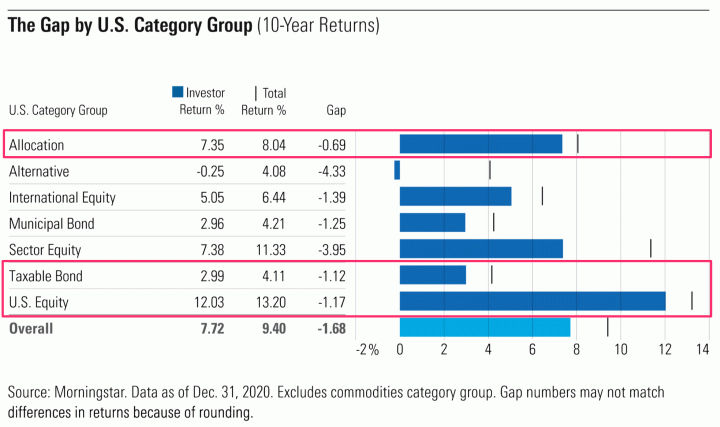
For the 10-year period from 12/31/2010 to 12/31/2020, the average return gap was negative 1.7% annually, with negative gaps across the board:

Investors in US stock funds had a 10-year return gap of negative 1.2% annually. This gap has varied over past rolling 10-year periods, but has been consistently slightly negative:

Now, this is not completely due to performance chasing. Here’s a quick example of how steady dollar-cost averaging may also result in a return gap:

To use a simple example, let’s say an investor puts $1,000 into a fund at the beginning of each year. That fund earns a 10% return the first year, a 10% return the second year, and then suffers a 10% loss in the third year, for a 2.9% annual return over the full three-year period. But the investor’s dollar-weighted return is negative 0.4%, because there was less money in the fund during the first two years of positive returns and more money exposed to the loss during the third year. In this case, there was a 3.3-percentage-point per year gap between the investor’s return (negative 0.4%) and the fund’s (2.9%).

Morningstar ran some extra simulations and DCA does possibly account for some of the gap, but a perfectly-steady DCA investor still outperformed the real-world investor in 6 out of 7 fund categories. DCA can’t be helped if you are simply investing what you can, when you can, but there is still extra trading in and out that appears to only make things worse.

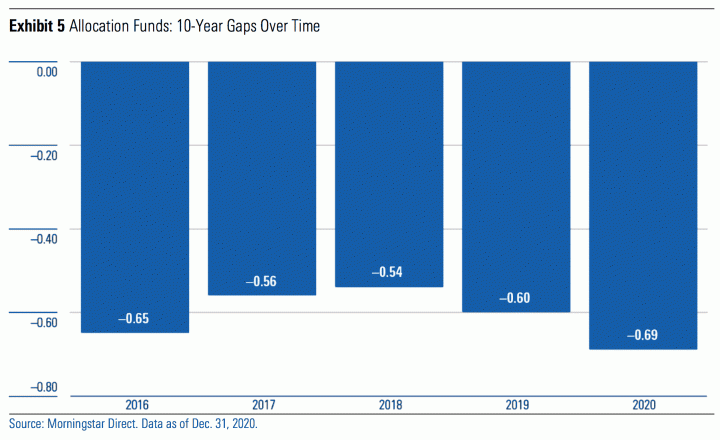
The most boring fund category that includes Target-Date funds has the smallest return gap. Target-date funds are included in the “Allocation” fund category as they include a managed mix of stocks, bonds, and other classes. These funds have the calmest trading activity, and we see that the return gap has been consistently smaller over time:

The fund categories with the most volatile cashflows in and out have the greatest return gaps. Alternative funds and sector equity funds did the worst.

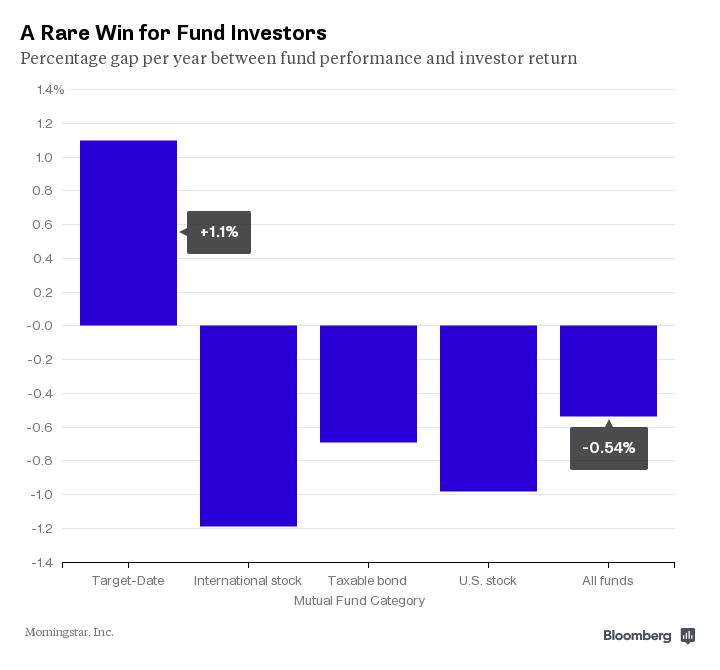
Investing in a low-cost target-date fund (TDF) is easy to dismiss as “too simple” or for the “inexperienced newbies only”, but often the inaction of TDF investors work in their favor. Maybe we should give credit to the humble investors that knows they could do a lot worse by thinking they have skills that they don’t actually have. (Meanwhile, I’m also guilty of thinking that I can do better than a TDF.) From a Bloomberg article using Mind the Gap data from 2015:

But target-date funds have one big advantage over other kinds of mutual funds, the data show. The average mutual fund has a flaw, which is that the average investor hardly ever does as well as his or her funds. Investors tend to jump in and out of funds at the wrong time. They buy high, choosing funds only after they’ve done well. And they sell low, dumping underperforming funds just as they’re about to take off.

targetdategap

Reminder: Consider Downgrading Annual Fee Cards Into Their No-Annual-Fee Versions

As another year of limited travel passes, this is a quick reminder that many credit cards with an annual fee have another version with no annual fee. You’ve already had the temporary ding on your credit report, and this allows you to keep that account history and credit limit. You’ll get less perks, but you still may retain something useful like the ability to keep earning points/miles on demand. Instead of canceling, you simply ask them for a “product change” or switch to another cards that they offer. I’ve recently converted two cards into their no annual fee versions:

The IHG Traveler Card makes it easy to keep earning a few IHG points here and there for keep my large existing points balance from expiring. I also keep the “Fourth Reward Night Free” perk when redeeming points for any 4+ night stay.

I’ve enjoyed having the Sapphire Reserve for years, as the $300 travel credit used to offset much of the previous $450 annual fee. However, the annual fee is now $550 and a couple years ago they removed the ability to bring my entire family including children into airport lounges with the Priority Pass Select (now limited to two guests) and likely also the new Sapphire Lounges. Converting to the Chase Freedom Unlimited preserves my Ultimate Rewards (UR) points balance, and we grabbed the Chase Sapphire Preferred thanks to their new big 100,000 point bonus. As Chase allows UR points transfers between immediate family members, I still maintain the ability to convert all of our combined Ultimate Rewards points to Hyatt hotel points, which are my preferred conversion value. I did convert some points using their Pay Yourself Back tool and cash out some points at 1.5 cents apiece first (I had a lot of points piling up).

Sometimes the no-annual-fee version of a card is not marketed very much, if at all. You can call the number on the back of your card and simply ask about your options. I usually wait until the annual fee charge shows up on my bill, but before the upcoming due date. They should want to keep your business – you often keep the same account number, but you most likely won’t be eligible for a new account sign-up bonus. You usually have to stay within the same “points” type, like Chase Ultimate Rewards, American Express Membership Rewards, Citi ThankYou points, Capital One miles, Delta miles, American miles, Marriott Bonvoy, etc. Personal cards must stay personal cards, and business cards must stay business cards.

Note: In some rare cases where the only card downgrade options limit their sign-up bonus to once within a certain period, and you haven’t gotten it yet, then you may wish to simply cancel the card. You may consider moving your credit limit over to another card first.

Savings Rate vs. Income Bracket: How Impressive Is Your Savings Rate?

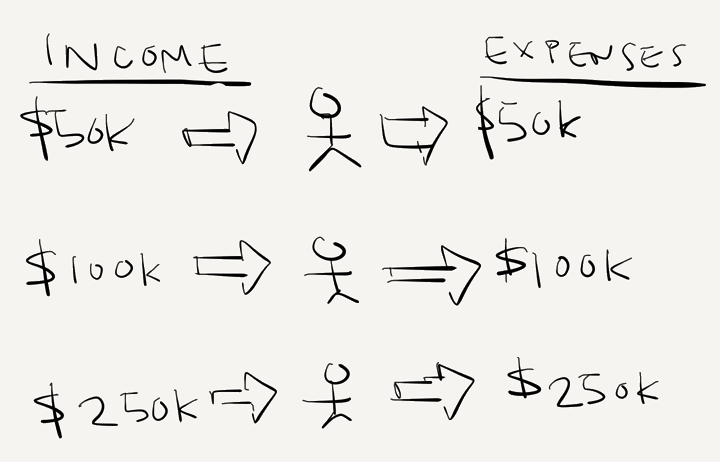
One of the criticisms of the pursuit of financial independence is that it is “only for the rich”. Certainly, having a lot more money coming in every month should make it easier to set some of it aside. However, you might also observe that most people with higher incomes have higher expenses – bigger homes, faster cars, fashionable clothing, and so on. What if everyone is basically running on a hamster wheel, regardless of income?

In other words, a 0% savings rate:

Well, according to this Economic Policy Institute analysis based on the Federal Reserve Board’s Survey of Consumer Finances and other data from 1989-2013, this is not far from the truth for everyone up to the 90th percentile of households:

This Mother Jones chart converts the percentile numbers into annual household income:

This chart shows the problem with any statistics about “average savings rate across all households”. While the average savings rate might be 10%, it’s basically zero for 90% of households while over 50% for those making over $750,000 a year (some of whom are making far, far more than $750k a year).

If you are making over $200,000 a year, then you shouldn’t be too proud that you are maxing out your 401k at $19,500 a year in 2021. If that’s all you are saving, that’s less than a 10% savings rate and you are barely average. If you’re making over $300,000 a year and only maxing out your 401k and your IRA every year, then you’re saving much less than your income bracket peers.

However, the most intriguing discovery to me is that the savings rate for those making $150k to $200k annually is essentially the same (zero) as everyone making $40k, $75k, and $125k a year! Within that wide range from $0 to $200k a year, it turns out to be pretty close to a hamster wheel! If you have any sort of significant savings in this income bracket, you should feel a little better today. Why does every household earning up to $200,000 a year, feel a need to spend nearly all of it on average? Perhaps in this range, you still believe that you are receiving “value” for that additional spending in terms of comfort, security, convenience, and/or happiness. If you can afford it, you really want it.

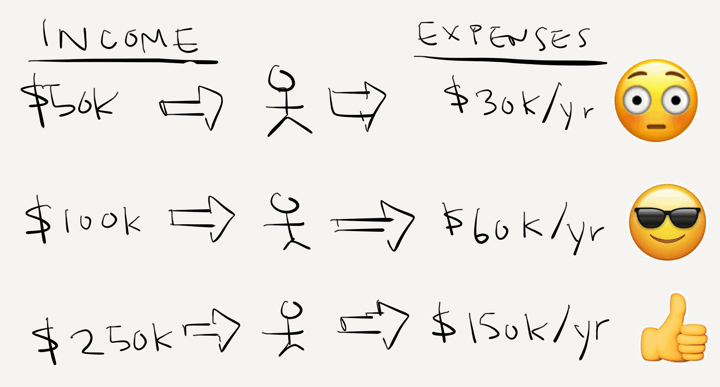
Let’s roughly estimate an ongoing 40% savings rate of your annual income as being on pace for truly “early” financial independence. (This assumes relatively constant income, not a big windfall.) Someone making $100,000 would have to spend as if they made $60,000 a year. I don’t see why this is impossible, as someone making $60k also spends $60k.

If people spend what they earn, why can’t they just pretend they earn less? If only it were so easy. So many of our choices are rooted in deep psychological desires, a combination of evolution (nature) and our childhood experiences (nurture). We are social, comparative creatures and have so many cognitive biases they barely fit on a huge infographic with tiny font. As Morgan Housel explains in The Psychology of Money:

Doing well with money has a little to do with how smart you are and a lot to do with how you behave.

As the data shows, for 99% of the population, anyone saving 40% of their income is a rare bird. While it is a more impressive and rare feat to see someone making $50k and spending $30k while putting $20k a year into productive assets, than for someone making $250k and spending $150k, you don’t get extra points for difficulty level! You should still work on increasing that income.

Bottom line. The average household earning between $0 to $150,000 per year spends nearly every dollar they year, but so does the average household earning $150,000 to $200,000 a year. Why is this, and what can we learn from it?

[Hamster wheel image credit]

Public REITs vs. Private Equity Real Estate Funds: A Performance Comparison

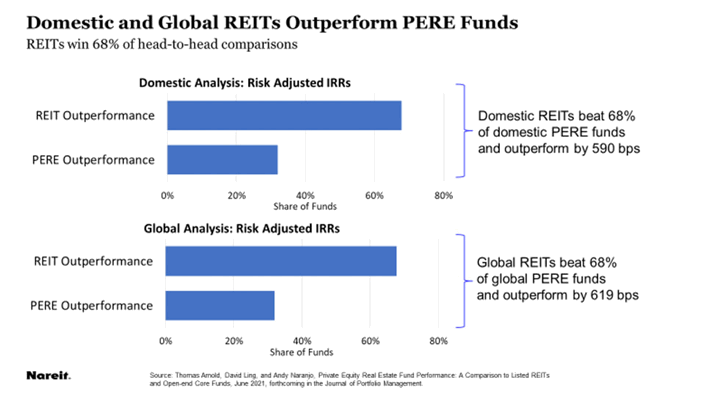
There are many ways to access real estate as an asset class – publicly-traded REITs like Realty Income, diversified REIT ETFs, private funds that hold baskets of individual properties, and many new fintech varieties. This Institutional Investor article discusses a new research article comparing public REITs and closed-end private equity real estate (PERE) funds:

In a new study published in the Journal of Portfolio Management’s real estate issue, authors Thomas Arnold, David Ling, and Andy Naranjo found that, when compared side-by-side, real estate investment trusts outperformed U.S. closed-end private equity real estate, or PERE, funds by 165 basis points annually.

Here is another Nareit article about the study, where I noticed that the research was actually sponsored by Nareit. Here is a direct link to the study itself.

This other Institutional Investor article points out one of the “benefits” of private real estate funds – namely the fact that they don’t offer accurate daily pricing. You should also consider this a “benefit” of personal homeownership – when things are scary, houses simply don’t sell (instead of giving you a shockingly low price at that moment).

REITs, like any public security, are priced in real time. At the depth of the economic shutdown in March and early April, REIT investors imagined doomsday scenarios as commercial property and hotels sat empty and analysts forecasted that individuals would be unable to make rent payments for the foreseeable future. The price of REITs fell in line with that outlook.

In contrast, private real estate funds use other valuation methods, including appraisals — which depend on property transactions. Back in March and April, no real estate was changing hands to inform these valuations. As a result, the net asset values of private portfolios didn’t reflect the carnage.

Real estate continues to intrigue me, but I’ve always stopped short of directly investing in a rental property because I want to avoid any management responsibility (or even the responsibility hiring a good property manager). To me, rentals are best considered a potentially-lucrative part-time self-employed business opportunity, with the greater upside and downside involved. I also love that I can completely ignore my portfolio for months at a time, and the dividends and interest payments still keep coming in.

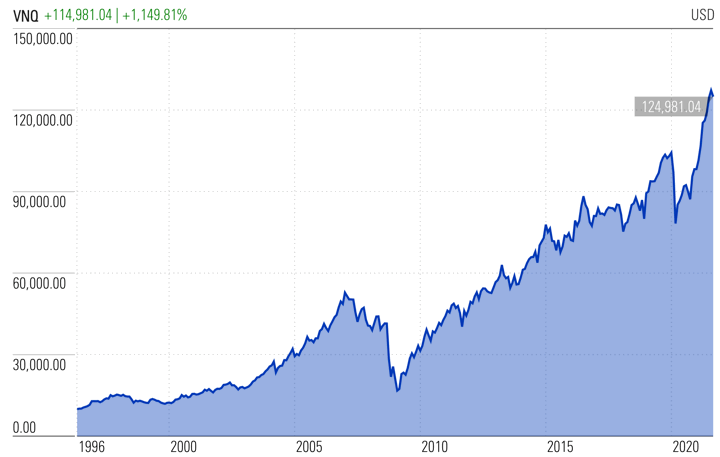
I’ve experimented with other options like PeerStreet, Fundrise and others, but the vast majority of my real estate investments are still in the low-cost index ETF VNQ (Vanguard Real Estate ETF). As long as you are good at ignoring the price drops during the scary times, it has been a solid long-term holding. Per Morningstar, here is the growth of $10,000 invested in VNQ since inception 25 years ago (with dividends reinvested!):

Monifi Fintech Bank App: $250 Direct Deposit Bonus Extended

Extended through end of November 2021. This $250 bonus has been extended through the end of November 2021. I can also report that I’ve already successfully gotten my $250 rather quickly after my 2nd deposit, for my account opened at the time of my original post (screenshots below). I even received another $25 due to a follow-up targeted offer (for new recent accounts?) for opening a new “Goal” account. Interestingly, both my payroll direct deposit and my external ACH transfers from Ally were both marked as “ACH deposit” by their system.


Monifi is a financial app that promises to blend “saving, spending and personal goals all in one place”. Right now, Monifi is also offering a $250 cash bonus (mobile browser required) for new customers that receive two direct deposits of at least $1,000 each into your Spend Balance. Must open by 11/30/21. Here is the fine print for the bonus:

*Receive $250 when you set up payroll direct deposit to your Spend Balance and receive two payroll direct deposits of $1,000 USD or more within 90 days of opening your Monifi Relationship. Valid for Monifi Relationships opened between June 1, 2021 and November 30, 2021. The payroll direct deposits must be an electronic deposit of the account owner’s paycheck, pension or government benefits, such as Social Security. Limit one incentive per customer. $250 USD paid as a credit to your Spend Balance within 45 days of meeting promotion requirements. Offer may be changed or withdrawn at any time. Monifi Relationship must be open and in good standing to receive promotion incentive.

What you’ll need to set up direct deposit:
Find your account and routing numbers in the Monifi App under Account Details – from the home screen, select your Spend Balance, and tap the icon at the top right.

The new fintech holy grail is an app that takes your entire paycheck and helps you budget, save for a rainy day, save for intermediate goals, and invest for the future. Monifi is a division of MidFirst Bank (Member FDIC), and appears to be expanding aggressively to grow their customer base. Here are more highlights:

  • 0.60% APY on your Save balance.
  • No monthly fee.
  • Free nationwide ATMs through the Allpoint Network.
  • Works with Zelle for person-to-person payments.
  • Free debit card. Free billpay.

$50 referral bonus. There is also a $50 referral bonus link (use mobile browser?) available with different requirements where you just need to reach $300 of account value within 7 days of account opening (no direct deposit requirement). The details and fine print:

Your friend Jonathan Ping wants you to try Monifi! Create and fund a Monifi Relationship with at least $300, and you’ll each receive a $50 credit to your Save Balance!

Download Monifi using referral link: https://monifibank.page.link/aiooseoMnTuAddiQ6

Terms and conditions apply: https://monifi.com/refer-a-friend

Referred customer’s Relationship must meet the following requirements to be considered a completed referral: Relationship Balance: $300 minimum deposit within seven (7) days of account opening and an Available Balance of $300 within seven (7) days of account opening.

Unfortunately, I’m not sure how to stack it with the $250 bonus offer above. As long you as you can manage the two $1,000+ deposits, I would simply go with the larger $250 bonus link above.

Stash Review: Simplified Automated Investing, Improved $80 New Account Bonus, Stock Parties

Updated with MyPoints promo and Stash Stock Party info. MyPoints has a new Stash promo that has a total value higher than the $20 Stash referral offer. If you don’t already have a MyPoints account, you can first join via this $10 MyPoints referral link to grab an additional $10 upfront bonus. Then log into your MyPoints account and search for “Stash”. Right now, MyPoints is offering 11,000 points (worth $70 in gift cards including Amazon) if you open via their link and deposit at least $5. Stash will give you another $10 as well, for a total bonus of $80. This is a limited-time offer. Their fine print:

*Points will appear as Pending for 32 days.
Must enter valid sign-up information, including bank account information to earn Points.
Offer may only be redeemed once (1) per user.

Original post with full review:

Stash is an investing app targeted that people who want a simple way to build a long-term diversified portfolio, as opposed to day-trading meme stocks, crypto, or high-risk options. All you need is five bucks, a smartphone, and a bank account.

Fee structure and plan features. Stash charges a simple, flat monthly fee. The three plan options are $1/month, $3/month, and $9/month (screenshot below). You make purchases in dollar-based amounts (fractional shares) and there are zero commissions per trade. Each ETFs still has its own underlying expense ratio, as with all brokers.

$1 a month tier (Beginner)

  • Taxable brokerage account and your selected mix of individual stocks and/or ETFs.
  • Automated investing. You choose how much money to direct each month, and all of that money will automatically be fully invested via fractional shares.
  • Stock-Back rewards debit card. If you open an optional bank account (Green Dot Bank), they will issue you a debit card that earns rewards in the form of stock shares. Earn 0.125% stock on all of your everyday purchases, and up to 5% at certain merchants with bonuses.
  • Savings and budgeting tools to help decide the right amount to put aside each month.
  • $1,000 in life insurance.

$3 a month tier (Growth)

  • Everything in the Beginner tier above, plus…
  • Traditional and Roth IRAs are supported.
  • Smart Portfolio. At this higher tier, Stash will help you design a target mix of ETFs that fits your needs.
  • Automatic rebalancing. Stash will automatically monitor and rebalance your portfolio as needed, if it drifts away from your target portfolio.

$9 a month tier (Stash+)

  • Everything in the Beginner and Growth tiers above, plus…
  • Children’s Custodial accounts. Invest in separate UGMA /UTMA account for your children under 18.
  • Double Stock Back. Get special bonuses the Stock-Back® Card and double the rewards you would earn on the regular tier.
  • Automatic rebalancing. Stash will automatically monitor and rebalance your portfolio as needed, if it drifts away from your target portfolio.
  • $10,000 in life insurance.

Stock and ETF trades are executed during four trading windows each weekday. Dividend reinvestment is offered on taxable, IRA, and custodial accounts. Stash Investments LLC is an SEC registered Investment Advisor, which means they are licensed to provide you retirement and investing advice. For me, the relatively low rewards percentage on their Stock Back card is not high enough to make it stand out, especially when compared to the 1% to 2% cash back you can get from other rewards credit cards.

The main draw to this app is the ability to automatically build a portfolio using small, regular amounts. This feels like a descendent of dividend reinvestment plans (DRIPs) where you would send in a check for $25 or $100 and be invested in a company’s stock like ExxonMobil. My great-aunt still gets a check every quarter from ExxonMobil from a DRIP she started decades ago. These days, you can pick nearly any company or group of companies via index ETFs.

Many other stock brokers offer commission-free trades, but the set-and-forget feature where it just sucks money from your bank account every month is very important. You can invest as little as $5 a month, automatically. Of course, this is a crowded field nowadays, and if you had the $1,000 minimum required for a Vanguard Target Retirement mutual fund at Vanguard.com, you could also make automatic additional investments of as little as $1 a month. I would also consider M1 Finance a close competitor.

Sign-up process.

  • Sign up via app or online. Now available on desktop, iOS, and Android.
  • Your personal information (name, address, SSN), same as with all SIPC-insured brokerage accounts.
  • Fill out a short risk questionnaire to help guide you towards an appropriate investment.
  • Pick your investment, which you can change later.
  • Fund with any bank account. Verification can be done via two small test deposits. For many banks, you can expedite the linking process by using your bank login credentials instead.

Stash Parties for free bits of stock. Every few days, the app will notify you of an upcoming “Stash Stock Party“:

By attending a Stash Stock Party, Stashers can get pieces of offered stock(s). The amount of stock depends on the amount of people that attend the Stock Party—the more people that show up, the bigger the split prize pot (and your share of it) ultimately grows. To join a party, just visit this page (party.stash.com) on the party day, log in, and tap Claim stock.

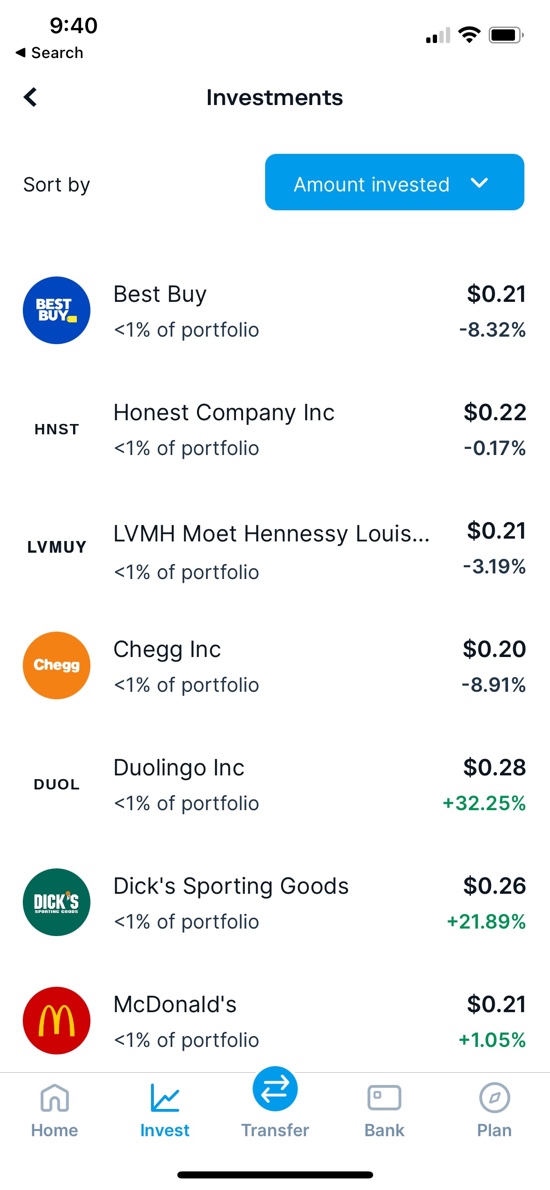
If you log in during their pre-announced short window of time, you can claim a tiny bit of free stock (might only be 10 cents or 30 cents of stock). This is definitely gimmicky, but I realized that it basically covers my a $1 monthly subscription fee, and now I get to watch how these tiny bits of stock can grow over time. They are like little free lottery tickets. If I am not busy, I pick up them up. If I’m busy, no big deal. I have no plans to sell them. Here are some screenshots showing just a portion of my little tiny stock positions:

$20 referral bonus. Right now, if you sign up via a Stash referral link, you can get $20 of free stock (or cash). The standard amount used to be only $5. That is my link, so thanks if you use it! You must open an account, link a bank account, and fund with at least a penny ($0.01) into your new Stash investment or bank account. You don’t need to make a stock purchase, although you certainly can. Screenshot with details:

Bottom line. Stash is a financial app that allows you to gradually and automatically build an investment portfolio using regular purchases of a mix of individual stocks and ETFs. They charge a flat monthly fee starting a $1 per month. Right now, new users can get $20 of free stock to start via referral link.

Also see: Big List of Free Stocks For New Commission-Free Brokerage Apps

Were Vanguard’s 10-Year Stock Market Return Forecasts Accurate? Or Really Wrong?

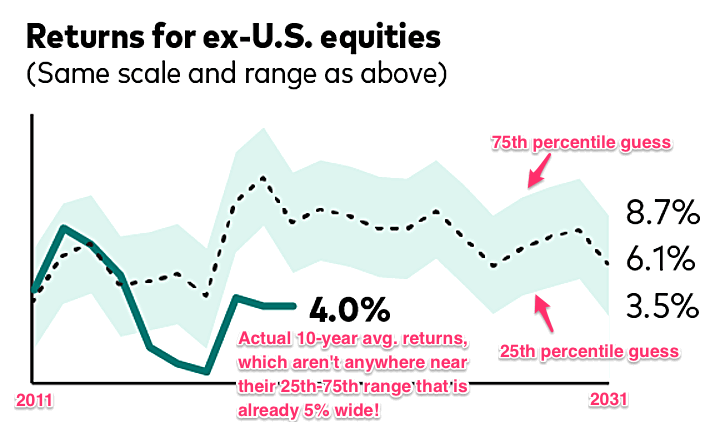
Periodically, Vanguard publishes asset class return forecasts for the next 10 years. Here is their most recent one for September 2021. To their credit, they have also published a recent follow-up post tracking both those forecasts alongside the actual returns in retrospect. This is a good lesson on the difficulty of any sort of short-term market prediction, even after allowing yourself 10 years and wide error bars.

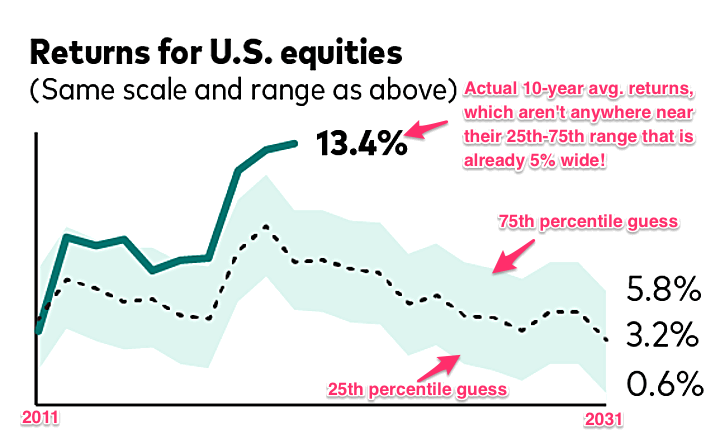
Below is a chart tracking their forecasts for the future 10-year average annualized returns of US stocks. Eyeballing their chart, for 2010-2020 their range of confidence was somewhere between roughly 5% and 10% annually, for a median around 7.5%. This accounts for their model’s 25th percentile to 75th percentage range of possible outcomes. This is a pretty big range! $100,000 times 5% annualized returns after 10 years is $163,000. $100,000 times 10% annualized returns after 10 years is $259,000.

Even accounting for that wide range, their forecast for US stocks was off. While the curve looks vaguely similar, US stocks did significantly better than their forecast:

Again, even accounting for the huge range of guesses, their forecast for international stocks was also off. Global non-US stocks did significantly worse than their forecast:

Vanguard’s original chart focuses on their 60/40 portfolio, which happens to look a lot better. Why? Their 60/40 portfolio consists of 36% US equities, 24% global ex-US equities, 28% US bonds, and 12% ex-US bonds. For one, future bond returns are much more simple to predict than stock returns. Your current 10-year yield is going to be pretty close to your eventual 10-year return. In addition, their US equities forecast was really wrong in one direction (too low), while their international equity forecast was wrong in the other direction (too high), so they tended to offset each other. Is this diversification in action? Certainly, yes, but also luck in my opinion. Both could have also been wrong in the same direction.

Should we just ignore this stuff completely then? I keep thinking back to this illuminating chart comparing the contributions of earnings growth, dividends, and P/E ratio changes to the total return of the S&P 500. Earnings growth and dividends have been pretty consistent for over 70 years, but the overall swings in return have been mostly caused by P/E ratio expansion and contraction.

Consider the analogy that P/E ratio expansion and contraction behaves like a rubber band. It can stretch pretty far, much farther than you might expect, but as you keep stretching it, the stronger it will eventually want to come back. But you never really know how far it can stretch, or when it will snap back. Forecasts can be wrong for a long, long time. You have to balance knowing that the run will end eventually, but not knowing when. Someone will always be right in retrospect.

If only we could focus solely on the earnings growth and dividends. Those are what really matter in the long run. This is the behavioral benefit of remembering that dividends are a share of profits being distributed to you as a business owner. Even if prices on a screen are dropping, the businesses are still working hard, making profits, reinvesting some for more earnings growth, and sending some of it to you as cash.

Reader Question: Should I Buy Savings Bonds in September/October 2021 or November 2021?

sb_poster

Here’s a timely reader question about Series I Bonds. It’s a good question because I predict that Series I Bonds will be soon getting even more media attention soon due to an even higher inflation-linked rate.

Would it be best to wait till November 1st to purchase I bonds? You mentioned the fixed rate will probably confine at 0. but what about the semiannual inflation rate? Do u think it is likely to be more than 3.54%? I’m new to this please educate me.

Series I Bond rates react every 6 months to delayed inflation reports from the Bureau of Labor Statistics. August CPI-U was already reported in mid-September, and September CPI-U will be reported in mid-October. 5 out of 6 months of data are already in the books, leaving only one month of data left. The 12-month trailing inflation rate as of that August CPI-U update was over 5%. Therefore, unless that data contains a significant amount of deflation, we already know that the next inflation rate on Series I Bonds is going to be higher than the 3.54% from May to October 2021. I roughly estimate the range that the next inflation rate will be between as 5% to 7%. That should be enough accuracy to make a purchase timing decision, earlier than my usual practice of waiting until mid-October.

  • If you buy in September or October 2021, you will receive a total rate of 3.54% for the first six months, then the “new” (estimated 5%-7%) rate for the next 6 months, and then new rates adjusted every six months for inflation onward.
  • If you buy in November 2021, you will receive the “new” (estimated 5%-7%) rate for the first 6 months, and then new rates adjusted every six months for inflation onward.

The takeaway is that either way, you will earn the “new” rate (estimated 5%-7%) eventually. If you buy in September/October, you’ll just have to wait a bit due to the staggered structure. Given that the current rate of 3.54% is still a higher interest rate than nearly any other savings account or CD is paying, I would personally just invest now if I had the cash ready and waiting. Also remember that Series I Bonds do not allow early withdrawals within the first 12 months after purchase date. As long as you complete your purchase by the end of September, it will count as purchased in September 2021 and you will be able to withdraw as of September 1st, 2022 (though subject to a penalty if held less than 5 years). It may take a little bit to set up your TreasuryDirect account, and it may take a couple business days for the withdrawal and purchase to process, so I wouldn’t wait until the last day.

Annual purchase limits. The annual purchase limit is now $10,000 in online I-bonds per Social Security Number. For a couple, that’s $20,000 per year. You can only buy online at TreasuryDirect.gov, after making sure you’re okay with their security protocols and user-friendliness. You can also buy an additional $5,000 in paper I bonds using your tax refund with IRS Form 8888. If you have children, you may be able to buy additional savings bonds by using a minor’s Social Security Number.

As noted in my previous savings bond posts, these Series I bonds are a unique investment opportunity in that they are only available to individuals and are subject to purchase limits. Even if the real yield (fixed rate) is set at zero, that is still significantly higher than that of TIPS that trade on the open market (well negative across the board!). If institutional investors like pension funds or endowments could buy I bonds like you and me, they would buying billions of them.

I plan to purchase up to my annual purchase limit for 2021 as part of my asset allocation to inflation-linked bonds, although you can start with as little as $25. I guarantee that there will be many more articles about Series I bonds in mainstream personal finance sites in November after the new rate is officially announced.

The Gift by Edith Eger: Combat Victimhood. Be Ready For Change. Forgive. Take The Risk.

Edith Eger was only a teenager when she and her family were sent to Auschwitz. She never saw her father and mother again. While she showed amazing mental strength to survive those horrors, it took her decades more before should could fully process and heal. I’ve seen her book The Gift: 12 Lessons to Save Your Life on multiple reading lists, and now I understand why. She provides a new lens to view your own traumatic experiences and useful insights on how you can escape the prison of your own mind:

Eger explains that the worst prison she experienced is not the prison that Nazis put her in but the one she created for herself, the prison within her own mind. She describes the twelve most pervasive imprisoning beliefs she has known—including fear, grief, anger, secrets, stress, guilt, shame, and avoidance—and the tools she has discovered to deal with these universal challenges.

I should warn you that this book describes some very graphic traumatic events that she and her patients have experienced. It will likely trigger some emotional memories of your own personal traumas, so be prepared and choose carefully when and where you read this book. (Not a light beach read in public!)

This is not a finance book. However, money is emotional. Fear, guilt, shame, avoidance. Right now, there is a millionaire that is too afraid to spend any money. Right now, someone is buying something they can’t afford to impress someone else and not seem “lesser”. How many bills are sitting on a counter unopened, with the debtor just hoping that ignoring it will make it go away?

We spend money on food and shelter, but we also spend money to satisfy our emotional needs of affection and attention. Buying a house is an emotional purchase. Your job ends up being more than money for a task. In this context, here are a few selected book highlights:

We do not change until we’re ready.

We do not change until we’re ready. Sometimes it’s a tough circumstance—perhaps a divorce, accident, illness, or death—that forces us to face up to what isn’t working and try something else. Sometimes our inner pain or unfulfilled longing gets so loud and insistent that we can’t ignore it another minute. But readiness doesn’t come from the outside, and it can’t be rushed or forced. You’re ready when you’re ready, when something inside shifts and you decide, Until now I did that. Now I’m going to do something else.

Always replace a dysfunctional habit with a healthy one.

Change is about interrupting the habits and patterns that no longer serve us. If you want to meaningfully alter your life, you don’t simply abandon a dysfunctional habit or belief; you replace it with a healthy one. You choose what you’re moving toward. You find an arrow and follow it. As you begin your journey, it’s important to reflect not only on what you’d like to be free from, but on what you want to be free to do or become.

Take the risk! Why not?

I’d been teaching psychology at a high school in El Paso for a few years—and had even been awarded teacher of the year—when I decided to return to school for a master’s in educational psychology. One day my clinical supervisor came to me and said, “Edie, you’ve got to get a doctorate.” I laughed. “By the time I get a doctorate I’ll be fifty,” I said. “You’ll be fifty anyway.” Those are the smartest four words anyone ever said to me.

Honey, you’re going to be fifty anyway—or thirty or sixty or ninety. So you might as well take a risk. Do something you’ve never done before. Change is synonymous with growth. To grow, you’ve got to evolve instead of revolve.

Freedom is about becoming your true self.

Finally, when you change your life, it isn’t to become the new you. It’s to become the real you—the one-of-a-kind diamond that will never exist again and can never be replaced. Everything that’s happened to you—all the choices you’ve made until now, all the ways you’ve tried to cope—it all matters; it’s all useful. You don’t have to throw everything out and start from scratch. Whatever you’ve done, it’s brought you this far, to this moment.

Much of our suffering stems from our misconception that we can’t be loved and genuine—that if we are to earn others’ acceptance and approval, we must deny or hide our true selves.

Survivors vs. victims.

In my experience, victims ask, “Why me?” Survivors ask, “What now?”

Suffering is universal. But victimhood is optional.

We’re going to be affected by environmental and genetic factors over which we have little or no control. But we each get to choose whether or not we stay a victim. We don’t get to choose what happens to us, but we do get to choose how we respond to our experience.

I’ve skipped many more highlights for dealing with more personal issues. This a great book on helping you deal with your own mind prisons. It was hard to ask myself all these questions, and I didn’t always like the answers, but it definitely taught me some things about myself and my framing of past issues.

Don’t Die With Zero: Money Still Buys Better Experiences When You’re Old

The idea of “consumption smoothing” tries to balance how our income changes over time with our spending needs. In theory, it may be ideal to go into debt when you are really young, save heavily when you are middle-aged, and spend it down when you are old (source):

The book Die With Zero (my review) reminds us that when we are young, we tend to have little money but lots of health. When we are old, we tend to have lots of time and much less health. So we should spend most of our money during our younger “best years” instead of when we are old. Here is a graphic from the book:

I enthusiastically support the idea of creating a specific bucket list of items designed for each stage of your life. However, I don’t like the title “Die with Zero” because it suggests that your time at the end is not valuable. A young, healthy person might think – why bother saving too much when you’re too old to enjoy it? Well, I would say that you start to appreciate the bottom layers of Maslow’s Hierarchy of Needs when you see them missing in someone’s life. (image credit)

We help take care of an older relative, and she has recently gotten to the stage where she can no longer safely live independently. According to the Katz Index of Independence, here are the basic activities of daily living (ADLs):

  • Bathing and showering: the ability to bathe self and maintain dental, hair, and nail hygiene.
  • Continence: having complete control of bowels and bladder.
  • Dressing: the ability to select appropriate clothes and outerwear, and to dress self independently
  • Mobility: being able to walk or transfer from one place to another, specifically in and out of a bed or chair.
  • Feeding (excluding meal preparation): the ability to get food from plate to mouth, and to chew and swallow.
  • Toileting: the ability to get on and off the toilet and clean self without assistance.

You may be 100% there mentally and only be struggling with one of these things, but that’s enough that you can’t live independently. The next level of “instrumental” activities of daily living includes things like cleaning, laundry, paying the bills, managing medication, cooking, shopping, communicating via telephone/computer, or transportation.

According to AARP, nearly 80% of adults age 65 and older want to remain in their current residence as long as possible. Seniors vastly prefer “aging in place” to facility care, and why wouldn’t they? The standard of care in an average nursing home is simply not that great. You live on their schedule, ignored most of the time. They are only required to give two baths a week. There are no national laws or regulations for staff to resident ratios. You may face a ratio of 15 residents to 1 nurse aid or worse. Medicaid pays for 6 in 10 nursing home residents. In 2021, a single Medicaid user must have under $2,382 per month in income and less than $2,000 in countable assets to qualify financially. Truly having “zero” near the end is not fun.

However, if you have the financial means, you can hire your own personal home health aide. This 1:1 ratio gives you your freedom back. You get to live in your own house. You wake up and live on your own schedule. You get to choose the food that you eat. You bath every day. You have someone to drive you wherever you want. You can still do your own shopping. You can have lunch with your friends. You can go to social events (memories! experiences!). This can get expensive at $15 to $30 an hour (often less overnight), but I’ve discovered that 1-on-1 help is the “luxury good” that the wealthy buy at this stage of their lives.

One of the findings of behavioral psychology is that above a certain level of income (maybe $80k a year in 2021?), you don’t get that much happier. At a certain point, you have your needs met and you feel safe and relatively comfortable. Above that, it’s mostly a nicer house, fancier car, more expensive restaurants, etc. Earning more doesn’t give you a more loving family and group of friends. When you get older, I’ve now seen how extra money can get you back to that level of satisfied comfort if you have health issues. The difference that I see in happiness levels was surprising to me. It just reminds me that the freedom to spend our time how we wish is the true goal.

Upgrading from the “economy” to “business class” lifestyle in your 40s is nice, but so is upgrading from a nursing home to 1-on-1 personal attention in your 70s and 80s. The very wealthy can afford both. But for the rest of us, it’s something to think about. Maximize pleasure when you are younger, or minimize suffering when you are older?

U.S. Bank Cash+ Plus Visa Signature Card Review – Choose Your 5% Cash Back Categories + $200 Bonus

New $200 welcome bonus. Here is a lesser-known card in the world of 5% cash back credit cards. The U.S. Bank Cash+ Visa Signature card actually lets you choose and change the categories in which you can earn 5% and 2% cash back. Here are the highlights:

  • $200 bonus after spending $1,000 in eligible purchases within the first 120 days of account opening.
  • 5% cash back on your first $2,000 in eligible net purchases each quarter on the combined two categories you choose.
  • 5% cash back on prepaid air, hotel and car reservations booked directly in the Rewards Center
  • 2% cash back on one everyday category, like Gas Stations/EV Charging Stations, Grocery Stores or Restaurants
  • 1% cash back on all other eligible purchases
  • 0% Intro APR on purchases and balance transfers for the first 15 billing cycles. After that, a variable APR currently 18.99 – 28.99%
  • Terms and conditions apply.
  • No annual fee.

Here’s how it works. Each quarter, you MUST enroll to choose one 2% back category from a list of three options: gas stations, grocery stores, or drugstores. You also get to choose the two 5% cash back categories every quarter, out of a preset selection of specific categories;

  • Fast Food
  • Cell Phone Providers
  • Home Utilities
  • Ground Transportation
  • Select Clothing Stores
  • Electronics Stores
  • Car Rentals
  • Gyms/Fitness Centers
  • Sporting Goods Stores
  • Department Stores
  • Furniture Stores
  • Movie Theaters
  • TV, Internet, and Streaming Services

You can pick the same categories each quarter, or switch them up once a quarter based on your planned spending. Make sure to choose your categories each quarter! – even if you want them to stay the same. If you do not choose your categories, all purchases revert to only earning 1% cash back for that quarter.

I have added the U.S. Bank Cash+ Visa Signature card to my quarterly-updated list of other 5% cash back cards like the Chase Freedom Flex, Citi Custom Cash, and Discover More cards.