Archives for September 2021

PFS Buyers Club: New US Mint Coin Deal on 9/13 ($100+ Net Profit, September 2021)

Another new coin deal on Monday, September 13th, 2021. PFS Buyers Club has another coin deal on a limited-edition American Eagle 2021 One Ounce Silver Reverse Proof Two-Coin Set Designer Edition. They will pay you a guaranteed fixed profit of $100.05 plus any credit card rewards. See details below.

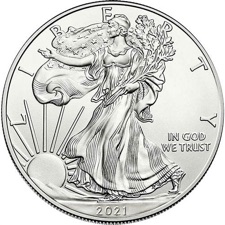
On September 13th – at 12:00PM ET the US Mint will release the limited edition American Eagle 2021 One Ounce Silver Reverse Proof Two-Coin Set Designer Edition.

There is a purchase limit of 1 Set per household, so you’re able to buy 1 Set.

The cost of each American Silver Eagle Two-Coin Set is $175.00. After including the $4.95 shipping charge, each order’s total will be $179.95

You will have the box shipped to your own house or office and then ship them to PFS Buyers Club with a prepaid FedEx shipping label that we will provide for you.

We will pay you $280.00 – for a profit of $100.05 per order.

This is also a great opportunity to earn valuable points/miles on your credit cards, as well as meet any spending thresholds.

If you are new to this type of deal please the previous similar (but expired!) deal for more background information and answers to most common questions. I have now done multiple deals with them and been paid as promised with no issues.

If you want to jump on this, you can sign up to join PFS Buyers Club here. PFS will provide *very* detailed instructions. Read them ahead of time, and follow them carefully to help you buy the coin before it sells out. If you use that link as a first-time buyer, I will receive a one-time referral fee the first time you successfully sell your coin for a profit. Thanks for those that use it, and for those that already used it in the past. I will be opting in myself as well.

John Paulson: Best Way For Average Person To Invest $100,000 Today?

Bloomberg has an interview transcript with investor John Paulson, and it has the catchy headline Billionaire Paulson Who Shorted Subprime Calls Crypto ‘Worthless’ Bubble. He does say that, but the interview also includes some insights on many other topics like asymmetrical trades, gold, the highly-limited supply of crypto leading to high volatility, interest rates, and controlling how you spend your time.
If you are having trouble getting around the paywall, let me include this quote:

If somebody came to you and asked how they should invest $100,000, what would you tell them?

I always say the best investment for an average individual is to buy their own home. So if you take that $100,000, put 10% down, get a $900,000 mortgage, you can buy a home for a $1 million. It was just reported that home prices were up 20% in the last month. So if you bought a home for a $1 million with $100,000 down and the home was up 20%, that’s $200,000 on a $100,000 investment. The longer you wait, the more the house is going to appreciate and the greater return you’ll have on your equity investment. So I think the single best investment for anyone with that type of money would be to buy their own house or apartment.

Basically, mortgages offer cheap leverage on an asset that he believe will keep going up for a while. A person can take $50,000 and control a $500,000 asset. If it goes up 10%, you just made another $50,000 and doubled your initial $50,000.

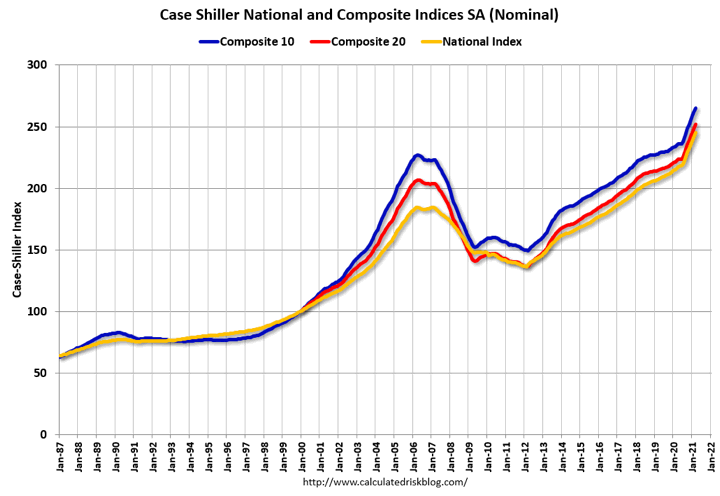
Yes, we learned that leverage works both ways in the 2008 Financial Crisis, meaning that if that $500,000 drops by 10%, you just lost your $50,000 downpayment. That’s what Paulson is most well-known for – making $20 billion betting against subprime mortgages during that crisis. In fact, I recall Paulson saying something very similar back in 2014 or so, that housing prices are going to keep going up. Here is the S&P/Case-Shiller U.S. National Home Price Index chart from Calculated Risk:

With this interview, I guess he doesn’t see this trend ending soon. I’m not saying I necessarily agree with this answer, but it is an interesting one when you consider all of the possible options.

CVS: $20 off $20+ In-Store Purchase with Paypal or Venmo App

Update: This offer has expired due to too many uses. Sorry!

Here is an offer for $20 off a single $20+ purchase at CVS stores, promoting the touchfree “scan to pay” feature of PayPal and Venmo apps. Open up your PayPal or Venmo app and look for the “Scan” option/code logo in the bottom left of the screen. Scan the following QR code below (or try this link). Then just go to a CVS store and pay using the “Show to Pay” option in your app. After completing the purchase at the full price, $20 will later be sent to your account.

Expires soon on 9/10/2021 at 11:59pm ET. One-time use only. Credit to JHClagg at SD. It says to share with friends! 😀

House Downpayments and Low Interest Rates: Keep Your Eye on the Prize

My neighbors put up their house for sale a couple weeks ago. A single open house, what felt like over 100 private showings, and in escrow within a week. So when I read this WSJ article Where to Stash Your Down Payment if You Didn’t Buy a House This Year, I felt their answer was too wishy-washy and complex. If you are looking for a house, as in – if the right one came up you would buy it – then keep your downpayment in 100% liquid and safe cash. Simple.

Keep your eye on the prize: The house + a 30-year fixed mortgage at 3%. Best quote from the WSJ article:

As Blair duQuesnay, a financial planner at Ritholtz Wealth Management, points out, there is another upside to waiting longer to buy: You can grow the original amount by ramping up your savings. “If they’re still earning, that could add to the down payment,” she said. “And the low interest rates we’re all complaining about? That’s how you’re going to get a low mortgage rate.

Exactly. Don’t complain about earning a low interest rate on your downpayment for perhaps 12 months. Be grateful that you’ll get a low fixed interest rate on your mortgage for the next three decades! A lot can happen in that timeframe, look at the past 50 years (via @lenkeifer):

Don’t forget that the American 30-year fixed mortgage with no prepayment penalty is an amazing product that would not exist if not for government intervention. It’s an awesome inflation hedge. If you don’t move (or even if you move but don’t sell), your mortgage payment is fixed for 30 years, no matter how high inflation gets. Mortgage rates are at historical lows, but even if rates do somehow go even lower, you simply refinance. You are covered either way!

According to this LendingTree study, the average downpayment across the nation’s 50 largest metros is is $46,283. The lowest is $28,000 in Oklahoma City, and the highest is $115,138 in San Jose. That’s roughly 10% of the average home prices in each area. FHA loans require a down payment of just 3.5%.

$50,000 is a lot of money (although many people drive around in cars worth more than that….) but your time horizon is very short when house shopping. Home buying is an emotional roller coaster in the best of times, and inventory is tight. There were over 30 offers on the house that we bought, and we couldn’t sleep until our offer was finally accepted. I’m not interested in the buy vs. rent debate, as there are too many personal and local variables for there to be a single answer. If I was in the market right now, I’d have all my ducks are in a row – mortgage pre-approval, downpayment documentation, income documentation, clean and orderly bank statements, and so on.

Long-term investments and short-term investments should be treated differently. For your house downpayment, don’t worry about the stock market going up another 10%. Don’t buy risky bonds chasing another 2%. Worry that messing around with your downpayment will somehow impair your ability to buy the home that you want. If earning zero interest bothers you, check out my best rates and earn 1% to 3% APY while keeping it 100% liquid and safe. Good luck!

Image credit: Imgflip

Best Interest Rates on Cash – September 2021 Update

via GIPHY

Here’s my monthly roundup of the best interest rates on cash as of September 2021, roughly sorted from shortest to longest maturities. I look for lesser-known opportunities to earn 2% APY and higher while still keeping your principal FDIC-insured or equivalent. Check out my Ultimate Rate-Chaser Calculator to see how much extra interest you’d earn by moving money between accounts. Rates listed are available to everyone nationwide. Rates checked as of 9/7/2021.

Fintech accounts
Available only to individual investors, fintech companies often pay higher-than-market rates in order to achieve fast short-term growth (often using venture capital). I define “fintech” as a software layer on top of a different bank’s FDIC insurance. These do NOT require a certain number debit card purchases per month. Read about the types of due diligences you should do whenever opening a new bank account.

  • 3% APY on up to $100,000. The top rate is still 3% APY for July through September 2021 (actually up to 3.5% APY with their credit card), and they have not indicated any upcoming rate drop. HM Bradley requires a recurring direct deposit every month and a savings rate of at least 20%. Due to high demand, you must currently use a referral link to join. See my HM Bradley review.
  • 3% APY on 10% of direct deposits + 1% APY on $25,000. One Finance lets you earn 3% APY on “auto-save” deposits (up to 10% of your direct deposit, up to $1,000 per month). Separately, they also pay 1% APY on up to another $25,000 with direct deposit. New customer $50 bonus via referral. See my One Finance review.
  • 3% APY on up to $15,000. Porte requires a one-time direct deposit of $1,000+ to open a savings account. New customer $50 bonus via referral. See my Porte review.
  • 1.20% APY on up to $50,000. OnJuno recently updated their rate tiers, while keeping existing customers on the grandfathered 2.15% APY rate. If you don’t maintain a $500 direct deposit each month, you’ll still earn 1.20% on up to $5k. See my updated OnJuno review.

High-yield savings accounts
While the huge megabanks pay essentially no interest, I think every should have a separate, no-fee online savings account to accompany your existing checking account. The interest rates on savings accounts can drop at any time, so I list the top rates as well as competitive rates from banks with a history of competitive rates. Some banks will bait you with a temporary top rate and then lower the rates in the hopes that you are too lazy to leave.

  • T-Mobile Money is still at 1.00% APY with no minimum balance requirements. The main focus is on the 4% APY on your first $3,000 of balances as a qualifying T-mobile customer plus other hoops, but the lesser-known fact is that the 1% APY is available for everyone. Thanks to the readers who helped me understand this.
  • There are several other established high-yield savings accounts at closer to 0.50% APY. Marcus by Goldman Sachs is on that list, and if you open a new account with a Marcus referral link (that’s mine), they will give you and the referrer a 0.50% boost on top of the current interest rate for 3 months. You can then extend this by referring others to the same offer. Right now, Marcus is paying 0.50% APY, so with the offer you’d get 1.00% APY currently for your first 3 months.

Short-term guaranteed rates (1 year and under)
A common question is what to do with a big pile of cash that you’re waiting to deploy shortly (plan to buy a house soon, just sold your house, just sold your business, legal settlement, inheritance). My usual advice is to keep things simple and take your time. If not a savings account, then put it in a flexible short-term CD under the FDIC limits until you have a plan.

  • No Penalty CDs offer a fixed interest rate that can never go down, but you can still take out your money (once) without any fees if you want to use it elsewhere. CFG Bank has a 13-month No Penalty CD at 0.62% APY with a $500 minimum deposit. Ally Bank has a 11-month No Penalty CD at 0.50% APY for all balance tiers. Marcus has a 7-month No Penalty CD at 0.45% APY with a $500 minimum deposit. You may wish to open multiple CDs in smaller increments for more flexibility.
  • Lafayette Federal Credit Union has a 12-month CD at 0.80% APY ($500 min). Early withdrawal penalty is 6 months of interest. Anyone can join this credit union via partner organization ($10 one-time fee).

Money market mutual funds + Ultra-short bond ETFs
Many brokerage firms that pay out very little interest on their default cash sweep funds (and keep the difference for themselves). Unfortunately, money market fund rates are very low across the board right now. Ultra-short bond funds are another possible alternative, but they are NOT FDIC-insured and may experience short-term losses at times. These numbers are just for reference, not a recommendation.

  • The default sweep option is the Vanguard Federal Money Market Fund which has an SEC yield of 0.01%. Vanguard Cash Reserves Federal Money Market Fund (formerly Prime Money Market) currently pays 0.01% SEC yield.
  • Vanguard Ultra-Short-Term Bond Fund currently pays 0.28% SEC yield ($3,000 min) and 0.38% SEC Yield ($50,000 min). The average duration is ~1 year, so your principal may vary a little bit.
  • The PIMCO Enhanced Short Maturity Active Bond ETF (MINT) has a 0.23% SEC yield and the iShares Short Maturity Bond ETF (NEAR) has a 0.36% SEC yield while holding a portfolio of investment-grade bonds with an average duration of ~6 months.

Treasury Bills and Ultra-short Treasury ETFs
Another option is to buy individual Treasury bills which come in a variety of maturities from 4-weeks to 52-weeks. You can also invest in ETFs that hold a rotating basket of short-term Treasury Bills for you, while charging a small management fee for doing so. T-bill interest is exempt from state and local income taxes. Right now, this section isn’t very interesting as T-Bills are yielding close to zero!

  • You can build your own T-Bill ladder at TreasuryDirect.gov or via a brokerage account with a bond desk like Vanguard and Fidelity. Here are the current Treasury Bill rates. As of 9/7/2021, a new 4-week T-Bill had the equivalent of 0.04% annualized interest and a 52-week T-Bill had the equivalent of 0.08% annualized interest.
  • The Goldman Sachs Access Treasury 0-1 Year ETF (GBIL) has a -0.07% SEC yield and the SPDR Bloomberg Barclays 1-3 Month T-Bill ETF (BIL) has a -0.09% (!) SEC yield. GBIL appears to have a slightly longer average maturity than BIL.

US Savings Bonds
Series I Savings Bonds offer rates that are linked to inflation and backed by the US government. You must hold them for at least a year. If you redeem them within 5 years there is a penalty of the last 3 months of interest. The annual purchase limit is $10,000 per Social Security Number, available online at TreasuryDirect.gov. You can also buy an additional $5,000 in paper I bonds using your tax refund with IRS Form 8888.

  • “I Bonds” bought between May 2021 and October 2021 will earn a 3.54% rate for the first six months. The rate of the subsequent 6-month period will be based on inflation again. More info here.
  • In mid-October 2021, the CPI will be announced and you will have a short period where you will have a very close estimate of the rate for the next 12 months. I will have another post up at that time.
  • See below about EE Bonds as a potential long-term bond alternative.

Prepaid Cards with Attached Savings Accounts
A small subset of prepaid debit cards have an “attached” FDIC-insured savings account with exceptionally high interest rates. The negatives are that balances are severely capped, and there are many fees that you must be careful to avoid (lest they eat up your interest). There is a long list of previous offers that have already disappeared with little notice. I don’t personally recommend nor use any of these anymore, as I feel the work required and risk of messing up exceeds any small potential benefit.

  • Mango Money pays 6% APY on up to $2,500, if you manage to jump through several hoops. Requirements include $1,500+ in “signature” purchases and a minimum balance of $25.00 at the end of the month.

Rewards checking accounts
These unique checking accounts pay above-average interest rates, but with unique risks. You have to jump through certain hoops which usually involve 10+ debit card purchases each cycle, a certain number of ACH/direct deposits, and/or a certain number of logins per month. If you make a mistake (or they judge that you did) you risk earning zero interest for that month. Some folks don’t mind the extra work and attention required, while others would rather not bother. Rates can also drop suddenly, leaving a “bait-and-switch” feeling.

  • The Bank of Denver pays 2.00% APY on up to $25,000 if you make 12 debit card purchases of $5+ each, receive only online statements, and make at least 1 ACH credit or debit transaction per statement cycle. The rate recently dropped. If you meet those qualifications, you can also link a Kasasa savings account that pays 1.00% APY on up to $50k. Thanks to reader Bill for the updated info.
  • I removed Devon bank this month because it is now restricted only to Illinois residents (previously available nationwide).
  • Presidential Bank pays 2.25% APY on balances up to $25,000, if you maintain a $500+ direct deposit and at least 7 electronic withdrawals per month (ATM, POS, ACH and Billpay counts).
  • Evansville Teachers Federal Credit Union pays 3.30% APY on up to $20,000. You’ll need at least 15 debit transactions and other requirements every month.
  • Lake Michigan Credit Union pays 3.00% APY on up to $15,000. You’ll need at least 10 debit transactions and other requirements every month.
  • Find a locally-restricted rewards checking account at DepositAccounts.

Certificates of deposit (greater than 1 year)
CDs offer higher rates, but come with an early withdrawal penalty. By finding a bank CD with a reasonable early withdrawal penalty, you can enjoy higher rates but maintain access in a true emergency. Alternatively, consider building a CD ladder of different maturity lengths (ex. 1/2/3/4/5-years) such that you have access to part of the ladder each year, but your blended interest rate is higher than a savings account. When one CD matures, use that money to buy another 5-year CD to keep the ladder going. Some CDs also offer “add-ons” where you can deposit more funds if rates drop.

  • Abound Credit Union has a special 13-month Share Certificate at 0.80% APY ($500 min), a special 47-month Share Certificate at 1.40% APY ($500 min), and a 59-month Share Certificate at 1.35% APY ($500 min). Early withdrawal penalty is 1 year of interest (and only with the consent of the credit union, so be aware). Anyone can join this credit union via partner organization ($10 one-time fee).
  • USALLIANCE Financial Credit Union has a special 18-month CD at 1.00% APY ($500 minimum new money) with an early withdrawal penalty of 6 months interest. You must join the credit union first, but anyone can join via American Consumer Council (ACC).
  • Lafayette Federal Credit Union has a 5-year CD at 1.26% APY ($500 min). Early withdrawal penalty is 6 months of interest. Anyone can join this credit union via partner organization ($10 one-time fee).
  • You can buy certificates of deposit via the bond desks of Vanguard and Fidelity. You may need an account to see the rates. These “brokered CDs” offer FDIC insurance and easy laddering, but they don’t come with predictable early withdrawal penalties. Right now, I see a 5-year CD at 1.05% APY. Be wary of higher rates from callable CDs listed by Fidelity.

Longer-term Instruments
I’d use these with caution due to increased interest rate risk, but I still track them to see the rest of the current yield curve.

  • Willing to lock up your money for 10 years? You can buy long-term certificates of deposit via the bond desks of Vanguard and Fidelity. These “brokered CDs” offer FDIC insurance, but they don’t come with predictable early withdrawal penalties. You might find something that pays more than your other brokerage cash and Treasury options. Right now, I see a 10-year CD at 1.70% APY vs. 1.37% for a 10-year Treasury. Watch out for higher rates from callable CDs from Fidelity.
  • How about two decades? Series EE Savings Bonds are not indexed to inflation, but they have a unique guarantee that the value will double in value in 20 years, which equals a guaranteed return of 3.5% a year. However, if you don’t hold for that long, you’ll be stuck with the normal rate which is quite low (currently 0.10%). I view this as a huge early withdrawal penalty. But if holding for 20 years isn’t an issue, it can also serve as a hedge against prolonged deflation during that time. Purchase limit is $10,000 each calendar year for each Social Security Number. As of 9/7/2021, the 20-year Treasury Bond rate was 1.91%.

All rates were checked as of 9/7/2021.

State Farm Homeowner Policyholders: Free Ting Electrical Fire Sensor + $1,000 Repair Credit

If you have State Farm homeowner’s insurance, check to see if you are eligible for a free Ting smart sensor that monitors your home’s electrical wiring for faults that can lead to fires. Three years of Ting service is included, which includes a $1,000 credit toward the cost of a licensed electrician to find and fix hazards found by Ting. Their press release states that electrical fires make up approximately 13% of all home fires.

Some of these preventive detections included sensing clear arcing signals isolated to a chandelier in master bathroom, identifying a missing neutral connection in a sub-panel, and detecting arcing signals consistent with water interaction with electrical system.

Qualified customers who enroll will receive:

– Free Ting sensor with mobile app access
– Pay no annual service fees for three years (fees paid by State Farm)
– Receive $1,000 credit toward remediation of electrical fire hazards (provided by Whisker Labs)

What happens after the 3rd year? Before the end of the 3rd year, State Farm will notify you if the program will be extended as-is, changed, or discontinued. No payment information is requested at the time of enrollment, and you can cancel at any time. There is no obligation to continue the service.

Do all hazards identified by Ting require a licensed electrician for mitigation? In many cases, remediation of the hazard simply means stopping the use of an offending device, such as a heating blanket, sump pump, lamp, or pet feeder (all of these are real examples, among many more). In other cases, a hazard requires professional remediation.

Hat tip to DoC, as I did not receive en e-mail regarding this even though I am eligible and have since gotten and installed my free sensor.

Currently available in the following states:

Alabama
Arizona
Arkansas
California
Colorado
Connecticut
Florida
Georgia
Hawaii
Idaho
Illinois
Indiana
Iowa
Kentucky
Maine
Massachusetts
Mississippi
Missouri
Montana
Nevada
New Hampshire
Ohio
Oklahoma
Pennsylvania
Rhode Island
South Carolina
Texas
Utah
Vermont
Virginia
Washington
Washington, DC
West Virginia

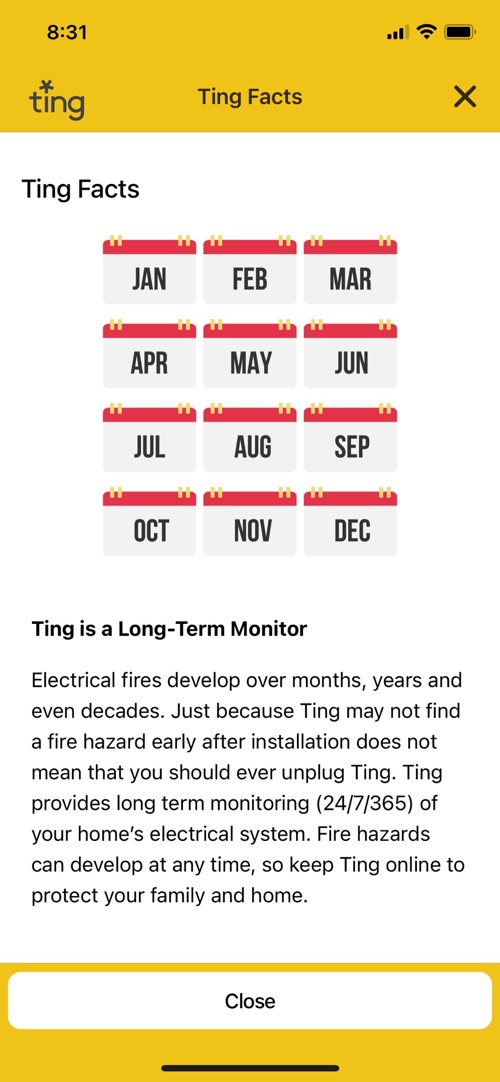
My experience. Enrollment was quick and easy, and the sensor arrived from Ting within a few days. Installation was also quick and easy; just install the app and everything is done via Bluetooth and WiFi within a couple of minutes. Right now, it is is “learning mode” and analyzing my home’s electrical wiring. It will be reassuring to know that there is no obvious electrical fire hazard lurking in my (old) home.

45 Years of the Vanguard S&P 500 Index Fund: The Power of Low Costs

Just over 45 years ago on August 31st, 1976, the late Jack Bogle started the first index mutual fund at Vanguard. It nearly didn’t get off the ground, garnering only 7% of the initial funding goal – it wasn’t even enough to buy shares of all the stocks in the S&P 500! Read Bogle’s own take from exactly 10 years ago at this 9/3/2011 WSJ article to better appreciate it took determination and stubbornness to make this happen.

Industry leaders mocked “Bogle’s folly”, wondering aloud why anyone would voluntarily agree to be “just average”. Well, Bogle had common sense and simple math on his side. He knew that over time, his fund was guaranteed to be above average due to it’s low costs. Some active mutual funds would outperform for a while, sure, but would there be reliable persistence in those superior returns? It turns out, very little. These days, people worry more about too much index fund investment.

Over time, more and more investors have realized the power of low costs. They are running away from high-cost funds. Morningstar just released it 2020 U.S. Fund Fee Study (free with registration). From the Executive Summary:

The average expense ratio paid by fund investors is half of what it was two decades ago. Between 2000 and 2020, the asset-weighted average fee fell to 0.41% from 0.93%. Investors have saved billions as a result.

(Thank you, Mr. Bogle.)

This chart shows the new investments flows into the cheapest 20% of funds (blue) against the remaining 80% (red) over the last 20 years:

Morningstar research has demonstrated that fees are a reliable predictor of future returns. Low-cost funds generally have greater odds of surviving and outperforming their more-expensive peers. […] Since 2000, net flows into funds charging fees that rank within the cheapest 20% of their Morningstar Category group have trended higher. Flows for the remaining 80% of funds have been negative in nine of the past 10 years.

Vanguard and it’s dirt-cheap index clones are winning. If you look closer, it’s the really low-cost funds that are gathering the most new investment. These are mostly the big names that have started competing directly with Vanguard on cost – iShares, Schwab, Fidelity, SPDR.

Of the $445 billion that flowed into the cheapest 20% of funds and share classes in 2020, nearly all of it went into the cheapest of the cheap, as 93% of net new money flowed into the least costly 5% of all funds.

Investors voted with their money. Follow this trend and continue to effect change with your investment choices. Look for a low-cost fund option in your 401k, and ask why if you don’t see it.

American Express Membership Rewards: Airline and Hotel Points Transfer Bonuses, Up to 40%

If you have collected a nice stash of Membership Rewards (MR) points from American Express, you may want to log into your account and check out the many new transfer bonuses available to their airline and hotel partners. Waiting for one of these limited-time transfer promotions is a good way to maximize the value of your AmEx MR points. Note that these transfers are not reversible. Some offers expire September 30th, while others are marked October 31st.

Airlines

  • British Airways: 40% Bonus. 1,000 MR points = 1,400 Avios.
  • Hawaiian Airlines: 25% Bonus. 1,000 MR points = 1,300 Virgin points.
  • Aer Lingus: 40% Bonus. 1,000 MR points = 1,400 Avios.
  • Iberia: 40% Bonus. 1,000 MR points = 1,400 Avios.
  • Air Canada: 20% Bonus. 1,000 MR points = 1,200 Aeroplan points.
  • Aeromexico: 25% Bonus. 1,000 MR points = 2,000 Premier points.
  • Air France/KLM Flying Blue: 25% Bonus. 1,000 MR points = 1,250 Flying Blue miles.
  • Avianca / Lifemiles: 15% Bonus. 1,000 MR points = 1,150 LifeMiles.
  • Virgin Atlantic: 30% Bonus. 1,000 MR points = 1,300 Virgin points.
  • Qantas: 30% Bonus. 500 MR points = 600 Qantas points.

Hotels

  • Hilton Honors: 30% Bonus. 1,000 MR points = 2,600 Hilton points.
  • Marriott Bonvoy: 30% Bonus. 1,000 MR points = 1,300 Bonvoy points.

Airlines that are currently NOT offering a transfer bonus include Delta, ANA, Emirates, Etihad, and Singapore Airlines. Choice hotels are also not offering any bonuses at this time.

I’m not a big traveler these days, so I don’t have any of the Gold or Platinum cards right now, even though they are offering big bonuses. I do keep one consumer AmEx and one business AmEx that earns Membership Rewards points, both with no annual fee.

  • The Amex EveryDay Card doesn’t see a lot of use, but it keeps my Membership Rewards points active with no annual fee and helps qualify for various Amazon promotions.
  • The Blue Business Plus from American Express does see a lot of action as my primary small business card, as it earns 2X Membership Rewards points on all purchases on up to $50,000/year with no annual fee. I can always transfer to Delta Skymiles which at least knock off 1 cent per mile off a Delta ticket, which means a MR points is at least worth 1 cent minimum for my situation. Too bad Delta is not participating this time.