Archives for July 2021

This Becky Quick Quote Sums Up the Buffett and Munger Partnership

After finishing up the 4-part CNBC Squawk Podcast containing the full “Wealth of Wisdom” interview with Warren Buffett and Charlie Munger, the journalist Becky Quick summed up the essence of their 60-year friendship and partnership (emphasis mine):

It’s not a complicated lesson, it’s probably just one we don’t sit on and reflect upon often enough. You should surround yourself with people who inspire you, and people you don’t want to disappoint. That’s what it’s all about, right? Making sure we are all our best selves. It’s such a universal truth. All of us can look at the relationships we’ve had over the years, and what inspires you to do better? It’s really those people who put faith in you, and wow, you don’t want to let them down.

Definitely something to reflect upon.

I enjoy all of these CNBC interviews with Becky Quick – you can see that she has a comfortable and respectful relationship with them, while still pressing them for clarity on certain issues. As soon as the interview officially ends, Becky Quick lets out a laugh and remarks:

You’d rather be in jail… than work at a corporation!?!”

Technically, Warren Buffet says he would rather be in jail with some interesting people and a good pile of books… rather than micro-managing the daily activities and hundred of employees of Berkshire subsidiaries. I get your point, Warren! 👍

Creating a 10-Year Backup Plan For (Post) Early Retirement

My contrarian thought of the day? I feel that the retirement planning industry downplays the role of luck. Life is not a as certain as the smooth exponential curves that they show you. Perhaps the statistically optimal bet is to jump a bit early and hope for the best, while having a backup plan for the worst. You might just win an extra 10 years of freedom.

If you tinker with portfolio survival calculators like FireCalc and cFIREsim that model hundreds of possible paths, you may notice that the “failure” paths usually happen when a bear market occurs soon after you retire. If you keep spending when a portfolio is down, it may never recover.

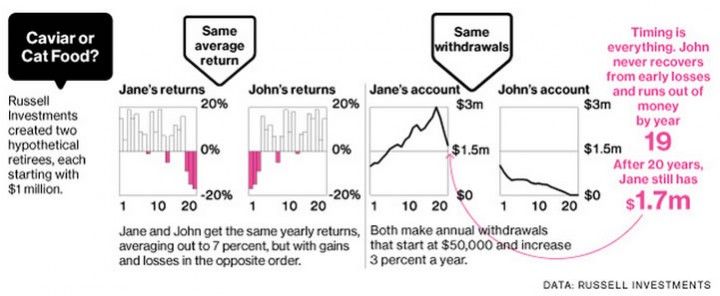
Even if you have the same portfolio size, same withdrawals, and the same average returns, having the bad years occur upfront can lead to failure while having the bad years at the end can lead to success. This is known as sequence of returns risk.

sor_risk

Retiring in 2000 with a 4% withdrawal rate: Warning! 🚨🚨🚨 In 2021, most people happily accept that the stock market just goes up and up. However, every so often there will be a “lost decade”. If you retired in 2000 with a portfolio invested in the S&P 500 and used a 4% withdrawal rate (increasing each year by 3% for inflation), here’s how that would have looked like (yellow line):

Retiring in 2010 with a 4% withdrawal rate: More money than you started with. 💰💰💰 If you have solid returns upfront, then you gained a decade of priceless freedom! For retirees of the “Class of 2011”, consider that their portfolio is likely larger today in 2021 even after a decade of withdrawals.

Retiring in 2021? Crystal ball is cloudy. If you are in the retirement “Class of 2021”, many predictions call for another lost decade. Yet, even if the next 10 years have poor returns, better times may be right around the corner. From this article by Davis Advisors:

Though frustrating, stretches of disappointing results for the market are not unprecedented. History shows however, that these difficult stretches have been followed by periods of recovery. Why? Because lower prices increase future returns. – Christopher Davis

This article was written in 2012, and it turns out that Davis was right. As of Q2 2021, the trailing 10-year annual return of the S&P 500 is over 12% annualized. Here is a chart showing the subsequent 10-year performance after each past “lost decade of stock returns”.

Surviving the first 10 years of retirement. The lesson here is to avoid taking out big withdrawals during a stock market slump drop during the first 10 years, so that it can benefit from the rebound of the next 10 years. At the same time, you don’t want give up the chance of 10 extra years of freedom. Therefore, perhaps the best bet is to retire when you have a reached your chosen savings target (for example, 25 times annual expenses), but also maintain a detailed backup plan during the first 10 years. Here are some things you might include in that plan:

  • Plan ahead for way that you can temporarily cut back on spending if you need to. Big to small. For example, plan to move to a lower-cost city, country, or housing option.
  • Identify non-essential assets that you will sell if you need to. Vacation property, etc.
  • Maintain employment opportunities in your current career field. Go back to part-time, freelance, consulting, etc.
  • Have alternative employment plans in a different career field to create supplemental income.

(By “plan”, I mean written out on a piece of paper. This improves the clarity of your thinking.)

The most powerful way to counter “sequence of returns risk” is variable withdrawals – a fancy term for the brilliant idea of not taking out as much money from your portfolio when it is getting beaten down. But the first 10 years is the most important, and the first 10 years is probably the easiest to go back to the workforce in a limited capacity.

Bottom line. Deciding when to stop working can be a difficult, personality-driven decision, but one option is to retiring with 95-98% odds of success with a practical backup plan, rather than waiting several more years and reaching 99.5% odds of success. Accept that luck matters (and also that you might have to go back to work). However, you also might gain extra priceless years of freedom. Life is never 100% certain anyway.

PFS Buyers Club: New US Mint Coin Arbitrage Opportunity ($300+ Net Profit, July 2021)

New deal July 29th, 2021. The US Mint regularly releases limited-edition coins to collectors. The coin sets are often limited to one per household, but end up worth more than the initial cost. PFS Buyers Club is a website broker that recruits regular folks to buy their allotted coin set with a set markup amount, with the agreement that they will sell only to PFS Buyers Club. For example, you might pay $300 for a coin and they’ll agree to pay you $350 for it – a fixed profit of $50.

On Thursday, July 29th at 12:00 pm Noon Eastern Time, there is a new guaranteed profit opportunity. A limited edition American Eagle Four-Coin Set will be released then, with a purchase limit of one per household. The cost of the Four-Coin Set should be either $4,962.50 or $5,055.00 (depends on the spot price of Gold on 7/28). Shipping will cost $4.95.

PFS will pay you a fixed commission of $200.05 for each Four-Coin Set, on top of your cost for the set.

You’ll also earn credit card rewards on your ~$5,000 purchase (worth another ~$100 here at 2% cash back), or also possibly satisfying the requirements for some $500+ value credit card bonuses. This makes the total net profit safely over $300.

Note that the eventual value of the set may exceed that elsewhere – you may be able to get more than $200 extra for each coin on eBay, for example – but if you want to make that bet, don’t promise to sell to PFS Buyers Club. Just buy it on your own and try to sell it yourself. Keep in mind that eBay seller fees can be quite high, and you’ll be responsible for other costs like the proper shipping with adequate insurance. PFS Buyers Club will send you a free prepaid mailing label (including insurance) and pay you via eCheck, paper check, or PayPal.

My past experience. I used PFS back in March for the first time, and everything went smoothly and I was paid my money in full without issue. The amount of communication was great and better than expected; I was kept up-to-date every step of the way. The total time commitment was about 30 minutes for $400+ profit, including the stop at the Fedex store to drop off the box with prepaid label. The eCheck option worked great – I printed the check out at home and deposited immediately via mobile app. PFS has a very solid reputation online, and I referred several blog readers last time and did not receive a single complaint. (Some folks were unable to buy the coins from the US Mint before it went out of stock.)

Here is the product page: American Eagle 2021 Gold Proof Four-Coin Set. Here is a direct quote of the deal text:

On July 29th – at 12:00PM ET, the US Mint will be releasing a limited edition American Eagle Four-Coin Set. The set has a purchase limit of one per household, so you’re able to buy one set.

The cost of the Four-Coin Set should be either $4,962.50 or $5,055.00. (The Mint will only be releasing the exact price for these products on Wednesday the 28th, and it will depend on the spot price of Gold over the day.)

Each purchase will also have a $4.95 shipping charge.

You will have each order shipped to your own house or office and then ship it to PFS Buyers Club with a prepaid shipping label that we will provide for you.

PFS will be offering a commission of $200.05 for each Four-Coin Set.

This is also a great opportunity to earn valuable points/miles on your credit cards, as well as meet any spending thresholds.

If you want to jump on this, you can sign up to join PFS Buyers Club here. Sometimes these deals fill up, so I would sign-up and opt-in sooner rather than later. You can still opt out of the deal until an hour prior to the coins going on sale. They will provide very detailed instructions. Follow them carefully, and it was pretty easy for me as a first-time buyer. If you use that link, I will receive a referral fee the first time you successfully sell your coin for a profit. Thanks for those that use it, and for those that already used it last time! I will be opting in myself as well.

529 College Savings Plan Flexibility: My529 Sends Money To All 50 States

My quarterly statement told me that the My529 plan (formerly Utah Educational Savings Plan) has been around for 25 years now, and included the map above which has dots from all the different places that they have directly sent withdrawals. All 50 states are covered. This is good reminder to examine the flexible options that 529 plans provide, many of which were added relatively recently:

  • Save and invest using the 529 plan custodian from any state. You don’t need to use the 529 plan from your home state (although you might get a tax break if you do – see below).
  • Easy to accept outside gifts directly into your 529 balance. Just as people like to use gift cards instead of cash, it can be easier to ask for a gift directly to your child’s 529 plan instead of the latest YouTube-fueled toy. You can often just send a link and the money goes directly into your 529.
  • Many investment options. You can choose an auto-pilot investment similar to a target-date fund (TDF), or you can mange your own glide path using a mix of active and/or passive index mutual funds. You can even stay super-conservative and invest in stable value funds or bank CDs.
  • Spend in any state. You don’t need to use the money towards a college in your home state.
  • Spend at a variety of educational options. 529 funds can be used at universities, colleges, certain overseas/international programs, trade and technical schools, apprenticeships, continuing education for adults, or K-12 private tuition.
  • Spend beyond tuition. 529 funds can be used toward room, board, fees, books, computers, supplies and equipment that are required by those educational institutions.
  • Scholarship exemption. If you end up receiving a scholarship, you can withdraw that amount from the 529 without paying the 10% penalty (normal income taxes on gains will still apply if not used towards qualified educational expenses).
  • Spend on student loans. 529 funds can be used toward the principal or interest on qualified student loans (up to $10,000 lifetime maximum for the designated beneficiary and each of their siblings).
  • Change beneficiaries. You can easily transfer 529 funds to another beneficiary, for example a sibling, nephew/niece, or even yourself. You can transfer funds from one 529 custodian to another.
  • Save for the next generation. With any leftover amount, you can even change the beneficiary to the next generation (grandchild), although it would be considered a gift for tax purposes. Still, even a small upfront gift can to a big number if left to grow for decades.

My eldest child is 8 years old, so that means I’ve been contributing to her 529 plan for 8 years, and she’ll be making withdrawals in perhaps only 10 more years! Many fintech startups are offering custodial brokerage accounts now, and while I do think there is a teaching opportunity there when she’s a teenager, until then I only plan on funding the 529 account. The investments grow tax-free, adjust automatically with age, don’t create any tax reporting hassles, and are flexible enough for my expectations. By starting early, the tax-free growth benefit can potentially save thousands of dollars in taxes.

More 529-related posts:

USDC Stablecoin Reserves Breakdown July 2021

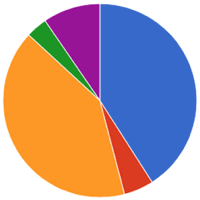
For those following stablecoin, Centre (founded by Circle) has released another breakdown of USDC reserves as of July 16, 2021. The accounting firm Grant Thornton attests that the total fair value of US dollar denominated assets held in segregated accounts are at least equal to the now $22.2 billion of USDC in circulation. Here is their breakdown of the reserves:

I honestly don’t see why they don’t just keep it all in cash. If they maintain the highest level of trust, they can make so much money elsewhere. Yet, while I am not a fan of seeing the 9% in commercial paper and 5% in corporate bonds, this breakdown is much better than Tether (USDT) reserves breakdown. Tether reported only 3% in cash and 65% in commercial paper, which would make it one of the the largest commercial paper holders in the world, yet nobody has any idea whose paper they own! I’m disappointed in USDC, but I would never actually own USDT.

Bloomberg’s Matt Levine has observed that “most of what actually happens with Bitcoin is about rediscovering financial history and re-creating the traditional financial system from scratch.” The same goes for stablecoin deposits, as we are seeing banking without FDIC insurance to even the playing field amongst big and small banks (and protect individual depositors). As in the past, since there is the chance of a “bank failure” and/or fraud, people demand higher interest for higher risk, while the safer places can get away with paying less interest. Consider the current interest rates on USDC deposits:

Although if we keep following that history model, then at some point there will be a stablecoin crisis where some portion of folks will lose money, leading to much tighter regulations about maintaining reserves, etc.

The poor transparency about stablecoin reserves and the lack of FDIC-insurance are why I don’t list these APYs in my monthly updates on the best rates on cash. You must perform your own due diligence on stablecoin risks.

The Blue Business® Plus Credit Card from American Express Review: 2X Points on Purchases Up to $50k/Year + 0% Intro APR Welcome Offer

card_name

card_name is a business rewards card that features double Membership Rewards points. Therefore, if you can redeem for more than 1 cent per point of value, this card has the potential to beat a flat 2% cash back card. This is currently my primary business credit card.

  • Earn 15,000 Membership Rewards(R) points after you spend $3,000 in eligible purchases on the Card within your first 3 months of Card Membership.
  • 0% intro APR on purchases for 12 months from the date of account opening, then reg_apr,reg_apr_type, based on your creditworthiness and other factors as determined at the time of account opening. APRs will not exceed 29.99%.
  • 2X Membership Rewards points on the first $50,000 in purchases each year. 1 point per dollar thereafter. Terms and limitations apply.
  • No annual fee. (See Rates and Fees)
  • Terms Apply.

Better than 2% cash back? Membership Rewards points can be converted to the following airline miles (there are more, this is just a selection):

  • Delta SkyMiles
  • Hawaiian Airlines
  • ANA Mileage Club (partner of United Airlines)
  • Air Canada (partner of United Airlines)
  • British Airways (partner of American Airlines)
  • FlyingBlue (Air France/KLM)
  • Virgin Atlantic
  • Virgin America

If you value any of these miles at more than 1 cent per mile, then you would be getting more value than a 2% cash back card. You also add the ability to keep all your Membership Rewards points active.

My backup redemption plan. This card can earn the equivalent of 2 Delta miles per dollar spent. Delta has a “Pay with Miles” option that lets me get 1 cent of Delta airfare for each Delta miles, I am always able to get 1 cent of value from 1 Membership Rewards point as I fly Delta regularly. Of course, I try to do better than that, but at least I have a backup plan to get 2% value back.

Unfortunately, there are many redemption options for Membership Rewards points that are worse than 1 cent per point value. Here are a few examples:

  • Shop with Membership Rewards Points (~0.5 cents per point)
  • Shop with Points at Amazon.com (~0.7 cents per point)
  • Use points at BestBuy.com (~0.7 cents per point)
  • Gift Cards (varies from 0.5 up to 1 cent per point). For example, I have redeemed 10,000 points for a $100 Home Depot gift card recently.

If you don’t expect to get at least 1 cent per mile value, then you should stick with a 2% cash back card.

Business credit card eligibility. Many people aren’t aware that they can apply for business credit cards, even if they are not a corporation or LLC. Any individual can be a small business. Perhaps you sell items on eBay, Craiglist, or Etsy. Maybe you do some graphic design, web design, freelancing and/or consulting. If you received a 1099-MISC tax form and filled out a Schedule C, that means you have business income, you pay self-employment taxes, and you’re a sole proprietorship. This is the simplest business entity, but it is fully legit and recognized by the IRS. On a business credit card application, you should use your own legal name as the business name, and your Social Security Number as the Tax ID.

This card will require you to personally guarantee that you’ll pay them back what you charge on the card, which means they’ll check your personal credit score like any other consumer card. However, as the card is a business card, American Express won’t have it show up on your personal credit report, so it won’t change things like your credit limits, average account age, or credit utilization ratio.

Bottom line. card_name is a unique small business card in that it earn 2X Membership Rewards points on purchases up to $50,000 per year with no annual fee. The ability to transfer to miles means that you’re effectively earning 2X miles per dollar spent with no annual fee. Finally, linking this card also allows you keep Membership Rewards points earned from other cards active while having no annual fee. (See Rates and Fees)

Summer of Dashpass 2021 Deals + New Chase Co-Branded $10 Doordash Credit

Doordash is running their Summer of Dashpass promotion again this year, with weekly deals from 7/20 through 9/6. First, Dashpass members will get an extra $10 in savings each week during this period. There will be a themed promotion each week:

  • July 20–26: Free cheese or pepperoni ExtraMostBestest® pizza with a Little Caesars order $20+ with code CAESARS.
  • July 27 — August 2: $10 off any Pickup order of $20+ with code HUNGRY.
  • August 3–9: $10 off a gift order of $20+ using code FRIENDLY.
  • August 10–16: Eligible DashPass members (21 yrs+) can get $10 off an alcohol order of $40+ with code THIRSTY (where available).
  • August 17–23: $10 off an order of $20+ on any Convenience or DashMart order using the code SNACKY.
  • August 24–30: $10 off any pet supply order of $20 or more using the code FLUFFY.
  • August 31 — September 6: $10 off grocery orders of $25+ using the code EASY.

DashPass is a subscription service that offers a $0 delivery fee and reduced service fees when ordering $12 or more from any DashPass-eligible restaurant (look for the checkmark), as well as 5% back on Pickup orders. The regular price is $9.99/month.

Up to 12 months of free Dashpass membership is included with many Chase credit cards, including co-branded cards, and they are throwing in an additional $10 Doordash credit to those co-branded cards on your next purchase by 9/30 if you register/add your card here. Note that after those free 12 months, you’ll automatically be charged $9.99/month for continued membership unless you cancel DashPass. Eligible co-branded cards include:

If you have a Chase Sapphire Reserve or Sapphire Preferred credit card, you can also get free DashPass benefits on eligible orders for at least 12 months (and a maximum of 24 months) after activation. Sapphire Reserve cardholders also get $60 in statement credits towards DoorDash in 2021.

If you have a Chase Freedom or Slate credit card, you can free DashPass benefits on eligible orders for 3 months after activation. After the first 3 months, the user will be auto-enrolled for the next 9 months in DashPass with a 50% discount applied to the then current membership rate. You can cancel at any time.

If you are new customer to DoorDash and sign up via my DoorDash referral link, you will get $10 off your first 3 DoorDash orders over $15 ($30 total savings). I will get food credits as well. Thanks if you use it!

MMB Portfolio Update July 2021: Dividend and Interest Income

dividendmono225

While my July 2021 portfolio asset allocation is designed for total return, I also track the income produced quarterly. Stock dividends are the portion of profits that businesses have decided they don’t need to reinvest into their business. The dividends may suffer some short-term drops, but over the long run they have grown faster than inflation. Here is the historical growth of the S&P 500 absolute dividend, updated as of 2021 Q2 (source):

This means that if you owned enough of the S&P 500 to produce an annual dividend income of about $13,000 a year in 1999, then today those same shares would be worth a lot more AND your annual dividend income would have increased to $50,000 a year, even if you spent all that dividend income every year.

I track the “TTM” or “12-Month Yield” from Morningstar, which is the sum of the trailing 12 months of interest and dividend payments divided by the last month’s ending share price (NAV) plus any capital gains distributed over the same period. I prefer this measure because it is based on historical distributions and not a forecast. Below is a rough approximation of my portfolio (2/3rd stocks and 1/3rd bonds).

Asset Class / Fund % of Portfolio Trailing 12-Month Yield (Taken 7/19/21) Yield Contribution
US Total Stock
Vanguard Total Stock Market Fund (VTI, VTSAX)
25% 1.26% 0.36%
US Small Value
Vanguard Small-Cap Value ETF (VBR)
5% 1.60% 0.08%
International Total Stock
Vanguard Total International Stock Market Fund (VXUS, VTIAX)
25% 2.44% 0.53%
Emerging Markets
Vanguard Emerging Markets ETF (VWO)
5% 1.98% 0.09%
US Real Estate
Vanguard REIT Index Fund (VNQ, VGSLX)
6% 2.34% 0.24%
Intermediate-Term High Quality Bonds
Vanguard Intermediate-Term Treasury ETF (VGIT)
17% 1.26% 0.26%
Inflation-Linked Treasury Bonds
Vanguard Short-Term Inflation-Protected Securities ETF (VTIP)
17% 1.35% 0.20%
Totals 100% 1.69%


Trailing 12-month yield history. Here is a chart showing how this 12-month trailing income rate has varied since I started tracking it in 2014.

Portfolio value reality check. One of the things I like about using this number is that when stock prices drop, this percentage metric usually goes up – which makes me feel better in a bear market. When stock prices go up, this percentage metric usually goes down, which keeps me from getting too euphoric during a bull market.

Here’s a related quote from Jack Bogle (source):

The true investor… will do better if he forgets about the stock market and pays attention to his dividend returns and to the operating results of his companies.

Absolute dividend income history. It was more difficult to track the absolute income produced as I’d have to remove the effect of additional investments, reinvestment of dividends and interest, rebalancing, and capital gains distributions. To get a general idea, I looked at the Vanguard LifeStrategy Growth Fund (VASGX) to see what kind of income that $1 million back in 2014 would have generated up until today. This is not exactly my portfolio, but is somewhat close at a steady 80% stock/20% bond ratio with some international stock exposure. For example, it’s current 12-month yield is 1.59%.

During 2014, VASGX distributed about $0.61 of income per share, at an average price about $29 per share. That’s a yield of about 2.1%. So $1,000,000 of VASGX in 2014 would have distributed about $21,000 of annual income (about 34,482 shares).

Those same 34,482 shares would be worth about $1,510,000 currently (as of 7/16/2021 at $43.79 per share). In 2018, the income produced was roughly $27,500 a year (80 cents per share). In 2019, the income produced was $29,000 a year (84 cents per share). In 2020, the income produced was $23,000 a year (67 cents per share ).

Putting it all together. This quarter’s trailing income yield of 1.69% is the lowest ever since 2014. It is almost exactly 1% lower than what it was in late 2018. At the same time, both the portfolio value and the absolute income produced is higher than in 2014. If you retired back in 2014 and have been living off your stock/bond portfolio, you’ve been doing fine.

However, this is not necessarily good news going forward. There are countless articles debating this topic, but I historically support a 3% withdrawal rate as a reasonable target for planning purposes if you want to retire young (before age 50) and a 4% withdrawal rate as a reasonable target if retiring at a more traditional age (closer to 65). However, nobody is guaranteeing these numbers and flexibility may be required to make your portfolio reliably last a long time.

If you are not close to retirement, there is not much use worrying about these decimal points. Your time is better spent focusing on earning potential via better career moves, improving in your skillset, and/or looking for entrepreneurial opportunities where you can have an ownership interest.

How we handle this income. Our dividends and interest income are not automatically reinvested. I treat this money as part of our “paycheck”. Then, as with a traditional paycheck, we can choose to either spend it or invest it again. Even if still working, you could use this money to cut back working hours, pursue new interests, start a new business, travel, perform charity or volunteer work, and so on.

MMB Portfolio Update July 2021: Asset Allocation & Performance

portpie_blank200

Here’s my quarterly update on my current investment holdings as of July 2021, including our 401k/403b/IRAs, taxable brokerage accounts, and savings bonds but excluding our house, cash reserves, and a small portfolio of self-directed investments. Following the concept of skin in the game, the following is not a recommendation, but a real-world example of a mostly low-cost, diversified, simple DIY portfolio with a few customized tweaks. The goal of this portfolio is to create sustainable income that keeps up with inflation to cover our household expenses.

Actual Asset Allocation and Holdings
I use both Personal Capital and a custom Google Spreadsheet to track my investment holdings. The Personal Capital financial tracking app (free, my review) automatically logs into my different accounts, adds up my various balances, tracks my performance, and calculates my overall asset allocation. Once a quarter, I also update my manual Google Spreadsheet (free, instructions) because it helps me calculate how much I need in each asset class to rebalance back towards my target asset allocation.

Here are updated performance and asset allocation charts, per the “Allocation” and “Holdings” tabs of my Personal Capital account, respectively:

Stock Holdings
Vanguard Total Stock Market (VTI, VTSAX)
Vanguard Total International Stock Market (VXUS, VTIAX)
Vanguard Small Value (VBR)
Vanguard Emerging Markets (VWO)
Vanguard REIT Index (VNQ, VGSLX)

Bond Holdings
Vanguard Limited-Term Tax-Exempt (VMLTX, VMLUX)
Vanguard Intermediate-Term Tax-Exempt (VWITX, VWIUX)
Vanguard Intermediate-Term Treasury (VFITX, VFIUX)
Vanguard Inflation-Protected Securities (VIPSX, VAIPX)
Fidelity Inflation-Protected Bond Index (FIPDX)
iShares Barclays TIPS Bond (TIP)
Individual TIPS bonds
U.S. Savings Bonds (Series I)

Target Asset Allocation. I do not spend a lot of time backtesting various model portfolios, as I don’t think picking through the details of the recent past will necessarily create superior future returns. Usually, whatever model portfolio is popular in the moment just happens to hold the asset class that has been the hottest recently as well.

I believe in the importance of doing your own research and owning productive assets in which you have strong faith. Every asset class will eventually have a low period, and you must have strong faith during these periods to truly make your money. You have to keep owning and buying more stocks through the stock market crashes. You have to maintain and even buy more rental properties during a housing crunch, etc.

Personally, I try to own broad, low-cost exposure to asset classes that will provide long-term returns above inflation, distribute income via dividends and interest, and finally offer some historical tendencies to balance each other out. I have faith in the long-term benefit of owning publicly-traded US and international shares of businesses as well as high-quality US federal and municipal debt. I also own real estate through REITs.

Again, personally, I simply don’t have strong faith in the long-term results of commodities, gold, or bitcoin. I own my own house, but I choose not to participate in the higher potential gains but also higher potential risks (of both requiring more time and money) of rental real estate.

My US/international ratio floats with the total world market cap breakdown, currently at ~58% US and 42% ex-US. I’m fine with a slight home bias (owning more US stocks than the overall world market cap), but I want to avoid having an international bias.

Stocks Breakdown

  • 43% US Total Market
  • 7% US Small-Cap Value
  • 33% International Total Market
  • 7% Emerging Markets
  • 10% US Real Estate (REIT)

Bonds Breakdown

  • 33% High-Quality Nominal bonds, US Treasury or FDIC-insured
  • 33% High-Quality Municipal Bonds
  • 33% US Treasury Inflation-Protected Bonds

I have settled into a long-term target ratio of 67% stocks and 33% bonds (2:1 ratio) within our investment strategy of buy, hold, and occasionally rebalance. I use the dividends and interest to rebalance whenever possible in order to avoid taxable gains. I plan to only manually rebalance past that if the stock/bond ratio is still off by more than 5% (i.e. less than 62% stocks, greater than 72% stocks). With a self-managed, simple portfolio of low-cost funds, we can minimize management fees, commissions, and taxes.

Holdings commentary. The world seems to have stabilized since the March 2020 market drop and overall panic, but I try not to get too attached to these numbers. They seem too good to be true, even as things continue to open up. All I can do is listen to the late Jack Bogle and “stay the course”. I remain optimistic that capitalism, human ingenuity, human resilience, human compassion, and our system of laws will continue to improve things over time.

I would like to note that when few people were paying attention, TIPS have had a pretty good run for an insurance-like investment. The iShares TIPS ETF (TIP) went up 8.3% in 2019 and 10.9% in 2020. The 10-year breakeven inflation rate between TIPS and Treasury is currently about 2.3%. I’m still happy owning a chunk of my bonds as TIPS.

Performance numbers. According to Personal Capital, my portfolio is up +9.4% for 2021 YTD. I rolled my own benchmark for my portfolio using 50% Vanguard LifeStrategy Growth Fund and 50% Vanguard LifeStrategy Moderate Growth Fund – one is 60/40 and the other is 80/20 so it also works out to 70% stocks and 30% bonds. That benchmark would have a total return of +8.2% for 2021 YTD as of 7/18/2021.

I’ll share about more about the income aspect in a separate post.

Class Action Settlement Websites: The Consumer Safety Benefit

picture of gavel, https://meta.wikimedia.org/wiki/File:Legal_Gavel_(27571702173).jpgThere are multiple websites that help publicize and decipher class action lawsuit settlements for consumers. Here are just a few that look the most comprehensive:

These are privately-run websites and I wouldn’t give them your personal information or payment details, but they can be very useful for research purposes as the official lawsuit websites are often hard to understand. They can help sort through the legalese and help you understand your eligibility status and the requirements for filing a claim.

In addition, scanning them regularly can even help you protect you and your family. Today I stumbled across a banner ad regarding a Benefiber class action settlement. (I try to consume a lot of fiber in general, including Benefiber…) While researching this settlement on TopClassActions.com, I ran across news of a class action lawsuit against Philips CPAP machines. One of my children uses a Philips CPAP, and it turns out that in June, Philips somewhat quietly recalled their CPAP machines due to a defect which could release carcinogenic materials into their lungs (!). Philips never contacted me directly and I would not have found out about this otherwise.

Philips issued a voluntary recall of some of its CPAP machines and ventilators over concerns the PE-PUR sound abatement foam could degrade and become toxic, and potentially cause cancer.

When the foam deteriorates, tiny particles and gases may be inhaled or ingested. CPAP users may experience chemical exposure and develop health issues such as headache, hypersensitivity, irritation, nausea, vomiting, and potential carcinogenic effects.

I checked the serial numbers and our machine is affected. I have filed a claim and they now promise to (eventually) repair or provide me with a new CPAP machine without the defect. No timeline is provided at all.

I know that class action lawsuits are often criticized for being rather frivolous, arguing about terms like “natural” and “healthy” and whatnot, but in this case this website and the lawsuit provided me a real service. I doubt Philips is excited about shipping thousands of new replacement CPAP machines which can cost over $1,000 each. Philips is thus incentivized to be as quiet as possible about this recall. However, in the case of a class action lawsuit, they are incentivized to publicize it in order to find affected consumers like myself. Unfortunately, sometimes it takes some bad publicity to speed up remedial action. I hope that Philips does right by their customers and provides a replacement quickly. Check out the sites and you may learn about products you use that affect your own health and/or safety.

Bottom line. Scanning class action lawsuit websites periodically can help you come across important food and other safety issues that aren’t well-publicized.

Buffett & Munger Wealth of Wisdom on CNBC: Full Video and Transcript

Update: Apparently there was a lot of the interview that wasn’t shown in the CNBC video below, but is being released in a four part series on their podcast, Squawk Pod. Let me know if you find a transcript.

Original post:

For the Buffett and Munger fans out there, Becky Quick had another CNBC special interview with the pair about their longtime friendship and partnership, called Buffett & Munger: A Wealth of Wisdom on June 29th, 2021. Thankfully, you can watch the full video online and/or read the full text transcript.

All in all, this interview didn’t offer a lot of new insights if you already listened to the 2021 Berkshire Hathaway shareholder meeting and 2021 Daily Journal shareholder meeting (Robinhood still promotes gambling and Bitcoin is still a delusion), but it did provide a little more background into their personal histories.

Here is my single favorite quote from the interview (emphasis mine):

BUFFETT: And we’re still doing it, yeah. We made a lot of money. But what we really wanted was independence. And we have had the ability since pretty much a little after we met financially we could associate with people who we wanted to associate with. And if we had, if we associated with jerks, that was our problem. But we didn’t have to. We’ve had that luxury now for, you know, 60 years or close to it. And, and that beats 25-room houses and, you know, six cars or that stuff is, what really is great is if you can do what you want to do in life and associate with the people you want to associate with in life. And, now, it, it’s and, and we both had that, that spirit all the way through.

These two friends may be famous because they are rich, but they are happy because they are able to spend their time with people that they enjoy.

Buffett and Munger explicitly wanted to get rich, so they could be independent. True freedom is the ability to control how you spend your time. But that usually takes a certain amount of money, so we have the term “financial freedom”.

I think it’s okay to say “I want accumulate a lot of money for the next X months or years”, especially if you’re in debt. As Munger has also stated, the first $100,000 is the hardest. If you really want independence quickly, then you need to embrace some pain and sacrifice to earn your freedom. This is why I try not to criticize anyone taking “extreme” measures to improve their savings rate. Some people are willing to endure a very spartan lifestyle for independence sooner, while others aren’t, or they may have a higher income and not need to give up much.

At the same time, after reaching a certain level of financial stability, we then need to figure how what game we really want to play with our limited time on this planet, beyond simply buying more luxurious stuff. Buffett enjoyed the game of capital allocation and accumulating more dollars; that was his idea of fun. He even had a partner to play the game with him. For most people, I think continuing to make more money involves more stress and hard work.

Best Interest Rates on Cash – July 2021 Update

Here’s my monthly roundup of the best interest rates on cash as of July 2021, roughly sorted from shortest to longest maturities. You will find lesser-known opportunities to earn 3% APY and higher while still keeping your principal FDIC-insured or equivalent. Check out my Ultimate Rate-Chaser Calculator to see how much extra interest you’d earn by moving money between accounts. Rates listed are available to everyone nationwide. Rates checked as of 7/13/2021.

Fintech accounts
Available only to individual investors, fintech companies often pay higher-than-market rates in order to achieve fast short-term growth (often using venture capital). I define “fintech” as a software layer on top of a different bank’s FDIC insurance. These do NOT require a certain number debit card purchases per month. Read about the types of due diligences you should do whenever opening a new bank account.

  • 3% APY on up to $100,000. The top rate is still 3% APY for July through September 2021 (actually up to 3.5% APY with their credit card), and they have not indicated any upcoming rate drop. HM Bradley requires a recurring direct deposit every month and a savings rate of at least 20%. See my HM Bradley review.
  • 3% APY on 10% of direct deposits + 1% APY on $25,000. One Finance lets you earn 3% APY on “auto-save” deposits (up to 10% of your direct deposit, up to $1,000 per month). Separately, they also pay 1% APY on up to another $25,000 with direct deposit. New customer $50 bonus via referral. See my One Finance review.
  • 3% APY on up to $15,000. Porte requires a one-time direct deposit of $1,000+ to open a savings account. New customer $100 bonus via referral. See my Porte review.
  • 1.20% APY on up to $50,000. OnJuno recently updated their rate tiers, while keeping their promise to existing customers with a grandfathered rate. If you don’t maintain a $500 direct deposit each month, you’ll still earn 1.20% on up to $5k. See my updated OnJuno review.

High-yield savings accounts
While the huge megabanks pay essentially no interest, it’s easy to open a new “piggy-back” savings account and simply move some funds over from your existing checking account. The interest rates on savings accounts can drop at any time, so I list the top rates as well as competitive rates from banks with a history of competitive rates. Some banks will bait you with a temporary top rate and then lower the rates in the hopes that you are too lazy to leave.

  • T-Mobile Money is still at 1.00% APY with no minimum balance requirements. The main focus is on the 4% APY on your first $3,000 of balances as a qualifying T-mobile customer plus other hoops, but the lesser-known perk is the 1% APY for everyone. Thanks to the readers who helped me understand this. There are several other established high-yield savings accounts at closer to 0.50% APY.

Short-term guaranteed rates (1 year and under)
A common question is what to do with a big pile of cash that you’re waiting to deploy shortly (just sold your house, just sold your business, legal settlement, inheritance). My usual advice is to keep things simple and take your time. If not a savings account, then put it in a flexible short-term CD under the FDIC limits until you have a plan.

  • No Penalty CDs offer a fixed interest rate that can never go down, but you can still take out your money (once) without any fees if you want to use it elsewhere. Marcus has a 7-month No Penalty CD at 0.45% APY with a $500 minimum deposit. Ally Bank has a 11-month No Penalty CD at 0.50% APY for all balance tiers. CIT Bank has a 11-month No Penalty CD at 0.30% APY with a $1,000 minimum deposit. You may wish to open multiple CDs in smaller increments for more flexibility.
  • CommunityWide Federal Credit Union has a 12-month CD at 0.85% APY ($1,000 min). Early withdrawal penalty is calculated as the amount of the withdrawal times the remaining term (days) of this certificate at the rate of 2 times the APR (divided by 365) paid on this certificate. Anyone can join this credit union via partner organization ($5 one-time fee).

Money market mutual funds + Ultra-short bond ETFs
Many brokerage firms that pay out very little interest on their default cash sweep funds (and keep the difference for themselves). Unfortunately, money market fund rates are very low across the board right now. Ultra-short bond funds are another possible alternative, but they are NOT FDIC-insured and may experience short-term losses at times. These numbers are just for reference, not a recommendation.

  • The default sweep option is the Vanguard Federal Money Market Fund which has an SEC yield of 0.01%. Vanguard Cash Reserves Federal Money Market Fund (formerly Prime Money Market) currently pays 0.01% SEC yield.
  • Vanguard Ultra-Short-Term Bond Fund currently pays 0.28% SEC yield ($3,000 min) and 0.38% SEC Yield ($50,000 min). The average duration is ~1 year, so your principal may vary a little bit.
  • The PIMCO Enhanced Short Maturity Active Bond ETF (MINT) has a 0.25% SEC yield and the iShares Short Maturity Bond ETF (NEAR) has a 0.36% SEC yield while holding a portfolio of investment-grade bonds with an average duration of ~6 months.

Treasury Bills and Ultra-short Treasury ETFs
Another option is to buy individual Treasury bills which come in a variety of maturities from 4-weeks to 52-weeks. You can also invest in ETFs that hold a rotating basket of short-term Treasury Bills for you, while charging a small management fee for doing so. T-bill interest is exempt from state and local income taxes. Right now, this section isn’t very interesting as T-Bills are yielding close to zero!

  • You can build your own T-Bill ladder at TreasuryDirect.gov or via a brokerage account with a bond desk like Vanguard and Fidelity. Here are the current Treasury Bill rates. As of 7/13/2021, a new 4-week T-Bill had the equivalent of 0.05% annualized interest and a 52-week T-Bill had the equivalent of 0.07% annualized interest.
  • The Goldman Sachs Access Treasury 0-1 Year ETF (GBIL) has a -0.09% SEC yield and the SPDR Bloomberg Barclays 1-3 Month T-Bill ETF (BIL) has a -0.12% (!) SEC yield. GBIL appears to have a slightly longer average maturity than BIL.

US Savings Bonds
Series I Savings Bonds offer rates that are linked to inflation and backed by the US government. You must hold them for at least a year. If you redeem them within 5 years there is a penalty of the last 3 months of interest. The annual purchase limit is $10,000 per Social Security Number, available online at TreasuryDirect.gov. You can also buy an additional $5,000 in paper I bonds using your tax refund with IRS Form 8888.

  • “I Bonds” bought between May 2021 and October 2021 will earn a 3.54% rate for the first six months. The rate of the subsequent 6-month period will be based on inflation again. More info here.
  • In mid-October 2021, the CPI will be announced and you will have a short period where you will have a very close estimate of the rate for the next 12 months. I will have another post up at that time.
  • See below about EE Bonds as a potential long-term bond alternative.

Prepaid Cards with Attached Savings Accounts
A small subset of prepaid debit cards have an “attached” FDIC-insured savings account with exceptionally high interest rates. The negatives are that balances are severely capped, and there are many fees that you must be careful to avoid (lest they eat up your interest). There is a long list of previous offers that have already disappeared with little notice. I don’t personally recommend nor use any of these anymore, as I feel the work required and risk of messing up exceeds any small potential benefit.

  • Mango Money pays 6% APY on up to $2,500, if you manage to jump through several hoops. Requirements include $1,500+ in “signature” purchases and a minimum balance of $25.00 at the end of the month.

Rewards checking accounts
These unique checking accounts pay above-average interest rates, but with unique risks. You have to jump through certain hoops which usually involve 10+ debit card purchases each cycle, a certain number of ACH/direct deposits, and/or a certain number of logins per month. If you make a mistake (or they judge that you did) you risk earning zero interest for that month. Some folks don’t mind the extra work and attention required, while others would rather not bother. Rates can also drop suddenly, leaving a “bait-and-switch” feeling.

  • The Bank of Denver pays 2.00% APY on up to $25,000 if you make 12 debit card purchases of $5+ each, receive only online statements, and make at least 1 ACH credit or debit transaction per statement cycle. The rate recently dropped. If you meet those qualifications, you can also link a Kasasa savings account that pays 1.00% APY on up to $50k. Thanks to reader Bill for the updated info.
  • Devon Bank has a Kasasa Checking paying 2.50% APY on up to $10,000, plus a Kasasa savings account paying 2.50% APY on up to $10,000 (and 0.85% APY on up to $50,000). You’ll need at least 12 debit transactions of $3+ and other requirements every month.
  • Presidential Bank pays 2.25% APY on balances up to $25,000, if you maintain a $500+ direct deposit and at least 7 electronic withdrawals per month (ATM, POS, ACH and Billpay counts).
  • Evansville Teachers Federal Credit Union pays 3.30% APY on up to $20,000. You’ll need at least 15 debit transactions and other requirements every month.
  • Lake Michigan Credit Union pays 3.00% APY on up to $15,000. You’ll need at least 10 debit transactions and other requirements every month.
  • Find a locally-restricted rewards checking account at DepositAccounts.

Certificates of deposit (greater than 1 year)
CDs offer higher rates, but come with an early withdrawal penalty. By finding a bank CD with a reasonable early withdrawal penalty, you can enjoy higher rates but maintain access in a true emergency. Alternatively, consider building a CD ladder of different maturity lengths (ex. 1/2/3/4/5-years) such that you have access to part of the ladder each year, but your blended interest rate is higher than a savings account. When one CD matures, use that money to buy another 5-year CD to keep the ladder going. Some CDs also offer “add-ons” where you can deposit more funds if rates drop.

  • NASA Federal Credit Union has a special 49-month Share Certificate at 1.35% APY ($10,000 min). Early withdrawal penalty is 1 year of interest. Anyone can join this credit union by joining the National Space Society (free). Note that NASA FCU may perform a hard credit check as part of new member application.
  • Abound Credit Union has a special 18-month Share Certificate at 0.80% APY ($500 min), a special 47-month Share Certificate at 1.45% APY ($500 min), and a 59-month Share Certificate at 1.35% APY ($500 min). Early withdrawal penalty is 1 year of interest (and only with the consent of the credit union, so be aware). Anyone can join this credit union via partner organization ($10 one-time fee).
  • Lafayette Federal Credit Union has a 5-year CD at 1.26% APY ($500 min). Early withdrawal penalty is 6 months of interest. Anyone can join this credit union via partner organization ($10 one-time fee).
  • You can buy certificates of deposit via the bond desks of Vanguard and Fidelity. You may need an account to see the rates. These “brokered CDs” offer FDIC insurance and easy laddering, but they don’t come with predictable early withdrawal penalties. Right now, I see a 5-year CD at 1.00% APY. Be wary of higher rates from callable CDs listed by Fidelity.

Longer-term Instruments
I’d use these with caution due to increased interest rate risk, but I still track them to see the rest of the current yield curve.

  • Willing to lock up your money for 10 years? You can buy long-term certificates of deposit via the bond desks of Vanguard and Fidelity. These “brokered CDs” offer FDIC insurance, but they don’t come with predictable early withdrawal penalties. You might find something that pays more than your other brokerage cash and Treasury options. Right now, I see a 10-year CD at 1.80% APY vs. 1.41% for a 10-year Treasury. Watch out for higher rates from callable CDs from Fidelity.
  • How about two decades? Series EE Savings Bonds are not indexed to inflation, but they have a unique guarantee that the value will double in value in 20 years, which equals a guaranteed return of 3.5% a year. However, if you don’t hold for that long, you’ll be stuck with the normal rate which is quite low (currently 0.10%). I view this as a huge early withdrawal penalty. But if holding for 20 years isn’t an issue, it can also serve as a hedge against prolonged deflation during that time. Purchase limit is $10,000 each calendar year for each Social Security Number. As of 7/13/2021, the 20-year Treasury Bond rate was 1.96%.

All rates were checked as of 7/13/2021.