Archives for July 2021

Vanguard: Improving Portfolio Safe Withdrawal Rates for FIRE

Vanguard Research has published a new whitepaper titled Fuel for the FIRE: Updating the 4% rule for early retirees, which discusses its assumptions and how different factors can hurt or improve your odds of success. Many of these topics have been discussed at length elsewhere, but as always I appreciate the power of concise definitions and simple charts to help with understanding.

Here is a nice, concise definition for FIRE:

FIRE stands for “Financial Independence Retire Early.” FIRE investors save as much of their income as possible during their working years, hoping to attain financial independence at a young age and maintain it through the rest of their life—aka retirement.

Here is a nice, concise history of the 4% Rule:

Bengen (1994) calculated the maximum percentage that retirees could withdraw annually from their portfolio without running out of money over 30 years. Advisors refer to this percentage as the safe withdrawal rate. Bengen summarized his findings as follows: “Assuming a minimum requirement of 30 years of portfolio longevity, a first-year withdrawal rate of 4 percent, followed by inflation-adjusted withdrawals in subsequent years, should be safe.” And the 4% rule was born.

Here are the potential issues with the assumptions embedded within the 4% rule:

  • The use of historical returns as a guide for future returns
  • A retirement horizon of 30 years
  • Returns equal to those of market indexes, without accounting for fees
  • A portfolio invested only in domestic assets (“home bias”)
  • A fixed percentage withdrawal in real terms (“dollar plus inflation”)

Here are suggested adjustments. Additional, helpful details are in the paper.

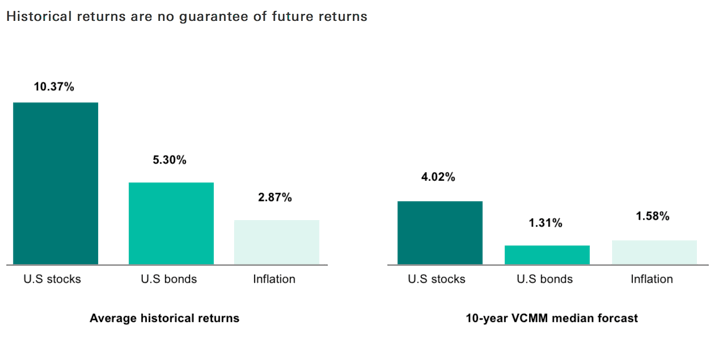
Don’t assume historical averages will hold for the future. Vanguard calculates their own forward-looking estimates based on factors like stock P/E ratios, current bond interest rates, and recent inflation statistics. They are a lot lower than historical averages, as seen in the graphic above (at the top of this post).

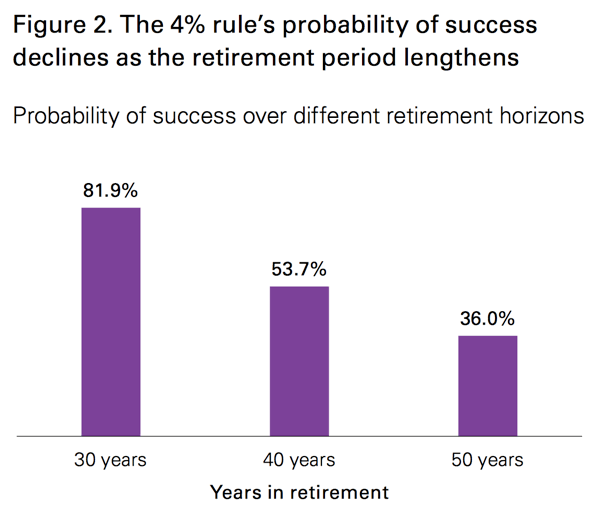
Understand that your retirement horizon may be much longer than 30 years. The longer a portfolio has to last, the more likely it can fail.
Minimize costs. Advisor fees, mutual fund and ETF fees, taxes, and other fees will cut directly into your net income. 1% in investment fees makes a big impact.

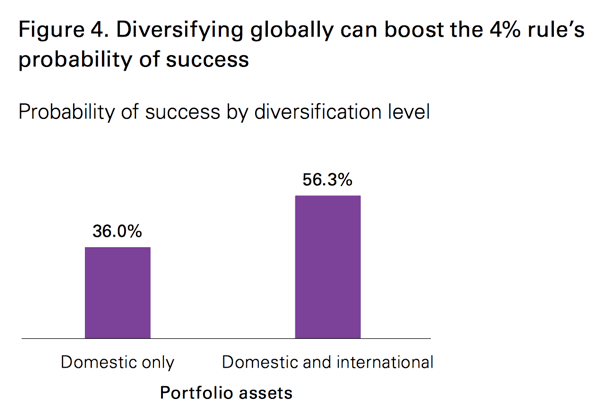
Invest in a diversified portfolio. Vanguard believes that adding some international assets will improve your chances of success. Right now, international stocks have lower valuations (P/E and related) as compared to US stocks.
Use a dynamic spending strategy. As you can see below, this is one of the most powerful ways to improve your odds of success. If you can spend less during a bear market (while also getting to spend more in a bull market), your portfolio’s chances of survival improve dramatically. Either your budget has enough “padding” such that cutting back won’t hurt much, or it hurts but you are willing to endure that temporary pain, or you maintain the option to work a little to earn some additional income if needed.
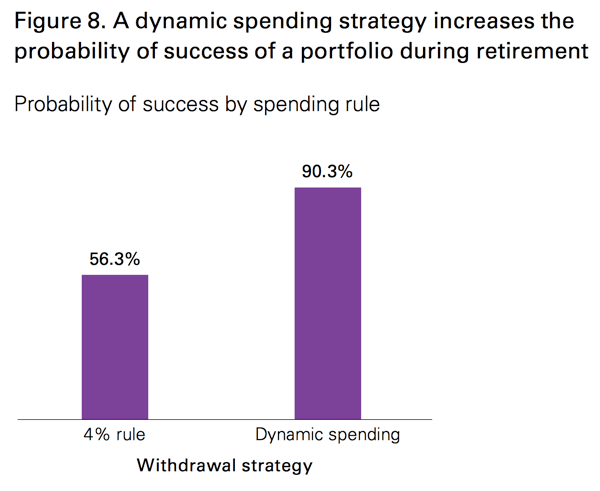
Vanguard doesn’t give any hard numbers when it comes to replacing the 4% number, but the lower expected future returns, longer time horizon, and fee impact all point to a lower number. However, being flexible with your portfolio withdrawals can raise the number.

I enjoy thinking about these sorts of variables and ways to optimize, but the fact is that nobody knows the future “safe” withdrawal rate, even within a percentage point. You have to let go of the idea of 100% certainty. Planning for flexibility (identifying areas to cut back temporarily, maintaining backup work options) and having belief in your ability to adapt is critical for pulling off FIRE at any reasonable withdrawal rate (say 3% to 4%). FIRE is about balancing the fear of running out of money with the fear of running out of time.

Stockpile Review: Starter Investing For Kids, Buy Stock Gifts via Credit Card With No Fee

Stockpile is a niche stock broker that is designed for beginner investors, especially children. You can purchase a gift card for $25, $50, $100, etc. and then a child/parent can redeem that gift card an open their own custodial brokerage account. They receive fractional shares of Apple, Amazon, Google, Berkshire Hathaway, or an index fund ETF which they can watch go up and down in value (or sell). Their tagline is “Starting is everything.”

There are no monthly fees or account minimums. However, until now, they did have trading fees and gift card fees. Before July 2021, Stockpile had a trading fee of 99 cents if paid with cash (fund with bank account) and 99 cents + 3% if paid with credit/debit cards. There was also an additional $2.99 e-gift fee for the first stock (+ 99 cents for each additional company). Physical gift cards had slightly higher fees. Here is how much it used to cost to gift $100 of stock:

If you give Jack one stock, the gifting fee is $2.99 + 3%. To give $100 of Nike stock, for example, you’ll pay $100 + $2.99 + $3.00 = $105.99.

No trading fees. No debit/credit card transaction fees. As of July 7th, 2021, Stockpile announced that they are getting rid of trading fees and gift card fees. You can buy a $100 stock gift card with a credit card for a total price of $100, and the recipient will receive the full $100 of Nike stock or whatever. You can email an “e-gift card”, or print out a physical voucher. (The giver can put a suggested company like Apple on the card, but the recipient can choose to buy a different company.) Here’s a screenshot from the e-mail they send out:

Here’s what they say regarding payment methods:

What payment methods do you accept?
We try to make buying stock as easy as accessible as we can! That means we offer a multitude of ways to get started with investing. The cheapest and most simple is by linking your bank to your Stockpile account. You can link your bank account by following the instructions here. You can also add cash instantly to your Stockpile account using a debit card.

When buying stock on the web, we accept all major debit cards.

You’ll notice it is silent regarding credit cards. A quiet quirk: You can’t buy stocks directly with a credit card for your own Stockpile account, but you can buy e-gift cards using a credit card which can then be redeemed for stock by anyone. Here is a screenshot of the ability to buy a gift card using a credit card with no fees.

Whenever a 3% credit card transaction fee is removed, it makes it more attractive to pay with a credit card in order to generate cash back or airline miles rewards. The possibility of earning 2% cash back upfront on every stock purchase sounds intriguing, but a potential drawback to this is that Stockpile isn’t a full-service brokerage firm, it’s more of a stock piggy bank for kids with limited customer service and support features. (It’s still SIPC-insured.) I don’t know that I’d want to build up my primary portfolio there, even if they do offer broad ETFs like Vanguard Total Stock Market ETF (VTI). Unfortunately, they don’t offer IRAs, so you can’t do your annual IRA contribution.

Another option would be to buy a cash-like ETF. Two options in their catalog are PIMCO Enhanced Short Maturity Active ETF (MINT) and Goldman Sachs Access Treasury 0-1 Year ETF (GBIL). Potential drawbacks here are that the largest gift card you can buy is for $2,000, and they may limit how many gift cards you can purchase.

I tested this out myself as I already have a Stockpile account from a previous promotion, and I was able to successfully buy a $25 gift card using a Chase credit card, but another credit card was rejected. The purchase total was exactly $25, and it was redeemed for exactly $25 of stock (Berkshire Hathaway to avoid dividends and thus extra tax paperwork).

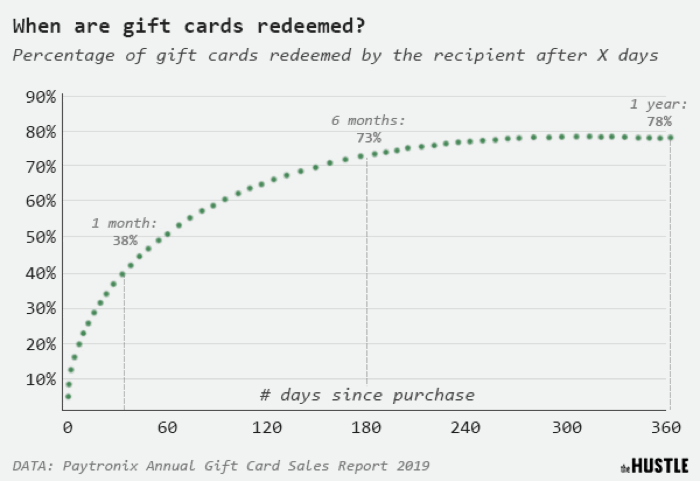
How will Stockpile make money without charging even credit card transaction fees? Even if Stockpile accepts “payment for order flow”, their volume must be relatively low (no daytraders here) and the spread percentage would be far less than 3% on a trade. A better guess is that they found their “breakage” to be sufficient to cover the fees, which refers to the fact that 20% of all gift cards are never redeemed even after a year. (Ever notice how many gift cards are 20% off face value at Costco and Sam’s Club?)

You pay upfront for the gift card, but if they are never redeemed, then Stockpile just gets to keep that as profit. Their breakage is probably less than 20%, but perhaps it is enough for them to make this move.

Bottom line. If you want to teach a kid about stock investing by giving them actual shares of stock, Stockpile is a convenient way to do so and now has no trading fees and no gift card purchase fees. Spend exactly $100 on a gift card, even using a credit card, and they’ll get exactly $100 worth of stock.

AmEx Shop Small Offer 2021: $5 off $10+ on Two Purchases

If you have any American Express credit cards, check your “Amex Offers” in either your online account or smartphone app. Most people are seeing the offer “Spend $10+, get $5 back up to 2X (total of $10) after you Shop Small”.

Get a $5 statement credit by using your enrolled eligible Card to make a single purchase of $10+ directly at any business on the Shop Small Map (or Online Directory) in the US or US territories by 08/22/21. Limit of 2 statement credits (total of $10 back)

Here’s a screenshot:

You can find eligible businesses at americanexpress.com/shopsmalloffer or americanexpress.com/shopsmallonline.

This is a smaller deal than last year, but it’s easy enough.

Our two “keeper” consumer American Express cards are the Amex EveryDay Card (keeps my Membership Rewards points active with no annual fee, helps qualify for various Amazon and AmEx promotions) and the AmEx Blue Cash Preferred (earns 6% cash back on US supermarkets, up to $6,000 annually and 6% cash back on US streaming services).

The “keeper” business American Express card that I maintain is the Blue Business Plus Card – Earn 2X Membership Rewards points on all purchases, of up to $50,000/year. There is also the Blue Business Cash Card that earns a flat 2% cash back on up to $50,000 in purchases each year. I prefer the flexibility of having MR points, but both have no annual fee.

S&P 500 Dividend Aristocrats Infographic: Current Dividend Yield vs. Years of Consecutive Dividend Growth

A Dividend Aristocrat is a company in the S&P 500 index that has paid and increased its dividend payout every year for at least 25 consecutive years. You’re looking at companies that have had such reliable profits over multiple economic cycles that they can just keep sending checks to their shareholders every quarter while still not only maintaining but growing their business. Visual Capitalist just created a Dividend Aristocrat infographic that shows all 65 companies on the 2021 list, charted by current dividend yield and years of consecutive dividend growth.

Genuine Parts (GPC) and Dover Corp (DOV) have increased their dividend payout for 65 consecutive years!

Each year, some companies may be added or removed. For example, new in 2021 are IBM (IBM), NextEra Energy (NEE) and West Pharmaceutical Services (WST). Removed in 2021 are Raytheon (RTX), Carrier Global (CARR), Otis Worldwide (OTIS), Church and Dwight (CHD), and Stryker Corporation (SYK). Note that companies are sometimes removed because they were acquired by another company without the same dividend history.

I’ve always maintained a small side account where I own individual stocks and alternative investments. “Play Money”, “Mad Money”, “Fun Money”, whatever you want to call it. Even though it is only a small percentage of my net worth, I have enjoyed growing it over time and learning from the process. For example, I have found that in times of crisis, I am actually more comfortable buying more of the individual companies inside my self-directed account than buying my trusty broad index funds. I’m also a very low turnover investor, and usually make fewer trades per year than fingers on my hands.

I don’t solely buy companies on this list, but many of the companies are good research ideas if you like to learn about history. I prefer the idea of reliable and growing dividend income, not just momentarily “high” dividend yield. Of course, there are many solid companies that don’t satisfy the requirements for this list, and even list includes questionable companies will be eventually cut (like AT&T, which has already announced a future dividend cut even though still on this chart).

6 Months of Disney+ Free with Amazon Music Unlimited

Amazon is running a new Amazon Music Unlimited promotion that includes up to 6 months of Disney+ streaming subscription free:

  • New Amazon Music Unlimited subscribers: Prime members pay a $7.99 month, and you get 6 months of Disney plus for free as well ($7.99 value each month). You must be a new Disney+ subscriber (with a new e-mail address not associated with any other Disney+ account). If you don’t cancel, each are $7.99 separately after the promo.
  • Past and Current Amazon Music Unlimited subscribers: Get 3 free months of Disney+. You must be a new Disney+ subscriber (with a new e-mail address not associated with any other Disney+ account).

Basically a discount for new subscribers, but a nice little freebie for existing subscribers. Especially good if you also just got the 4-month free trial from Prime Day.

(Reminder that I’m not allowed to use Amazon affiliate link in e-mails, so you may have to view the post online to see the link.)