Archives for November 2022

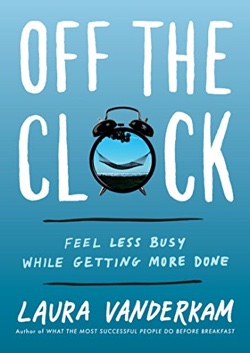
Off the Clock: Feel Less Busy While Getting More Done (Book Highlights)

If you are serious about dramatically improving your personal finances (like getting rid of credit card debt), the first step is to find out exactly where your money goes – track every dollar for a month using a spending log. I recall it being quite uncomfortable, but also eye-opening. In the same way, the book Off the Clock: Feel Less Busy While Getting More Done by Laura Vanderkam is based on the detailed hour-by-hour time diaries of thousands of people.

What characteristics make some people both feel less busy yet still spend time on the activities that are important to them? Some of the highlights below you may have seen elsewhere, but I did discover some new, actionable advice.

Know where your time goes. Track it. Reflect.

As a born skeptic, I had long been fascinated by what these logs showed about the blind spots people have about time. There can be great gaps between how we think we spend our time and reality as recorded. People claim to have no leisure time and then can recount in detail what happened on the most recent Big Bang Theory. Or—I was guilty of this one—we feel like we spend hours unloading the dishwasher, only to learn it takes five minutes each time, the four times per week we do it.

First, people who feel like they have enough time are exceedingly mindful of their time. They know where the time goes. They accept ownership of their lives and think through their days and weeks ahead of time. They also reflect on their lives, figuring out what worked and what didn’t.

It is not that people who have more free time have the time to reflect. After all, people with low time-perception scores actually spend more time on social media and TV than people with high time-perception scores. Instead, people allocate time to thinking and reflecting, and then they feel that they have more time.

Get rid of time-wasting activities. Check your e-mail less often. Check your phone less often. It wastes time, makes you more anxious, and it doesn’t create lasting memories. Be aware and perhaps limit your TV time.

They scrub their lives of anything that does not belong there. This includes self-imposed time burdens, such as constant connectivity, that clog time for no good reason. Indeed, one of the most striking findings of my survey was the gap in estimated phone checks per hour between people who felt relaxed about time and those who felt anxious.

Accept the “good enough” and even “better than nothing”. Aim for small, daily habits that move you steadily towards your goals. Five minutes towards your goal every day is so much better than nothing.

They let go of expectations of perfection and big results in the short run. Instead, they decide that good enough is good enough, knowing that steady progress over the long run is unstoppable.

What type of person do you want to be? What do you want to be known for spending your time on? Pick your worthwhile struggle. Spend time on the important people in your life.

There is freedom from things we don’t want to do, but there is also freedom to do the things we want to do, and figuring out the right balance requires understanding when commitments are burdens and when they are benefits.

These choices involve commitments, but they also stretch time, because as you choose to spend time on these things, you become in your mind the kind of person who has the time to spend on these things.

Happiness requires effort. It is not just bestowed; it is the earned interest on what you choose to pay in.

If my anticipating self wanted to do something, my remembering self will be glad to have done it. Indeed, my experiencing self may even enjoy parts of it. I am tired now, but I will always be tired, and we draw energy from meaningful things.

Outsource the other pain points if possible. Outsource the chores and errands that cause the most stress and/or block other productive pursuits.

In my life, learning to use childcare strategically has been a big breakthrough.

Fight for more flexible hours or less hours at work. The author shares stories about an engineer that had to find a new job first and threaten to quit, before the old employer would allow them to work at home for 4 days a week. (Sounds familiar!) Others have cut their work hours to 80% of full-time or 50% of full-time (if they can afford the accompanying loss in income). However, I found this quote to be useful work advice:

Of course, not all organizations or jobs are amenable to part-time work, and sometimes going off a full-time track can have far-reaching implications for a person’s career. I find that part-time options tend to work best in careers (such as medicine) where hours are more set and you are either in the office or not. The danger in other kinds of salaried work, as my time-diary studies have found, is that if no one knows how many hours anyone is working, “part-time” can often mean full-time hours for less pay. If that sounds like the reality of your industry, it might be a more satisfying option to hunt for (or craft) a job you love, and then negotiate for flexible hours in lieu of extra cash. If you do elect to take a pay cut to go part-time, work out a schedule where you get real days off—for example, you don’t go into the office Thursday or Friday—rather than accept vague promises of a reduced workload. This has the virtue of reducing work hours and commuting time too.

Ready to do your own time diary? The author provides free timesheets (including PDF, xls, and Google Sheets versions) for her 168 Hours Time Tracking Challenge at LauraVanderkam.com where you can track your own time for a week.

After tracking your time, look back over your schedule and ask yourself a few questions: What do I like about my schedule? What would I like to spend more time doing? What would I like to spend less time doing? How can I make that happen?

This book was published in 2018, but the author also has a new book Tranquility by Tuesday: 9 Ways to Calm the Chaos and Make Time for What Matters that just came out October 2022, although I have not read it and don’t know how it differs from this book.
Best Interest Rates on Cash – November 2022 Update

Here’s my monthly roundup of the best interest rates on cash as of November 2022, roughly sorted from shortest to longest maturities. We all need some safe assets for cash reserves or portfolio stability, and there are often lesser-known opportunities available to individual investors. Check out my Ultimate Rate-Chaser Calculator to see how much extra interest you’d earn by moving money between accounts. Rates listed are available to everyone nationwide. Rates checked as of 11/6/2022.

TL;DR: 5% on up to $10,000 from Juno. 4% APY on up to $6,000 for liquid savings at Current with no direct deposit requirement. Merchants Bank of Indiana Money Market at 3.82% APY. 1-year CD at 4.30% APY. 5-year CD at 4.42% APY. Compare against Treasury bills and bonds at every maturity (12-month near 4.75%). 6.89% Savings I Bonds still available if you haven’t maxed out 2022 limits.

Fintech accounts
Available only to individual investors, fintech companies often pay higher-than-market rates in order to achieve fast short-term growth (often using venture capital). “Fintech” is usually a software layer on top of a partner bank’s FDIC insurance.

  • 5% on up to $10,000. Juno now pays 5% on all cash deposits up to $10,000 and 3% on cash deposits from $10,001 up to $250,000. $50 direct deposit bonus. Please see my Juno review for details.
  • 4.00% APY on $6,000 with no direct deposit requirement. Current offers 4% APY on up to $6,000 total ($2,000 each on three savings pods). No direct deposit required. $50 referral bonus for new members with $200+ direct deposit with promo code JENNIFEP185. Please see my Current app review for details.
  • 4.00% APY on up to $250,000, but requires direct deposit and credit card spend. Currently a waitlist for new applicants. The top tier requires you to maintain positive cashflow in the checking account each month, $500 in total monthly direct deposits, and $500 in credit card purchases each month. Existing customers will get 4% APY through April 2023, with requirements waived through March 2023. Please see my updated HM Bradley review for details.

High-yield savings accounts
Since the huge megabanks STILL pay essentially no interest, I think every should have a separate, no-fee online savings account to accompany your existing checking account. The interest rates on savings accounts can drop at any time, so I list the top rates as well as competitive rates from banks with a history of competitive rates. Some banks will bait you with a temporary top rate and then lower the rates in the hopes that you are too lazy to leave.

Short-term guaranteed rates (1 year and under)
A common question is what to do with a big pile of cash that you’re waiting to deploy shortly (plan to buy a house soon, just sold your house, just sold your business, legal settlement, inheritance). My usual advice is to keep things simple and take your time. If not a savings account, then put it in a flexible short-term CD under the FDIC limits until you have a plan.

  • No Penalty CDs offer a fixed interest rate that can never go down, but you can still take out your money (once) without any fees if you want to use it elsewhere. CIT Bank has a 11-month No Penalty CD at 3.30% APY with a $1,000 minimum deposit. Ally Bank has a 11-month No Penalty CD at 3.10% APY for all balance tiers. Marcus has a 13-month No Penalty CD at 2.55% APY with a $500 minimum deposit. You may wish to open multiple CDs in smaller increments for more flexibility.
  • Banesco USA has a 12-month certificate at 4.30% APY. $1,500 minimum. Early withdrawal penalty is 90 days of interest.

Money market mutual funds + Ultra-short bond ETFs*
Many brokerage firms that pay out very little interest on their default cash sweep funds (and keep the difference for themselves). * Money market mutual funds are regulated, but ultimately not FDIC-insured, so I would still stick with highly reputable firms. I am including a few ultra-short bond ETFs as they may be your best cash alternative in a brokerage account, but they may experience short-term losses.

  • Vanguard Federal Money Market Fund is the default sweep option for Vanguard brokerage accounts, which has an SEC yield of 3.24%. Compare with your own broker’s money market rate.
  • Vanguard Ultra-Short-Term Bond Fund currently pays 4.14% SEC yield ($3,000 min) and 4.24% SEC Yield ($50,000 min). The average duration is ~1 year, so there is some term interest rate risk.
  • The PIMCO Enhanced Short Maturity Active Bond ETF (MINT) has a 3.81% SEC yield and the iShares Short Maturity Bond ETF (NEAR) has a 4.09% SEC yield while holding a portfolio of investment-grade bonds with an average duration of ~6 months.

Treasury Bills and Ultra-short Treasury ETFs
Another option is to buy individual Treasury bills which come in a variety of maturities from 4-weeks to 52-weeks and are fully backed by the US government. You can also invest in ETFs that hold a rotating basket of short-term Treasury Bills for you, while charging a small management fee for doing so. T-bill interest is exempt from state and local income taxes.

  • You can build your own T-Bill ladder at TreasuryDirect.gov or via a brokerage account with a bond desk like Vanguard and Fidelity. Here are the current Treasury Bill rates. As of 11/4/2022, a new 4-week T-Bill had the equivalent of 3.66% annualized interest and a 52-week T-Bill had the equivalent of 4.77% annualized interest.
  • The iShares 0-3 Month Treasury Bond ETF (SGOV) has a 2.82% SEC yield and effective duration of 0.10 years. SPDR Bloomberg Barclays 1-3 Month T-Bill ETF (BIL) has a 2.78% SEC yield and effective duration of 0.08 years.

US Savings Bonds
Series I Savings Bonds offer rates that are linked to inflation and backed by the US government. You must hold them for at least a year. If you redeem them within 5 years there is a penalty of the last 3 months of interest. The annual purchase limit for electronic I bonds is $10,000 per Social Security Number, available online at TreasuryDirect.gov. You can also buy an additional $5,000 in paper I bonds using your tax refund with IRS Form 8888.

  • “I Bonds” bought between November 2022 and April 2023 will earn a 6.89% rate for the first six months. The rate of the subsequent 6-month period will be based on inflation again. More on Savings Bonds here.
  • In mid-April 2023, the CPI will be announced and you will have a short period where you will have a very close estimate of the rate for the next 12 months. I will have another post up at that time.
  • See below about EE Bonds as a potential long-term bond alternative.

Prepaid Cards with Attached Savings Accounts
A small subset of prepaid debit cards have an “attached” FDIC-insured savings account with exceptionally high interest rates. The negatives are that balances are severely capped, and there are many fees that you must be careful to avoid (lest they eat up your interest). There is a long list of previous offers that have already disappeared with little notice. I don’t personally recommend nor use any of these anymore, as I feel the work required and the fees charged if you mess up exceeds any small potential benefit.

  • Mango Money pays 6% APY on up to $2,500, if you manage to jump through several hoops. Requirements include $1,500+ in “signature” purchases and a minimum balance of $25.00 at the end of the month.
  • NetSpend Prepaid pays 5% APY on up to $1,000 but be warned that there is also a $5.95 monthly maintenance fee if you don’t maintain regular monthly activity.

Rewards checking accounts
These unique checking accounts pay above-average interest rates, but with unique risks. You have to jump through certain hoops which usually involve 10+ debit card purchases each cycle, a certain number of ACH/direct deposits, and/or a certain number of logins per month. If you make a mistake (or they judge that you did) you risk earning zero interest for that month. Some folks don’t mind the extra work and attention required, while others would rather not bother. Rates can also drop suddenly, leaving a “bait-and-switch” feeling.

  • The Bank of Denver pays 4.00% APY on up to $15,000 if you make 12 debit card purchases of $5+ each, receive only online statements, and make at least 1 ACH credit or debit transaction per statement cycle. Thanks to reader Bill for the updated info.
  • Presidential Bank pays 3.75% APY on balances between $500 and up to $25,000 (3.00% APY above that) if you maintain a $500+ direct deposit and at least 7 electronic withdrawals per month (ATM, POS, ACH and Billpay counts).
  • Liberty Federal Credit Union pays 3.45% APY on up to $20,000. You’ll need at least 15 debit transactions and other requirements every month.
  • Lake Michigan Credit Union pays 3.00% APY on up to $15,000. You’ll need at least 10 debit transactions and other requirements every month.
  • Find a locally-restricted rewards checking account at DepositAccounts.

Certificates of deposit (greater than 1 year)
CDs offer higher rates, but come with an early withdrawal penalty. By finding a bank CD with a reasonable early withdrawal penalty, you can enjoy higher rates but maintain access in a true emergency. Alternatively, consider building a CD ladder of different maturity lengths (ex. 1/2/3/4/5-years) such that you have access to part of the ladder each year, but your blended interest rate is higher than a savings account. When one CD matures, use that money to buy another 5-year CD to keep the ladder going. Some CDs also offer “add-ons” where you can deposit more funds if rates drop.

  • Lafayette Federal Credit Union has a a 5-year certificate at 4.42% APY ($500 min), 4-year at 4.32% APY, 3-year at 4.22% APY, 2-year at 4.11% APY, and 1-year at 3.80% APY. Early withdrawal penalty can be quite severe though, with the 5-year CD penalty being 600 days of interest. Anyone can join this credit union via partner organization ($10 one-time fee).
  • First Internet Bank has a 5-year certificate at 4.39% APY ($1,000 min), 4-year at 4.33% APY, 3-year at 4.28% APY, 2-year at 4.23% APY, and 1-year at 4.18% APY. The early withdrawal penalty for the 5-year is 360 days of interest.
  • You can buy certificates of deposit via the bond desks of Vanguard and Fidelity. You may need an account to see the rates. These “brokered CDs” offer FDIC insurance and easy laddering, but they don’t come with predictable early withdrawal penalties. Inventory is limited and right now, but I see a 3-year CD at 4.85% (non-callable). Be wary of higher rates from callable CDs, which means they can call back your CD if rates drop later.

Longer-term Instruments
I’d use these with caution due to increased interest rate risk, but I still track them to see the rest of the current yield curve.

  • Willing to lock up your money for 10 years? You can buy long-term certificates of deposit via the bond desks of Vanguard and Fidelity. These “brokered CDs” offer FDIC insurance, but they don’t come with predictable early withdrawal penalties. You might find something that pays more than your other brokerage cash and Treasury options. Right now, I see a 10-year CDs at 5.15% (non-callable) vs. 4.17% for a 10-year Treasury. Watch out for higher rates from callable CDs where they can call your CD back if interest rates drop.
  • How about two decades? Series EE Savings Bonds are not indexed to inflation, but they have a unique guarantee that the value will double in value in 20 years, which equals a guaranteed return of 3.5% a year. However, if you don’t hold for that long, you’ll be stuck with the normal rate which is quite low (currently 0.10%). This feature is not currently interesting because as of 11/6/2022, the 20-year Treasury Bond rate was 4.49%.

All rates were checked as of 11/6/2022.

Citi Double Cash Card: 2% Cash Back on All Purchases

The Citi® Double Cash Card is a popular rewards credit card as it offers 2% flat cash back on all purchases, not just specific categories. As of March 2022, $1 in cash back rewards is also 100 Citi ThankYou points for potentially even better reward redemptions (details below). For example, if you value a Citi ThankYou point at 1.5 cents per point (by using the Citi Premier card and redeeming them as airline miles for free flights), then that is effectively get 3% value back! I’ve had this card for years.

  • Earn 2% on every purchase with unlimited 1% cash back when you buy, plus an additional 1% as you pay for those purchases.
  • To earn cash back, pay at least the minimum due on time.
  • No annual fee.

There is a 0% APR balance transfer offer available, but I must warn you that if you transfer a balance, interest will be charged on your purchases unless you pay your entire balance (including balance transfers) by the due date each month.

  • Balance Transfer Only Offer: 0% intro APR on Balance Transfers for 18 months. After that, the variable APR will be 18.99% – 28.99%, based on your creditworthiness.
  • Balance Transfers do not earn cash back. Intro APR does not apply to purchases.
  • There is an intro balance transfer fee of 3% of each transfer (minimum $5) completed within the first 4 months of account opening. After that, your fee will be 5% of each transfer (minimum $5).

Cash back details. Imagine you make a $100 purchase. 1 point per $1 spent is 100 points. You pay the $100 bill from your bank account, and get an additional 100 points. Final tally: 200 points = $2.00 back on $100 in purchases. In other words, still 2% cash back.

There is no longer a minimum redemption amount of $25 for direct deposits into your bank account or statement credit ($5 minimum for paper check). You can redeem as little as 1 point for 1 cent, cashing out down to the penny.

You can redeem for cash via statement credit, direct deposit to your bank account, or a paper check. The direct deposit works with any Citi bank account or verified non-Citi bank account. In the past, this just meant that you made two successful credit card payments from your non-Citi bank account.

Citi ThankYou point details. Since $0.01 in cash back rewards is the same as 1 Citi ThankYou point, it is very valuable that Citi lets you combine Citi Thankyou points across cards. From their FAQ:

Can customers combine points from multiple Citi accounts?
Absolutely, as long as all the Citi Accounts are owned by the same person. If they have one (or more) Citi credit cards participating in ThankYou® Rewards, Citibank consumer checking account and other linked banking products and services, an enrolled Citi Corporate Travel & Entertainment Card, they can combine the associated ThankYou® accounts into 1 ThankYou® Account. Please note that if they combine their ThankYou® Accounts, points are not separated based on which Citi Account they were earned and are displayed as a total among all Citi Accounts.

If you have the Citi® Double Cash Card AND the Citi Premier Card:

  • By having the Citi Premier Card, you can transfer the ThankYou points earned on the Citi Double Cash to participating airline mileage programs on a 1:1 basis including JetBlue TrueBlue, Virgin Atlantic, Singapore Airlines, Cathay Pacific, EVA Air, Etihad, Flying Blue by Air France and KLM, and Thai Airways.
  • By having the Citi Double Cash, you can cash out the ThankYou points earned on the Citi Premier Card (which has the special feature of paying 3X points at Supermarkets, Restaurants, Gas Stations, Air Travel, and Hotels).

If you have the Citi® Double Cash Card AND the Citi Rewards+ Card:

  • By having the Citi Rewards+ Card, you get 10% Points Back for the first 100,000 ThankYou® Points you redeem per year. For example, if you earn and redeem 20,000 ThankYou points, you’ll get 2,000 points rebated back to your account.
  • The Citi Rewards+ Card automatically rounds up to the nearest 10 points on every purchase, so for example a $1 parking charge or $2 cup of coffee can earn 10 points. ).

If you have the Citi® Double Cash Card AND the Citi Custom Cash Card:

  • By using the Citi Custom Cash Card, you get 5% cash back (5X Thank You points) on your top eligible spending category up to $500 spent each monthly billing cycle. (The Citi Double Cash card does not have any special categories.)
  • By using the Citi Double Cash, you get 2% cash back (2X Thank You points) on all other purchases. (The Citi Custom Cash card only earns 1% cash back on all other purchases.)

You can combine all of your various ThankYou points account into one account by calling Citi ThankYou at 800-842-6596 or the number on the back of your card. Alternatively, you can try it online by logging into your ThankYou account and clicking on “Points Summary” in the top right corner where it says “Hi [Your Name]”. See below:

As you can see, Citi has been steadily improving their ThankYou point program to make it more rewarding to hold multiple Citi credit cards. It is good for the consumer to have competition with Chase Ultimate Rewards, American Express Membership Rewards points, and Capital One Miles.

Bottom line. The Citi® Double Cash Card lets you earn 2% cash back on all purchases: 1% when you buy plus 1% as you pay. Everyone should have a 2% cash back card in their purse/wallets, even if they have other cards with higher cashback in specific categories. I’ve had this card for several years now. You can also convert $1 in cash back into 100 Citi ThankYou points, which offers additional flexibility and potentially more valuable redemption options when combined with other Citi rewards cards.

Ally Bank New Deposit Promo: Up to $500 Cash Bonus (Expired, But New CD Opportunity)

Update November 2022: Ally has raised the rates on their CDs and savings accounts, but notably the 11-month No Penalty CD is now at 3.10% APY, which isn’t amazing, but if you are already committed to this deposit bonus, it is a way to raise your effective interest rate while both still qualifying for the deposit bonus and maintaining liquidity. Note the terms state “Your new money must remain in an eligible Ally Bank account: Online Savings, Money Market or a CD.”

Original post (offer is now expired):

Ally Bank has a new “Get Paid” cash deposit bonus (link for existing customers) that is offering a 1% cash bonus (up to $500) on new deposits on top of their existing interest rate. Valid for both new and existing customers. Given the holding period, this roughly equates to the same total interest paid as a 3-month bank CD at 6.25%+ APY. Thanks to reader Paul for the heads up. Here’s how it works:

  • Open an account and/or enroll by 10/21/2022. You must enroll or you won’t get the bonus. New customers use the promo code GETPAID. Existing customers must enroll with the same e-mail as linked to their Ally bank account.
  • Fund your account by 10/31/2022. This means your account has to be approved, opened and funded by this date. Move at least $1,000 from another financial institution to a new or existing eligible Ally Bank account. Remember, transfers can take up to 3 business days.
  • Keep money in your account through 1/15/2023. Your new money must remain in your eligible Ally Bank account through 1/15/2023. Keep in mind, any withdrawals made during this time may reduce your bonus.
  • Get your cash bonus on or by 2/15/2023. Get a 1% bonus on the money you moved, up to $500.

Ally had a similar bonus in 2018 and 2020. Note the following extra details:

  • Cash bonus applies to new money added to an eligible Ally Bank account, not your total balance.
  • Your new money must remain in an eligible Ally Bank account: Online Savings, Money Market or a CD.
  • Minimum cash bonus is $10 ($1,000 deposit), maximum is $500 ($50,000 deposit).

Here’s an example:

1. Take your 10/11 end of day balance total across all eligible accounts. Ex. $5,000.
2. Take your 10/31 end of day balance total across all eligible accounts. Ex. $15,000.
3. Your max possible bonus is 1% of $10,000 = $100. If your total balance across all eligible balance ever goes below 15,000, then your bonus goes down as well. Let’s say your total balances from 10/31 onward through 1/15 varies from $12,000 to $18,000. Your bonus will only be 1% of $7,000 = $70.

Rough math. The current rate on the Ally Online Savings account is 2.25% APY (variable, likely to rise again soon, but who knows what the future holds) as of 10/12/22. Given that you can an additional 1% bonus in roughly 3 months, the bonus itself works out to the equivalent of a 4% annualized yield. 2.25% + 4% = 6.25% total annualized yield over 3 months (no guarantee, this is just an example estimate). You could also open a CD to lock in an even higher rate.

Should I move money out of Ally and back in to qualify? No, it won’t make any difference as Ally has already thought of that. Basically, your comparison point is your balance as of the end of day on 10/11/22. From the full terms and conditions:

We base your Cash Bonus calculation on the New Money you deposit into an eligible Online Savings account, Money Market account, or CD at Ally Bank between 10/12/2022 and 10/31/2022 (and then keep in your account through 1/15/2023). This means money you move out of Ally Bank and then back in won’t qualify for the bonus, and any withdrawals you make from an Online Savings account, Money Market account, or CD between 10/12/2022 and 1/15/2023 may reduce your bonus amount. Transfers of funds between existing Ally Bank accounts won’t qualify for the bonus. Remember, check deposits and transfers from other financial institutions can take a few or more days to complete, so make sure to start any transactions well enough before the 10/31/2022 deadline for those transactions to clear by or before 10/31/2022.

We’re all about playing fair, so if we believe you’re trying to game or abuse this offer, you won’t be allowed to participate in this offer or any future offers.

Existing customers. As a longtime Ally accountholder, I’m happy again to see that this offer includes existing customers, even if it has to be new money.

Bottom line. Ally Bank has a new promotion to attract new money (or bring back old money). You get a 1% cash bonus (up to $500) on new deposits on top of their existing interest rates. At the current rates for their savings account, this works out to a 3-month holding period paying roughly 6.25% annualized interest. You must enroll soon by 10/21/22 and your account must be opened and fully funded by 10/31/22 at the very latest.

Looks like I will be scraping up all the idle cash from my various accounts in the hopes of maximizing this bonus.

The Value of Not Checking Your Investment Statements

The WSJ asks an interesting question: Public REITs Are Down, Nontraded REITs Are Up. Which Is Right? (paywall?). Public REITs are traded on an open market with daily liquidity, and prices are down ~26% overall this year. Non-traded private REITs are simply assigned a value by the sponsors of the REIT, have very limited liquidity windows, and have somehow increased their net asset values (NAVs) slightly this year. That seems rather… convenient.

The valuations differ because public REITs are valued at whatever their shares are trading for on the stock market. Nontraded REITs are valued monthly by their sponsors working with independent appraisers analyzing how much the commercial property they own is worth.

As usual, I agree with whatever Allan Roth says:

“With nontraded REITs increasing their valuations while markets are punishing public REITs, I’d run for the hills,” said Allan Roth

Again, as usual, Matt Levine has a clever take with People Will Pay for Illiquidity:

Another, funnier sort of financial innovation is about subtracting liquidity. If you can buy and sell something whenever you want at a clearly observable market price, that is efficient, sure, but it can also be annoying. Consider the following financial product:

You give me the password to your brokerage account.
I change it.
You can’t look at your brokerage account for one year, because you don’t have the password.
At the end of the year, I give you back your password and you pay me $5.

[…] “It is well known that one of the best services a retail broker can provide is not answering the phones during a crash,” I once wrote; in this product I am charging you for that service. Your mileage will vary — perhaps you are good at market timing — but this service might well be worth more than $5 to you.

This explains one reason why private equity has become ever more popular amongst large institutions:

By being illiquid, the private equity fund can look less volatile. Getting similar returns with less volatility is good; getting similar returns and feeling like you have less volatility also might be good.

The inability to sell your non-traded REITs is a feature! So is accepting a made-up NAV instead open market pricing! It’s better that they hide the true volatile nature of “Mr. Market” from you. Kind of like telling your kids about how the dog went away to live on the farm. It doesn’t change the truth, but maybe they’ll feel better about it.

If seeing volatile market prices is bad, the best thing a passive DIY investor can do (besides own privately-held businesses) is not look at their brokerage statement. If you are truly a “long-term investor”, then what’s the point in looking at daily, weekly, or even monthly fluctuations? You don’t need the liquidity, so we should use that as a feature. People also love to anchor to the all-time high of their portfolio, even though it is really just an arbitrary moment in time. If you only check once a year, then you’ll most likely have missed a peak or a trough.

Savings I Bonds November 2022 Interest Rate: 6.48% Inflation Rate, 0.40% Fixed Rate

November 2022 rates officially announced. May 2022 rate confirmed at 9.62%. 11/1/2022 press release. The variable inflation-indexed rate for I bonds bought from November 2022 through April 2023 will indeed be 6.48% as predicted. Every single I bond will also earn this rate eventually for 6 months, depending on the initial purchase month. The fixed rate for I bonds bought from November 2022 through April 2023 will be 0.40% (up from zero, and right in the midpoint of my guess), for a composite rate of 6.89% for 6 months. Still a good deal, either buying now or in January when the purchase limits reset.

See you again in mid-April for the next early prediction for May 2023.

Original post 10/13/22:

Inflation still 🚀 😬 Savings I Bonds are a unique, low-risk investment backed by the US Treasury that pay out a variable interest rate linked to inflation. With a holding period from 12 months to 30 years, you could own them as an alternative to bank certificates of deposit (they are liquid after 12 months) or bonds in your portfolio.

New inflation numbers were just announced at BLS.gov, which allows us to make an early prediction of the November 2022 savings bond rates a couple of weeks before the official announcement on the 1st. This also allows the opportunity to know exactly what a October 2022 savings bond purchase will yield over the next 12 months, instead of just 6 months. You can then compare this against a November 2022 purchase.

New inflation rate prediction. March 2022 CPI-U was 287.504. September 2022 CPI-U was 296.808, for a semi-annual increase of 3.24%. Using the official formula, the variable component of interest rate for the next 6 month cycle will be 6.48%. You add the fixed and variable rates to get the total interest rate. The fixed rate hasn’t been above 0.50% in over a decade, but if you have an older savings bond, your fixed rate may be up to 3.60%.

Tips on purchase and redemption. You can’t redeem until after 12 months of ownership, and any redemptions within 5 years incur an interest penalty of the last 3 months of interest. A simple “trick” with I-Bonds is that if you buy at the end of the month, you’ll still get all the interest for the entire month – same as if you bought it in the beginning of the month. It’s best to give yourself a few business days of buffer time. If you miss the cutoff, your effective purchase date will be bumped into the next month.

Buying in October 2022. If you buy before the end of October, the fixed rate portion of I-Bonds will be 0%. You will be guaranteed a total interest rate of 0.00 + 9.62 = 9.62% for the next 6 months. For the 6 months after that, the total rate will be 0.00 + 6.48 = 6.48% for the subsequent 6 months.

Let’s look at a worst-case scenario, where you hold for the minimum of one year and pay the 3-month interest penalty. If you theoretically buy on October 31st, 2022 and sell on October 1st, 2023, you’ll earn a ~7.01% annualized return for an 11-month holding period, for which the interest is also exempt from state income taxes. If you theoretically buy on October 31st, 2022 and sell on January 1, 2024, you’ll earn a ~6.90% annualized return for an 14-month holding period. Comparing with the best interest rates as of October 2022, you can see that this is much higher than a current top savings account rate or 12-month CD.

Buying in November 2022. If you buy in November 2022, you will get 6.48% plus a newly-set fixed rate for the first 6 months. The new fixed rate is officially unknown, but is loosely linked to the real yield of short-term TIPS. My guess is somewhere between 0.1% and 0.6%, but who knows. If I Every six months after your purchase, your rate will adjust to your fixed rate (set at purchase) plus a variable rate based on inflation.

If you have an existing I-Bond, the rates reset every 6 months depending on your purchase month. Your bond rate = your specific fixed rate (based on purchase month, look it up here) + variable rate (total bond rate has a minimum floor of 0%). So if your fixed rate was 1%, you’ll be earning a 1.00 + 6.48= 7.48% rate for six months.

Buy now or wait? Given that the current I bond rate is already much higher than the equivalent alternatives, I would personally buy in October to lock in the high rate for the longest possible time. I would grab the “bird in the hand”, even though you might get a slightly higher fixed rate in November. I already purchased up to the limits first thing in January 2022, and I’ll probably buy again in January 2023. However, I am also buying TIPS as the real yield right now is higher than that of I bonds.

Unique features. I have a separate post on reasons to own Series I Savings Bonds, including inflation protection, tax deferral, exemption from state income taxes, and educational tax benefits.

Over the years, I have accumulated a nice pile of I-Bonds and consider it part of the inflation-linked bond allocation inside my long-term investment portfolio. Right now, the inflation protection “insurance” is paying off with high yields and no principal risk.

Annual purchase limits. The annual purchase limit is now $10,000 in online I-bonds per Social Security Number. For a couple, that’s $20,000 per year. You can only buy online at TreasuryDirect.gov, after making sure you’re okay with their security protocols and user-friendliness. You can also buy an additional $5,000 in paper I bonds using your tax refund with IRS Form 8888. If you have children, you may be able to buy additional savings bonds by using a minor’s Social Security Number. TheFinanceBuff has a nice post on gifting options if you are a couple and want to frontload your purchases now. TreasuryDirect also allows trust accounts to purchase savings bonds.

Note: Opening a TreasuryDirect account can sometimes be a hassle as they may ask for a medallion signature guarantee which requires a visit to a physical bank or credit union and snail mail. This doesn’t apply to everyone, but the takeaway is don’t wait until the last minute.

Bottom line. Savings I bonds are a unique, low-risk investment that are linked to inflation and only available to individual investors. You can only purchase them online at TreasuryDirect.gov, with the exception of paper bonds via tax refund. For more background, see the rest of my posts on savings bonds.

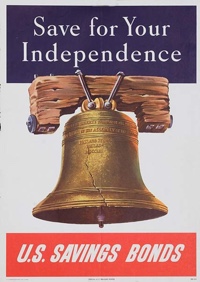
[Image: 1950 Savings Bond poster from US Treasury – source]

Reader Question: Credit Card Bonuses, Paying Annual Fees, and FICO Scores

Here’s a reader question via email that comes up pretty regularly, and I’m surprised that I don’t have a dedicated post answering it. So here it is! 😁

Hi Jonathan,

I have been following you for a long time and appreciate your work. One question, for the credit cards that have an annual fee do keep them and pay the fee or do you cancel them before the fee is applied? I wa just approved for the citi premier card.

For most new credit cards with big bonuses, if the annual fee is not waived for the first year, it will be charged immediately on your first billing cycle. So with the Citi Premier card, you should see a $95 charge in your first monthly statement. You can’t avoid it if you want the sign-up bonus. Of course, the good news is that the sign-up offer is worth over $800. Now, after 12 months, another annual fee will be charged. What then?

I view credit card bonuses as a paid trial. The credit card issuer wants to make me their customer, in the hopes of making profits (transaction fees, interest, fees, etc) by providing me a service. As a consumer, I am lazy and don’t really want to go through the hassle of applying for a new credit card. I certainly wouldn’t do it for free. Therefore, the credit card issuer must offer an incentive. What do I owe the credit card issuer? I agree to give them a chance to earn my business by testing out the features for a full year.

Is it ever worth it? Yes, there are several credit cards that I have kept for at least another year and paid the annual fee because they earned my business. I felt the annual fee was worth it. As my professional and travel habits changed, some cards were dropped and others were added. Here are a few past and present examples:

Don’t think it’s worth it? Other times, it’s not worth it or circumstances change. Again, I usually wait a full year until the next annual fee is charged onto my statement. Then, I call them up and either ask to cancel or tell them directly the annual fee is too high and I don’t want to pay it.

  • They might directly offer to waive the annual fee for another year.
  • They might offer some sort of mini-hurdle like spend $1,000 on the card in 60 days and they will credit back the annual fee.
  • They might offer to downgrade to another card version with no annual fee.
  • They might offer you nothing and cancel your card on the spot.

If they close the account, that’s fine. I gave them a shot. End of agreement.

Still worried? The issue underlying this question is usually this: Doesn’t closing a credit card hurt my credit score?

For me, the answer is no, at least not enough for me to notice. For others, the answer is a bit more complicated. This post is old but still valid – How Opening and Closing Credit Card Accounts Affects Your Credit Score.

Here’s the short version: Closing a credit card will affect the following two factors in your credit score: Credit utilization ratio (percent of total available credit used as debt) and average age of accounts. So if the credit card in question has a credit limit of $10,000 and your only other credit card is brand new with a $500 limit, then closing it will likely lower your score quite noticeably. If you have multiple credit cards with a few years of history, pay off your balance each month, and don’t close the oldest credit card, then the effect will be much smaller.

If you think about it, you need to open up multiple credit cards over time in order to eventually build up a durable credit utilization ratio and average age of accounts. Otherwise, you’ll always be one forced/arbitrary account closure away from a credit score drop. Over time, I have multiple accounts that are decades old and no new credit card is ever more than 10% of my total available credit, so I don’t worry at all about closing a card that I don’t want anymore. If you are brand-new to credit, then you may wish to tread more lightly and find some quality no-annual-fee cards to open and keep to build up your credit profile.

Photo by Avery Evans, Unsplash