Archives for November 2021

Morningstar Safe Withdrawal Rate Report: 3.3% Base Rate + Ways To Increase It

Financial freedom seekers usually have a Number – the value at which their investments can support their spending indefinitely. This is directly linked to “safe withdrawal rates”. For example a 4% safe withdrawal rate is a 25x multiplier – meaning $30,000 in spending needs not covered by Social Security, annuities, or pensions would require 25 x $30,000 = $750,000. Morningstar recently released a 59-page research paper called The State of Retirement Income: Safe Withdrawal Rates (summary article) that digs deeper into the “4% rule”. The headline is that they now estimate 3.3% a conservative base rate (30x multiplier):

What’s a safe withdrawal rate for retirees? We estimate 3.3%. However, there are various factors that could affect this percentage, resulting in the retiree withdrawing a significantly higher amount. This report explores ways that retirees can make their savings last longer without compromising their standard of living.

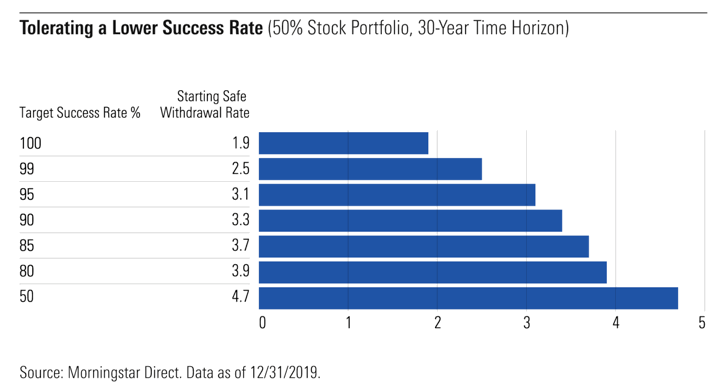
Instead of focusing on the 3.3% base rate, look at the various ways you can improve it. The 3.3% base rate assumes a 50% stock/50% bond portfolio, fixed withdrawals (adjusted upwards for inflation annually, no matter what) over a 30-year time horizon, and a 90% probability of success. What if you changed up some of these assumptions?

Lever #1: Hold a higher percentage of stocks. Historically, having a minimum amount of stocks is important in order to outpace inflation. However, going past 50% to 75% stocks no longer helps your minimum safe withdrawal rate. Not much room for improvement here.

Lever #2: Tolerate lower safety (success rate). This chart is useful to help accept the role of luck for a stock-based retirement portfolio. The fact is that 50% of the time, you could have withdrawn 4.7% and been just fine. You simply don’t know. (This is hard for me as a planner.) The retiree “Class of 2011” could have spent more than that so far without even denting their nest egg. However, the “Class of 2021” may have a very different experience. Going down to 80% probability of success moves you up from 3.3% to 3.9%.
Lever #3: Don’t keep adjusting upward for inflation. Your personal inflation rate might not keep up with the national averages. You might very well spend less as you age. If you adjust for 3/4th of inflation, that 3.3% goes up to 3.6%.

Forgoing inflation adjustments–at least in part–is another lever. That might seem farfetched in the current environment, given that inflation is top of mind. But research from David Blanchett, formerly of Morningstar but now at PGIM, has demonstrated that retirement spending doesn’t necessarily track inflation and often trends down throughout the lifecycle. Our research shows that the retiree who adjusts his or her paycheck by just 75% of the actual inflation rate would be able to take a starting withdrawal of 3.6%, for example.

Lever #4: Work longer. Make more money, make retirement period shorter. Not much fun, but effective. My view is that any amount of income will help reduce your withdrawal rate, if you have the time and ability. It is less common nowadays to go from full-time job to zero income. Working 10 hours a week feels much different than 40-50 hours a week.

Reducing the time horizon for drawdown–for example, by delaying retirement a few years–can likewise contribute to a higher starting safe withdrawal rate. For example, delaying retirement by five years and truncating the in-retirement spending horizon to 25 years from 30 results in a starting safe withdrawal amount of 4.1%.

Lever #5: Flexible spending based on market performance. There are several ways that you could adjust your spending in retirement in response to your portfolio’s return. In general, you’d want to spend less when the market is down. Some of this will come naturally as it’s easier to cut back on spending when you see your friends and neighbors cutting back as well. However, I was surprised to see that several of the proposed methods really don’t change the numbers much.

The method that does help significantly is called the Guyton-Klinger “guardrails” method, which allows inflation adjustments but applies “guardrails” so that the spending rate stays within 20% of the initial withdrawal percentage. Lets say your initial percentage is 4%. If markets go sky-high, the guardrails let you spend at least 3.2% of your new portfolio value (with inflation adjustments). If markets plummet, the guardrails let you spend at most 4.8% of your new portfolio value (with inflation adjustments).

Hold up! Early Retirement Now has an excellent post about how the Guyton-Klinger guardrails are much more “variable” than just +/- 20%. The guardrails move with the portfolio value. If you started out taking $40,000 out of a $100,000 portfolio, by following this rule starting in 1966, your income would have dropped to below $20,000 a year! A 50% drop in income is far too flexible for most people.

My personal thoughts. Every year that passes, I pay less attention to historical backtests and precise safe withdrawal rates. Instead, I care more about understanding the earning power of the assets that I own (including my own skills), and understanding the structure and flexibility of my expenses.

In regards to market returns, it is better to be lucky than anything else. Let’s say you retired about a year ago on October 31st, 2020 and owned the Vanguard Balanced Index Fund (VBIAX) that is 60% US stocks and 40% US bonds. If you had a $1,000,000, a 4% withdrawal rate is $40,000. But a year later, on October 31st, 2021, your portfolio would be just shy of $1,200,000 ($1,195,584) even after taking out $40,000 during the first year. This is just after one year!

In other words, 3.3% could easily be obsolete in a year. You are multiplying a safe withdrawal rate by something that can easily move up or down 20% each year, so why care about decimal points? Focus on what you can control. Looking back at all the levers above, here is what I can control:

  • Accept that a stock-based retirement portfolio will rely on luck. 3% = very safe. 4% = probably safe. 5% = risky. 6% = not safe.
  • Keep your portfolio in retirement somewhere between 50% and 75% stocks, with the rest in investment-grade bonds.
  • Don’t blindly keep taking out more money each year for inflation.
  • Working longer may be required, but explore ways to downshift while still making some income. Even small amounts of income make a difference. For example, 1% of $750,000 is $7,500 per year ($144/week). Earning $144 per week in income would move you from a 5% withdrawal rate to a 4% withdrawal rate, from a 4% withdrawal rate to a 3% withdrawal rate, and so on.
  • Don’t plan to spend the same amount every year. Spend less when markets are down, as most people do anyway. Think about the flex in your budget. Don’t lock in long-term commitments (vacation home ownership, any debt, agreements to pay for your kid’s X). Pick things that you can shut off (vacation rentals, travel, dining out).

Giving Tuesday 2021: Matching Donations and Finding The Right Charity

givingtuesdayTuesday, November 30th is Giving Tuesday 2021, an international day about giving support through charities and nonprofits by donating money or volunteering your time. In case you aren’t inundated with mailings already, this time of year is a big deal for charities, with 40% of donations occurring in the last six weeks of the year. Here are some ways you can “double your impact” with a matching donation.

Facebook Match (good toward any charity that accepts donations via Facebook). Starting at 8am Eastern on 11/30, Facebook will match $8 million in donations to U.S. nonprofits – up to $100,000 per nonprofit and $20,000 per donor. Donations will be matched for the first $2M, 10% for the next $6M.

For example, give directly with the donate button on the The Humane Society Facebook Page. You can also start your own fundraiser here or simply post up a donate button to support your favorite charity.

Double Up Drive. Check out the high-quality, spotlighted charities at Double Up Drive where your donation up to $10,000 can be matched dollar-for-dollar:

At Double Up Drive, we believe that public giving influences greater generosity and that resulting donations carry more impact. We raise money and awareness for highly effective charities by hosting matching drives that collect up-front pledges from large donors, to provide 1:1 matches for smaller contributors.

Check for an employer match. Try this lookup tool from DoubleTheDonation. Most of these programs don’t require you to actually give on a specific day, but you may want to start the process today so you don’t forget in the holiday rush.

Individual charities. Many charities are organizing their own matching program for #GivingTuesday. Here are some large charities have organized their own matches in the past, but I would check to make sure.

Also check with your favorite local community nonprofit. GivingTuesday.org has some additional ideas.

Having trouble deciding where to give? Here are some charity comparison sites that will help you pick where to send your help.

  • CharityNavigator – Largest and well-publicized charity rating site, provides a 4-star rating based primarily on financial criteria.
  • GiveWell – Tries to identify the best charities, not rate them all. Focused primarily on charities working internationally that “save or improve lives the most per dollar”. Examples are treating malaria and parasitic infections in developing countries.
  • GreatNonProfits – Allows clients, volunteers, and funders to post personal reviews based on their experiences. Lots of reviews of smaller, local charities.
  • GuideStar – Tries to be a one-stop shop for both financial data and in-depth analysis of charities. Must register (free) to see a lot of things, and pay a subscription fee for premium data (aimed at industry insiders).

Looking to volunteer your time? Check out Feeding America and VolunteerMatch to find a volunteer opportunity near you.

Black Cyber Deals: Low-Hanging Fruit and Buy Now Pay Later Mind Tricks

I attempted a bit of a “digital vacation” this long weekend in order to maximize my feelings of thankfulness, but I couldn’t help taking a peek at what was available in the “I was going to spend this money anyway” department. I’ll try to keep this updated with all the low-hanging fruit.

You may also wish to check if you are newly-targeted for these Amazon Pay-with-Points promotions:

Quick bonus thought: The real trick behind “Buy Now Pay Later” services is that the average total purchase is much bigger because you only have to pay for 25% of it upfront. You may commit to spending $200, but only “spend” $50 on those shoes that day. Normally, even if you pay with a credit card, you still have to charge the entire balance upfront. BNPL makes you spend more than otherwise because of a mind trick. Don’t fall for it! It’s still debt. My rule remains: If you can’t pay for it upfront, you can’t afford it.

AMC+ Black Friday Deal: $1.99/Mo with Annual Plan (70% Off)

The AMC+ streaming service is also running a Black Friday deal where you can pay $1.99/month if you buy the annual plan ($23.88 + tax). The standard monthly cost of AMC+ is $8.99 (plus tax). The standard price for the annual plan is $83.88, making this 71% off. Auto-renews at the end of the year at the regular rate. Thanks to reader Don for the tip.

*This promotional offer is valid or a limited time only and gives subscribers access to AMC+ upon enrollment at a discounted rate of $1.99/month with an annual commitment.

Chewy.com Autoship Discount

Online pet store Chewy.com is offering 35% off your first Autoship order, which is similar to Amazon Subscribe & Save where you sign up for recurring shipments of pet food and/or treats in exchange for a ongoing discount. You can cancel at any time, even after the first order. Flea medicine, big bag of dog/cat food, bulk pack of treats, etc. Discount applied at checkout. No coupon necessary.

I recommend comparing prices with Amazon regularly, as Amazon’s prices on my dog food does change from month to month.

Disclosure: This post contains affiliate links, and I will be compensated if you make a purchase after clicking on my links.

Time Best Inventions of 2021: Easy 401k Rollovers, Optimize Home Remodels, AI Tutor, Kid Plane Bed

Time magazine has announced their Best Inventions of 2021. In addition to offering a hopeful look at the future each year (which we can all use these days), I always find a few useful products and services that can save you money and/or effort as compared to the traditional option. Warning: The annoying thing is that every individual item with short description counts as an “article” against their paywall limit. Here are a few potentially-useful inventions that caught my eye:

Capitalize – Easy 401(k) Rollovers (Are they really that hard?)

Millennials change jobs often, and when they do, many neglect to bring along their 401(k)s, put off by the hassle of long phone queues and locating obscure documents. […] Simply enter the names of former employers or retirement-account providers, and Capitalize does the rest—unearthing accounts, handling paperwork and suggesting IRAs where old money can make new gains.

Realm – Optimize Home Remodels (for property value, not personal enjoyment)

Homeowners often struggle to decide which upgrades will offer the biggest property-value boost. Realm helps out by analyzing real estate, tax, zoning and other data to offer recommendations—assessing the impact of different designs, materials and financing options to calculate the return on, say, a kitchen renovation.

Amira and the StoryCraft – AI Reading Tutor App (1-on-1 tutoring is not affordable for everyone)

Research shows that the best remedy for reading disorders is early intervention. Unfortunately, there are not nearly enough teachers and tutors for one-on-one instruction. Amira and the StoryCraft was developed to help. Using speech-recognition software, the app ($7.99) listens to students read aloud, pausing when a child stalls or makes a mistake on a word. Then, the app teaches them how the word is pronounced. A Carnegie Mellon University study found that students using the software for 20 minutes posted twice the gains as those using traditional methods.

JetKids BedBox – Convert airplane seat to bed for small kids 3-7

It costs $199 but if my kids would have reliably fallen asleep on it, I’d have bought it for sure… Approved my many major airlines including American, Delta, Southwest and actually sold by others like Cathay and Singapore. (I did notice that United is not on their approved list.)

OXO Spoon Rest with Lid Holder

I like the overall quality of OXO products (their tongs have lasted forever compared to cheaper alternatives) and while this invention won’t change the world, it does solve a problem with my drippy lids resting on random things in my kitchen. *clicks “Add to Wish List”*

Dimensional Fund Advisors (DFA) ETF Lineup Keeps Expanding

Some investors like to break down their portfolio into several different asset and sub-asset classes. One long-standing example of the “slice-and-dice” is the “Ultimate Buy-and-Hold Portfolio” recommended by Paul Merriman (see pie chart; expanded labels below). You don’t need to hold every one of these asset classes, but when held in combination they historically offer a higher return with lower volatility.

  • S&P 500 (US Large Cap Blend)
  • US Large Value
  • US Small
  • US Small Value
  • US REIT
  • International Large Cap Blend
  • International US Large Value
  • International Small
  • International Small Value
  • Emerging Markets
  • Short-term/Intermediate-term Bonds

For a long time, Dimensional Fund Advisors (DFA) offered some of the best lower-cost mutual funds tracking these types of sub-asset classes, but they also required you to invest through a DFA-affiliated financial advisor (and pay the accompanying management fees). Eventually, some former DFA executives and employees broke off and started Avantis ETFs, which are available to any investor with a brokerage accounts and offered a good DFA alternative. Avantis’ assets under management have been growing…

Lo and behold, DFA has just announced a big expansion of their DFA ETF lineup. Competition works!

Newly-listed DFA Bond ETFs

  • Dimensional Core Fixed Income ETF (DFCF)
  • Dimensional Short-Duration Fixed Income ETF (DFSD)
  • Dimensional National Municipal Bond ETF (DFNM)
  • Dimensional Inflation-Protected Securities ETF (DFIP)

Future DFA Equity ETFs

  • International Core Equity 2 ETF
  • Emerging Markets Core Equity 2 ETF
  • US Small Cap Value ETF
  • International Small Cap ETF
  • International Small Cap Value ETF
  • Emerging Markets Value ETF
  • US High Profitability ETF
  • International High Profitability ETF
  • Emerging Markets High Profitability ETF
  • US Real Estate ETF

Existing DFA ETFs

  • Dimensional US Core Equity Market ETF (DFAU)
  • Dimensional International Core Equity Market ETF (DFAI)
  • Dimensional Emerging Core Equity Market ETF (DFAE)
  • Dimensional US Core Equity 2 ETF (DFAC)
  • Dimensional US Equity ETF (DFUS)
  • Dimensional US Small Cap ETF (DFAS)
  • Dimensional US Targeted Value ETF (DFAT)
  • Dimensional International Value ETF (DFIV)
  • Dimensional World ex US Core Equity 2 ETF (DFAX)

Some of the confusing names are a result of these ETFs being conversions from the old mutual fund versions. Even though I try to keep things relatively simple and humble, I welcome these new investment options to the competitive marketplace along with their reasonably-low expense ratios. I may even switch my TIPS holdings to the DFA TIPS ETF (DFIP), as it is cheaper than the iShares TIPS Bond ETF (TIP).

I use Vanguard for my “core” index funds, but about 10% of my total portfolio is split between US Small Value and International/Emerging Small Value stocks. I recently bought/rebalanced into some of the new Avantis International Small Cap Value ETF (AVDV), but will keep an eye on the new DFA version. I suppose they could be a tax-loss harvesting ETF pair, but I have them inside a tax-sheltered account.

Sam’s Club Black Friday: Disney Gift Card 10% Off (Up to $100 Savings)

disney500The Sam’s Club Black Friday page includes $50 off a $500 Disney gift card (limit 2). These are eGift cards, so you can buy them online starting midnight on Thursday, November 25th. If a member buys the limit, that works out to $100 off of $1,000 in Disney gift cards.

If you are planning a Disney-related vacation, especially a package deal or Disney Cruise, this is an easy $100 savings for each member. Disney Gift Cards are valid at:

  • Walt Disney World® Resort (including hotels, restaurants, gift shops, etc.)
  • Disneyland® Resort
  • Disney Cruise Line
  • Disney Store locations in the U.S.
  • ShopDisney.com
  • Disney PhotoPass™
  • Disney Vacation Club®
  • Adventures by Disney®
  • Aulani, A Disney Resort & Spa in Ko Olina, Hawaii
  • Disney’s Hilton Head Island and Vero Beach resorts

Bank of America Preferred Rewards: New Tiers for $1M+ Assets

If you like maximizing your credit card rewards, you probably know that you can earn a base rewards rate of 2.6% cash back on ALL your credit card purchases and up to 5.2% cash back on the first $2,500 in combined grocery/wholesale club/gas purchases each quarter by combined the right Bank of America credit card with their Preferred Rewards program. The catch is that you have to park at least $100,000 in assets inside qualifying Bank of America deposit and/or Merrill investment accounts. You can avoid any lost interest or management fees by transferring over some existing IRA or brokerage assets to a self-directed Merrill Edge account.

Bank of America recently updated the tiers for their Preferred Rewards program, and thankfully the benefits for the three existing tiers did not change. You can still earn the 75% bonus with $100,000 (Platinum Honors) in qualifying assets and 50% bonus with $50,000 (Platinum) in qualifying assets. Specifically, they track your average daily balance for the trailing three calendar months for qualifying accounts:

  • Bank of America deposit accounts (including checking, savings, certificate of deposit)
  • Merrill investment accounts (including brokerage “Cash Management Accounts”, IRAs, 529 Plans)

BofA added two brand-new tiers for those with $1 million+ (Diamond) and $10 million+ (Diamond) in qualifying assets. Here is an edited comparison table that includes the new Diamond and Diamond Honors benefits with the most potential value (mortgage and HELOC interest rate deductions). Of course, I would compare rates to make sure that BofA’s loan rates are initially competitive. Click to enlarge:

In addition, they added new lifestyle benefits to the Diamond and Diamond Honors tiers. These include “access” and “discounts” to travel experiences, luxury merchandise, special events, and concierge-type services. You can also gain Avis Preferred Plus status (Diamond) or Avis President’s Club (Diamond Honors).

My take. I personally don’t see anything special that would encourage me to aspire to Diamond or Diamond Honors status, but you may feel differently. I’m glad that they are keeping the 75% boost for $100,000 in assets, and it has worked as I would not otherwise have much of a “relationship” with BofA. I would not have an active Merrill Edge account, and I wouldn’t have any active BofA credit cards without the boosts.

This “2.6% back on everything” has been my catch-all system for a long time, used whenever I couldn’t earn more while trying out a new credit card promo or 5% bonus category.

(hat tip Doctor of Credit)

Student Loans: File Waiver For Expanded Public Service Loan Forgiveness (PSLF)

Like many folks, I left college with a negative net worth due to $30,000 in student loans. After reading through several articles about changes in the Education Department regarding student loans, I think the overall takeaway is that if you’ve had problems with your student loan management in past years, now would be a good time to check again – especially if you are working towards the Public Service Loan Forgiveness (PSLF) program.

The idea behind PSLF was that if you worked full-time in public service (ex. military, government, nurses, teachers, non-profit workers) and made regular income-based payments for 10 years (120 monthly payments), you would have the remaining balance forgiven at the end of those 10 years. However, this incentive turned out to be an elusive reward at the end of a long and winding maze. The program started in 2007, and as of April 2020, only a little over 2,000 people total (under 2% of the 145,000+ applicants) were ever approved for PSLF.

The maze appears to be opening up a bit, with over 30,000 people expected to be approved in 2021. Most importantly, you must take action and file for a PSLF waiver as soon as possible (must be done by October 2022):

On Oct. 6, 2021, the U.S. Department of Education (ED) announced a temporary period during which borrowers may receive credit for payments that previously did not qualify for PSLF or TEPSLF. Learn more about limited PSLF waiver.

The previous rules were pretty complex and rigid. For example, you could have been paying more than required, but if you weren’t on the right repayment plan, your payments didn’t count toward the 120 monthly payments required (10 years).

Under the new rules, any prior payment made will count as a qualifying payment, regardless of loan type, repayment plan, or whether the payment was made in full or on time. All you need is qualifying employment.

This change will apply to student loan borrowers with Direct Loans, those who have already consolidated into the Direct Loan Program, and those who consolidate into the Direct Loan Program by Oct. 31, 2022.

If you file for the waiver, these types of past monthly payments can now count towards the 120 required:

  • If you were previously ineligible because your loan was of the wrong “type” (will have to consolidate)
  • If you were on an “ineligible” payment plan method
  • If you were deployed active military and placed your loans on hold
  • If you had partial payments
  • If you had payments that were late

You must still be:

  • Employed by government, 501(c)(3) not-for-profit, or other not-for-profit organization that provides a qualifying service
  • Work full-time
  • Have Direct Loans or consolidate into Direct Consolidation Loans. Private student loans are NOT eligible.

It is still rather confusing as to which jobs exactly qualify as “public service”. Your job description doesn’t matter, only the status of your official employer. You could be a teacher or a nurse, but one might be a nurse at a nonprofit hospital and the other might be at a private hospital (or their hospital changed from one to the other at some point, out of their control).

There are also now special considerations for borrowers misled by their schools. Examples of such schools include Corinthian Colleges (Heald College, Everest College, WyoTech), ITT Technical Institute, American Career Institute, Westwood College, Marinello Schools of Beauty, and the Court Reporting Institute. This is called Borrower Defense Loan Discharge:

If your school misled you or engaged in other misconduct in violation of certain state laws, you may be eligible for “borrower defense to loan repayment,” sometimes shortened to “borrower defense.” This is the discharge of some or all of your federal student loan debt.

Students with total and permanent disability have also had their student loan debt forgiven. Students whose schools closed while they were enrolled may also receive loan forgiveness.

Notably, all student loan forgiveness is also considered tax-free at least through through December 31, 2025.

Even if you don’t work in public service, there are still other income-based repayment plans and forgiveness programs. I’m not an expert on the student loan landscape these days, but I would be careful before re-financing your student loans with a private lender as it is non-reversible. Be sure to understand the benefits (such as a lower interest rate) but also what you are giving up (such as these types of forgiveness options).

(image source)

Digital Minimalism Book Review: Parallels With Time and Money Management

I initially stopped reading the NY Times bestseller Digital Minimalism: Choosing a Focused Life in a Noisy World by Cal Newport midway through because it seemed to target a problem that I did not have – I don’t spend much time on social media and deliberately avoid the front page news cycle. However, I’m glad that I went back as it contained many useful parallels with time management and financial independence.

Here is my favorite definition of digital minimalism:

A philosophy of technology use in which you focus your online time on a small number of carefully selected and optimized activities that strongly support things you value, and then happily miss out on everything else.

Read that quote again but remove “of technology” and “online”, and isn’t that just a good philosophy for life in general?

This thought process also aligns with the book Four Thousand Weeks: Time Management for Mortals:

A truly practical approach to making the best use of time demands that we stop trying to deny the undeniable, acknowledging not merely that we might not get around to everything but that we definitely never will. That we’re guaranteed to have to abandon certain ambitions, disappoint certain people and drop certain balls in order to make time for doing a few things that count.

I also appreciated this description of the digital maximalist:

Notice, this minimalist philosophy contrasts starkly with the maximalist philosophy that most people deploy by default—a mind-set in which any potential for benefit is enough to start using a technology that catches your attention. A maximalist is very uncomfortable with the idea that anyone might miss out on something that’s the least bit interesting or valuable.

Put another way: minimalists don’t mind missing out on small things; what worries them much more is diminishing the large things they already know for sure make a good life good.

This comparison of minimalism vs. maximalism was the most useful part of the book for me. You can apply it to everything – your monthly spending, your collection of clothes/gadgets/stuff, the food you consume, how you spend your time every day. Minimalism is about where to draw the line, and how that line is probably closer to “less” than you think.

Happily missing out. I am working to identify my maximalist tendencies, and I like the phrase “happily missing out” as the opposite of FOMO. Instead of trying to moderate your use on something that isn’t clearly awesome, it’s easier to simply cut it out completely. Delete the app from your phone. Cancel the subscription. Don’t let the junk food enter you home. End the toxic relationship. Get rid of the widget that didn’t work out (even if it was expensive). Sell the regrettable investment (even at a loss). After the initial shock, I usually end up saying “Why didn’t I do that earlier?”

If you are interested in changing your tech habits, here’s the basic actionable strategy of the book:

  • Perform a 30-day “Digital Declutter” where you completely stop using social media and other optional digital apps.
  • During this reset, explore and rediscover activities and behaviors that you find satisfying and meaningful. Socialize in-person, spend time alone without your phone, build something with your hands.
  • After 30 days, reintroduce the apps carefully into your life one-by-one. They should only return if they are the best way to help you achieve something you deeply value.

Even this could have parallels to personal finance:

  • Perform a 30-day “Expense Fast” where you stop every optional expense.
  • Experiment by replacing your expenses with alternatives. Think of ways to eat everything edible that is already in your house. Realize that you have 10 different subscriptions and you don’t need them all. Walk outside instead of the gym. Ask someone to walk with you. Talk with an old friend on the phone. Don’t buy a single piece of new clothing.
  • After 30 days, reintroduce each expense life one-by-one. Some things you may realize should be a high priority. That’s good. Some things you may realize are low priority. Happily spend your money on the high priority items, and happily miss out on the rest.

Amazon: Pay with Citi ThankYou Points, Get Up to 50% Off (Targeted)

Check again to see if targeted for latest promo. If you have a Citi credit card that earns ThankYou points, you can redeem them to buy eligible items at Amazon.com. The redemption rate is 1 ThankYou points = 0.8 cents to spend at Amazon, which may not be the best value available. However, here are targeted promotions where you can save money after redeeming just 1 single MR point (a penny’s worth). (To see the link, you may need to visit this page on the internet if viewing this via e-mail or RSS.)

Here are some additional tips:

  • If you haven’t linked yet, you can link your ThankYou points balance to your Amazon account here.
  • If you have already linked your cards and aren’t targeted, you may consider removing your Citi card from your account completely, and then linking it again after a day, and then checking the offer page(s) again after another day.
  • Items must be marked as both sold AND shipped by Amazon.com.
  • Be sure to select your Citi credit card as your payment method and redeem at least 1 point or $0.01 in value of ThankYou points.
  • Savings should be reflected on the final order checkout page, before you commit to purchase.

Notably, the Citi Double Cash card, Citi Custom Cash card, and Citi Rewards+ all now earn ThankYou points. You may want to try linking them to see if you qualify for this promotion now or in the future. For redemptions, I’d probably stick with the 2% cash back option for the Double Cash, and look at the new airline transfer options for the premium travel cards like Citi Premier.