Archives for October 2021

Best 529 College Savings Plan Rankings 2021 – Morningstar (+ My Top Pick)

Investment research firm Morningstar has released their annual 529 College Savings Plans gold/silver/bronze medalist ratings for 2021. While the full ratings and plan analysis for every individual plan are restricted to paid premium members, the vast majority are mediocre and can be ignored.

If you are among the 50% of the population who either don’t get an in-state tax break or have “tax parity” where you get the same tax break regardless of plan location, then you can open an account at any state plan across the nation. In my opinion, there are two ways to pick a good plan. You can pick the absolute top-rated one right now, or you can pick a consistent “Top 10” plan with a history of good behavior.

Here are the Gold-rated plans for 2021 (no particular order). Morningstar uses a Gold, Silver, or Bronze rating scale for the top plans and Neutral or Negative for the rest.

All three of these plans were also rated as Gold last year.

Here are the consistently top-rated plans from 2011-2021. I’ve been tracking these rankings roughly since my first child was born. The plans below have been rated either Gold or Silver (or equivalent) for every year the rankings were done from 2011 through 2021. No particular order.

  • T. Rowe Price College Savings Plan, Alaska
  • Maryland College Investment Plan
  • Vanguard 529 College Savings Plan, Nevada
  • CollegeAdvantage 529 Savings Plan, Ohio
  • My529, formerly the Utah Educational Savings Plan

The “Four P” criteria.

  • People. Who’s behind the plans? Who are the investment consultants picking the underlying investments?
  • Process. Are the asset-allocation glide paths and funds chosen for the age-based options based on solid research?
  • Parent. Does the state trustee and its partners put education savers first?
  • Price. How are the total fees relative to the competition?

State-specific tax benefits. Now, what if you are in the 50% who do have an in-state tax break that requires you to keep your money with the in-state provider? My general take is that your in-state plan is most likely decent enough these days that if you can max out the tax break, it’s worth it to stay. There may be some edge cases where if you keep a very large balance in a relatively expensive plan, then a cheaper plan might be worth going out-of-state.

Find details on your state-specific tax benefits via the tools from Morningstar, SavingForCollege, or Vanguard. Then compare the tax break benefit with how much better a gold plan is than your in-state plan.

If you change your mind later, you have the ability to roll over balances between different 529 plans. (Watch out for tax-benefit recapture rules if you got a tax break initially.)

My pick. I’ve simplified down to one single pick for my favorite 529 plan – the Utah My529. You’ll notice they are also the only plan on both of my lists above. They have everything that I look for: low costs, high-qualify investment options from Vanguard and DFA, reasonable automatic portfolios for those that want to set-and-forget, and highly-customizable glide paths for DIY investors.

I’ve rolled over all my other 529 holdings to Utah over the years. If you don’t have a tax break to keep you in-state, I recommend this plan. I don’t live in Utah myself, but Utah residents are lucky to get a tax break on top of having one of the top plans in the country. (No disclosure on this one, although I wish they had a referral program!)

Here is a chart showing how Utah keep lowering their fees over time. I like that the cost savings realized as they grow is being shared with customers, just like Vanguard.

Finally Time to Start Redeeming Miles and Points Again!

It’s been a while since I’ve redeemed any airline miles or hotel points, so I’m excited to start doing so again. We still had thousands of dollars in airline credit balances from early 2020, and I just booked a flight and two hotel nights in Vancouver, Canada. This also gave me an opportunity to check out the current value of some of my currency. I have to work around school schedules so it’s hard to fully maximize the value of every point.

The cash price for a junior suite during Spring Break at the Hilton Vancouver Airport for our family of 5 was CAD $343, which is US $$277 per night.

The same room with the same cancellation policy costs 50,000 Hilton Honors points per night, which equates to a value of 0.55 cents per Hilton point. This compares well to my standard valuation of 0.5 cents per Hilton point. This is making me take a second look at the current Hilton Honors American Express offer of up to 130,000 Hilton points with no annual fee.

American Express is currently running a transfer bonus to Hilton Honors points, such that 1,000 Membership Rewards points = 2,600 Hilton Honors points. The promo ends soon, but the transferred points posted instantly for me.

This means that 20,000 Membership Rewards points would equal 52,000 Hilton points. That equates to a value of 1.4 cents per Membership Rewards point, much better than my standard valuation of 1.0 cents per MR point. (I would have gotten about 1.1 cents much without the transfer bonus.) Even better, I already had around 30,000 Hilton points lying around, so I only needed another 8,000 Membership Rewards points to reach the first night award. Later, I made another transfer of 19,000 Membership Rewards for the second night since I had about 1,000 Hilton points left over. This ability to “top off” a variety of accounts is why people love the flexible points so much.

In the end, I’m happy to finally convert some points into cash savings (and then into family memories). I’ve still got more planning to do, more hotel nights to book with my IHG/Hyatt stash, and I have a few award night certificates that I hope I can use up as well.

My point is that sure, I’d rather get $1,000 cash than 100,000 Membership Rewards points, but the fact is that it is a lot easier to get a big pile of points and miles for trying out a new credit card while never carrying a balance. I try to value them conservatively, but they definitely still hold value for me. I hope that you all are able to redeem your points and miles for memories soon as well.

BlockFi Promos: 8.75% APY Interest on Stablecoins, BTC Bonus, Bitcoin Rewards Credit Card

(Update February 2022: BlockFi now pays 8.75% APY on stablecoin balances up to $20,000 (USDC, GUSD, USDT) and 4.5% APY on up to 0.10 BTC.)

BlockFi is a cryptocurrency platform that both pays high interest on crypto deposits (including stablecoins) and lets you gain liquidity by borrowing cash backed by your cryptocurrency. They also a have a new credit card that pays Bitcoin rewards.

BlockFi Interest Account bonus. Receive up to $250 in bonus Bitcoin for new clients that sign up and fund a new BlockFi Interest Account. Here are the updated bonus tiers:

  • Deposit $25 to $1,499 Get $15 in BTC.
  • Deposit $1,500 to $19,999, Get $20 in BTC.
  • Deposit $20,000 to $39,999, Get $40 in BTC.
  • Deposit $40,000 to $74,999, Get $75 in BTC.
  • Deposit $75,000 to $99,999, Get $150 in BTC.
  • Deposit $100,000+, Get $250 in BTC.

This must be your first deposit, and you must make the qualifying deposits within 30 days of account opening. The required holding period is roughly 3 months. This one is an affiliate offer and you should see the promo code partner250 auto-filled on your application.

BlockFi now supports instant ACH transfers from your bank account. You can start earning interest on your funds or start trading immediately. Note that BlockFi may requires your deposits to stay there for at least 60 days:

BlockFi credits this bank transfer instantly (so you have the ability to trade and earn interest on those funds), however it generally takes 2-3 business days for the funds to be removed from your bank account. We require that you keep enough funds in your bank account to cover any bank transfers we have credited in our platform.

While we do not have a policy to hold these funds for 60 days, if we see certain behaviors such as attempting to withdraw all funds from the platform including value added via bank transfer we may put a hold on the value of the bank transferred funds for up to 60 days.

BIA interest rates. As of 2/2022, the BlockFi Interest Account (BIA) currently pays 4.5% APY on up to 0.1 Bitcoin (BTC) and 8.75% APY on up to $20,000 of USDC/GUSD stablecoins (subject to change on a monthly basis). There are no trade requirements, but when you deposit USD it will be converted to the GUSD (Gemini stablecoin) by default. (You can then use it to buy USDC or something else if you wish.)

Their overall business model is to earn a spread on the difference between lending out money and paying interest.

To earn interest on crypto, we lend assets to highly vetted and audited institutional counterparties. The interest we are able to pay is based on the yield that we are able to generate from lending, which directly correlates to the market demand in the space (I.e. what rate institutions are willing to pay to borrow specific crypto assets, as it varies from asset to asset).

One free crypto withdrawal per calendar month and one free stablecoin withdrawal per month. After that, additional stablecoin withdrawals are $0.25 each.

Earn 0.5% back on recurring crypto purchases. Another current promo is that if you set up recurring purchases of crypto, they will give you 0.5% back in stablecoin. Note that you can’t buy stablecoins, but you can buy other crypto like BTC and ETH.

*Clients who set up qualifying repeat trades during the promotion period (09/30/21 00:00:00 – 10/31/21 23:59:59 UTC) are eligible to get 0.50% back in stablecoin on all qualified trades. Note: stablecoin to stablecoin trades do not qualify.

Qualified repeat trades must be established within the promotion period, and be maintained without cancelling or changing until 11/30/21. Traded value will be tracked as the sum of all qualifying trades executed during the promotion period (09/30/21 00:00:00 – 11/30/21 23:59:59 UTC). Bonuses will be credited on or before the second Friday of the month in December, 12/10/21. This offer cannot be combined with other trading offers. Any recurring trades changed or cancelled by BlockFi on behalf of the client may still be eligible to receive 0.50% back in stablecoin for the time the trade was active at the discretion of BlockFi. Trading qualifications are dependent upon geographical or regulatory restrictions. Terms subject to change.

Blockfi credit card. The new Blockfi Rewards Visa Signature card has is a new rewards credit card that earns BTC instead of cash back. They’ve been adding a few new perks and removed the annual fee, so that altogether it can be a good compliment for BlockFi users. Here are the highlights:

  • Earn 3.5% back in bitcoin on all purchases in the first 90 days of card ownership after activation, up to $100 in bitcoin.
  • Earn 0.25% back on all eligible trades, up to $500 in BTC each month.
  • Earn 1.5% back in bitcoin on every purchase.
  • Earn 2% back in bitcoin on every purchase over $50,000 of annual spend.
  • No annual fee.

BlockFi is definitely one of the more well-established crypto sites, but you should do your own due diligence as it is not an FDIC-insured bank account nor a SIPC-insured brokerage account. I found that they were backed by some reputable firms including Fidelity Investments and Coinbase, with over $500 million raised so far. They use Gemini as their primary custodian, which is a licensed custodian and regulated by the New York State Department of Financial Services. As such, they will still require your name, address, and Social Security Number to verify the identity of all accountholders.

I hold some GUSD/USDC stablecoins and some crypto, but I consider them both forms of speculative investments. I’ve written about stablecoins in the past, but I like the analogy from Matt Levine of Bloomberg that stablecoins are like the casino chips of the crypto world since traditional banks won’t interact with them. Stablecoins are like casino chips. They said $1 on them, but you have to trust the casino to convert them back to cash. Thus, I would only hold casino chips from a stable casino where I am confident that I can cash them out again for US dollars. I find it both intriguing and wary that my cash is earning 9% APY here, but I also know I would much prefer holding them at BlockFi which has been valued as a $3 billion company than a DeFi-style app where millions can be lost with a typo. I also am of the opinion that GUSD and USDC are safer stablecoins than USDT. I don’t own any USDT (aka Tether).

Bottom line. BlockFi is offering a sign-up deposit bonus, over 8% APY on stablecoin deposits, also offer credit card that earns Bitcoin rewards along with a rebate on crypto trades.

Spiral Banking App Review: $50 + $200 Bonus Details, Donations Required, iOS Only

Spiral is a new fintech banking app (iOS only currently) with a unique mandate on social responsibility through charitable giving. If you maintain an account with them, you must agree to set aside some portion of every deposit towards a charitable donation (Giving Account). The minimum amount is 0.25% ($2.50 for every $1,000 deposited). In turn, Spiral will match your donations up to $150 per year. Spiral is a fintech, with banking services provided by nbkc bank, Member FDIC. Hat tip to DoC.

Sign-up bonuses. Spiral is also offering some good sign-up bonuses to encourage you to try them out. There are currently two separate bonuses:

  • $50 bonus when you fund your new Spiral checking account with at least $200 by November 30, 2021.
  • $200 bonus after recurring direct deposits of at least $1000 each month for two consecutive months.

Inactivity fee warning. They promise the usual no minimum balance and no monthly fees, but there is an inactivity fee that is relatively punitive:

Spiral will charge your account $7 per month (up to 6 months) if you do not make a deposit or withdrawal for 90 days. Interest posting is not considered a deposit for purposes of this fee.

Giving Account details. Here’s an excerpt from the terms of their Giving Account:

As a condition to opening and maintaining a Spiral Account and receiving the Spiral Services, you must open an account designated as your donation or giving account (the “Giving Account”). Upon establishing your Spiral Account, you must deposit an amount equal to no less than 0.25% of your initial and future deposits to your Checking or Savings Accounts in the Giving Account. You may select (and periodically adjust on the Spiral App and Spiral Website) by indicating the percentage (between 0.25% and 20%) of each deposit (rounded down to the nearest penny). You agree to direct the distribution of funds in the Giving Account to a charitable organization of your choice that is an organization that qualifies as an exempt organization under section 501(c)(3) of the Internal Revenue Code, or the corresponding section of any future federal tax code, through the Spiral App and Spiral Website.

They have a very large directory of millions of eligible nonprofits.

Application details. I found this app interesting and decided to try it out. The application was straightforward, 100% online, and took a few minutes. My free credit monitoring suite detected no hard credit checks. I connected an external checking account via Plaid, made a $250 deposit, and quickly received in-app confirmation that I qualified for the $50 bonus.

My $250 deposit is pending, but I was reminded that $0.62 will be set aside for my giving account (see screenshots below). It appears that Spiral also seeded my giving account with a $5 “Giving Cash Bonus” as well. I discovered that the savings account only pays 0.07% APY, so I did not open one. I intend to go for the direct deposit bonus as well.

M1 Finance Backdoor Roth IRA Instructions, How To w/ Screenshots

I recently completed a Backdoor Roth IRA contribution at M1 Finance (my review), so here is a detailed step-by-step walkthrough of the process along with screenshots based on my actual experience. M1 Finance currently has a new customer bonus offer up to $150 for new accounts, based on initial deposit amount. You can also add on the up to $2,500 transfer bonus for moving assets over from another brokerage firm. (Disclosure: I am now an affiliate of M1 Finance, and may be compensated if you click through my link and open a new account.)

Quick background. The Backdoor Roth IRA is a way for individuals to fund a Roth IRA even though their income (modified AGI) exceeds the phaseout limits set for a direct Roth IRA contribution. ($140,000 MAGI for individuals, $208,000 MAGI for married filing joint in 2021.) I won’t go deep into the details, but the general idea is:

  • An individual can contribute to a Traditional IRA without any income limits. However, the contribution is not tax-deductible if you exceed the income limits.
  • An individual can also convert a Traditional IRA to a Roth IRA, also without any income limits. You won’t owe any taxes on those non-deductible IRA contributions, because they are already after-tax.
  • Perform these two steps right after each other, and you have a “Backdoor” Roth IRA.

There are other considerations and details involved, so please do your own research before taking action. Roth conversions cannot be undone. This option may go away in 2022, so if you have any Traditional IRA balances that you have been considering to convert to a Roth IRA, you may want to make your decision before the end of 2021.

M1 Finance Backdoor Roth IRA walkthrough.

Open a new Traditional IRA account and fund it. If you already have an M1 account, click on the name of your portfolio in the top right area, and then click on “Add account”.

Choose “Retirement”, then “Traditional IRA”, then read and accept the terms. Next, you will have the option to select an investment “pie”, but since you are going to convert this quickly to a Roth IRA, it’s fine to just choose something close to cash. One option is the PIMCO Enhanced Short Maturity Active ETF (search for ticker MINT), add it your pie basket, and make it 100%. Finally, you must fund it, probably using your bank account numbers unless you have an existing M1 Finance account or other ideas.

Open a separate Roth IRA account, but do NOT fund it. M1 wants you to have the Roth IRA set up before any conversion request can be made. So start like above and open a new Retirement account, but this time pick Roth IRA. You can now pick your “real” investment portfolio pie, but again don’t fund it! Just think of it as an empty container for now.

Wait for a bit. It may take a few days for your Traditional IRA to get set up, funded, and invested into something. This step is still important. Some people even wait for the Traditional IRA to generate a full monthly account statement so they have paper documentation that they completed this step. Others just wait a day and then move on.

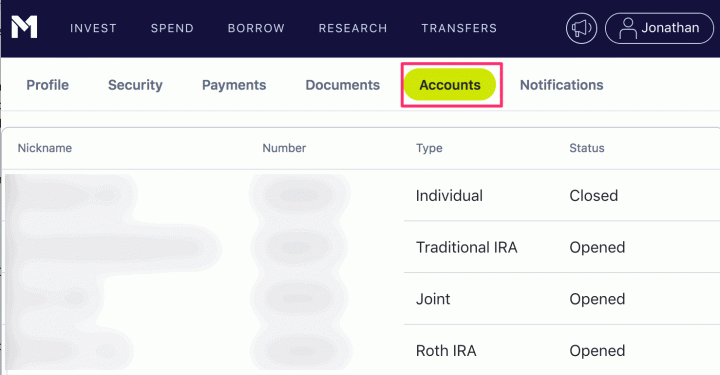
Find both your Traditional and Roth IRA account numbers. It’s conversion time. To find your account numbers, find your name in the top right corner. Click on that, and then click on “View Account Settings”. Then click on the subheading “Accounts”. You should end up with a list of your account nicknames, account numbers, and account types.

Request the conversion, sign and return documents. You can request the conversion via their automated chat bot, secure message, or phone number during business hours. I was able to complete the entire process via chat bot and email without having to use the phone. Here’s my chat transcript with personal details removed:

USER: roth conversion

BOT: M1 Invest can perform IRA conversions. Please keep in mind that due to high volumes, transfers can take 5-7 business days to complete. To get started with this process, please reply with the following information:

BOT: What is the M1 Invest account number of the traditional IRA you would like to convert out of?

USER: XXXXXXXX

BOT: What is the M1 Invest account number of the Roth IRA you would like to convert into?

USER: XXXXXXXX

BOT: What is the amount you would like to convert (if full account conversion, please simply confirm ‘full account’)?

USER: full account

BOT: What is the email address you use to login to M1?

USER: xx@xx.com

Within an hour, they emailed me a PDF form that I had to complete and sign. I uploaded the signed PDF into their secure drop box, and had confirmation that they had sent the request over to their clearing firm within another hour or so.

Jonathan,

We have submitted this conversion to our clearing firm. Both accounts will be paused for the duration of the transfer. We will notify you once the transfer is complete and you will see the funds placed in the correct account.

If you are transferring securities, please make sure the securities you are transferring are located in your Roth IRA portfolio.

This process can take 1-3 business days to complete.

Best,
Brokerage Operations
M1 Team

Once it shows in my M1 Invest dashboard that the funds have been moved into my Roth IRA account, then I’ll be done. I should be sent a form at tax time regarding the amount converted. If I contributed $6,000 to the non-deductible Traditional IRA and the value didn’t change at the time of conversion, then I won’t have any capital gains to pay taxes on. My $6,000 Backdoor Roth IRA contribution will be complete and now I can enjoy tax-free growth and tax-free withdrawals of all future gains. I hope you find this useful for informational purposes.

Charlie Munger: A Double Layer of Risk Protection

My current commute/workout/kid taxi listening is old Berkshire Hathaway shareholder meetings after finding them in podcast format. (I know, out of all the choices available, somehow I find these the most stimulating?!) Here is a educational excerpt from the 2008 BRK meeting (transcript and video available at CNBC) where Charlie Munger is discussing how Berkshire works to avoid low-probability problems that could destroy the company now and in the future.
CHARLIE MUNGER: Yeah. You can see how risk averse Berkshire is. In the first place, we try and behave in a way so that no rational person is going to worry about our credit.

And after we’ve done that, and done it for many years, we also behave in a way that, if the world suddenly didn’t like our credit, we wouldn’t even notice it for months, because we have such liquidity and are so unlikely to be — unable to be — pressured by anybody.

That double layering of protection against risk is like breathing around Berkshire. It’s just part of the culture.

[…]

We do not want to be dependent on anybody or anything else. And yet we want to keep doing things.

So, we’ve found a way to do it — we think we found a way — to do that. It may give up some of the — well, obviously gives up earning higher returns 99 percent of the time, and maybe 99.9 percent of the time.

Obviously, we could have run Berkshire with more leverage over the years than we have. But we wouldn’t have slept as well, and we wouldn’t feel comfortable — we’d have a lot of people in this room that have almost all their net worth in Berkshire, including me — and we wouldn’t feel comfortable running a business that way.

Why do it? I mean, it doesn’t — it just doesn’t make any sense to us to be exposed to ruin and disgrace and embarrassment and — for something that’s not that meaningful.

If we can earn a decent return on capital, you know, what’s an extra percentage point? It just isn’t that important.

Takeaways. The parallels for personal finance seem pretty straightforward:

  • Maintain an excellent credit reputation (score). Having a good credit score will help you borrow for a house, buy a car, lower your insurance premiums in many cases, and finance larger projects and transactions. However, that credit line may still disappear quickly in a crisis.
  • Maintain adequate liquidity separate from any credit lines. Imagine that you lose your job and can’t find a new one for six months. Can your household survive without major disruption? What if at the same time, your stocks also got a 50% haircut and everyone else is suffering as well? Do you have cash or liquid assets to tide you over?
  • Accept that this level of safety means you won’t earn the highest returns. You’ll do fine, but you may not do as well as someone else who bet it all (or more than all using leverage) what happened to be the right thing during the good times. That’s okay, because you won’t be exposed to ruin.

Healthcare and Dependent Care FSA Check-up Reminder (Average Loss $157)

As we head into the last few months of 2021, this is a reminder to check on your Healthcare and Dependent Care Flexible Spending Accounts (FSA). This NYT article outlines some temporary changes this year, while also revealing that nearly half of all FSA participants have lost some amount of their contributions, with a median lost balance of $157.
Healthcare FSA carryover allowance for 2021 into 2022.

Employers may allow a “full” carry-over of remaining balances for next year — up to the total balance in the worker’s F.S.A. So if you had $1,000 in your account at the end of this year, you could carry it all over into 2022. (The usual carry-over limit is $550.)

Masks, hand sanitizer, sanitizing wipes, and at-home COVID tests are FSA eligible expenses. See official IRS notice. The Amazon FSA and HSA Store accepts your FSA/HSA debit card for hassle-free reimbursements and is also an easy way to find eligible items that may be useful to you.

The accounts can be used for medical care and co-payments, nonprescription drugs, and a variety of health-related services, products and supplies, including menstrual pads and tampons, breast pumps, contact lenses and lens solution.

And the I.R.S. recently clarified that masks, hand sanitizer and other items that protect against the spread of Covid-19 are eligible for reimbursement. At-home Covid tests also qualify, the I.R.S. said, because “the cost to diagnose Covid-19 is an eligible medical expense for tax purposes.”

Dependent Care FSA carryover allowance for 2021 into 2022..

Under a temporary pandemic relief change, however, all funds in dependent care accounts may be rolled over into 2022 — if the employer chooses to allow it.

Balance carryover extensions are thus possible but still require your employer’s approval, so check with your HR department first.

I hate wasting potential tax savings, but this is another year of struggling with my Dependent Care FSA benefits provider over reimbursement approvals. FSA “stores” made some things easier, but many childcare providers simply aren’t used to providing detailed, itemized receipts like Amazon or Walgreens.

Hanscom Federal CU Thrive Review: 5.00% APY Saving Habit Builder and Maintainer

savebuttonbankHanscom Federal Credit Union (HFCU) has hiked back up the rate on their CU Thrive account to 5.00% APY, which is a capped certificate of deposit that rewards consistent saving. The rate is set for 12 months, and during those 12 months you can transfer up to $500 every month from a HFCU checking account. No monthly fees. However, you cannot make any withdrawals during those 12 months, or you will be subject to an early withdrawal penalty of 90 days interest.

This product is not meant for big balances. Instead, it is meant to encourage the creation AND maintenance of a modest savings habit. 5.00% APY is more than 10 times what the top “high-yield” savings accounts offer right now.

How much interest can I earn? At 5% APY, if you maxed out this account and set aside the full $500 a month for 12 months, at the end you’d have put in $6,000 and earned about $150 in interest by the end of the year (~$162 if you made every transfer on the 1st of the each month by my quick calculations). $6,000 also happens to be just about the same amount as a full Roth IRA contribution (hint hint) or the foundation of a solid emergency fund.

At the end of the 12 months, all accrued savings plus earned dividends will be transferred into your primary savings account. It will NOT automatically renew at maturity. Each member can only have one CU Thrive account open at one time, but after one 12-month period ends you can open up another one to keep up the savings habit (assuming it is still offered). Full disclosure (PDF).

Eligibility details. To open a CU Thrive account, you must first open an HFCU checking account in addition to the savings account required for all members. HFCU offers a free checking account with no direct deposit and no minimum balance requirement. HFCU membership is open to active duty or retired military along with many other groups (see application), but anyone can also join the Air Force Association, Paul Revere Chapter for a one-time $20 fee and be eligible. On the application, choose the option “I am a member of or will be joining a sponsoring member organization.” You must also keep $25 in the share savings account as long as you are a member.

New refer-a-friend program. HFCU has a referral program which offers an additional $30 cash bonus after your new savings and checking accounts are open and in good standing for 90 days. The referring member gets $30 as well. If you would like a referral from me, please me send your full name, e-mail address, the text “HFCU referral” via my contact form. I will use this information only to fill out their referral form.

Account opening process (from a few years ago). I started the online application and had to provide the usual personal information and then answer questions based on my credit report to verify my identity. Based on my free credit monitoring, they did not perform a hard pull on my credit report. You can fund with an online bank transfer but they also gave me the option to fund with credit card up to $2,000 (not sure if this is still an option today). They didn’t mention if this would be considered a cash advance or not, but it showed up as a purchase for me. Finally, you must print out, sign, and mail in a signature card. You can also open an account in-person. All of their physical branches appear to be located in Massachusetts.

My 1-year experience. I had set the maximum $500 to be transferred every month to my CU Thrive account from my HFCU Checking account. I made 11 transfers but missed one because my checking balance was too low on the date of automatic transfer. My fault. When that happens, the account basically just skips the transfer. There is no penalty, you just don’t get to add that money to the account. I called them but they said there was no way to replace that transfer, even if I moved more money into the checking account a day later. Other than that, everything went very smoothly and I was paid my interest as promised. At the 1-year maturity date, the funds were automatically transferred to my HFCU savings account and the CU Thrive no longer shows up on my online account page. I can now open up another CU Thrive account, if I wish.

I also discovered that Hanscom Federal has paid a Loyalty Dividend to its Credit Union members for over 20 consecutive years. When I had this account, I earned another $1.57 in bonus loyalty dividends on top of my $78.46 of interest earned.

In addition to the CU Thrive and free checking options, HFCU also has a Kasasa Cash Checking account that offers up to 1.00% APY on balances up to $15,000 if you make at least 12 debit card or credit card purchases per month, complete at least 1 ACH Credit/Direct deposit per month, and enroll in online statements. This isn’t the highest Kasasa rate available nationwide, but if you’re already a member, it may be convenient.

Bottom line. The CU Thrive account is a good option for people looking to build up a savings habit, with 5.00% APY for 12 months. However, the system really works best if you use HFCU’s free checking as your primary checking account. (You may also consider their Kasasa Cash checking account with higher interest but debit card activity requirements.) Juggling it as an external savings account is perfectly possible, but you have to keep on top of your transfers to avoid idle cash earning zero interest. I received all of the interest promised, the customer service was nice and polite when contacted, and any errors were my own.

MMB Portfolio Update October 2021 (Q3): Dividend and Interest Income

dividendmono225While my 3rd Quarter 2021 portfolio asset allocation is designed for total return, I also track the income produced quarterly. Stock dividends are the portion of profits that businesses have decided they don’t need to reinvest into their business. The dividends may suffer some short-term drops, but over the long run they have grown faster than inflation.

I track the “TTM” or “12-Month Yield” from Morningstar, which is the sum of the trailing 12 months of interest and dividend payments divided by the last month’s ending share price (NAV) plus any capital gains distributed over the same period. (ETFs rarely have to distribute capital gains.) I prefer this measure because it is based on historical distributions and not a forecast. Below is a rough approximation of my portfolio (2/3rd stocks and 1/3rd bonds).

Asset Class / Fund % of Portfolio Trailing 12-Month Yield (Taken 10/17/21) Yield Contribution
US Total Stock
Vanguard Total Stock Market Fund (VTI, VTSAX)
25% 1.28% 0.32%
US Small Value
Vanguard Small-Cap Value ETF (VBR)
5% 1.67% 0.08%
International Total Stock
Vanguard Total International Stock Market Fund (VXUS, VTIAX)
25% 2.56% 0.64%
Emerging Markets
Vanguard Emerging Markets ETF (VWO)
5% 2.25% 0.11%
US Real Estate
Vanguard REIT Index Fund (VNQ, VGSLX)
6% 2.65% 0.16%
Intermediate-Term High Quality Bonds
Vanguard Intermediate-Term Treasury ETF (VGIT)
17% 1.18% 0.20%
Inflation-Linked Treasury Bonds
Vanguard Short-Term Inflation-Protected Securities ETF (VTIP)
17% 2.26% 0.38%
Totals 100% 1.89%


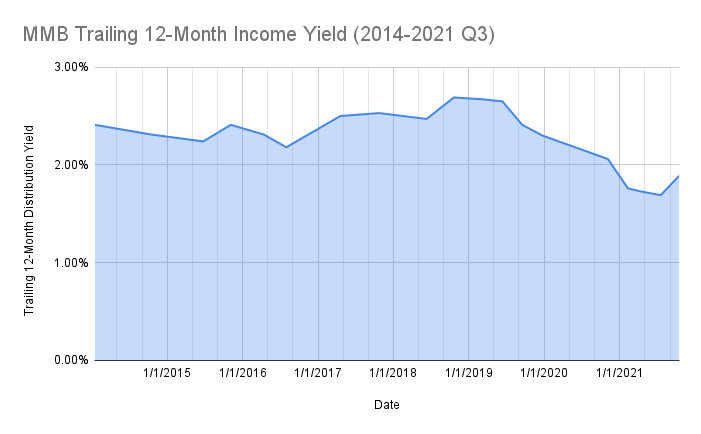
Trailing 12-month yield history. Here is a chart showing how this 12-month trailing income rate has varied since I started tracking it in 2014.

Maintaining perspective on portfolio value. One of the things I like about using this number is that when stock prices drop, this percentage metric usually goes up – which makes me feel better in a bear market. When stock prices go up, this percentage metric usually goes down, which keeps me from getting too euphoric during a bull market.

Here’s a related quote from Jack Bogle (source):

The true investor will do better if he forgets about the stock market and pays attention to his dividend returns and to the operating results of his companies.

Absolute dividend income. This quarter’s trailing income yield of 1.89% is still near the all-time lows since 2014. At the same time, both the portfolio value and the absolute income produced is higher than in 2014. If you retired back in 2014 and have been living off your stock/bond portfolio, you’ve been doing fine.

Here is the historical growth of the S&P 500 absolute dividend, updated as of Q3 2021 (source):

This means that if you owned enough of the S&P 500 to produce an annual dividend income of about $13,000 a year in 1999, then today those same shares would be worth a lot more AND your annual dividend income would have increased to over $50,000 a year, even if you had spent every penny of dividend income every year.

As a result, I prefer looking at absolute income produced rather than portfolio value or dividend yield percentages. Total income goes up much more gradually and consistently, encouraging me as I keep plowing more of my savings into more stock purchases. I imagine them as a factory that just churns out more dollar bills.

via GIPHY

Big picture and rules of thumb. If you are not close to retirement, there is not much use worrying about these decimal points. Your time is better spent focusing on earning potential via better career moves, improving in your skillset, and/or looking for entrepreneurial opportunities where you can have an ownership interest.

I support the common 4% or 3% rule of thumb, which equates to a target of accumulating roughly 25 to 30 times your annual expenses. I would lean towards a 3% withdrawal rate if you want to retire young (before age 50) and a 4% withdrawal rate if retiring at a more traditional age (closer to 65). Build in some spending flexibility to make your portfolio more resilient in the real world, and that’s perfectly good goal to put on your wall.

How we handle this income. Our dividends and interest income are not automatically reinvested. I treat this money as part of our “paycheck”. Then, as with a traditional paycheck, we can choose to either spend it or invest it again. Even if still working, you could use this money to cut back working hours, pursue new interests, start a new business, spend more time with your family and loved ones, travel, perform charity or volunteer work, and so on. This is your one life and it only lasts about 4,000 weeks.

MMB Portfolio Update October 2021 (Q3): Asset Allocation & Performance

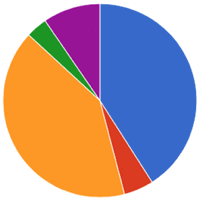
portpie_blank200Here’s my quarterly update on my current investment holdings as of October 2021, including our 401k/403b/IRAs and taxable brokerage accounts but excluding our house, “emergency fund” cash reserves, and a side portfolio of self-directed investments. Following the concept of skin in the game, the following is not a recommendation, but just to share an actual, low-cost, diversified DIY portfolio complete with some real-world messiness. The goal of this portfolio is to create sustainable income that keeps up with inflation to cover our household expenses.

Actual Asset Allocation and Holdings
I use both Personal Capital and a custom Google Spreadsheet to track my investment holdings. The Personal Capital financial tracking app (free, my review) automatically logs into my different accounts, adds up my various balances, tracks my performance, and calculates my overall asset allocation. Once a quarter, I also update my manual Google Spreadsheet (free, instructions) because it helps me calculate how much I need in each asset class to rebalance back towards my target asset allocation.

Here are updated performance and asset allocation charts, per the “Allocation” and “Holdings” tabs of my Personal Capital account, respectively. (The blue line went flat for a while because the synchronization stopped and I don’t checked my performance constantly.)

Stock Holdings
Vanguard Total Stock Market (VTI, VTSAX)
Vanguard Total International Stock Market (VXUS, VTIAX)
Vanguard Small Value (VBR)
Vanguard Emerging Markets (VWO)
Avantis International Small Cap Value ETF (AVDV)
Cambria Emerging Shareholder Yield ETF (EYLD)
Vanguard REIT Index (VNQ, VGSLX)

Bond Holdings
Vanguard Limited-Term Tax-Exempt (VMLTX, VMLUX)
Vanguard Intermediate-Term Tax-Exempt (VWITX, VWIUX)
Vanguard Intermediate-Term Treasury (VFITX, VFIUX)
Vanguard Inflation-Protected Securities (VIPSX, VAIPX)
Fidelity Inflation-Protected Bond Index (FIPDX)
iShares Barclays TIPS Bond (TIP)
Individual TIPS bonds
U.S. Savings Bonds (Series I)

Target Asset Allocation. This “Humble Portfolio” does not rely on my ability to pick specific stocks, sectors, trends, or countries. I own broad, low-cost exposure to asset classes that will provide long-term returns above inflation, distribute income via dividends and interest, and finally offer some historical tendencies to balance each other out. I have faith in the long-term benefit of owning publicly-traded US and international shares of businesses, as well as high-quality US federal and municipal debt. My stock holdings roughly follow the total world market cap breakdown at roughly 60% US and 40% ex-US. I also own real estate through REITs.

I strongly believe in the importance of doing your own research. Every asset class will eventually have a low period, and you must have strong faith during these periods to truly make your money. You have to keep owning and buying more stocks through the stock market crashes. You have to maintain and even buy more rental properties during a housing crunch, etc. A good sign is that if prices drop, you’ll want to buy more of that asset instead of less.

I do not spend a lot of time backtesting various model portfolios, as I don’t think picking through the details of the recent past will necessarily create superior future returns. Usually, whatever model portfolio is popular in the moment just happens to hold the asset class that has been the hottest recently as well. I’ve also realized that I don’t have strong faith in the long-term results of commodities, gold, or bitcoin. I’ve tried many times to wrap my head around it, but have failed. I prefer things that send me checks while I sleep.

This is not the optimal, perfect, ideal anything. It’s just what I came up with, and it’s done the job. You may have different beliefs based on your own research and psychological leanings. Holding a good asset that you understand is better than owning and selling the highest-return asset when it is at its temporary low point.

Stocks Breakdown

  • 45% US Total Market
  • 7% US Small-Cap Value
  • 31% International Total Market
  • 7% International Small-Cap Value
  • 10% US Real Estate (REIT)

Bonds Breakdown

  • 66% High-Quality bonds, Municipal, US Treasury or FDIC-insured deposits
  • 33% US Treasury Inflation-Protected Bonds (or I Savings Bonds)

I have settled into a long-term target ratio of 67% stocks and 33% bonds (2:1 ratio) within our investment strategy of buy, hold, and occasionally rebalance. This is more conservative than most people my age, but I am settling into a more “perpetual portfolio” as opposed to the more common accumulate/decumulate portfolio. I use the dividends and interest to rebalance whenever possible in order to avoid taxable gains. I plan to only manually rebalance past that if the stock/bond ratio is still off by more than 5% (i.e. less than 62% stocks, greater than 72% stocks). With a self-managed, simple portfolio of low-cost funds, we can minimize management fees, commissions, and taxes.

Holdings commentary. The fact that I did research about Shiba Inu coins today is the latest evidence that there is too much money sloshing around chasing speculative investments. Somehow, I own 4,000,000 SHIB from a recent Voyager referral promotion! You really have to wonder how 2021 events will be described in 2030 or 2040. All I can do is listen to the late Jack Bogle and “stay the course”. I remain optimistic that capitalism, human ingenuity, human resilience, human compassion, and our system of laws will continue to improve things over time.

My thought for the quarter is that there is all this focus on tech/crypto/cloud but I hope we still invest enough in physical things like farming/energy/infrastructure.

Performance numbers. According to Personal Capital, my portfolio is up +11.4% for 2021 YTD. I rolled my own benchmark for my portfolio using 50% Vanguard LifeStrategy Growth Fund and 50% Vanguard LifeStrategy Moderate Growth Fund – one is 60/40 and the other is 80/20 so it also works out to 70% stocks and 30% bonds. That benchmark would have a total return of +10.1% for 2021 YTD as of 10/15/2021.

I’ll share about more about the income aspect in a separate post.

Four Thousand Weeks: Productivity Trap, Gratitude, and Paying Yourself First (Book Highlights)

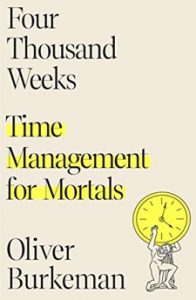
Four Thousand Weeks: Time Management for Mortals by Oliver Burkeman is a relatively short book filled with thought-provoking observations about the constant pressure that we feel, how there never seems to be enough time to accomplish the things that we really want. I can work from home while having almost anything delivered to my doorstep with a few taps, but somehow I still feel exhausted. Upon finishing, my Kindle showed 156 (!) highlighted passages, but I’ve whittled that down to a dozen of my favorites below. Don’t have time for even that? Here is the entire book condensed to a single sentence:

You have to choose a few things, sacrifice everything else, and deal with the inevitable sense of loss that results.

Free yourself from the productivity trap.

The problem isn’t exactly that these techniques and products don’t work. It’s that they do work—in the sense that you’ll get more done, race to more meetings, ferry your kids to more after-school activities, generate more profit for your employer—and yet, paradoxically, you only feel busier, more anxious, and somehow emptier as a result.

…by any sane logic, in a world with dishwashers, microwaves, and jet engines, time ought to feel more expansive and abundant, thanks to all the hours freed up. But this is nobody’s actual experience. Instead, life accelerates, and everyone grows more impatient.

Convenience culture seduces us into imagining that we might find room for everything important by eliminating only life’s tedious tasks. But it’s a lie.

Fellow financial freedom enthusiasts should appreciate this quote:

As a result, they work harder and harder, and soon busyness becomes an emblem of prestige. Which is clearly completely absurd: for almost the whole of history, the entire point of being rich was not having to work so much.

Gratitude. Don’t start from a place of entitlement. Shift your perspective so that you start from a position of gratitude. Every day is a gift.

Why assume that an infinite supply of time is the default, and mortality the outrageous violation? Or to put it another way, why treat four thousand weeks as a very small number, because it’s so tiny compared with infinity, rather than treating it as a huge number, because it’s so many more weeks than if you had never been born?

…if it’s amazing to have been granted any being at all—if “your whole life is borrowed time,” as Cain realized, watching news reports of the Danforth Avenue shootings—then wouldn’t it make more sense to speak not of having to make such choices, but of getting to make them? From this viewpoint, the situation starts to seem much less regrettable: each moment of decision becomes an opportunity to select from an enticing menu of possibilities, when you might easily never have been presented with the menu to begin with. And it stops making sense to pity yourself for having been cheated of all the other options.

In this state of mind, you can embrace the fact that you’re forgoing certain pleasures, or neglecting certain obligations, because whatever you’ve decided to do instead—earn money to support your family, write your novel, bathe the toddler, pause on a hiking trail to watch a pale winter sun sink below the horizon at dusk—is how you’ve chosen to spend a portion of time that you never had any right to expect.

Personal finance parallels: Pay yourself first in both money and time.

If you take a portion of your paycheck the day you receive it and squirrel it away into savings or investments, or use it for paying off debts, you’ll probably never feel the absence of that cash; you’ll go about your business—buying your groceries, paying your bills—precisely as if you’d never had that portion of money to begin with. (There are limits, of course: this plan won’t work if you literally earn only enough to survive.) But if, like most people, you “pay yourself last” instead—buying what you need and hoping there’ll be some money remaining at the end to put into savings—you’ll usually find that there isn’t any.

The same logic, Abel points out, applies to time. If you try to find time for your most valued activities by first dealing with all the other important demands on your time, in the hope that there’ll be some left over at the end, you’ll be disappointed.

After years of trying and failing to make time for her illustration work, by taming her to-do list and shuffling her schedule, Abel saw that her only viable option was to claim time instead—to just start drawing, for an hour or two, every day, and to accept the consequences, even if those included neglecting other activities she sincerely valued. “If you don’t save a bit of your time for you, now, out of every week,” as she puts it, “there is no moment in the future when you’ll magically be done with everything and have loads of free time.”

Slow the rest down.

Just as there will be a final occasion on which I pick up my son—a thought that appalls me, but one that’s hard to deny, since I surely won’t be doing it when he’s thirty—there will be a last time that you visit your childhood home, or swim in the ocean, or make love, or have a deep conversation with a certain close friend. Yet usually there’ll be no way to know, in the moment itself, that you’re doing it for the last time. Harris’s point is that we should therefore try to treat every such experience with the reverence we’d show if it were the final instance of it. And indeed there’s a sense in which every moment of life is a “last time.”

I’ve probably watched too many time-altering movies, but I’ve started doing this weird thing where I imagine this is the last day of my life, except I’m not allowed to tell anyone. Somehow, it really does change my perspective and helps me enjoy the moment. It makes you take more pleasure in the mundane. I’m old enough that there has been the “last time” I’ve ever had dinner with multiple friends or relatives. I’ve now changed the last diaper on all three of my children, fed them their last bowl of mush, and so on. 😢

This quote is a good reminder:

“Because children grow up, we think a child’s purpose is to grow up,” Herzen says. “But a child’s purpose is to be a child. Nature doesn’t disdain what only lives for a day. It pours the whole of itself into each moment … Life’s bounty is in its flow. Later is too late.”

I’ve been implementing many of these various happiness/perspective tips and they do seem to help, at least for a while, but the long-term effectiveness is still unknown.

Quontic Bank High Interest Checking Review: 1.10% APY on all Balance Tiers

The Quontic Bank High Interest Checking account has recently raised their interest rate and applied it to all balance tiers, with the result being the rare combination of a competitive interest rate with a high balance limit. Here are the highlights:

  • Earn 1.10% APY all balance tiers.
  • APY earned is based on the portion of the daily balance within the specified tiers.
  • No minimum balance requirement.
  • No monthly fees.
  • $100 minimum deposit required to open an account.

In order to qualify for the higher rate, you must complete the following qualifying debit card transactions each statement cycle:

10 debit card point of sale transactions of $10 or more per statement cycle required to earn the maximum APY on the portion of the account daily balance tier.

If you meet those requirements, here is the exact interest rate breakdown:

– the portion of the daily balance $150,000 or less will earn 1.10% APY
– the portion of your daily balance above $150,000 and up to and including $1,000,000.00 earns from 1.10% APY
– the portion of your daily balance above $1,000,000 will earn from 1.10% APY
– If the qualifying activity requirement is NOT fulfilled, the interest rate paid on the entire balance will be 0.01% APY

Note the following details about qualifying point-of-sale (POS) transactions:

The following activities are not considered qualifying POS debit card transactions and do not count toward earning rewards: ATM- processed transactions; transfers between accounts; purchases made with debit cards not issued by our bank; cash over portions of point-of-sale transactions; Peer-to-Peer (P2P) payments (such as Apple Pay Cash*); loan payments or account funding made with your debit card and purchases made using third-party payment accounts.

I’ve shared other checking accounts with debit card requirements, but the main difference here is the rare combination of competitive interest rate and very high eligible balance. 1.10% APY on a $150,000 balance would result in earning $1,650 of interest in a year. The difference between that and an account paying 0.70% APY is $600 more interest over a year. There is also no monthly direct deposit requirement with this account.

Note: Earnings of $1,650 with 1.10% APY and $1,050 with 0.70% APY is calculated based on only those respective balances being maintained in the High Interest Checking account for an entire year, with nothing debited to or credited from the account during its duration.

* APY means Annual Percentage Yield

Updated as of 5/31/22.