Archives for October 2021

FIRE Starters: Profiles of 12 Individuals and Families Pursuing Early Financial Freedom

I enjoyed watching all 14 YouTube videos in the FIRE Starters interview series by Marketwatch. The videos were well-edited, in that they averaged only about 5-7 minutes each but still explained the individual and/or family’s unique path to financial independence. You can watch a single video during any small break, or you could watch them all in about an hour and a half. The profiles usually covered the initial spark, overall occupation and salary range, age timeframe, and a monthly budget breakdown. Some of the videos follow the same person(s) a couple of years apart (before and after the pandemic began).

Here a few embedded video examples (might not show up in e-mail):

A few observations:

  • Work. I saw a nurse, flight attendant, hourly IT consultant, lawyer, and energy trader. People who pursue Financial Independence are more likely to have an above-average income, sure, but are they also more likely to be paid on an hourly or shift basis? Maybe when there is a direct link between trading your time (life) for money, you quickly realize the power of dialing up and down your hours. Use the difference between income and spending to buy productive assets and create an supplemental income stream, and those are the primary variables of financial independence.
  • Possibilities. Seeing how other people have customized their lifestyles helps you visualize your own path. The more examples the better. Don’t blindly follow the perceived default of 40-50 hours a week times 40 years. You don’t have to spend like your friends. You don’t have to work the same hours as your friends. You might live in a tiny 500 sf urban condo. You might live on an off-grid 10-acre farm. You might not have kids. You might have 5 kids. You might invest in stocks. You might invest in real estate. You could work full-time, 50% time, or 8.562% time. There are so many ways to play the game.
  • FIRE is just a catchy but imperfect acronym. As someone who started on this journey before “FIRE” was a popular acronym, I’m not sure why “FIRE” is so catchy. I’d say 80% of successful FIRE folks end up saying “I really just focus on the Financial Independence part” and not the “Retire Early”. So why bother with the RE part? The word “retire” evokes a very specific idea, while “financial independence” doesn’t force itself to be black or white. “Grey” semi-retirement may offer a better path, allowing you to work less and live more while you are young and healthy.
  • The first $10,000 is the hardest. As I’ve said before… Only a small percentage of the population can save up $10,000. Even having that amount of money can change your life. If you can save up $10,000, you can save up $100,000. If you can save up $100,000 and add some time and productive investments, you can reach $1,000,000. The most important thing is to start. Let these videos inspire you.
Best Interest Rates on Cash – October 2021 Update

via GIPHY

Here’s my monthly roundup of the best interest rates on cash as of October 2021, roughly sorted from shortest to longest maturities. I look for lesser-known opportunities earning at least double what most savings accounts and money market funds are earning while still keeping your principal FDIC-insured or equivalent. Check out my Ultimate Rate-Chaser Calculator to see how much extra interest you’d earn by moving money between accounts. Rates listed are available to everyone nationwide. Rates checked as of 10/6/2021.

Fintech accounts
Available only to individual investors, fintech companies often pay higher-than-market rates in order to achieve fast short-term growth (often using venture capital). I define “fintech” as a software layer on top of a different bank’s FDIC insurance. These do NOT require a certain number debit card purchases per month. Read about the types of due diligences you should do whenever opening a new bank account.

  • 3% APY on up to $100,000. The top rate is still 3% APY for October through December 2021 (can be 3.5% APY with their credit card), and they have not indicated any upcoming rate drop. HM Bradley requires a recurring direct deposit every month and a savings rate of at least 20%. Due to high demand, you must currently use a referral link to join. If you have any available to share (you get 3), please drop it in the comments of my HM Bradley review.
  • 3% APY on 10% of direct deposits + 1% APY on $25,000. One Finance lets you earn 3% APY on “auto-save” deposits (up to 10% of your direct deposit, up to $1,000 per month). Separately, they also pay 1% APY on up to another $25,000 with direct deposit. New customer $50 bonus via referral. See my One Finance review.
  • 3% APY on up to $15,000. Porte requires a one-time direct deposit of $1,000+ to open a savings account. New customer $50 bonus via referral. Important note: Porte is adding additional restrictions in January 2022. See my Porte review.
  • 1.20% APY on up to $50,000. OnJuno recently updated their rate tiers, while keeping existing customers on the grandfathered 2.15% APY rate. If you don’t maintain a $500 direct deposit each month, you’ll still earn 1.20% on up to $5k. See my updated OnJuno review.

High-yield savings accounts
While the huge megabanks pay essentially no interest, I think every should have a separate, no-fee online savings account to accompany your existing checking account. The interest rates on savings accounts can drop at any time, so I list the top rates as well as competitive rates from banks with a history of competitive rates. Some banks will bait you with a temporary top rate and then lower the rates in the hopes that you are too lazy to leave.

  • T-Mobile Money is still at 1.00% APY with no minimum balance requirements. The main focus is on the 4% APY on your first $3,000 of balances as a qualifying T-mobile customer plus other hoops, but the lesser-known fact is that the 1% APY is available for everyone. Thanks to the readers who helped me understand this. Unfortunately, some readers have reported their applications being denied.
  • Evangelical Christian Credit Union (ECCU) is offering new members 1.01% APY on up to $25,000 when you bundle a High-Yield Money Market Account & Basic Checking. (Existing members can get 0.75% APY.) To join this credit union, you must attest to their statement of faith.
  • There are several other established high-yield savings accounts at closer to 0.50% APY. Marcus by Goldman Sachs is on that list, and if you open a new account with a Marcus referral link (that’s mine), they will give you and the referrer a 0.50% boost on top of the current interest rate for 3 months. You can then extend this by referring others to the same offer. Right now, Marcus is paying 0.50% APY, so with the offer you’d get 1.00% APY currently for your first 3 months.

Short-term guaranteed rates (1 year and under)
A common question is what to do with a big pile of cash that you’re waiting to deploy shortly (plan to buy a house soon, just sold your house, just sold your business, legal settlement, inheritance). My usual advice is to keep things simple and take your time. If not a savings account, then put it in a flexible short-term CD under the FDIC limits until you have a plan.

  • No Penalty CDs offer a fixed interest rate that can never go down, but you can still take out your money (once) without any fees if you want to use it elsewhere. CFG Bank has a 13-month No Penalty CD at 0.62% APY with a $500 minimum deposit. Ally Bank has a 11-month No Penalty CD at 0.50% APY for all balance tiers. Marcus has a 7-month No Penalty CD at 0.45% APY with a $500 minimum deposit. You may wish to open multiple CDs in smaller increments for more flexibility.
  • Lafayette Federal Credit Union has a 12-month CD at 0.80% APY ($500 min). Early withdrawal penalty is 6 months of interest. Anyone can join this credit union via partner organization ($10 one-time fee).

Money market mutual funds + Ultra-short bond ETFs
Many brokerage firms that pay out very little interest on their default cash sweep funds (and keep the difference for themselves). Unfortunately, money market fund rates are very low across the board right now. Ultra-short bond funds are another possible alternative, but they are NOT FDIC-insured and may experience short-term losses at times. These numbers are just for reference, not a recommendation.

  • The default sweep option is the Vanguard Federal Money Market Fund which has an SEC yield of 0.01%. Vanguard Cash Reserves Federal Money Market Fund (formerly Prime Money Market) currently pays 0.01% SEC yield.
  • Vanguard Ultra-Short-Term Bond Fund currently pays 0.27% SEC yield ($3,000 min) and 0.37% SEC Yield ($50,000 min). The average duration is ~1 year, so your principal may vary a little bit.
  • The PIMCO Enhanced Short Maturity Active Bond ETF (MINT) has a 0.22% SEC yield and the iShares Short Maturity Bond ETF (NEAR) has a 0.34% SEC yield while holding a portfolio of investment-grade bonds with an average duration of ~6 months.

Treasury Bills and Ultra-short Treasury ETFs
Another option is to buy individual Treasury bills which come in a variety of maturities from 4-weeks to 52-weeks. You can also invest in ETFs that hold a rotating basket of short-term Treasury Bills for you, while charging a small management fee for doing so. T-bill interest is exempt from state and local income taxes. Right now, this section isn’t very interesting as T-Bills are yielding close to zero!

  • You can build your own T-Bill ladder at TreasuryDirect.gov or via a brokerage account with a bond desk like Vanguard and Fidelity. Here are the current Treasury Bill rates. As of 10/6/2021, a new 4-week T-Bill had the equivalent of 0.04% annualized interest and a 52-week T-Bill had the equivalent of 0.10% annualized interest.
  • The Goldman Sachs Access Treasury 0-1 Year ETF (GBIL) has a -0.06% SEC yield and the SPDR Bloomberg Barclays 1-3 Month T-Bill ETF (BIL) has a -0.09% (!) SEC yield. GBIL appears to have a slightly longer average maturity than BIL.

US Savings Bonds
Series I Savings Bonds offer rates that are linked to inflation and backed by the US government. You must hold them for at least a year. If you redeem them within 5 years there is a penalty of the last 3 months of interest. The annual purchase limit is $10,000 per Social Security Number, available online at TreasuryDirect.gov. You can also buy an additional $5,000 in paper I bonds using your tax refund with IRS Form 8888.

  • “I Bonds” bought between May 2021 and October 2021 will earn a 3.54% rate for the first six months. The rate of the subsequent 6-month period will be based on inflation again. More info here.
  • In mid-October 2021, the CPI will be announced and you will have a short period where you will have a very close estimate of the rate for the next 12 months. I will have another post up at that time, although we already know that it will be likely higher than 5%!
  • See below about EE Bonds as a potential long-term bond alternative.

Prepaid Cards with Attached Savings Accounts
A small subset of prepaid debit cards have an “attached” FDIC-insured savings account with exceptionally high interest rates. The negatives are that balances are severely capped, and there are many fees that you must be careful to avoid (lest they eat up your interest). There is a long list of previous offers that have already disappeared with little notice. I don’t personally recommend nor use any of these anymore, as I feel the work required and risk of messing up exceeds any small potential benefit.

  • Mango Money pays 6% APY on up to $2,500, if you manage to jump through several hoops. Requirements include $1,500+ in “signature” purchases and a minimum balance of $25.00 at the end of the month.

Rewards checking accounts
These unique checking accounts pay above-average interest rates, but with unique risks. You have to jump through certain hoops which usually involve 10+ debit card purchases each cycle, a certain number of ACH/direct deposits, and/or a certain number of logins per month. If you make a mistake (or they judge that you did) you risk earning zero interest for that month. Some folks don’t mind the extra work and attention required, while others would rather not bother. Rates can also drop suddenly, leaving a “bait-and-switch” feeling.

  • The Bank of Denver pays 2.00% APY on up to $25,000 if you make 12 debit card purchases of $5+ each, receive only online statements, and make at least 1 ACH credit or debit transaction per statement cycle. The rate recently dropped. If you meet those qualifications, you can also link a Kasasa savings account that pays 1.00% APY on up to $50k. Thanks to reader Bill for the updated info.
  • Presidential Bank pays 2.25% APY on balances up to $25,000, if you maintain a $500+ direct deposit and at least 7 electronic withdrawals per month (ATM, POS, ACH and Billpay counts).
  • Evansville Teachers Federal Credit Union pays 3.30% APY on up to $20,000. You’ll need at least 15 debit transactions and other requirements every month.
  • Lake Michigan Credit Union pays 3.00% APY on up to $15,000. You’ll need at least 10 debit transactions and other requirements every month.
  • Find a locally-restricted rewards checking account at DepositAccounts.

Certificates of deposit (greater than 1 year)
CDs offer higher rates, but come with an early withdrawal penalty. By finding a bank CD with a reasonable early withdrawal penalty, you can enjoy higher rates but maintain access in a true emergency. Alternatively, consider building a CD ladder of different maturity lengths (ex. 1/2/3/4/5-years) such that you have access to part of the ladder each year, but your blended interest rate is higher than a savings account. When one CD matures, use that money to buy another 5-year CD to keep the ladder going. Some CDs also offer “add-ons” where you can deposit more funds if rates drop.

  • Abound Credit Union has a 59-month Share Certificate at 1.35% APY ($500 min). Early withdrawal penalty is 1 year of interest (and only with the consent of the credit union, so be aware). Anyone can join this credit union via partner organization ($10 one-time fee).
  • NASA Federal Credit Union has a special 49-month Share Certificate at 1.35% APY ($10,000 min of new funds). Early withdrawal penalty is 1 year of interest. Anyone can join this credit union by joining the National Space Society (free). However, NASA FCU will perform a hard credit check as part of new member application.
  • Lafayette Federal Credit Union has a 5-year CD at 1.26% APY ($500 min). Early withdrawal penalty is 6 months of interest. Anyone can join this credit union via partner organization ($10 one-time fee).
  • You can buy certificates of deposit via the bond desks of Vanguard and Fidelity. You may need an account to see the rates. These “brokered CDs” offer FDIC insurance and easy laddering, but they don’t come with predictable early withdrawal penalties. Right now, I see a 5-year CD at 1.10% APY. Be wary of higher rates from callable CDs listed by Fidelity.

Longer-term Instruments
I’d use these with caution due to increased interest rate risk, but I still track them to see the rest of the current yield curve.

  • Willing to lock up your money for 10 years? You can buy long-term certificates of deposit via the bond desks of Vanguard and Fidelity. These “brokered CDs” offer FDIC insurance, but they don’t come with predictable early withdrawal penalties. You might find something that pays more than your other brokerage cash and Treasury options. Right now, I see a 10-year CD at 1.65% APY vs. 1.54% for a 10-year Treasury. Watch out for higher rates from callable CDs from Fidelity.
  • How about two decades? Series EE Savings Bonds are not indexed to inflation, but they have a unique guarantee that the value will double in value in 20 years, which equals a guaranteed return of 3.5% a year. However, if you don’t hold for that long, you’ll be stuck with the normal rate which is quite low (currently 0.10%). I view this as a huge early withdrawal penalty. But if holding for 20 years isn’t an issue, it can also serve as a hedge against prolonged deflation during that time. Purchase limit is $10,000 each calendar year for each Social Security Number. As of 10/6/2021, the 20-year Treasury Bond rate was 2.02%.

All rates were checked as of 9/7/2021.

Practical Time Management: The Won’t Do List vs. Must Do List

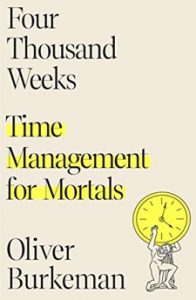
80 years times 50 weeks a year is 4,000 weeks. If we’re lucky, that means we’ll have about 4,000 Mondays, 4,000 Saturdays, and that’s it. I’ve started reading Four Thousand Weeks: Time Management for Mortals by Oliver Burkeman, which suggests that all those productivity hacks look at this number the wrong way. “If only you did X, you could fit in Y more stuff into your day and then you’ll be happy!” But the more likely result is that even if you do X, and fit in Y more stuff, you’ll remain just as stressed and unsatisfied.

In 1930, the economist John Maynard Keynes predicted that his grandkids would work just 15 hours a week due to increases in productivity. Well, the productivity per worker did increase, but we still work close to the same number of hours per week. We can have food delivered to our door with an few taps, but how many of us feel an abundance of free time? Even worse, we are “busy” but not because we are working on the things we want to be working on. We have an ever-growing “some day” list, so that we won’t have to face the truth that it is actually the “never” list.

So what’s the solution? This FT article Endless to-do list? Here’s how not to waste your life is an excerpt from the book. Here’s a good quote:

A truly practical approach to making the best use of time demands that we stop trying to deny the undeniable, acknowledging not merely that we might not get around to everything but that we definitely never will. That we’re guaranteed to have to abandon certain ambitions, disappoint certain people and drop certain balls in order to make time for doing a few things that count.

In the words of the creativity coach Jessica Abel, borrowing an insight from the world of personal finance, that means “paying yourself first” when it comes to time. What she means is doing at least a little of what you care about now, as opposed to banking on finding time for it in the future, once the decks are clear and life’s duties are out of the way. Life’s duties will never be out of the way. And so if you really mean it when you say you’d like to write a novel or spend more of your time with your ageing parents or fighting climate change, at some point you’re just going to have to start doing it.

We need to remind ourselves to drop the relatively unimportant things in order to elevate the truly important ones.

Turning this into something little more concrete, here is my proposal:

  • Won’t Do List. Identify 2-3 lesser things that “would be nice” to do, but will simply end up a distraction from the really important things. Give them up. Leave them off your To Do list forever.
  • Must Do List. Identify one thing that you really want to do but have been putting off for too long. Do it for an hour early in the day, even if it pushes other things out of the way. You must work on it, even a little. It’ll probably be hard, which is why you put it off earlier. You may even discover that you really don’t want to do it after all, but at least now you know and can move on. (This is similar to the Charlie Munger “work for yourself an hour each day” advice.)

On a daily basis, I try to cut out the following things to add some time to my day. I haven’t solved my huge pile of e-mail, but I have given up on “Inbox Zero”, check it less often, and am more at peace that I will miss some things the first time around. This isn’t right for everyone, but I also limit myself to an average of 15 minutes a day on Twitter, 5 minutes on Instagram, and zero minutes on Facebook and TikTok. Social media just reminds me of junk food that tastes great in the moment but has little nutrition and I’m hungry again in 20 minutes. I believe Twitter has the most useful information, but filtering can be time-consuming. (I need Instagram to know where my favorite food trucks are at.) I finally decided cut cable TV and gave up following most live sports in 2020. I will miss watching it, but it does free up a lot of time.

Bottom line. You can’t have it all. Don’t fit more in. Cut things out, and lift a few key things up. The finance/time analogy is that you can afford nearly any one thing, but you can’t afford everything. Trying to do everything will keep you “busy” until you run out of weeks:

(image credit: Financial Times)

Vanguard Target Retirement Funds Update: Big Expense Ratio Drop in Early 2022

I always keep track of the Vanguard Target Retirement 20XX Funds (TRFs) because:

  • They are a low-cost, broadly-diversified, “all-in-one” fund that I believe are a good starting point for both beginning investors and all investors that desire simple effectiveness along with professional management.
  • I have recommended them to my own immediate family, and some of them hold Vanguard TRFs as a significant chunk of their retirement portfolios. I feel a responsibility to make sure they remain solid investments.
  • I view them as an indicator of what Vanguard executives think is the optimal asset allocation mix for most people.

For a while now, one of the primary “cons” of Target Retirement Funds was that it would be much cheaper to buy the individual component ETFs yourself. You could build your own simple portfolio with only three ETFs – VTI (US stocks), VXUS (Global non-US stocks), and BND (US Bonds) at any brokerage firm. Your combined annual expense ratio would be about 0.05% (5 basis points). Yet, the Target Retirement Funds line-up currently charges between 0.12% and 0.15%. You could sign-up for the Vanguard Digital Advisor Services and and only pay 0.20% “all-in” (0.15% for the advice plus 0.05% from ETFs).

Vanguard recently announced they were “streamlining” the Target Retirement Fund line-up and lowering the expense ratio to 0.08% (8 basis points) for each TRF, with an estimated completion date of February 2022. That would be a 47% fee reduction for the stock-heavy TRFs, and a 33% cost reduction for the bond-heavy TRFs. Vanguard estimates $190 million in aggregate savings in 2022 alone as a result of this cost reduction.

As a result, Target Retirement Funds are again safely amongst the cheapest “advised” option for individual investors. By this, I mean that an individual investor decides how much money to put in and an algorithm makes the investment decisions. You don’t have to worry about picking the asset allocation, adjusting as you age, remembering to buy/sell different ETFs every month, enter limit orders, rebalance, and so on. You just send them $100, $500, whatever and it gets put to work. This is essentially the same idea as robo-advisors like Wealthfront, Betterment, and other “guided investing” services. Fidelity and Schwab now also have very low-cost index-based target-date funds.

(If you hold Vanguard TRFs in your 401k or other employer-sponsored tax-deferred account, you may own the institutional shares with an even lower expense ratio.)

There will also be a new fund option, called the Vanguard Target Retirement Income and Growth Fund/Trust. This is a fund designed for those in retirement but would like a higher (50%) stock allocation due to various reasons (greater desire for growth, less need for income). This new option would work well for wealthier investors that don’t need/expect to spend it all down and can thus take on more risk. The default Vanguard Target Retirement Income Fund/Trust will remain with its 30% stock allocation.

Here is the current glide path for Vanguard TRFs. For younger investors, TRFs hold 90% stocks and 10% bonds.

For reference, here is a brief history of the major tweaks to Vanguard Target Retirement fund portfolios:

  • 2003: Target Retirement 20XX Funds are first introduced.
  • 2006: Overall total stock exposure is increased slightly for various Target dates. Emerging markets stocks are added to certain Target dates with longer time horizons.
  • 2010: International stocks as percentage of total stock allocation is increased from 20% to 30%. Three of the underlying funds (European Stock Index, Pacific Stock Index, and Emerging Markets Stock Index) were replaced by a single fund, Vanguard Total International Stock Index Fund.
  • 2013: International bonds are added as 20% of the total bond allocation. Vanguard Short-Term Inflation-Protected Securities Index Fund replaced the Vanguard Inflation-Protected Securities Fund for certain Target dates with shorter time horizons.
  • 2015: International stocks as percentage of total stock allocation increased from 30% to 40%. International bonds as percentage of total bond allocation increased from 20% to 30%.

Kabbage Business Checking Review: 1.10% APY + Public $300 Bonus

(Update October 2021: Post has been updated to reflect a new public $300 bonus. I posted about a $300 bonus in the past, but it ended up being targeted select AmEx business cardholders. This one is open to the public. You must scroll down a bit to see the bonus info, screenshot below. Note that you may be asked to provide supplemental business documentation like Articles of Incorporation.)

Updated full review:

Kabbage offers financial solutions for small businesses, and was acquired by American Express in late 2020. On top of the very competitive interest rate of 1.10% APY, there is currently a public $300 bonus for their business checking account. Here are the highlights:

  • 1.10% APY on balances up to $100,000
  • No monthly maintenance fees.
  • No minimum balance requirements.
  • Free ATM access. Check app for a map to the nearest in-network ATM.
  • Deposit checks for free via mobile app.
  • Deposit cash at one 90,000 participating retailers nationwide (including Walgreens, CVS, Walmart) for a variable fee up to $4.95. Check app for a map to the nearest location.
  • Need paper checks? $20 fee for one pack of 100 personal-sized checks.

Looks like if you like doing all your business banking via a mobile app, this would be a good fit. If you deal with a lot of physical cash or write a lot of checks… not so much, since you would have to pay a fee for each cash deposit and a $20 fee for every 100 checks. However, at 1.10% APY and no minimum balance requirement, you could just use this as a business savings account.

Other Kabbage products include a business line of credit and a service to send invoices and accept payments. (They also helped dole out a lot of PPP loans.)

Kabbage Checking is provided by Green Dot Bank, member FDIC. The routing number may show up as “GoBank, A Division of Green Dot Bank.”

$300 bonus details.

New accounts earn a cash deposit of $300. Earn a $300 cash deposit into your Kabbage Checking account after you complete a total of 5 debit card purchases within 45 days of account opening. (You must apply and be approved by 12/15/2021. Terms apply.)

This promotion is being offered by American Express Kabbage Inc. (“we”, “us” or “our”). The Kabbage Checking account is provided by Green Dot Bank. Green Dot Bank will deposit a $300 cash deposit into your Kabbage Checking account subject to the terms of this offer as stated below. To be eligible to earn the $300 cash deposit, you must 1) apply and be approved for a Kabbage Checking account opened between October 1, 2021 and December 15, 2021 at 11:59 p.m. ET, and 2) successfully complete 5 debit and/or virtual card purchases within 45 calendar days of the opening of your Kabbage Checking account. Only transactions that clear within 45 calendar days of Kabbage Checking account opening will qualify. Transactions that do not clear within this 45-day period will not qualify. To receive the $300 cash deposit from Green Dot Bank, your Kabbage Checking account must be open and in good standing at the time of fulfillment. Once you have completed all the above eligibility requirements, the $300 cash deposit will be deposited into your Kabbage Checking account between 45 to 90 calendar days from the date your Kabbage Checking account was opened. Limit one offer per new Kabbage Checking account. This offer (i) is not available to existing Kabbage Checking customers, (ii) is non- transferable, and (iii) cannot be combined with any other offer.

This bonus was previously targeted to holders of an American Express business credit card, but a representative messaged me and said this one is now fully open to the public.

Bottom line. Kabbage offers a digital-first business checking account that would work well for small businesses that don’t deal with a lot of physical cash deposits or paper checks (due to the fees involved). I get the feeling that it is only a matter of time before this becomes the “American Express business checking account”. Hopefully the interest rate stays high for a while.

Porte Banking App Review: 3% APY on up to $15,000

Update October 2021: On 10/1/2021, Porte announced that starting on 1/1/2022 they will be adding some significant new requirements to obtain the 3% APY on balances up to $15,000. You must have each of the following during each calendar quarter:

  • Receive at least $3,000 in Qualifying Direct Deposits of payroll, pension, or government benefits payments from an employer or government agency into your Porte Spending Account.
  • Make at least 15 Qualifying Debit Card Purchase Transactions with a merchant for goods or services (excludes transfers and/or cash withdrawals) from your Porte Spending Account.

Again, this goes into effect on January 1st, 2022, so I am not updating my review below. If you meet these qualifications during a quarter in 2022, you’ll get 3% APY for that same quarter (they only pay out interest quarterly). The new requirements aren’t horrible (works out to $1,000 direct deposit and 5 debit purchases per month on average), but definitely makes their offering more hassle and less competitive. If you don’t meet these new requirements, then you’ll only get 0.20% APY on balances under $15,000. All balances over $15,000 will also earn 0.20% APY as of 1/1/2022.

Original full review:

Porte is another banking fintech app, this time with the notable feature of 3.00% APY on up to $15,000 on their attached high-yield savings account. To enable access to this account, you must have a one-time occurrence of $1,000+ of direct deposits within one month. There doesn’t appear to be any ongoing requirements after that.* This makes it a more simple setup than the 3% APY accounts of HM Bradley and One Finance, albeit with a lower balance limit. Thanks to reader Matt for the tip.

Referral bonus. New sign-ups can also earn an additional $50 bonus if you open a new account via referral link (follow the direction if not on a mobile browser) and establish a direct deposit of at least $500. That’s my link and I will also get the same bonus, so thanks if you use it! If you have issues with the bonus posting, please let me know.

Quick 3% APY math. If you were to max out the $15,000 at 3% APY and this interest rate holds for a year (a big if), you would get $450 of interest over that year. Compare with a 0.50% APY savings account that would earn $75 in interest on $15,000 in a year, for a difference of $375 a year. As long as that gap stays wide enough, that could be an ongoing $20 to $30 a month in extra interest income.

Additional features.

  • No monthly fees, no minimum balances.
  • Fee-free access to Moneypass ATM network (32,000+ locations).
  • Free debit Visa card.
  • Mobile check deposit via app.

They have “real human” (their words) customer service available at 800-267-7080. FDIC insurance is provided by their partner bank, MetaBank. This is the same bank behind Netspend, which used to have a more interesting 5% APY prepaid card. Note that interest also posts quarterly.

An important missing feature is that you can’t use their app to link an external bank account to make ACH deposits/withdrawals. You can make one-time deposits via a debit card from one of your other accounts (they use Plaid). You will have to link this account using another online bank as the hub (Ally, CapOne 360, Marcus, etc) to make ACH transfers. Otherwise, you’ll have to use their debit card and use Venmo/Apple Cash or similar. Little things like this show that it is a small start-up.

* Fine print. The wording on the site is a little ambiguous, but if you look through the fine print you’ll see that you only need one direct deposit to open the savings account, and once it is open, everybody gets the higher interest rate (3% APY as of this writing). There are no ongoing hoops listed.

No minimum balance to open Savings Account or obtain the yield(s). However, you must receive direct deposit(s) totaling at least $1,000 within one (1) calendar month to be eligible to open a Savings Account.

If the Average Daily Balance is $15,000.00 or less, the interest rate paid on the entire balance will be 2.97% with an annual percentage yield (APY) of 3.00%.

My experience. I opened the checking account and was allowed to open the savings account immediately after making $1,000 in qualifying direct deposits. (They don’t seem to be highly discerning as to what constitutes a direct deposit, but no guarantees.) You must manually transfer your funds from the checking to savings in order to get the 3% APY, which makes the funds inaccessible to your debit card. Even so, I declined their “Overdraft Service”, as I’d rather they just reject any transaction that would send me into negative territory. It doesn’t appear that the savings can be used as an overdraft source. My routing number is 073972181, which matches MetaBank, NA. I was able to make deposits and withdrawals to this account.

Bottom line. Porte is a new fintech app that offers a notable 3% APY on balances up to $15,000 once you complete a one-time direct deposit of $1,000 within a month. This is currently a much higher interest rate than the competition. The rest of the app is similar to other fintech offerings, but the high-yield savings account may be attractive for savers. There is special sign-up bonus via referral link (see above).