Archives for March 2021

American Rescue Plan Act of 2021: New 3rd Stimulus Chart, Child-Related Tax Credits, COBRA, Dependent Care FSA Limits

The American Rescue Plan Act of 2021 became effective March 11th, 2021 and there is a lot to unpack in the $1.9 trillion economic stimulus bill. Besides the headline $1,400 stimulus checks, there are many other items that could be worth over a thousand dollars each – expanded child and childcare tax credits, subsidized ACA/COBRA health insurance premiums, and increased pre-tax contributions to Dependent Care FSAs. After reading the NY Times, Tax Foundation, Wikipedia, and Kitces round-ups, here again are my minimalist highlights so that you can research further if it applies to your situation.
3rd Stimulus checks / Recovery rebates.

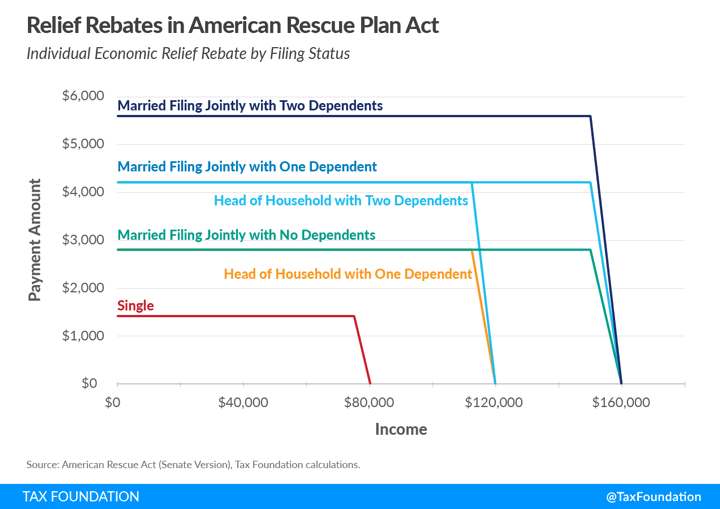
  • $1,400 for each eligible recipient. This includes $1,400 for each child and adult dependent, including college students claimed as dependents.
  • Income phase-out starts at AGI of $75,000 Single, $112,500 Head of Household, and $150,000 Married Filing Joint. Fully phased out at $80k/120k/160k. Qualify using your 2019 or 2020 income (once filed), or even 2021.
  • Track status at IRS Get My Payment tool.

Unemployment benefits.

  • Previous changes extended (including expanded eligibility) for additional 25 weeks, until 9/6. $300 weekly supplement also extended until 9/6.
  • For 2020, the first $10,200 of UI benefits are now tax-free if your income is under $150,000.

Expanded Child Tax Credit.

  • For 2021, it increases to up to $3,000 per child ($3,600 for ages 5 and under). The age limit for qualifying children also rises to 17, from 16. Previously, the max credit was $2,000 per child (and was only $1,000 as recently as 2017).
  • Now fully refundable.
  • Income phase-outs start at MAGI of $150,000 for married filing joint ($75,000 single).

Expanded Child and Dependent Care Tax Credit.

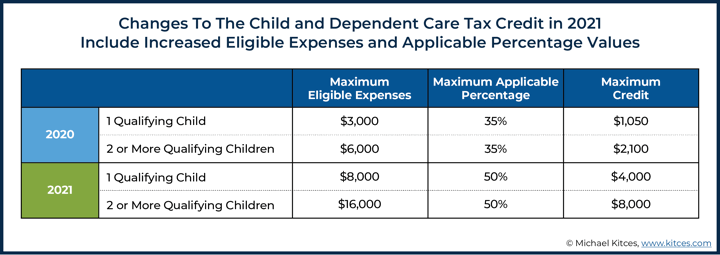
  • For 2021, now worth up to $4,000 for one qualifying individual or $8,000 for two or more. More expenses are eligible, at a higher percentage. The net increase in value could be worth up to $5,900 (see chart below).
  • Now fully refundable.
  • Qualifying children are under the age of 13 for the entire year.
Dependent Care Flexible Spending Accounts.

  • For 2021, you can now contribute $10,500 (married filing joint) into a Dependent Care FSA instead of the normal $5,000 (married filing joint). Single filers can contribute up to $5,250, up from $2,500.
  • Employers must choose to allow this option. Bug your HR department and hopefully they’ll make the change before it’s too late.

Student loans.

  • For student loan debt forgiven between 1/1/2021 and 12/31/2025, the forgiven amount will no longer be considered as taxable income.
  • No actual student loan debt is being forgiven as part of this bill, but it may be wise to prepare for the possibility in the near future. (I might not consider paying down any student loan amounts under $10,000, especially while they are in deferral.)

COBRA Health Insurance.

  • If you lost your job involuntarily (or had job hours cut and thus lost coverage), the government will pay for your entire COBRA health insurance premium from 4/1 through 9/30. This could add up to several thousand dollars.

Health insurance bought from ACA exchanges.

There will always be debate about details of this bill, but that is theoretical while my goal is to be actionable. The goal here is to help taxpayers be proactive and make sure they get any benefits and aid for which they qualify.

Lesser-Known Cheap Basic Prepaid Cell Phone Plans on Every Network – Starting Under $10 a Month

(Updated 2021. T-Mobile absorbed Sprint, so no more Sprint MVNOs. Tello is now a T-Mobile MVNO, but is still quite affordable. Ting Mobile has new flexible plans that work well for occasional data users, and you can now choose from either the T-Mobile or Verizon network.)

You can get unlimited talk and unlimited texts for $10 a month or less on every major network. That’s less than my bare landline used to cost. The major networks sell wholesale minutes to lesser-known MVNOs (Mobile Network Virtual Operators), which they in turn sell at a significant discount to individuals. Below are the best options by network below (Verizon, AT&T, T-Mobile) along with an alternative. I sort by network because that usually makes it easier to Bring Your Own Device (BYOD), though every MVNO will have a form where you can check compatibility via identification number (IMEI or MEID). Here are the cheapest plans with unlimited talk & text and 5G/LTE high-speed data.

Disclosure: This post includes affiliate links where available. If you make a purchase through the links below, I may be compensated.

T-Mobile NetworkT-Mobile Network Color: Hot Pink

  • Unlimited Talk & Text. Tello Mobile also has an unlimited talk, text, and no data for $8 a month. You need to choose a custom plan to find this option. Upgrade to 1 GB of data at only $10 per month. New user promo: Get 50% off their first 3 months.
  • Unlimited Talk & Text + Flexible Data. Ting Mobile has an unlimited talk and text for $10 a month plus pay-for-what-you-use data for $5 per GB of high-speed data. This may work best for those that want to always have access to data at a reasonable price, but no data during most months. Ting data can also be shared across multiple lines ($10 per line base). Ting now runs on both the T-Mobile and Verizon networks. For T-Mobile, you should be directed their “X1 SIM card”. New user promo: Bring over your own phone and get a free $25 service credit.
  • Higher price, but not MVNO. Alternatively, you can go directly with T-Mobile Connect and get unlimited talk and text with 2 GB data for $15 a month.

Note: I personally use Mint Mobile, which offers unlimited talk, text, and 4 GB data for $15 a month – see my Mint Mobile review for tips and details based on my experiences.

AT&T NetworkAT&T Network Color: Blue

  • Unlimited Talk & Text. Good2Go Mobile offers unlimited talk and text for $10 a month. Upgrade to 1 GB of data and pay $15 month. Buy the SIM card from Amazon for $5 and get $5 credit included.
  • 3 GB LTE data, more expensive. Alternatively, Red Pocket Mobile offers unlimited talk, text, and 3 GB data for $19 a month. After your LTE data runs out, you still get data included at slower 2G data speeds until your month resets. Be sure to choose the AT&T network (GSMA) when you sign up.

Verizon NetworkVerizon Network Color: Red

  • Unlimited Talk & Text + Flexible Data. Ting Mobile has an unlimited talk and text for $10 a month plus pay-for-what-you-use data for $5 per GB of high-speed data. This may work best for those that want to always have access to data at a reasonable price, but no data during most months. Ting data can also be shared across multiple lines ($10 per line base). Ting now runs on both the T-Mobile and Verizon networks. For Verizon, you should be directed their “V1 SIM card”. New user promo: Bring over your own phone and get a free $25 service credit.
  • I previously listed US Mobile, which also advertises unlimited talk and text for $10 a month, but they actually tack on a mandatory $2 month “access fee” on top of the usual taxes and fees. I don’t know of any other provider that does this, as it is basically a secret way to make the price really $12 a month.
  • 3 GB LTE data, more expensive. Alternatively, Red Pocket Mobile offers unlimited talk, text, and 3 GB data for $19 a month. After your LTE data runs out, you still get data included at slower 2G data speeds until your month resets. Be sure to choose the Verizon network (CDMA) when you sign up.

(Note: Now that Sprint has finally completed its merger with T-Mobile, some T-Mobile MVNOs can now access Sprint towers and some previous Sprint MVNOs are switching to T-Mobile MVNOs.)

Here are the cheapest plans with unlimited talk & text and 5G/LTE high-speed data.

PFS Buyers Club: US Mint Coin Purchase Opportunity ($100 + $200 Guaranteed Profit)

(Update: The 3/11 opportunity is no longer available. You can still sign up for an account and be alerted of the next opportunity roughly 48 hours prior. They seem to pop up every 3-6 months.)

The US Mint regularly releases limited-edition coins to collectors. The coin sets are often limited to one per customer. PFS Buyers Club is a website broker that recruits regular folks to buy their allotted coin set with a set markup amount, with the agreement that they will sell only to PFS Buyers Club. For example, you might pay $300 for a coin and they’ll agree to pay you $350 for it – a fixed profit of $50.

Note that the eventual value of the set may exceed that elsewhere – you may be able to get $400 for that coin on eBay, for example – but if you want to make that bet, don’t promise to sell to PFS Buyers Club. Just buy it on your own and try to sell it yourself. Keep in mind that eBay fees can be quite high, and you’ll be responsible for other costs like the proper shipping with adequate insurance. PFS Buyers Club will send you a prepaid mailing label (including insurance) and pay you via eCheck, paper check, or PayPal.

On Thursday March 11th (short notice, I know), there is a new guaranteed profit opportunity. The commission is larger than usual (up to $300 + credit card rewards), but so is the upfront cost (up to $6,500). I will be trying this out myself for the first time, especially as the high spending amount will also help me trigger some big credit card bonuses. PFS Buyers Club has a very solid reputation, but this way I can also write more honestly and in detail about the process.

The cost of the Four-Coin Set should be either $4,317.50 or $4,410.00 and the cost of the One Ounce Gold Eagle should be either $2,325.00 or $2,375.00. (The Mint will only be releasing the exact price for these products on Wednesday the 10th, and it will depend on the spot price of Gold over the next couple of days.)

Each item would need to be purchased as a separate Mint order, as such, each purchase will also have a $4.95 shipping charge. You will have each order shipped to your own house or office and then ship it to PFS Buyers Club with a prepaid shipping label that we will provide for you.

PFS will be offering a commission of $200.05 for each Four-Coin Set.

PFS will be offering a commission of $100.05 for each One Ounce Gold Eagle coin.

This is also a great opportunity to earn valuable points/miles on your credit cards, as well as meet any spending thresholds.

Spending $6,500 on your credit card would earn another $130 profit at 2% cash back. That’s a total of $430. You could do even better if satisfying a credit card sign-up bonus hurdle. Here is the 4-coin set and the 1-ounce coin.

If you want to jump on this, you can sign up to join PFS Buyers Club here. I’ll write a more detailed review afterward. If you use that link, I will receive a referral fee if you successfully sell your coin for a profit.

The Sweaty Startup: Think Small and Do NOT Pursue Your Passion

How’s this for a different path to entrepreneurship: Don’t have fun. Don’t pursue your passion. Don’t try to change the world. This Medium article profiles Nick Huber, founder of The Sweaty Startup is basically the opposite of the Silicon Valley story that you see everywhere else:

“The Sweaty Startup,” on the other hand, is all about achievability: Create a service business. Do it better than competitors. Make a couple hundred thousand a year, work 40 hours a week or so, and leave plenty of time for family, friends, and hobbies. […] “It’s get-rich-slow,” says Huber, who cautions against following your passion when creating a business. “You gotta do something not-fun for five years to make this work.”

Why? It all comes down to competition. If it’s fun, the competition is too intense and as a result the margins will be too slim. You have to find the stuff that nobody else really wants to do, searching the “inefficient markets”, and do it better than the (limited) competition.

His point: there’s too much competition for the fun stuff — so go for the scut work. “People don’t want to hear this stuff,” Huber says.

“Let’s think about who’s making really good money by not being very good businessmen, and go compete with them.”

Not Fun = Good (Less Competition)

  • Plumbing
  • Pest Control
  • Lawn Care
  • Firewood delivery
  • Maid services
  • Water damage removal

Fun = Bad (Too Much Competition)

  • Smartphone App that goes viral
  • Bakery
  • Designing jewelry
  • Cute stuff on Etsy
  • YouTube/Instagram influencer
  • Life coaching

As with many things this is all easier said than done, but I’m sure some folks will happen to have the personality and knack for this type of thing – which is also perfectly compatible with financial independence. Create your own six-figure job, save a large percentage of it for years, and when you’re close to being done, the best part is that you also own a valuable asset. You can now sell that small business for a multiple of the annual revenue. (Compare this against a franchise, where if you don’t do it right, you are simply “buying a job”. Read this Hustle article about Subway franchises.)

I became curious about early retirement after I couldn’t think of any job where I’d say “Wow, I love doing this so much, I’ll work until I die”. Some people truly love their work. I know that now. However, other people are built to “suck it up” for a while and then get the heck out. With this concept, you can sell your job when you’re done, and sail off into the sunset.

Best Interest Rates on Cash – March 2021

Here’s my monthly roundup of the best interest rates on “safe” cash as of March 2021, roughly sorted from shortest to longest maturities. I keep 12 months of expenses as part of my semi-retirement cashflow planning, and there are many lesser-known opportunities to improve your yield while still being FDIC-insured or equivalent. Check out my Ultimate Rate-Chaser Calculator to see how much extra interest you’d earn by moving money between accounts. Rates listed are available to everyone nationwide. Rates checked as of 3/8/2021.
Fintech accounts
Available only to individual investors, fintech accounts oftentimes pay higher-than-market rates in order to achieve high short-term growth (i.e. higher interest via venture capital). I define “fintech” as a software layer on top of a different bank’s FDIC insurance. Although I have open accounts with the ones listed below after doing my own due diligence, read about the Beam app for potential pitfalls and best practices.

  • 3% APY on up to $100,000. The top rate is 3% APY for January through March 2021, and they have not indicated any upcoming rate drop. Sign up now and complete a direct deposit to get the highest tier in April. HM Bradley requires a recurring direct deposit every month and a savings rate of at least 20%. See my HM Bradley review.
  • 3% APY on 10% of direct deposits + 1% APY on $5,000. One Finance lets you earn 3% APY on “auto-save” deposits (up to 10% of your direct deposit, up to $1,000 per month). Separately, they also pay 1% APY on up to another $25,000 with direct deposit. New $50 bonus via referral. See my One Finance review.
  • 3% APY on up to $15,000. Porte requires a one-time direct deposit of $1,000+ to open a savings account. $50 bonus via referral. See my Porte review.
  • 2.15% APY on up to $5k/$30k. Limited-time offer of free membership to their higher balance tier for 6 months with direct deposit. See my OnJuno review.

High-yield savings accounts
While the huge megabanks pay essentially no interest, it’s easy to open a new “piggy-back” savings account and simply move some funds over from your existing checking account. The interest rates on savings accounts can drop at any time, so I list the top rates as well as competitive rates from banks with a history of competitive rates. Some banks will bait you with a temporary top rate and then lower the rates in the hopes that you are too lazy to leave.

  • T-Mobile Money has the top rate at the moment at 1.00% APY with no minimum balance requirements. The main focus is on the 4% APY on your first $3,000 of balances as a qualifying T-mobile customer plus other hoops, but the lesser-known perk is the 1% APY for everyone. Thanks to the readers who helped me understand this. There are several other established high-yield savings accounts at closer to 0.50% APY.

Short-term guaranteed rates (1 year and under)
A common question is what to do with a big pile of cash that you’re waiting to deploy shortly (just sold your house, just sold your business, legal settlement, inheritance). My usual advice is to keep things simple and take your time. If not a savings account, then put it in a flexible short-term CD under the FDIC limits until you have a plan.

  • No Penalty CDs offer a fixed interest rate that can never go down, but you can still take out your money (once) without any fees if you want to use it elsewhere. Marcus has a 7-month No Penalty CD at 0.45% APY with a $500 minimum deposit. AARP members can get an 8-month CD at 0.55% APY. Ally Bank has a 11-month No Penalty CD at 0.50% APY for all balance tiers. CIT Bank has a 11-month No Penalty CD at 0.30% APY with a $1,000 minimum deposit. You may wish to open multiple CDs in smaller increments for more flexibility.
  • Lafayette Federal Credit Union has a 12-month CD at 0.80% APY ($500 min). Early withdrawal penalty is 6 months of interest. Anyone can join this credit union via partner organization ($10 one-time fee).

Money market mutual funds + Ultra-short bond ETFs
Normally, I would say to watch out for brokerage firms that pay out very little interest on their default cash sweep funds (and keep the difference for themselves). However, money market fund rates are very low across the board right now. Ultra-short bond funds are another possible alternative, but they are NOT FDIC-insured and may experience short-term losses in extreme cases. I personally don’t think the risk is worth the tiny yield at this time.

  • The default sweep option is the Vanguard Federal Money Market Fund which has an SEC yield of 0.01%. Vanguard Cash Reserves Federal Money Market Fund (formerly Prime Money Market) currently pays 0.01% SEC yield.
  • Vanguard Ultra-Short-Term Bond Fund currently pays 0.38% SEC yield ($3,000 min) and 0.48% SEC Yield ($50,000 min). The average duration is ~1 year, so there is more interest rate risk.
  • The PIMCO Enhanced Short Maturity Active Bond ETF (MINT) has a 0.24% SEC yield and the iShares Short Maturity Bond ETF (NEAR) has a 0.38% SEC yield while holding a portfolio of investment-grade bonds with an average duration of ~6 months.

Treasury Bills and Ultra-short Treasury ETFs
Another option is to buy individual Treasury bills which come in a variety of maturities from 4-weeks to 52-weeks. You can also invest in ETFs that hold a rotating basket of short-term Treasury Bills for you, while charging a small management fee for doing so. T-bill interest is exempt from state and local income taxes. Right now, this section isn’t very interesting as T-Bills are yielding close to zero!

  • You can build your own T-Bill ladder at TreasuryDirect.gov or via a brokerage account with a bond desk like Vanguard and Fidelity. Here are the current Treasury Bill rates. As of 3/5/2020, a new 4-week T-Bill had the equivalent of 0.04% annualized interest and a 52-week T-Bill had the equivalent of 0.08% annualized interest.
  • The Goldman Sachs Access Treasury 0-1 Year ETF (GBIL) has a -0.01% SEC yield and the SPDR Bloomberg Barclays 1-3 Month T-Bill ETF (BIL) has a -0.08% (!) SEC yield. GBIL appears to have a slightly longer average maturity than BIL.

US Savings Bonds
Series I Savings Bonds offer rates that are linked to inflation and backed by the US government. You must hold them for at least a year. If you redeem them within 5 years there is a penalty of the last 3 months of interest. The annual purchase limit is $10,000 per Social Security Number, available online at TreasuryDirect.gov. You can also buy an additional $5,000 in paper I bonds using your tax refund with IRS Form 8888.

  • “I Bonds” bought between November 2020 and April 2021 will earn a 1.68% rate for the first six months. The rate of the subsequent 6-month period will be based on inflation again. More info here.
  • In mid-April 2021, the CPI will be announced and you will have a short period where you will have a very close estimate of the rate for the next 12 months. I will have another post up at that time.
  • See below about EE Bonds as a potential long-term bond alternative.

Prepaid Cards with Attached Savings Accounts
A small subset of prepaid debit cards have an “attached” FDIC-insured savings account with exceptionally high interest rates. The negatives are that balances are severely capped, and there are many fees that you must be careful to avoid (lest they eat up your interest). Some folks don’t mind the extra work and attention required, while others do. There is a long list of previous offers that have already disappeared with little notice. I don’t personally recommend nor use any of these anymore.

  • One of the few notable cards left in this category is Mango Money at 6% APY on up to $2,500, along with several hoops to jump through. Requirements include $1,500+ in “signature” purchases and a minimum balance of $25.00 at the end of the month.

Rewards checking accounts
These unique checking accounts pay above-average interest rates, but with unique risks. You have to jump through certain hoops which usually involve 10+ debit card purchases each cycle, a certain number of ACH/direct deposits, and a certain number of logins per month. If you make a mistake (or they judge that you did) you risk earning zero interest for that month. Some folks don’t mind the extra work and attention required, while others would rather not bother. Rates can also drop suddenly, leaving a “bait-and-switch” feeling.

  • The Bank of Denver pays 2.00% APY on up to $25,000 if you make 12 debit card purchases of $5+ each, receive only online statements, and make at least 1 ACH credit or debit transaction per statement cycle. The rate recently dropped. If you meet those qualifications, you can also link a Kasasa savings account that pays 1.00% APY on up to $50k. Thanks to reader Bill for the updated info.
  • Devon Bank has a Kasasa Checking paying 2.50% APY on up to $10,000, plus a Kasasa savings account paying 2.50% APY on up to $10,000 (and 0.85% APY on up to $50,000). You’ll need at least 12 debit transactions of $3+ and other requirements every month. The rate recently dropped.
  • Presidential Bank pays 2.25% APY on balances up to $25,000, with fewer hoops than some others.
  • Evansville Teachers Federal Credit Union pays 3.30% APY on up to $20,000. You’ll need at least 15 debit transactions and other requirements every month.
  • Lake Michigan Credit Union pays 3.00% APY on up to $15,000. You’ll need at least 10 debit transactions and other requirements every month.
  • Find a locally-restricted rewards checking account at DepositAccounts.

Certificates of deposit (greater than 1 year)
CDs offer higher rates, but come with an early withdrawal penalty. By finding a bank CD with a reasonable early withdrawal penalty, you can enjoy higher rates but maintain access in a true emergency. Alternatively, consider building a CD ladder of different maturity lengths (ex. 1/2/3/4/5-years) such that you have access to part of the ladder each year, but your blended interest rate is higher than a savings account. When one CD matures, use that money to buy another 5-year CD to keep the ladder going. Some CDs also offer “add-ons” where you can deposit more funds if rates drop.

  • Wings Financial Federal Credit Union has a 5-year CD from 1.26% APY ($500 min)up to 1.41% APY ($250,000 min) . Early withdrawal penalty is big – 2 years of interest! Anyone can join this credit union via partner organization for as little as $5 (Wings Financial Foundation).
  • Affinity Plus Federal Credit Union has a 5-year certificate at 1.25% APY ($500 minimum). Early withdrawal penalty is 1 year of interest. 4-year at 1.05% APY, and 3-year at 0.95% APY ($500 minimum). Anyone can join this credit union via partner organization ($25 one-time fee).
  • You can buy certificates of deposit via the bond desks of Vanguard and Fidelity. You may need an account to see the rates. These “brokered CDs” offer FDIC insurance and easy laddering, but they don’t come with predictable early withdrawal penalties. I see a 5-year CD at 0.90% APY right now, which might still pay more than the other options at your brokerage. Be wary of higher rates from callable CDs listed by Fidelity.

Longer-term Instruments
I’d use these with caution due to increased interest rate risk, but I still track them to see the rest of the current yield curve.

  • Willing to lock up your money for 10 years? You can buy long-term certificates of deposit via the bond desks of Vanguard and Fidelity. These “brokered CDs” offer FDIC insurance, but they don’t come with predictable early withdrawal penalties. You might find something that pays more than your other brokerage cash and Treasury options. Right now, I see a 10-year at Vanguard for 1.80% APY. Watch out for higher rates from callable CDs from Fidelity.
  • How about two decades? Series EE Savings Bonds are not indexed to inflation, but they have a unique guarantee that the value will double in value in 20 years, which equals a guaranteed return of 3.5% a year. However, if you don’t hold for that long, you’ll be stuck with the normal rate which is quite low (currently 0.10%). I view this as a huge early withdrawal penalty. But if holding for 20 years isn’t an issue, it can also serve as a hedge against prolonged deflation during that time. Purchase limit is $10,000 each calendar year for each Social Security Number. As of 3/8/2021, the 20-year Treasury Bond rate was 2.18%.

All rates were checked as of 3/8/2021.

Standardized Personal Finance Advice: Reddit Flowchart Version

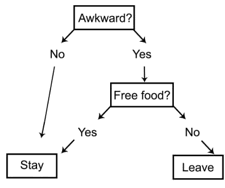
funny flowchart exampleWhen creating financial statements, there are “generally accepted accounting principles” (GAAP) so that all companies follow the same standardized set of rules. After reading 100+ books on personal finance, you could also create what I would call “generally accepted personal finance principles” (GAPFP?), as organized into a flowchart below by u/atlasvoid in the r/personalfinance subreddit. Hat tip to the NYT article So You Saved a Little Money This Past Year. Now What?. (Click to see full version. Might be hard to read on mobile.)

There are also additional versions for Canada, Australia, European Union, Ireland, New Zealand, and the United Kingdom.

I view this as the next step up in detail from personal advice on a 3×5 index card, while still trying to maximize the amount useful information in the given space. You might have some minor quibbles with the ordering or want to add some exceptions, but it still provides a good place to start additional research.

iCloud Photos Backup Options: Direct Transfer to Google Photos, Bulk Download Tool

As an iPhone user, I store nearly all of my precious photos on their iCloud service. I used to backup my photos on Google Photos since they offered free unlimited storage at “high” quality, but Google announced it will stop offering this feature on June 1, 2021. After 6/1/21, all photos will count towards your overall storage limit (15 GB free). However, all photos uploaded before 6/1/21 will be grandfathered in and will not be counted towards your storage limit.

New iCloud to Google direct transfer tool. This means I have one last chance to make a free backup snapshot of my current iCloud photos. Uploading via app was taking forever, so thankfully Apple just released a new tool that promises to directly transfer all of your iCloud photos over to your Google Photos account. There are some limitations, but here are the directions from Apple Support:

1. Sign in with your Apple ID at privacy.apple.com.
2. Select Transfer a copy of your data.
3. Follow the prompts to complete your request.

iCloud bulk download to local physical drive. In addition, you use the same data privacy tool to download all of your iCloud photos directly onto your computer (or external hard drive) as one huge file. Look for “Get a copy of your data”. It takes them a few days to put it together, but then the download should be much faster than on a photo-by-photo basis. I don’t have enough space to store all my photos on my laptop, but USB flash drives are cheap enough now that I think it’s worth it to create a physical backup copy annually and just leave it in my safe deposit box or safe.

Amazon Prime membership = unlimited cloud photo storage. Something like 2/3rds of all online shoppers have an Amazon Prime membership. If you have an Amazon Prime membership, Amazon Photos will include unlimited photo storage at full resolution. (They only store up to 5 GB of video.)

Amazon Photos offers unlimited, full-resolution photo storage, plus 5 GB video storage for Prime members. All other customers get 5 GB photo and video storage. Securely store, print, and share your favorite photos from the Amazon Photos app. Keep your memories close at hand on devices like Fire TV, Echo Show, and Amazon Fire tablets. Backup your photos to the cloud. Once you save your pics to Amazon Photos you can safely delete them from your device to free up space.

I admit, Apple got me with iCloud and I also pay for their service. I still back them up elsewhere though, as I don’t want to risk losing any sentimental photos. I try to buy discounted Apple gift cards whenever available, and then load them to my Apple account.

Slide: Up to 5% Back at Instacart, eBay, Uber Eats, Grubhub, Doordash via Instant Gift Cards ($20 Bonus)

Instacart update: Slide now includes 4% back at Instacart (5% cash back if you pre-fund). My Instacart tip is to stay logged into the app on your phone and wait for them to send you periodic promotions. At least once a month, I will either get offered $20 off $100, $10 off $50, or a free delivery fee. Stacking this Slide discount and credit card rewards, it basically allows me to at least break even with tip. My goal is to pay either the same or a little less than if I bought it in-person, while also saving time as I avoid shopping with my kids during COVID. (New users can get $10 off their first order with my Instacart referral link.)

New $20 Slide referral promo: Open a new account via Slide referral link and get $5 credit towards your each of your first four purchases (up to $20 bonus total). Each purchase only needs to be at least $10 (minimums vary by retailer), so you can get $40 of gift cards (4 times $10) for $20. Thanks if you use it!

Updated full review:

Slide is a new iOS and Android app that sells you discounted, new gift cards in exact amounts that are delivered digitally instantly. Basically, it is designed to allow you to wait until the moment before purchase when you already have the final purchase price (in-person or online), and then go buy a discounted gift card via the app down to the penny (usually a $25 minimum). The main problem with gift cards is waste when you don’t use it all. This avoids the waste. You can get 4% cash back at all of these retailers (not the full list):

  • Instacart
  • eBay
  • Grubhub
  • Uber and Uber Eats
  • DoorDash
  • Dunkin Donuts
  • Domino’s
  • Lowe’s
  • Panera
  • Burger King
  • Taco Bell
  • Chipotle
  • Southwest Airlines
  • GameStop
  • Google Play
  • Petco
  • Bass Pro Shops
  • Ulta Beauty

You get 4% cash back from the gift card purchase, but you also get 1% cash back when you pre-load your Slide balance with a credit card. You must pre-load in set increments, but you can but the gift cards down to the penny. In this way, you can actually get 5% cash back total. The app is from company behind the gift card marketplace Raise.com, so I trust it to be reputable, and these are not secondhand gift cards.

You still earn your normal credit card rewards as well (ex. 2% total cash back with Citi Double Cash), although I don’t think Slide will count as any special category. For physical stores, the app will provide a barcode for easy scanning. You can cash out at $15 via PayPal or Venmo, or apply smaller balances towards your next gift card purchase. I have already successfully cashed out my Slide balance via Venmo with no issues.

Grubhub test run. My first use was with my a Grubhub order. First, you’ll want to download the Slide app. As of right now, Slide gives you 4% cash back on Grubhub gift cards of at least $25+. You can get an additional 1% by pre-loading your Slide balance ($25 minimum) via credit card using any amount down to the penny (total 5%).

Then, I did my Grubhub order and got to the final page with the total including tip. Grubhub gift cards can cover tips. If the total is under $25, then you would still need to buy a $25 gift card from Slide and then use the remaining balance later. If the total is, say, $33.44, then you can buy a gift card for exactly $33.44. It works with Apple Pay and Google Pay, so I didn’t have to spend any time entering credit card numbers. I was able to copy/past the gift card code back into the Grubhub app and use it immediately without issue.

I mostly use the food delivery apps only when they have a good promo to offset all those fees, and here I was able to also stack a “free sandwich” promo and Grubhub+ free delivery on top of all these other discounts.

More discounts for even more complexity!? You can also stack with cashback shopping portals. TopCashBack and DollarDig offer cashback on Slide app purchases. Rakuten, TopCashBack, and other portals offer cashback on Grubhub, Uber Eats, and other food delivery apps.

Let’s say you bought exactly $25 of Grubhub food. Right now you could theoretically get 3% back on your Slide purchase from TopCashback ($0.75), 5% cash back from Slide itself on the Grubhub gift card ($1.25), and another 2% from TopCashBack for your Grubhub purchase ($0.50). That’s a total of 10% off for making some strategic clicks. You also get your points/miles/cashback from paying Slide with your credit card.

Slide may also be good for some larger purchases, for example at Lowe’s or Southwest Airlines, but remember that using a credit card can sometimes include other benefits like an extended warranty or travel insurance. I recently used it on a larger eBay purchase (refurbished Dyson vacuum direct from Dyson) and earned the cash back with no issues.

Disclosure: This post includes affiliate and referral links, where I am compensated if you click through and make a purchase. Thanks if you use them!

BofA Business Advantage Unlimited Cash Rewards Mastercard: $500 Statement Credit

The Bank of America Business Advantage Unlimited Cash Rewards Mastercard® credit card (yes, that is really the official name!) is the no-annual-fee “cash back” credit card in the Bank of America small business card line-up. The normal bonus recently has been a $300 statement credit, but this special link has a $500 statement credit after spending $5,000 within the first 90 days. Here are the cash back highlights:

  • 3% cash back on your choice of one of the following six categories: gas stations (default), office supply stores, travel, TV/telecom & wireless, computer services or business consulting services.
  • 2% cash back on dining and unlimited 1% cash back on all other purchases. The 3% and 2% cash back applies to the first $50,000 in combined category/dining purchases each calendar year, 1% thereafter.
  • No annual fee.

This card really gets interesting if you can take advantage of their Preferred Rewards for Business program, which can boost your effect cash back rates by up to 75% (to effectively 5.25% on your selected choice category, 3.5% on dining, and unlimited 1.75% cash back on all other purchases.) Unfortunately, the Preferred Rewards for Business program is separate from the consumer version of Preferred Rewards. You will need a eligible Bank of America business checking account, as well as 3-month combined average daily balance of $20,000 or more in qualifying Bank of America business deposit accounts and/or Merrill® business investment accounts.

You can find more information on the consumer Preferred Rewards program in my review of the consumer version of this card, the Bank of America Cash Rewards card.

I will be adding this to the Top 10 Best Small Business Card Bonus Offers. Chase Ink Business Unlimited, Chase Ink Business Cash, and US Bank Business Leverage cards are also on that list. Each has different rewards structures, and the best ongoing card will depend on your business expense needs.

Berkshire Hathaway 2020 Annual Letter by Warren Buffett

Berkshire Hathaway (BRK) released its 2020 Letter to Shareholders over the weekend. If you also found reading this letter and Charlie Munger’s Daily Journal transcript an enjoyable way to spend your weekend… you might be an investing geek! As usual, the letter is not long at 15 pages. Here are my personal highlights.

I found the overall theme to be “Here’s a reminder of the many ways that Berkshire Hathaway is different than other companies”. For example, Buffett and Munger both started out with partnerships, where they invested nearly all their own net worth alongside their partners. They treated the investments as carefully as if it was their own money, because it was! I want to take the same care in writing this blog. I want to write things that I would want to read myself, and make recommendations that I would want to see being made to my own family and friends.

A minor surprise was that Buffett’s biggest purchase was $25 billion of BRK’s own shares in 2020 – roughly 5% of all outstanding shares! In other words, they though BRK itself was one of the best investments available in 2020. I guess I should have bought more BRKB when it was lingering at $165 a share.

Last year we demonstrated our enthusiasm for Berkshire’s spread of properties by repurchasing the equivalent of 80,998 “A” shares, spending $24.7 billion in the process. That action increased your ownership in all of Berkshire’s businesses by 5.2% without requiring you to so much as touch your wallet.

He also bought shares of a few big companies like Chevron ($8.6 billion) and Verizon ($4.1 billion), but it would seem that he thinks that most public and all available privately-held businesses are overpriced right now.

While Buffett indirectly pointed out that his Apple shares have gained nearly $90 billion for shareholders ($120B current value minus $31B cost basis), he also admitted a mistake in the price he paid for Precision Castparts:

The final component in our GAAP figure – that ugly $11 billion write-down – is almost entirely the quantification of a mistake I made in 2016. That year, Berkshire purchased Precision Castparts (“PCC”), and I paid too much for the company.

High prices for a stock can be a temporary illusion:

Investing illusions can continue for a surprisingly long time. Wall Street loves the fees that deal-making generates, and the press loves the stories that colorful promoters provide. At a point, also, the soaring price of a promoted stock can itself become the “proof” that an illusion is reality.

But, we should still appreciate our ability to own shares of wonderful businesses by buying shares with just a few clicks:

It took me a while to wise up. But Charlie – and also my 20-year struggle with the textile operation I inherited at Berkshire – finally convinced me that owning a non-controlling portion of a wonderful business is more profitable, more enjoyable and far less work than struggling with 100% of a marginal enterprise.

Be realistic about your expectations for bonds:

And bonds are not the place to be these days. Can you believe that the income recently available from a 10-year U.S. Treasury bond – the yield was 0.93% at yearend – had fallen 94% from the 15.8% yield available in September 1981? In certain large and important countries, such as Germany and Japan, investors earn a negative return on trillions of dollars of sovereign debt. Fixed-income investors worldwide – whether pension funds, insurance companies or retirees – face a bleak future.

Don’t take on unknown risk to chase higher yields:

Some insurers, as well as other bond investors, may try to juice the pathetic returns now available by shifting their purchases to obligations backed by shaky borrowers. Risky loans, however, are not the answer to inadequate interest rates. Three decades ago, the once-mighty savings and loan industry destroyed itself, partly by ignoring that maxim.

Buffett shared some historical profiles of Berkshire-owned companies that started out only as an idea from a single person or couple with limited funds. Through many years of hard work, determination, and taking advantage of the opportunities available in America, these turned into huge businesses. You may recognize the names: GEICO, See’s Candies, Clayton Homes, and Pilot Travel Centers.

Our unwavering conclusion: Never bet against America.

On the creation of wealth (reminds me of this):

Productive assets such as farms, real estate and, yes, business ownership produce wealth – lots of it. Most owners of such properties will be rewarded. All that’s required is the passage of time, an inner calm, ample diversification and a minimization of transactions and fees. Still, investors must never forget that their expenses are Wall Street’s income.

Past shareholder letters.

  • 1977-2020 are free on the Berkshire Hathaway website (PDF). 1965-2019 are $2.99 at Amazon (Kindle). Three bucks seems pretty reasonable for a permanent copy with the ability to search text and maintain highlights.
  • 2018 Letter discussed why BRK will continue to do fine without Warren Buffett around.
  • 2018 Letter discussed using debt very sparingly and the importance of holding productive assets over a long time.
  • 2017 Letter discussed patience, risk, and why they have so much cash.
  • 2016 Letter touched on the rarity of skilled-stock pickers and some insight on his own stock-picking practices.
  • 2015 Letter discussed his optimism in America and his “Big 4” stock holdings.
  • 2014 Letter discussed the power of owning shares of productive businesses (and not just bonds).
  • 2013 Letter included Buffett’s Simple Investment Advice to Wife After His Death.

The annual shareholder meeting will be virtual again this year, but at least it will include Charlie Munger! Yahoo Finance will livestream it on May 1st at 1pm EDT. I will probably wait to listen in the car via the Yahoo Finance podcast version.