Archives for March 2021

Evidence-Based Doomsday Prepping and Personal Finance

I dug into the longread Doomsday prepping for less crazy folk today. The title pretty much says it all – I prefer to call it “evidence-based doomsday prepping”.

Effective preparedness can be simple, but it has to be rooted in an honest and systematic review of the risks you are likely to face. Plenty of excited newcomers begin by shopping for ballistic vests and night vision goggles; they would be better served by grabbing a fire extinguisher, some bottled water, and then putting the rest of their money in a rainy-day fund.

[…] I also found that to come up with a rational threat model, we need to think of “risk” as a product of both the probability and the consequences of a given event. By that metric, stubbed toes and zombie outbreaks are equally uninteresting; one of them has nearly zero significance, the other, nearly zero odds.

Strangely enough, my favorite part might have been the section on getting in shape and losing weight, as it very closely matched my own experiences and opinions on the topic. But since this is my money blog, I’ll talk about the personal finance aspects. If you’re going to build a resilient lifestyle, you’ll need some assets and figure out how to protect them.

Good ole’ emergency fund. The most likely “disaster” you’ll face is probably unemployment. Forget retiring at age 30, you’re just trying to survive having no income (or a severe cut) for 6 months. If you can figure out how to build a stash of 6 months of living expenses, you’ll already be way ahead of most people and have a rough blueprint for eventual financial freedom anyway.

Cash. You should be prepared to not have access to banks or ATMs for a short period of time. It could be a huge systemic crisis, or you might simply have a bad case of identity theft. Cash is still mighty handy for anything other than an extremely severe event – although it might be good to smaller bills.

For short-term survival, simple solutions work best: just keep about 2-4 weeks’ worth of cash somewhere at hand; have enough money on you to get you back home when traveling, too. Of course, be mindful of the risk of burglary, so if you’re keeping the funds at home, pick an unobvious location for the stash; more about that soon.

Break-ins are difficult to prevent, especially in suburban single-family homes with secluded backyards and street-level windows and doors; tall fences and window bars can work, but they are expensive and tend to draw the ire of your neighbors. The most cost-effective solution may be to keep your windows and doors closed when away, but beyond that, just optimize for hassle-free outcomes. You can leave some less important goodies in plain sight – say, some cheap jewelry, a modest amount of cash, and a beat-up phone – and put all the real valuables in a much less obvious or less accessible spot. A heavy safe will usually do; diversion safes fashioned into books, cans or clocks are pretty cool, too – if you trust yourself not to accidentally throw them away.

Banking. The author suggests splitting your money between two unrelated banks. This practice could easily extend to your brokerage accounts.

As for the remainder of your money, I suggest splitting it across two largely unrelated financial institutions with different risk profiles – say, a big national bank and a local credit union.

Gold. Before you follow the safety box suggestion, know that banks aren’t responsible if they lose the contents of safe deposit boxes. Serious preppers recommend paying for a reputable, international vault to store your gold – I imagine it to be dug deep into the mountains of Switzerland – but as noted that is expensive and reserved for those with a high net worth.

Because of its very high value-to-volume ratio, physical gold is stored and moved around very easily, but keeping substantial amounts at home can be ill-advised; theft is a very real risk, and most insurance policies will not adequately cover the loss. Safe deposit boxes at a local bank, available for around $20 a year, are usually a better alternative – although they come with some trade-offs; for example, the access to deposit boxes was restricted by the government during the Greek debt crisis in 2015. Non-bank storage services do not have that problem, but cost quite a bit more.

Bitcoin. Cryptocurrencies aren’t discussed at all, but they are meant to be independent of governments. If you put your keys into a hardware wallet, this is another store of value that could have an infinite “value-to-volume ratio” and possibly easier to move than gold or cash. Will Bitcoin be more or less valuable in a crisis? I don’t know. The answer also might change over time.

Stuff. Yes, yes, guns and ammo. But for the most likely scenarios the best thing you could have done was to take a bit of your money buy some everyday stuff: keeping your gas tank half full, keeping a full propane tank, packing a simple Go Bag with clothes/first aid kit/energy bars/extra prescription medicine, a few crates of water, and so forth. Fire extinguishers, fire ladders, smoke and CO detectors in every room could be the best money you ever spent. You might also throw in a will and an advanced health directive.

Insurance. I was surprised that there wasn’t a more detailed discussion of insurance. If we’re talking real-world life-altering disasters, either getting hit by a car or hitting someone else with your car has got to be one of the more likely ones. Do you have adequate health insurance? disability insurance? auto (liability) insurance? homeowners? flood? earthquake/hurricane add-on? Don’t forget these 11 reasons to buy an umbrella liability insurance policy.

Bottom line. There are many simple things that you can do to make your life more resilient that doesn’t involve building your own underground bunker, and many of it meshes with basic personal finance advice. Here’s a nice ending line to keep things in perspective:

In the end, ladders, cars, and space heaters are a much greater threat to your well-being than a gun-toting robber or an army of zombie marauders could ever be.
High-Yield Crypto Accounts: 6% Interest in Bitcoin or 9% Interest on Stablecoin

This WSJ article is the first mainstream financial article that I’ve seen discuss the high interest rates paid on Bitcoin and stablecoin (cryptocurrency backed by a “stable” asset like the US dollar). I am (again) not a cryptocurrency expert, but it does seem appropriate to educate and warn other curious investors about the risks. Here’s my take:

  • The price of Bitcoin can vary a lot. It probably went up or down by a hundred dollars in the time you took to read this sentence.
  • Stablecoin prices tend to vary less because they promise to be backed by a stable asset. USDT (Tether) and USDC (USD Coin) are both currently trading exactly at US$1.00, so it appears that the market believes this claim. However, US dollar stablecoins are not affiliated with the US government or any central bank.
  • Brokers/exchanges where you can buy and sell these cryptocurrencies are not backed by government insurance. They are businesses – some will end up worth billions, some will get bought by a bigger competitor, and some will probably fail (likely because they were hacked). Even though they might be called “savings” or “interest” accounts, no cryptocurrency is held in an FDIC-insured bank, or even an SIPC-insured brokerage account. They will promise to keep your crypto safe and pay interest, but it is possible they may not live up to their end of the deal, AKA “counterparty risk”. Not every exchange is equal.
  • This potential risk is a big reason that they have to pay you 6% annual interest in your Bitcoin and/or 9% annual interest in your USDC stablecoin. They are lending out your assets and earning even more interest, because traditional banks won’t do so.
  • The result is two separate risks – the risk of the price of crypto itself, and counterparty risk of the place holding your crypto.

In the end, I agree with this part of the article (even with the mocking tone):

If you’re a risk-taker who relishes the ride when an asset soars and can laugh off the losses when it crashes, then maybe you should consider letting a broker borrow your cryptocurrency at a generous rate.

After all, if you aren’t troubled by the extraordinary volatility of virtual money, you might as well earn some interest on it.

I did buy some crypto a few years ago as a purely speculative investment and to promote my own learning. We are talking less than 1% of net worth, but it has become a 5-figure amount. I was very skeptical at first, but now I am partial to the theory that either BTC is worth zero, or it will eventually be worth at least on par with the market cap of gold (roughly $200,000). I accept that both scenarios are possible.

I bought Bitcoin using the Voyager app ($25 bonus, publicly-traded with $3 Billion market cap) and also opened an account with BlockFi ($250 bonus, just completed $350m Series D at $3B valuation). Both of these companies are worth well over a billion dollars and gone though various rounds of funding, which isn’t bulletproof but it means that smarter people than me have vetted their security protocols and business practices.

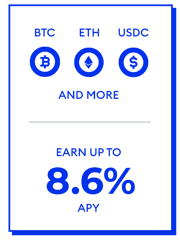
BlockFi pays me 6% interest on up to 2 BTC (8.6% on USDC) and Voyager pays 6.25% interest on BTC (9% on USDC). I reinvest the interest so that I own a little bit more BTC each month. However, I fully accept that I am getting paid this interest and getting the convenience of buying BTC with a few taps in exchange for the potential risk that they will go bust while losing all my BTC. There are other options like hardware wallets, but I am don’t want the inconvenience or to worry about forgetting my bitcoin passwords for my relatively small investment.

Bottom line. Sorry, you can’t earn a 9% “safe” interest rate on your cryptocurrency, even if it is a US-dollar backed stablecoin. At a minimum, you still have counterparty risk. This is a business lending out your assets, charging interest, and giving you a cut. They can go bust, and not all exchanges are the same. Perform your own due diligence when picking a broker/exchange to buy from. I picked what I think are among the safest, but it’s still risky.

Even though the interest rates are quite low, I keep my “safe” cash in FDIC-insured bank accounts and similar.

The Most Popular Ages When People Actually Claim Social Security

Although I’m still decades away from Social Security, I see a constant stream of articles about the “best” time to start taking benefits. Often, you are told to delay claiming until age 70, as you will receive a more valuable, inflation-adjusted, government-guaranteed payout for the rest of your life. But if you have a spouse, it may be better for one of them to claim as early as possible, at age 62. There are many calculators out there – here is one free tool for Optimal Social Security Claiming Strategy.

Apart from the theoretically optimal, when do people actually start taking Social Security? Here is a chart from this Morningstar article (which otherwise includes a lot of speculation):

The three most popular times are:

  • Age 62: As early as possible. Many people feel that they have little choice but to ask for the money the moment it is available. Some have health issues which change the odds against waiting. Some just want the bird in the hand now. Finally, this may be the mathematically optimal strategy for one member of a couple. Together, this makes ASAP the most popular choice by far.
  • Age 66: “Full” retirement. Although there is nothing technically magical about the age 66, it is called “full retirement age” for people retiring in 2019. This is when you’ll get “100%” of your “full” benefits, and anything less is called a “benefit reduction” and anything more is called an “benefit increase”. I wonder if behavior would change if they changed their wording? They could, for example, also just call 62 the base age and call everything after that a benefit increase.
  • Age 70: As late as possible. In order to decline “free” money from the government for 8 years, you must believe in your odds of having an average/above-average life expectancy and have enough financial assets to pay for your expenses during the wait. Less than 10% of people go this route. Your reward is a monthly benefit that is 33% higher than claiming at age 66, and 76% more than claiming at age 62. This increased income will also increase with inflation each year, and inflation-adjusted annuities are only sold by a few insurance companies and are quite expensive.

This matches my anecdotal experience from family and friends. Most people don’t consult a complicated calculator. They either take it as soon as they can for whatever reason, or they “follow the rules” and take it at the “full” retirement age. I’ll probably cough up the money for a calculator when the time comes.

Four Pillars of Retirement: Money, Purpose, People, and Health

While it is understandable that most talk about “retirement planning” concerns money, a truly successful retirement requires more than that. Coincidentally, the same week I was pondering the Components of Happiness, I also stumbled upon a 6-year leanFIRE update from LivingaFI. It was a very honest and thoughtful story of someone who carefully planned and quit their job at age 37. I usually focus on my reason for financial indepedence as “spending my time as I wish”, but now I realize that it may help to specifically address certain areas regularly.

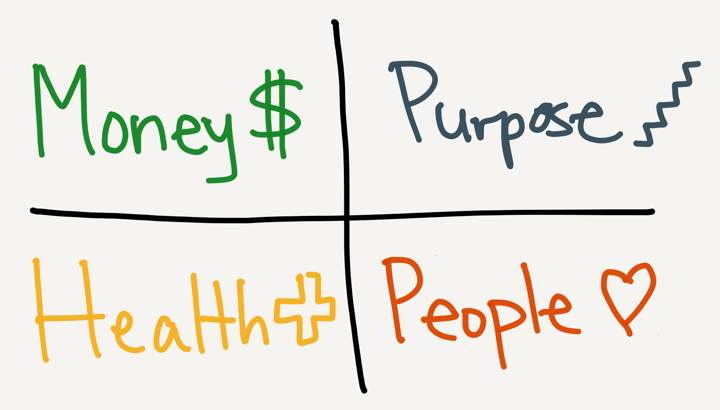
For your consideration, here are The Four Pillars of Retirement*:

  • Money: You need enough money to pay for housing, transportation, food, healthcare, and everything sold at Walmart/Target/Amazon/Costco.
  • Purpose: You need to feel that you are useful, moving forward, pursuing a goal, and/or making the world a tiny bit better.
  • People: You need love. Love and social interaction from your life partner, children, family, friends, and/or animal companions.
  • Health: You need to feel physically healthy, or be at peace with your level of health.

Imagine each pillar as one of the legs of a square table. We have to maintain and shore up any cracks before it gets serious. If you are lacking in any one of these pillars, your retirement gets wobbly. If any two are crumbling, that’s enough to make the entire thing tip over.

Most people say that they hate work, but working takes care of more than just the money pillar. In addition to income, work can provide a sense of purpose and self-worth, as well as a wide social circle. Some people just like having something fixed to build their routine around; they flounder with “nothing to do”. People often imagine retirement as a perpetual weekend – playing golf, eating out, travel, shopping, etc. – but it can get weird when all your friends are still working. Here is a WSJ article on how leaving work can put a lot of strain on couples.

It can be difficult to get out of the “I must be busy and productive” mindset. When you retire, use the opportunity to sit in the quiet and ponder what is most important to you. Choose your hard thing.

Finally, even if you have done all you can to be prepared, life still happens. The author of LivingaFi had nearly $1 million in assets, reasonable expenses, a committed life partner with a similar level of assets, lots of outside interests, and good health. This is not judgment, but a scary reminder for all of us: jobs, bull markets, relationships and good health can all end faster than you think. Your actions matter, but luck matters too. For example, the Social Security Administration says that a 20-year-old worker has a 1-in-4 chance of being disabled before retirement age. (Where available, we should buy adequate life, health, and disability insurance.)

My biggest blind spot was that if you have children, any one of them may also develop a health condition or other special needs that may require additional financial support indefinitely. I really didn’t appreciate the hidden struggles that so many families go through that is no fault of their own. I also didn’t fully appreciate how lucky I was to not have to deal with any of these things while growing up as a kid.

If you accept that luck matters in your investments, then the optimal choice might be to retire earlier with a more modest amount so that if things go well, you get more retirement years, but if things go badly, then you fall back on some part-time back-up work. Being willing to be flexible can pay off. You have to balance your odds of running out of money with the odds of running out of time.

On the other hand, if you are a high-earner, it might be better to work “One More Year” while you work on planning for the other pillars. Finding a new purpose, finding new friends, finding a new routine, it can be quite difficult. Looking back, I am thankful that we did not attempt to retire early and instead adjusted our hours (and income) downward while still keeping our foothold in the workforce. I’m still working on these pillars myself, but our middle path has worked well for us.

(* A nod to the classic The Four Pillars of Investing, one of the first investing books I ever read and reviewed here way back in 2004.)

TD Double Up Card: 2% Cash Back on All Purchases (TD Bank Deposit Account Required)

The TD Double Up card is a new cashback rewards credit card from TD Bank which earns up to 2% flat cash back on all eligible purchases without worrying about the merchant or category.

  • 1% cash back on purchases + 1% cash back when you redeem into an eligible TD Bank Deposit Account.
  • New customer bonus: $75 cash back via statement credit after $500 in purchases within the first 90 days.
  • 0% introductory APR on balance transfers for first 15 billing cycles.
  • No annual fee.

At first, I though this was not-so-subtle copycat of the Citi Double Cash card, which offers 1% on purchases + 1% when you pay Citi back for those purchases (which you should each month to avoid carrying a balance). Citi does not required any other accounts with them. Here, the restriction to earn that extra 1% back is that you must be an active holder of a TB Bank checking or savings account. TD Bank only offers accounts to customers in select states:

Connecticut, Delaware, Florida, Maine, Maryland, Massachusetts, New Hampshire, New Jersey, New York, North Carolina, Pennsylvania, Rhode Island, South Carolina, Texas, Vermont, Virginia, Washington, D.C.

Bottom line. If you are a TD Bank customer, the TD Double Up card is another welcome option for a simple flat 2% cash back credit card with no annual fee. Everyone should have a 2% cash back card in their purse/wallets, even if they have other cards with higher cashback in specific categories. If you don’t bank with TD Bank or have a Fidelity account, check out the Citi Double Cash card.

Gold as a Hedge Against Bonds During Low Interest Rates

Perhaps it is because I somehow ended up buying $5,000 in gold coins a couple weeks ago, but I’ve been doing some reading about gold again. The stock market is at higher and higher valuations, while the Fed promises that interest rates will stay low for a long time. The real yield on TIPS remains negative, meaning that it is highly unlikely that any high-quality investment-grade bonds will beat inflation over the next decade. Is there really no alternative?

This Compound Advisors article does a great job exploring why gold is not an ideal hedge against inflation. The comparison chart below of performance since 1975 summarizes things in one picture. Over the 50 years since the US came off the gold standard, gold has only barely kept up with inflation while stocks and REITs… well, just look:

Here is the price of gold over the last decade (FRED).

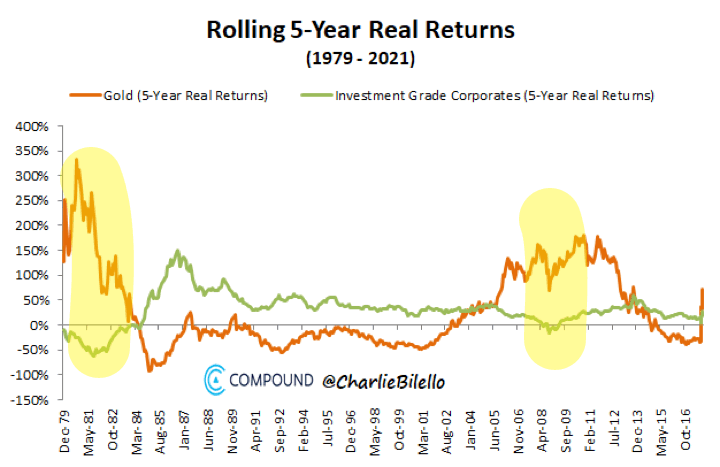
Okay, so maybe I’m not interested in holding a huge chunk of gold as a long-term asset. But what about a little bit during this strange period of negative real yields? Movement Capital points out in the chart below that gold prices are “tethered” to real interest rates. Gold prices seem to go up when bonds stop keeping up with inflation.

If you own bonds, it is quite possible that your return this year has been negative. I peeked and the Vanguard Total Bond ETF (BND) is down 4% YTD (as of 3/19/21). Gold seems to perform best when bonds perform their worst, as highlighted below:

Therefore, if bonds are supposed to keep your portfolio safe, but right now they are in the vulnerable position of paying out less interest than inflation, gold might be a good complement. Even if gold just matches inflation, you would still come out ahead. Of course, gold often feels so volatile that it is hard to rely on the price for anything specific.

I’ve said before that I simply don’t have the proper faith in gold to own it long-term, and I’m still in that place. I suppose my primary observation is that low interest rates have made nearly everything go up in price (stocks, bonds, real estate, Bitcoin), but gold seems to be mostly ignored.

Free Krispy Kreme Donut Every Day in 2021 w/ Vaccine Card

Krispy Kreme is giving away a free Original Glazed doughnut if you show them your COVID-19 vaccination card. This is valid once a day, every day for the rest of 2021! Valid in-store or drive-thru in participating US locations. No purchase required. No, they won’t take a picture of your card.

You don’t need to eat a doughnut every day, but it’s a nice gesture and this means you can just pop in whenever you feel like it. If you happen to stop in on a Monday starting 3/29, you can get a free donut and a medium brewed coffee for free, no purchase required. Monday Coffee offer does not require any vaccination card and expires 5/24/21.

ZYNLO Bank Review: 1.25% APY (No Longer Available To New Signups), 100% Match on Roundups

Update: As of 4/8/21, the ZYNLO website now lists their money market as “no longer available”, although the rate is still 1.25% APY if you opened it in time. The savings account pays 0.80% APY and still includes the roundups. There is a new “Tomorrow Savings” account that only pays 0.40% APY, so I’m not sure why anyone would pick that one.

ZYNLO Bank is another new “digital-first” bank, backed by the FDIC insurance of PeoplesBank in Massachusetts. Along with the common features of no monthly fees and Allpoint ATM network access, ZYNLO differentiates itself from the banking app crowd in a few different ways.

0.80% to 1.25% APY. Their main page advertises 0.80% APY on their Money Market account, which is already a competitive rate, but if you enter the promo code BANK (should auto-populate at this promo link) at account opening, they promise a higher promo rate of 1.25% APY on up to $250,000. Looks like promo code NERD gives the same result. Unfortunately, there is no rate guarantee as to how long either rate will last.

100% match on Roundups. When you purchase something with the ZYNLO debit card from their checking account (ex. $4.44), they will round up the transaction to the nearest dollar (ex. $5), deposit that amount (ex. 56 cents) into your savings account, and also match that amount (ex. another 56 cents). Their Savings Account (not the same as Money Market) offers a 100% match on “roundups” during their first 100 days. After that, you must maintain an average daily balance of $3,000 to continue to receive a 100% match. Otherwise, you only get a 25% match. The savings account pays negligible interest.

Let’s say you make 20 debit card purchase per month. If your purchase amounts are random over time, you will average a roundup of 50 cents per transaction. At a 100% match, that works out to $10 a month in matches per month (plus $10 of your own money being put aside in savings for you). 40 debit transaction per month = $20 a month at 100% roundup, and so on. If you make a lot of debit card purchases, it might be worth keeping a $3,000 balance to keep that 100% match.

Note that they don’t accept applications from a few states:

Who can use ZYNLO?
Any U.S. citizen 18 or older with a valid Taxpayer Identification Number. We can open accounts for people throughout the United States with the exception of CA, CT, MA, & NY.

My take. The money market promo rate may be attractive to those with very high balances as it applies to balances up to $250,000. The roundup matching might be attractive for people that make a lot of purchases on their debit cards. The negative is that there is no rate guarantee period and thus the slightly higher promo rate may not be high to guarantee a solid return over what might be a short period of time, given the other bank options near 3% APY available.

Hat tip to DepositAccounts.

Happiness Test Questions? The Components of Happiness and Well-Being

As part of the first week of The Science of Well Being (AKA the “Yale happiness” class), I was assigned two psychological surveys meant to measure my baseline happiness:

  • PERMA Profiler (Positive emotion, Engagement, Relationships, Meaning, and Accomplishment), “Measures Flourishing”
  • Authentic Happiness Inventory, “Measures Overall Happiness”

How happy am I? The types of questions asked were interesting, as it revealed what the creators believed were the components and characteristics of happiness and high levels of well-being. I have a hard time believing that anyone never feels lonely or that they always for excited and positive about life, but…

Here’s how the world’s happiest person might answer these questions:

  • I consistently feel that I am making progress towards accomplishing my goals. I have direction in my life.
  • I consistently become absorbed in what I am doing. Time seems to pass quickly when I am working.
  • I rarely feel anxious.
  • I consistently achieve the important goals that I set for myself. I am successful at what I do.
  • I am in excellent health and am satisfied with my level of health.
  • I consistently lead a purposeful and meaningful life. I spend my time on things that are important.
  • I consistently receive help and support from others when I need it.
  • I consistently feel that my life is valuable and worthwhile.
  • I am consistently excited and interested in things.
  • I rarely feel lonely.
  • I consistently feel positive and rarely sad nor angry.
  • I consistently feel loved.

If aren’t part of the online class, you can sign up for a free account at the UPenn Authentic Happiness website to take them yourself. They list many other happiness assessment options as well.

My own measured happiness levels ended up somewhere a bit above the middle of their scales. I hope you didn’t think I was deliriously happy, I definitely could do better – why else would I sign up for this course?

Topics not addressed. Neither survey asked about any of the following items. Perhaps they don’t correlate with happiness and well-being? Perhaps they do but just not as much as the topics they did ask about? Perhaps something else altogether.

  • Salary/income
  • Net worth
  • Marital/relationship status
  • Number of children
  • Prestige of job title
  • Quality of stuff (size of home, brand of car, model of smartphone)
  • Physical beauty or attractiveness.

Free Practical Course To Improve Your Happiness from Yale University

Want to take a free online class together with me (and 3.3 million other people)? The NYT had a nice profile of the free online course The Science of Well-Being offered by Yale University on Coursera. (It was the most popular class ever taught at Yale.) I’d heard about this class before and have even taken other courses at Coursera, but I had the mistaken impression that it was more of a lecture series. In reality, the course requires weekly practice to help you “rewire” and permanently change your behavior based on psychology research.

In this course you will engage in a series of challenges designed to increase your own happiness and build more productive habits. As preparation for these tasks, Professor Laurie Santos reveals misconceptions about happiness, annoying features of the mind that lead us to think the way we do, and the research that can help us change. You will ultimately be prepared to successfully incorporate a specific wellness activity into your life.

I’m not sure how often the course runs, but I’m enrolled in the one that starts today, March 17th, 2021. I’m guessing they’ll keep enrollment open for a little while longer at least. Here’s my first message after enrolling, which gives you a better idea of what to expect:

Congratulations on taking part in this journey! Over the next several weeks, we’ll explore what new results in psychological science teach us about how to be happier, how to feel less stressed, and how to flourish more. We’ll then have a chance to put these scientific findings into practice by building the sorts of habits that will allow us to live a happier and more fulfilling life.

Each week you will have requirements (graded quizzes) and “rewirements” (weekly practices aimed at rewiring your habits to boost mood and overall well-being). The final project asks you to practice a scientifically validated wellness behavior for four weeks and write about the experience.

Even though the course is completely free (skip the $49 certificate), it is one of those “you get out what you put in” situations. The course runs for 10 weeks and is estimated to require a consistent commitment of 1-2 hours per week. In a given week, you might track your sleep patterns, keep a gratitude journal, perform random acts of kindness, or try to meditate regularly.

You take an initial happiness assessment (answer a bunch of questions) in the beginning and another one at the end of the course. In this way, you have a way of measuring of whether taking these new actions has changed your well-being. Even a small improvement in happiness has to be a pretty valuable thing, no? I mean, think of how often we try to gain a little bit of joy through buying a new object (home, car, phone, shoes, meal).

The creator and professor of this course, Dr. Laurie Santos, also has a podcast called The Happiness Lab. Another popular online course with broad application is Learning How to Learn: Powerful mental tools to help you master tough subjects.

TIPS Inflation Bonds Performance: Breakeven vs. Actual Inflation Rates

I own inflation-linked bonds as part of my investment portfolio. Specifically, Treasury Inflation-Protected Securities (TIPS) make up about 1/3rd of the bond portion, or 10% of my total portfolio. I go into more detail in my post Reasons To Own TIPS, but essentially they pay interest based on a fixed real yield plus ongoing inflation. To simplify: if the real yield is 1% and inflation is 3%, they pay 4%.

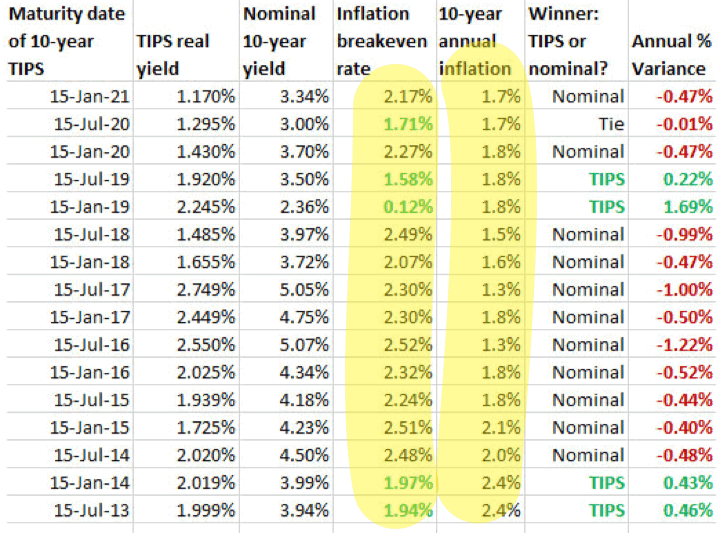
Traditional “nominal” Treasury bonds simply pay a flat interest rate that doesn’t change with inflation (i.e. 3%). The difference between the TIPS real yield and the nominal Treasury yield is at any given time is what inflation would have to be for them to pay out the exact same total yield, called the “breakeven inflation rate”. If the real yield on TIPS is 1% while the nominal rate is 3% at the same moment, then the breakeven rate is 2%. You could call it a market-based prediction of future inflation.

It turns out that 10-year TIPS bonds that matured over the last several years mostly underpeformed regular nominal Treasuries, as the actual inflation turned out to be less than the breakeven inflation rate. David Enna of TIPS Watch created the interesting chart below comparing the final performance of TIPS vs. nominal Treasury bonds maturing over the last several years, where green means that TIPS “won” and red means TIPS “lost” in terms of total return. I removed some columns and highlighted the initial breakeven rate (the market-based guess) and the actual inflation rate.

Enna states:

Still, the market-determined inflation breakeven rate measures sentiment and should not be viewed as an accurate prediction. In fact, the market often does a lousy job of predicting future inflation. The fact is, over the last decade, investors have been betting on higher inflation than actually resulted, and that has led to TIPS (in general) under-performing nominal Treasuries of the same term.

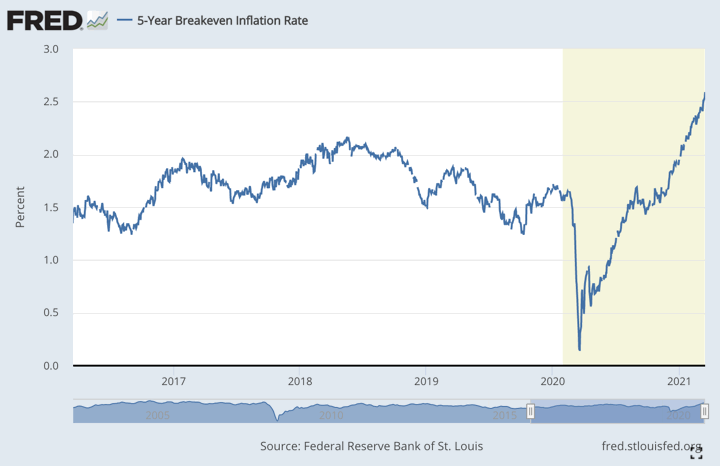
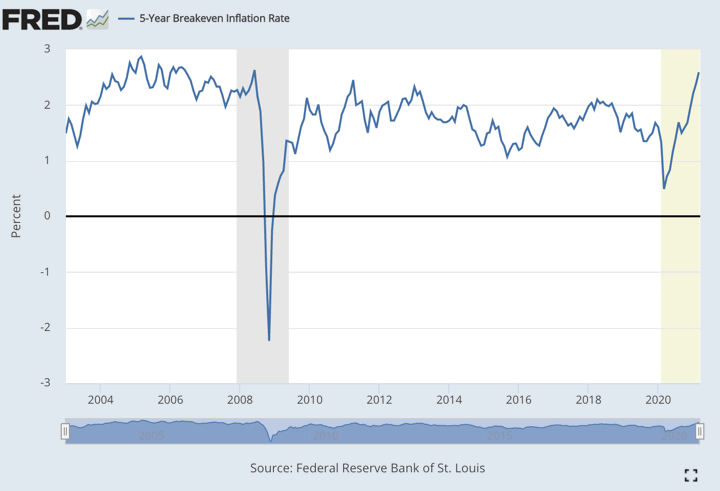
I have read some articles suggesting that you could adjust your TIPS holdings based on the real yield, but perhaps another way is to adjust your holdings based on inflation breakeven rate instead. You can track the 5-year and 10-year breakeven inflation rates at FRED. As of this writing in March 2021, the breakeven inflation rate has been rising very quickly since dropping quickly in early 2020.

The last time that the breakeven inflation rate dropped so drastically was in 2009. As with stocks, it can pay off to buy when everyone else is afraid. I was lucky to buy a chunk of long-term TIPS in 2009, but I didn’t buy much in 2020 since the real yields were still quite low.

I hold Treasuries, TIPS, and FDIC/NCUA-insured CDs because I like my “safe” assets to be of the highest quality, with no worries about getting both my principal and interest. In addition, TIPS also serves as a hedge against higher-than-expected inflation. However, that also means I might suffer if there is lower-than-expected inflation. My “insurance” didn’t pay out over the last 10 years, but that’s okay. I’m also fine if my don’t make a claim on my auto insurance, homeowners insurance, (and definitely life insurance!).

p.s. If you want to buy TIPS, these days you should consider buying Series I Savings Bonds first these days (up to the purchase limits). Their 0% real yield is better than the negative real yields on nearly all TIPS right now.

Neighborhood Nosh Review: Up to 10% Back at Participating Restaurants

Neighborhood Nosh (formerly iDine) is a promotional service allows you to earn cash back when you dine at participating restaurants and pay with your linked credit card. You may already be familiar with using Rewards Network to earn airline and hotel points, but this is a rebrand of their standalone program which offers cash back in the form of an American Express gift card. Here is the standard structure:

  • Sign up for a free account and provide your credit/debt card numbers. (I believe they only ask for the 16 digits. They won’t charge anything on it.)
  • If you use that linked card to pay for a meal at a participating restaurant (dine-in, takeout, or direct delivery), you will automatically earn cash back rewards on the entire amount including tip.
  • No membership cards, no coupons, no apps. You don’t do anything that announces that you are seeking a discount.
  • Earn either 5% or 10% back.

Usually, you earn 5% back until you reach $750 in spending with in the calendar year. After that, you start earning 10% cash back.

New and existing member promo. Right now, existing members get 10% back until 4/4/21. If you sign up as a new member by 7/31, link a card, and pay with that card within the first 30 days, and opt-in to their marketing emails, you’ll also earn 10% cash back right away.

Existing iDine member rewards will also automatically be transferred to Neighborhood Nosh.

Cash out details. It appears they will mail you a physical AmEx gift card once you reach a rewards balance of $20.

After a member reaches $20 in accumulated restaurant rewards from Neighborhood Nosh, an American Express® Reward Card will be mailed the following month with all available rewards. Rewards in an amount less than $20 are subject to expiration if no dining activity occurs within one year from the date the rewards were originally earned.

My take. I like the fact that you don’t have to do change your existing eating habits to earn extra rewards. I could simply link the card that I put most dining purchases on (for example the Chase Sapphire Preferred 2X or Chase Sapphire Reserve 3X points or the American Express Gold 4x points) and then promptly forget about it for the most part. If the restaurant I visit happens to be part of the program, then I get some free rewards as a nice surprise.

I do look through their list of participating restaurants when I want some miles activity for a specific airline to avoid the expiration of points. Each of your credit cards can only be linked to one type of Rewards Network account. I usually have 5-7 different credit cards linked to 5-7 different programs, so I can pick up points from a specific program as needed with a single targeted purchase. You have to plan ahead a little bit, as the points can take a while to post.

Now, if you eat at a participating Rewards Network restaurants regularly, then the 10% cash back from Neighborhood Nosh could really add up. Could be worth a look.