Archives for August 2020

Vanguard Prime Money Market Fund Changes

Vanguard is making a few changes to their Vanguard Prime Money Market Fund, which is often their highest-yielding option:

  • Name change. Vanguard Prime Money Market Fund will change its name to Vanguard Cash Reserves Federal Money Market Fund.
  • Even safer. It will now invest only in securities fully backed by the U.S. government or cash. I believe that they used to invest in some highly-rated short-term commercial paper.
  • Even cheaper. Basically, everyone will get the lower expense ratio from Admiral shares which previously had a $5,000,000 minimum (!). The minimum investment to get started is still $3,000.
  • No more checkwriting. You can still get checkwriting with certain other funds, including the Vanguard Federal Money Market Fund.

The actionable event here is that if you own the Prime Investor Shares (VMMXX), you can manually convert to the Admiral Shares (VMRXX) to immediately take advantage of the lower expense ratio (and thus higher yield) instead of waiting until possibly 2021:

Existing Investor share owners (VMMXX): You have the option to immediately convert† to Admiral Shares to begin taking advantage of the lower expense ratio. You can find simple step-by-step instructions here. If you don’t initiate a conversion, you’ll be automatically converted sometime between late 2020 through 2021. Note: Our checkwriting service isn’t available for the fund’s Admiral share class. Checkwriting is available for Vanguard Federal Money Market Fund and other Vanguard money market funds.

While this fund usually offers one of the highest cash sweep amongst brokerage accounts, the interest rate is still really low at about 0.10% SEC yield right now. At the same time, many online savings accounts are at about 0.80%. Still, if you own this fund you might as well convert now. The Vanguard Federal Money Market Fund remains Vanguard’s default cash sweep option, which historically has yielded slightly less than Vanguard Prime.

Schwab Plan Review: Free DIY Financial Planning Software

Schwab has rolled out a new digital financial planning tool called Schwab Plan. They claim it to be a simplified version of the same financial planning software used by many human financial advisors. From their press release:

Schwab Plan is a digital self-guided financial plan available through Schwab.com that helps investors build a personalized plan that includes a range of factors such as desired retirement age, retirement goals, social security expectations, portfolio risk profile and asset allocation, and various income sources.

[…] they are able to generate a retirement plan that shows retirement goals and probability of funding those goals, a comparison of an individual’s current asset allocation to a recommended allocation based on plan inputs, and suggested next steps to get and stay on track.

Access to this tool is free to anyone with any type of Schwab account. (Eventually, this should include TD Ameritrade clients as well.) There is no minimum asset requirement and you don’t need to sign up for a new service. For example, I was able to access it with only a Schwab PCRA brokerage window account. Here are a few initial impressions and screenshots after testing it out.

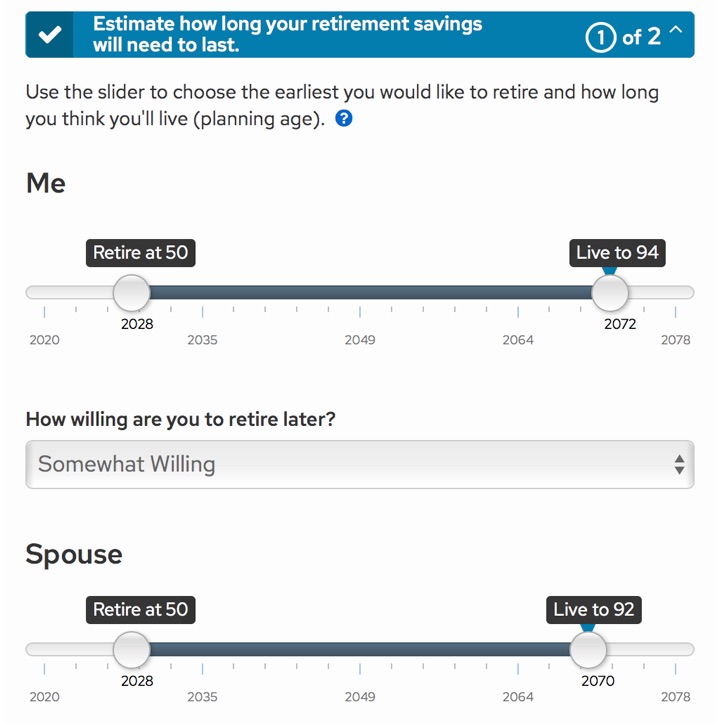
First, you enter some basic personal information like current age, gender, retirement age, and life expectancy:

Next, you estimate your income needs in retirement. They offer additional assistance in estimated your health insurance costs in retirement. You then enter your assets and income sources. Your Schwab accounts are automatically imported, and you can manually add the raw balances of additional external accounts (no account aggregation). They use your information to estimate your Social Security income, and also ask about stock options and restricted stock units.

(They don’t ask about children, college savings, term life insurance, disability insurance, or any of those smaller details that a full-service advisor would ask about. There is also very little customization available in terms of recognizing your external asset allocations.)

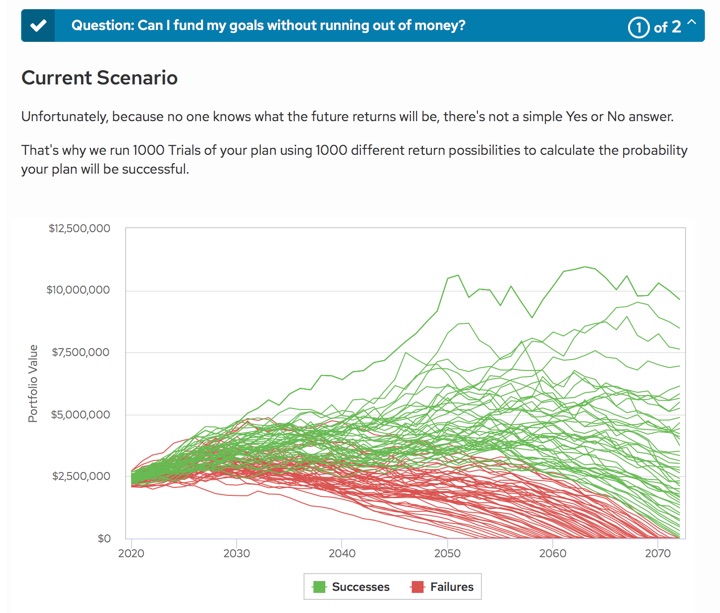
Once everything is entered, they run a Monte Carlo simulation to estimate your probability of success.

You can then adjust the variables, such your retirement age and future spending, in order to see how it affects your success rate. I found the analysis to be reasonably consistent with my other research, and I liked that the results changed significantly for an early retirement (45 year period) as opposed to a traditional retirement (30 year period). They use a “confidence zone” system:

(The Monte Carlo simulations above does not equate to an 86% confidence level. This was after making some tweaks to improve the results.)

Bottom line. Schwab has added a free financial planning tool for all of their customers (no minimum asset requirement). After testing it out, it is not quite “professional-grade”, but I did find it to be slightly more advanced than most other free options. I would recommend trying it out if you have any type of Schwab account. Of course, it also provides a pathway to upgrade to their other portfolio management services, and I still have concerns about their Intelligent Portfolios product.

MMB Household Money Flowchart (Money Map)

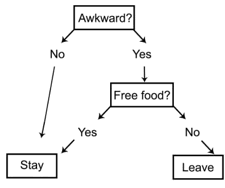
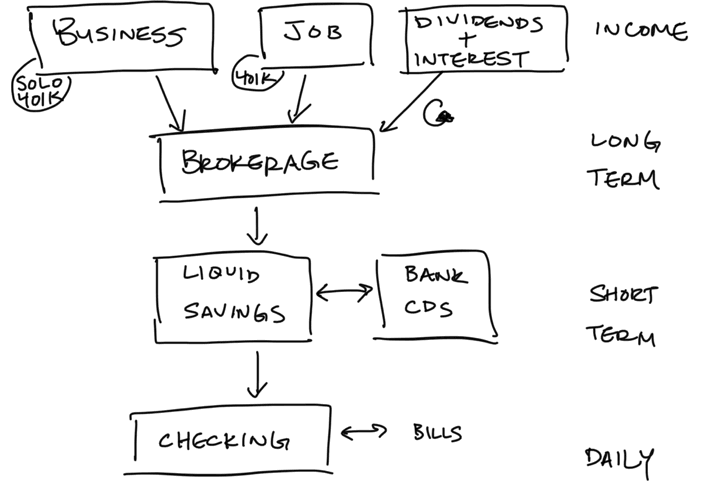
funny flowchart exampleA reader asked me to complete a money map to help visualize how I manage our finances, as per this neat Money Map chain. I wasn’t sure exactly how much detail to add, but the flowchart below is a good representation of how I organize things mentally. Specifics like brokerage or bank choices may change a few years from now, but this overall structure probably won’t.

Income sources. We receive income via business profits, W-2/contractor jobs, and our portfolio. A portion is automatically directly into 401k, HCFSA, DCFSA, and Solo 401k accounts. (We are not eligible for an HSA.) The dividend and interest income is a circular arrow because technically it is generated and then held in the brokerage account. One day, this might include Social Security, rental income, annuity payments, etc.

Long-term investments (5+ years time horizon). Historically, all our income flows directly into our brokerage accounts (most brokers allow direct deposits). I used to invest monthly, but now the business/job income flows are much smaller in semi-retirement. Dividends arrive into the taxable account quarterly, so I now check once every three months to manually reinvest and/or distribute funds as needed. Other than this check-in every 3 months, this tier is “consciously neglected” and designed to grow over time and eventually become self-sustaining. Here are my intermittent portfolio updates.

Short-term investments (1 month to 5 years). This tier is basically my “emergency fund”. In the accumulation stage, it was between 6 months to a year of expenses. Now, I keep five years of expenses as I am much more reliant on unstable portfolio income and there is less stable job income (human capital). Money comes in quarterly from above, and is taken out monthly for household expenses. This tier is “actively-managed” as I aim for higher returns without extra risk to principal (everything is US gov’t/FDIC/NCUA-insured).

  • Liquid savings. Roughly one year of expenses are kept in a 100% liquid savings account. The location can vary but the default is Ally Bank, as they have a good balance of decent rates, solid user interface for interbank transfers, and human customer service. You can also create multiple savings accounts, all with no minimum balance.
  • Certificates of deposit, etc. The other 4 years of expenses are moved roughly into a 5-year CD ladder, adjusted based on rates. Savings bonds and Treasury Bills may also be used if priced competitively. I tried to take advantage of CD rates when they were 3.5 to 4% APY. I write about these banking opportunities regularly and summarize them monthly.
  • Bank bonuses. If CDs rates are not worthwhile, cash may also be optimized via banking promotions. Banks offer you an incentive to try their product, and I accept the offer if the terms are agreeable. I also write about these opportunities here as they come up.

Day-to-day needs. Each month, a “paycheck” transfer goes from savings to checking. Wherever possible, our day-to-day expenses are put on credit cards to trigger the best credit card bonuses. After the float period, it is paid off in full from checking. A larger purchase may require a direct withdrawal from savings account (i.e. estimated tax payments) or one-time transfer to checking (i.e. fix the fridge). I also use Ally Checking, as you can assign one of your savings accounts as a no-fee overdraft backup source.

This design includes a few purposeful features.

  • Savings to 401k are automatic and first, which is critical when that is your major source of savings. It should happen without any energy requirement. No effort, no reminders.
  • Work income is separated from our spending. In the accumulation stage, you want to get bigger paychecks over time but try your best to ignore them when it comes to spending. Instead, all the income gets mixed together and the first place it lands is long-term investments. In semi-retirement, our incomes fluctuate (quite downward in 2020) and we smooth things out with portfolio withdrawals.
  • Portfolio fluctuations are also tempered by a big cash bucket. It’s easier to sleep at night when you have five years of expenses in safe cash readily available. We didn’t need this much cash in the accumulation stage, but when you rely on the stock market for part of your monthly income, it really helps. Is it psychological? Yes.
  • The “fun” hobby stuff is optional. Don’t feel like chasing rates? Just consolidate at one bank. Don’t feel like a different credit card every quarter? Just switch to one.
  • All accounts are joint where possible. That is simply what has worked best for us.

Anyhow, that’s how it works for us. That monthly transfer from savings to checking gives me a rough idea of our monthly and thus annual spending. As long as that number stays a reasonable percentage of our total portfolio, things are happy. We have had a lot of luck, and I don’t want to squander it.

HSBC Bank Promo: 3% Cash Bonus on New Deposits, Up to $600 Total

Interest rates on liquid savings accounts keep dropping, making bank bonuses more attractive on a relative basis. Opening new accounts are more hassle, so I usually want at least double the interest rates I could get by doing nothing. This $240/$600 HSBC bank bonus satisfies that requirement at over 12% APY. This bonus is not as simple as I’d like, so let’s unpack the details a bit.

Premier Checking (up to $600) bonus details.

  • Open by 9/30/2020. Customers who held an HSBC consumer deposit or investment account from June 29, 2017 through and including June 29, 2020 are not eligible for this offer.
  • 3% cash bonus on qualifying direct deposits, up to $100 per calendar months for 6 months ($600 total). The 6 calendar months begin with the first full calendar month after account opening.
  • Qualifying Direct Deposits are electronic deposits of regular periodic payments (such as salary, pension, Government Benefits or other monthly income) made into your HSBC Premier checking account from third parties at least once per calendar month.
  • Bonus arrives 8 weeks after qualifying activity. To be eligible for the offer, your HSBC Premier checking account must be open without being changed to a product with lower balance requirements, and in good standing at the time of fulfillment.
  • Limit one 3% Promotional Offer or New Consumer Deposit Offer per customer, including all individual and joint accounts — the first line name on the joint account is considered the customer for gift purposes.

HSBC Premier checking has a $50 monthly maintenance fee, unless you have one of the following:

  • Balances of $75,000 in combined U.S. consumer and qualifying commercial U.S. Dollar deposit and investment* accounts; OR
  • Monthly recurring direct deposits totaling at least $5,000 from a third party to an HSBC Premier checking account(s); OR
  • HSBC U.S. residential mortgage loan with an original loan amount of at least $500,000, not an aggregate of multiple mortgages. Home Equity products are not included.

This is not official, but to me the wording suggests that a regularly scheduled monthly ACH transfer pushed from an external bank can count as a direct deposit. The comments under this Doctor of Credit post support this. Obviously, you may want to switch over a payroll if that is an option for you. HSBC doesn’t have any high-interest bank accounts where it would be beneficial to park $75,000 (even if you had this large amount available), so this leaves the best move as making an ACH transfer of $5,000 per month into the account during those 6 months (wait to start until the next new month after opening). This triggers the full bonus and you can then withdraw the funds as you wish, as you have already done the deposits and waived the monthly fee. Limit one per customer, so you and a spouse/partner can each get a bonus, but as usual I would make two individual accounts instead of joint accounts.

The fact that you don’t keep those $5,000 monthly deposits in the account is what I missed initially, and what makes this bonus worth a second look. You can just cycle it: deposit $5k, spend/transfer out $5k, and then deposit $5k again. Now you’re earning a $600 bonus on $5,000 instead of $30,000 or $75,000 in committed cash. Even if you were loose with the math and assumed you had to keep $5,000 in the account for 12 months, a $600 bonus would be 12% annualized. Don’t downgrade your account until get the bonus!

Advance Checking (up to $240) bonus details.

  • Open by 9/30/2020. Customers who held an HSBC consumer deposit or investment account from June 29, 2017 through and including June 29, 2020 are not eligible for this offer.
  • 3% cash bonus on qualifying direct deposits, up to $40 per calendar months for 6 months ($240 total). The 6 calendar months begin with the first full calendar month after account opening.
  • Qualifying Direct Deposits are electronic deposits of regular periodic payments (such as salary, pension, Government Benefits or other monthly income) made into your HSBC Advance checking account from third parties at least once per calendar month.
  • Bonus arrives 8 weeks after qualifying activity. To be eligible for the offer, your HSBC Advance checking account must be open without being changed to a product with lower balance requirements, and in good standing at the time of fulfillment.
  • Limit one 3% Promotional Offer or New Consumer Deposit Offer per customer, including all individual and joint accounts — the first line name on the joint account is considered the customer for gift purposes.

HSBC Advance checking has a $25 monthly maintenance fee, unless you have one of the following:

  • Balances of $5,000 in combined U.S. consumer and qualifying commercial U.S. Dollar deposit and investment* accounts; OR
  • Monthly recurring direct deposits (of any amount) from a third party to an HSBC Advance checking account(s); OR
  • HSBC U.S. residential mortgage loan (of any amount). Home Equity products are not included.

You can either park $5,000 there for about 8 months, or you can make a small direct deposit of any amount each month to waive the monthly fee. However, you will need to deposit at least $1,334 each month to max out the bonus at $40 per month. Even if you were loose with the math and assumed you had to keep $1,500 in the account for 12 months, a $240 bonus would be 16% annualized. Don’t downgrade your account until get the bonus!

Which one? If you have $5,000 that you can cycle, then the $600 Premier bonus is a better use of your time as this bonus will require you to set up multiple transfers and take 8-9 months to complete. If you only have $1,500 to cycle, getting a $240 bonus is still pretty good. Bank bonuses require attention to detail, a tracking/reminder system, and patience. It helps to have that quirk where getting the equivalent of guaranteed 12% annual return on your money is “fun”. 🙂

Thanks to reader Brian M for the tip.

The Warren Buffett Pilot Story: The Importance of Making a NOT To Do List

Even before COVID, I hated that feeling at the end of the day that comes after running around but not being able to list anything accomplished. Here’s a helpful idea of what I call the story of Warren Buffett and his pilot. I’ve read a few different versions from various sources, and I honestly don’t even know any of them are true. This one is taken from the book Grit: The Power of Passion and Perseverance by Angela Duckworth:

Warren Buffett—the self-made multibillionaire whose personal wealth, acquired entirely within his own lifetime, is roughly twice the size of Harvard University’s endowment – reportedly gave his pilot a simple three-step process for prioritizing.

The story goes like this: Buffett turns to his faithful pilot and says that he must have dreams greater than flying Buffett around to where he needs to go. The pilot confesses that, yes, he does. And then Buffett takes him through three steps.

First, you write down a list of twenty-five career goals.

Second, you do some soul-searching and circle the five highest-priority goals. Just five.

Third, you take a good hard look at the twenty goals you didn’t circle. These you avoid at all costs. They’re what distract you; they eat away time and energy, taking your eye from the goals that matter more.

(Note that this is from a book about not giving up!)

Creating this list provides a clear yardstick at the end of each day. Did you make any progress towards your top 5 goals? Even a little progress makes the day seem well spent. A common problem is that not even knowing what those top 5 goals are.

However, equally if not more important is the second list. Instead of the ever-expanding To Do List, we need a NOT To Do List. In order to be truly productive, we need to be willing to focus on the most important things and not just ignore the unimportant things, but also ignore the simply not-quite-as important things. You only have a limited amount of time and energy (focus). As someone with completionist and perfectionist tendencies, this is hard!

Doing this properly means giving up on a good and respectable goal (at least temporarily). For example, I chose to give up pursuing rental properties and residential real estate. I also spend minimal time on Facebook/Twitter/Instagram, even though it can be useful for research, networking, and marketing. These might be near the top of someone else’s list, but just not high enough on my personal list. I still don’t feel like I have enough time, but it is nice to let go of feeling guilty about not doing something that other successful people do.

This concept can apply to many different areas of life. Money is finite as well, so we have budgeting. You should have two lists: What can you cut? Yes. But also, what do you love so much that you want to spend more on? Ideally, you now have a positive reason that motivates you to make that change.

Marie Kondo has created an entire brand in applying this to getting rid of your stuff. I don’t claim to grasp her ethos completely, but my take is that you can spend more money (and space and time) on the list of things that “brings you joy” if you get rid of the other list of things that “you don’t really need but still can’t seem to give away”. (Still working on this one too.)

Vanguard Fair Value CAPE Chart

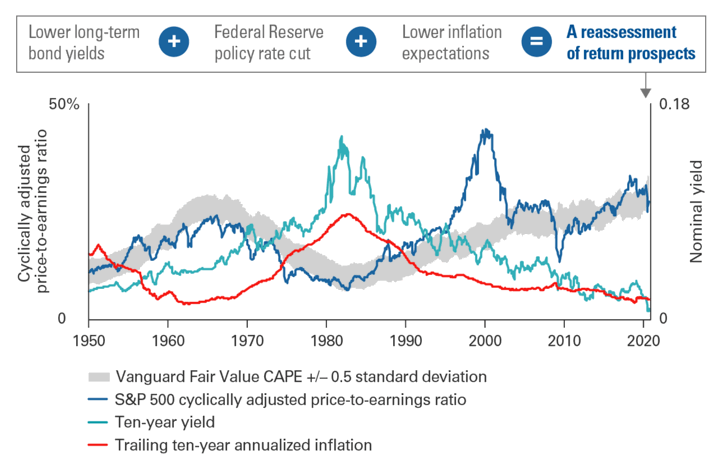
A lot of investment “analysis” is simply finding a reasonable and convincing way to explain present market prices. Whatever the price is, you can find a story to match. Working backwards like that means there usually isn’t much useful nor actionable information. I say this before I link to the recent Vanguard article Why equity markets have recovered, mainly for this chart of what they see as a “fair value” for CAPE (cyclically-adjusted PE) or PE10 (price/average earnings over last 10 years):

Vanguard’s U.S. fair value CAPE framework is based on a statistical model that corrects measures of cyclically adjusted price-to-earnings ratios for the level of inflation expectations and for interest rates. The statistical model specification is a three-variable vector error correction including equity-earnings yields, ten-year trailing inflation, and ten-year U.S. Treasury yields.

Basically, low interest rates (with low inflation) mean that stock earnings are more attractive and thus result in higher price/earnings (PE) ratios. The rest is the usual hedging and disclaimers. “The market could go up or down from here.”

Rates are not just “low”, they are the lowest in history. The real yield on 30-year TIPS (inflation-linked Treasury bonds) are negative for the first time in history – so low that people are willing to hand over $116 today in order to get only $100 back (adjusted for inflation) after 30 years! If bonds are the most expensive in history, does that mean the stock market should be the most expensive in history? The S&P 500 did just hit an all-time high amidst enormous economic suffering for much of the working population. This chart tries to make sense of things, but still I don’t like the idea of calling the current state of things “rational”.

Chase You Invest Brokerage Transfer Bonus: Up to $725 Cash

Financial institutions increasingly want all of your money under one roof. Brokerage firms and robo-advisors are adding savings accounts and debit cards. Banks want to let you trade stocks. If you have built up some sizeable assets, you can make extra money when they decide to pay you to move over your assets. Try them out, see if you like them, and move again if you need to.
The self-directed brokerage arm for Chase is You Invest, and they are currently offering up the following transfer bonuses:

  • $200 with $25,000-$99,999 in qualifying new money
  • $350 with $100,000–$249,999 in qualifying new money
  • $725 with $250,000+ in qualifying new money

The cash bonus applies to any new You Invest Trade account (Brokerage, Traditional IRA, or Roth IRA) and is limited to one per customer. You can only participate in one Chase Private Client Checking, Chase Sapphire Checking or You Invest new money bonus in a 12 month period from the last bonus enrollment date. New money must come from outside J.P. Morgan, Chase, or their affiliates.

The $200 bonus is best in terms of percentage (0.8% of $25,000), but in terms of time/effort you may just want to get the biggest bonus. Funds must arrive within 45 days of opening your account, and you must keep it there for 90 days after funding. Bonus arrives 10 business days after that, and may be reported on 1099-MISC. Given the current low interest rates, you may even consider depositing cash. I’m sure their interest in cash sweep is zero or close enough to zero, but you might also consider ultra-short bond ETFs like MINT (still possible to lose value).

If you have that much in ETFs, mutual funds, or stocks at another broker, you could perform an in-kind ACAT transfer over to You Invest, and all of your tax basis information should also move over. Your old broker may charge you an outgoing ACAT fee about about $75, although you should ask You Invest if they will reimburse you for this fee.

There have been some higher bonuses in the past for Sapphire Banking in which you could use You Invest assets to count towards the requirements (ex. $1,000 for $75k in assets), but they are not currently available. This is a relatively new product for Chase, so I wouldn’t expect a top-quality trading interface. If you mostly hold index ETFs, it should be fine.

Also see: BofA/Merrill Edge transfer bonus, M1 Finance transfer bonus

Experian Boost Review: Improve Your Credit Score For Free By Adding Utility Payment History

If you’re also guilty of watching more TV these days, you may have seen this strange TV commercial (embedded below) for a product called Experian Boost that promises to “boost your credit score instantly”. Usually, good honest products don’t need a gimmicky commercial, so I was skeptical. I assumed that Experian would make you pay somehow to improve your credit score. It turned out I was wrong. The service is free and even makes logical sense, unlike the commercial.

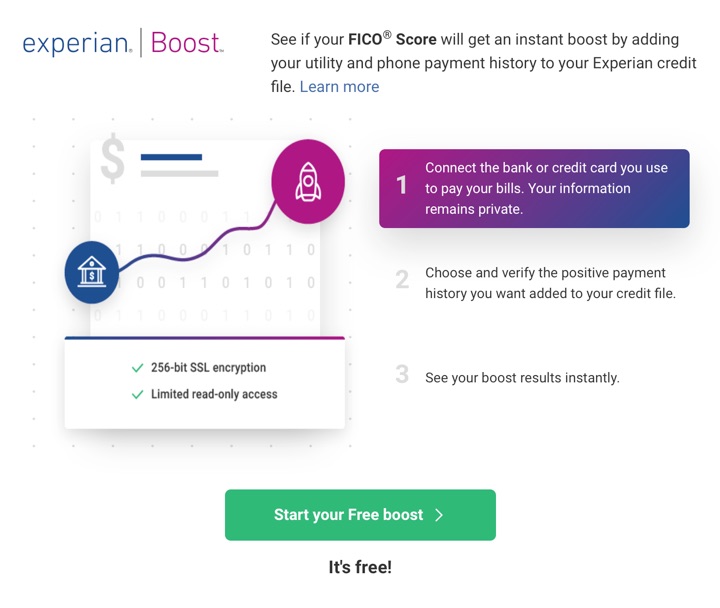
Basically, the idea is that you can include your on-time payments to utility companies like telephone, internet, electricity, gas, and even cell phone bills. Here are some additional details:

  • Experian Boost only includes on-time payments, so it can only improve your credit score and never makes it worse than before. Note that unpaid utility bill debts have always been able to decrease your credit scores.
  • Proof of on-time utility payments are made by linking your bank or credit card accounts, where you must submit your username and password (much like linking between online savings accounts). They claim the usual SSL encryption and bank-grade security measures. When analyzing your transactions, they are looking for at least 3 payments within the last 6 months.
  • “Experian Boost applies to most credit scores that lenders use, including the base FICO® Score, as well as bankcard, mortgage, and auto scores.” Good that it includes the other FICO “flavors”.
  • Experian Boost only changes your Experian credit report, so it won’t affect your TransUnion or Equifax-based scores. Not all lenders check Experian.

How much can Experian Boost improve your credit score? Here’s what they say:

Based on data from Experian, 10% of people who previously didn’t have enough information in their credit file to have a credit score became scoreable after using the tool. Also, 75% of people with a FICO® Score below 680 saw an improvement in their score after adding utility payment information to their report.

The TV ad claims “my credit score went up 13 points!”, so we should have relatively modest expectations. In addition, the above quote suggests that the improvement will be more significant for lower credit scores. My scores are relatively high, but I decided to try it out anyway, if only to make sure that it is truly free.

Here’s the initial sign-up page, which confirms how they know you paid your utility bills:

Here’s my credit score before adding any utility information. I have an excellent credit history already, and it was an ominous sign that there was no number in the “average boost” section. I feel like it usually says something like “+10 points average boost” instead of a blank space.

I have an existing free account at Experian, and declined the option to upgrade to their paid tier. I was able to proceed without ever giving them any credit card or bank payment information, so this is not a free trial. It is completely free.

The process is just like linking other accounts via Plaid and similar services. You provide login information and also have to input any two-factor authentication tokens (text message codes, etc).

It does take a few moment for them to scan your transactions, but it should complete while you wait. (In other words, not quite “instantly”, but close enough.) This is where I got the information that they are specifically looking for a history of at least 3 payments in the last 6 months.

After completion, you will receive an e-mail confirmation:

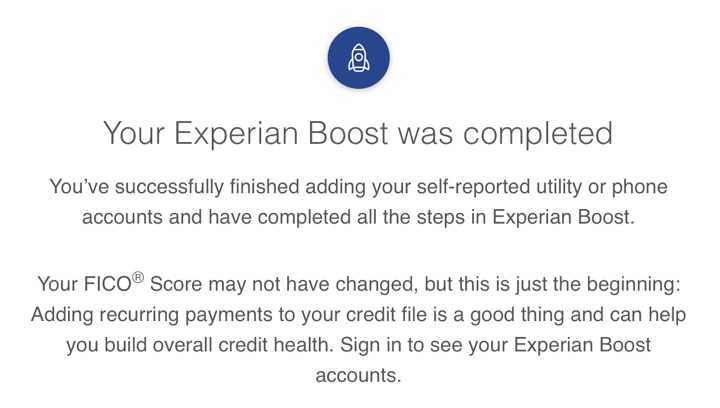
After adding my self-reported utility accounts, I was rewarded with… no FICO score increase. Here’s the message I received:

I guess it makes sense. Previously, I already had a long history of evidence that I was highly likely to pay any debts. After considering this additional evidence… I was equally likely to pay back my debts. Experian Boost is probably best for those that have a few blemishes and could use a little positive evidence added to the mix.

Bottom line. Experian Boost is a free way to potentially improve your Experian-based credit score by adding on-time utility and phone bill payments. I tested it out and it was indeed free with no credit card required nor trials to cancel, although you will have to share your bank transaction data. Although free to all, this service will be more helpful for those with a few dings and blemishes on their credit report.

Financial Independence Not As a Number, But Creating a Content Lifestyle

If you’re reading this, then financial independence is probably a goal of yours. Yet, most people who accumulate a pile of money big enough to retire upon keep on working if they are able. Why? They may truly love their job and be willing to work for free, they may worry that they won’t have enough, they might decide they’d rather have nicer things, or they may simply not have fully considered a life after paid work.

The problem is that reaching your “Number” is like finally buying that big house or fancy car or 100,000th social media follower. There is never a point at which you can say “I’m here! I’ll be forever happy and satisfied from now on.” It is always tempting to keep reaching for more. As the saying goes: If all you care about is money, you’ll never have enough money. If all you care about is social prestige, you’ll never have enough social prestige. You are forever stuck on the hamster wheel.

The article Redefining Success So It Doesn’t Crush Your Soul touches on many concepts related to this puzzle.

It’s high time to redefine success. Success is not something that you reach—not something that is outside of yourself, just down the field. Success is creating a life you want to live in right now. The great tragedy, Fromm writes, is that “man misses the only satisfaction that can give him really happiness—the experience of the activity in the present moment—and chases after a phantom that leaves him disappointed as soon as he believes he has caught it—the illusory happiness called success.”

According to decades of psychological research, a successful life is one in which your basic needs for food, shelter, health care, and income are met and in which you have a sense of autonomy, mastery, and belonging. A life that is not about enduring means you can’t stand in order to reach ends you are supposed to want; but rather, about selecting pursuits based on how much you’ll enjoy the process of doing them.

Happiness is not a goal. It is a side effect of how you spend each day. Imagine a day where money is not limitless, but it also doesn’t matter to your wellbeing. You can pick to “work” on something you both enjoy and find meaningful, while also spending time with people you love. What would that look like? I completed a similar Dream Day activity in 2005, and the improved clarity definitely helped.

Starting out, I thought of financial independence as a race to a fixed goal. Track numbers, plot them on a chart. I’d work hard, save hard, reach my net worth target, and finally turn in my resignation letter and disappear.

Looking back, what worked better was a gradual transition between two versions of the same sustainable lifestyle. To build up your assets, you have to enjoy your daily process so you don’t burn out, while also maintaining a gap between your income and expenses. Invest that excess money into productive assets (building a private business, buying stock shares of public businesses, rental real estate, etc), and over time your choices expand. You can work the same job but less hours, work a different job with lower pay/lower stress, decline promotions, or simply do nothing (much rarer than you think). Part of this is the ability to be content with your non-work lifestyle and expenses. Life should just keep getting better and better, instead of you simply wanting more and more.

But it all starts with that work lifestyle, which requires something meaningful, moderately enjoyable, and pays well. Even with an aggressive savings rate, you’ll need to work for more than a decade, so invest money into yourself first! Get a job that is more interesting, more enjoyable, or just pays better. Use your money to take time off, switch to a entry-level job in a different industry, go back to school full-time, or spend nights and weekends working on new skills. Perhaps find a government-based job with a secure pension agreement if that fits you.

caddell620

I plan to advise my own kids to spend their 20s in this manner. Live cheaply and invest in yourself. An emergency fund is important, but after that – What are you willing to spend 80 hours a week doing? Take the job that opens up future opportunities. Work with a great mentor. Study hard and don’t settle until you finally get into your target professional school. Work 80 hours a week because you (and maybe your friends) are building a business from scratch. Take asymmetric risks with big upsides and minimal downsides. Find your joys, and don’t waste money on the rest.

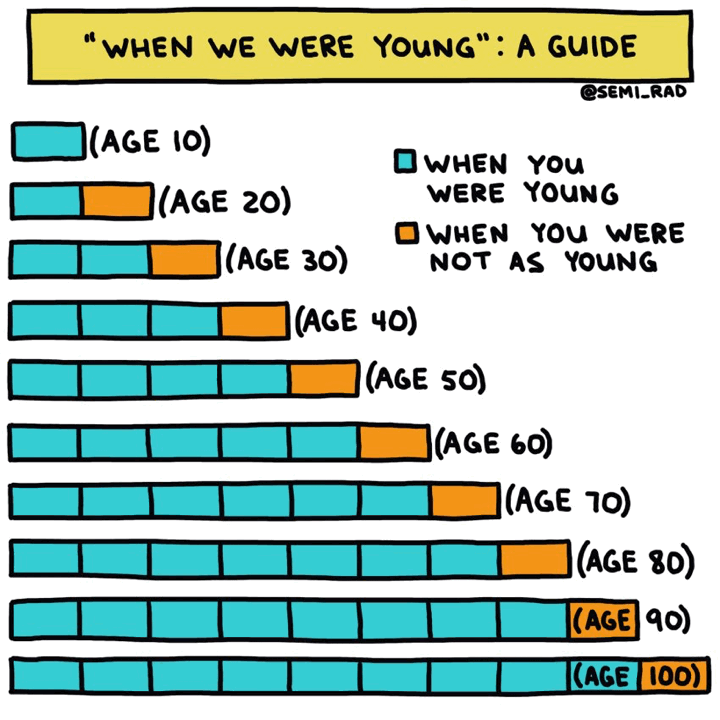
I’m still working on improving my own daily routine. I look back onto my 20s as a special period because time felt so abundant before you have others to support (partners, kids, parents). Having dependents also makes it harder to take risks and change your life. These two factors help explain why life satisfaction is lowest in your 40s. Yet harder doesn’t mean impossible. My father went back to school in his 30s and didn’t finish his schooling until I was already 10 years old. I constantly remind myself that I will eventually think of today as “back when I was young”:

Bottom line. Financial independence is not simply a faraway number like accumulating $1,000,000 in 30 years. Most important is figuring out how to enjoy the process by creating a content lifestyle that is meaningful and aligned with your values so that saving regularly doesn’t feel like a constant struggle. You want life to keep getting even better as you go vs. simply wanting ever more.

Best Interest Rates on Cash – August 2020

Is it August? The days are all melding together in the MMB household. We’ve also reached the point where anything above 1% APY is worth a second look. Being willing to switch to bank or credit union CDs can still beat out Treasury bonds and/or brokerage cash sweep options that also pay nearly zero.

Here’s my monthly roundup of the best interest rates on cash for August 2020, roughly sorted from shortest to longest maturities. I track these rates because I keep 12 months of expenses as a cash cushion and also invest in longer-term CDs (often at lesser-known credit unions) when they yield more than bonds. Check out my Ultimate Rate-Chaser Calculator to see how much extra interest you’d earn by moving money between accounts. Rates listed are available to everyone nationwide. Rates checked as of 8/11/2020.

High-yield savings accounts
While the huge megabanks make huge profits while paying you 0.01% APY, it’s easy to open a new “piggy-back” savings account and simply move some funds over from your existing checking account. The interest rates on savings accounts can drop at any time, so I list the top rates as well as competitive rates from banks with a history of competitive rates. Some banks will bait you with a temporary top rate and then lower the rates in the hopes that you are too lazy to leave.

  • Affirm has the top rate at the moment at 1.30% APY with no minimum balance requirements. I wonder how long this will last, as the rate is high but Affirm also charges really high interest to let folks buy jeans on a payment plan. There are several other established high-yield savings accounts at up to 1% APY for now.
  • Side note: HM Bradley is still advertising 3% APY for those that spent the previous quarter saving at least 20% of your direct deposit. Might be worth a gamble to open now and hope that it somehow stays at 3% APY at the next rate reset on October 1st.

Short-term guaranteed rates (1 year and under)
A common question is what to do with a big pile of cash that you’re waiting to deploy shortly (just sold your house, just sold your business, legal settlement, inheritance). My usual advice is to keep things simple and take your time. If not a savings account, then put it in a flexible short-term CD under the FDIC limits until you have a plan.

  • No Penalty CDs offer a fixed interest rate that can never go down, but you can still take out your money (once) without any fees if you want to use it elsewhere. Marcus has a 7-month No Penalty CD at 0.90% APY with a $500 minimum deposit. AARP members can get an 8-month CD at 1.10% APY. Ally Bank has a 11-month No Penalty CD at 0.75% APY for all balance tiers. CIT Bank has a 11-month No Penalty CD at 0.50% APY with a $1,000 minimum deposit. You may wish to open multiple CDs in smaller increments for more flexibility.
  • CommunityWide Federal Credit Union has a 12-month CD at 1.10% APY ($1,000 min). Early withdrawal penalty depends on how early you withdraw. Anyone can join this credit union via partner organization ($5 one-time fee).

Money market mutual funds + Ultra-short bond ETFs
If you like to keep cash in a brokerage account, beware that many brokers pay out very little interest on their default cash sweep funds (and keep the difference for themselves). The following money market and ultra-short bond funds are NOT FDIC-insured and thus come with a possibility of principal loss, but may be a good option if you have idle cash and cheap/free commissions.

  • Vanguard Prime Money Market Fund currently pays an 0.08% SEC yield. The default sweep option is the Vanguard Federal Money Market Fund which has an SEC yield of 0.10%. You can manually move the money over to Prime if you meet the $3,000 minimum investment.
  • Vanguard Ultra-Short-Term Bond Fund currently pays 0.92% SEC yield ($3,000 min) and 1.02% SEC Yield ($50,000 min). The average duration is ~1 year, so there is more interest rate risk.
  • The PIMCO Enhanced Short Maturity Active Bond ETF (MINT) has a 0.66% SEC yield and the iShares Short Maturity Bond ETF (NEAR) has a 0.86% SEC yield while holding a portfolio of investment-grade bonds with an average duration of ~6 months. Note that there was a sudden, temporary drop in net asset value during the March 2020 market stress.

Treasury Bills and Ultra-short Treasury ETFs
Another option is to buy individual Treasury bills which come in a variety of maturities from 4-weeks to 52-weeks. You can also invest in ETFs that hold a rotating basket of short-term Treasury Bills for you, while charging a small management fee for doing so. T-bill interest is exempt from state and local income taxes. Right now, this section probably isn’t very interesting as T-Bills are yielding close to zero!

  • You can build your own T-Bill ladder at TreasuryDirect.gov or via a brokerage account with a bond desk like Vanguard and Fidelity. Here are the current Treasury Bill rates. As of 8/11/2020, a new 4-week T-Bill had the equivalent of 0.08% annualized interest and a 52-week T-Bill had the equivalent of 0.15% annualized interest.
  • The Goldman Sachs Access Treasury 0-1 Year ETF (GBIL) has a 0.08% SEC yield and the SPDR Bloomberg Barclays 1-3 Month T-Bill ETF (BIL) has a -.01% (yikes!) SEC yield. GBIL appears to have a slightly longer average maturity than BIL.

US Savings Bonds
Series I Savings Bonds offer rates that are linked to inflation and backed by the US government. You must hold them for at least a year. There are annual purchase limits. If you redeem them within 5 years there is a penalty of the last 3 months of interest.

  • “I Bonds” bought between May 2020 and October 2020 will earn a 1.06% rate for the first six months. The rate of the subsequent 6-month period will be based on inflation again. More info here.
  • In mid-October 2020, the CPI will be announced and you will have a short period where you will have a very close estimate of the rate for the next 12 months. I will have another post up at that time.

Prepaid Cards with Attached Savings Accounts
A small subset of prepaid debit cards have an “attached” FDIC-insured savings account with exceptionally high interest rates. The negatives are that balances are capped, and there are many fees that you must be careful to avoid (lest they eat up your interest). Some folks don’t mind the extra work and attention required, while others do. There is a long list of previous offers that have already disappeared with little notice. I don’t personally recommend nor use any of these anymore.

  • The only notable card left in this category is Mango Money at 6% APY on up to $2,500, along with several hoops to jump through. Requirements include $1,500+ in “signature” purchases and a minimum balance of $25.00 at the end of the month.

Rewards checking accounts
These unique checking accounts pay above-average interest rates, but with unique risks. You have to jump through certain hoops, and if you make a mistake you won’t earn any interest for that month. Some folks don’t mind the extra work and attention required, while others do. Rates can also drop to near-zero quickly, leaving a “bait-and-switch” feeling. If you want rates above 2% APY, this is close to the only game in town.

  • Consumers Credit Union Free Rewards Checking (my review) still offers up to 4.09% APY on balances up to $10,000 if you make $500+ in ACH deposits, 12 debit card “signature” purchases, and spend $1,000 on their credit card each month. The Bank of Denver has a Free Kasasa Cash Checking offering 3% APY on balances up to $25,000 if you make 12 debit card purchases and at least 1 ACH credit or debit transaction per statement cycle. If you meet those qualifications, you can also link a savings account that pays 2% APY on up to $50k. (Effective with the qualification cycle beginning August 20, 2020, the rates on Kasasa Cash and Kasasa Saver are changing to 2.5% APY and 1.5% APY, respectively.) Thanks to reader Bill for the updated info. Find a locally-restricted rewards checking account at DepositAccounts.

Certificates of deposit (greater than 1 year)
CDs offer higher rates, but come with an early withdrawal penalty. By finding a bank CD with a reasonable early withdrawal penalty, you can enjoy higher rates but maintain access in a true emergency. Alternatively, consider building a CD ladder of different maturity lengths (ex. 1/2/3/4/5-years) such that you have access to part of the ladder each year, but your blended interest rate is higher than a savings account. When one CD matures, use that money to buy another 5-year CD to keep the ladder going. Some CDs also offer “add-ons” where you can deposit more funds if rates drop.

  • Connexus Credit Union has a 5-year certificate at 1.56% APY ($5,000 min), 4-year at 1.46% APY, 3-year at 1.26% APY, and 2-year at 1.11% APY. Note that the early withdrawal penalty for the 5-year is 365 days of interest. Anyone can join this credit union via partner organization for a one-time $5 fee.
  • You can buy certificates of deposit via the bond desks of Vanguard and Fidelity. You may need an account to see the rates. These “brokered CDs” offer FDIC insurance and easy laddering, but they don’t come with predictable early withdrawal penalties. Vanguard has a 4-year at 0.35% APY right now. Be wary of higher rates from callable CDs listed by Fidelity.

Longer-term Instruments
I’d use these with caution due to increased interest rate risk, but I still track them to see the rest of the current yield curve.

  • Willing to lock up your money for 10 years? You can buy long-term certificates of deposit via the bond desks of Vanguard and Fidelity. These “brokered CDs” offer FDIC insurance, but they don’t come with predictable early withdrawal penalties. At this writing, there are no available offerings. Watch out for higher rates from callable CDs from Fidelity.
  • How about two decades? Series EE Savings Bonds are not indexed to inflation, but they have a unique guarantee that the value will double in value in 20 years, which equals a guaranteed return of 3.5% a year. However, if you don’t hold for that long, you’ll be stuck with the normal rate which is quite low (currently a sad 0.10% rate). I view this as a huge early withdrawal penalty. But if holding for 20 years isn’t an issue, it can also serve as a hedge against prolonged deflation during that time. As of 8/11/2020, the 20-year Treasury Bond rate was 1.10%.

All rates were checked as of 8/11/2020.

Free CFA Investment and Portfolio Management Books

The CFA Institute Research Foundation publishes some short finance ebooks on Amazon Kindle that qualify as continuing education credits for Chartered Financial Analysts (CFAs), a type of investment professional certification. The Finance Buff points out that several are free to download right now for everyone, while others are $0.99 if you have some No-Rush Shipping credits that expire soon. Download them now while they are free, read later at your own pace.

Here is a list of booklets published by CFA Institute Research Foundation, and below are specific titles that are currently free as of this writing:

Online Shopping: Are You Being Tricked By These 15 Dark Patterns?

During these stressful times, many of us are doing a lot more shopping online (unfortunately for local retailers). The competition to get you to spend as much as possible has evolved to take full advantage of all of our psychological weaknesses. This Wired article discusses The Subtle Tricks Shopping Sites Use to Make You Spend More, including the deceptive tactics called “dark patterns”. They linked to an academic study Dark Patterns at Scale: Findings from a Crawl of 11K Shopping Websites, which carefully broke things down into the following 15 dark patterns which usually target at least one cognitive bias.
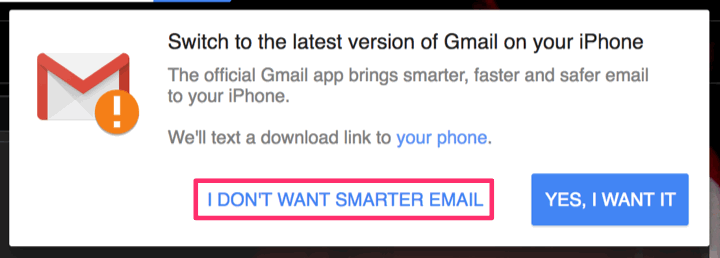
If you’ve bought anything online recently, you should recognize many of these tricks, but there were a few that were new to me. I was intrigued and tested out many of the sites myself. I no longer plan to shop at certain retailers like Proflowers and CellularOutfitter due to their use of certain shady tactics.

“No, I don’t want become smarter and wealthier”

  • Confirmshaming: Using language to steer your choices
  • Cognitive bias: Framing effect

“YES! vs. no

  • Visual interference: Steering users using visual design.
  • Cognitive bias: Anchoring, Framing effect

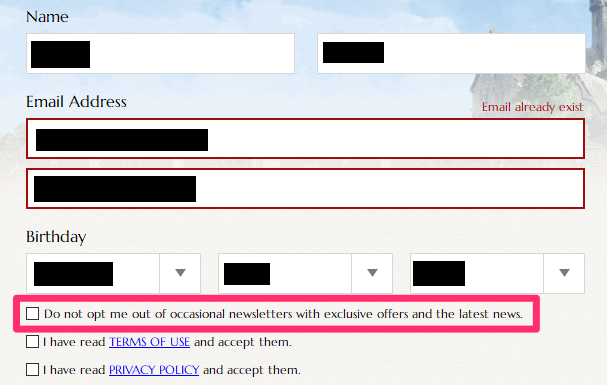
“Uncheck the box if you prefer not to receive lots of spam”

  • Trick questions: Steering users using confusing language
  • Cognitive bias: Default, Framing effect

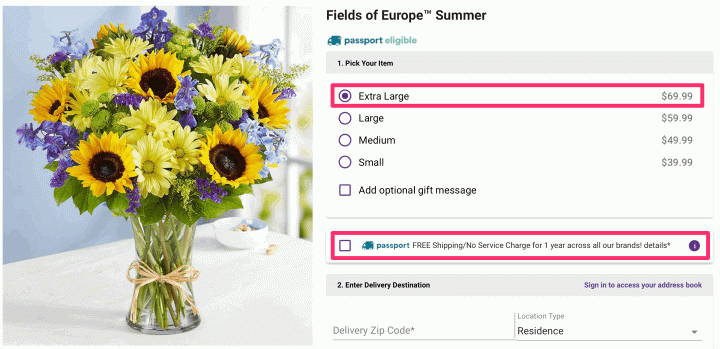
“Do you really want to cheap out on the flower bouquet for your mom?”

  • Pressured selling: Most expensive option is the default.
  • Cognitive bias: Anchoring, Default Effect, Scarcity Bias

“Free shipping with (trial) membership!”

  • Hidden subscription: Charging a recurring fee which isn’t clearly disclosed.

“⏲ Sale ends in 00:15:36 ⏲”

  • Countdown timer: Suggests that deal or discount will expire soon using countdown timer
  • Cognitive bias: Scarcity bias

“Only 3 left in stock. Order soon!”

  • Low-stock message: Suggests that limited quantities are available
  • Cognitive bias: Scarcity bias

“🔥 Selling Fast! 🔥”

  • High-demand message
  • Cognitive bias: Scarcity bias

“‼ Sale ends soon! ‼”

  • Limited-time message
  • Cognitive bias: Scarcity bias

“43 other people are viewing this item” or “Joseph in Maryland just bought these masks!”

  • Activity message: Informs that someone else did an activity or purchase
  • Cognitive bias: Bandwagon effect

“These yoga pants are the most comfortable ever! – Jane from IA”

  • Testimonial
  • Cognitive bias: Bandwagon effect

“Care & Handling Fee: $2.99” (Looking at you, Proflowers!)

  • Hidden cost: Adding new fees or charges at the last page of checkout, after you have submitted address and payment details.
  • Cognitive bias: Sunk cost fallacy

“You must create an account to continue.”

  • Forced enrollment: Must create account or share information to complete task
  • Cognitive bias: Sunk cost fallacy

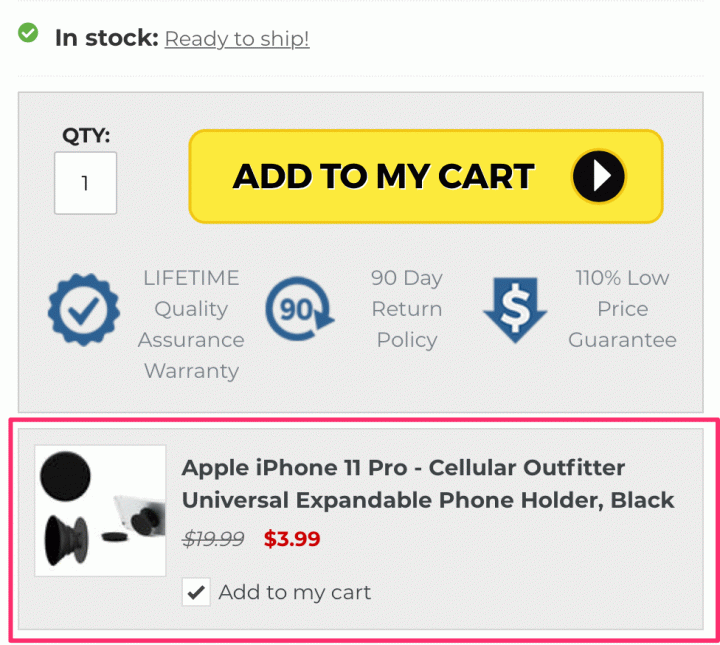
“Oops, how did that item end up in your shopping cart?”

  • Sneak into basket: Additional products placed in shopping carts without consent, like accessories (CellularOutfitter) or warranty/insurance.
  • Cognitive bias: Default effect

“Please call 1-800-NOT-OPEN between 1:34 and 1:36 AM to cancel.”

  • Hard to cancel: Easy to sign-up, hard to cancel.