Archives for May 2020

Citibank $200/$400/$700 Checking Account Bonus 2020

Citibank has tiered $200, $400, and $700 bonus offers when you open a new eligible Citi checking account by 6/30/20 and deposit and maintain a certain balance for 60 to 150 days. There is also a $1,500 bonus if you have $200,000 to move over. This offer is restricted to those who have not had a Citibank checking account within the last 180 calendar days. Here are the highlights followed by a few tips on how to optimize the bonus.

$200 bonus details:

  • Open a new eligible checking account in the Basic Banking Package during the offer period 4/01/2020 to 6/30/2020.
  • Within 30 days of opening your account, deposit $5,000 in New-to-Citibank funds into the new checking account.
  • Maintain a minimum balance of $5,000 for 60 consecutive calendar days.
  • You will receive your cash bonus within 90 days after you complete the required activities.
  • For the Basic Banking Package, to waive the $12 monthly service fee, make one qualifying direct deposit per statement period and one qualifying bill payment per statement period, or maintain a $1,500 or more combined average monthly balance in eligible linked accounts.

$400 bonus details:

  • Open new eligible checking and savings accounts in the Citibank® Account Package during the offer period 4/01/2020 to 6/30/2020.
  • Within 30 days of opening your account, deposit $15,000 in New-to-Citibank funds between the new checking and savings accounts.
  • Maintain a minimum balance of $15,000 between the checking and savings accounts for 60 consecutive calendar days.
  • You will receive your cash bonus within 90 days after you complete the required activities.
  • A monthly service fee of $25 and a $2.50 non-Citibank ATM fee apply to the checking account in the Citibank Account Package if a combined average monthly balance of $10,000 or more is not maintained.

$700 bonus details:

  • Open new eligible checking and savings accounts in the Citi Priority Account Package during the offer period 4/01/2020 to 6/30/2020.
  • Within 30 days of opening your account, deposit $50,000 in New-to-Citibank funds between the new checking and savings accounts.
  • Maintain a minimum balance of $50,000 between the checking and savings accounts for 60 consecutive calendar days.
  • You will receive your cash bonus within 90 days after you complete the required activities.
  • A monthly service fee of $30 applies to the checking account in the Citi Priority Account Package if a combined average monthly balance of $50,000 or more is not maintained. There is no monthly service fee for a checking account in the Citigold Account Package.

$1,500 bonus details:

  • Open new eligible checking and savings accounts in the Citigold Account Package during the offer period 4/01/2020 to 6/30/2020.
  • Within 30 days of opening your account, deposit $200,000 in New-to-Citibank funds between the new checking and savings accounts.
  • Maintain a minimum balance of $200,000 between the checking and savings accounts for 60 consecutive calendar days.
  • You will receive your cash bonus within 90 days after you complete the required activities.
  • If you do not maintain a minimum combined average monthly balance of $200,000 in eligible linked deposit, retirement and investment accounts, your Citigold Account Package will be converted to the Citi Priority Account Package and your accounts will be subject to the terms and conditions then in effect for that package.

Fine print analysis and value calculations. A tricky part of this bonus is the following fine print:

At the time the Cash Bonus is paid, it will be credited to the new Eligible Checking Account. If the Eligible Checking Account is closed, then the Cash Bonus will be credited to the new Eligible Savings Account. Open accounts must be in good standing.

You explicitly cannot “downgrade” your account to one with lower monthly fees during the 60 day maintenance period, but this seems to also suggest that you need to maintain the package that you opened until the bonus arrives. (It’s not 100% clear, but that is the conservative interpretation.) That means that in order to avoid the possibly hefty monthly fees, you would have to leave a certain amount of money in the account not for 60 days, but up to 150 days until the bonus is deposited.

After the 60 day maintenance period, you would want to withdraw everything not need to avoid the monthly fees, as both the checking and savings account pay negligible interest. Here’s how that would work for each tier:

  • $200 bonus tier. Deposit and maintain $5,000 for 60 days, then lower to $1,500 for 90 days.
  • $400 bonus tier. Deposit and maintain $15,000 for 60 days, then lower to $10,000 for 90 days.
  • $700 bonus tier. Deposit and maintain $50,000 for 150 days.
  • $1,500 bonus tier. Deposit and maintain $200,000 for 150 days. (There may be some alternatives like moving over some investments to satisfy the Citigold requirements.)

Bonus will be reported on 1099-INT (as should be expected). Here is the rough equivalent annualized APY earned from each bonus if you followed the schedule above exactly, got the promised bonus at the 150 day mark, and then downgraded/closed/moved your money out:

  • $200 bonus works out to ~16.5% annualized interest.
  • $400 bonus works out to ~8.0% annualized interest.
  • $700 bonus works out to ~3.4% annualized interest.
  • $1,500 bonus works out to ~1.8% annualized interest.

I have done Citibank bonuses in the past and haven’t had any issues, although they did wait until the last possible moment to post the bonus. I did not experience a hard credit check upon opening. However, others have reported having to call them up and ask for the bonus, and some have reported that they were denied the bonus improperly. Their above-average complaints of unreliability is a big reason why I would not downgrade the accounts, in order to help maintain proper bonus tracking. For all bank bonuses, be sure to keep track of your promotion details and transaction dates in a Google Doc or other spreadsheet.

Bottom line. Citibank has a set of tiered bonuses for opening a new checking and savings accounts with them, which I have broken down how to optimize based on the fine print. If you were planning on opening an account anyway, this can be a good offer. Be sure you understand the terms and conditions first.

Creative Business Idea: Selling Baked Goods Online via Etsy

My family enjoys watching Kid’s Baking Championship on Food Network, and I’m always impressed how many of these 8-13 year-old contestants have a side baking business! Last weekend, the WSJ article How Etsy Became America’s Unlikeliest Breadbasket profiled home bakers selling their baked goods online through Etsy. That could be a perfect business education for a teenager, including concepts like business plans, accounting, customer service, online marketing, and basic coding.

Cottage food laws. Many states allow exemptions that don’t require you to use a commercial kitchen to sell “non-potentially hazardous” items like bread and other baked goods. I knew about “cottage food laws” in terms of church bake sales, but I wasn’t aware that some states have much more relaxed laws than others. For example, some states require you to sell in-person and you must hand-deliver it yourself to a customer within your home state. However, the following states allow you to sell bread and other baked goods via online marketplace and deliver them via mail:

  • Colorado
  • Idaho
  • Iowa
  • Maine
  • Maryland
  • Nebraska
  • Ohio
  • Oregon
  • Pennsylvania
  • Tennessee
  • Utah
  • Vermont
  • Virginia
  • West Virginia
  • Wisconsin

Source: Forrager.com, May 2020. Note that some states will require an annual home inspection and/or permits.

The WSJ article profiled the Etsy shop ChickensintheRoad by Suzanne McMinn. She lives in West Virginia, which has some of the most open cottage food laws. McMinn shares some of her Etsy history in this blog post. Both an experienced baker and soapmaker, she realized that the competition was much more intense in the soap category. She now specializes in fresh baked goods as well as various dry food and seasoning mixes.

What is a hand-crafter worth? Can you buy biscuits–or cookies or fudge or soap or bread of whatever–for less at the grocery store? YES. But you don’t get the hand-crafter. You don’t get the individual batch per order. You don’t get homemade. You don’t get that attention to detail. You don’t get that packaging that makes every order of a dozen biscuits (or whatever) look like a present under the Christmas tree. That is what you get from a hand-crafter on Etsy.

Making the most out of your valuable knowledge. Thanks to a recent profile on Good Morning America, it looks like McMinn isn’t even taking any new orders until late June. She’s booked solid! Her skills are definitely valuable, but I can’t help but notice that if she is not baking, she’s not making money. She’s still selling her time for money.

What I would love to see her do is create a series of online videos for making some of her specialties, and then charge for access. Yes, there are many videos for free on YouTube, but what about those superfan customers that want to recreate her exact biscuits? The best part is that it would only take a one-time commitment of say, 10 hours. After that, the upside is unlimited.

Actually, you know what would make the most money? A full digital course that would teach others how to start their own online home baking business. For example, her blog post also revealed the triple-wrapping method that keeps her biscuits at maximum freshness even when delivered in a USPS box. I’m sure she has make many mistakes along the way that would be valuable to know ahead of time. You could charge anywhere from $100 or far upwards depending on how much detailed, step-by-step content was included. Again, the upfront cost is fixed and the upside is unlimited. She could make $1,000, but she could also make $100,000 if she sold 1,000 copies over time. She could always keep on baking, but now she’d also be making money 24 hours a day, even when she’s sleeping.

Indeed, she’s pretty funny and I appreciate her sense of humor:

Remember that year, when I first moved to Sassafras Farm, and all the pipes froze, and I had no money, and it was like, Kids, be happy we have running water, that is your Christmas present? This year is almost like that, but with running water, and it’s like, Kids, be happy there are a couple leftover cookies after I make this batch I’m shipping, cuz other than that, you can just starve! OR PAY ME BECAUSE I CHARGE FOR FOOD.

There’s nothing like someone telling you that what you’re doing isn’t worth what you’re charging right when you’re dying of exhaustion from doing it.

Anyhow, I thought this was a cool example of how someone’s special knowledge can be turned into a living by taking advantage of new opportunities, in this case new cottage food laws and the Etsy online marketplace. I’m also always trying to show my kids ways to decouple time and money, and not forever work for an hourly wage.

Suze Orman’s Updated Financial Advice 2020

The NYT has a new Suze Orman comeback piece called Suze Orman Is Back to Help You Ride Out the Storm. I’m old enough to feel nostalgia over the peak Suze Orman years, and it was interesting to read how some of her advice as changed:

Some of Ms. Orman’s advice has shifted since the Great Recession of a decade ago. The coronavirus has led her to the belief that having an emergency fund for food and health care is more important than concerns over debt. That’s why she’s telling people in financial trouble to scrape their money together and put it aside for emergencies, regardless of the damage it may do to a FICO score.

“Can you believe Suze Orman’s telling you to ‘please use your credit cards’?” she said on “Today.” “And only pay the minimum amount due. You might even want to call your credit card companies and ask them to expand your credit limit.”

Those who are in a slightly better situation frequently ask Ms. Orman what they should do about their stock holdings. Once upon a time, Ms. Orman was an evangelist for municipal bonds and an opponent of the stock market. But that changed as the interest on them descended to “almost nil,” as she put it.

So Ms. Orman’s recommendation now is to dollar-cost average in the stock market: purchasing a little bit every month, mostly in index funds, regardless of whether markets rise or fall.

I guess she has enough money now to feel less conservative these days – she went from muni bonds to sharing about her stock market timing prowess.

I don’t see any new TV episodes, but she does have an active podcast. I always thought her original slogan was rather clever: “People first. Then Money. Then Things.”

Tastyworks Brokerage Bonus: 100 Free Shares, Worth $100 to $600

Free stock shares are the trendy bonus nowadays – WeBull, SoFi, Robinhood, Public, and more – but how about 100 free shares? Tastyworks wants your attention by offering 100 free shares of a randomly-picked stock valued between $1 and $6 per share. That means the total value will be between $100 and $600, with an average total value of $200-$220. Offer now extended until 6/30/2020. Details below.

The odds of specific stock allocation is implemented as follows: there is a 70% chance of receiving Stock priced under $2.00 per share, and a 30% chance of receiving Stock priced over $2.00 per share. The value of Stock received will average $200-$220 USD based on the price of shares at which the Stock is purchased by tastyworks.

Tastyworks is a discount brokerage targeted at active options traders. They offer $0 comission stock trades and options commissions at $1 to open and $0 to close. That means a open/close roundtrip on options costs $1.00. TD Ameritrade, Schwab, Fidelity, and E-Trade all charge $0.65 per contract, which is $1.30 for open/close roundtrip. Thus, Tastyworks is 30% cheaper than the big brokers for options trading while also having the full fancy options interface.

For this promotion, you have to fund a new account with at least $2,000. You get the 100 bonus shares after a week, but you have to keep your $2,000 plus the value of the bonus shares for at least 3 months (otherwise they yank it back). See quoted fine print below:

The funds deposited to Qualified Customer’s account, plus the initial value of the Stock received (less any losses on the Stock) are required to remain in Qualified Customer’s account for a minimum of three months starting the day shares deposited into account, subject to extension from date of entry, before withdrawal in order for Qualified Customer to receive the value of the Stock (“Three Month Period.”) The value of stock Qualified Customer receives will be credited to their account upon deposit, but will be debited out of Qualified Customer’s account if the Three Month Period requirement is not met, and will not count toward Qualified Customer’s buying power until the end of the Three Month Period. Qualified Customers can sell their Stock once deposited into their account, but the proceeds will be subject to the foregoing Three Month Period requirement.

All that fine print aside, a $200 average payout on a $2,000 deposit with a minimum 3 month holding period is a good ratio. Just don’t go nuts with the options trading!

Morningstar Target Date Retirement Fund Rankings 2020: Not All The Same

The default option inside many employer-sponsored retirement plans are Target Date Funds (TDFs), which adjust their portfolio holdings automatically over time based on a specific target retirement date. Morningstar just released their 2020 Target-Date fund report. You’ll need to provide your name and e-mail to download the free full report. There is a lot of in-depth analysis for industry insiders, although many individual investors are basically stuck with the one fund series that is available in their 401k/403b plan. Besides looking up your fund, here are a few broader takeaways.

Here is the average glide path across 53 different TDF series (taken from 2019 report). On average, most TDFs have an asset allocation close to 90% equity and 10% bonds in the early years, with the equity percentage dropping (and bond percentage rising) as time goes on. At the year of retirement, the average asset allocation is roughly 45% equity and 55% bonds.

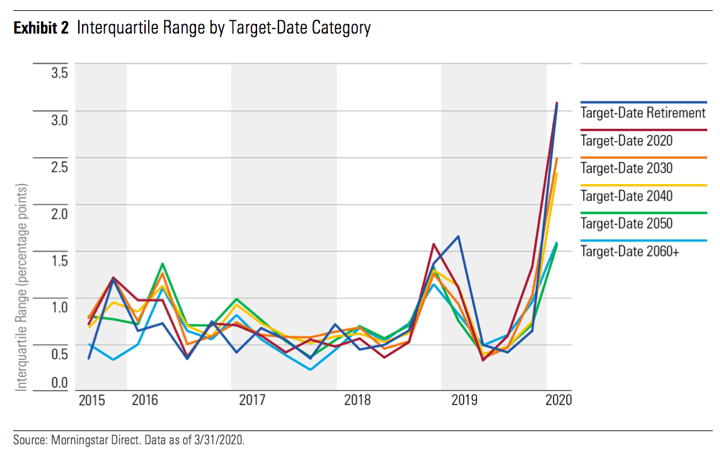
Glide paths stick closer to the average across funds during the early accumulation years, but differ much more as you near retirement. Near-retirees take notice! The chart below shows the historical percentage difference in quarterly return between funds with the same target dates. (All the 2020 funds were compared, all the 2030 funds were compared, etc.) You can see that during the “COVID crash” in Q1 2020, the biggest difference in performance actually came from the funds meant for those in retirement.

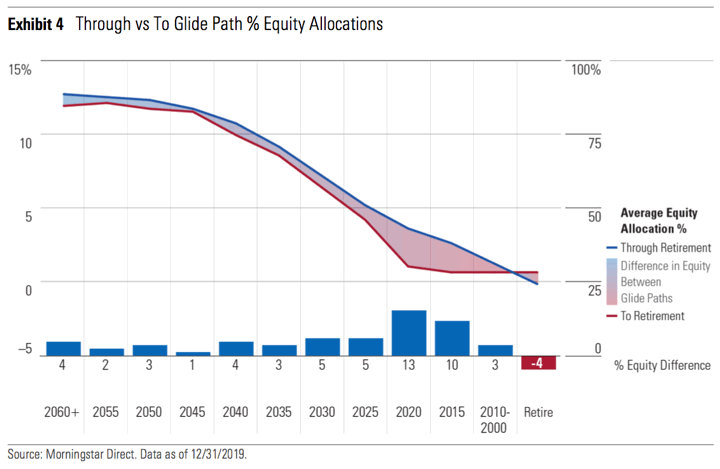
Some TDFs maintain a higher equity allocation and keep lowering it gradually “through” the retirement date, while others decrease more sharply right up “to” the retirement date and then hold things steady. For a 2020 fund, this could mean a 15% difference in the amount of stocks being held in 2020 (ex. 45% stocks vs. 30% stocks). The situation actually flips a decade after retirement and the “through” funds end up holding less stocks on average.

The past performance of TDFs often hinges on recent stock market performance and which funds are holding the most stocks (or most domestic stocks). Both the “through” and “to” methods have their pros and cons, but one might fit your own preferences better. I personally think that people do respond differently to market drops after they stop working completely and have fully exhausted their “human capital”. (Once you can’t make any more money, you start to stare at your balance more often…) Perhaps the gradual “through” funds would work better for those that also stop working gradually, while the “to” funds would be better for those that stop work completely.

You can adjust your volatility level by picking a different date. You probably only have one TDF series as opposed to a wide menu. If it’s too stock-heavy for you, then just pick a retirement date that is earlier. If it holds too many bonds, then just pick a retirement date that is earlier. There is no rule that you have to pick your actual retirement year, or even any single one.

Gold or Silver-rated Target Date Funds. Morningstar changed up their ratings methodology in November 2019. A very detailed explanation and full rankings are in the report. Here are the gold/silver-rated funds and whether they are “through/to”:

  • Blackrock LifePath Index (To)
  • JPMorgan SmartRetirement Blend (To)
  • Fidelity Freedom Index (Through)
  • Fidelity Freedom (Through)
  • JPMorgan SmartRetirement (To)
  • State Street Target Retirement (Through)
  • Vanguard Target Retirement (Through)
  • American Funds Target Date Retirement (Through)
  • T. Rowe Price Retirement (Through)

All other things equal, I’d still prefer a passive index approach with rock-bottom costs, but I’m glad to see even the actively-managed TDFs have lower expense ratios now than before.

Some of these TDF series are not available to retail investors outside of a employer-sponsored retirement plan. The Vanguard Target Retirement fund series remains the most popular with a 37% market share as of March 2020, and is also available to retail investors with a $1,000 minimum investment.

Bottom line. Although we often don’t have much choice in the matter, the good news is that every year the average target date fund gets cheaper and more competitive. Any of the gold/silver fund series above are able to provide a simple all-in-one solution. Added together, these “top-rated” options make up 78% of all TDF assets. However, it is still important to understand how your fund’s asset allocation changes as it nears the target retirement year, and know that you can pick a different year to adjust your risk level. If your fund is one of the bottom-dwellers, you may want to use this report to bug the HR department.

Top 10 Sources to Raise Emergency Cash, Ranked

While not exactly a fun exercise, do you know where you’d turn for some extra cash in an extended emergency? Morningstar has 10 Sources of Emergency Cash, Ranked from Best to Worst which contains many good points, but I would differ in my rankings.

I wondered about severity and duration. Is this money you expect to be able to pay back within a year, or is it a one-time permanent expense? You may not know the answer for sure, but for the purposes of this list I will assume that I become unemployed for an extended period and can’t start paying the loan back for 12 months.

1. Do the legwork and delay, defer, or work out a payment plan. Many lenders will work with you if you are in a temporary cash crunch, but you have to take the initiative. It may be possible to defer mortgage payments, put your student loan into forbearance, or get other forms of relief. By delaying any of these bills and ideally adding the payment due to the end of your term, you can save cash now for something else that can’t be put off until later.

2. Existing emergency fund. The standard advice is to keep 3-6 months of expenses in a liquid savings account. Has there been a reliable study on how many households actually have this? I would keep a little held back if possible and move down to the next available option below.

3. Sell the stuff. If you own things you don’t truly need, like a second car, timeshare, boat, jewelry, or other non-essential assets, it may be time to sell even at a loss. Your pride shouldn’t come in the way of protecting your family’s financial security.

4. 0% APR credit cards. Sure, credit card interest rates can be very high, but that’s because they can’t take away your house, car, or 401k balance away from you if you can’t pay it back! This is an important detail! If you’ve been taking good care of your credit score, you can score some low-interest financing for over a year. You can either go for a 0% APR balance transfer or simply put everything possible on your card to take advantage of 0% APR for purchases. If I was really hurting, cashing one of these 0% APR checks I keep getting and paying an upfront 3% balance transfer fee would be fine. If you don’t have them lined up yet, you should apply before you lose your job, as the credit card companies are tracking your employment nowadays and they may know if you’ve been laid off recently.

5. Taxable brokerage account. If you have stocks and bonds held outside employer plans and IRAs, these are fair game to sell. If I was really paying 17% interest, I would pay off the credit cards with some of this. I would first stop reinvesting dividends and start taking them as cash. Most places say to sell your bonds because they probably have minimal capital gains and haven’t dropped significantly in value during a crisis. You may also look for stock lots with tax losses that you can harvest. Again, it would depend on the tax situation; I might move on below if the expense is a temporary one.

6. Margin loans. Don’t want to sell some of your positions? Margin loans are backed by the value of your brokerage assets, and you can get it as cold hard cash. The risk is that if your collateral (stocks, bonds, ETFs, mutual funds) drop steeply in value, your broker will force you to sell them to cover your loan. That could be a double-whammy of badness! Therefore, you should only borrow a very small percentage of the available amount. (In other words, this option is best if you have a big brokerage balance.) If you believe there is a good chance you will use this feature, consider moving your account over to Interactive Brokers as they have some of the lowest margin rates available (currently 1.55% on $25k). Margin requirements can get a little complex, see this Fidelity article.

7. Home Equity Line of Credit (HELOC). Here’s another place I differ from Morningstar. I would much rather draw some money from my HELOC at about 5% interest for maybe a few months to a year than pull out a Roth IRA contribution that I can’t replace ever again. The catch here is that during a crisis, many banks may stop accepting applications or even freeze your existing HELOC. As of this writing, Wells Fargo and Chase have already stopped opening up new HELOCs. You should set one up now and not wait to pull money out at the last minute.

8. IRA “Loan” (CARES Act.) This is specific to right now. The CARES Act now allows you to take up to $100,000 out of your IRAs, after which you have 3 years to put it back into your IRA again without penalty or tax. It’s kind of like a really long rollover window. However, you will owe income tax on whatever partial amount is not put back within 3 years. This is called a coronavirus-related distribution (CRD) and is limited to those affected by the coronavirus (ex. diagnosed with COVID-19, experienced a layoff, furlough, reduction in hours, or inability to work due to COVID-19, or lack of childcare because of COVID-19.)

9. Life insurance cash values. I don’t have any whole life insurance myself, but built-up cash values seem like an acceptable place to draw some money in a true emergency. The loan option seems to be more complicated.

10. 401k loans. If one person in the household has a job that is very secure, then a 401k loan can offer a very low interest rate. You also pay the interest back into the 401k balance, so the only effective “cost” of the loan is that you will pay income tax on the interest an extra time. For example if the interest rate is 8% and your marginal income tax rate was 25%, you’d only effectively be paying 2% interest. The CARES Act now allows you to take out 100% of the vested balance, up to $100,000. The risk with a 401k loan is that if you get laid off, you must pay back the loan within 90 days or it will count as an unqualified withdrawal (taxes + penalties) until you are over age 59.5.

Everything else. Other options may include taking Social Security early, taking out a reverse mortgage on your home, and other forms of personal loans. My overall theme is that I want to protect my tax-sheltered assets if possible. I don’t want to touch my Traditional IRA, Roth IRA, 401(k). These are meant to grow for decades and decades, and since the contribution amounts are limited each year, I can’t get them back once I have taken them out as a hardship withdrawal.

PenFed Credit Union $200 Checking Bonus

Update: This promotion appears to have ended early.

Pentagon Federal Credit Union has a $200 bonus promotion for opening their new Access America checking account. You must deposit a minimum of $1,200, and make 5 debit card purchases within 90 days of account opening. They market this as a way of “adding $200” to your $1,200 stimulus check (not a requirement). Offer expires 6/14/20.

In order to avoid a $10 monthly fee with this account, you must maintain a $500 daily balance OR a monthly direct deposit of $500 or more. I would just keep at least $500 in the account until the bonus posts. With interest rates quickly heading back to 1% APY or lower, these bank bonuses are starting to look more appealing. For example, it would take $20,000 earning 1% APY for an entire year to make $200 in interest.

PenFed offers a variety of other financial services. With this account, you also become eligible for their 2% cash back credit card and their $250 bonus on car loan refinances. They’ve also been competitive on mortgages in the past. Unfortunately, their bank CD rates haven’t been great recently.

PenFed’s membership eligibility includes affiliated military and Federal employees, but anyone can join if they are a member of a partner organization. I have been a member for years after joining the National Military Family Association for $17. The website also states that being a previous Red Cross blood donor or volunteer makes you eligible. I recommend going through the PenFed application process and letting them guide you.

Offer valid from 5/4/2020 – 6/14/2020. Must receive at least $1200 in deposits in your checking account within 90 days of account opening and make 5 debit card purchases in the first 90 days. Only available to new personal checking members who do not have an existing checking account and qualify for an Access America Account. Once the criteria is met, the bonus will be credited to the new personal checking account no later than 120 days from account opening. Account must remain open, active and in good standing (no negative balance) at time bonus is distributed. PenFed will issue an IRS form 1099 reporting the value of the bonus. One bonus per member.

Refinance Your Car Loan Due To Ultra-Low Interest Rates?

Many interest rates are at all-time lows right now. This means that if you have any sort of debt, you should explore refinancing. The goal is to lower your interest rate and monthly payments while paying minimal upfront costs and fees.

Did you know that you can refinance your existing car loan? While I advise avoiding car loans because they turn a painful $1,500 in optional features into “only” $20 a month, I also know that most people do end up taking out a loan. Experian says that 85% of new cars and 55% of used cards are financed as of Q4 2019.

I’ve long recommended a good credit union for a new or used car loan. Below are one refi-centric rate comparison and several national credit unions that offer competitive rates on refinancing existing car loans – down to as low as 2% APR. For credit unions, don’t be afraid to use the alternative paths listed to join. There should be no loan application fee, although you will have to undergo a credit check. You should get multiple quotes to compare, including at least one credit union.

MyAutoLoan.com Refinance

  • This one is not a credit union, it is like LendingTree for auto loan refinancing. Open to everyone, you submit one application and they will give you multiple quotes from different private lenders.
  • They offer an interest rate estimator tool with no credit check based on your overall credit profile.
  • No application fees.
  • Refinance for as low as 2.04% APR for 36 months. They seem to specialized in refi, as their listed refinance rates are lower than their new/used car purchase loan rates.
  • No payments for up to 90 days for qualified borrowers.

Pentagon Federal Credit Union

  • Membership open to active, honorably discharged, or retired military, Federal employees, or select membership groups. This includes being a Red Cross blood donor or volunteer. You can also join the Navy League for $25. I recommend just going through the PenFed application process and let them guide you.
  • Currently, they are offering a $250 bonus when you refinance an auto loan with them.
  • Refinance a 2019/2020 model year car for as low as 2.14% APR for 36 months.
  • Refinance a 2018 or older model year car for as low as 2.99% APR for 36 months.

Navy Federal Credit Union

  • Membership open to active military, veterans, and family members of veterans.
  • Refinance a 2019/2020 model year car for as low as 2.29% APR for 36 months.
  • Refinance a 2018 or older model year car for as low as 3.89% APR for 36 months.

USAA

  • Membership open to those with the military affiliation: active duty, Guard or Reserve, a veteran, an eligible family member, or a cadet or midshipman. USAA is the most strict about their membership if you are not military, but they usually have very competitive rates.
  • No application fee.
  • No payments until 60 days after your loan is approved.

Hanscom Federal Credit Union

  • Membership open to active or retired military as well as other partner organizations. If you don’t otherwise qualify, anyone can join the Nashua River Watershed Association for a one-time $35 fee.
  • Hanscom FCU offers a 0.25% discount for loans on new and used vehicles (excluding motorcycles) to current active duty members in the U.S. Military.
  • No application fees or title transfer fees.

Why multiple quotes? If you apply for a car loan, they will run a credit check and provide a specific rate quote on your credit report data. (Check your credit reports for free once a week until April 2021.) Thus, I wouldn’t only go by which place advertises the lowest “as low as” rate unless you have a perfect credit score. You should apply to multiple lenders and compare as they may target differed borrower profiles. If you make these credit checks within a short period of time (Experian suggests 14 days or less), the credit bureaus should automatically recognize that you are comparison shopping and only count one hard inquiry against your credit score.

68 Bits of Unsolicited Advice by Kevin Kelly

The best thing I read this week was a “Things I’ve Learned…” list called 68 Bits of Unsolicited Advice by Kevin Kelly – a very interesting fellow (see his bio, about me pages) who must have secretly figured out how to freeze time given all the things he does! I’m most familiar with him as the editor of Cool Tools.

Certain items on the list will sound familiar and only a few are finance-related, but chances are you’ll find something new that clicks. Here’s a small selection:

– When you are young spend at least 6 months to one year living as poor as you can, owning as little as you possibly can, eating beans and rice in a tiny room or tent, to experience what your “worst” lifestyle might be. That way any time you have to risk something in the future you won’t be afraid of the worst case scenario.

– Don’t be the best. Be the only.

– Perhaps the most counter-intuitive truth of the universe is that the more you give to others, the more you’ll get. Understanding this is the beginning of wisdom.

– Separate the processes of creation from improving. You can’t write and edit, or sculpt and polish, or make and analyze at the same time. If you do, the editor stops the creator. While you invent, don’t select. While you sketch, don’t inspect. While you write the first draft, don’t reflect. At the start, the creator mind must be unleashed from judgement.

– Following your bliss is a recipe for paralysis if you don’t know what you are passionate about. A better motto for most youth is “master something, anything”. Through mastery of one thing, you can drift towards extensions of that mastery that bring you more joy, and eventually discover where your bliss is.

Definitely something to bookmark and read again.

Best Interest Rates on Cash – May 2020

The Federal Reserve is buying everything in sight (even junk bonds apparently), so it has been rate drops all around. Bank accounts now offer much higher available rates than Treasury bonds. I’d also recommend checking on your brokerage money market sweep fund as most are back to very low rates.


Here’s my monthly roundup of the best interest rates on cash for May 2020, roughly sorted from shortest to longest maturities. I track these rates because I keep 12 months of expenses as a cash cushion and also invest in longer-term CDs (often at lesser-known credit unions) when they yield more than bonds. Check out my Ultimate Rate-Chaser Calculator to see how much extra interest you’d earn by moving money between accounts. Rates listed are available to everyone nationwide. Rates checked as of 5/6/2020.

High-yield savings accounts
While the huge megabanks make huge profits while paying you 0.01% APY, it’s easy to open a new “piggy-back” savings account and simply move some funds over from your existing checking account. The interest rates on savings accounts can drop at any time, so I list the top rates as well as competitive rates from banks with a history of competitive rates. Some banks will bait you with a temporary top rate and then lower the rates in the hopes that you are too lazy to leave.

Short-term guaranteed rates (1 year and under)
A common question is what to do with a big pile of cash that you’re waiting to deploy shortly (just sold your house, just sold your business, legal settlement, inheritance). My usual advice is to keep things simple and take your time. If not a savings account, then put it in a flexible short-term CD under the FDIC limits until you have a plan.

  • No Penalty CDs offer a fixed interest rate that can never go down, but you can still take out your money (once) without any fees if you want to use it elsewhere. Marcus has a 7-month No Penalty CD at 1.55% APY with a $500 minimum deposit. Ally Bank has a 11-month No Penalty CD at 1.50% APY with a $25,000 minimum deposit. CIT Bank has a 11-month No Penalty CD at 1.40% APY with a $1,000 minimum deposit. You may wish to open multiple CDs in smaller increments for more flexibility.
  • Comenity Direct has a 12-month CD at 1.70% APY ($1,500 min).

Money market mutual funds + Ultra-short bond ETFs
If you like to keep cash in a brokerage account, beware that many brokers pay out very little interest on their default cash sweep funds (and keep the difference for themselves). The following money market and ultra-short bond funds are NOT FDIC-insured and thus come with a possibility of principal loss, but may be a good option if you have idle cash and cheap/free commissions.

  • Vanguard Prime Money Market Fund currently pays an 0.57% SEC yield. The default sweep option is the Vanguard Federal Money Market Fund which has an SEC yield of 0.40%. You can manually move the money over to Prime if you meet the $3,000 minimum investment.
  • Vanguard Ultra-Short-Term Bond Fund currently pays 2.00% SEC yield ($3,000 min) and 2.10% SEC Yield ($50,000 min). The average duration is ~1 year, so there is more interest rate risk.
  • The PIMCO Enhanced Short Maturity Active Bond ETF (MINT) has a 2.47% SEC yield and the iShares Short Maturity Bond ETF (NEAR) has a 2.48% SEC yield while holding a portfolio of investment-grade bonds with an average duration of ~6 months. Note that the higher yield come partly from a drop in net asset value during the recent market stress.

Treasury Bills and Ultra-short Treasury ETFs
Another option is to buy individual Treasury bills which come in a variety of maturities from 4-weeks to 52-weeks. You can also invest in ETFs that hold a rotating basket of short-term Treasury Bills for you, while charging a small management fee for doing so. T-bill interest is exempt from state and local income taxes. Right now, this section probably isn’t very interesting as T-Bills are yielding close to zero!

  • You can build your own T-Bill ladder at TreasuryDirect.gov or via a brokerage account with a bond desk like Vanguard and Fidelity. Here are the current Treasury Bill rates. As of 5/6/2020, a new 4-week T-Bill had the equivalent of 0.09% annualized interest and a 52-week T-Bill had the equivalent of 0.16% annualized interest.
  • The Goldman Sachs Access Treasury 0-1 Year ETF (GBIL) has a 0.57% SEC yield and the SPDR Bloomberg Barclays 1-3 Month T-Bill ETF (BIL) has a 0.14% SEC yield. GBIL appears to have a slightly longer average maturity than BIL. Expect that GBIL yield to drop significantly as it is updated.

US Savings Bonds
Series I Savings Bonds offer rates that are linked to inflation and backed by the US government. You must hold them for at least a year. There are annual purchase limits. If you redeem them within 5 years there is a penalty of the last 3 months of interest.

  • “I Bonds” bought between May 2020 and October 2020 will earn a 1.06% rate for the first six months. The rate of the subsequent 6-month period will be based on inflation again. More info here.
  • In mid-October 2020, the CPI will be announced and you will have a short period where you will have a very close estimate of the rate for the next 12 months. I will have another post up at that time.

Prepaid Cards with Attached Savings Accounts
A small subset of prepaid debit cards have an “attached” FDIC-insured savings account with exceptionally high interest rates. The negatives are that balances are capped, and there are many fees that you must be careful to avoid (lest they eat up your interest). Some folks don’t mind the extra work and attention required, while others do. There is a long list of previous offers that have already disappeared with little notice. I don’t personally recommend nor use any of these anymore.

  • The only notable card left in this category is Mango Money at 6% APY on up to $2,500, but there are many hoops to jump through. Requirements include $1,500+ in “signature” purchases and a minimum balance of $25.00 at the end of the month.

Rewards checking accounts
These unique checking accounts pay above-average interest rates, but with unique risks. You have to jump through certain hoops, and if you make a mistake you won’t earn any interest for that month. Some folks don’t mind the extra work and attention required, while others do. Rates can also drop to near-zero quickly, leaving a “bait-and-switch” feeling. I don’t use any of these anymore.

  • Consumers Credit Union Free Rewards Checking (my review) still offers up to 4.09% APY on balances up to $10,000 if you make $500+ in ACH deposits, 12 debit card “signature” purchases, and spend $1,000 on their credit card each month. The Bank of Denver has a Free Kasasa Cash Checking offering 3% APY on balances up to $25,000 if you make 12 debit card “signature” purchases and at least 1 ACH credit or debit transaction per statement cycle. If you meet those qualifications, you can also link a savings account that pays 2% APY on up to $50k. Thanks to reader Bill for the tip. Find a locally-restricted rewards checking account at DepositAccounts.

Certificates of deposit (greater than 1 year)
CDs offer higher rates, but come with an early withdrawal penalty. By finding a bank CD with a reasonable early withdrawal penalty, you can enjoy higher rates but maintain access in a true emergency. Alternatively, consider building a CD ladder of different maturity lengths (ex. 1/2/3/4/5-years) such that you have access to part of the ladder each year, but your blended interest rate is higher than a savings account. When one CD matures, use that money to buy another 5-year CD to keep the ladder going. Some CDs also offer “add-ons” where you can deposit more funds if rates drop.

  • The Federal Savings Bank has a 5-year certificate at 2.05% APY ($10,000 minimum). Early withdrawal penalty is 365 days of interest.
  • Pen Air Federal Credit Union has a 5-year certificate at 2.20% APY ($500 minimum). Early withdrawal penalty is 180 days of interest. Their other terms are competitive as well, if you want build a CD ladder. Anyone can join this credit union via partner organization ($3 one-time fee).
  • You can buy certificates of deposit via the bond desks of Vanguard and Fidelity. You may need an account to see the rates. These “brokered CDs” offer FDIC insurance and easy laddering, but they don’t come with predictable early withdrawal penalties. Vanguard and Fidelity both have a 5-year at 1.00% APY right now. Be wary of higher rates from callable CDs listed by Fidelity.

Longer-term Instruments
I’d use these with caution due to increased interest rate risk, but I still track them to see the rest of the current yield curve.

  • Willing to lock up your money for 10 years? You can buy long-term certificates of deposit via the bond desks of Vanguard and Fidelity. These “brokered CDs” offer FDIC insurance, but they don’t come with predictable early withdrawal penalties. Watch out for higher rates from callable CDs from Fidelity.
  • How about two decades? Series EE Savings Bonds are not indexed to inflation, but they have a unique guarantee that the value will double in value in 20 years, which equals a guaranteed return of 3.5% a year. However, if you don’t hold for that long, you’ll be stuck with the normal rate which is quite low (currently a sad 0.10% rate). I view this as a huge early withdrawal penalty. You could also view it as a hedge against prolonged deflation (again if you can hold on for 20 years). As of 5/6/2020, the 20-year Treasury Bond rate was 1.16%.

All rates were checked as of 5/6/2020.

Savings I Bonds May 2020 Interest Rate: 0.00% Fixed, 1.06% Inflation Rate

sb_poster

Update May 2020. The fixed rate will be 0.00% for I bonds issued from May 1, 2020 through October 31st, 2020. The variable inflation-indexed rate for this 6-month period will be 1.06% (as was predicted). The total rate on any specific bond is the sum of the fixed and variable rates, changing every 6 months. If you buy a new bond in between May 2020 and October 2020, you’ll get 1.06% for the first 6 months. See you again in mid-October for the next early prediction for November 2020.)

Original post 4/13/20:

Savings I Bonds are a unique, low-risk investment backed by the US Treasury that pay out a variable interest rate linked to inflation. You could own them as an alternative to bank certificates of deposit (they are liquid after 12 months) or bonds in your portfolio.

New inflation numbers were just announced at BLS.gov, which allows us to make an early prediction of the May 2020 savings bond rates a couple of weeks before the official announcement on the 1st. This also allows the opportunity to know exactly what a April 2020 savings bond purchase will yield over the next 12 months, instead of just 6 months. You can then compare this against a May 2020 purchase.

New inflation rate prediction. September 2019 CPI-U was 256.759. March 2020 CPI-U was 258.115, for a semi-annual increase of 0.53%. Using the official formula, the variable component of interest rate for the next 6 month cycle will be 1.06%. You add the fixed and variable rates to get the total interest rate. If you have an older savings bond, your fixed rate may be very different than one from recent years.

Tips on purchase and redemption. You can’t redeem until 12 months have gone by, and any redemptions within 5 years incur an interest penalty of the last 3 months of interest. A known “trick” with I-Bonds is that if you buy at the end of the month, you’ll still get all the interest for the entire month as if you bought it in the beginning of the month. It’s best to give yourself a few business days of buffer time. If you miss the cutoff, your effective purchase date will be bumped into the next month.

Buying in April 2020. If you buy before the end of April, the fixed rate portion of I-Bonds will be 0.20%. You will be guaranteed a total interest rate of 0.20 + 2.02 = 2.22% for the next 6 months. For the 6 months after that, the total rate will be 0.20 + 1.06 = 1.26%.

Let’s look at a worst-case scenario, where you hold for the minimum of one year and pay the 3-month interest penalty. If you theoretically buy on April 30th, 2020 and sell on April 1, 2021, you’ll earn a ~1.55% annualized return for an 11-month holding period, for which the interest is also exempt from state income taxes. Comparing with the best interest rates as of April 2020, you can see that this is lower than a current saving rate or 12-month CD.

Buying in May 2020. If you buy in May 2020, you will get 1.06% plus a newly-set fixed rate for the first 6 months. The new fixed rate is unknown, but is loosely linked to the real yield of short-term TIPS. In the past 6 months, the 5-year TIPS yield has dropped to a negative value! My best guess is that it will be 0.00%. Every six months, your rate will adjust to your fixed rate (set at purchase) plus a variable rate based on inflation.

If you have an existing I-Bond, the rates reset every 6 months depending on your purchase month. Your bond rate = your specific fixed rate (set at purchase) + variable rate (total bond rate has a minimum floor of 0%).

Buy now or wait? In the short-term, these I bond rates will definitely not beat a top 12-month CD rate if bought in April, and most likely won’t if bought in May either unless inflation skyrockets. Thus, if you just want to beat the current bank rates, I Bonds are not a good short-term buy right now.

If you intend to be a long-term holder, then another factor to consider is that the April fixed rate is 0.2% and that it will likely drop at least a little in May in my opinion. You may want to lock in that higher fixed rate now, which is higher than the real yield on TIPS right now.

Honestly, I am not too excited to buy either in April or May, but if I liked the long-term advantages of savings bonds (see below), I would consider buying now in April rather than May due to my guess of a higher fixed rate. You could also wait, as things might change again during the next update in mid-October.

Unique features. I have a separate post on reasons to own Series I Savings Bonds, including inflation protection, tax deferral, exemption from state income taxes, and educational tax benefits.

Over the years, I have accumulated a nice pile of I-Bonds and now consider it part of the inflation-linked bond allocation inside my long-term investment portfolio.

Annual purchase limits. The annual purchase limit is now $10,000 in online I-bonds per Social Security Number. For a couple, that’s $20,000 per year. Buy online at TreasuryDirect.gov, after making sure you’re okay with their security protocols and user-friendliness. You can also buy an additional $5,000 in paper bonds using your tax refund with IRS Form 8888. If you have children, you may be able to buy additional savings bonds by using a minor’s Social Security Number.

For more background, see the rest of my posts on savings bonds.

[Image: 1946 Savings Bond poster from US Treasury – source]

Reduce or Pause Auto Insurance During Coronavirus? Insure Only One Car?

Many of us are driving less these days. Nearly all of the major auto insurers are providing some sort of refund – this detailed list suggests an overall average of 15% to 25% back on two months of premiums. But what if you don’t need to use your vehicle for an extended period of time? You might:

  • Reduce your coverage levels to the minimum liability coverage levels required by your state for driving, saving money on premiums but assuming some risk yourself (depending on how much you actually drive).
  • Suspend your coverage as if your car was in storage. This would include liability and collision insurance. You may consider keeping comprehensive insurance to protect against theft, fire, or other damage.
  • Something in between. If you feel like you are driving a lot less, you could do some combination of raising your collision/comprehensive deductibles, dropping only collision coverage, or changing up any of the various options to lower your overall premium.

A common situation might be that a couple owns two cars but only really needs one for a while. Reader Beth shared that she chose to drop the (more expensive) coverage on her newer car while keeping the existing coverage on the older car, thus saving more than 50% on her total bill:

Our family lives in Texas, and we own two cars. Right now because of COVID-19, my husband and I are both working from home and hardly leaving our house, so we do not need both cars. I called our insurance company and temporarily dropped coverage on our newer, more expensive car, which is saving us more than half our 6-month premium. Once the COVID-19 restrictions ease up, we’ll add the second car back on.

[…] We took our newer car off completely and left our older car with the same level of coverage it had beforehand. Allstate said they would happily add the newer car back on whenever we’re ready, and they will simply prorate the amount for however much is left of our 6-month policy.

We are only driving the older car (we drive a couple of times a week right now), and the newer car stays in the garage. Allstate even emailed us a little sign to print off to tape on the steering wheel to remind us to call and reinstate coverage.

I agree with her other advice that the best thing to do is to call your insurance company and explore your options. Mine has always been happy to help me compare a variety of options along with the resulting price changes. If asking about pausing or suspending coverage, you want to make sure it is treated differently than “canceling” coverage, as gaps in coverage can make you look riskier and hike up your future premiums.

As an aside, if you are not going to move your car for a long time, you should looks up tips to prep it for long-term storage. Otherwise, I’d worry that the damage might exceed the insurance savings. Ideally, you would start it up every couple of weeks and drive it for a while on a private driveway.

Note that if your car is under a loan or lease agreement, you may have agreed to maintain a minimum level of coverage that includes both collision and comprehensive coverage. Has anyone else had success in doing this? Or tried and run into problems?