Archives for October 2022

PNC Bank Checking Account Bonus ($200 or $400)

Update: Based on what I see in my zip code, it appears this bonus was extended to January 2, 2023.

PNC Bank is one of the Top 10 largest banks in the US, and they have a nice bonus available as well. Enter your zip code into their checking offer locator page and you should see either a $200 or $400 bonus based on your geographic location. You have to apply by 10/31 (although the offer may be extended) and you have 60 days to meet the direct deposit hurdles:

  • The $400 offer that came up required total qualifying direct deposits of $5,000 or more to the Spend account within the first 60 days after account opening.
  • The alternative offer was $200 bonus for total qualifying direct deposits of $2,000 or more to the Spend account within the first 60 days after account opening.

Here is the fine print attached to my specific offer (may differ slightly for your zip code):

You may earn a $400 reward if you open a new Virtual Wallet with Performance Select, a $200 reward if you open a new Virtual Wallet with Performance Spend, or a $50 reward if you open a new Virtual Wallet. If you change your Virtual Wallet product type after account opening, the product type that you are in at the end of the month in which you opened your account will determine your offer eligibility, terms and corresponding reward amount, if applicable.

To qualify for the reward, the new Virtual Wallet product must be started online via the application links on this page and completed with a mobile device, or in a branch using the appropriate coupon between 07/22/2022 to 10/31/2022, and a qualifying Direct Deposit(s) must be received within the first 60 days. Your Virtual Wallet product must remain open in order for you to receive the reward, which will be credited to the eligible account within 60–90 days after all conditions have been met and will be identified as “CREDITS CHECK REWARD” on your monthly statement.

A qualifying Direct Deposit for this offer, is defined as a recurring Direct Deposit of a paycheck, pension, Social Security or other regular monthly income electronically deposited by an employer or an outside agency into the Spend account of a Virtual Wallet with Performance Select, Virtual Wallet with Performance Spend or Virtual Wallet. The total amount of all qualifying Direct Deposits credited to your Spend account must be at least $5,000 for Virtual Wallet with Performance Select, $2,000 for Virtual Wallet with Performance Spend and $500 for Virtual Wallet. Credit card cash advance transfers, wire transfers, person to person transfers, transfers from one account to another or deposits made at a physical PNC location or ATM do not qualify as qualifying Direct Deposits.

New account will not be eligible for offer if you or any signer on the new account has an existing PNC Bank consumer checking account or has closed an account within the past 90 days, or has been paid a PNC promotional premium in the past 24 months. If multiple accounts are opened with the same signers, only one account will be eligible for the premium.

The Virtual Wallet Checking Pro has no monthly fees. The PNC Virtual Wallet with Performance Select and PNC Virtual Wallet with Performance Select have monthly fees that can be waived with either a minimum balance across accounts or a minimum direct deposit size. There is also an early closure fee of $25 if you close the account within 60 days, so you may need to downgrade your account after meeting the bonus requirements. The details may change with your address.
Discover Card Free Online Privacy Protection Review (Delayed Success!)

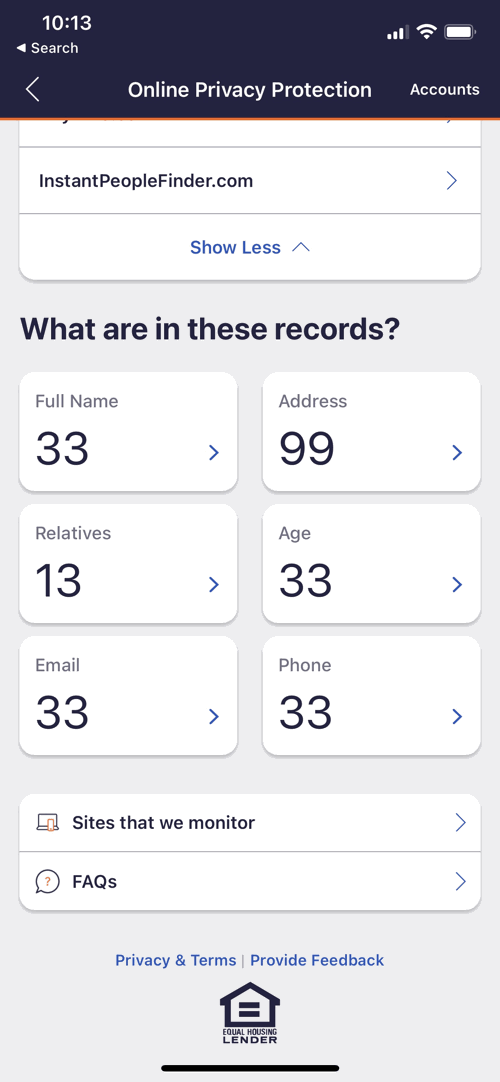
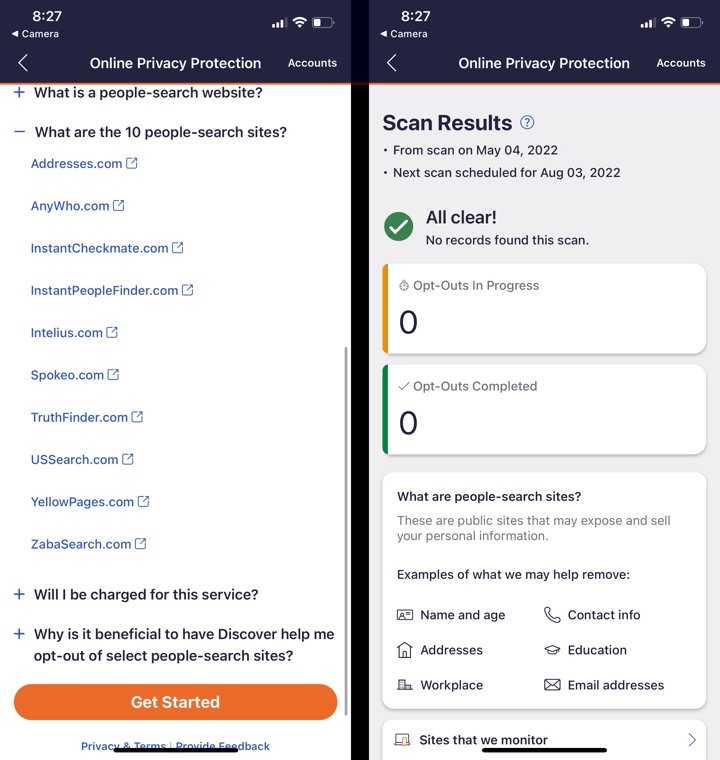
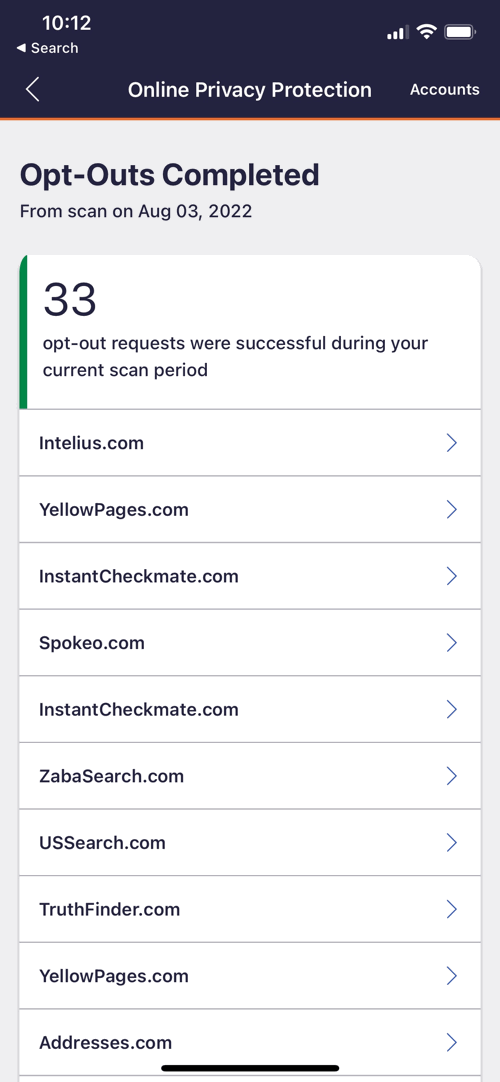
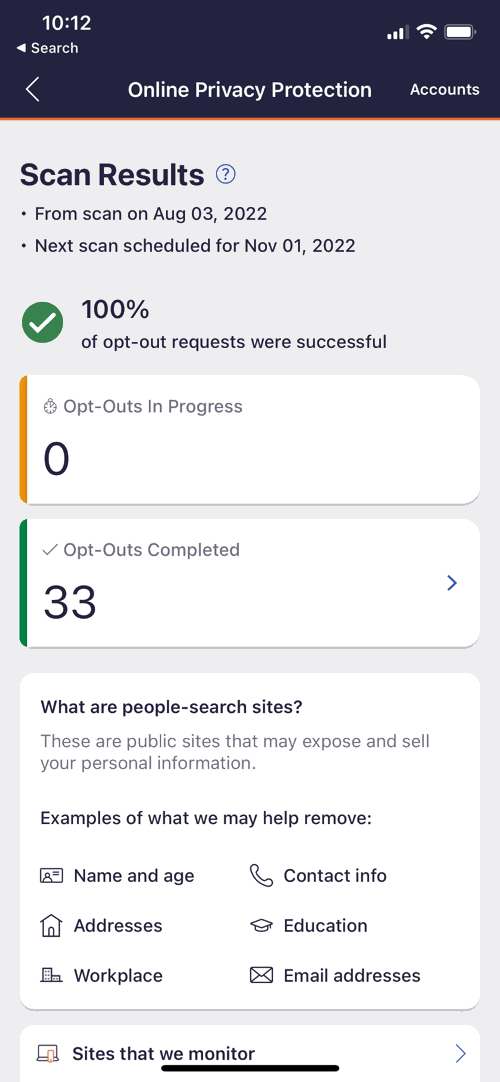
Follow-up: Although the initial scan did not find any hits (even though my data was on the sites), a subsequent scan did a better job and Discover removed my data from 33 different hits from the 10 people search sites. I randomly spot-checked them and confirmed that my information was removed. For a free service that didn’t take up my time, I am happy with this result. I would now recommend opting in and being patient. Screenshots below:

Full review:

Discover is offering their credit card and banking customers a new free service called Online Privacy Protection (press release). Essentially, it automatically submits opt-out requests at 10 selected “people search sites”. These are creepy websites that scrape your personal information from many different publicly-available databases and then makes money by selling access. I wrote about these invasive sites previously and you may be surprised at how much information about you is floating around out there – your age, current and past addresses, phone numbers, and the names of your parents, siblings, children, cousins, and in-laws.

Once catch is that you must access this feature via the Discover app. They are still rolling it out, so it may not be available to everyone yet. I used the QR code from the link and it seemed to find it directly after installing the app.

Initially, after signing up for the service, I was disappointed that my May 2022 scan didn’t find my name on any of the databases. I was hopeful that was because I already opted out of several of these sites manually a few years ago. However, I manually checked and did find some of my information some of the sites. So the service is not perfect.

Here are the ten sites they mention, although there are more out there (not linked on purpose):

  • Addresses.com
  • AnyWho.com
  • InstantCheckmate.com
  • InstantPeopleFinder.com
  • Intelius.com
  • Spokeo.com
  • TruthFinder.com
  • USSearch.com
  • YellowPages.com
  • ZabaSearch.com

The scan occurs every 90 days or so. On my August 2022 scan, the app did find a bunch of hits (often multiple profiles at the same site with similar info) and went to work removing my data. I manually spot-checked a few of them and am happy to report that my information was indeed removed.

I would recommend signing up for this service now, with the knowledge that a little patience may be required.

I mainly use my Discover card for the 5% cash back categories and the occasional Amazon Pay with Points promos, but I do appreciate these side efforts. Besides being one of the first to offer a free FICO score, they also have a free Social Security and Experian credit inquiry alert service.

The Average Portfolio Asset Allocation of a Millionaire (You Might Be Surprised)

The current issue of the Journal of Financial Economics has a new paper titled Millionaires speak: What drives their personal investment decisions? about how millionaires invest their money (via Alpha Architect):

We survey 2,484 U.S. individuals with at least $1 million of investable assets about how well leading academic theories describe their financial beliefs and personal investment decisions. The wealthy’s beliefs about financial markets and the economy are surprisingly similar to those of the average U.S. household, but the wealthy are less driven by discomfort with the market, financial constraints, and labor income considerations.

To be honest, I found most of the stated “beliefs” to be rather unsurprising. I’d rather just see what they actually own, which is revealed in this table:

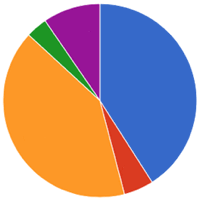
I’ve gone ahead and simplified and rounded-off the averages above into a pie chart:

Over 1/3rd of the assets of millionaires are held in either cash, bonds, or the equivalent. The rich certainly have their riskier business ownership assets, but they also have a lot of cash. This is somewhat surprising since you’d think the rich wouldn’t need that much free cash lying around, but perhaps they feel that to stay a millionaire, you have to survive all the emergencies and liquidity crunches that inevitably occur from time to time.

Target Date Retirement Fund Average Glidepath Trends 2012-2022

Everyday investors now have trillions of dollars invested inside Target Date Funds (TDFs) with their “set-and-forget” simplicity that provides “industry-standard” investment advice for a relatively low cost. Many people are out there selling better solutions, but I think TDFs are a good default that lets you focus on the saving. Another benefit of TDFs is their structure tends to encourage inaction – There was relatively little TDF selling activity during the March 2020 temporary market drop.

The Callan article Target Date Funds and the Ever-Evolving Glidepath reminds us that “industry standard” investment advice is not written in stone. It’s set by big institutions with marketing departments and does change over time. You are handing over the reigns to the fund provider, be it Fidelity, Vanguard, T. Rowe Price, Blackrock, etc.

Here are the overall trends to TDF asset allocation from in the decade from 2012 to 2022:

  • Growth assets (stocks, REITs, junk bonds) went up across the board. Ex. At age 25, growth asset allocation grew from 89% in 2012 to 94% in 2022.
  • Fixed income (bonds) have gotten slightly riskier credit ratings at younger ages (presumably to boost yield a bit).
  • Inflation-sensitive assets (TIPs, commodities) went down across the board in 2021/2022 than in 2012, only to tick up slightly looking forward in 2022.

What I see are big institutions making small, gradual changes to the glidepath, with the directions almost certainly to be towards mild performance chasing. Nobody gets fired from the executive suite for doing that. From 2012-2022, the stock market has done quite well (more of that!), bond yields have been tiny (let’s crank up the risk to boost yield!), and inflation was very mild (less of that, we don’t need to worry about infla-whoops!). If the next decade has low stock returns, high bond interest rates, and lots of inflation, I would expect a reactionary-but-slow turning of the enormous cruise ship.

Multi-Year Guaranteed Annuity (MYGA) to Immediate Annuity Example (Rates Now 5%+)

Many people hold a blanket assumption that all annuities are bad investments. Indeed, many annuities offer confusing promises with high hidden expenses, but I believe that certain annuities can be a very useful tool in retirement planning. First, the annuities must be transparent with clear, contractual guarantees such that you can directly comparison shop different products against each other. Two of the most simple types of annuities fit this definition:

  • Single premium immediate annuities (SPIA). These are for lifetime income in retirement. You pay an upfront lump sum (single premium), and you immediately start receiving a guaranteed monthly income check for the rest of your life (or joint life).
  • Multi-year guaranteed annuity (MYGA) fixed deferred annuity. These are for the accumulation stage. You put up your principal and similar to a bank certificate of deposit, you receive a fixed, guaranteed rate of return for a certain number of years. The investment growth is tax-deferred until age 59.5 when you withdraw your funds without the 10% IRS penalty. At that time, you could also roll into an SPIA.

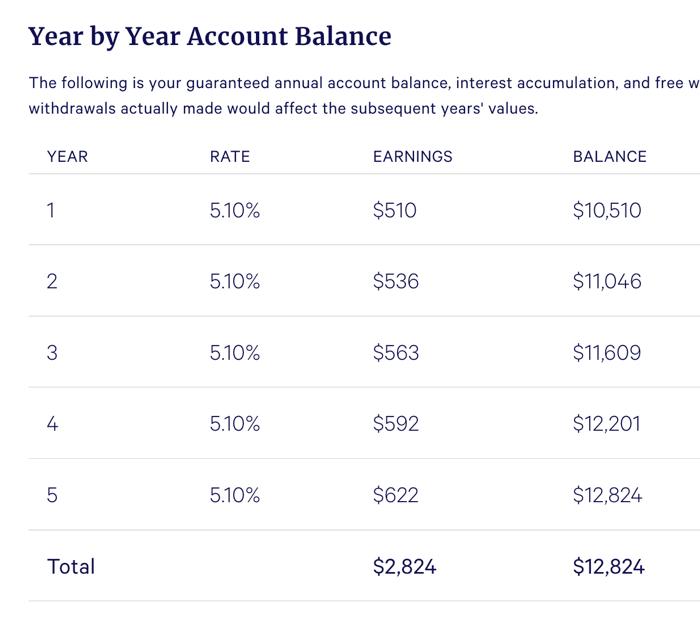
As of this writing, MYGA rates are over 5% at the 5-year term and longer. (Image above is a sample chart of the growth of a $10,000 investment for a 5-year MYGA at 5.10%.) These rates are still higher than prevailing bank certificate rates and Treasury bond rates, while also offering the potential for tax-deferred growth while in the annuity wrapper.

There are additional wrinkles of course like early withdrawal penalties and annual withdrawal allowances, but the most important part is that you you can compare apples to apples at websites like Blueprint Income, Stan the Annuity Man, and ImmediateAnnuities.com.

MYGAs 101: Who are MYGAs a good fit for? They aren’t for everyone. I wondered how a MYGA would fit into something like the Standardized Personal Finance Advice Flowchart.

  • You have adequate emergency funds.
  • You don’t have debt besides primary mortgage.
  • You have maxed out your available Roth IRA, 401k/403b/457, and HSA contributions.
  • As part of your asset allocation, you would like more room for a CD/fixed-income style investment in a tax-deferred vehicle.
  • You are saving for close to a traditional retirement age (i.e. don’t need any liquidity until age 59.5).
  • You have looked at your state-specific guaranty limits and will stay below them for any single insurance issuer. You understand what the state guaranty system does and doesn’t provide.

I have written in more detail about MYGAs here:

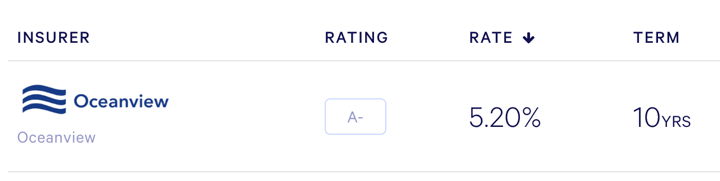
Low-Risk MYGA to SPIA $100,000 Example. Let’s say you are a risk-averse 50 yo investor (Texas resident) with $100,000 and want to retire at age 60. Based on actual rates available as of this writing (10/19/2022), you could put the $100,000 into a 10-year MYGA at 5.20% today and in 10 years you will have $166,019 due to the tax-deferred compounding. Both the initial and final values are well within the Texas state guaranty limits of $250,000 per insurer and the insurer Oceanview is rated A-.

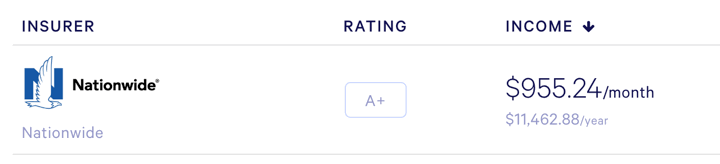
I can’t tell you the future, but let’s say you are 60yo and have that $166,019 today. At current rates, with $166,019 you can get an immediate annuity from Nationwide Insurance paying between $955 a month or $11,500 a year (female) and $11,800 a year or $987 a month (male) for the rest of your life. This will stack with your Social Security to create a very stable income base to complement your riskier growth assets, even if you live to 110. Note that you may owe income taxes on the pro-rated amount of your income that is marked as capital gains.

You are giving up the possibility of higher returns via the stock market in exchange for a slow-and-steady option with no stock market volatility. If you were going to invest in bonds anyway for part of your portfolio, this option offers the potential for higher returns in a tax-deferred wrapper (like with a Traditional IRA, you still owe taxes on gains at the end).

Bottom line: MYGAs can be a good tool to keep an eye upon. Each unique tool available has different features for the right situation. For example, a no-penalty CD offers the unique combination of a rate that you can always ratchet upward but will never go down (savings accounts can drop whenever they want), plus you have instant liquidity whenever you want. In contrast, this MYGA offers a significantly higher rate with tax-deferral benefits that can really add up over time, but you have extremely harsh early withdrawal penalties and you must do your due diligence and diversify to minimize any risk involved. You might find them useful for a portion of your portfolio, or you might not ever need either one.

Federal Student Loan Forgiveness Application Website Now Open

Update 10/18/2022: You can now apply for the Federal Student Loan Debt Relief Program at https://studentaid.gov/debt-relief/application. “Time to Complete: About 5 Minutes. No Login or Documents Required.”

Original post 8/24/2022:

The big news today was that a Biden administration executive order granted a one-time forgiveness of up to $20,000 in federal student loan balances (based on income) for tens of millions of borrowers (press release). Although technically right now nobody has to make any loan repayments due to the pandemic pause, this is important to note for those that are making student loan payments anyway or planning on a private loan refinance. If you are eligible for forgiveness, you should stop making payments immediately, as you will not receive any refund for federal student loan repayments already made. Here are the highlights:

Who qualifies for debt forgiveness?

  • Annual income must have been below $125,000 (for individuals) or $250,000 (for married couples or heads of households). This is based on your 2020 or 2021 income tax returns, specifically your adjusted gross income (AGI).
  • If you DID receive a Pell Grant in college and meet the income threshold, you will be eligible for up to $20,000 in debt cancellation.
  • If you did NOT receive a Pell Grant in college and meet the income threshold, you will be eligible for up to $10,000 in debt cancellation.
  • Current students are also eligible. If they are dependents, they will be assessed based on their parents’ income.
  • Parent PLUS loans, federal loans taken out by parents to help their children pay for college, are included in the plan. In the households where the student and the parent separately took out qualifying loans, both would be eligible for relief.
  • Loans must have been originated before July 1st, 2022.

What happens if I already paid down my student loans below the $10k/$20k cap?

Sorry. The amount of forgiveness is capped at the amount of your outstanding debt. For example: If you are eligible for $20,000 in debt relief, but have a balance of $15,000 remaining, you will only receive $15,000 in relief.

If I qualify, what actions should I take now?

  • If you are making student loan payments and are near or below the cap, look into stopping those payments immediately. Don’t refinance into a private loan. Any payment you make towards your Federal student loan won’t be refunded.
  • Check with your loan servicer to ensure your address, email, and phone number are correct.
  • If the Department of Education (DoE) doesn’t have your income information already (due to an income-based repayment plan), then you will have to wait for additional guidance from your servicer.
  • To be alerted when the application process is open, sign up for email updates from the Department of Education here.

The student loan repayment pause (and 0% interest) that started in March 2020 was extended through December 31, 2022, with payments resuming in January 2023. The extended pause will occur automatically. This is supposed to be the final extension. I assume that they plan to process the forgiveness before the pause ends.

Reminder: If you haven’t yet applied for the waiver for Expanded Public Service Loan Forgiveness (PSLF), the deadline is approaching fast at the end of October 2022! I have friends that have navigated the labyrinth and finally gotten their loans forgiven via this significant opportunity.

The rest of the order starts with “the Biden-Harris Administration is proposing a rule…” so I prefer not talk about that until it is actually implemented.

Many have strong opinions about this topic. I know that I would have been quite disappointed if this occurred right after I aggressively paid down my own $30,000 in student loans while still in school (and thus deferment) and paid it off completely within a year after graduation. I always wonder how both the mortgage market (and thus housing prices) and student loan market (and thus tuition prices) would look without government involvement. Would a private lender have given me that much money based on future earning potential, if that debt was treated like others and allowed to be discharged in bankruptcy?

As the NY Times notes, this debt relief plan may be subject to legal challenges. However, if this can help you, I would fully prepare to take advantage of it.

Firstrade Broker Deposit or ACAT Transfer Bonus: Up to $4,000

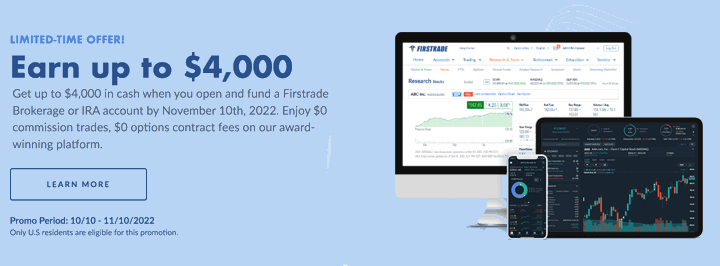
Firstrade is a broker unique in that they include $0 online stock/ETF trades, $0 options + $0 per contract, and $0 mutual fund trades (including no-load). Most of the major brokers charge per options contract and for no-load mutual fund trades. They are also unique in that they originally started out catering to the Chinese-speaking community in New York, and thus offer a Chinese language version of their site (Simplified and Traditional) and Chinese-speaking customer service reps (Mandarin and Cantonese). Right now, the are offering up to a $4,000 ACAT transfer bonus depending on the size of transferred assets:

  • $50 with $5,000 in transferred assets or deposits
  • $100 with $10,000 in transferred assets or deposits
  • $300 with $25,000 in transferred assets or deposits
  • $700 with $100,000 in transferred assets or deposits
  • $1,500 with $500,000 in transferred assets or deposits
  • $3,000 with $1,000,000 in transferred assets or deposits
  • $4,000 with $1,500,000 in transferred assets or deposits

Offer details.

  • New taxable and IRA accounts are eligible.
  • Firstrade will also cover up to $200 in ACAT transfer fees and up to $25 in wire transfer fees.
  • You must keep the assets there for at least 12 months.
  • Must open by 11/10/22 and fund within 30 days of account opening.

Offer valid for new Firstrade Brokerage or IRA accounts opened from 10/10/2022 to 11/10/2022 and funded within 30 days of account opening with $5,000 or more. To be eligible for the bonus, the new account must be opened using the specific “Open an Account” button associated with this promotional offer. Limit one offer per account type.

This offer is open to U.S. residents only and excludes current and former Firstrade account holders who have closed their accounts within the past 90 days. This offer is not transferable.

Important: The account must remain open for 12 months with the minimum funding or assets required for participating in the offer (minus any trading losses), or Firstrade may charge the account for the cost of the offer at its sole discretion. Firstrade reserves the right to restrict or revoke this offer at any time.

Commentary. This is an overall solid promotion, although right now other offers may be slightly better at any given tier amount. For example, the Public offer of $10,000 for $1,000,000 in new assets is still tops. However, I would classify Firstrade as a much more established and reputable broker with a history of solid customer service than the Public app. (I know that some people had some concerns about moving a million dollars of assets to a little-known startup.) Also, Public doesn’t allow IRAs, which is where a lot of people have their assets held. The highest ratio they offer is the $300 for $25,000 tier at slightly over 1%. Historically, paying out a 0.3% ratio ($3,000 for $1,000,000 transferred) is not bad at the $1,000,000 tier. Note the 12-month minimum holding period.

Reminder: Brokerage Asset Bonuses vs. Bank Deposit Bonuses. There is an important difference between brokerage asset bonuses and bank deposit bonuses. A bank deposit bonus pays you extra interest for holding a certain amount of cash with them. A brokerage asset bonus requires you to transfer over your existing investments like index funds, individual shares of Apple or Berkshire Hathaway, individual shares of REITs, and so on. You still own the asset and it’s still doing its thing. The brokerage bonus is on top.

In this example, if you really wanted to compare it directly against an interest rate, you should at least assume you will be holding a T-Bill ETF like GBIL or BIL (current SEC yield roughly 2.5%) and then adding this bonus on top of the yield. However, the real benefit for patient, long-term investors that you can just keep your existing assets and essentially get paid a DIY “management fee”.

Starbucks + Delta Airlines Promo: 500 SkyMiles + 150 Stars

Delta Airlines is partnering with Starbucks, including with a account linking promo worth an easy 500 Delta Skymiles and 150 Starbucks Stars (worth a free drink of any size or breakfast/snack item):

  • 150 Stars and 500 miles when you link before 12/31/22.
  • Double Stars on Delta travel days
  • 1 Delta mile per $1* spent at Starbucks (excludes taxes and gratuities)

Fine print on the bonus (you need to link and then make a purchase for the 150 stars):

*Account Linking Bonus: Link your SkyMiles account and Starbucks Rewards account through DeltaStarbucks.com between October 12, 2022 and December 31, 2022 to earn (a) 500 miles and (b) if you make a Qualifying Purchase, 150 Stars. “Qualifying Purchase” means any purchase at a participating Starbucks Store of food, beverage(s), and/or merchandise, excluding purchases of alcoholic beverages, Starbucks Cards and Starbucks Card reloads. Miles will be deposited into your SkyMiles account within 10 business days of linking, and Stars will be deposited in your Starbucks Rewards account within 2 business days of the date of your first Qualifying Purchase.

Easy $5 worth of Skymiles and free drink. Looks like the website is overwhelmed right now, but I’ll try again later.

Public Stock Brokerage App: Up to $10,000 ACAT Transfer Bonus (New Tiers)

Update January 2023: Public has been gradually making the bonus tiers higher and/or the bonus amount lower, but the offer is still alive. Please visit the offer page for the most current tiers and terms.

Updates 10/11/22: Here are a few updates to my original post below:

  • The promotion now has an expiration date of 12/31/22. Of course, they always reserve the right to end it even earlier.
  • There is also now a 12-month required holding period for the $1 million asset level bonus (still 6 months holding for all other levels).
  • I have successfully received my $2,000 cash bonus for a $100,000+ ACAT transfer. I chose this bonus because 2% of assets is a very good ratio. I had to wait the full month after the transfer initiation date. The ACAT transfer itself took about 5 business days from initiation date, which was a little concerning because there were a few days where the assets were gone from my Fidelity account and hadn’t showed up at Public yet.
  • Public only has individual accounts (no joint), so you have to transfer individual accounts (no joint). Here was my process. I created a new individual brokerage account at Fidelity. I called Fidelity and asked them to transfer X shares of Y stock worth a little over $100,000 from joint to the new individual account. I transferred the entire new individual account to Public. Fidelity charged zero fees.
  • I e-mailed Public customer service a few times and they responded the same day within a few hours. I have been pleasantly surprised by the responsiveness and quality of replies.
  • I still have the same shares of the same stock, and I’ll probably buy $2,000 more with this bonus during this little market drop. 🤑

Original post 9/7/22:

Public is a stock brokerage app that has a similar user interface to Robinhood, but has a big focus on the social aspect of sharing your trades and following the stock trades of other users (thus the name). $0 stock commissions, no account minimums, Android or iOS app-only (no desktop). Interestingly, Public no longer accepts Payment for Order Flow (PFOF). Right now, they are offering up to a $10,000 cash bonus to gather more assets via ACAT transfers, depending the value of assets that you move over. Found via DoC.

  • $150 with $5,000 – $24,999 in transferred assets
  • $500 with $25,000 – $99,999 in qualifying new money
  • $2,000 with $100,000 – $499,999 in qualifying new money
  • $5,000 with $500,000 – $999,999 in qualifying new money
  • $10,000 with $1,000,000+ in qualifying new money

$500/$2,000 is 2% of $25,000/$100,000, and $10,000 is 1% of $1,000,000. As a percentage of assets transferred, these are relatively high bonus amounts at those asset levels. The minimum holding period is 6 months, per their terms:

*Cash bonus will be applied to qualifying accounts one (1) month after the transfer initiation date. Transferred funds must stay in your Public account for at least 6 months or bonus will be revoked.

As with all similar ACAT transfer offers, you can transfer over your existing stock holdings and the cost basis should also transfer over with no tax consequences. You just keep your same shares of Apple or index ETFs at a different broker. If you want to hold cash, you could also own things like Treasury bill ETFs or ultra-short term bond ETFs and earn interest on top of the bonus.

Public will also cover your former broker’s outgoing ACAT transfer fee (usually around $75) if you transfer at least $500:

Public charges no fees for incoming transfers. If your current brokerage charges you on the way out, we’ll even cover the fee if your incoming account is over $500.

Public appears to have created their own tool with a nice user interface to transfer the assets, but on the backend they use the same underlying clearing firm as many other brokerage apps (including SoFi, Stash, Betterment, WeBull, and formerly Robinhood), namely Apex Clearing. More details from their bonus FAQ:

Download the Public app and once your account is set up, go to your Settings. In the “Account” section, you’ll see an option to transfer your stocks to Public.

This offers appears to be available to both new and existing Public users. I am considering doing a partial ACAT transfer of $100,000 in ETFs as that looks like the sweet spot.

New customer to Public? Their referral program offers “free stock” worth between $3 and $300 if you open with a referral code and deposit $20+ (referrer also gets whatever you get). My referral code is mymoneyblog which you can enter on the second page of the transfer promo link above. Thanks if you use it! Alternatively, the shopping portal Swagbucks is offering $16 worth of Swagbucks points right now. If you go the Swagbucks route, it looks like you should first open the account and then go for the transfer bonus.

Side note: If Public doesn’t make money by selling your trade flow, how do they make money? For one, it earns interest on your idle cash by paying you tiny interest as many other brokers do. For another, it lends out your shares of stocks to short-sellers (and keeps all the interest). The strange thing here is that that it appears to do so by default, whereas most other brokers you must opt-in (and they split the interest with you). However, you can opt out at any time:

You may opt out of Apex’s Fully-Paid Securities Lending Program at any time by sending an email to us at support@public.com with “Securities Lending Opt-Out” in the subject.

I would opt out, as if they lend out the shares and aren’t paid back, there is counterparty risk involved if the company fails. I am not always opposed to Fully Paid Lending, but (1) I want a share of the profits and (2) I want the broker to be rock-solid financially. Read more at Loan Out Your Stocks For Extra Interest? Fully Paid Lending Income Programs. I e-mailed Public and they replied the same day with confirmation:

Thank you for reaching out! I have added you to our opt-out list. Please allow 24-48 hours for your request to be fully processed by our clearing firm.

Amazon October 11-12 Prime Day 2022: Free $10 Credit w/ $50 Gift Card Purchase

Amazon is having another Prime Day on October 11 & 12, basically another day of deals. Here are the low-hanging fruit like a $10 gift card credit and a few select deep-discount deals. Otherwise, I check on the things I need to buy anyway and try to stack them with the Shop with Points offers (like $10 off $10.01 purchase with Discover).

As the name suggests, most deals require a Prime membership. New members can sign up for a 30-day free trial. If you’ve already done the trial, you can simply buy a month of Prime for $14.99 ($6.99 with EBT or Medicaid card).

(Note: If you are reading this in an email/RSS reader, unfortunately I am not allowed to include any Amazon affiliate links in e-mails, so they have been removed. Just click here to view the links.)

Live on October 11th

  • $10 promotional credit with the purchase of $50 gift card from top brands, including but not limited to Amazon, Panera, GAP, and Fanatics. Promotional offers and options may vary, while supplies last. Update: For Amazon GC, “you must not have purchased an Amazon Gift Card in the last 12 months.”
  • 20% off (up to $10) on Grubhub orders using code Prime20. This 48-hour deal is available for orders over $15 and can only be used once.
  • Amazon Music 4 month free trial

“Shop with Points” Promos (Check again to see if targeted)

Free year of Grubhub+ membership ($120 value)

  • Amazon Prime members can enjoy a free one-year Grubhub+ membership (normally $9.99/month) with their Prime membership.
  • Grubhub+ is a monthly membership offering unlimited $0 delivery fees on orders of $12+ (before tax, tip, and other applicable fees) at eligible restaurants, access to exclusive member perks—like free food and order discounts—and donation matching. See the full Grubhub+ terms and conditions for more information.
  • After your free one-year Grubhub+ membership ends, Grubhub will charge the payment method associated with your Grubhub account on a monthly basis at the then-current rate (currently $9.99/month). You can cancel any time by contacting Grubhub customer support or visiting the “Grubhub+ membership” section in your Grubhub account settings.

Misc

If you don’t have the Amazon credit card, Discover has Amazon as a 5% cash back category this quarter.

MMB Portfolio 2022 3rd Quarter Update: Dividend & Interest Income

Here’s my quarterly income update for my Humble Portfolio (2022 Q3). I track the income produced as an alternative metric for performance. The total income goes up much more gradually and consistently than the number shown on brokerage statements (price), which helps encourage consistent investing. Imagine your portfolio as a factory that churns out dollar bills.

Background: Overall stock market dividend growth. Stock dividends are a portion of net profits that businesses have decided to distribute directly to shareholders, as opposed to reinvesting into their business, paying back debt, or buying back shares directly. The dividends may suffer some short-term drops, but over the long run they have grown faster than inflation.

In the US, the dividend culture is somewhat conservative in that shareholders expect dividends to be stable and only go up. Thus the starting yield is lower, but grows more steadily with smaller cuts during hard times. Here is the historical growth of the trailing 12-month (ttm) dividend paid by the Vanguard Total US Stock ETF (VTI), courtesy of StockAnalysis.com. Currently, 31% of VTI’s net earnings are sent to you as a dividend. Notice how it grows gradually, with the current annual dividend 80% higher than in September 2013:

European corporate culture tends to encourage paying out a higher (sometimes fixed) percentage of earnings as dividends, but that means the dividends move up and down with earnings. Thus the starting yield is higher but may not grow as reliably. Here is the historical growth of the trailing 12-month (ttm) dividend paid by the Vanguard Total International Stock ETF (VXUS). Currently, 47% of VXUS’s net earnings are sent to you as a dividend. Notice how it stays more stable (but also dropped during 2020 due to COVID), with the current annual dividend only 20% higher than in September 2013:

The dividend yield (dividends divided by price) also serve as a rough valuation metric. When stock prices drop, this percentage metric usually goes up – which makes me feel better in a bear market. When stock prices go up, this percentage metric usually goes down, which keeps me from getting too euphoric during a bull market. Here’s a related quote from Jack Bogle (source):

The true investor will do better if he forgets about the stock market and pays attention to his dividend returns and to the operating results of his companies.

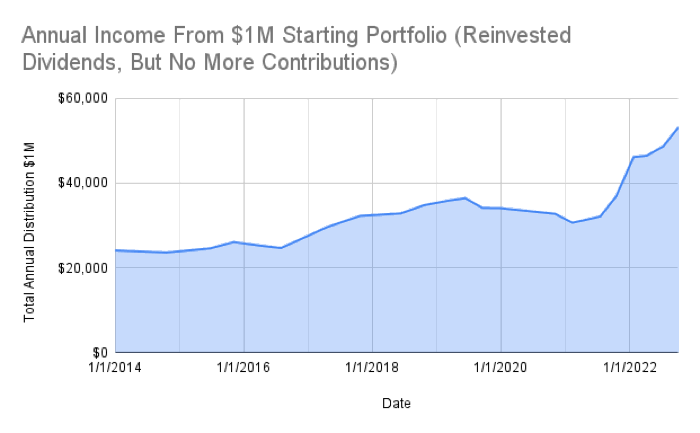
My personal portfolio income history. I started tracking the income from my portfolio in 2014. Here’s what the annual distributions from my portfolio look like over time:

  • $1,000,000 invested in my portfolio as of January 2014 would have generated about $24,000 in annual income over the previous 12 months. (2.4% starting yield)
  • If I reinvested the income but added no other contributions, today in 2022 it would have generated ~$53,000 in annual income over the previous 12 months.

This chart shows how the total annual income generated by my portfolio has changed. It’s not all about current yield.

TTM income yield. To estimate the income from my portfolio, I use the weighted “TTM” or “12-Month Yield” from Morningstar (checked 10/5/22), which is the sum of the trailing 12 months of interest and dividend payments divided by the last month’s ending share price (NAV) plus any capital gains distributed (usually zero for index funds) over the same period. The trailing income yield for this quarter was 3.33%, as calculated below. Then I multiply by the current balance from my brokerage statements to get the total income.

Asset Class / Fund % of Portfolio Trailing 12-Month Yield Yield Contribution
US Total Stock (VTI) 25% 1.74% 0.44%
US Small Value (VBR) 5% 2.30% 0.12%
Int’l Total Stock (VXUS) 25% 4.18% 1.05%
Emerging Markets (VWO) 5% 3.95% 0.20%
US Real Estate (VNQ) 6% 3.89% 0.23%
Inter-Term US Treasury Bonds (VGIT) 17% 1.42% 0.24%
Inflation-Linked Treasury Bonds (VTIP) 17% 6.24% 1.06%
Totals 100% 3.33%


Commentary. My ttm portfolio yield is now roughly 3.33%. (This is not the same as the dividend yield commonly reported in stock quotes, which just multiplies the last quarterly dividend by four.) Both US and international stock prices have gone down, and my ttm dividend yield has gone up. The price of my Treasury bonds have also gone down as nominal rates have gone up, but the yield will eventually go up as the money is reinvested into new bonds at higher rates. My TIPS yield has gone up significantly as it tracks CPI inflation. Of course, the NAV on my TIPS has also gone down, as real yields have gone up (again will be better as money is reinvested). TIPS are a bit complicated like that.

Use as a retirement planning metric. For goal planning purposes, I support the simple 4% or 3% rule of thumb, which equates to a target of accumulating roughly 25 to 33 times your annual expenses. I would lean towards a 3% withdrawal rate if you want to retire young (before age 50) and a 4% withdrawal rate if retiring at a more traditional age (closer to 65). It’s just a useful target, not a number sent down from a higher being. During the accumulation stage, your time is better spent focusing on earning potential via better career moves, improving in your skillset, and/or looking for entrepreneurial opportunities where you can have an ownership interest.

Even if do you reach that 25X or 30X goal, it’s just a moment in time. The market can shift, your expenses can shift, and so I find that tracking income makes more tangible sense in my mind and is more useful for those who aren’t looking for a traditional retirement. Our dividends and interest income are not automatically reinvested. They are another “paycheck”. Then, as with a traditional paycheck, we can choose to either spend it or invest it again to compound things more quickly. Even if we spend the dividends, this portfolio paycheck will still grow over time. You could use this money to cut back working hours, pursue a different career path, start a new business, take a sabbatical, perform charity or volunteer work, and so on.

Right now, I am happily in the “my kids still think I’m cool and want to spend time with me” zone. I am consciously choosing to work when they are at school but also consciously turning down any more work past that. This portfolio income helps me do that.

MMB Humble Portfolio 2022 3rd Quarter Update: Asset Allocation & Performance

portpie_blank200Here’s my quarterly update on my current investment holdings as of 10/4/22, including our 401k/403b/IRAs and taxable brokerage accounts but excluding real estate and side portfolio of self-directed investments. Following the concept of skin in the game, the following is not a recommendation, but just to share our real, imperfect, low-cost, diversified DIY portfolio. The goal of this “Humble Portfolio” is to create sustainable income that keeps up with inflation to cover our household expenses.

“Never ask anyone for their opinion, forecast, or recommendation. Just ask them what they have in their portfolio.” – Nassim Taleb

How I Track My Portfolio
I’m often asked how I track my portfolio across multiple brokers and account types. There are limited free options nowadays as Morningstar recently discontinued free access to their portfolio tracker. I use both Personal Capital and a custom Google Spreadsheet to track my investment holdings:

  • The Personal Capital financial tools and real-time tracking (free, my review) automatically logs into my different accounts, adds up my various balances, tracks my performance, and calculates my overall asset allocation daily.
  • Once a quarter, I also update my manual Google Spreadsheet (free, instructions) because it helps me calculate how much I need in each asset class to rebalance back towards my target asset allocation. I also create a new tab each quarter, so I have snapshot of my holdings dating back many years.

October 2022 Asset Allocation and YTD Performance
Here are updated performance and asset allocation charts, per the “Allocation” and “Holdings” tabs of my Personal Capital account.

Target Asset Allocation. I call this my “Humble Portfolio” because it accepts the repeated findings that individuals cannot reliably time the market, and that persistence in above-average stock-picking and/or sector-picking is exceedingly rare. Costs matter and nearly everyone who sells outperformance, for some reason keeps charging even if they provide zero outperformance! By paying minimal costs including management fees and tax drag, you can actually guarantee yourself above-average net performance over time.

I own broad, low-cost exposure to productive assets that will provide long-term returns above inflation, distribute income via dividends and interest, and finally offer some historical tendencies to balance each other out. I have faith in the long-term benefit of owning publicly-traded US and international shares of businesses, as well as the stability of high-quality US Treasury and municipal debt. My stock holdings roughly follow the total world market cap breakdown at roughly 60% US and 40% ex-US. I add just a little “spice” to the vanilla funds with the inclusion of “small value” ETFs for US, Developed International, and Emerging Markets stocks as well as additional real estate exposure through US REITs.

I strongly believe in the importance of knowing WHY you own something. Every asset class will eventually have a low period, and you must have strong faith during these periods to truly make your money. You have to keep owning and buying more stocks through the stock market crashes. You have to maintain and even buy more rental properties during a housing crunch, etc. A good sign is that if prices drop, you’ll want to buy more of that asset instead of less. I don’t have strong faith in the long-term results of commodities, gold, or bitcoin – so I don’t own them.

I do not spend a lot of time backtesting various model portfolios, as I don’t think picking through the details of the recent past will necessarily create superior future returns. Usually, whatever model portfolio is popular in the moment just happens to hold the asset class that has been the hottest recently as well.

Find productive assets that you believe in and understand, and just keep buying them through the ups and downs. Mine may be different than yours.

I have settled into a long-term target ratio of roughly 70% stocks and 30% bonds (or 2:1 ratio) within our investment strategy of buy, hold, and occasionally rebalance. This is more conservative than most people my age, but I am settling into a more “perpetual income portfolio” as opposed to the more common “build up a big stash and hope it lasts until I die” portfolio. My target withdrawal rate is 3% or less. Here is a round-number breakdown of my target portfolio.

  • 30% US Total Market
  • 5% US Small-Cap Value
  • 20% International Total Market
  • 5% International Small-Cap Value
  • 10% US Real Estate (REIT)
  • 20% US Treasury Nominal Bonds or FDIC-insured deposits
  • 10% US Treasury Inflation-Protected Bonds (or I Savings Bonds)

Commentary. According to Personal Capital, my portfolio down about 18% for 2022 YTD. My US and International stocks have dropped again (even more than the bonds, which also dropped) and so available cashflow is being placed into buying more of those asset classes.

During this last quarter, I sold all of my municipal bonds and bought US Treasuries instead. Due to the rising rates, I had no capital gains to worry about. When I previously cycled into muni bonds, munis were yielding 24% more than Treasuries even before accounting for the tax benefits. In September 2015, I compared the 1.78% SEC yield of Vanguard Intermediate-Term Tax-Exempt Investor Shares (VWITX) to the 1.48% SEC yield of Vanguard Intermediate-Term Treasury Investor Shares (VFITX). The ratio was 1.24. As of October 2022, the ratio is now 0.93 (3.26% vs. 3.51%). At those levels, I am getting compensated much less for the additional risk of municipal finances. My bond portfolio is now US Treasury bonds, bank/credit union CDs (bought if/when the rates exceed US Treasuries), TIPS, and savings I bonds. Can’t get higher quality than that.

I take solace that for now I see more shrinking P/E ratios as opposed to crashing earnings on the stocks side, my REITs are yielding more, and my bonds are yielding more. One good thing about more “normal” interest rates if they can hold is that it gives conservative (often older) savers a chance to keep their principal safe and still earn a small bit of income without market volatility. My primary fear remains that of war.

I’ll share about more about the income aspect in a separate post.