Archives for June 2020

AmEx Shop Small Offer: $5 off $10+ At Small Businesses (Up to $50 Savings Total)

If you have any American Express credit cards, check your “Amex Offers” in either your online account or smartphone app. Most people are seeing the offer “Spend $10+, get $5 back, up to 10 times when you Shop Small by 9/20/20”.

Get a $5 statement credit by using your enrolled Card to make a single purchase of $10+ at a US business location on the Shop Small Map (or Online Directory) by 9/20/20. Limit of 10 statement credits (total of $50).

Before you click on that “Add to Card” button, be sure that you have selected the specific AmEx card that you intend to use for this promotion. Once you add this offer to one of your cards, the offer will disappear from the rest of them. You must enroll by 7/26/20. Here’s a screenshot:

You can find eligible businesses at americanexpress.com/shopsmalloffer or americanexpress.com/shopsmallonline.

Not a bad deal, you can support local small businesses and get up to $50 total back. (A couple with two cards in their own names can get $100 back.) Shouldn’t be too hard to support them ten times over the next 11 weeks, even if once-weekly at a local restaurant for take-out.

Economics of Shared Living: How Much Money Do You Save With Roommates?

For most households, the biggest expense is housing. A time-tested way to reduce your housing costs is to share a place with others, but usually we think of a bigger house as the result of a bigger nuclear family. However, even young professional adults can choose to boost their savings rate by embracing shared living past the college days, and families can save big money by embracing the multigenerational households that are popular in other cultures.

In the article The “N” Factor and Retirement Planning, Scott Burns focuses on the financial impact of having kids but also shares a interesting way to estimate how the size of a household affects how much it spends overall:

Here’s the algorithm: The cost of living for a household is the square root of the number of people in the household. So if you are single, your cost of living is the square root of 1 or… 1.

But if you are recently married, your cost of living is the square root of 2, or 1.414. Yes, two can’t live for the price of one. But they can live for only 42 percent more than the price of one. Economists call this “economies of shared living.”

The article is focused on families with children, but here I am shifting it to talking about individual adults. Therefore, I’d rather talk about it in terms of the amount you are saving through shared living as a percentage of your previous level

Theoretical savings from shared living. If you’re single and live by yourself, your total cost of housing may be $2,000 per month.

  • Get one roommate, save 29%. Your cost goes down to √2/2 = 1.414/2 = 71% of living alone, or $1,420 per month.
  • Get two roommates, save 42%. Your cost goes down to √3/3 = 1.73/3 = 58% of living alone, or $1,160 per month.
  • Get three roommates, save 50%. Your cost goes down to √4/4 = 2/4 = 50% of living alone, or $1,000 per month.

Does this match up with actual rental prices? Using rental data from Abodo.com, I found the average rents for a one, two, and three bedroom rental in four major metro areas from around the US: Austin, San Francisco, Atlanta, and New York City. For example, if a 1-bedroom costs $1,366 in Austin and a 2-bedroom costs $1,725, that means your per-person share is $862.50, which is 63% of the cost of a 1-bedroom. This should provide a quick check for this rule, even though we are just looking at housing. It turns out to be pretty close:

According to the √N Rule, the biggest relative benefit comes when you stop living alone, at a savings of nearly 30%. This magnifies the savings ability of a dual-income couple, with possible double the income and 30% less in housing expenses.

Burns applies this to the savings that parents can feel after their kids move out of their house. As a result, retirees may be able to survive on much less than might be expected based on other rough rules of thumb.

Bottom line. Shared living is a powerful way to reduce your housing costs. As rents rise, this may result in more single adults sharing a house, or increased rates of multigenerational family living. Consider shared living as an available option to save more money and increase your financial stability, as opposed to only a last resort. Put another way, “Cooperation is a wonderful but generally overlooked substitute for money.”

[Revised and updated from original post from many years ago. I’m cleaning up my archives and updating selected articles.]

Amazon: $20 Promo Credit after $50+ Purchase Using American Express

Here is a new Amazon/AmEx promotion that promises “$20 off at Amazon after you make a single purchase of $50 or more using your American Express card”. However, the promotion has a lot of fine print to note:

  • You must purchase products “sold by Amazon.com” or “sold by Amazon Digital Services LLC” by 7/22/20. Amazon e-gift cards do not qualify.
  • You must spend $50+ on a single purchase using “any eligible American Express Consumer Card”.
  • I don’t see any notice that you qualify for the promotion at Checkout. Update: I tried again and when I do the proper things, I see a tiny “Qualifying offers: Promotion applied” message under my Order Total at Checkout. After the order actually ships, you will receive a confirmation e-mail with the promo credit.
  • The $20 promotional credit can only be used at the Amazon Moments store, which are “curated 4-Star & Above items”.
  • Promotional credit must be redeemed by August 22, 2020.
  • Offer limited to one per customer and account only.

This is one of those promotions where if I need to buy $50 of stuff, I’ll definitely try to qualify by using my consumer American Express card and checking out by the deadline, but I won’t go out of my way. (They should more clearly define what is an “eligible” American Express Consumer card.) I’m not quite sure of the point of this “curation” when it consists of a long list of 1,000+ items in every category. Who is going to shop Amazon this way?

My two “keeper” consumer American Express cards are the Blue Cash Preferred from AmEx (6% cash back on US supermarkets, up to $6,000 annually) and the Amex EveryDay Card (keeps my Membership Rewards points active with no annual fee, helps qualify for various Amazon promotions).

Planned vs. Perceived Obsolescence

The Story of Stuff (embedded below) is a short animated film about the lifecycle of material goods. Even though it was released over 10 years ago, the overall message of anti-consumerism and sustainability still applies to our current world. There are debates about specific statements from the movie which you can find on the film’s Wikipedia page, but I’m not here to defend the entire video. I believe that people should be able to watch something with a critical mind and not necessarily agree with every single point.

Here I am focusing on the discussion of planned vs. perceived obsolescence, which is approximately at 12:35 if you wanted to skip directly to that part.

Here are the definitions from the film glossary:

Planned obsolescence: designing and producing products in order for them to be used up (obsolete) within a specific time period. Products may be designed for obsolescence either through function, like a paper coffee cup or a machine with breakable parts, or through “desirability,” like a piece of clothing made for this year’s fashion and then replaced by something totally different next year. Planned obsolescence is also known as “design for the dump.”

Perceived obsolescence: the part of planned obsolescence that refers to “desirability”. In other words, an object may continue to be functional, but it is no longer perceived to be stylish or appropriate, so it is rendered obsolete by perception, rather than by function. Fashion is all about perceived obsolescence, and it could be said that perceived obsolescence is the number one “product” of the advertising industry.

Non-Consumer Alarm! In other words, companies have made easy it is to identify “non-consumers”, which usually comes with a negative connotation in our society. Let’s take cars. (Is it ever “cool” to drive an old car that isn’t a collectible?) Models change very often, even if just slightly, so it’s very easy to tell if you have an older car vs. a newer model. My wife and I have been half-jokingly told by our friends and co-workers that we need to buy nicer cars that better match our job titles and/or income levels. Yet even the newest cars pretty much do the same stuff. I could be driving a 15-year-old well-maintained Camry and add a smartphone for GPS/music/podcasts, and a blindfolded passenger probably couldn’t tell the difference.

The next time you are in public, look at the visible stuff that people own. Notice how easily you can figure out whether it was bought within the last few years.

Bottom line. I still buy stuff. You probably still buy stuff. However, we should at least acknowledge the pressure to own the most current version of everything, even if we are replacing something that still works. Cars. Cell phones. Water containers (Hydroflask). Headphones (Airpods). Kitchens that “need” remodeling because they are outdated. Shoes. Winter jackets. Purses. Clothing.

[Revised and updated from original post from many years ago. I’m cleaning up my archives and updating selected articles. Funnily enough, this post is getting increased attention because a lot of students have been assigned homework after watching this film as part of their “distance learning”.]

Bank of America Travel Rewards Credit Card Review: Up to 2.62% Back on Travel and Dining with Preferred Rewards

Update February 2021: The Bank of America Travel Rewards Credit Card has expanded the eligible categories of spending against which you can get their 1.5% to 2.62% back from only Travel purchases to include both Travel and Dining (including takeout). This change will apply indefinitely, and should make it much easier to redeem your points for optimal value. Here is the fine print:

Flexibility to redeem points for a statement credit to pay for travel and dining purchases, such as flights, hotel stays, vacation rentals, baggage fees, and also at restaurants – including takeout.

Full card review:

bofa_travelrewards191The Bank of America Travel Rewards Credit Card is the main “travel rewards” credit card branded by Bank of America. In this review, I’ll cover the card features but also focus on a lesser-known opportunity – if you’re a Preferred Rewards client, you can increase that bonus to 25% – 75%. For such “relationship” customers, the bonus can change this card from good to great, making it my current base rewards card (after any bonus 5% cash back categories, sign-up bonus cards, etc). Read on for details.

Here are the highlights of this card:

  • Earn unlimited 1.5 points per $1 spent on all purchases, with no annual fee and no foreign transaction fees and your points don’t expire.
  • 25,000 online bonus points if you make at least $1,000 in purchases in the first 90 days –  that can be a $250 statement credit toward travel/dining purchases.
  • Redeem points for a statement credit to pay for travel and dining purchases, such as flights, hotel stays, vacation rentals, baggage fees, and also at restaurants – including takeout.
  • 0% Introductory APR offer. See link for details.
  • 10% customer bonus when you have an active Bank of America checking or savings account.
  • If you’re a Preferred Rewards client, you can increase that bonus to 25% – 75%. See details below.
  • No foreign transaction fee.
  • No annual fee.

Preferred Rewards bonus. The Preferred Rewards program is designed to rewards clients with multiple account and higher assets located at Bank of America banking, Merrill Edge online brokerage, and Merrill Lynch investment accounts. Here is a partial table taken from their comparison chart (click to enlarge):

bofa_pref1

Let’s consider the options. Bank of America’s interest rates on cash accounts tend to be lower than highest-available outside banks (read: nearly zero), so moving cash over to qualify may result in earning less interest on your cash deposits. Merrill Lynch advisory accounts also usually come with management fees. The sweet spot is therefore the Merrill Edge self-directed brokerage, where you can move over your existing brokerage assets like stocks, mutual funds, and ETFs held elsewhere (Vanguard, Fidelity, Schwab, etc).

In the past, moving over to Merrill Edge at the Platinum and Platinum Plus levels also led to 30 to 100 free online stock trades every month. Fast forward to now, and nearly all major online brokers offer commission-free trades anyway.

Personally, I moved over $100k of brokerage assets from Vanguard to Merrill Edge to qualify for Platinum Honors. You should ask Merrill Edge if they will cover any ACAT transfer fees involved. I realize not everyone will have this level of assets to move around, but if you do then it is worth considering. Keep in mind that it will take a while for your “3-month average combined balance” to reach the $100k level and officially qualify for Platinum Honors. You might become Gold first, then Platinum, and so on. After that, the 25%-75% rewards bonus on credit card rewards kick in. Once you reach a certain tier, BofA guarantees that you will stay there for a year no matter what, even if your balance fluctuates.

Note that the terms state “The Preferred Rewards bonus will replace the customer bonus”, which means that you will lose the 10% customer bonus when you qualify for the 25% to 50% bonus.

Cash Back Rewards Tiers for Preferred Rewards

This card has a relatively simple rewards structure; you earn 1.5 points per dollar spent on all purchases. 1 point = 1 cent statement credit against any travel or dining purchase made on the card (flights, hotels, vacation packages, cruises, rental cars, or baggage fees, restaurants, take-out). As long you as you travel or eat at restaurants at least occasionally, I feel it is okay to value them at 1 cent per point, which means you could call this a “1.5% back on all purchases, if applied towards travel and dining purchases” rewards card. Here’s how the bonuses then work out:

  • Platinum Honors: 2.625% back, if applied towards travel and dining, or 2.625 points per dollar spent on any purchase (75% bonus).
  • Platinum: 2.25% back, if applied towards travel and dining, or 2.25 points per dollar spent on any purchase (50% bonus).
  • Gold: 1.875% back, if applied towards travel and dining, or 1.875 points per dollar spent on any purchase (25% bonus).

For more details, here are my redemption tips and experiences on qualifying for and receiving 2.625% back towards travel.

Their plan is working because Bank of America has managed to convince me to go from only having a checking account with them to now also having a Merrill Edge brokerage account and a Bank of America credit card. I definitely realize not everyone will have this level of assets to move around, and so this is somewhat a restricted offer. But if you do then it is worth considering. Both Platinum and Platinum Honors levels allow you to reach tiers that effectively give you over 2% back on all purchases, with the important caveat that your rewards must offset previous travel purchases on the card.

Bottom line. If you are able and willing to keep enough brokerage assets ($50k/$100k) at Merrill Edge, it will qualify you for their Preferred Rewards program. By using investment assets and not cash balances, it won’t cost you any potential interest from elsewhere. This allows the Bank of America Travel Rewards Credit Card to earn up to 2.6% back on ALL purchases in the form of statement credit offsetting any travel purchases within the last 12 months.

Forrager Podcast: Start Your Own Home-Based Food Business

If you enjoy listening to podcasts about entrepreneurial stories on a smaller scale (i.e. not tech unicorns), I recommend the Forrager Podcast about cottage food businesses, where people sell food made in their home kitchens (as opposed to a commercial kitchen). Depending on the cottage food laws in their state, you can learn from successful small (often solo) business owners selling their homemade bread, granola, nut mixes, cookies, pies, and other food products in both retail or wholesale environments.

The cottage food industry allows you to start small with minimal upfront investment. You keep your big potential upside, but you’ve minimized your downside. Being able to take asymmetrical risks like that is very powerful. You only need to hit it big once!

Here’s a quote from an episode with baker David Kaminer, who makes a living selling about 300 loaves of sourdough bread each week:

What’s so nice about the cottage food law is you have the opportunity to start small. Prior to cottage food laws existing, if I wanted to open up a bakery I’d be a quarter of a million dollars in before I could even produce my first loaf of bread. You can start making six loaves a week and trying to sell them on the weekends while you’re working your normal job and then see how it goes.

I feel like as long as you love making bread and you’re comfortable charging people for it and you understand the value of your time you could make a go at it pretty easily. For me it was starting like that just seeing if I could potentially ramp this up. So I feel like as long as you’re you’re ambitious and you love making bread you can pull off a cottage food business almost at any scale. It just all depends on defining how much you need and if it’s worth your time.

However, many people choose to keep it small on purpose. There is a common theme with the financial independence community of being able to work more on your own terms. Owning a cottage food business definitely won’t be for everyone, but it is more of a lifestyle choice that will be very attractive to a select few. Sound familiar? Here is a quote from an episode description with Lisa Kivirist who runs her own farm, bed & breakfast, and home bakery amongst many other things. It could very well be the bio for a personal finance author.

Lisa talks about living off the land, moving away from the corporate life-style, creatively packaging products, diversifying income streams, advocating for your laws, and everything in between.

Father’s Day Advice from Jack Bogle

Art Carey of the Phildelphia Inquirer shares some great quotes from a past interview with the late Jack Bogle, in which Bogle shared the advice he would give his own son: Vanguard’s John Bogle gives tips for life on Father’s Day. The advice is inspiring and has very little to do with investing in particular. The entire interview is worth reading if you can, but here are some partial excerpts:

[…] First, don’t forget your family, because in the end, that’s all you really have. Next, be a decent human being, and don’t think you’re better than anybody else, no matter what your condition of wealth or importance.

Never let things — the material possessions you may come to accumulate — become the measure of your life. It is an easy trap to fall into during these days of such material abundance in America, or at least in the privileged part of America that we see — with grander homes, bigger stores, more powerful cars, smarter phones, more exotic rock concerts, more sophisticated toys for children, and more elaborate toys for grown-ups, a cornucopia of things almost beyond measure.

And never forget the important role of luck in your life. Never, never, never, never say, ‘I did it all myself.’ Nobody does it all themselves. And when somebody has the temerity to tell me they did, I say to them: ‘That’s wonderful. I’m not sure I’ve ever met anybody who did it all themselves, but could I ask you one question: How did you arrange to be born in the United States of America?’

Above all, never give up your idealism. No matter how dark things get, keep your eye on the brighter side of things. Never let your determination falter. Even when the world turns against you and ridicules your ideas, ‘Press on, regardless.’ […] You don’t say, ‘I’ve arrived, I’m here.’ You say, ‘I’ll try to do a little better tomorrow, and all the tomorrows after that.’

Sprint Unlimited Line On Us: Add Line For Free + T-Mobile Tuesdays

If you are a current Sprint customer, they are running a promotion called Unlimited Line on Us where you can add a extra line with no monthly charge, although you are still subject to the monthly taxes and fees (approximately $5 to $10 a month depending on your local taxes). Full terms after you log in, but here are some eligibility details:

Who is eligible for the Unlimited Line On Us promotion?
Existing Sprint customers who:
– Joined Sprint prior to 6/17/2020.
– Have an eligible plan.
– Have at least one active voice line.
– Are eligible to add a line of service on their account.

You can bring your own device or even just reserve a line for future use (although they’ll start charging taxes). The monthly service plan charge for the line remains $0/mo. for the life of the line and requires you to keep all current phone lines on your account active through June 30, 2021. It is unclear if people who are on the $35 Sprint Unlimited Kickstart plan are eligible for this promotion.

In addition, Sprint customers can soon participate in the T-Mobile Tuesday perks program:

Sprint customers simply need to download the T-Mobile Tuesdays app from the iOS App Store or Google Play Store and register their number beginning on Tuesday, June 23.

I view these both as preemptive moves to keep Sprint customers from jumping ship before they are fully merged with T-Mobile.

Money in Excel: Automated Budgeting and Personal Finance Template (Free for Microsoft 365 Subscribers)

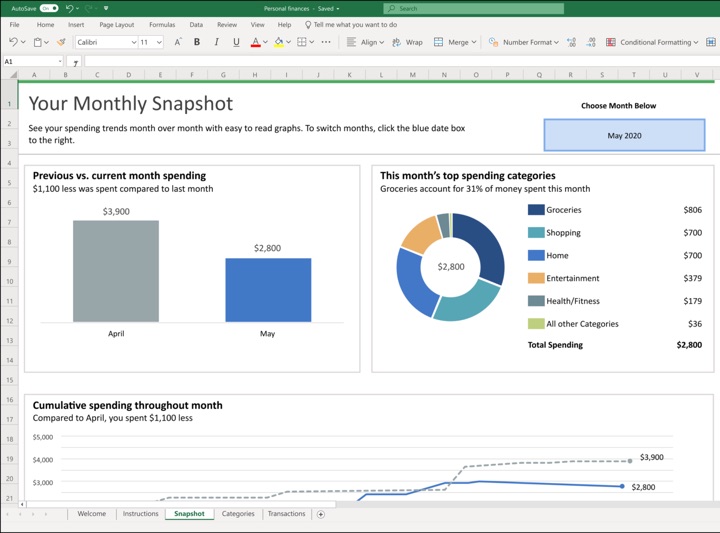
It’s not the classic Microsoft Money application (which I’m still asked about periodically), but Microsoft 365 Personal or Family subscribers can now download “Money in Excel” (free) which promises to help you manage your personal finances using Excel tools and the automated import of your transactions. Thanks to reader Motti for the tip. From their official blog:

Money in Excel is a dynamic, smart template and add-in for Excel that allows you to securely connect your bank, credit card, investment, and loan accounts to Excel and automatically import your transaction and account information into an Excel spreadsheet.

The service uses Plaid, a third-party company (recently acquired by Visa) to synchronize with all of your various financial accounts. You will have to provide the username and passwords for those accounts. (If you haven’t already, use a password manager so that you can maintain unique, strong passwords for each of your bank or brokerage accounts.)

You can do things like track your monthly spending by category, add up your net worth instantly, or get notified of selected transactions like big purchases or bank fees. Here is a screenshot:

Unfortunately, there doesn’t appear to be a way to access this premium template if you do not have a Microsoft 365 Personal or Family subscription ($70 to $100 annually). I am not a 365 subscriber myself, so I am unable to test this out further. I’d be interested to see if you are completely free to customize the Excel using all the imported data. That might work like the combination of Personal Capital and Google Sheets (also free) that I currently use to track my portfolio. If you try it, please let me know what you think in the comments or via Twitter @mymoneyblog.

Hertz Used Rental Cars: Good or Bad Idea? Big List of Pros and Cons

In better times, Hertz took out a big loan and put up their vast inventory of cars as collateral. COVID-19 caused the lender to worry about getting their money back, so they called in the loan. Hertz doesn’t exactly have much cashflow right now, so they are forced to sell off the cars in the hopes of surviving bankruptcy.

So, I found myself browsing HertzCarSales.com for the first time. I’ve never seriously considered buying a car from a rental agency, mostly due to the fact that I didn’t want a Dodge Caravan last redesigned in 1996. However, I did buy a cheap off-lease corporate fleet car from my employer, and it worked out great. Is buying a used rental car from Hertz a great idea, or a stupid idea? Here are some arguments from both sides.

Reasons why a used Hertz rental car may be BETTER than you think:

  • Check the in-service date and determine how much of the factory warranty is remaining; it could be a significant amount.
  • Hertz will let you bring it to a mechanic and do your own inspection.
  • No-haggle pricing will be appreciated by some, similar to CarMax.
  • All Hertz Certified vehicles include a 12-month/12,000-mile (whichever comes first) limited powertrain warranty.
  • Hertz has a better reputation of doing regular maintenance on their cars than lesser-known car rental companies. According to the Hertz website, while they do not provide copies of maintenance records, you can view the maintenance records in person.
  • Hertz is usually the most expensive option for a casual traveler. Most of their business is corporate and government workers. Business travelers tend to simply use the car as a tool to get from the airport to/from office/hotel, so the car will likely be in better shape than perhaps with other companies.
  • You can return your vehicle within 7 days or 250 miles after your purchase, whichever comes first. A cleaning and recertification fee of $200 will be deducted (unless prohibited by law), as well as any excess wear or damage to the vehicle.
  • Normally, used cars are subject to the “lemon” theory: people tend to sell the cars with problems. However, a rental agency does things robotically – all cars at a certain age are sold. They already bought the car at a highly-discounted bulk rate from the manufacturer, and they just need to get the car off their books in an expedient manner.
  • Some reports claim that the more “beat up” cars, especially cosmetically with dings and stains, never make it to the sale lot and are instead sold more cheaply via wholesale auctions.
  • Healthcare worker and first responders currently get $350 off with promo code HCS-HERO.

Reasons why a used Hertz rental car may be WORSE than you think:

  • Rental cars have a “fleet” or “rental” designation on the title, which stays with the car and can affect future resale value.
  • The reputation is that these cars are more “beaten up” given their mileage. I used to accelerate a little harder on freeway onramps in a rental car (it was usually the econobox version so not much excitement anyway), and was probably a bit more liberal with the air conditioning in those humid summers. However, I was still careful as I often skipped the insurance waiver on personal rentals.
  • You won’t get the “1 owner who drove it only on the freeway and was a neat freak with perfect maintenance records” car.
  • Anecdotally, cars that are made for “fleets” are of lower quality because the factory workers know these are fleet cars when they build them, and thus care less about quality control and more about pumping out 100 of the exact same car.
  • Some rental car agencies self-insure their cars and do repairs in-house, which means accidents are not necessarily reported on CarFax or other vehicle history reports.
  • Never buy “sports cars” as these are rented specifically so you can have fun going fast in them and do things you wouldn’t do in your normal car. Same deal with pickups, they are likely used heavily nearly every rental.
  • They will still add some sort of $200 to $400 documentation fee and attempt to upsell you various extended warranties, just as any other used car dealer.

Used car marketplace iSeeCars.com compared Hertz prices with their estimate of market value to find which models had the steepest discounts. I didn’t really find the results to be very useful though, as most models are rather rare with very limited availability (BMW 7-Series, MB A-Class, Buick Cascada?). The only Honda/Toyota/Mazda on the list was the Toyota Tundra, and I couldn’t find a single one within 200 miles of my location.

I tried to run some comparisons myself for a popular model with decent inventory like the Toyota RAV-4. This black 2019 Toyota RAV-4 XLE AWD (Hertz) with 22,000 miles was $23,587. This black 2019 Toyota RAV-4 XLE AWD (AutoTrader) with 22,000 miles was $21,689. I didn’t drill down into the options, but this shows that you should definitely do some comparison shopping first.

In the end, the process is similar to buying any used car and comes down to price. You need consider the reliability of the make/model, do your own personal pre-purchase inspection with an expert, and comparison shop across the same model, same options list, and similar mileage. Read the factors above and then add your own “Hertz adjustment”. Is the Hertz no-haggle price still the best deal?

Also see: How Much Car Can I Afford?

In Defense of Working One More Year (OMY)

In early retirement discussion forums, you’ll often see the term OMY, which refers to people who have reached their calculated retirement savings target, but decide to keep working “One More Year”. Sometimes that one more year becomes two more years, three more years, and so on. This leads to OMY being seen as an irrational behavioral quirk like hedonic adaptation. However, are the potential benefits of working one more year being under-appreciated?

In the Medium article How important is asset allocation versus withdrawal rates in retirement?, EREVN (he lives in Vietnam) compares the power of picking the optimal asset allocation vs. saving more money. Investors often worry about whether they own the right mix of stocks and bonds. Do you own enough stocks, as to get a high enough return? Do you own enough bonds, so you don’t freak out during a market drop?

EREVN points out that historically, the optimal asset allocation in terms of having your portfolio last the longest is almost always 100% stocks. (98% of the time.) Even including the other 2%, how much of a benefit is it to hold the optimal asset allocation?

Read the entire article for full understanding of the assumptions taken, but here is the summary of his experiments. We usually optimize asset allocation based on highest return, but that’s not exactly the same as withdrawal rate. Note: Whenever you see “4% withdrawal rate”, that’s the same as having 25 times your annual expenses. 3% withdrawal rate = 33.3x expenses, 2% withdrawal rate = 50x expenses, etc. I added the stuff in the brackets [].

Even with perfect hindsight, choosing the best possible asset allocation is only equivalent to going from a 4% withdrawal rate to a 3.7% or 3.8% withdrawal rate. [25x expenses to 26x or 27x expenses.] In other words, saving 1 or 2 extra years of expenses dominates getting the asset allocation decision perfectly correct. In reality, we don’t have perfect hindsight and our asset allocation will be sub-optimal.

The powerful conclusion:

Instead of stressing about trying to pick “the right” asset allocation, you’re better off picking anything reasonable and ignoring every other asset allocation internet discussion for the rest of your life… and then working an extra six or twelve months to pad out your retirement fund before retiring.

I like the paring of working one more year and being able to drop the worry about asset allocation now and forever! You don’t want to work forever, but this does make OMY have multiple benefits (existing portfolio can grow another year, might even save more, stop worrying about asset allocation).

Here are a few related posts on “Saving More vs. XXX” from the archives:

Image via GIPHY.

Don’t Expect Too Much From Exotic Asset Classes

If you like having a complicated portfolio and owning exotic asset classes for diversification, you might want to prepare yourself before reading Skating Where the Puck Was: The Correlation Game in a Flat World by William Bernstein. Most of the exotic classes you’ve ever thought about owning will be struck down:

  • Commodities futures? – disaster.
  • Private equity? – nope.
  • Hedge funds? – don’t bother.
  • Gold? – sorry, even the Permanent Portfolio would have been better off historically without gold if you measure since 1980 (after going off gold standard).

The basic premise is “Rekenthaler’s Rule”: If the bozos know about it, it doesn’t work any more.

Even international stocks are not nearly as useful a diversifier as they used to be. The book included a chart of the correlation between the S&P 500 (developed large-cap US stocks) and EAFA (developed large-cap international stocks), but I found a more recent one from Morningstar. International stocks used to offer high returns and low correlations, the ideal asset class to add to any portfolio! Not so much recently:

Now, there are still reasons to invest in international stocks – primarily the “big picture” deep risk of investing in a single country over a long period of time. But your short-term volatility is not going to be dampened much anymore.

So, what is left?

The best alternative asset class for the average investor may be in truly private investments, such as already mentioned, owner-managed (the owner being you) residential and commercial real estate in distressed markets, or in other private businesses in which you have special expertise.

I would be careful with this too, as there are many bad (quiet) real estate investors and failed/struggling businesses that you don’t hear about. Be sure you really have “special expertise”. However, one benefit of owning private real estate or a private business is that you don’t get daily price quotes. Nobody is going to tell you “Well, if you sold TODAY, the best price you could find is 50% of what you could have gotten last month! Tomorrow, it could only be 40%! Do you want to sell?!”. This means less likelihood of panic selling and more long-term investors.