Archives for June 2020

Amazon Prime: $8.98 Echo Dot (3rd Gen) + Music Unlimited Trial

Update: Offer is back again, but sold out quickly last time!

Amazon has brought back a good deal for Prime members interested in a cheap Echo Dot (newest 3rd generation). Sign up for a 1-month Amazon Music Unlimited membership for $7.99, and you get can get an Echo Dot (3rd gen) for only $0.99 (total cost $8.98). Here’s how:

  1. Click here for the combined Echo Dot + 1-month trial. You must pay with a credit card (no gift card), which will be used to enroll in Amazon Music Unlimited at $7.99 per month. The shipping is free at checkout.
  2. The membership will auto-renew, but you can cancel your Amazon Music Unlimited trial at any time, anytime before the month is up.

This limited time offer of 1 month of Amazon Music Unlimited Individual Plan and an Echo Dot for $8.98 is available only to customers who subscribe to Amazon Music Unlimited Individual Plan and who purchase an eligible Echo device. Current subscribers are not eligible. After the 1-month promotional term, your Amazon Music subscription will automatically continue at the monthly price of $7.99 plus applicable taxes until you cancel.

Amazon Music unlimited lets you listen to all 60 million songs ad-free and on-demand, you can call up songs with Alexa, and you can listen offline with unlimited skips.

The Rare Stock Market Do-Over

It used to be that you were supposed to use your experience from the 2008 stock market drop to help understand your true risk tolerance. Well, now we have a more recent reference point in the 2020 stock market drop. Allan Roth reminds us that thanks to the unprecedented recovery, we have A Rare Second Chance to Protect Nest Egg Savings.

Remember that the purpose of money is to give you choices in life. I’ve seen many people take unnecessary risks with their money and have to either go back to work or drastically cut back on their lifestyle. So use this second chance the market gave you to assess how much risk you want to take with your financial freedom. Let me repeat — don’t blow this second chance.

I’m still struggling a bit with this as it’s often hard to separate if you’re doing something because you have learned something new about yourself and/or permanently changed your investment philosophy, or are you just responding to what happened recently? I certainly don’t know what is happening next, but I am definitely nervous.

If you are near retirement, it is always a good idea to check if you’ve won the game and can stop playing with part of your portfolio.

Live Cheaply and Invest In Yourself

The The Money Diaries series at Wealthsimple continues to offer periodic interviews with an interesting mix of people sharing about their financial lives. I’d never heard of Carson Mell, but I appreciated how he cared most about doing what he wanted with his time as a young adult, and how he lived cheaply in order to invest in himself. (His most well-known project is probably Silicon Valley on HBO.)

The power on knowing the cost of your minimum viable lifestyle. My advice to a young ambitious person would be to figure out exactly how little you can live on. Mell’s monthly expenses were on the order of $1,150 a month:

[…] after a few months, I’d saved up some money and I made a decision: I’d quit my job and live as simple and frugal a lifestyle as I could, so that I could invest my time and energy in my own work. I had my own small apartment and paid $700 a month for it. I found that beyond rent, I could get by on 15 bucks a day. A nearby taco place had a $2.75 special for huevos rancheros — I ate there every single day. While I prided myself on throwing myself into my art instead of filling my days working mundane jobs, I learned quickly that meant becoming a cheap bastard.

Once you establish at level at which “I know I can survive on $XXX”, that can create a certain type of self-confidence. For example, I once knew that having $20,000 meant that I could cover my expenses for a year, and thus once I amassed that amount, I could take all the risks with my TIME that I wanted for a year. I could start a new business, learn a new trade, change the direction of my life.

Maybe cheap eats is key too? Beside my apartment, there was a restaurant that sold two eggs any way, hash browns, and toast for $1.99. I lived in the same rundown apartment and ate those over-easy eggs when I made under $20,000 a year, and when I made over $60,000 a year.

I decided that the thing to do was to keep investing in myself — living simply, being a cheap bastard, and putting my time and effort into my work.

Finding the motivation. Some people equate spending thoughtfully with being caring a lot about money (bad). However, it can really extend from caring a lot about how you spend your limited time on Earth (good).

As for myself, I no longer have the headache of hewing to a budget of 15 bucks a day. These days, I don’t mind paying to park in a parking structure, or leaving my car at the valet if it looks like finding a free space will be a pain in the butt. Anything that saves you time is worth spending money on, because your time is an invaluable resource. But I’m extremely mindful of where I spend my money. Here’s the thing: In TV, you don’t know when the next job will come. And I never want to have to take a job just to cover the cost of an upgraded lifestyle. I want to continue to have the chance to invest in myself — my own ideas, my own projects.

I spend money very thoughtfully, and because I save money, I can be selective about what jobs I take or don’t take, and where I put my time and energy.

I forget the exact quote, but to paraphrase – Once you find your “why”, the “how” becomes so much easier.

William Bernstein and Safe Withdrawal Rates

A recurring theme in investing is that you start out learning the simple basics, then you feel like you can optimize things and spend a lot of effort trying to do so, and eventually you realize that simple is probably just fine. No matter how closely you mine the past, you can’t predict the future. As the Buffett quote goes, “If past history was all there was to the game, the richest people would be librarians.” That’s what came to mind when I read William Bernstein on safe withdrawal rates in retirement:

Even the most sophisticated retirement projections contain so much uncertainty that the entire process can be summarized as follows: Below the age of 65, a 2% spending rate is bulletproof, 3% is probably safe, and 4% is taking chances. Above 5%, you’re taking an increasingly serious risk of dying poor. (For each five years above 65, add perhaps half of a percentage point to those numbers.)

Source: The Ages of the Investor: A Critical Look at Life-cycle Investing.

Something to keep in mind when you become obsessed about getting from a 98% success rate to a 99% success rate on a simple retirement calculator from Vanguard or a fancy one like FIRECalc. (Not that I’ve done that, ever, of course…)

Best Interest Rates on Cash – June 2020

Another month of slight rate drops, although bank accounts can still beat out Treasury bonds and/or brokerage cash sweep options by a significant margin.
Here’s my monthly roundup of the best interest rates on cash for June 2020, roughly sorted from shortest to longest maturities. I track these rates because I keep 12 months of expenses as a cash cushion and also invest in longer-term CDs (often at lesser-known credit unions) when they yield more than bonds. Check out my Ultimate Rate-Chaser Calculator to see how much extra interest you’d earn by moving money between accounts. Rates listed are available to everyone nationwide. Rates checked as of 6/2/2020.

High-yield savings accounts
While the huge megabanks make huge profits while paying you 0.01% APY, it’s easy to open a new “piggy-back” savings account and simply move some funds over from your existing checking account. The interest rates on savings accounts can drop at any time, so I list the top rates as well as competitive rates from banks with a history of competitive rates. Some banks will bait you with a temporary top rate and then lower the rates in the hopes that you are too lazy to leave.

Short-term guaranteed rates (1 year and under)
A common question is what to do with a big pile of cash that you’re waiting to deploy shortly (just sold your house, just sold your business, legal settlement, inheritance). My usual advice is to keep things simple and take your time. If not a savings account, then put it in a flexible short-term CD under the FDIC limits until you have a plan.

  • No Penalty CDs offer a fixed interest rate that can never go down, but you can still take out your money (once) without any fees if you want to use it elsewhere. Marcus has a 7-month No Penalty CD at 1.20% APY with a $500 minimum deposit. Ally Bank has a 11-month No Penalty CD at 1.20% APY for all balance tiers. CIT Bank has a 11-month No Penalty CD at 1.15% APY with a $1,000 minimum deposit. You may wish to open multiple CDs in smaller increments for more flexibility.
  • Lafayette Federal Credit Union has a 12-month CD at 1.61% APY ($500 min). Early withdrawal penalty is 180 days of interest. Anyone can join via partner organization for one-time $10 fee. Note that you will have to park $50 in a share savings account while a member.

Money market mutual funds + Ultra-short bond ETFs
If you like to keep cash in a brokerage account, beware that many brokers pay out very little interest on their default cash sweep funds (and keep the difference for themselves). The following money market and ultra-short bond funds are NOT FDIC-insured and thus come with a possibility of principal loss, but may be a good option if you have idle cash and cheap/free commissions.

  • Vanguard Prime Money Market Fund currently pays an 0.32% SEC yield. The default sweep option is the Vanguard Federal Money Market Fund which has an SEC yield of 0.20%. You can manually move the money over to Prime if you meet the $3,000 minimum investment.
  • Vanguard Ultra-Short-Term Bond Fund currently pays 1.61% SEC yield ($3,000 min) and 1.71% SEC Yield ($50,000 min). The average duration is ~1 year, so there is more interest rate risk.
  • The PIMCO Enhanced Short Maturity Active Bond ETF (MINT) has a 1.87% SEC yield and the iShares Short Maturity Bond ETF (NEAR) has a 1.83% SEC yield while holding a portfolio of investment-grade bonds with an average duration of ~6 months. Note that there was a slight drop in net asset value during the recent market stress.

Treasury Bills and Ultra-short Treasury ETFs
Another option is to buy individual Treasury bills which come in a variety of maturities from 4-weeks to 52-weeks. You can also invest in ETFs that hold a rotating basket of short-term Treasury Bills for you, while charging a small management fee for doing so. T-bill interest is exempt from state and local income taxes. Right now, this section probably isn’t very interesting as T-Bills are yielding close to zero!

  • You can build your own T-Bill ladder at TreasuryDirect.gov or via a brokerage account with a bond desk like Vanguard and Fidelity. Here are the current Treasury Bill rates. As of 6/2/2020, a new 4-week T-Bill had the equivalent of 0.12% annualized interest and a 52-week T-Bill had the equivalent of 0.17% annualized interest.
  • The Goldman Sachs Access Treasury 0-1 Year ETF (GBIL) has a 0.57% SEC yield and the SPDR Bloomberg Barclays 1-3 Month T-Bill ETF (BIL) has a -.04% (!) SEC yield. GBIL appears to have a slightly longer average maturity than BIL. Expect that GBIL yield to drop significantly as it is updated.

US Savings Bonds
Series I Savings Bonds offer rates that are linked to inflation and backed by the US government. You must hold them for at least a year. There are annual purchase limits. If you redeem them within 5 years there is a penalty of the last 3 months of interest.

  • “I Bonds” bought between May 2020 and October 2020 will earn a 1.06% rate for the first six months. The rate of the subsequent 6-month period will be based on inflation again. More info here.
  • In mid-October 2020, the CPI will be announced and you will have a short period where you will have a very close estimate of the rate for the next 12 months. I will have another post up at that time.

Prepaid Cards with Attached Savings Accounts
A small subset of prepaid debit cards have an “attached” FDIC-insured savings account with exceptionally high interest rates. The negatives are that balances are capped, and there are many fees that you must be careful to avoid (lest they eat up your interest). Some folks don’t mind the extra work and attention required, while others do. There is a long list of previous offers that have already disappeared with little notice. I don’t personally recommend nor use any of these anymore.

  • The only notable card left in this category is Mango Money at 6% APY on up to $2,500, but there are many hoops to jump through. Requirements include $1,500+ in “signature” purchases and a minimum balance of $25.00 at the end of the month.

Rewards checking accounts
These unique checking accounts pay above-average interest rates, but with unique risks. You have to jump through certain hoops, and if you make a mistake you won’t earn any interest for that month. Some folks don’t mind the extra work and attention required, while others do. Rates can also drop to near-zero quickly, leaving a “bait-and-switch” feeling. I don’t use any of these anymore.

  • Consumers Credit Union Free Rewards Checking (my review) still offers up to 4.09% APY on balances up to $10,000 if you make $500+ in ACH deposits, 12 debit card “signature” purchases, and spend $1,000 on their credit card each month. The Bank of Denver has a Free Kasasa Cash Checking offering 3% APY on balances up to $25,000 if you make 12 (temporarily 6) debit card purchases and at least 1 ACH credit or debit transaction per statement cycle. If you meet those qualifications, you can also link a savings account that pays 2% APY on up to $50k. Thanks to reader Bill for the tip. Find a locally-restricted rewards checking account at DepositAccounts.

Certificates of deposit (greater than 1 year)
CDs offer higher rates, but come with an early withdrawal penalty. By finding a bank CD with a reasonable early withdrawal penalty, you can enjoy higher rates but maintain access in a true emergency. Alternatively, consider building a CD ladder of different maturity lengths (ex. 1/2/3/4/5-years) such that you have access to part of the ladder each year, but your blended interest rate is higher than a savings account. When one CD matures, use that money to buy another 5-year CD to keep the ladder going. Some CDs also offer “add-ons” where you can deposit more funds if rates drop.

  • Lafayette Federal Credit Union has a 5-year certificate at 2.02% APY ($500 min). Beware that the early withdrawal penalty is 600 days of interest! Anyone can join via partner organization for one-time $10 fee. Note that you will have to park $50 in a share savings account while a member.
  • Pen Air Federal Credit Union has a 5-year certificate now at 1.85% APY ($500 minimum). Early withdrawal penalty is 180 days of interest. Their other terms are competitive (relatively), if you want build a CD ladder. Anyone can join this credit union via partner organization ($3 one-time fee).
  • You can buy certificates of deposit via the bond desks of Vanguard and Fidelity. You may need an account to see the rates. These “brokered CDs” offer FDIC insurance and easy laddering, but they don’t come with predictable early withdrawal penalties. Vanguard has a 5-year at 1.05% APY right now. Be wary of higher rates from callable CDs listed by Fidelity.

Longer-term Instruments
I’d use these with caution due to increased interest rate risk, but I still track them to see the rest of the current yield curve.

  • Willing to lock up your money for 10 years? You can buy long-term certificates of deposit via the bond desks of Vanguard and Fidelity. These “brokered CDs” offer FDIC insurance, but they don’t come with predictable early withdrawal penalties. Watch out for higher rates from callable CDs from Fidelity.
  • How about two decades? Series EE Savings Bonds are not indexed to inflation, but they have a unique guarantee that the value will double in value in 20 years, which equals a guaranteed return of 3.5% a year. However, if you don’t hold for that long, you’ll be stuck with the normal rate which is quite low (currently a sad 0.10% rate). I view this as a huge early withdrawal penalty. But if holding for 20 years isn’t an issue, it can also serve as a hedge against prolonged deflation during that time. As of 6/2/2020, the 20-year Treasury Bond rate was 1.24%.

All rates were checked as of 6/2/2020.

The Role of Luck in Long-Term Investing, and When To Stop Playing The Game

I am re-reading a series called “Investing for Adults” by William Bernstein. By “Investing for Adults”, Bernstein means that he assumes that you already know the basics of investing and that he can skip to more advanced insights. There are four parts:

A commonly-cited part of the first book The Ages of the Investor is the question “Once you have won the game, why keep playing?”. If you have enough money to buy a set of safe assets like inflation-adjusted annuities, delayed (and thus increased) Social Security payments, and a TIPS ladder to create enough income payments for life, you should seriously considering selling your risky assets and do exactly that. (This is referred to as a liability-matching portfolio, or LMP. You can keep investing any excess funds in risky assets, if you wish.)

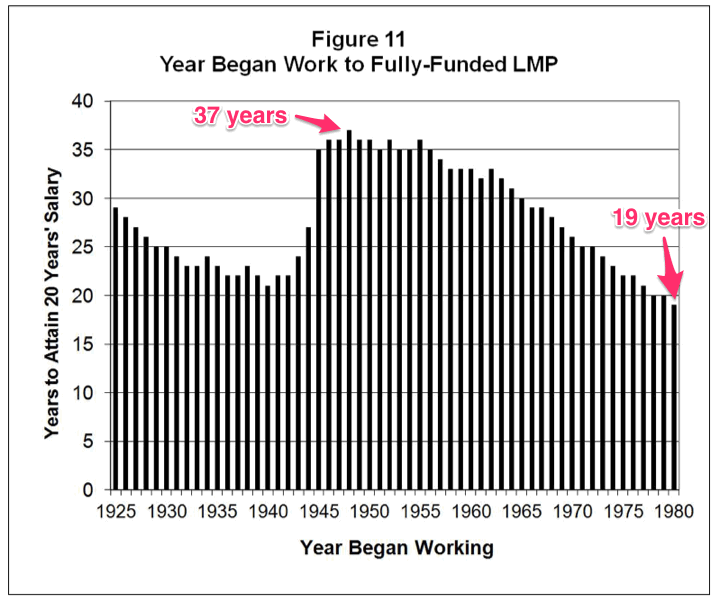
A wrinkle to this plan is that you won’t know exactly when the stock market will help make that happen. Before you reach your “number”, you’ll most likely be buying stocks and hoping they grow in value. Let’s say you saved 20% of your salary and invested it in the S&P 500*. How long would it take you to “win the game”?

Historically, it could be as little at 19 years or as long as 37. That’s nearly a two-decade difference in retirement dates! Same savings rate, different outcomes.

This paradigm rests on too many faulty assumptions to list, but it still illustrates a valid point: You just don’t know when you’re going to achieve your LMP, and when you do, it’s best to act.

If, at any point, a bull market pushes your portfolio over the LMP “magic number” of 20 to 25 times your annual cash-flow needs beyond Social Security and pensions, you’ve won the investing game. Why keep playing? Start bailing.

If you don’t act, the market might drop and it could take years to get back to your number again. This is one of the reasons why some people should not be holding a lot of stocks as they near retirement. Some people might need the stock exposure because the upside is better than the downside (they don’t have enough money unless stocks do well, or longevity risk), but for others the downside is worse than the upside (they DO have enough money unless stocks do poorly, or unnecessary market risk).

I find the concept of a risk-free liability-matching portfolio (LMP) much harder to apply to early retirement, as it is nearly impossible to create a truly guaranteed inflation-adjusted lifetime income stream that far into the future. Inflation-adjusted annuities are rare, expensive, and you’re betting that the insurer also lasts for another 50+ years if you’re 40 years old now. Social Security is subject to political risk and may become subject to means-testing. TIPS currently have negative real yields across the entire curve, and only go out to 30 years. (As Bernstein explores in future books, you’ll also have to avoid wars, prolonged deflation, confiscation, and other “deep risk” events.)

* Here are the details behind the chart:

As a small thought experiment, I posited imaginary annual cohorts who began work on January 1 of each calendar year, and who then on each December 31 invested 20% of their annual salary in the real return series of the S&P 500. I then measured how long it took each annual cohort, starting with the one that began work in 1925, to reach a portfolio size of 20 years of salary (which constitutes 25 years of their living expenses, since presumably they were able to live on 80% of their salary). Figure 11 shows how long it took each cohort beginning work from 1925 to 1980 to reach that retirement goal.