Archives for June 2019

Which Airline Miles Are Easiest To Redeem For Economy Awards? 2019

Cashing in your frequent flier miles for a free flight can be hit or miss, especially around a holiday. Which airlines are the most generous with making seats available? Each year, consulting firm IdeaWorks tries to run a fair comparison of all the major airlines to keep them honest. This WSJ article (paywall?) discusses their process:

In March, IdeaWorks searched for two award seats together on various travel dates between June and October on each airline’s busiest routes. Seats have to be available at the airline’s lowest everyday price—typically 25,000 miles round trip for a domestic coach ticket. The company made nearly 4,000 queries.

Below are the rankings of the 6 major US airlines. It is important to remember that this ranking focuses on domestic economy tickets only (no business class or international flights). The article does also rank international airlines on availability from a related metric.

For 2019, the most improved airline is United Airlines, while the worst decline goes to Delta. Not surprisingly, United claims this was totally on purpose because that’s what customers want and they are all about that… Meanwhile Delta suggested that the change was simply a result of more demand because their program is so popular. Shrug.

If you fly a lot on United, you can get significantly expanded award availability with the Chase United Explorer card. Add in the free checked bag for you and a companion, and the perks can easily offset the annual fee.

Southwest and JetBlue remain on top at close to 100% availability, but that is a bit misleading since both of their points are revenue-linked with no blackout dates. For example, 25,000 Southwest points will buy you basically any “Wanna Get Away” ticket that costs up to about $375. So the results are really just saying that Southwest’s busiest routes almost always have a flight that costs under ~$375. JetBlue is only 98% because some of their flights are just over the price threshold. I wonder if they included flights to Hawaii, now that Southwest flies there?

I have come to appreciate the simplicity of Southwest’s structure, especially now that I primarily shop for multiple economy tickets. For example, you can reliably value their credit card bonuses of 40,000 points = $600 in Wanna Get Away airfare, and 80,000 points = $1,200 of Wanna Get Away airfare. I can buy five seats on the same flight, no problem. Others prefer the traditional, more complex structure because it offered the skilled person the chance to get outsized value, like a $3,000 ticket for 50,000 points.

Airlines make a huge percentage of their revenue from selling these airline miles, which they create out of thin air both for actual flying and specifically for credit card users. This also means they have an incentive to create “miles inflation” such that each mile is worth less and less over time. I like this annual WSJ survey because it shows that someone is paying attention and calling them out publicly, at least on seat availability.


Stocks and Bonds Asset Class Correlations 2009-2019

Morningstar has an educational series on How and Why to Invest in Bonds, and one of the included articles What Role Do Bonds Play in a Portfolio? had an interesting chart of the correlations between several major asset classes for the past decade up to mid-2019:

You can see above that US and international stocks are closely (but not perfectly) correlated, which means that they tend to move in the same direction. However, junk bonds also tend to move very closely with US stocks.

The least correlated asset against US stocks was intermediate government bonds. In fact, they actually tended to go up a little when stocks go down. This is one of the reasons why I own short and intermediate Treasury bonds as part of my bond portfolio, while at the same time avoiding high-yield or investment-grade corporates.

There is also another correlation chart of the Great Financial Crisis of October 2007 to February 2009, which had similar overall results. The least correlated assets were again short-term and intermediate-term government bonds.

You can also explain this diversification intuitively without numbers. I love my shares of businesses (stocks), and much of them time they are going to chug along nicely. However, we know that there will be periods when they are in big trouble and the outlook is bleak. Weak companies will be going bankrupt, while many others teeter dangerously close to the edge. Do you want to own debt backed by those same companies at the same time? It’s a double-whammy when both your stock and bond holdings are going down at the same time.

I am also concerned by recent reports of record amounts of “barely” investment-grade debt. There is a thin line between being rated investment-grade and
“junk”. Do the ratings tend to land on the investment-grade side of that line because the ratings agencies themselves are being paid by those same companies? (Again, remember those mortgage-backed securities of the financial crisis.) I’d rather not to have to worry about that possibility. I like the simplicity and the “sleep better at night” safety of owning bonds backed by the US government instead. I do also own municipal bonds in my taxable accounts, which for some reason were not included in this chart.

Related past posts:

Jack Bogle on Mailbox Money

While poking around the Bogleheads investing forum, I came across a thread discussing a 2015 ETF.com interview with the late Jack Bogle that touches on the topic of mailbox money in retirement. First, a nice dose of Bogle common sense:

If anybody were to give you a blueprint, I would say put your hand over your wallet. There are no blueprints. There is common sense, and the obvious principle here is to be more conservative and more protective when you’re older than when you’re younger. When you’re young, you have a small amount of capital, you can take more risk, you’ve got years to recoup, and you don’t care about income. When you’re older you want to protect what you have; if you’re wrong, you don’t have a lot of time to recoup, and on balance you want more income.

Bogle on the idea of Social Security and stock dividends as mailbox money:

But you ought to think about all sources of your retirement income. Having said that, when you own an equity portfolio, don’t get into it for market reasons, get into it for income reasons. Oversimplifying, what you want to do when you retire is walk out to the mailbox on Social Security day and on dividend payment day for the funds—assuming they’re the same day—and make sure you have two envelopes out there. One is your fund dividend and the other is your Social Security check. The Social Security will keep up with inflation year after year, and dividends are likely to increase year after year. They have been going up. Every once in a while there is an interruption, such as the Great Depression of the early 1930s. And many bank stocks eliminated their dividends in 2008, so there was obviously a drop. But it has long since recovered, and then some.

Bet on the dividends, and not on the market price. You’ve got those two envelopes and that’s your retirement. If you have a pension plan (one that is not likely to go bankrupt—and a lot of them are likely to) that is a third envelope. You want to be concerned about whether you have enough income to pay utility bills, pay for your food, pay your rent or your mortgage, whatever it might be, every month. You want income to help you pay those bills. And in the retirement stage, that’s what investing should be about—regular checks from dividends and/or from Social Security and/or from a pension account.

The problem is that the yield on the Vanguard Total US Stock Market (VTSAX) or S&P 500 Index fund is only about 2%. That’s a lot less income than most people would like out of their portfolio. Here’s Bogle on a high-dividend stock strategy:

If you really need the dividend income, I see nothing wrong with overweighting high-dividend stocks, knowing you’re taking a small risk of falling significantly behind the total market. But you can own blue chip stocks, and you’re going to get a higher dividend, a situation I think would be attractive to an awful lot of investors. But once you depart from the market portfolio, you’re taking on extra risk. Any strategy may have done very well in the past, but in this business, the past is not prologue.

The draw here is that the low-cost Vanguard High Dividend Yield Index Fund (VHYAX) sends out bigger income “checks”, currently an SEC yield of 3.37% as of 5/31/19. However, roughly speaking, the dividend payout from high-dividend stocks is going to be more likely to drop with poor market conditions.

Alternative #1: Low-cost Value funds. While not from this interview, Bogle has said elsewhere that he thinks that Large-Cap Growth and Large-Cap Value stocks will have roughly the same average returns over the long run. The difference is that in Value you’ll get a slightly bigger share of returns in the form of dividends and a little less in share price appreciation. Growth is the opposite – less dividends and more price appreciation. Therefore, if you wanted to create a little more “mailbox money” than the S&P 500, you may consider buying the Vanguard Value Index Fund (VVIAX) or Vanguard Value ETF (VTV) with a current SEC yield of about 2.8%.

Alternative #2: Low-cost Dividend Appreciation fund. I can’t find any Bogle commentary on this strategy, but you could also buy into the Vanguard Dividend Appreciation ETF (VIG), which invests in companies with at least ten consecutive years of increasing dividends. This fund also has a ~2% yield similar to the S&P 500, but historically they offer a more stable and steadily growing income stream without sacrificing too much in total return.

In the end, treating your dividend checks as retirement income is not all that different than taking out about conservative 3% a year from your portfolio. If you really wanted to make your income checks equal 3%, you can do some tweaks like going with the Vanguard Value Index fund and the Vanguard Total Bond fund and get very close without “reaching for yield” with junk bonds or niche investments. My portfolio is different and yet the income still gets close to 3% when I track the dividends and interest every 3 months.

Bogle would also remind you to make sure you are investing in low-cost, passive funds so you aren’t giving away 1% off the top to a fund manager. If you have a DIY mindset, you also avoid paying a financial advisor taking out another 1%. Paying both of those and you’ll be missing 2/3rds of your potential mailbox money.

Even A Little Paid Work Makes You Happy

Over the weekend, I saw a local news piece on how the “average person needs only eight hours of work per week to be happy”. The source was a paper in the Social Science and Medicine journal titled A shorter working week for everyone: How much paid work is needed for mental health and well-being? The study used data from the UK Household Longitudinal Study, which tracked over 70,000 people living in the UK aged between 16 and 64 across the last decade (2009–2018). Per the abstract, here are the two major questions posed.

Q: What is the minimum amount of paid employment needed to deliver some or all of the well-being and mental health benefits that employment has been shown to bring?

A: 8 hours is sufficient. When going from unemployed/stay-at-home-parent/injured/disabled to working up to 8 hours a week, there was a significant increase in mental wellbeing. ScienceDaily stated that self-reported life satisfaction in men increased by around 30% with up to eight hours of paid work, although women didn’t see a similar jump until working 20 hours.

Q: What is the optimum number of working hours at which the mental health of workers is at its highest?

A: There was no single optimum number. There was basically no improvement (or deterioration) in mental wellbeing for working additional hours, up to 48 hours per week.

The authors claim that these findings support shorter work-week policies, while the local newspeople didn’t really think of much of that – “Yeah, well, I’d like to only work 8 hours a week too, but that’s not going to happen…”

My main takeaway is that having some form of paid work, however small, improves mental wellbeing. This can be an important lesson for retirees, those seeking financial independence, and even those who are stay-at-home parents. If you know that you actually want to work a certain amount, that can change your early retirement numbers. You might plan to work fewer hours per week for more years.

It’s true that not all jobs are good fits with part-time work, but I think finding something that does fit that could (should?) be part of the retirement planning process. A medical professional like a nurse has a lot of part-time options, an experienced accountant can line up a job helping out during the busy tax season, an engineer can grow a network of contacts that can supply limited-time consulting gigs, and so on.

This also aligns with my personal experience. After my wife and I found out we were able to have kids, we had to figure out how to balance childcare duties. Long story short, it turns out that neither of us wanted to be full-time stay-at-home parents. (We also didn’t want to go with full-time daycare and were fortunate to be able to make that happen financially.) Now, instead of one person being full-time employed and one person being stay-at-home, we both work part-time and that makes us both happier!

If you look closely at a lot of “retired” people, a lot of them still take on paid work. I think this is one of those things that I would put on a list of “Top 10 Secrets of Early Retirees.” Even if you no longer have to work to make your mortgage payment, it still feels good to add some purpose to your day and to be perfectly honest, get paid money!

Immediate Annuity Payout Rates vs. Long-Term Bond Interest Rates

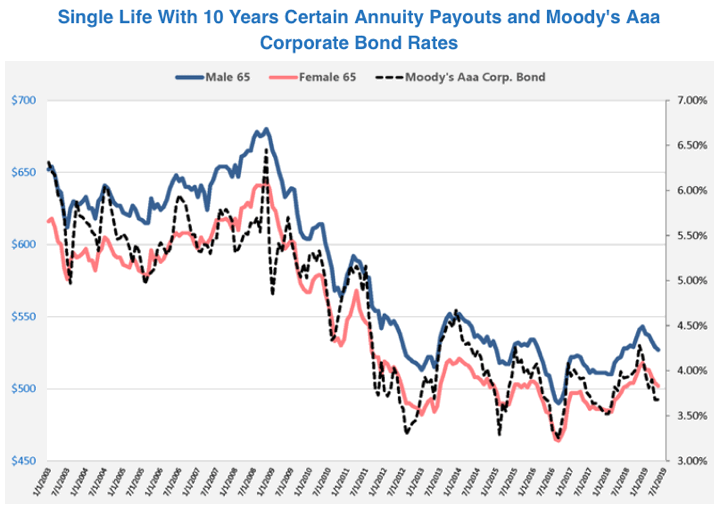
I’m still learning about immediate annuities as a potential future income stream, and came across this ImmediateAnnuities.com article about the relationship between immediate annuity payout rates and interest rates. (Note: I am not talking about indexed or variable annuities. Those I avoid completely.) The chart below shows the close relationship between the payout rate for a common type of immediate annuity (single life, 10-year guaranteed payout) and the interest rate on high-quality long-term corporate bonds.

At the same time, there is much less correlation between the payout rates and short-term interest rates. The “Fed Funds Rate” that you hear about all the time in the financial media is a short-term rate set by the Federal Reserve.

Even though annuities like to tout themselves as “guaranteed”, nominal annuities with a fixed payout are still exposed to inflation risk. For example, your contract might state a fixed payout of $1,000 a month for the rest of your life, but if inflation spikes, that $1,000 won’t go nearly as far. With 3% average inflation, your effective paycheck shrinks to only $640 of equivalent buying power after 15 years. With 4% inflation, it shrinks to $550 of buying power.

Right now, long-term interest rates are near historical low and thus so are payouts. You could argue that your downside potential is much greater than the upside as historically there are many more examples of extended periods of high inflation than extended periods of deflation. I don’t want to buy a 20-year bond paying the current market rate of 3.5%, but I really don’t want to locked in what is essentially a lifetime bond paying 4%.

Now, if you are definitely going to buy an annuity, the article does make a valid point that if you wait a year for rates to increase, that’s one less year of income you earn from a lifetime annuity. You may also opt to hedge your inflation risk elsewhere.

I’m still decades away from the age when I would like to buy an annuity, but I do think now is a very tough time for current retirees trying to create guaranteed income. The income available from “safe” investments are so low, and you do even worse after taxes. However, I simply don’t buy into the theory that inflation has gone away forever, and I personally would have a hard time buying an annuity at current rates.

Navy Federal Membership Open to Veterans and Family Members

Navy Federal Credit Union is the nation’s largest credit union and has recently surpassed $100 billion in assets as reported by DepositAccounts. I can understand their growth, as many of their financial products have very competitive rates, including certificates of deposit specials and mortgage rates. If the recent rate drops have you looking to refinance, I would definitely compare their rates against the major rate quote sites like LendingTree, especially if you are looking for a jumbo loan or other non-standard mortgage type.

You can now join Navy Federal without serving in the military. It is true that until 2017, it was hard to become a member of Navy Federal unless you were active military, Department of Defense worker, or a military retiree. Even honorably discharged veterans couldn’t join! However, the current membership rules are more open. Here is their eligibility tool.

If you have ever served in the military, you are now eligible to join. This includes:

  • Active Duty Army, Marine Corps, Navy, Air Force or Coast Guard
  • Army or Air National Guard
  • Delayed Entry Program
  • Officer Candidate / ROTC
  • Reservist
  • Veteran, Retiree or Annuitant

Beyond that, if one of your immediate family members serves or has EVER served in the military, you are also eligible for membership. Immediate family members include:

  • Parents and grandparents
  • Children and grandchildren
  • Siblings and spouses

This applies even if they are not a NavyFed member themselves. You may need some form of identifying document that shows your family member’s military relationship. Call NavyFed at 1-888-842-6328 and they should be happy to assist you.

This change greatly opens their field of membership, which I am sure has contributed to their impressive growth in assets. We have never served, but we do have both past and current family members in the military.

World of Hyatt Credit Card Review: 60,000 Bonus Points

The World of Hyatt credit card is a Hyatt consumer credit card issued by Chase that offers several perks for those that enjoy Hyatt hotels. There is a current sign-up bonus of up to 65,000 Hyatt points. Here are the highlights:

  • 30,000 Bonus Hyatt Points after you spend $3,000 on purchases in your first 3 months from account opening. Plus, up to 30,000 More Bonus Points by earning 2 Bonus Points total per $1 spent in the first 6 months from account opening on purchases that normally earn 1 Bonus Point, on up to $15,000 spent.
  • Enjoy complimentary World of Hyatt Discoverist status for as long as your account is open.
  • 1 Free Night award each year after your Cardmember anniversary at any Category 1-4 Hyatt hotel or resort.
  • 1 Additional Free Night award at any Category 1-4 Hyatt hotel or resort if you spend $15,000 during your cardmember anniversary year.
  • Receive 5 tier qualifying night credits towards status after account opening, and each year after that for as long as your account is open.
  • Earn 2 qualifying night credits towards your next tier status every time you spend $5,000 on your card.
  • Earn up to 9 points total for Hyatt stays – 4 Bonus Points per $1 spent at Hyatt hotels & 5 Base Points per $1 from Hyatt as a World of Hyatt member
  • Earn 2 Bonus Points per $1 spent at restaurants, on airline tickets purchased directly from the airlines, on local transit and commuting and on fitness club and gym memberships
  • $95 annual fee.

If you’ve gotten a bonus from any Hyatt Card within the last 2 years, please note the following:

The product is not available to either (i) current Cardmembers of any Hyatt Credit Card, or (ii) previous Cardmembers of any Hyatt Credit Card who received a new Cardmember bonus within the last 24 months.

If you have the old Chase Hyatt card, you can call them up and ask for upgrade options.

The 5/24 rule applies to this card. On many Chase cards, there is an unofficial rule that they will automatically deny approval on new credit cards if you have 5 or more new credit cards from any issuer on your credit report within the past 2 years (aka the 5/24 rule). This rule is designed to discourage folks that apply for high numbers of sign-up bonuses. This is applied on a per-person basis, so in our household one applies to Chase while the other applies at other card issuers. The 5/24 rule is now believed to apply to this card.

What can you get with 50,000 Hyatt points? Here are all the Hyatt redemption options, but the most popular options are for free hotel nights, points+cash hotel combinations, or room upgrades. Hyatt allows you the flexibility of combining your points with any other World of Hyatt member to redeem an award.

After the recent Marriott/Starwood merger, I believe that Hyatt points are now the most valuable hotel points on a per-point basis. In general, I would rather convert my Chase Ultimate Rewards points into Hyatt points than any other hotel program.

Below is their points award chart, and here is their award search tool. Free rooms start at 5,000 points. A suite upgrade is 6,000 points.

For example, 50,000 points can get you two free nights at the Category 6 properties like the Hyatt Regency Maui or Grand Hyatt Kauai (25,000 pts/night). You also avoid the resort fees of up to $45 per night with an award redemption. Alternatively, 50,000 points would get you 4 nights at a Category 3 like the Hyatt Regency Grand Cypress in Orlando (12,000 pts/night) with some points left over. Finally, you could get 10 nights at 5,000 points per Category 1 night like the Hyatt Place Austin/Round Rock.

If you compare with the cash cost of these hotels, the number varies you are nearly always getting between 1 cent and 2 cents per point value, sometimes more. We are staying at the Grand Hyatt Kauai this summer on Hyatt points from this card, where the cash value is $701 per night when you include all taxes and the $35/night resort fee. That works out to 2.8 cents per Hyatt point.

Annual fee and free anniversary night. This card does have a $95 annual fee, but in exchange you get a Free Night Certificate good at any Category 1-4 hotel or resort. I can easily get $95 of value out of this certificate, so this card is a keeper card for me. Your travel situation may be different.

You can also earn an additional free night at any Category 1-4 Hyatt hotel if you spend $15,000 during your cardmember anniversary year. I had to spend $6,000 to reach the sign-up bonus the first year, so I went ahead and reached this hurdle to reach a total of 2 free Cat 1-4 nights + 50,000 points after the first year. I probably won’t go for it in future years, though.

Hyatt points expire after 24 months of inactivity, but earning points via this credit card counts as activity. Chase Ultimate Rewards points also convert to Hyatt points and the transfer counts as activity.

Ongoing rewards structure. I might book my Hyatt nights on this card, but the rest of the rewards aren’t terribly exciting to me.

  • 9 points total per $1 spent at Hyatt – 4 Bonus Points per $1 when you use your card at Hyatt hotels & 5 Base Points per $1 you can earn as a World of Hyatt member.
  • 2 points per $1 spent at restaurants, on airlines tickets purchased directly from the airlines, on local transit and commuting and on fitness club and gym memberships.
  • 1 point per $1 spent on all other card purchasesoffer details reference link*

The free Discoverist status from this card gets you a free bottle of water daily, a free upgrade to premium WiFi internet, dedicated check-in area, and a 2pm late checkout upon request at participating locations. You are also eligible for a minor room upgrade within your type booked.

Bottom line. The World of Hyatt credit card is the new co-branded Hyatt credit card. As with most of these types of card, the best value is obtained by folks like like to stay at Hyatt properties. World of Hyatt is my favorite hotel rewards program, and thus my favorite hotel point to earn.

Also see: Top 10 Best Credit Card Bonus Offers.

Home Bias Against International Stocks: Lower Past Performance vs. Cheaper Valuations

globe

One the big decisions in portfolio construction is how much to allocate between US stocks and non-US stocks. You won’t find universal agreement on a correct answer, but this Morningstar article Investors Have Fewer Reasons Than Ever for Home Bias by Ben Johnson does a nice job of outlining the factors behind “home bias”:

“Home bias” is the term used to describe investors’ tendency to tilt their portfolios in favor of domestic stocks (bonds, too, but I’m going to focus on stocks). Here, I’ll discuss how home bias is measured, the factors that underpin this phenomenon, and why it’s probably a good idea to expand your horizons a bit.

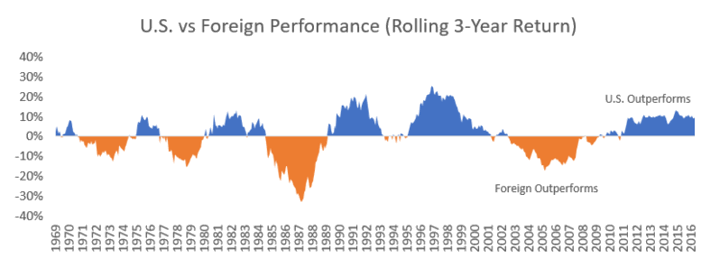
Sometimes the US outperforms international stocks for a while. Sometimes it lags. Here is a chart from Factor Investor that helps you visualize these past cycles:

us_intl_cycle

Right now, the market cap of the world’s publicly-traded businesses split at roughly 55% US and 45% international. This ratio has been flipped in the past (45% US/55% International) but the US has performed much better in the past decade.

Right now, the US looks great but International stocks have much higher earnings yields. The most interesting chart from the Morningstar article shows the current Shiller P/E Ratio amid the range of historical valuations for major indexes including the S&P 500, MSCI EAFA (Developed International), and MSCI EM (Emerging Markets). You can see that US stocks are currently on the high (expensive) side, while the international stocks are on the low (cheap) side.

It’s a tug of war. US stocks have done better recently. US stocks have a rosier outlook, which results in them being more expensive. International stocks have a bleaker outlook, but the price-to-earning ratios are much cheaper. If you own a Vanguard Target Retirement 20XX Fund or a LifeCycle Fund, you own 60% US/40% International. Most of the other Target Date Funds break it down differently, so you’ll have to check. I am in the market-weight camp and hold either 50/50 for simplicity. I have seen opinions of what is “best” change over time, and that supports the advice of having a written investment policy statement of what you believe and why.

My Money Blog Portfolio Income and Withdrawal Rate – June 2019 (Q2)

dividendmono225One of the biggest problems in retirement planning is making sure a pile of money lasts through your retirement. I have read hundreds of articles about this topic, and still haven’t a perfect solution to this problem. Most recently, I looked into the idea of buying a ETF that tracks stocks with 10+ year histories of growing dividends.

The imperfect (!) solution I chose is to first build a portfolio designed for total return and enough downside protection such that I can hold through an extended downturn. As you will see below, the total income is a little under 3% of the portfolio annually. I could easily crank out a portfolio with a 4% income rate, or even 5% income. But you have to take some additional risks to get there.

Starting with a more traditional portfolio, only then do I try to only spend the dividends and interest. The analogy I fall back on is owning a rental property. If you are reliably getting rent checks that increase with inflation, you can sit back calmly and ignore what the house might sell for on the open market. With this method, I am more confident that the income cover our expenses for the rest of our lives.

I track the “TTM Yield” or “12 Mo. Yield” from Morningstar, which the sum of a fund’s total trailing 12-month interest and dividend payments divided by the last month’s ending share price (NAV) plus any capital gains distributed over the same period. (Index funds have low turnover and thus little in capital gains.) I like this measure because it is based on historical distributions and not a forecast. Below is a very close approximation of my investment portfolio (2/3rd stocks and 1/3rd bonds).

Asset Class / Fund % of Portfolio Trailing 12-Month Yield (Taken 6/13/19) Yield Contribution
US Total Stock
Vanguard Total Stock Market Fund (VTI, VTSAX)
25% 1.99% 0.50%
US Small Value
Vanguard Small-Cap Value ETF (VBR)
5% 2.20% 0.11%
International Total Stock
Vanguard Total International Stock Market Fund (VXUS, VTIAX)
25% 3.00% 0.75%
Emerging Markets
Vanguard Emerging Markets ETF (VWO)
5% 2.69% 0.13%
US Real Estate
Vanguard REIT Index Fund (VNQ, VGSLX)
6% 3.96% 0.24%
Intermediate-Term High Quality Bonds
Vanguard Intermediate-Term Tax-Exempt Fund (VWIUX)
17% 2.79% 0.47%
Inflation-Linked Treasury Bonds
Vanguard Inflation-Protected Securities Fund (VAIPX)
17% 2.66% 0.45%
Totals 100% 2.65%


Over the last 12 months, my portfolio has distributed 2.65% of its current value as income. One of the things I like about using this number is that when stock prices drop, this percentage metric usually goes up – which makes me feel better in a gloomy market. When stock prices go up, this percentage metric usually goes down, which keeps me from getting too happy. This also applies to the relative performance of US and International stocks. In this way, this serves as a rough form of a valuation-based dynamic withdrawal rate.

In practical terms, I let all of my dividends and interest accumulate without automatic reinvestment. I like to look at this money as my “paycheck” arriving on a regular basis. Then, as with my real paycheck, I can choose to either spend it or reinvest in more stocks and bonds. This gets me used the feeling of living off my portfolio and learning to ignore the price swings.

We are a real 40-year-old couple with three young kids, and this money has to last us a lifetime (without stomach ulcers). This number does not dictate how much we actually spend every year, but it gives me an idea of how comfortable I am with our withdrawal rate. We spend less than this amount now, but I like to plan for the worst while hoping for the best. For now, we are quite fortunate to be able to do work that is meaningful to us, in an amount where we still enjoy it and don’t feel burned out.

Life is not a Monte Carlo simulation, and you need a plan to ride out the rough times. Even if you run a bunch of numbers looking back to 1920 and it tells you some number is “safe”, that’s still trying to use 100 years of history to forecast 50 years into the future. Michael Pollan says that you can sum up his eating advice as “Eat food, not too much, mostly plants.” You can sum up my thoughts on portfolio income as “Spend mostly dividends and interest. Don’t eat too much principal.” At the same time, live your life. Enjoy your time with family and friends. You may be more likely to run out of time than run out of money.

In the end, I do think using a 3% withdrawal rate is a reasonable target for something retiring young (before age 50) and a 4% withdrawal rate is a reasonable target for one retiring at a more traditional age (closer to 65). If you’re still in the accumulation phase, you don’t really need a more accurate number than that. Focus on your earning potential via better career moves, investing in your skillset, and/or look for entrepreneurial opportunities where you own equity in a business.

Free Websites Reveal Your Address History and Names of Relatives (How to Opt Out)

mag

Updated 2019 with more websites. “People would care more about privacy if they knew how exposed they already are online,” says Geoffrey A. Fowler in his WSJ article Your Data Is Way More Exposed Than You Realize.

I hear this all the time: “I have nothing to hide.” The truth is, pretty much everybody does something online they have reason to keep private.

I would have to agree. These days, it just takes a few clicks to find out your age, current and past addresses, phone numbers, and the names of your parents, siblings, children, cousins, and in-laws (and thus all of their information). Try entering your own name and city into one of the first few websites on this list:

  • Peoplefinders.com – Public access to your current and past addresses, phone numbers, relatives and associates. Opt out at www.peoplefinders.com/manage.
  • InstantCheckMate.com – Public access to your current and past addresses, phone numbers, relatives and associates. Opt out at www.instantcheckmate.com/opt-out.
  • FamilyTreeNow.com – Public access to your current and past addresses, phone numbers, relatives and associates. Opt out at www.familytreenow.com/optout.
  • TruePeopleSearch.com – Public access to your current and past addresses, phone numbers, relatives and associates. Opt out at www.truepeoplesearch.com/removal.
  • MyHeritage.com – Must e-mail them at privacy@myheritage.com to remove information.
  • Geni.com – Must e-mail them at privacy@geni.com to opt out.
  • Spokeo.com – Public/paid access to birth month, email, current and past addresses, phone numbers, relatives, social networks and court records. Opt out at spokeo.com/optout.
  • Acxiom is a data broker that uses information to target ads and marketing. I found some unique data on there, although supposedly it’s not public (just up for sale). Opt out at acxiom.com/optout.

Opt out. For most of these websites, there is an opt-out option hidden in either their “Terms & Conditions” or “Privacy Policy” pages. Even though many of these sites appears to be clones of each other, you must opt out of each of them individually. The only “good” news is that where available, my opt out requests were fulfilled and I can’t find those records even a year later. It’s like stomping a cockroach but knowing there are more that you just can’t see.

Here are some related resources:

Facebook and Google serve as bottomless vacuums of your personal data. These tools help show you exactly what they keep.

  • StalkScan.com – Not public. Just links to specific parts of your own Facebook profile. Find out everything that Facebook stores about you, even if it’s hard to find otherwise.
  • Google Maps Timeline – Google may be tracking your location all day long and keeping records forever. Not public. You can log in and request your data to be deleted.
  • Google My Activity – Google may be tracking every search and your web browsing history and keeping records. Not public. You can log in and request your data to be deleted.

Free Consumer Reports. You can also get a copy of your data stored at official consumer reporting agencies via the Fair Credit Reporting Act (FCRA).

My Money Blog Portfolio Asset Allocation Update, June 2019 (Q2)

portpie_blank200

Here’s my portfolio update for the second quarter of 2019. Most of my dividends arrive on a quarterly basis, and this helps me determine where to reinvest them. These are my real-world holdings, including 401k/403b/IRAs, taxable brokerage accounts, and savings bonds but excluding our house, cash reserves, and a few side investments. The goal of this portfolio is to create sustainable income that keeps up with inflation to cover our household expenses for the next (hopefully) 40+ years.

Actual Asset Allocation and Holdings

I use both Personal Capital and a custom Google Spreadsheet to track my investment holdings. The Personal Capital financial tracking app (free, my review) automatically logs into my accounts, adds up my balances, tracks my performance, and calculates my asset allocation. I still use my manual Google Spreadsheet (free, instructions) because it helps me calculate how much I need in each asset class to rebalance back towards my target asset allocation.

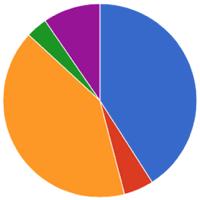
Here are my YTD performance and current asset allocation visually, per the “Holdings” and “Allocation” tabs of my Personal Capital account, respectively:

Stock Holdings
Vanguard Total Stock Market Fund (VTI, VTSAX)
Vanguard Total International Stock Market Fund (VXUS, VTIAX)
WisdomTree SmallCap Dividend ETF (DES)
Vanguard Small Value ETF (VBR)
Vanguard Emerging Markets ETF (VWO)
Vanguard REIT Index Fund (VNQ, VGSLX)

Bond Holdings
Vanguard Limited-Term Tax-Exempt Fund (VMLTX, VMLUX)
Vanguard Intermediate-Term Tax-Exempt Fund (VWITX, VWIUX)
Vanguard Intermediate-Term Treasury Fund (VFITX, VFIUX)
Vanguard Inflation-Protected Securities Fund (VIPSX, VAIPX)
Fidelity Inflation-Protected Bond Index Fund (FIPDX)
iShares Barclays TIPS Bond ETF (TIP)
Individual TIPS securities
U.S. Savings Bonds (Series I)

Target Asset Allocation. Our overall goal is to include asset classes that will provide long-term returns above inflation, distribute income via dividends and interest, and finally offer some historical tendencies to balance each other out. I make a small bet that US Small Value and Emerging Markets will have higher future long-term returns (along with some higher volatility) than the more large and broad indexes, although I could be wrong. I don’t hold commodities, gold, or bitcoin as they don’t provide any income and I don’t believe they’ll outpace inflation significantly.

I believe that it is important to imagine an asset class doing poorly for a long time, with bad news constantly surrounding it, and only hold the ones where you still think you can maintain faith based on a solid foundation of knowledge and experience.

Stocks Breakdown

  • 38% US Total Market
  • 7% US Small-Cap Value
  • 38% International Total Market
  • 7% Emerging Markets
  • 10% US Real Estate (REIT)

Bonds Breakdown

  • 50% High-quality, Intermediate-Term Bonds
  • 50% US Treasury Inflation-Protected Bonds

I have settled into a long-term target ratio of 67% stocks and 33% bonds (2:1 ratio) within our investment strategy of buy, hold, and occasionally rebalance. I will use the dividends and interest to rebalance whenever possible in order to avoid taxable gains. (I’m fine with it drifting a bit either way.) With a self-managed, simple portfolio of low-cost funds, we minimize management fees, commissions, and taxes.

Holdings commentary. On the stocks side, everything has had a nice bounce back up since the drop in late 2018. I know that US stocks have beaten international stocks for a while, but I remain satisfied with my mix, knowing that I will own whatever successful businesses come out of the US, China, or wherever in the future.

On the bond side, my primary objective is to hold high-quality bonds with a short-to-intermediate duration of under 5 years or so. This means US Treasuries, TIPS, or investment-grade municipal bonds. I don’t want to worry about my bonds “blowing up”. I then tweak the specific breakdown based on my tax-deferred space available, the tax-effective rates of muni bonds, and the real interest rates of TIPS. Right now, it is roughly 1/3rd Treasuries, 1/3 Muni bonds, and 1/3rd TIPS.

Performance commentary and benchmarks. According to Personal Capital, my portfolio went up 9.9% so far in 2019. I see that during the same period the S&P 500 has gone up over 15%, Foreign Developed stocks up nearly 11%, and the US Aggregate bond index was up nearly 5%.

An alternative benchmark for my portfolio is 50% Vanguard LifeStrategy Growth Fund and 50% Vanguard LifeStrategy Moderate Growth Fund – one is 60/40 and the other is 80/20 so it also works out to 70% stocks and 30% bonds. That benchmark would have a total return of +10.97% for 2019 YTD.

I’ll share about more about the income in a separate post.

Rates Drop Under 4% = Refinance Check! 7 Million People Can Lower Mortgage Rate By 0.75%+

A mortgage broker once told me that he didn’t care if rates were high or low. He just wanted them to change. As long as interest rates move enough in either direction, more mortgages will be created. He’s probably getting a lot of calls right now, as the average 30-year fixed mortgage has dropped down to 3.82% from nearly 4.5% over the last 3 months (source).

The result? Nearly 7 million Americans can now refinance and potentially lower their existing rate by at least 0.75% according to mortgage analytics company Black Knight (source):

According to Axios, the average principal and interest payment would be reduced by $268 per month. Your number may differ, but still that’s every month! If you are looking for opportunities with a high return-on-time-invested, this could be a big one.

Bottom line. If you have a mortgage, now is a good time to compare your existing rate with what is available. Get an accurate full quote with all the costs involved with a online comparison site like LendingTree (tip: don’t enter a phone number if you don’t want them to call you) or go local and call up your neighborhood broker. You might also try an “instant quote” below that doesn’t require any personal information. If you can save money, lock in the rate as they can pop back up quickly.