Archives for September 2023

Treasury vs. TIPS vs. Breakeven Inflation Interest Rate Update (September 2023)

Just as I track the interest rates on savings accounts and CDs, I also follow the real rates of Treasury Inflation-Protected Securities (TIPS). Right now, the real (inflation-adjusted) yield on TIPS are reaching 10+ year highs and worth a closer look.

TIPS basics recap. The inner workings of TIPS can be complicated. John Rekenthaler recently attempted to break down how TIPS work in this Morningstar article, and I applaud his efforts but… my head still hurt after reading it through multiple times. 😓 Hopefully you’ll do better.

My close-enough version! TIPS are priced based on their real yield. Let’s say a 30-year TIPS has a real yield of 2%. That means it promises to yield 2% above inflation. Let’s say a 30-year traditional US Treasury bond has a yield of 4.5%. This is a nominal number, like that of a bank interest rate. The difference between those two rates is 2.5%, referred to as the breakeven inflation rate.

  • If over the next 30 years, inflation is 2.5%, then both will end up with the same final total return of 4.5%.
  • If over the next 30 years, inflation is 2%, then TIPS will return 4% while the regular Treasury will return 4.5%.
  • If over the next 30 years, inflation is 3%, then TIPS will return 5% while the regular Treasury will return 4.5%.

If inflation is higher than the breakeven rate over the bond maturity, TIPS win. If inflation is lower than the breakeven rate over the bond maturity, the regular Treasuries win.

Let’s take a look at the current numbers as of late September 2023.

30-year TIPS rate is 2.33% as of 9/26/23, the highest since they started selling them again in 2010. Chart from FRED (doesn’t include spike from last two days):

30-year Treasury rate is 4.70% as of 9/26/23, also the highest in a while. Chart from FRED:

The 30-year breakeven inflation rate is thus 2.37% as of 9/26/23. Chart from FRED:

(By the way, according to TIPSladder.com, you can construct a ladder of TIPS with today’s rates that will provide you a guaranteed inflation-protected income over the next 30 years at a 4.62% withdrawal rate as of this writing. In other words, $1 million portfolio can turn into $46,200 a year, inflation-adjusted every year, for the next 30 years. They show you how to build a ladder where the last bond would mature and the principal would be gone at the end of 30 years.)

I don’t know what future inflation will be, so I hold a mix of both regular Treasuries and TIPS in my bond portfolio. Right now, you get a historically solid real rate and a historically reasonable breakeven rate. I should add that as long as inflation is roughly as expected and you hold the bonds until maturity, then both types of bonds will earn roughly the same returns. There isn’t that much “cost” if things remain pretty calm.

The reason to consider dealing with the added hassle and complexities of TIPS is the potential danger from unexpected, high inflation. I’ll repeat that not a single insurance company will sell you similar inflation protection at ANY price. They’ll sell you a 3% step-up every year, sure, but no way will they let it float with actual inflation on an uncapped basis. They know that inflation probably won’t be 5%+ for an extended period of time… but it might. It has certainly happened in the past, and as we’ve seen, lots of things that have never happened ever before can still happen.

Parallels Between Running and Personal Finance Advice: Listen, Experiment, Self-Assess, Adapt

I’ve recently taken up the hobby of running (very slowly) and have been making my way through the available Libby eBooks for both tips and inspiration. Running advice feels similar to personal finance advice in many ways. There are some broad concepts that seem to have secured broad agreement, but dig deeper and there are endless different variations within those areas. There is a mountain of advice available from veteran gurus, rockstar professionals, and amateur enthusiasts.

Here are some good quotes from the book 50/50: Secrets I Learned Running 50 Marathons in 50 Days by Dean Karnazes. His books are more on the inspirational side, as he obviously just loves endurance running and there is less arguing about exact training schedules or nutritional tracking down to the electrolyte. He doesn’t appear to sell his own trademarked method, which means he can take a step back.

Most important to just start and listen.

If I could offer only one piece of advice to runners, it would be this: “Listen to everyone, follow no one.” That’s because each runner is unique, so there’s no single training system, shoe, or breakfast that is equally effective for every athlete. I always encourage other runners to experiment during training and find what works best for them.

Personal finance parallels: The fact that you are interested in learning more is more important than which book you read first. Sure, there are some semi-dangerous quacks out there, but if you keep reading a cross section of the most commonly recommended books, then you should soon gather enough information to discover the general themes. The best book is the book that gets you to take action.

Discover your own unique strengths.

Each runner is unique. There is no single formula for running success that works equally well for everyone. Some runners are naturally speedy and struggle to build endurance; others are the opposite. Some runners are injury-resistant, others are injury-prone. Some runners recover quickly from hard workouts while others take longer.

Personal finance parallels: Some people happen to be talented at skills that are very highly-compensated at this moment in time. Some people are great at sales. Some are clever risk-takers that find opportunities with high upside and tolerable downside. Some are conservative but can focus for long periods of time. Some people are good at not needing to spend much money to be happy. Some people are just better at tolerating corporate bureaucracies.

Take action and prioritize your own specific goals.

“You can have anything you want, you just can’t have everything you want.”

Experiment, expect some surprises, and adapt.

To continually improve as a runner, try to really tune in to how your body responds to training and continuously evolve your training methods accordingly. When you’re a beginner, the best you can do is follow one-size-fits-all training guidelines obtained from a coach, a book, or a more experienced runner. As you do so, however, you are sure to discover that they don’t always meet all your individual needs. Eventually, these general methods will need to be modified and tweaked to better fit your personal goals and approach. As Charles Darwin has written, “It is not the strongest of the species that survives, nor the most intelligent, but the one most responsive to change.”

Personal finance parallels: There will always be a fascination with the idea of “early retirement in your 30s” or “millionaire by age XX”, but the real world is much messier. Your business does great. Your business fails. You have a kid (or more). You experience a health scare. Your parents or other relatives need assistance. My life doesn’t translate well to an inspirational book, but I know that paying attention to my finances has made my life better by allowing me to spend more quality (relaxed) time with my family. The game changes, and you have to keep adapting.

I hope that going down the path of running will provide a sense of personal fulfillment and enjoyment, on top of any health benefits. That’s how I feel about personal finance as well. I hope that people know that going down the path of learning about and improving their personal finance practices can help provide a happier, calmer, and more fulfilled life, not just more money.

Project Gutenberg + AI = Free High-Quality Audiobook Classics

Project Gutenberg is well-known as a volunteer-driven, non-profit project that digitizes free public-domain books, mostly those whose copyright has expired. However, their eBooks were often uncomfortable to read as plain text. Standard eBooks took the most popular ones and improved the typography and device-specific formatting, such that they look as modern as other retail eBooks.

The Project Gutenberg Open Audiobook Collection is a new collaboration between Project Gutenberg, Microsoft AI, and MIT to create audiobooks with natural-sounding speech using neural text-to-speech technology. I wouldn’t say it perfectly matches that of a trained voice actor, but it is certainly a huge improvement over the old robotic voice. I recently read Call of the Wild by Jack London as it was on my kid’s summer reading list, and you can compare the different versions yourself.

Here is the current full list of available audiobooks. You can also find them on Google Podcats, Apple Podcasts, and Spotify. This makes it much easier to listen to classic books during your commute and also for the visually-impaired.

For some title ideas, check out this list of the most downloaded Project Gutenburg eBooks. Here are the top 10 right now:

  • Frankenstein; Or, The Modern Prometheus by Mary Shelley
  • Romeo and Juliet by William Shakespeare
  • Pride and Prejudice by Jane Austen
  • The Scarlet Letter by Nathaniel Hawthorne
  • Dracula by Bram Stoker
  • Alice’s Adventures in Wonderland by Lewis Carroll
  • The Yellow Wallpaper by Charlotte Perkins Gilman
  • A Doll’s House : a play by Henrik Ibsen
  • Moby Dick; Or, The Whale by Herman Melville
  • The Picture of Dorian Gray by Oscar Wilde

US Bank Business Checking: Up to $800 Bonus

US Bank has up to a $800 bonus when you open a new Business Checking account using the promo code Q3BUS23 and complete the following activities. Offer valid through October 31, 2023.

  • Open a U.S. Bank Business Checking account (Silver, Gold, Platinum). The lowest Silver tier has no monthly maintenance fee and includes 125 free transactions per month.
  • Deposit $5,000 or $25,000 in new money within 30 days of account opening and then maintain your balance until the 60th day after account opening. .

Your bonus is determined by the total amount of your deposits:

  • Earn $350 when you deposit $5,000.
  • Earn $800 when you deposit $25,000.

This offer may be restricted to those states where US Bank has a physical branch presence. In addition, sometimes people outside this footprint may be allowed to open an account if they have other US Bank products. They’ll tell you when you apply, early on in the process, if your address is not allowed.

The business checking bonus will be deposited into your new U.S. Bank Silver, Gold, or Platinum Business Checking account within 30 days following the last calendar day of the month you complete all the offer requirements, as long as the account is open and has a positive available balance.

Here is their definition of “new” account:

Offer is not valid if you or any signer on the new business checking account have an existing U.S. Bank Business Checking account or had a U.S. Bank Business Checking account in the last 24 months.

Thanks to Dividend Growth Investor for the tip.

This is for business checking accounts (their personal checking offer is different each month) but this offer is worth a mention due to the relatively big bonus combined with a reasonable minimum holding period. Earning $350 for holding $5,000 for 60 days is roughly a 42% annualized return. Earning $800 for holding $25,000 for 60 days is roughly a 19% annualized return. Self-employed business owners can open a business checking account for themselves as a sole proprietorship or LLC.

The Hidden Effect of Securities Lending in Index Funds and ETFs (Are They Already Free?)

Morningstar has an educational article called Understanding Securities Lending in ETFs (also see the full whitepaper) that provided a lot of real-world numbers in an often overlooked area that actually affects the majority of ETF and mutual fund investors. ETFs hold a basket of stocks, and securities lending is the practice where the fund sponsor lends out some of those stocks for a fee. Borrowers may include hedge funds participating in a short or arbitrage play, or broker/dealers that need some shares to cover their own settlement needs.

If you own a Vanguard/Fidelity/Blackrock Target Retirement Fund or Total Stock Market ETF, you are benefiting from securities lending and earning a slightly higher return over time (while taking on a tiny bit of extra risk). Every major ETF and mutual fund provider, including Vanguard, Fidelity, Blackrock/iShares, State Street (SPDRs), American Funds, and T. Rowe Price participates in this practice.

Securities lending historically adds an average of around 0.005% to 0.03% of extra annual return. This means that for every $10,000 invested, you might earn an extra $0.50 to $3 a year. Here’s a Morningstar chart of the average securities lending return by sponsor. 1 basis point = 0.01%. It’s hard to tell if any differences are due to some level of operational skill, or that their holdings are simply more attractive to borrowers (more smaller stocks, more crypto stocks or whatever has higher short interest).

Due to the low expense ratios in many index funds, securities lending can significantly offset expense ratios. Securities lending interest usually goes toward quietly increasing the fund’s performance a little bit, as opposed to directly reducing the management expense ratio. Here’s a table of how much of each fund sponsor’s expense ratios are offset by securities lending income overall. Not surprisingly, the fund sponsors with mostly low-cost ETFs have the highest offset percentages.

Are some index ETFs already effectively free? The WSJ says index funds are almost free after State Street’s SPDR Portfolio S&P 500 ETF (SPLG) recently lowered its expense ratio to 0.02%, but given this information, it’s quite conceivable that the real “net” expense is already very close to zero, if not at zero.

These are all pretty small numbers for most individual investors. However, given the tiny expense ratio differences between index ETFs and the huge amount of assets held by them, the importance of every single basis point of additional performance is magnified. I’m glad to see that Vanguard remains competitive in this area, but also not overly aggressive.

Side note: Can individual investors earn even more extra income lending out the ETFs themselves? There is also the possibility of owning an ETF and lending out those entire ETF shares for interest. State Street runs the popular S&P 500 ETF SPY and in the article Unlocking the Securities Lending Potential of SPY makes the case that even though its ETF has a higher expense ratio that say Vanguard’s S&P 500 ETF VOO, the fact that SPY is the most popular ETF used for shorting the S&P 500 means that you might possibly net 8-9 basis points in this manner. The article appears to be targeted to institutional clients, so I’m not sure if any retail customers are getting anywhere near this amount of securities lending income. For my own portfolio as a whole, instead of even a single basis point, I am currently earning less than 0.04 basis points at Fidelity.

Even in the ideal case, retail customers only get about half of the gross income that the broker earns (a 50/50 split), and so given that VOO is still beating SPY in terms of straight-up 5-year past performance by 6 basis points or so every year, even if you allow the theoretical lending edge of 0.06% (with half or 3 basis points going to the investors), that still leaves VOO ahead of SPY. But as a practical matter, has anyone out there actually earned any income lending out their index ETFs? I haven’t; I’d imagine the supply would greatly outpace the demand.

TradeStation Brokerage: $150 Bonus with $500 Deposit

TradeStation is a brokerage targeted at active traders of stocks, ETFs, stock options, futures, and futures options. Right now they have a $150 bonus promotion when you deposit $500 or more into a new TradeStation Securities account with promo code BRAVAGDC:

Get an extra $150 in your account when you deposit $500 or more into a new TradeStation Securities account. Open a TradeStation account using offer code BRAVAGDC and maintain a minimum balance of $500 and look out for your reward. Additional terms apply.*

You may need to take a picture of your driver’s license during the application process, using your smartphone. I was able to get approved instantly and fund via a Plaid ACH link and transfer.

You don’t need to place any trades to qualify for this bonus, but you do need to keep your deposit there for 2 months after the funding date (first $75 bonus payment) and then until 3 months after funding date (second $75 payment). Therefore you may wish to buy something at least with your funds, like SGOV which holds short-term Treasury Bills at $100.xx per share.

Here is their fee schedule. Note that there is a $10 monthly activity fee unless one of the following criteria are met (I believe that this does not apply during first 90 days, but will once there is 90 days of inactivity): $5,000 average end-of-month equity balance OR at least ten (10) trades placed during the previous 90-day period.

The bid-ask spread for SGOV is only $0.01 on most days. Each share is only a little over $100. I plan on transferring about $505 and simply buying 1 share at a time, and then selling one share at a time, just enough to satisfy the activity requirements. I also plan to hold overnight to avoid daytrading restrictions.

Offer found via DoC. Full terms and conditions:

Only New Entity (non-Institutional) Individual or Joint equities and futures accounts with the correct promotional code entered and initially funded with New Assets (as defined below) of $500.00 or greater are eligible for this cash offer. To qualify, you must enroll by entering the promotional code on new account application or request to enroll a new account, via telephone or email, with a TradeStation Representative. You must initially fund the Account with New Assets within 45 calendar days of Account enrollment. New Assets is defined as cash or securities held at a financial institution other than TradeStation (assets transferred from an existing TradeStation account do not qualify). Your Account will not qualify for the cash offer if you withdraw or transfer assets from your Account, then redeposit them into the Account. Asset fluctuations (up or down) do not affect the calculation of Qualifying Assets. Minimum funding of $500 must be maintained through month following account fund date for first payment and through the next month for subsequent payment. The cash offer will be determined based on Qualifying Assets in the Account as follows:

Less than $500.00 – cash reward of $0;
$500 or more – 2 cash rewards of $75 (total of $150).

Cash reward will be paid out in monthly increments of $75. First deposit of $75 into the Account will be two months following the account fund date. Each subsequent credit will post in following month of qualification. This offer is not affiliated with TradingView and a subscription to TradingView is not required for qualification. This offer cannot be combined with any other offers. Only one offer per client on one qualifying account. Existing clients are not eligible for this offer. Customers who receive promotional offers from any TradeStation affiliate may be subject to IRS Form 1099-MISC reporting requirements should the total value of those items exceed $599 in a calendar year. Please consult a tax professional.

Another drop in my 2023 IRA $6,500 challenge bucket.

Michigan MESP 529 College Savings Plan: $100 Bonus Per Accountholder/Beneficiary Combo

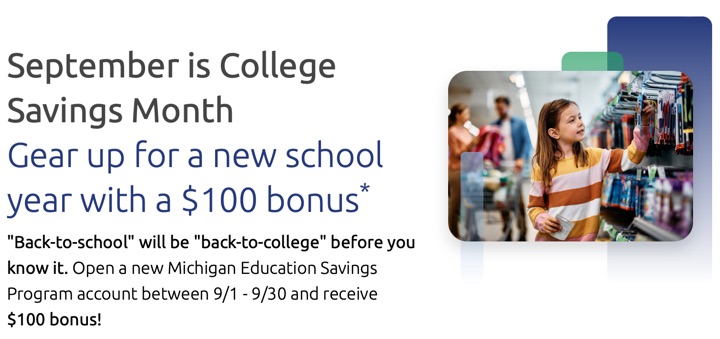
The Michigan Education Savings Program (MESP) is offering a $100 bonus when you open a new account by 9/30/23 and deposit $1,000+ within 10 business days of establishing the account. Your $100 matching deposit will arrive by 1/31/24. The 529 account must be open with a non-zero balance to receive the bonus.

Compared to all 529 plans nationwide, MESP is a top overall plan with reasonable costs and good investment options (official plan of Michigan, run by TIAA-CREF), making it an excellent option for those without specific in-state tax incentives. See here to compare 529 tax benefits across all 50 states.

This offer is very similar to the ScholarShare 529 promo, as both are managed by TIAA-CREF and this also has a limit of “one (1) Matching Deposit pernew Michigan Education Savings Program (MESP) account per unique accountholder/beneficiary combination.” Please see that post for more background information. Additional considerations for this promo:

  • Michigan taxpayers may qualify for a state tax deduction up to $10,000 if married filing jointly ($5000 single), for contributions made into an MESP account.
  • You should be able to stack this with other 529 offers like that from California Scholarshare. If you have multiple 529 accounts from different state plans/managers, you can later transfer the balances and merge them into each other, although there may be a modest amount of paperwork required each time. You are allowed one rollover per beneficiary during a rolling 12-month period.

From the full fine print:

Offer Description: The Michigan Education Savings Program (MESP) is a 529 college saving splan administered bythe Michigan Department of Treasury, and managed by TIAA-CREF Tuition Financing, Inc. (“TFI”). To receive a $100 matching deposit (“the Matching Deposit”), eligible individuals must (a) open a new Michigan Education Savings Program (MESP) account (for a new beneficiary) online at www.MIsaves.com between September 1, 2023 at 12:01 AM Eastern Time (ET) and September 30, 2023 at 11:59 PM ET with an initial deposit of at least $1,000 to be contributed and invested at the time the new Michigan Education Savings Program (MESP) account is opened. The initial $1,000 deposit must be received within 10 business days after the account is established. The Matching Deposit will be made to the eligible Michigan Education Savings Program (MESP) account on or before 8:59 PM ET on January 31, 2024. To receive the Matching Deposit, the Michigan Education Savings Program (MESP) account must be open with a dollar balance greater than zero on the day the Matching Deposit is made. Limit: one (1) Matching Deposit per new Michigan Education Savings Program (MESP) account per unique accountholder/beneficiary combination.

Oklahoma 529 College Savings Plan: $50/$100 Bonus Per Beneficiary

The Oklahoma 529 College Savings Plan is offering a $50 or $100 bonus when you open a new account and meet these deposit requirements:

  • $50 bonus: Open with a minimum initial deposit of $250 and set up recurring contributions via bank account or direct deposit) of $50 or more per month until 3/31/2024.
  • $100 bonus: Open with a minimum initial deposit of $500 and set up recurring contributions (via bank account or direct deposit) of $100 or more per month until 3/31/2024. Note that the info on the offer page conflicts with the fine print.
  • After six months, your $50 or $100 bonus will be deposited in your account on or before 5/17/2024.

Compared to all 529 plans nationwide, MESP is an above-average overall plan with reasonable costs and investment options (official plan of Oklahoma, run by TIAA-CREF), making it an acceptable option for those without specific in-state tax incentives. See here to compare 529 tax benefits across all 50 states.

Note that this offer has a limit of “Only one Matching Deposit per new Oklahoma 529 account per beneficiary”, which is more restrictive than the ScholarShare 529 bonus promo. Please see that post for more background information. Additional considerations for this promo:

  • Oklahoma taxpayers may qualify for a state tax deduction up to $20,000 if married filing jointly ($10,000 single) for contributions made into Oklahoma 529 account.
  • You should be able to stack this with other 529 offers like that from California Scholarshare. If you have multiple 529 accounts from different state plans/managers, you can later transfer the balances and merge them into each other, although there may be a modest amount of paperwork required each time. You are allowed one rollover per beneficiary during a rolling 12-month period.

From the full fine print:

PROMOTION DESCRIPTION: To receive a $50 promotion deposit (“the Promotion Deposit”), eligible individuals must (a) open a new Oklahoma 529 account (for a new unique Account Owner/Beneficiary combination) online during the Promotion Period with an initial deposit of at least $250 to be contributed and invested at the time the new account is opened and (b) establish a recurring contribution (from a bank account or by payroll direct deposit) for the new account of at least $50 per month, and shall be maintained at minimum through 11:59 PM CT on March 31, 2024. The Promotion Deposit will be made to the eligible account on or before May 17, 2024.

To receive a $100 promotion deposit, eligible individuals must: a) open a new Oklahoma 529 account (for a new unique Account Owner/Beneficiary combination) online during the Promotion Period with an initial deposit of at least $500 to be contributed and invested at the time the new account is opened and (b) establish a recurring contribution (from a bank account or by payroll direct deposit) for the new account of at least $100 per month, and shall be maintained at minimum through 11:59 PM CT on March 31, 2024. The Promotion Deposit will be made to the eligible account on or before May 17, 2024.

Limit: Only one Matching Deposit per new Oklahoma 529 account per beneficiary. Void where prohibited or restricted by law.

Bond Drawdown and Growth Comparison Charts: Short vs. Intermediate vs. Long-Term Bonds

When investing in bonds, one of the decisions is how long you want the “term to maturity”, or how much longer the bond will pay interest and then upon maturity repay the principal. The longer the term, the more sensitive the bond price is to interest rates. They are usually broken up into short-term, intermediate-term, and long-term categories. iShares manages a set of popular ETFs that invests in US Treasury bonds of certain maturities:
  • iShares 1-3 Year Treasury Bond ETF (SHY)
  • iShares 7-10 Year Treasury Bond ETF (IEF)
  • iShares 20+ Year Treasury Bond ETF (TLT)

Historically, the longer the term, the higher the return. In exchange for this potential higher return, the longer term leaves you expose to higher interest rate risk. A recent “Chart of the Day” from Abnormal Returns compared the drawdowns of short-term (SHY), intermediate-term (IEF), and long-term (TLT) Treasuries over the last 20 years. I found it a very good visualization of the greater interest rate risk of longer-term bonds in terms of a dropping balance in your brokerage account.

Right now, you might look at this chart and question why anyone would have wanted to own long-term Treasury bonds if you could experience a drawdown of 41%! And from “100% safe government bonds” no less! 😡

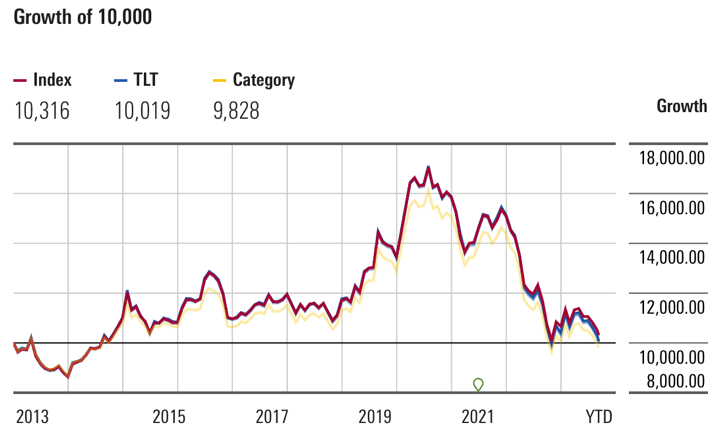
Well, lots of people were quite happy with their long-term bonds up until recently. Here is a Morningstar chart that tracks the growth of $10,000 first invested 10 years ago (2013) in the long-term Treasury ETF TLT. During the initial COVID response, your $10,000 investment would have been worth nearly $17,000 when interest rates were dropping. But as of today, you are basically back to only $10,000 again after a long 10 years.

The Growth of 10k chart for the intermediate-term Treasury ETF IEF is similar, but a bit downsized. The peak value in 2020 was about $13,000 before coming back to close to $10,000 again as well. (Focus on blue line only.)

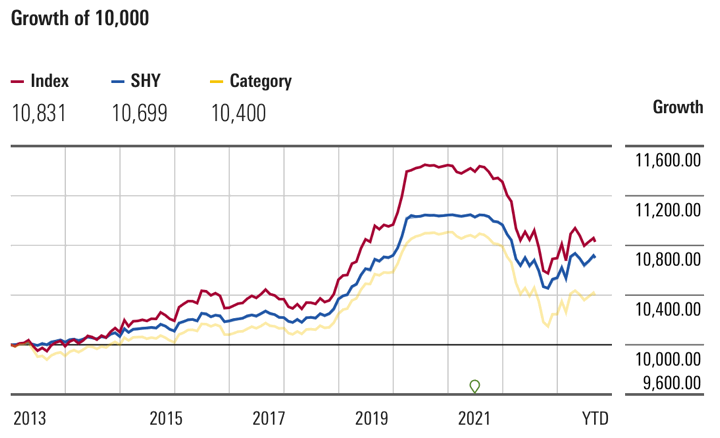
Finally, the Growth of 10k chart for the short-term Treasury ETF SHY was much more ho-hum. Notice how the vertical axes increase in much smaller increments. The peak value in 2020 was only about $11,000 before ending just slightly lower at ~$10,700. (Focus on blue line only.)

In fact, if you compare all three ETFs, the short-term ETF SHY had the highest ending value (and highest total return) over the last 10 years. Term risk showed up, and you could have had both a calm ride and more money in the end.

This is not a recommendation to only buy short-term bonds. Interest rates have been rising recently at one of the fastest rates in history, and that may stop or reverse at any time. Many people still choose to purchase longer-term Treasury bonds as a protection against deflation and/or dropping interest rates. Mostly, these charts help illustrate how these different types of bond terms respond to volatile interest rates. You may wish for a quieter ride (and less downside potential), even if you give up some upside potential. Or not.

Schwab Cash Sweep Options – Increase Yield 10X, Updated September 2023

Updated September 2023. Charles Schwab became a major player by offering discounted stock trades back when high commissions were the norm. These days, nearly every broker offers $0 commission trades on online equity/ETF trades. Where they differ is how they choose to squeeze out profit in such a lean environment. Even though Schwab will deny it publicly, they have chosen in many cases to focus on earning interest from their customers’ idle cash as one of their major sources of revenue.

Chase, Bank of America, Wells Fargo, they all make money by making money off your idle checking account balances while paying you nothing or 0.01% APY. They could all pay you more interest, but they don’t. This is why I post regular updates and monthly summaries of better banking options.

However, Schwab has the worst default cash sweep option for cash sweep amongst the “Big Three” brokerage firms by asset size (Vanguard, Fidelity, Schwab). Their mandatory default cash sweep pays only 0.48% APY as of 9/6/23.

For comparison, Vanguard’s default cash sweep is the Vanguard Federal Money Market Fund, which has an SEC yield of 5.27% as of 9/6/23. If I make a sale or receive a dividend distribution, my Vanguard cash automatically waits in this low-cost fund and earns a competitive interest rate. I may complain about how Vanguard is slipping in the customer service area, but this feature by itself is a major reason that I maintain my Vanguard brokerage account.

Fidelity has a FDIC cash sweep available as well, but they also let me switch my “core position” (their term for default cash sweep) to a higher-yield money market fund like Fidelity Treasury Money Market Fund (FZFXX) which has an SEC yield of 4.97% as of 9/6/23 or Fidelity Government Money Market Fund (SPAXX) which has an SEC yield of 4.97% as of 9/6/23. I find it amusing that Schwab was so chippy with Fidelity in this old article Zero Confusion: Setting the Record Straight. There is a reason why Schwab places that “one click” wall between you and a higher APY.

In the end, the most important thing is for you as the customer to understand the situation. Schwab still has other positive attributes and a reputation for good customer service. The good news is that there are several options for self-motivated individuals (like you that read posts like this!) who are willing to put forth a little effort to earn what could add up to hundreds or thousands in extra interest.

Manually invest in Schwab money market funds. The key is to visit this page: Schwab Purchased Money Funds for the most current fund options, minimums, and rates. These are not FDIC-insured, but they are still regulated by the SEC and required to hold very safe investments of a very short duration. Here the the available Schwab funds and SEC yields as of 9/5/23 with zero minimums. No transaction fees. There are higher-yielding options if you have more than $1 million.

  • Schwab Value Advantage Money Fund® – Investor Shares (SWVXX) 5.23%
  • Schwab Government Money Fund – Investor Shares (SNVXX) 5.05%
  • Schwab Treasury Obligations Money Fund – Investor Shares (SNOXX) 5.06%
  • Schwab U.S. Treasury Money Fund – Investor Shares (SNSXX) 5.03%

Again, these money market mutual funds can’t be set as an automatic sweep; you must manually move money in and out of the product. Every time you have a dividend or capital gains distribution, or you made a sale, you have to remember to move your cash (“sort”) into a higher-yielding option. This also means that if you want to for example buy new shares of stock, you would need to first put in an order to sell your money market mutual fund shares into cash (in order to have the funds available to buy that stock). The system won’t be able to automatically sell your fund. You’ll have to coordinate settlement times, and it may be helpful to have a margin account for faster funds availability.

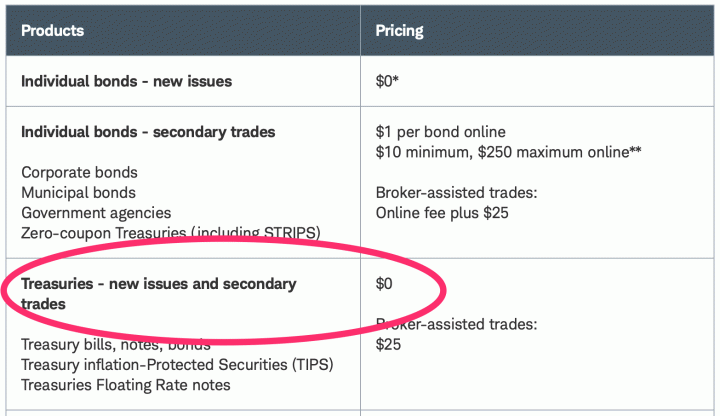
Treasury bills (auction and secondary). You can buy US Treasury bills and bonds directly through the Schwab fixed income desk. You can place either an auction order for a “new” T-Bill or buy them on the secondary market. There is no commission for online orders and a $25 fee per broker-assisted trade.

Buying an outside ETF. You can also use your free stock trades to buy an ETF that is close to cash (ultra-short duration, high-quality bonds). These will not be FDIC-insured and carry a bit of duration risk, but if your ETF holds T-Bills then those are also fully backed by the US government. Here are a few ideas (note the the reported rates may lag by up to one month):

  • The iShares 0-3 Month Treasury Bond ETF (SGOV) has an effective duration of 0.10 years. SPDR Bloomberg Barclays 1-3 Month T-Bill ETF (BIL) has an effective duration of 0.08 years.
  • The PIMCO Enhanced Short Maturity Active Bond ETF (MINT) and the iShares Short Maturity Bond ETF (NEAR) hold a portfolio of investment-grade bonds with an average duration of ~6 months.

Bottom line. Charles Schwab has a default cash sweep option with a relatively tiny interest rate. To earn more, you must do some research and manually buy one of the alternatives listed above that can earn ~10x more.

Best Interest Rates on Cash – September 2023

Here’s my monthly roundup of the best interest rates on cash as of September 2023, roughly sorted from shortest to longest maturities. There are often lesser-known opportunities available to individual investors. Check out my Ultimate Rate-Chaser Calculator to see how much extra interest you could earn from switching. Rates listed are available to everyone nationwide. Rates checked as of 9/5/2023.

TL;DR: Mostly minor movements this month. 6% APY now (barely) available with 12-month CD special and rewards checking accounts. Compare against Treasury bills and bonds at every maturity, taking into account state tax exemption.

Fintech accounts
Available only to individual investors, fintech companies often pay higher-than-market rates in order to achieve fast short-term growth (often using venture capital). “Fintech” is usually a software layer on top of a partner bank’s FDIC insurance.

  • 5.26% APY ($1 minimum). SaveBetter lets you switch between different FDIC-insured banks and NCUA-insured credit unions easily without opening a new account every time, and their liquid savings rates currently top out at 5.26% APY from multiple banks. See my SaveBetter review for details. SaveBetter does not charge a fee to switch between banks.
  • 5.30% APY (before fees). MaxMyInterest is another service that allows you to access and switch between different FDIC-insured banks. You can view their current banks and APYs here. As of 8/7/23, the highest rate is from Customers Bank at 5.30% APY. However, note that they charge a membership fee of 0.04% per quarter, or 0.16% per year (subject to $20 minimum per quarter, or $80 per year). That means if you have a $10,000 balance, then $80 a year = 0.80% per year. This service is meant for those with larger balances. You are allowed to cancel the service and keep the bank accounts, but then you may lose their specially-negotiated rates and cannot switch between banks anymore.

High-yield savings accounts
Since the huge megabanks STILL pay essentially no interest, everyone should have a separate, no-fee online savings account to piggy-back onto your existing checking account. The interest rates on savings accounts can drop at any time, so I list the top rates as well as competitive rates from banks with a history of competitive rates. Some banks will bait you with a temporary top rate and then lower the rates in the hopes that you are too lazy to leave.

  • The top rates at the moment are at Valley Direct and Milli.bank (app-only) at 5.25% APY. CIT Platinum Savings at 5.05% APY with $5,000+ balance.
  • SoFi Bank is now up to 4.50% APY + up to $275 new account bonus with direct deposit. You must maintain a direct deposit of any amount each month for the higher APY. SoFi has their own bank charter now so no longer a fintech by my definition. See details at $25 + $250 SoFi Money new account and deposit bonus.
  • There are several other established high-yield savings accounts at 4.25%+ APY that aren’t the absolute top rate, but historically do keep it relatively competitive for those that don’t want to keep switching banks.

Short-term guaranteed rates (1 year and under)
A common question is what to do with a big pile of cash that you’re waiting to deploy shortly (plan to buy a house soon, just sold your house, just sold your business, legal settlement, inheritance). My usual advice is to keep things simple and take your time. If not a savings account, then put it in a flexible short-term CD under the FDIC limits until you have a plan.

  • No Penalty CDs offer a fixed interest rate that can never go down, but you can still take out your money (once) without any fees if you want to use it elsewhere. CIT Bank has a 11-month No Penalty CD at 4.90% APY with a $1,000 minimum deposit. Ally Bank has a 11-month No Penalty CD at 4.55% APY for all balance tiers. Marcus has a 13-month No Penalty CD at 4.50% APY with a $500 minimum deposit. Consider opening multiple CDs in smaller increments for more flexibility.
  • American 1 Credit Union has a 12-month CD special at 6.00% APY. Probably won’t last long. Minimum opening deposit is $1,000. Early withdrawal penalty is 90 days interest. Anyone can join this credit union via $3 membership fee to join partner organization (must also keep $5 in share savings).
  • MapleMark Bank has a 12-month certificate at 5.75% APY. Also a limited-time offer. $25,000 minimum. Early withdrawal penalty is 6 months interest.

Money market mutual funds + Ultra-short bond ETFs*
Many brokerage firms that pay out very little interest on their default cash sweep funds (and keep the difference for themselves). * Money market mutual funds are regulated, but ultimately not FDIC-insured, so I would still stick with highly reputable firms. I am including a few ultra-short bond ETFs as they may be your best cash alternative in a brokerage account, but they may experience losses.

  • Vanguard Federal Money Market Fund is the default sweep option for Vanguard brokerage accounts, which has an SEC yield of 5.28%. Odds are this is much higher than your own broker’s default cash sweep interest rate.
  • The PIMCO Enhanced Short Maturity Active Bond ETF (MINT) has a 5.52% SEC yield and the iShares Short Maturity Bond ETF (NEAR) has a 5.57% SEC yield while holding a portfolio of investment-grade bonds with an average duration of ~6 months.

Treasury Bills and Ultra-short Treasury ETFs
Another option is to buy individual Treasury bills which come in a variety of maturities from 4-weeks to 52-weeks and are fully backed by the US government. You can also invest in ETFs that hold a rotating basket of short-term Treasury Bills for you, while charging a small management fee for doing so. T-bill interest is exempt from state and local income taxes, which can make a significant difference in your effective yield.

  • You can build your own T-Bill ladder at TreasuryDirect.gov or via a brokerage account with a bond desk like Vanguard and Fidelity. Here are the current Treasury Bill rates. As of 9/5/23, a new 4-week T-Bill had the equivalent of 5.38% annualized interest and a 52-week T-Bill had the equivalent of 5.43% annualized interest.
  • The iShares 0-3 Month Treasury Bond ETF (SGOV) has a 5.36% SEC yield and effective duration of 0.10 years. SPDR Bloomberg Barclays 1-3 Month T-Bill ETF (BIL) has a 5.18% SEC yield and effective duration of 0.08 years.

US Savings Bonds
Series I Savings Bonds offer rates that are linked to inflation and backed by the US government. You must hold them for at least a year. If you redeem them within 5 years there is a penalty of the last 3 months of interest. The annual purchase limit for electronic I bonds is $10,000 per Social Security Number, available online at TreasuryDirect.gov. You can also buy an additional $5,000 in paper I bonds using your tax refund with IRS Form 8888.

  • “I Bonds” bought between May 2023 and October 2023 will earn a 4.30% rate for the first six months. The rate of the subsequent 6-month period will be based on inflation again. More on Savings Bonds here.
  • In mid-October 2023, the CPI will be announced and you will have a short period where you will have a very close estimate of the rate for the next 12 months. I will have another post up at that time.
  • See below about EE Bonds as a potential long-term bond alternative.

Rewards checking accounts
These unique checking accounts pay above-average interest rates, but with unique risks. You have to jump through certain hoops which usually involve 10+ debit card purchases each cycle, a certain number of ACH/direct deposits, and/or a certain number of logins per month. If you make a mistake (or they judge that you did) you risk earning zero interest for that month. Some folks don’t mind the extra work and attention required, while others would rather not bother. Rates can also drop suddenly, leaving a “bait-and-switch” feeling.

  • Credit Union of New Jersey pays 6.00% APY on up to $25,000 if you make 15 debit card purchases, opt into online statements, and make at least 1 direct deposit, online bill payment, or automatic payment (ACH) per statement cycle. Anyone can join this credit union via $5 membership fee to join partner organization.
  • Pelican State Credit Union pays 6.05% APY on up to $10,000 if you make 15 debit card purchases, opt into online statements, log into your account at least once, and make at least 1 direct deposit, online bill payment, or automatic payment (ACH) per statement cycle. Anyone can join this credit union via partner organization membership.
  • Orion Federal Credit Union pays 6.00% APY on up to $10,000 if you make electronic deposits of $500+ each month (ACH transfers count) and spend $500+ on your Orion debit or credit card each month. Anyone can join this credit union via $10 membership fee to partner organization membership.
  • Genisys Credit Union pays 5.25% APY on up to $7,500 if you make 10 debit card purchases of $5+ each, and opt into receive only online statements. Anyone can join this credit union via $5 membership fee to join partner organization.
  • The Bank of Denver pays 5.00% APY on up to $25,000 if you make 12 debit card purchases of $5+ each, receive only online statements, and make at least 1 ACH credit or debit transaction per statement cycle. Thanks to reader Bill for the updated info.
  • All America/Redneck Bank pays 5.30% APY on up to $15,000 if you make 10 debit card purchases each monthly cycle with online statements.
  • Find a locally-restricted rewards checking account at DepositAccounts.

Certificates of deposit (greater than 1 year)
CDs offer higher rates, but come with an early withdrawal penalty. By finding a bank CD with a reasonable early withdrawal penalty, you can enjoy higher rates but maintain access in a true emergency. Alternatively, consider building a CD ladder of different maturity lengths (ex. 1/2/3/4/5-years) such that you have access to part of the ladder each year, but your blended interest rate is higher than a savings account. When one CD matures, use that money to buy another 5-year CD to keep the ladder going. Some CDs also offer “add-ons” where you can deposit more funds if rates drop.

  • United States Senate FCU has a 60-month CD at 4.86% APY $1,000 minimum. Jumbo CDs have slightly higher rates ($100k+, $200k+). The early withdrawal penalty is 360 days of interest. Anyone can join this credit union via partner organization.
  • Dept of Commerce FCU has a 60-month CD at 4.67% APY $500 minimum. The early withdrawal penalty is 180 days of interest. Anyone can join this credit union via partner organization.
  • You can buy certificates of deposit via the bond desks of Vanguard and Fidelity. You may need an account to see the rates. These “brokered CDs” offer FDIC insurance and easy laddering, but they don’t come with predictable early withdrawal penalties. Right now, I see a 5-year non-callable CD at 4.65% APY (callable: no, call protection: yes). Be warned that now both Vanguard and Fidelity will list higher rates from callable CDs, which importantly means they can call back your CD if rates drop later.

Longer-term Instruments
I’d use these with caution due to increased interest rate risk, but I still track them to see the rest of the current yield curve.

  • Willing to lock up your money for 10 years? You can buy long-term certificates of deposit via the bond desks of Vanguard and Fidelity. These “brokered CDs” offer FDIC insurance, but they don’t come with predictable early withdrawal penalties. You might find something that pays more than your other brokerage cash and Treasury options. Right now, I see a 10-year CDs at 4.35% (callable: no, call protection: yes) vs. 4.28% for a 10-year Treasury. Watch out for higher rates from callable CDs where they can call your CD back if interest rates drop.
  • How about two decades? Series EE Savings Bonds are not indexed to inflation, but they have a unique guarantee that the value will double in value in 20 years, which equals a guaranteed return of 3.5% a year. However, if you don’t hold for that long, you’ll be stuck with the normal rate, currently 2.50% for EE bonds issued from May 2023 to October 2023. As of 9/5/23, the 20-year Treasury Bond rate was 4.56%.

All rates were checked as of 9/5/2023.

ScholarShare 529 College Savings Plan: $100 Bonus Per Accountholder/Beneficiary Combo

The ScholarShare 529 College Savings Plan is offering a $100 bonus when you open a new account by 9/30/23 and deposit $1,000+ within 10 business days of establishing the account. Your $100 matching deposit will arrive by 1/31/24. The ScholarShare 529 account must be open with a non-zero balance to receive the bonus.

Compared to all 529 plans nationwide, the ScholarShare 529 is a solid overall plan with reasonable costs (official plan of California, run by TIAA-CREF), making it a good option for those without specific in-state tax incentives. See here to compare 529 tax benefits across all 50 states.

I find that having an open 529 plan is a great way to redirect various gifts from friends and family (like grandparents) so that the money doesn’t just get spent mindlessly and then forgotten. If someone gives them a gift card, I just put the equivalent value into the 529 and spend the gift card myself. Since by the time they really understand money it will have been 10 years since birth, it can been a good lesson on how steady saving and investing adds up. Finally, opening a plan and making any contribution also starts the 15-year clock on potential future 529-to-Roth IRA rollovers.

This specific bonus is also interesting due to the limit of “one (1) Matching Deposit per new ScholarShare 529 account per unique accountholder/beneficiary combination.” That means a couple with three children could open six accounts for $600 in total bonuses. It would also require a significant upfront deposit, but many families are already setting aside $100+ each month per kid for future college expenses.

  • Spouse 1 + Child 1
  • Spouse 1 + Child 2
  • Spouse 1 + Child 3
  • Spouse 2 + Child 1
  • Spouse 2 + Child 2
  • Spouse 2 + Child 3

If you have multiple 529 accounts from different state plans/managers, know that you can later transfer the balances and merge them into each other, although there may be a modest amount of paperwork required each time. You are allowed one rollover per beneficiary during a rolling 12-month period.

From the full fine print:

Offer Description: The ScholarShare 529 College Savings Plan (“ScholarShare 529”) is a 529 college savings plan administered by the ScholarShare Investment Board (“SIB”), an instrumentality of the state of California, and managed by TIAA-CREF Tuition Financing, Inc. (“TFI”). To receive a $100 matching deposit (“the Matching Deposit”), eligible individuals must (a) open a new ScholarShare 529 account (for a new beneficiary) online at www.ScholarShare529.com between September 1, 2023 at 12:01 AM Pacific Time (PT) and September 30, 2023 at 8:59 PM PT with an initial deposit of at least $1,000 to be contributed and invested at the time the new ScholarShare 529 account is opened. The initial $1,000 deposit must be received within 10 business days after the account is established. The Matching Deposit will be made to the eligible ScholarShare 529 account on or before 8:59 PM PT on January 31, 2024. To receive the Matching Deposit, the ScholarShare 529 account must be open with a dollar balance greater than zero on the day the Matching Deposit is made. Limit: one (1) Matching Deposit per new ScholarShare 529 account per unique accountholder/beneficiary combination.