Archives for March 2022

Marcus Bank CD Promo: 1.10% APY for 10-Month Term, Rising Rate Commentary

Rates are rising… slowly. Marcus Bank has a 10-month promo CD paying 1.10% APY ($500 min, early withdrawal penalty is 90 days of interest). Ally Bank has a 14-month promo CD paying 1.00% APY (No min, early withdrawal penalty is 60 days of interest). If you have a short-term window, these (sadly) are competitive rates. I figure I should mention them, although you can also get 1%+ APY from a liquid savings account if you know where to look.

Personally, I’m only keeping my cash in short-term lock-ups with high effective APYs like the deposit promos recently from CIT Bank (still live) and Live Oak Bank (probably too late if you haven’t started) and Marcus Bank (already expired).

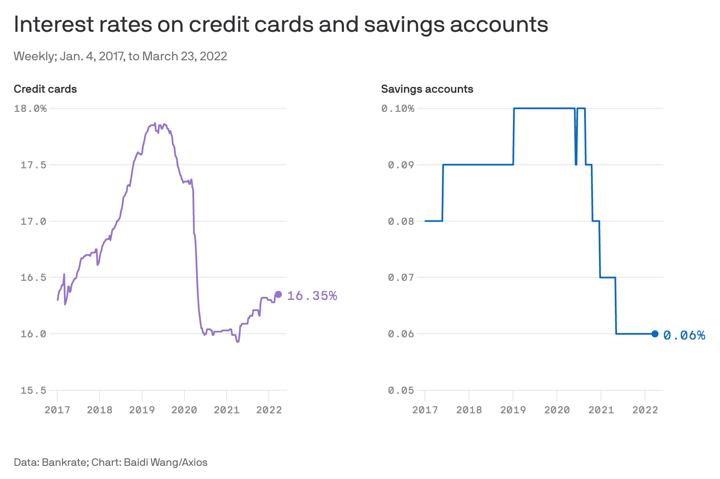
Overall, I definitely don’t on locking in any 5-year CDs due to the mix of current low rates and impending possibility of higher rates soon. Inflation numbers are still elevated. However, I also don’t expect to see significantly higher rates on savings accounts right away. Banks tend to raise their rates on credit cards first and by a lot, and savings account last and by a little. Via Axios (notice the different scales!):
Mint Mobile: My Canada International Roaming Experience and Tips

After a delay of two years, my family finally used up our flight credits and stash of hotel points to travel internationally to Vancouver and Whistler, British Columbia for some snow-filled fun. I was a bit worried about how well my “budget” cellular service Mint Mobile would work in Canada. (I’ve used them for years now to keep my monthly bill under $20 a month – see my Mint Mobile review.) Hopefully this information along with my personal experiences will be helpful to other cost-conscious travelers.

Mint Mobile has an international roaming page with some basic “official” information:

  • You can add prepaid funds to your international roaming balance in $5, $10 or $20 increments. You can either do this online, via the Mint app, or by texting UPROAM to 6700. You should probably do this in advance, as you need internet access or cell service in the first place.
  • For Canada, the rates are: 6 cents per minute voice, 2 cents per SMS text, and 6 cents per MB of data. This means 1 GB of data costs $60!
  • You can check your balance by texting ROAM to 6700.
  • Note: While in the US, you can make free voice calls from the US to Canada and Mexico. Handy for trip planning!

Additional tips to activate voice and data roaming on your phone. Mint says the above is all you need, but I dug up following additional steps to try after reading about user difficulties on the Reddit forum which seemed to make sense (i.e. make sure you enable cellular voice network roaming and cellular data roaming). I did all this upfront and both voice calls and texts worked fine for me, but I’m not sure if it was critical. Try the following on your phone:

– Before leaving the US, enable airplane mode.
– Once you arrive at your destination’s, disable airplane mode.
– Dial (#766#) from your phone’s keypad to activate roaming.
– Activate roaming and data roaming on your device.

No data? Check your APN settings. Again, my cellular data roaming worked fine without changing my APN settings, but if it doesn’t for you, changing them to one of the settings either at Mint Mobile (try the Android settings even if you have an iPhone) or Ultra Mobile (same owner) has worked for other users. I might even print these out beforehand, or copy them onto an offline doc on your phone. After changing your APN settings, you may be allowed to pick a specific local network provider in Canada like TELUS.

Tips to minimize costs. Due to the high cost of cellular data, we pretended we were back in 2010.

  • Cellular coverage was quite adequate in Vancouver and Whistler, BC. My wife and I communicated primarily by SMS text message. At 2 cents each, it was very efficient and economical. We did have a few voice calls when text was too cumbersome.
  • We turned off cellular data for 95% of the time, only really using it when we needed Uber/Lyft or additional Google Maps guidance.
  • When cellular data was turned on, it was on “Low Data” mode to prevent too much automatic background usage.
  • We did all our iMessage, emails, and other activities when we were back on hotel WiFi, free restaurant/coffee shop WiFi, or other free public/airport WiFi.
  • While on WiFi, we also downloaded offline maps onto the Google Maps app for all the areas we knew we’d be going. GPS worked fine using offline maps. We also *gasp* used physical maps too! Felt strange.

Before we left, we loaded $20 each ($40 total) to our Mint international roaming balance. After about 10 days of running around Canada, we ended up using about $10 each ($20 total). The balance supposedly never expires, so we can use the rest later. Overall, I felt it was a very reasonable price for the flexibility provided. Again, some other users do report having trouble with initially connecting to cellular data in Canada, but we had no such issues. Hopefully, with all the troubleshooting tips above, you can also use Mint Mobile while on a short trip to Canada.

Schwab Starter Kit: $101 in Free Stock (or Cash) For New Customers

I’m a old fart now, but if I am going to keep most of my net worth somewhere, I want it somewhere that if I called their phone number, I’d be confident to have a knowledgable human pick up the phone and help me with my problem. That means Vanguard, Fidelity, and Schwab over Robinhood. Still, competition is good. I like trying out new interfaces and features, and the best of those new apps usually flows down to everyone else. The Robinhood era has helped make everyone’s apps more user-friendly. Commissions are lower. And now even the big boys have are willing to pay you cash to try them out!

Schwab has a Schwab Starter Kit that includes $101 in free fractional shares of stock (“slices”) plus some educational resources. The $101 will be split equally across the top five largest companies in the S&P 500 index – currently Apple, Microsoft, Alphabet/Google, Amazon, and Tesla. (If you do not want the stock shares and just want the $101 in cash, see the fine print quoted below for the short window of time when you can cancel the trades.) To qualify, you must be a new customer opening a Schwab account through that page and deposit at least $50 within 30 days. Emphasis mine:

After you enroll in the offer, here’s what will happen:

Two business days after your account is opened, Schwab will begin checking for qualifying deposits every business day. Once your qualifying deposit has been received, Schwab will credit the $101 cash bonus to your brokerage account at approximately 6:00 p.m. Eastern Time the next trading day. (If you make your qualifying deposit after 8:30 p.m. Eastern Time, Schwab will credit the $101 cash bonus at approximately 6:00 p.m. Eastern Time two trading days later.)

Schwab will send you an email about your 5 trade orders the night before the orders are placed.

Schwab will place the 5 orders for you ($20.20 fractional share orders for each of the top 5 stocks in the S&P 500) at approximately 8:00 p.m. Eastern Time the day the cash bonus is credited to your account, provided you maintain at least $50 in your brokerage account at that time.

You will have a short period of time (from approximately 8:00 p.m. Eastern Time until approximately 9:25 a.m. the next trading day) to cancel the orders.

To cancel the orders, you will need to go to the Order Status page on schwab.com or on any of Schwab’s other trading platforms or call a Schwab representative at 800-435-4000.

If you cancel your orders, you will keep the $101 cash bonus and can save or invest it however you want.

If you take no action, the orders will be executed shortly after market open the next trading day. You will then see the stocks reflected in your account and Schwab will send you trade confirmations for the trades.

Amazon Pickup Points Promo: $10 Off First Order of $20+ (Targeted)

Amazon has a targeted promotion of $10 off $20+ purchase when you try out an Amazon pickup point, which include in-store pickup counters (like Whole Foods) and self-service Amazon Hub lockers. Enter the code 10OFFPICKUP and select an Amazon pickup location as your shipping address at checkout. Must be shipped and sold by Amazon. Expires May 9th, 2022, valid for first 40,000 uses. If you use a locker, there may be size restrictions. Amazon knows quite well that people are lazy and they need to incentive us to make behavioral changes. 🙂

Historical Asset Class Correlations: Stocks vs. Bonds, International Stocks, Commodities, Gold

Morningstar has published their 2022 Diversification Landscape (direct link?, but free with email), another useful whitepaper for DIY investors that looks closer at the correlations between different asset classes. The first three sentences quoted below are important:

The problem is that correlation coefficients shift over time, so what worked in the past won’t necessarily work in the future. In addition, adding asset classes to reduce volatility can also drag down returns, sometimes over multiyear periods. Moreover, correlations between many assets spike during periods of market crisis—in other words, exactly when you need diversification the most. The catalysts for crisis periods that lead to equity-market declines can also vary dramatically. Macroeconomic stress can drive declines (as it did during 2008 and early 2020), but so can rising interest rates, geopolitical uncertainty, and so on. Those underlying conditions can have an impact on which diversifiers fare best.

In this paper, we dig into the diversification benefits of adding various assets to a U.S. equity portfolio, including taxable bonds, municipal bonds, international equity, commodities, alternatives, sector-specific indexes, investment styles, factor indexes, and cryptocurrency.

I’m not very interested in correlations over a recent 1-year timeframe, but I am interested in stepping back and seeing how asset classes behave over longer periods of time.

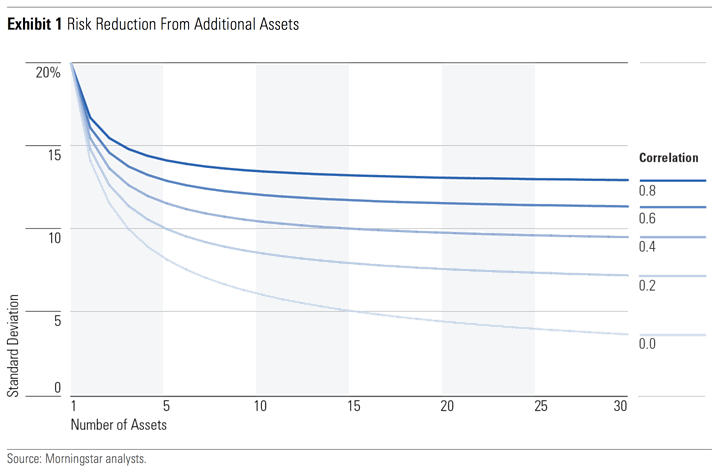
The lower the correlation between asset classes (the less they move in the same direction), the greater the reduction in volatility you get by combining assets. As long as you combine asset classes with correlations below 1, you get some degree of volatility reduction.

Here are a few selected charts from the research paper, along with my quick takeaway.

Takeaway #1: In terms of diversification benefits, staying as safe as possible is still the way to go. The best is still US Treasury bonds. Even the popular US “total bond” indices which include corporate bonds have shown positive correlations with stocks at times.

Takeaway #2: High-quality muni bonds have also kept their correlations negative, but high-yield “junk” muni bonds spike at the exact wrong time (market crashes).

Takeaway #3: International stocks offer a little diversification benefit, but are usually strongly correlated with US stocks. You must have faith that international stock returns will at times exceed US stock returns for periods of time to invest in this asset class.

Takeaway #4: Commodities go through boom and bust cycles as part of their nature, and the correlations with US stocks can also stay high or low for years at a time. I find it all very unreliable and unpredictable.

Takeaway #5: Gold has shown a consistently low correlation with US stocks. For myself, it’s not the correlation I’m concerned with, but the long-term returns.

S&P 500 and Global Stock Market Dividend Yield 2000-2020

Here is an article about dividends by Capital Group. I didn’t really find the analysis very actionable, but I did like their chart that tracked the historical yields of the S&P 500 index, the MSCI ACWI index, and 10-year US Treasury bonds from 2000 to 2020.

The MSCI ACWI Index is a global stock index that tracks ” large- and mid-cap stocks across 23 developed and 24 emerging markets.”. Basically, a world stock market index that includes US and all other global stock markets.

I know that the total performance of international stocks has underperformed the S&P 500 for a while now, but holding international stocks does seem to consistently boost your overall dividend yield. In addition, I don’t see a strong direct relationship between dividend yields and interest rates.

PFS Buyers Club: New US Mint Coin Arbitrage Opportunity ($250+ Net Profit, March 2022)

New deal March 17th, 2022. The US Mint regularly releases limited-edition coins to collectors. The coin sets are often limited to one per household, but end up with a market value greater than the initial cost. PFS Buyers Club is a website broker that recruits regular folks to buy their allotted coin set with a set markup amount, with the agreement that they will sell only to PFS Buyers Club. For example, you might pay $300 for a coin and they’ll agree to pay you $350 for it – a fixed profit of $50.

On Thursday, March 17th at 12:00 pm Noon Eastern Time, there is a new guaranteed profit opportunity. A limited edition American Eagle Four-Coin Set will be released then, with a purchase limit of one per household. The cost of the Four-Coin Set should be either $5,332.50 or $5,240.00 (depends on the spot price of Gold). Shipping will cost $4.95.

PFS will pay you a fixed commission of $162.55 for each Four-Coin Set, on top of your cost for the set.

You’ll also earn credit card rewards on your ~$5,000 purchase (worth another ~$100 here at 2% cash back), or also possibly satisfying the requirements for some $500+ value credit card bonuses. This makes the total net profit safely over $250.

Note that the eventual value of the set may exceed that elsewhere – you may see a higher bid on eBay, for example – but if you want to make that bet, don’t promise to sell to PFS Buyers Club. Just buy it on your own and try to sell it yourself. Keep in mind that eBay seller fees can be quite high (12.9% of the final selling price + PayPal fees), and you’ll be responsible for other costs like the proper shipping with adequate insurance. PFS Buyers Club will send you a free prepaid mailing label (including insurance) and pay you via eCheck, paper check, or PayPal. I enjoy the low-stress experience.

My past experience. I used PFS last year for the first time, and everything went smoothly and I was paid my money in full without issue. The amount of communication was great and better than expected; I was kept up-to-date every step of the way. The total time commitment was about 30 minutes for $400+ profit, including the stop at the Fedex store to drop off the box with prepaid label. The eCheck option worked great – I printed the check out at home and deposited immediately via mobile app. PFS has a very solid reputation online, although some folks were unable to buy the coins from the US Mint before it went out of stock. I have done over six deals with them myself with no issues whatsoever.

If you want to jump on this, you can sign up to join PFS Buyers Club here. Sometimes these deals fill up, so I would sign-up (it’s free) and opt-in sooner rather than later. You can still opt out of the deal until an hour prior to the coins going on sale. They will provide very detailed instructions. Follow them carefully, and it was pretty easy for me as a first-time buyer. If you use that link, I will receive a referral fee the first time you successfully sell your coin for a profit. Thanks for those that use it, and for those that already used it last time! I would sign up, but I will unfortunately be skipping this round because I am currently on vacation and at that moment I will be on a dogsledding excursion!

Major Asset Class 10-Year Return Forecast 2022 Collection From Huge Investment Management Firms

Christine Benz at Morningstar has helpfully compiled the 7 to 10-year forecasts for major stock and bond asset classes from some huge investment firms that collectively manage trillions of dollars.

The problem is… they are all over the place?! US stocks return predictions vary from 1.6% to 6.7% annualized. Developed international stock return predictions vary from 2.6% to 9.2% annualized. US Bond return predictions are close together, but these are easy to predict for everyone including even “dumb money” like me.

I used to keep track of these 10-year stock return predictions because they made me feel better about owning lagging asset classes. Now I mainly keep track of them with the expectation that I will look back in 10 years and realize how pointless they were, even though these are smart people trying their best.

10-Year S&P 500 Returns Tend To Cluster Around Triple-Your-Money Runs… or Stagnation

[Programming note: This week is our Spring Break, so I have scheduled some interesting charts that I’ve put aside as they provided interesting “food for thought”. Comment moderation and e-mail replies will be delayed.]

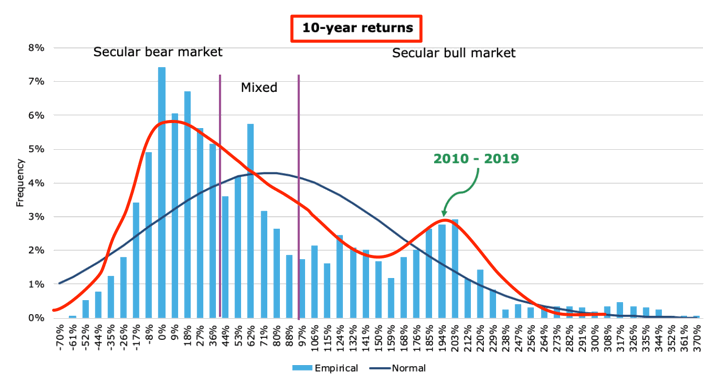
Here is an interesting observation from Klement on Investing. If we chart the frequency of annual (1-year) returns of the S&P 500 index, we get something familiar and close to a (statistically) normal distribution around the average of about 10% (red added by me):

However, if we chart the frequency of the 10-year annual returns of the S&P 500, we see slightly different behavior (red added by me). Klement notes a “trimodal” distribution, but I still see two main peaks. Over this longer timeframe, we see clumping around periods of “bear markets” and “bull markets”.

The big hump on the left is marked “secular bear market”. Note that anything between -35% and +35% in a 10-year return works out to between -3% and +3% annualized. Not much movement. Meanwhile, the other big hump on the right is spread out between +100% to +300%. That means you end up with somewhere between double and quadruple your initial amount, with the peak of the “secular bull market” hump around triple.

This post is from early 2020, and we know that we had a big crash and even bigger recovery in the markets since then. For the most part though, our current secular bull market kept going for all of 2021. Klement closes with a warning:

However, we need to be aware that while the last decade was a run of the mill secular bull market, this also means that the next decade will likely be a mixed period where we experience the tail end of the current secular bull market and the front end of the next secular bear market. Why? Because there has not been a single secular bull market in history that has lasted for two full decades. We know that the current bull market is already the longest bull market in history so it is only reasonable to assume that it will end sometime in the next decade. And then, we should expect that market returns move into the mixed zone of mediocre returns.

My takeaway is that we have to be prepared for some prolonged streaks. Averages can be deceiving. Some people expect a crash after just a few good years, but often we should just ride that wave. At the same time, we need to expect and prepare to survive periods of stagnation (not the same as permanent capital loss).

Plaid Data Privacy $58M Class Action Settlement (Venmo, Robinhood, Chime, SoFi, Coinbase, Etc)

Many online banking, stock trading, crypto, and fintech apps use the Plaid service to provide easy funding via your existing bank accounts. The price of this convenience is that you are providing some very sensitive data to a small, private company. They have your bank login information and can see all your transaction data. (Visa was in an agreement to acquire Plaid for over $5 billion, but it was cancelled to due antitrust concerns.) A recent Plaid class action lawsuit alleges the following improper actions:
The allegations include that Plaid: (1) obtained more financial data than was needed by a user’s app, and (2) obtained log-in credentials (username and password) through its user interface, known as “Plaid Link,” which had the look and feel of the user’s own bank account login screen, when users were actually providing their login credentials directly to Plaid. Plaid denies these allegations and any wrongdoing and maintains that it adequately disclosed and maintained transparency about its practices to consumers.

(You may have gotten an e-mail about this as early as mid-January. Thanks to those who sent it in as well. I still managed to forget about it until writing a post about firewall bank accounts to avoid such data privacy concerns.)

If you connected your financial account(s) to a mobile or web-based app that has used Plaid between January 1, 2013 and November 19, 2021 in the United States, you may be eligible for a payment from this class action Settlement. This might include Venmo, Robinhood, Chime, SoFi, Coinbase, OnJuno, Lili, M1 Finance, or Blockfi just off the top of my head. I don’t have any special insights about the merits of this lawsuit, but the proposed settlement amount is for $58 million with the payout per claim being unknown. The settlement also requires Plaid to:

  • Delete certain data from Plaid systems;
  • Inform Class Members of their ability to use Plaid Portal to manage the connections made between their financial accounts and chosen applications using Plaid and delete data stored in Plaid’s systems;
  • Continue to include certain disclosures and features in Plaid’s standard Link flow;
  • Enhance disclosures about Plaid’s data collection practices, how Plaid uses data, and privacy controls Plaid has made available to uses in Plaid’s End User Privacy Policy;
  • Minimize the data that Plaid stores; and
  • Continue to host a dedicated webpage with detailed information about Plaid’s security practices.

The deadline to submit a claim is April 28, 2022.

Best Interest Rates on Cash – March 2022 Update

Here’s my monthly roundup of the best interest rates on cash as of March 2022, roughly sorted from shortest to longest maturities. I look for lesser-known opportunities available to individuals while still keeping your principal FDIC-insured or equivalent. I use this information for both my cash reserves and as possible bond substitutes. Check out my Ultimate Rate-Chaser Calculator to see how much extra interest you’d earn by moving money between accounts. Rates listed are available to everyone nationwide. Rates checked as of 3/7/2022.

Significant changes since last month: Pretty quiet. 7.12% Savings I Bonds still available if you haven’t done it yet. Treasury rates around the 1 and 2 year terms are rising, as with CD rates overall. In general, there still doesn’t seem to be much upside to locking in any length of CD at somewhere around 1% APY when there are so many short-term options nearly as good (or better). I like keeping my options open while waiting to see how much rates rise in 2022.

Fintech accounts
Available only to individual investors, fintech companies often pay higher-than-market rates in order to achieve fast short-term growth (often using venture capital). “Fintech” is usually a software layer on top of a partner bank’s FDIC insurance.

  • 4% APY on $2,000/$6,000. Current offers 4% APY on up to $2,000 on each of their “savings pods”. Free users get 1 savings pod, while premium users get 3 savings pods. Potential promos include $50 bonus and “Premium free for life”. Please see my Current app review for details.
  • 3% APY on up to $100,000, but requires direct deposit and credit card spend. HM Bradley pay 3% APY if you open both a checking and credit card with them, and maintain $1,500 in total direct deposit each month and make $100 in credit card purchases each month. Please see my updated HM Bradley review for details.
  • 3% APY on 10% of direct deposits + 1% APY on $25,000. One Finance lets you earn 3% APY on “auto-save” deposits (up to 10% of your direct deposit, up to $1,000 per month). Separately, they also pay 1% APY on up to another $25,000 with direct deposit. New customer $50 bonus via referral. See my One Finance review.
  • 3% APY on up to $15,000, requires direct deposit and credit card transactions. Porte requires a one-time direct deposit of $1,000+ to open a savings account. Porte then requires $3,000 in direct deposits and 15 debit card purchases per quarter (average $1,000 direct deposit and 5 debit purchases per month) to receive 3% APY on up to $15,000. New customer bonus via referral. See my Porte review.
  • 1.20% APY on up to $50,000. You must maintain a $500 direct deposit each month for this balance cap, otherwise you’ll still earn 1.20% on up to $5,000. They also pay 4% on USDC stablecoin, but I avoid this as it is not FDIC-insured (and you can get higher rates elsewhere if you did want to hold USDC.) New customer $50 bonus via referral. See my OnJuno review.
  • 1.00% APY on up to $50,000 per account. SoFi is now offering 1% APY on the first $50k each of their checking, savings, and Vault accounts ($150k total possible). You must maintain a direct deposit each month of any amount. Convenient if you already have a relationship with them. $25 new Sofi Money account bonus. See my roundup of current SoFi bonuses.

High-yield savings accounts
Since the huge megabanks pay essentially no interest, I think every should have a separate, no-fee online savings account to accompany your existing checking account. The interest rates on savings accounts can drop at any time, so I list the top rates as well as competitive rates from banks with a history of competitive rates. Some banks will bait you with a temporary top rate and then lower the rates in the hopes that you are too lazy to leave.

  • T-Mobile Money is still at 1.00% APY with no minimum balance requirements. The main focus is on the 4% APY on your first $3,000 of balances as a qualifying T-mobile customer plus other hoops, but the lesser-known fact is that the 1% APY is available for everyone. Thanks to the readers who helped me understand this. Unfortunately, some readers have reported their applications being denied.
  • AdelFi (formerly ECCU) is offering new members 1.01% APY on up to $25,000 when you bundle a High-Yield Money Market Account & Basic Checking. (Existing members can get 0.75% APY.) To join this credit union, you must attest to their statement of faith.
  • There are several other established high-yield savings accounts at closer to 0.50% APY. Marcus by Goldman Sachs is on that list, and if you open a new account with a Marcus referral link (that’s mine), they will give you and the referrer a 1.00% APY for your first 3 months (a 0.50% boost). You can then extend this by referring others.

Short-term guaranteed rates (1 year and under)
A common question is what to do with a big pile of cash that you’re waiting to deploy shortly (plan to buy a house soon, just sold your house, just sold your business, legal settlement, inheritance). My usual advice is to keep things simple and take your time. If not a savings account, then put it in a flexible short-term CD under the FDIC limits until you have a plan.

  • No Penalty CDs offer a fixed interest rate that can never go down, but you can still take out your money (once) without any fees if you want to use it elsewhere. CFG Bank has a 13-month No Penalty CD at 0.70% APY with a $500 minimum deposit. Ally Bank has a 11-month No Penalty CD at 0.50% APY for all balance tiers. Marcus has a 13-month No Penalty CD at 0.65% APY with a $500 minimum deposit. You may wish to open multiple CDs in smaller increments for more flexibility.
  • Comenity Direct has a 1-year CD at 1.00% APY ($1,500 min). Early withdrawal penalty is 180 days of interest.

Money market mutual funds + Ultra-short bond ETFs
Many brokerage firms that pay out very little interest on their default cash sweep funds (and keep the difference for themselves). Unfortunately, money market fund rates are very low across the board right now. Ultra-short bond funds are another possible alternative, but they are NOT FDIC-insured and may experience short-term losses at times. These numbers are just for reference, not a recommendation.

  • The default sweep option is the Vanguard Federal Money Market Fund which has an SEC yield of 0.01%.
  • Vanguard Ultra-Short-Term Bond Fund currently pays 0.97% SEC yield ($3,000 min) and 1.07% SEC Yield ($50,000 min). The average duration is ~1 year, so your principal may vary a little bit.
  • The PIMCO Enhanced Short Maturity Active Bond ETF (MINT) has a 0.85% SEC yield and the iShares Short Maturity Bond ETF (NEAR) has a 0.86% SEC yield while holding a portfolio of investment-grade bonds with an average duration of ~6 months.

Treasury Bills and Ultra-short Treasury ETFs
Another option is to buy individual Treasury bills which come in a variety of maturities from 4-weeks to 52-weeks. You can also invest in ETFs that hold a rotating basket of short-term Treasury Bills for you, while charging a small management fee for doing so. T-bill interest is exempt from state and local income taxes. Right now, this section isn’t very interesting as T-Bills are yielding close to zero!

  • You can build your own T-Bill ladder at TreasuryDirect.gov or via a brokerage account with a bond desk like Vanguard and Fidelity. Here are the current Treasury Bill rates. As of 3/7/2022, a new 4-week T-Bill had the equivalent of 0.17% annualized interest and a 52-week T-Bill had the equivalent of 1.05% annualized interest.
  • The Goldman Sachs Access Treasury 0-1 Year ETF (GBIL) has a 0.05% SEC yield and the SPDR Bloomberg Barclays 1-3 Month T-Bill ETF (BIL) has a -0.05% (!) SEC yield. GBIL appears to have a slightly longer average maturity than BIL.

US Savings Bonds
Series I Savings Bonds offer rates that are linked to inflation and backed by the US government. You must hold them for at least a year. If you redeem them within 5 years there is a penalty of the last 3 months of interest. The annual purchase limit for electronic I bonds is $10,000 per Social Security Number, available online at TreasuryDirect.gov. You can also buy an additional $5,000 in paper I bonds using your tax refund with IRS Form 8888.

  • “I Bonds” bought between November 2021 and April 2022 will earn a 7.12% rate for the first six months. The rate of the subsequent 6-month period will be based on inflation again. More on Savings Bonds here.
  • In mid-April 2022, the CPI will be announced and you will have a short period where you will have a very close estimate of the rate for the next 12 months. I will have another post up at that time.
  • See below about EE Bonds as a potential long-term bond alternative.

Prepaid Cards with Attached Savings Accounts
A small subset of prepaid debit cards have an “attached” FDIC-insured savings account with exceptionally high interest rates. The negatives are that balances are severely capped, and there are many fees that you must be careful to avoid (lest they eat up your interest). There is a long list of previous offers that have already disappeared with little notice. I don’t personally recommend nor use any of these anymore, as I feel the work required and risk of messing up exceeds any small potential benefit.

  • Mango Money pays 6% APY on up to $2,500, if you manage to jump through several hoops. Requirements include $1,500+ in “signature” purchases and a minimum balance of $25.00 at the end of the month.

Rewards checking accounts
These unique checking accounts pay above-average interest rates, but with unique risks. You have to jump through certain hoops which usually involve 10+ debit card purchases each cycle, a certain number of ACH/direct deposits, and/or a certain number of logins per month. If you make a mistake (or they judge that you did) you risk earning zero interest for that month. Some folks don’t mind the extra work and attention required, while others would rather not bother. Rates can also drop suddenly, leaving a “bait-and-switch” feeling.

  • Lafayette Federal Credit Union is offering 2.02% APY on balances up to $25,000 with a $500 minimum monthly direct deposit to their checking account. No debit transaction requirement. They are also offering new members a $100 bonus with certain requirements. Anyone can join this credit union via partner organization ($10 one-time fee).
  • Quontic Bank is offering 1.01% APY on balances up to $150,000. May be useful for those with high balances. You need to make 10 debit card point of sale transactions of $10 or more per statement cycle required to earn this rate.
  • The Bank of Denver pays 2.00% APY on up to $10,000 if you make 12 debit card purchases of $5+ each, receive only online statements, and make at least 1 ACH credit or debit transaction per statement cycle. If you meet those qualifications, you can also link a Kasasa savings account that pays 1.00% APY on up to $25k. Thanks to reader Bill for the updated info.
  • Presidential Bank pays 2.25% APY on balances between $500 and up to $25,000, if you maintain a $500+ direct deposit and at least 7 electronic withdrawals per month (ATM, POS, ACH and Billpay counts).
  • Evansville Teachers Federal Credit Union pays 3.30% APY on up to $20,000. You’ll need at least 15 debit transactions and other requirements every month.
  • Lake Michigan Credit Union pays 3.00% APY on up to $15,000. You’ll need at least 10 debit transactions and other requirements every month.
  • Find a locally-restricted rewards checking account at DepositAccounts.

Certificates of deposit (greater than 1 year)
CDs offer higher rates, but come with an early withdrawal penalty. By finding a bank CD with a reasonable early withdrawal penalty, you can enjoy higher rates but maintain access in a true emergency. Alternatively, consider building a CD ladder of different maturity lengths (ex. 1/2/3/4/5-years) such that you have access to part of the ladder each year, but your blended interest rate is higher than a savings account. When one CD matures, use that money to buy another 5-year CD to keep the ladder going. Some CDs also offer “add-ons” where you can deposit more funds if rates drop.

  • NASA Federal Credit Union has a special 49-month Share Certificate at 1.70% APY ($10,000 min of new funds). Early withdrawal penalty is 1 year of interest. They also have a 15-month special at 1.05% APY and 9-month at 0.80% APY.
    Anyone can join this credit union by joining the National Space Society (free). However, NASA FCU will perform a hard credit check as part of new member application.
  • KS StateBank has a 5-year CD at 1.90% APY ($500 min). Early withdrawal penalty is 18 months of interest.
  • You can buy certificates of deposit via the bond desks of Vanguard and Fidelity. You may need an account to see the rates. These “brokered CDs” offer FDIC insurance and easy laddering, but they don’t come with predictable early withdrawal penalties. Right now, I see a 5-year CD at 2.00% APY. Be wary of higher rates from callable CDs listed by Fidelity.

Longer-term Instruments
I’d use these with caution due to increased interest rate risk, but I still track them to see the rest of the current yield curve.

  • Willing to lock up your money for 10 years? You can buy long-term certificates of deposit via the bond desks of Vanguard and Fidelity. These “brokered CDs” offer FDIC insurance, but they don’t come with predictable early withdrawal penalties. You might find something that pays more than your other brokerage cash and Treasury options. Right now, I see a 10-year CD at 2.40% APY vs. 1.77% for a 10-year Treasury. Watch out for higher rates from callable CDs from Fidelity.
  • How about two decades? Series EE Savings Bonds are not indexed to inflation, but they have a unique guarantee that the value will double in value in 20 years, which equals a guaranteed return of 3.5% a year. However, if you don’t hold for that long, you’ll be stuck with the normal rate which is quite low (currently 0.10%). I view this as a huge early withdrawal penalty. But if holding for 20 years isn’t an issue, it can also serve as a hedge against prolonged deflation during that time. Purchase limit is $10,000 each calendar year for each Social Security Number. As of 3/7/2022, the 20-year Treasury Bond rate was 2.29%.

All rates were checked as of 3/7/2022.

Problems with TASC Denying Dependent Care Expense Reimbursement With No Reason Provided?

My muscles tense up with just the thought of dealing with health insurance claims and flexible spending account reimbursement. I feel they are both incentivized to deny your claims and thus put up layers and layers of bureaucracy in the hopes that you’ll just give up. Sometimes I feel like I’m a customer of Insuricare.

I have actually skipped participating in FSAs for entire years due to bad administrators. At some point, the potential tax savings isn’t worth the added stress and time spent to submit $20 receipts for approval. However, I thought it might be different for the Dependent Care Flexible Spending Account (DCFSA). I can contribute $5,000 and a single preschool tuition alone was easily over that. Just one receipt and done! Right?

No. This is light paraphrasing of my recent interaction with TASC (Total Administrative Services Corporation), which is the benefits administration provider for our DCFSA. I wish I had a recording of the call; I really felt that I was in the movie Office Space. Even worse, it wasn’t this person’s fault. The highly-paid people who created this situation made sure they had a layer of low-paid workers shielding them from the actual customers (again, see Insuricare). You can skip to the end if you want the final resolution.

Me: Hi! I am checking in again on why my dependent care expense reimbursement request was denied (again).

TASC: I see that it was denied again. I can’t tell you why it was denied. I can tell you the things we usually look for: name of provider, name of service recipient, date, amount, and description of service.

Me: The receipt that I sent in has all of those things.

TASC: I see. I can tell you the things we usually look for: name of provider, name of service recipient, date, amount, and description of service.

Me: So which of those things was missing in my reimbursement request?

TASC: I can’t tell you that.

Me: Can I talk to the people who denied me?

TASC: No, you can’t talk to them. They are in a separate department. They don’t talk to customers. We talk to the customers.

Me: So I can’t talk to the people who denied my request. They are just allowed to deny my request without providing even the tiniest clue to say WHY they denied my request?

TASC: That is correct.

Me: So can you tell me EXACTLY what I need to do to get my reimbursement approved? I am contributing $5,000 of my paycheck to this Dependent Care FSA this year. It’s a lot of money.

TASC: You need to send in a new reimbursement request. I can tell you the things we usually look for: name of provider, name of service recipient, date, amount, and description of service.

Me: How should it be different than my previous reimbursement request?

TASC: I can’t tell you that.

Me: I must point out that I submitted the exact same documentation in 2020 and it was approved.

TASC: I can’t help you with that. I can tell you the things we usually look for: name of provider, name of service recipient, date, amount, and description of service.

Me: Umm… we don’t seem to be making any progress here. Can I talk to a supervisor?

After an additional 15-minute hold time (where I reminded myself of the $1,000 in tax savings at the end of the rainbow) and another discussion with the supervisor, they finally told me about the existence of an alternative method: the TASC Dependent Care Contract. My preschool provider had to fill it out (I felt bad making more work for them), I signed it, scanned it, uploaded it, and it was finally approved. (There may be different versions of the form out there. I wouldn’t put it past them.)

Note that I had talked to three different customer service reps about my denied reimbursement request, and NONE of them mentioned this magical form. Only after escalating to a supervisor was this option finally revealed to me. I hope that some of these keywords will make it into Google and other search engines and help the next parent pulling out their hair.

If you want to cover all your bases, you should also ask your care provider to fill out IRS Form W-10, “Dependent Care Provider’s Identification and Certification” at the same time as the TASC form.