Archives for January 2022

Will Your Robo-Advisor Stay The Course? UBS Buys Wealthfront

Over time, more and more people are seeing the benefits of investing in stocks and bonds through low-cost index funds. Here is a chart from Morningstar showing the overall flow of assets out of actively-managed and into passively-managed US equity funds over the last 15 years.

For a while, people wondered if low-cost digital advisors that managed a portfolio of index funds for a modest fee would take over. The picture looks a little different today.

Wealthfront was one of the early digital-only startups, promising to manage a diversified portfolio of low-cost ETFs for you for a modest 0.25% of assets, even if you had as little as $500 to invest. They tried a few different things over the years, including changing up their model portfolios, trying to add a in-house risk-parity fund, and even recently adding crypto and individual stock options. Their final move came this week, when they announced they would be sold to UBS for $1.4 billion. This wasn’t exactly a huge exit, given the huge amount of venture capital they had burned through over the years. As usual with such acquisitions, they promise both “nothing will change” and “things will only get better”.

In hindsight, I am relieved that I didn’t let Wealthfront handle my assets. They clearly had no firm guiding principles, tweaking their portfolios with each new trend. Based on the reporting, it looks like they sold their customers to the highest bidder, as UBS is not exactly known for low-cost passive investing. This play is widely seen a way for UBS to obtain young investors that will one day be rich (read: one day will generate lots of wealth management fees). See UBS Buys Wealthfront for $1.4 Billion to Reach Rich Young Americans and Why a Bank for the Super Rich Is Taking Aim at the Younger Merely Rich.

Is this move what is best for Wealthfront’s customers? Or what was best for Wealthfront’s investors? Mark the date. I will be checking to see what Wealthfront clients own in 5 and 10 years, if that is still possible. Keep in mind that any portfolio changes usually result in taxable events.

Funds flowed into index funds for a simple reason: they performed better and made folks more money. Index funds performed better primarily due to low costs and low turnover (low tax costs). However, it doesn’t appear that Wealthfront could operate successfully independently while offering low costs. One way or another, the new owners are going to try and extract more money per client either via portfolio changes or higher fee products.

Unfortunately, I worry that even Vanguard, in its pursuit of growth, is gradually going down the same path as many large nonprofits. Many “nonprofits” are huge bureaucracies that chase money as eagerly as any corporation – more money means bigger salaries to management, more political power, and greater career advancement. (Side note: I thought that Vanguard got away with their huge Target Date fund capital gains distribution with little media attention, but now see: Massachusetts investigating sales of target date funds to retail investors after word of surprise tax bills.)

I don’t write much about robo-advisors any more. They showed promise initially, but apparently the business model just isn’t working.

MMB Portfolio 2021 Year-End (Late Update): Dividend and Interest Income

dividendmono225Here’s my (late) quarterly update on the income produced by my “Humble Portfolio“. The total income goes up much more gradually and consistently than the number shown on brokerage statements (price), encouraging me as I keep plowing more of my savings into more stock purchases. I imagine them as a factory that just churns out more dollar bills.

via GIPHY

Income yield history (percentage of portfolio value). Here is a chart showing how this 12-month trailing income rate has varied since I started tracking it in 2014. There appears to be a slight recovery from the early pandemic time period.

I track the “TTM” or “12-Month Yield” from Morningstar, which is the sum of the trailing 12 months of interest and dividend payments divided by the last month’s ending share price (NAV) plus any capital gains distributed over the same period. (ETFs rarely have to distribute capital gains.) I prefer this measure because it is based on historical distributions and not a forecast. Below is a rough approximation of my portfolio (2/3rd stocks and 1/3rd bonds).

Asset Class / Fund % of Portfolio Trailing 12-Month Yield (Taken 1/24/22) Yield Contribution
US Total Stock
Vanguard Total Stock Market Fund (VTI, VTSAX)
25% 1.21% 0.30%
US Small Value
Vanguard Small-Cap Value ETF (VBR)
5% 1.75% 0.09%
International Total Stock
Vanguard Total International Stock Market Fund (VXUS, VTIAX)
25% 3.09% 0.77%
Emerging Markets
Vanguard Emerging Markets ETF (VWO)
5% 2.64% 0.13%
US Real Estate
Vanguard REIT Index Fund (VNQ, VGSLX)
6% 2.56% 0.15%
Intermediate-Term High Quality Bonds
Vanguard Intermediate-Term Treasury ETF (VGIT)
17% 1.14% 0.19%
Inflation-Linked Treasury Bonds
Vanguard Short-Term Inflation-Protected Securities ETF (VTIP)
17% 4.69% 0.80%
Totals 100% 2.44%


Stock dividends are the portion of profits that businesses have decided they don’t need to reinvest into their business. The dividends may suffer some short-term drops, but over the long run they have grown faster than inflation.

The ratio of dividend payouts to price also serve as a rough valuation metric. When stock prices drop, this percentage metric usually goes up – which makes me feel better in a bear market. When stock prices go up, this percentage metric usually goes down, which keeps me from getting too euphoric during a bull market.

Here’s a related quote from Jack Bogle (source):

The true investor will do better if he forgets about the stock market and pays attention to his dividend returns and to the operating results of his companies.

Absolute dividend history. Even though the dividend yield hasn’t been too impressive, there is a different story when you look at the absolute amount of income paid out over time. If you retired back in 2014 and have been living off your stock/bond portfolio, your total income distributions are much higher in 2022 than in 2014.

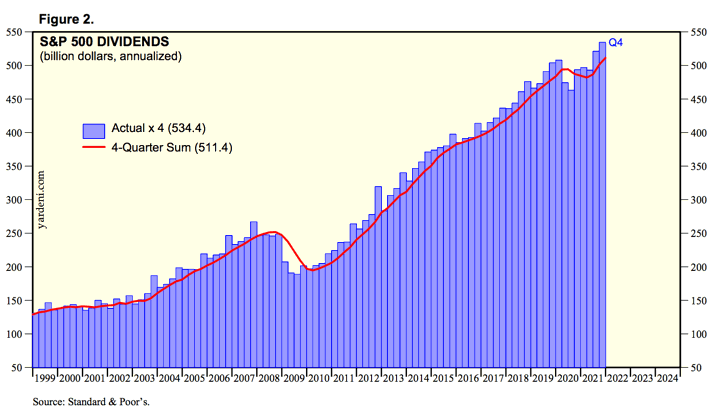
Here is the historical growth of the S&P 500 absolute dividend, which tracks roughly the largest 500 stocks in the US, updated as of Q4 2021 (via Yardeni Research):

This means that if you owned enough of the S&P 500 to produce an annual dividend income of about $13,000 a year in 1999, then today those same shares would be worth a lot more AND your annual dividend income would have increased to over $50,000 a year, even if you had spent every penny of dividend income every year.

Here is the historical growth of the absolute dividend of the EAFE iShares MSCI ETF, which tracks a broad index of developed non-US stocks (VXUS is a newer ETF), via Netcials.

European dividend culture seems to encourage paying out a higher percentage of earnings as dividends, but as a result those dividends are also more volatile, moving up and down with earnings. US dividend culture tends to be more conservative, with the expectation that dividends will be growing or at least stable. This is not true across every company, but in general there appears to be a greater stigma associated with dividend cuts in US stocks than in international stocks.

Big picture and rules of thumb. If you are not close to retirement, there is not much use worrying about decimal points. Your time is better spent focusing on earning potential via better career moves, improving in your skillset, and/or looking for entrepreneurial opportunities where you can have an ownership interest.

As a result, I support the simple 4% or 3% rule of thumb, which equates to a target of accumulating roughly 25 to 30 times your annual expenses. I would lean towards a 3% withdrawal rate if you want to retire young (before age 50) and a 4% withdrawal rate if retiring at a more traditional age (closer to 65). Build in some spending flexibility to make your portfolio more resilient in the real world, and that’s a reasonable goal to put on your wall.

Using the income before “full” retirement. Our dividends and interest income are not automatically reinvested. I treat this money as part of our “paycheck”. Then, as with a traditional paycheck, we can choose to either spend it or invest it again to compound things more quickly. Even if still working, you could use this money to cut back working hours, pursue a different career path, start a new business, take a sabbatical, perform charity or volunteer work, and so on. This is your one life and it only lasts about 4,000 weeks.

MMB Portfolio 2021 Year-End (Late Update): Asset Allocation & Performance

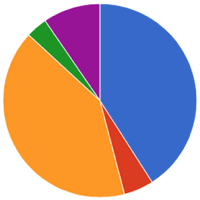
portpie_blank200Here’s my (late) quarterly update on my current investment holdings, as of 1/23/22, including our 401k/403b/IRAs and taxable brokerage accounts but excluding a side portfolio of self-directed investments. Following the concept of skin in the game, the following is not a recommendation, but just to share an real, imperfect, low-cost, diversified DIY portfolio. The goal of this portfolio is to create sustainable income that keeps up with inflation to cover our household expenses.

Actual Asset Allocation and Holdings
I use both Personal Capital and a custom Google Spreadsheet to track my investment holdings. The Personal Capital financial tracking app (free, my review) automatically logs into my different accounts, adds up my various balances, tracks my performance, and calculates my overall asset allocation. Once a quarter, I also update my manual Google Spreadsheet (free, instructions) because it helps me calculate how much I need in each asset class to rebalance back towards my target asset allocation.

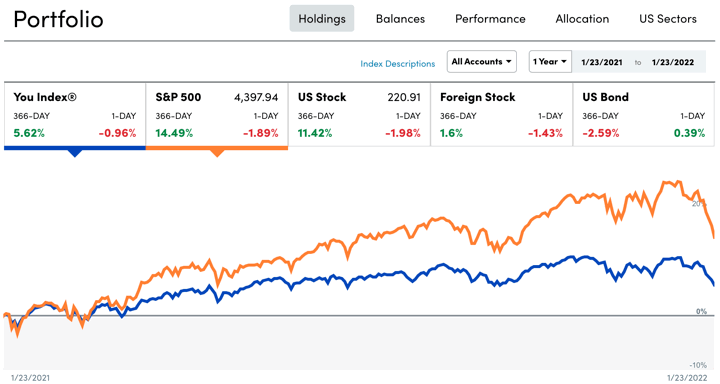
Here are updated performance and asset allocation charts, per the “Allocation” and “Holdings” tabs of my Personal Capital account.

Stock Holdings
Vanguard Total Stock Market (VTI, VTSAX)
Vanguard Total International Stock Market (VXUS, VTIAX)
Vanguard Small Value (VBR)
Vanguard Emerging Markets (VWO)
Avantis International Small Cap Value ETF (AVDV)
Cambria Emerging Shareholder Yield ETF (EYLD)
Vanguard REIT Index (VNQ, VGSLX)

Bond Holdings
Vanguard Limited-Term Tax-Exempt (VMLTX, VMLUX)
Vanguard Intermediate-Term Tax-Exempt (VWITX, VWIUX)
Vanguard Intermediate-Term Treasury (VFITX, VFIUX)
Vanguard Inflation-Protected Securities (VIPSX, VAIPX)
Fidelity Inflation-Protected Bond Index (FIPDX)
iShares Barclays TIPS Bond (TIP)
Individual TIPS bonds
U.S. Savings Bonds (Series I)

Target Asset Allocation. This “Humble Portfolio” does not rely on my ability to pick specific stocks, sectors, trends, or countries. I own broad, low-cost exposure to asset classes that will provide long-term returns above inflation, distribute income via dividends and interest, and finally offer some historical tendencies to balance each other out. I have faith in the long-term benefit of owning publicly-traded US and international shares of businesses, as well as high-quality US federal and municipal debt. My stock holdings roughly follow the total world market cap breakdown at roughly 60% US and 40% ex-US. I also own real estate through REITs.

I strongly believe in the importance of “knowing WHY you own something”. Every asset class will eventually have a low period, and you must have strong faith during these periods to truly make your money. You have to keep owning and buying more stocks through the stock market crashes. You have to maintain and even buy more rental properties during a housing crunch, etc. You might own laundromats or vending machines or an online business. A good sign is that if prices drop, you’ll want to buy more of that asset instead of less.

Find a good asset that you believe in and understand, and just keep buying it through the ups and downs.

I do not spend a lot of time backtesting various model portfolios, as I don’t think picking through the details of the recent past will necessarily create superior future returns. Usually, whatever model portfolio is popular in the moment just happens to hold the asset class that has been the hottest recently as well. I’ve also realized that I don’t have strong faith in the long-term results of commodities, gold, or bitcoin. I’ve tried many times to wrap my head around it, but have failed. I prefer things that send me checks while I sleep.

Stocks Breakdown

  • 45% US Total Market
  • 7% US Small-Cap Value
  • 31% International Total Market
  • 7% International Small-Cap Value
  • 10% US Real Estate (REIT)

Bonds Breakdown

  • 66% High-Quality bonds, Municipal, US Treasury or FDIC-insured deposits
  • 33% US Treasury Inflation-Protected Bonds (or I Savings Bonds)

I have settled into a long-term target ratio of 67% stocks and 33% bonds (2:1 ratio) within our investment strategy of buy, hold, and occasionally rebalance. This is more conservative than most people my age, but I am settling into a more “perpetual” as opposed to the more common “build up a big stash and hope it lasts until I die” portfolio. My target withdrawal rate is 3% or less. With a self-managed, simple portfolio of low-cost funds, we can minimize management fees, commissions, and taxes.

Holdings commentary. I’ve been investing steadily for over 15 years, and the results have exceeded my expectations. There is ALWAYS something that looks worrying. Looking back, my best investment decisions were to NOT do anything different during times of stress. Maybe 2022 will have more such times. Ignore the noise, if you can.

I often wonder how I can teach my children such patience in investing, and that seems to be the hardest aspect.

Performance numbers. According to Personal Capital, my portfolio is up another +13.9% for 2021.

I’ll share about more about the income aspect in a separate post.

Real-World Numbers: Investing $850 a Month Turned Into $200,000 Over 10 Years (2022 Edition)

Instead of focusing on the current hot thing, how about stepping back and taking the longer view? How would a steady investor have done over the last decade? Most successful savers invest money each year over a long period of time.

Target date funds. The Vanguard Target Retirement 2045 Fund is an all-in-one fund that is low-cost, globally-diversified, and available both inside many employer retirement plans and to anyone that funds an IRA. When you are young (up until age 40 for those retiring at 65), this fund holds 90% stocks and 10% bonds. It is a solid default choice in a world of mediocre, overpriced options. This is also a good benchmark for others that use low-cost index funds.

The power of consistent, tax-advantaged investing. For the last decade, the maximum allowable annual contribution to a Traditional or Roth IRA has been roughly $5,000 per person. The maximum allowable annual contribution for a 401k, 403b, or TSP plan has been over $10,000 per person. If you have a household income of $67,000, then $10,000 is right at the 15% savings rate mark. Therefore, I’m going to use $10,000 as a benchmark amount. This round number also makes it easy to multiply the results as needed to match your own situation. Save $5,000 a year? Halve the result. Save $20,000 a year? Double the numbers, and so on.

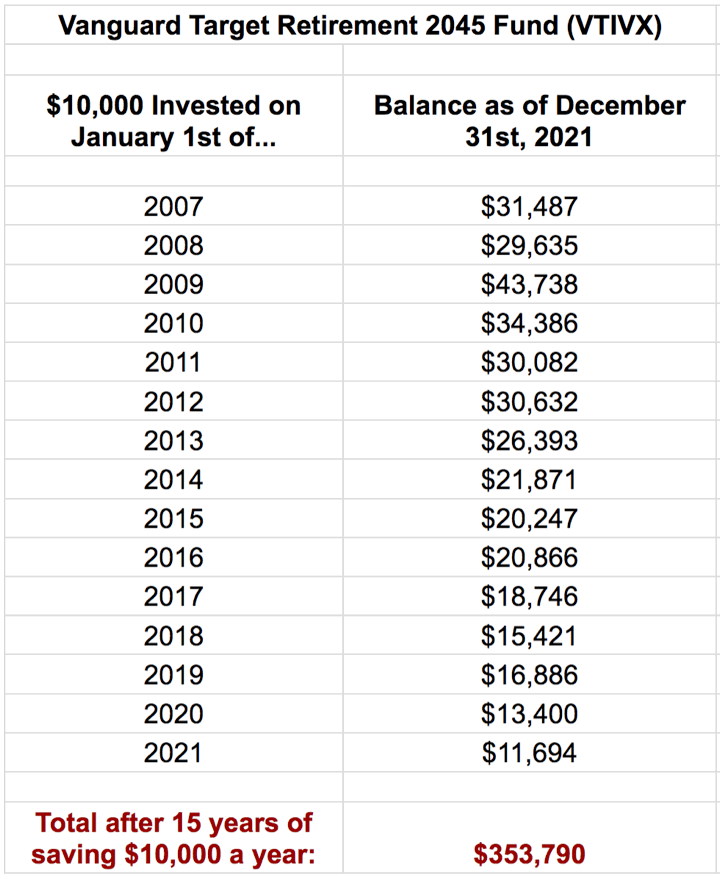
The real-world payoff from a decade of saving $833 a month. What would have happened if you put $10,000 a year into the Vanguard Target Retirement 2045 Fund, every year, for the past 10 years? With the interactive tools at Morningstar and a Google spreadsheet, we get this:

Investing $10,000 every year ($833 a month, or $384 per bi-weekly paycheck) for the last decade would have resulted in a total balance of $196,000. Bump that up to $850 a month, and you’d be sitting on $200,000 right now, broken up into $102,000 in contribution and $98,000 in investment gains.

What would have happened if you extended that to the past 15 years instead? Investing $10,000 every year for the last decade and a half would have resulted in a total balance of $353,000. That breaks down to $150k in contributions + $203k investment growth. Your gains are now officially more than what you initially invested.

Real-world path to becoming a 401(k) millionaire. Not theoretical numbers from a calculator! Are you a dual-income household that can put away more? If you each invested $14,150 a year ($28,300 total for both) for the last 15 years, you would have a million dollars. That means starting at age 22 and ending at 37, or starting at 25 and ending at 40.

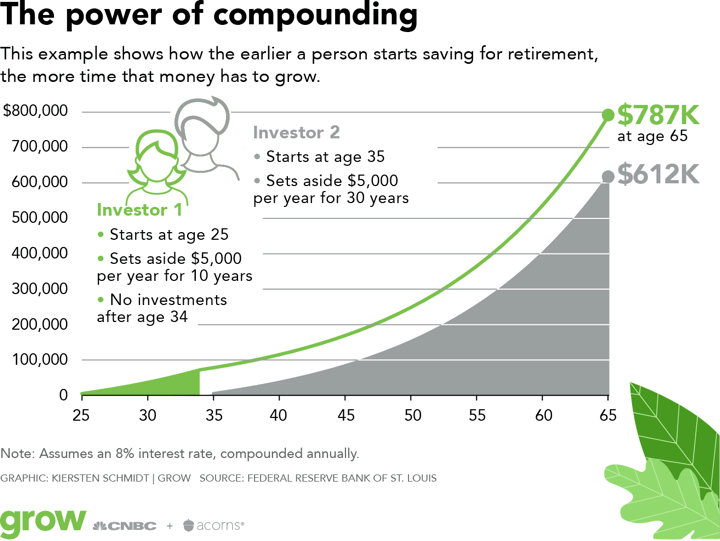
It gets even better if you started early. There is a popular example of the power of compound interest that shows how someone who started saving at age 25, saves and invests for 10 years but then stops and never saves a penny again still beats someone who starts saving at 35 and keeps on saving for 30 years. Acorns provides a nice illustration:

Once you have that initial momentum, it just keeps going.

Timing still matters, but not as much as you might think due to the dollar-cost averaging and longer time horizon. Yes, the last decade has been a great run for US stock markets. But Vanguard Target funds also own a lot of international stocks, which haven’t been nearly as hot and have maintained lower valuations. Diversification means you aren’t 100% in the hot thing, but your bases are covered if the hot things goes cold. Here are my previous “saving for a decade” posts:

Work on improving your career skills (or start your own business), save a big chunk of your income, and then invest it in productive assets. Keep calm and repeat. The only “secret” here is consistency and starting as early as you can. (The best time is always yesterday. The second best time is today.) We have maxed out both IRA and the 401k salary deferral limits nearly every year since 2004. We are fortunate in many ways, but we received no inheritance and no house downpayment assistance. We are not super-skilled stock pickers or Bitcoin early adopters. You can still build serious wealth with something as accessible and boring as the Vanguard Target Retirement fund (or a simple collection of low-cost index funds).

Health Insurance Required to Cover Free At-Home COVID Tests Starting 1/15

If you’ve been facing the prospect of spending hundreds of dollars on at-home COVID tests so that you and/or your kids can go back to work/school after an exposure event, please note that starting Saturday, January 15th, health insurance companies will be required to cover 8 free At-Home COVID tests per person, per month. From NPR:

Insurance companies and health plans will be required to cover eight free over-the-counter at-home tests per covered individual per month, according to White House officials. For instance, a family of four all on the same plan would be able to get up to 32 of these tests covered by their health plan per month.

There is more information in this CMS.gov FAQ.

Starting January 15, most people with a health plan can go online, or to a pharmacy or store to purchase an at-home over-the-counter COVID-19 diagnostic test authorized by the U.S. Food and Drug Administration (FDA) at no cost, either through reimbursement or free of charge through their insurance. This applies whether you purchased your health plan on your own or whether you get health insurance through your job.

The test will either be free directly at the point of sale, if your health plan provides for direct coverage, or by reimbursement if you are charged for your test. Be sure to keep your receipt if you need to submit a claim to your insurance company for reimbursement. If your plan has set up a network of preferred providers at which you can obtain a test with no out-of-pocket expense, you can still obtain tests from other retailers outside that network. Insurance companies are required to reimburse you at a rate of up to $12 per individual test (or the cost of the test, if less than $12).

The actionable advice here is to perhaps not stock up on these COVID tests until January 15th. At that time, hopefully you’ll just be able to pick them up for free at the local pharmacy or health provider, but at the minimum you should save your receipts to be reimbursed. Given how much hassle reimbursement usually is, I’ll probably try to wait until I can have the pharmacy to deal with the insurance paperwork.

I say wait until 1/15 if you can, because of this:

Plans and insurers are required to cover at-home over-the-counter COVID-19 tests purchased on or after January 15, 2022. Plans or issuers may, but are not required by federal law to, provide such coverage for at-home over-the-counter COVID-19 tests purchased before January 15. Contact your health plan to inquire about getting reimbursed for tests purchased before January 15, 2022. Some states may have existing requirements related to coverage of at-home over-the-counter COVID-19 tests.

I’ve already bought several of these iHealth Antigen Rapid Tests (FDA-authorized) from Amazon and they have come a little faster than promised.

Chase Freedom Flex® Credit Card Review: $200 Bonus, 5% Rotating Categories, 3% Back on Dining Out, No Annual Fee

The Chase Freedom Flex® Card is the new 5% cash back rotating category card for Chase, with the notable addition of 3% cash back on dining out and drugstore purchases. All of the popular features from the old Freedom remain as well: Up to 5% cash back on select categories throughout the year, no annual fee, and the ability to earn Ultimate Rewards points (useful in combination with Chase Sapphire cards). Highlights:

  • $200 cash bonus (20,000 Ultimate Rewards points) after $500 in purchases in your first 3 months.
  • 0% Intro APR for 15 months from account opening on purchases and balance transfers. 3% intro balance transfer fee when you transfer a balance during the first 60 days your account is open, with a minimum of $5. After that, the fee for future balance transfers is 5% of the amount transferred, with a minimum of $5.

Here are the ongoing features of the Freedom Flex:

  • 5X points (5% cash back) on up to $1,500 in combined purchases in rotating categories each quarter you activate.
  • 5X points (5% cash back) on travel purchased through Chase Ultimate Rewards(R).
  • 3X points on dining out, take-out, and eligible delivery services.
  • 3X points on drugstore purchases.
  • 1X points on all other purchases.
  • Cell phone insurance is one of the noteworthy World Elite Mastercard benefits. “Up to $800 per claim and $1,000 per year in cell phone protection against theft or damage for phones listed on cardmembers’ monthly bill.”
  • No annual fee.

Enroll after logging into your online account (look on the right-hand side). 5% rewards won’t apply until after you activate your rewards, so it is best to activate now before you forget. No annual fee.

Remember that these cards earn Ultimate Rewards (UR) points, which can then be redeemed for cash at 1 UR point = $0.01. Therefore, you can either view a category as 3X points per dollar points, or 3% cash back. When UR points are transferred to a Chase Sapphire Preferred or Chase Sapphire Reserve card, they can become much more valuable when converted to frequent flier miles or hotel points. For example, if you have the Chase Sapphire Reserve, 5x points = 5 United miles per dollar spent, 5 Hyatt points per dollar spent, or 7.5% value back towards travel redeemed at the Chase Ultimate Rewards travel portal.

This is a new card (different than the regular Chase Freedom Visa), so everyone should be eligible for the bonus, but Chase does have an unofficial rule that they will automatically deny approval on new credit cards if you have 5 or more new credit cards from any issuer on your credit report within the past 2 years (aka the 5/24 rule). This rule is designed to discourage folks that apply for high numbers of sign-up bonuses. This rule applies on a per-person basis, so in our household one applies to Chase while the other applies at other card issuers.

If you have an existing Chase card like the original Freedom card, you may be able to convert to this card by calling them directly. You won’t get the sign-up offer, but you will get the new ongoing features.

Bottom line. The Chase Freedom Flex® Card is a unique rewards card that lets you earn 5% cash back on select categories each quarter, in addition to a constant 3% cash back on dining out and drugstore purchases. If you have a Chase Sapphire card, this card is a great way to earn Ultimate Rewards points while using the additional redemption options of the Sapphire (hotel points, airline miles, and travel redemptions).

PSA: Ask For Extension/Credit on Expired Free Hotel Night Certificates

Many hotel rewards programs offer free night and upgrade certificates as a perk, and many of them were set to expire on December 31st. However, many programs are offering a courtesy extension and/or points credit. Some may have quietly extended it automatically, but you may have to ask directly for this courtesy. Here are credit cards that offer free night certificates:

For example, I just received 10,000 Hyatt points for my Cat 1-4 Free Night Award that expired December 31, 2021. I logged into my World of Hyatt account and asked politely via their Live Chat feature. It only took about 5 or 10 minutes, while 10,000 Hyatt points are worth at least $100 to me. If I didn’t ask, the award would have simply expired worthless. Definitely worth the effort. If you are logged out due to inactivity, just log back in and the chat history should be preserved.

I also have a free IHG night certificate with an expiration date that was extended from mid-2022 until the end of 2022 (without asking). You may wish to call in to ask about certificates that expired in 2021.

Hilton also extended many of their free nights certificates, so I’d check that too.

Best Interest Rates on Cash – January 2022 Update

Here’s my monthly roundup of the best interest rates on cash as of January 2022, roughly sorted from shortest to longest maturities. Significant changes since last month: 7.12% Savings I Bonds annual purchase limit reset for 2022, new 2% APY LFCU checking, few other minor rate changes. I plan on buying I Bonds in late January. You could choose to wait until mid-April to see the next rate, but you’d likely be earning less interest in the meantime.

I look for lesser-known opportunities earning more than most “high-yield” savings accounts and money market funds while still keeping your principal FDIC-insured or equivalent. Check out my Ultimate Rate-Chaser Calculator to see how much extra interest you’d earn by moving money between accounts. Rates listed are available to everyone nationwide. Rates checked as of 1/9/2022.

Fintech accounts
Available only to individual investors, fintech companies often pay higher-than-market rates in order to achieve fast short-term growth (often using venture capital). “Fintech” is usually a software layer on top of a partner bank’s FDIC insurance.

  • 3% APY on up to $100,000, but more hoops coming next month. The top rate will be 3% APY for January 2022 (source), but 1% APY starting February 2022 unless you have their credit card and satisfy both a spending and direct deposit requirement. Please see my updated HM Bradley review for details. I’m sticking with them as already have the credit card, but the only real upside for new customers is that they will remove the waitlist in February 2022.
  • 3% APY on 10% of direct deposits + 1% APY on $25,000. One Finance lets you earn 3% APY on “auto-save” deposits (up to 10% of your direct deposit, up to $1,000 per month). Separately, they also pay 1% APY on up to another $25,000 with direct deposit. New customer $50 bonus via referral. See my One Finance review.
  • 3% APY on up to $15,000. Porte requires a one-time direct deposit of $1,000+ to open a savings account. Starting January 2022, Porte requires $3,000 in direct deposits and 15 debit card purchases per quarter (average $1,000 direct deposit and 5 debit purchases per month) to receive 3% APY on up to $15,000. New customer $100 bonus via referral. See my Porte review.
  • 1.20% APY on up to $50,000. You must maintain a $500 direct deposit each month for this balance cap, otherwise you’ll still earn 1.20% on up to $5,000. New customer $50 bonus via referral. See my OnJuno review.

High-yield savings accounts
Since the huge megabanks pay essentially no interest, I think every should have a separate, no-fee online savings account to accompany your existing checking account. The interest rates on savings accounts can drop at any time, so I list the top rates as well as competitive rates from banks with a history of competitive rates. Some banks will bait you with a temporary top rate and then lower the rates in the hopes that you are too lazy to leave.

  • T-Mobile Money is still at 1.00% APY with no minimum balance requirements. The main focus is on the 4% APY on your first $3,000 of balances as a qualifying T-mobile customer plus other hoops, but the lesser-known fact is that the 1% APY is available for everyone. Thanks to the readers who helped me understand this. Unfortunately, some readers have reported their applications being denied.
  • Evangelical Christian Credit Union (ECCU) is offering new members 1.01% APY on up to $25,000 when you bundle a High-Yield Money Market Account & Basic Checking. (Existing members can get 0.75% APY.) To join this credit union, you must attest to their statement of faith.
  • There are several other established high-yield savings accounts at closer to 0.50% APY. Marcus by Goldman Sachs is on that list, and if you open a new account with a Marcus referral link (that’s mine), they will give you and the referrer a 1.00% APY for your first 3 months (a 0.50% boost). You can then extend this by referring others to the same offer.

Short-term guaranteed rates (1 year and under)
A common question is what to do with a big pile of cash that you’re waiting to deploy shortly (plan to buy a house soon, just sold your house, just sold your business, legal settlement, inheritance). My usual advice is to keep things simple and take your time. If not a savings account, then put it in a flexible short-term CD under the FDIC limits until you have a plan.

  • No Penalty CDs offer a fixed interest rate that can never go down, but you can still take out your money (once) without any fees if you want to use it elsewhere. CFG Bank has a 13-month No Penalty CD at 0.62% APY with a $500 minimum deposit. Ally Bank has a 11-month No Penalty CD at 0.50% APY for all balance tiers. Marcus has a 7-month No Penalty CD at 0.45% APY with a $500 minimum deposit. You may wish to open multiple CDs in smaller increments for more flexibility.
  • Poppy Bank has a 1-year CD at 1.00% APY ($1,000 min). According to DepositAccounts, early withdrawal penalty is 90 days of interest.

Money market mutual funds + Ultra-short bond ETFs
Many brokerage firms that pay out very little interest on their default cash sweep funds (and keep the difference for themselves). Unfortunately, money market fund rates are very low across the board right now. Ultra-short bond funds are another possible alternative, but they are NOT FDIC-insured and may experience short-term losses at times. These numbers are just for reference, not a recommendation.

  • The default sweep option is the Vanguard Federal Money Market Fund which has an SEC yield of 0.01%.
  • Vanguard Ultra-Short-Term Bond Fund currently pays 0.55% SEC yield ($3,000 min) and 0.65% SEC Yield ($50,000 min). The average duration is ~1 year, so your principal may vary a little bit.
  • The PIMCO Enhanced Short Maturity Active Bond ETF (MINT) has a 0.44% SEC yield and the iShares Short Maturity Bond ETF (NEAR) has a 0.56% SEC yield while holding a portfolio of investment-grade bonds with an average duration of ~6 months.

Treasury Bills and Ultra-short Treasury ETFs
Another option is to buy individual Treasury bills which come in a variety of maturities from 4-weeks to 52-weeks. You can also invest in ETFs that hold a rotating basket of short-term Treasury Bills for you, while charging a small management fee for doing so. T-bill interest is exempt from state and local income taxes. Right now, this section isn’t very interesting as T-Bills are yielding close to zero!

  • You can build your own T-Bill ladder at TreasuryDirect.gov or via a brokerage account with a bond desk like Vanguard and Fidelity. Here are the current Treasury Bill rates. As of 1/7/2022, a new 4-week T-Bill had the equivalent of 0.05% annualized interest and a 52-week T-Bill had the equivalent of 0.42% annualized interest.
  • The Goldman Sachs Access Treasury 0-1 Year ETF (GBIL) has a -0.06% SEC yield and the SPDR Bloomberg Barclays 1-3 Month T-Bill ETF (BIL) has a -0.09% (!) SEC yield. GBIL appears to have a slightly longer average maturity than BIL.

US Savings Bonds
Series I Savings Bonds offer rates that are linked to inflation and backed by the US government. You must hold them for at least a year. If you redeem them within 5 years there is a penalty of the last 3 months of interest. The annual purchase limit for electronic I bonds is $10,000 per Social Security Number, available online at TreasuryDirect.gov. You can also buy an additional $5,000 in paper I bonds using your tax refund with IRS Form 8888.

  • “I Bonds” bought between November 2021 and April 2022 will earn a 7.12% rate for the first six months. The rate of the subsequent 6-month period will be based on inflation again. More on Savings Bonds here.
  • In mid-April 2022, the CPI will be announced and you will have a short period where you will have a very close estimate of the rate for the next 12 months. I will have another post up at that time.
  • See below about EE Bonds as a potential long-term bond alternative.

Prepaid Cards with Attached Savings Accounts
A small subset of prepaid debit cards have an “attached” FDIC-insured savings account with exceptionally high interest rates. The negatives are that balances are severely capped, and there are many fees that you must be careful to avoid (lest they eat up your interest). There is a long list of previous offers that have already disappeared with little notice. I don’t personally recommend nor use any of these anymore, as I feel the work required and risk of messing up exceeds any small potential benefit.

  • Mango Money pays 6% APY on up to $2,500, if you manage to jump through several hoops. Requirements include $1,500+ in “signature” purchases and a minimum balance of $25.00 at the end of the month.

Rewards checking accounts
These unique checking accounts pay above-average interest rates, but with unique risks. You have to jump through certain hoops which usually involve 10+ debit card purchases each cycle, a certain number of ACH/direct deposits, and/or a certain number of logins per month. If you make a mistake (or they judge that you did) you risk earning zero interest for that month. Some folks don’t mind the extra work and attention required, while others would rather not bother. Rates can also drop suddenly, leaving a “bait-and-switch” feeling.

  • Lafayette Federal Credit Union is offering 2.02% APY on balances up to $25,000 with a $500 minimum monthly direct deposit to their checking account. They are also offering new members a $100 bonus with certain requirements. Anyone can join this credit union via partner organization ($10 one-time fee).
  • Quontic Bank is offering 1.01% APY on balances up to $150,000. This is best for people who have high balances, as the rate is not as high as other rewards checking accounts. You need to make 10 debit card point of sale transactions of $10 or more per statement cycle required to earn this rate.
  • The Bank of Denver pays 2.00% APY on up to $10,000 if you make 12 debit card purchases of $5+ each, receive only online statements, and make at least 1 ACH credit or debit transaction per statement cycle. If you meet those qualifications, you can also link a Kasasa savings account that pays 1.00% APY on up to $25k. Thanks to reader Bill for the updated info.
  • Presidential Bank pays 2.25% APY on balances between $500 and up to $25,000, if you maintain a $500+ direct deposit and at least 7 electronic withdrawals per month (ATM, POS, ACH and Billpay counts).
  • Evansville Teachers Federal Credit Union pays 3.30% APY on up to $20,000. You’ll need at least 15 debit transactions and other requirements every month.
  • Lake Michigan Credit Union pays 3.00% APY on up to $15,000. You’ll need at least 10 debit transactions and other requirements every month.
  • Find a locally-restricted rewards checking account at DepositAccounts.

Certificates of deposit (greater than 1 year)
CDs offer higher rates, but come with an early withdrawal penalty. By finding a bank CD with a reasonable early withdrawal penalty, you can enjoy higher rates but maintain access in a true emergency. Alternatively, consider building a CD ladder of different maturity lengths (ex. 1/2/3/4/5-years) such that you have access to part of the ladder each year, but your blended interest rate is higher than a savings account. When one CD matures, use that money to buy another 5-year CD to keep the ladder going. Some CDs also offer “add-ons” where you can deposit more funds if rates drop.

  • NASA Federal Credit Union has a special 49-month Share Certificate at 1.70% APY ($10,000 min of new funds). Early withdrawal penalty is 1 year of interest. They also have a 15-month special at 1.05% APY and 9-month at 0.80% APY.
    Anyone can join this credit union by joining the National Space Society (free). However, NASA FCU will perform a hard credit check as part of new member application.
  • Lafayette Federal Credit Union has a 5-year CD at 1.26% APY ($500 min). Early withdrawal penalty is 6 months of interest. Anyone can join this credit union via partner organization ($10 one-time fee).
  • You can buy certificates of deposit via the bond desks of Vanguard and Fidelity. You may need an account to see the rates. These “brokered CDs” offer FDIC insurance and easy laddering, but they don’t come with predictable early withdrawal penalties. Right now, I see a 5-year CD at 1.60% APY. Be wary of higher rates from callable CDs listed by Fidelity.

Longer-term Instruments
I’d use these with caution due to increased interest rate risk, but I still track them to see the rest of the current yield curve.

  • Willing to lock up your money for 10 years? You can buy long-term certificates of deposit via the bond desks of Vanguard and Fidelity. These “brokered CDs” offer FDIC insurance, but they don’t come with predictable early withdrawal penalties. You might find something that pays more than your other brokerage cash and Treasury options. Right now, I see a 10-year CD at 2.00% APY vs. 1.69% for a 10-year Treasury. Watch out for higher rates from callable CDs from Fidelity.
  • How about two decades? Series EE Savings Bonds are not indexed to inflation, but they have a unique guarantee that the value will double in value in 20 years, which equals a guaranteed return of 3.5% a year. However, if you don’t hold for that long, you’ll be stuck with the normal rate which is quite low (currently 0.10%). I view this as a huge early withdrawal penalty. But if holding for 20 years isn’t an issue, it can also serve as a hedge against prolonged deflation during that time. Purchase limit is $10,000 each calendar year for each Social Security Number. As of 1/7/2022, the 20-year Treasury Bond rate was 2.15%.

All rates were checked as of 1/9/2022.

GMO: The Case For Investing in Non-US Stocks (Even Though Recent Performance Is Poor)

The GMO quarterly letter is on my recurring “must read” list, and the 2021 Q3 letter “Winners, Losers, and the Case for Owning Each” did not disappoint, including some very interesting data for the DIY investor that wants to stay informed. Here are my takeaways and notes:

For bonds, their starting yield tracks very closely to resulting return. 10-year Treasury rate is 2%, so the 10-year future performance for Treasuries will likely be very close to 2%. Plan accordingly. I choose to invest in short-term and intermediate-term bonds (effective duration 5 years or less).

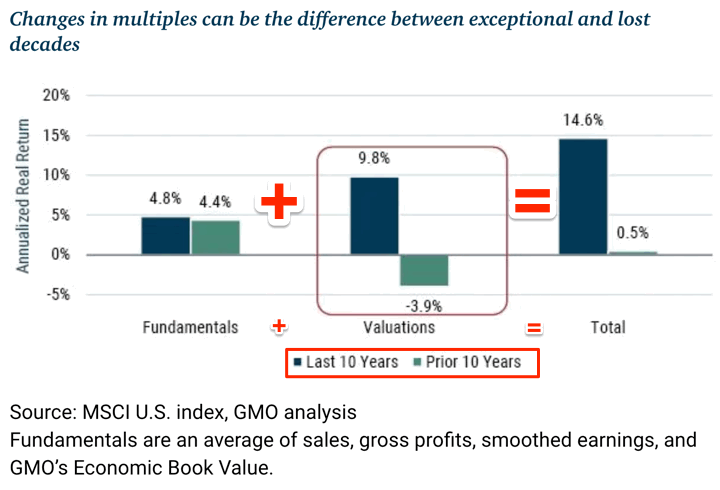
Valuations aren’t everything, but they are an important component. Total return = fundamental return + change in P/E ratio. If you compare the two decades 2001-2011 and 2011-2021, one is referred to as a “lost decade” while the other was one of the longest bull runs in history. However, the growth and reinvestment of earnings was actually about the same. The main difference was the change in P/E ratios (see chart below). Looking ahead, this means that US companies could still be growing profits, but if the P/E ratios drop even just a little, the total return could be quite poor.

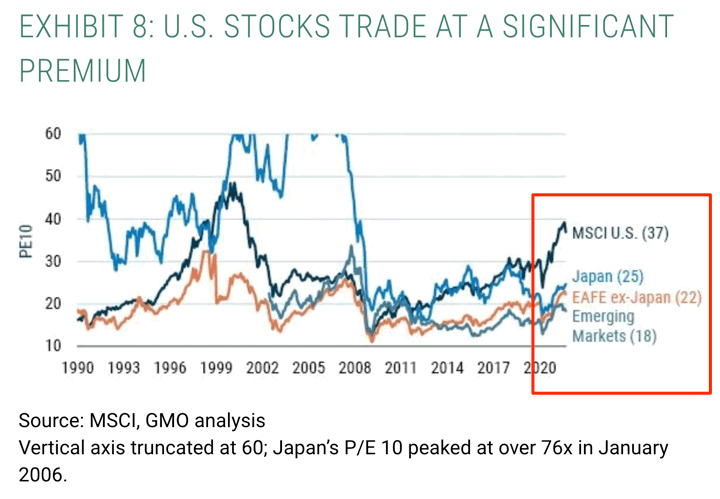
The P/E ratios for US stocks overall is still much higher than for international stocks. The gap is pretty significant.

GMO concludes that their is a strong case for having a significant allocation to non-US stocks. GMO shares how they actively adjust the asset allocation for the billions that they manage for large institutions based on this data. I haven’t seen them publicly share this information before now.

The unsaid part: GMO has been saying this type of thing for many years, and the overall US stock market has just kept outperforming non-US stocks. How long will this keeping going? I choose to admit that I don’t know. In this regard, I don’t bet on either momentum (things going in one direction keep going in that direction) or reversion to the mean (things will eventually go back towards long-term averages).

I call my low-cost, index fund portfolio my “humble portfolio” because it doesn’t require genius on my part. I simply track the passive global weighting on the left (60% US, 40% International currently). If US stocks continue to beat International stocks forever, then one day the world weighting will simply be 80% US or 90% or whatever, and that’s what I’ll own. If things revert back, then it might be 50% US or even 40%, and that’s what I’ll own. Again, by accomplishing this at rock-bottom costs and not paying “helpers” for their guesses (who charge their fees regardless of whether they are right), I guarantee myself above-average results.

Just like buying all the companies within the US, I am buying all the companies of the world. I am invested in well-known, important international names like Taiwan Semiconductor, Nestle (brands), Unilever (brands), Shopify, Samsung, and Diageo (brands). When someone buys Gerber baby food, Hellman’s mayo, or Guinness beer, or even support a local small business (Shopify), a tiny portion of that purchase lands in my brokerage account.

2022 401k and IRA Contribution Limits

The beginning of the year is a good time to check on the new annual contribution limits to the various available retirement accounts. Our income has been quite variable these last few years, so I regularly adjust the paycheck deferral percentages based on expected income for the year. This SHRM article has a nice summary of 2022 vs. 2021 numbers for most employer-based accounts.
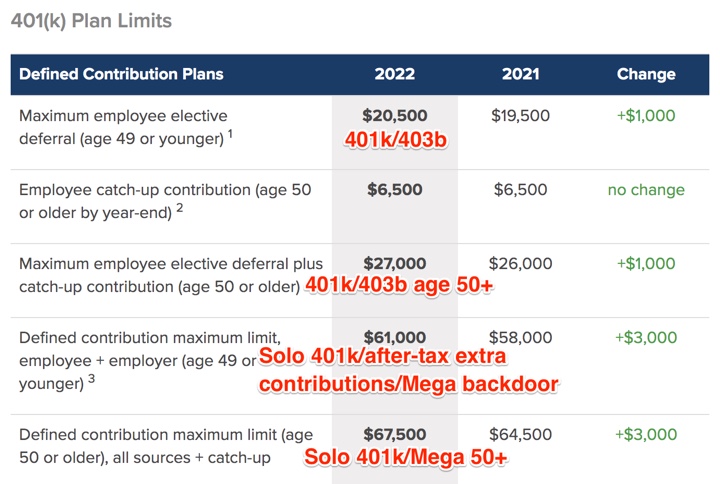
401k/403b Employer-Sponsored Accounts.

For example, I would break down the applicable limit down to monthly and bi-weekly amounts:

  • $20,500 annual limit = $1,708 per monthly paycheck.
  • $20,500 annual limit = $788 per bi-weekly paycheck.

If you are contributing to a pre-tax account instead of a Roth, you could also use a paycheck calculator to find the detailed impact to your take-home pay.

The higher numbers are for those folks that have the ability to contribute extra money into their 401k accounts on an after-tax basis (and potentially perform an in-service Roth rollover), or those self-employed persons with SEP IRAs or Self-Employed 401k plans.

The investment options in 401k plans have also improved on average steadily over the years with lower fees and costs, allowing your money to compound even faster.

Traditional/Roth IRAs. The annual contribution limits is unchanged from last year, $6,000 with an additional $1,000 allowed for those age 50+.

  • $6,000 annual limit = $500 per monthly paycheck.
  • $6,000 annual limit = $231 per bi-weekly paycheck.

Most brokerage accounts (Vanguard, Fidelity, M1 Finance) will allow you to set up automatic investments on a weekly, biweekly, or monthly basis. As long as you have enough money in your linked checking account, the broker will transfer the cash over and then invest it on a recurring basis. You may even be able to sync it to take out money the very same or next day as when your paycheck hits.

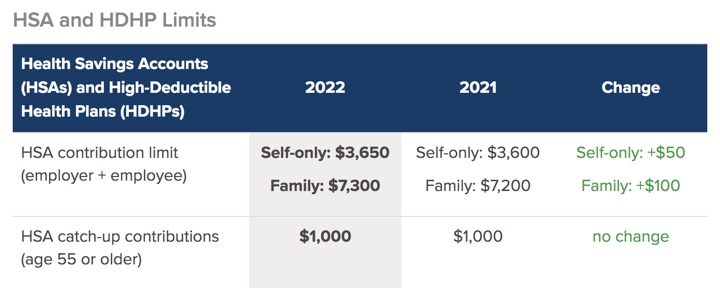
Health Savings Accounts are often treated as the equivalent of a “Healthcare IRA” due the potential triple tax benefits (tax-deduction on contributions, tax-deferred growth for decades, and tax-free withdrawals towards qualified healthcare expenses). This assumes that you have a high-deductible health insurance plan, you can cover your current healthcare expenses out-of-pocket, you can still afford to contribute to the HSA.

Even though I’ve been parroting the “standard personal finance advice” to raise that contribution percentage and save as much as you can in your 401k for years and years, it still holds true. There is some true mind trickery when the money never touches your bank account. The easiest way for me not to eat potato chips is not the have them in the house. (My nemesis is that Costco mega-sized bag of Himalayan Salt Kettle Chips…) The easiest way to make sure you don’t spend the money that you want to invest, is to never have it touch your bank account.

Vanguard Target Retirement Funds – Surprise 10%+ Year-End NAV Drop and Capital Gains Distribution Explained

The Vanguard Target Retirement Funds are one of the largest “set-and-forget” mutual funds that own a mix of stocks and bonds that automatically adjust over time based on your targeted retirement year, with combined assets across the institutional and retail classes of over $600 billion.

Reader rp pointed out that on December 30th, 2021, many Vanguard Target Retirement funds had their price (NAV) drop by over 10% in a single day! This was mostly the result of an abnormally large year-end long-term and short-term capital gains distribution. Taken from Vanguard’s final year-end estimates PDF:

Here is an example for the Vanguard Target Retirement 2040 Fund (VFORX). The 2021 cap-gains distribution was roughly 40 times as large as for 2020. Yet, other funds with a similar asset allocation like the Vanguard LifeStrategy Funds did not have a similar result. What happened?

Background. A mutual fund is forced to make a capital gains distribution when it sells stocks (or bonds) that have appreciated in value, thus realizing capital gains. There are various reasons why a mutual fund might sell stocks:

  • An actively-managed fund might sell shares of stocks that they believe are over-valued in order to purchase shares of another business.
  • An index fund might have to sell shares if the underlying index changes. By definition, an index fund must track an index. For example, sometimes the S&P 500 will remove a company from its index.
  • A balanced mutual fund might rebalance between stocks and bonds. If the target is 80% stocks and 20% bonds, the fund might sell some stocks after a big bull run in order to buy some bonds and revert back towards the target.
  • A mutual fund has a high number of redemptions (cash outflows), such that the fund has to sell assets in order to come up with the cash to satisfy all those withdrawals.

Vanguard Target Retirement Funds don’t follow an index themselves, as they are a “fund of funds”. That means they are basically a wrapper for the component index funds. For example, the Vanguard Target Retirement 2055 Fund (VFFVX) is composed of:

  • Vanguard Total Stock Market Index Fund Investor Shares 54.90%
  • Vanguard Total International Stock Index Fund Investor Shares 35.50%
  • Vanguard Total Bond Market II Index Fund Investor Shares 6.60%
  • Vanguard Total International Bond Index Fund Investor Shares 2.80%
  • Vanguard Total International Bond II Index Fund 0.20%

However, these underlying funds did not have huge capital gains distributions themselves that might flow through. In fact, the main components had zero capital gains to distribute, while the other distributed tiny amounts less than 1%.

What we have left is that the Target Retirement Fund itself sold some shares of the component index funds. Stocks did go up in 2021, but not nearly enough to warrant such a huge capital gain. Besides, stocks also went up a similar amount in 2020, and as we saw above the 2020 capital gains distribution was 40x smaller.

In addition, the Institutional Target Retirement 2040 fund only had cap gains distributions of 0.39% of NAV. This fund should have the same rebalancing needs as the retail version for individual investors. The rest of the Institutional Target Retirement years had similarly low distributions.

Strange! Thankfully, I found a great clue by “cas” in this Bogleheads thread. From reading the annual reports for VFORX, we find that as of 3/31/21, the net assets for Target Retirement 2040 was about $35 billion. From January through September 2021, over $16 billion of shares were redeemed from the Target Retirement 2040 fund, while only $6 billion were purchased. The underlying investments grew in value, but investors took out a net $10 billion in cash over the first 9 months of 2021! The large capital gains distribution was primarily due to these large net redemptions.

Okay, but again, why? The main problem was that the “Institutional Target Retirement Funds” are not a share class of the “Target Retirement Funds”. In December 2020, Vanguard lowered the plan-level minimum investment requirement for the Institutional Target Retirement Funds to $5 million from $100 million. Now, as long as an employer’s 401k plan had $5 million in assets across the entire plan (not just one person), they could now access the much cheaper Institutional version… a big savings for possibly thousands of small businesses.

Let’s check the annual reports again. Over the same time period that Target Retirement 2040 lost $10 billion in net cash outflows, the Institutional Target Retirement 2040 Fund gained $13 billion in net cash inflows. Coincidence?

Vanguard incentivized small business retirement plans to sell their holdings from Target Retirement in order to buy Institutional Target Retirement funds by offering them a 30% to 50% reduction in fees, and they did so, moving over billions and billions.

Eventually, in September 2021, Vanguard announced that they would merge each of the Vanguard Institutional Target Retirement Funds into its corresponding Target Retirement Fund. The mergers are not scheduled to be completed until February 2022. There may be more outflows until then. A merger would not have created any forced selling, so why not do this in the first place?

I wonder if Vanguard made a mistake and they simply didn’t realize this would create large outflows. Or perhaps they just didn’t care? Either way, it’s another recent blemish on their record. The order and time delay in which they did things indirectly hurt the individual taxable investors of Target Retirement funds. They should have simply merged the two series in the first place.

This is why the DIY investor should strongly consider only investing in the “raw materials” and “cook from scratch”. VTI, VXUS, and BND ETFs can be held at any brokerage firm, bought and sold for free, distributed tax-efficiently between 401k/IRA and taxable, and are available for ETF-pair tax-loss harvesting in a taxable account. On the other hand, this is something of a one-time event, so you may value the simplicity of Target Retirement funds above the potential drawbacks.

If you like the idea of “auto-pilot” but also want to be be only one allowed to program the autopilot, check out out M1 Finance and their pies (which you can always break back up into component ETFs) as well as Utah My529 and their “customized glide path” option for college savings. I don’t like the fact that Vanguard can always change up their target asset allocation to whatever is trendy. (I have the same issues with the robo-advisors like Wealthfront and Betterment.)

Summary. Vanguard Target Retirement Funds (Investor shares) made large capital gains distributions at the end of 2021. This was mostly due to large outflows from Target Retirement Funds (owned by individual investors and small businesses) into their separate Institutional Target Retirement Funds, as Vanguard lowered the minimums for the Institutional funds from $100 million to $5 million in December 2020. This appears to have forced the Target Retirement funds so sell their investments and incur large capital gains.

If you hold Target Retirement funds in a tax-deferred accounts like 401k/403b/IRA, this has no taxable effect on you. The net asset value (NAV) dropped by a certain amount, and you received a distribution for the same amount. You most likely have it set to reinvest immediately anyway. However, if you held this in a taxable account, you received a taxable distribution. You now owe some extra tax and lost the ability to compound that money into the future. It’s not a disaster, but it did hurt your returns a little, in my view unnecessarily as Vanguard could have handled things differently on their end.

Portfolio Asset Class Returns, 2021 Year-End Review

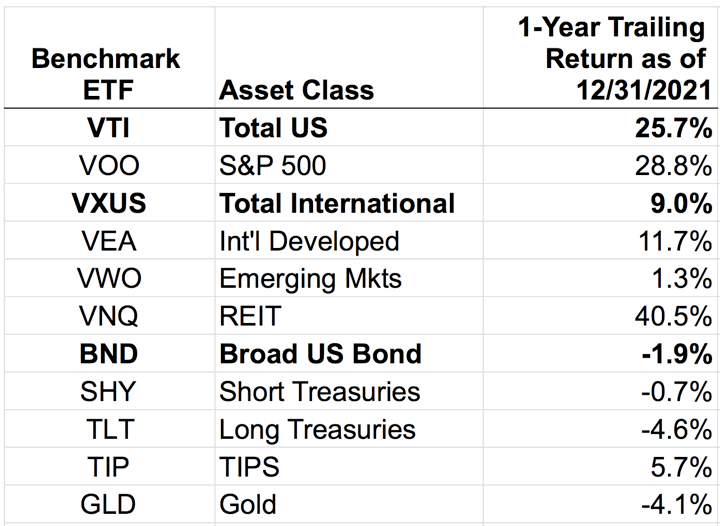
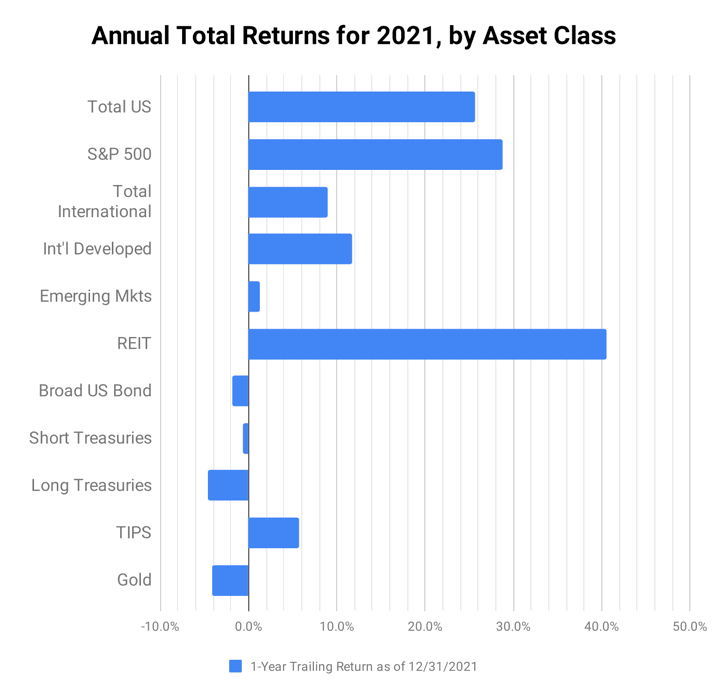
yearendreview2021 is finally in the books! Most of my portfolio is in low-cost index funds across various asset classes, which I purposefully ignore most of the time as I believe the proper time horizon is at least several years long. However, I do check in once a year. Per Morningstar, here are the annual returns for select asset classes as benchmarked by popular ETFs after market close 12/31/21.
Commentary. Investing is easy when everything just seems to keep on going up, up, up. The hardest part is looking over and seeing someone else making even more money. But as Warren Buffett reminds us, envy is the worst sin because you can’t even enjoy it. You just sit there and feel bad with no upside.

2021 was another year where being diversified into international developed and emerging stocks hurt your returns when compared to US stocks. However, I remain content with my market-cap-based split. If US stocks keep going up even with historically-high valuations, then that’s fine by me. If international stocks and their relatively-low valuations make a comeback, I will be covered too.

The only asset classes that dropped in value were the safe, boring bonds and the old-fashioned gold. As is often the case, they only dropped a little and at the same time as when to stocks went up, so nobody really minded much.

The “set and forget” Vanguard Target Retirement 2055 fund (roughly 90% diversified stocks and 10% bonds) was up 16.4% in 2021, almost the exact same number as last year.

In trying to think of a good takeaway, I believe a good investor should be a long-term optimist with long-term money, and remain cautious with their short-term cash reserves. This allows you to see past the current troubles and stay invested even when the outlook is uncertain. 2020 was uncertain. 2021 was uncertain. 2022 is definitely uncertain. If you always wait for the smoke to clear, you’ll miss out on some huge returns.