Archives for September 2020

Skin in the Game: How Much Do You Have To Lose? (Book Notes)

The central idea behind the book Skin in the Game: Hidden Asymmetries in Daily Life by Nassim Nicholas Taleb is simple. Never trust anyone without skin in the game. In the real world, behavior changes for the better when you have to pay a price for your mistakes. This is a very handy heuristic to apply in everyday life and applies in many areas. A good example of why we shouldn’t allow people to not have skin in the game is Bob Rubin:

The Bob Rubin trade? Robert Rubin, a former Secretary of the United States Treasury, one of those who sign their names on the banknote you just used to pay for coffee, collected more than $120 million in compensation from Citibank in the decade preceding the banking crash of 2008. When the bank, literally insolvent, was rescued by the taxpayer, he didn’t write any check—he invoked uncertainty as an excuse. Heads he wins, tails he shouts “Black Swan.”

If someone is giving you financial advice, don’t worry about what s/he “thinks”, ask them what they actually hold in their own portfolio. Sure, what is optimal for them may be different than what it optimal for your own situation, but at least put it out there and let the consumer decide. Predictions are cheap without real risk of loss/pain.

In case you are giving economic views: Don’t tell me what you “think,” just tell me what’s in your portfolio.

How much you truly “believe” in something can be manifested only through what you are willing to risk for it.

Conflicts of interest can be good, if it means skin in the game. Taleb argues that while many people think it is better for CNBC “experts” and/or journalists to not own the stocks or companies they talk about, it’s actually better that they do.

There are two types of “talking one’s book.” One consists of buying a stock because you like it, then commenting on it (and disclosing such ownership)—the most reliable advocate for a product is its user. Another is buying a stock so you can advertise the qualities of the company, then selling it, benefiting from the trumpeting—this is called market manipulation, and it is certainly a conflict of interest.

We removed the skin in the game of journalists in order to prevent market manipulation, thinking that it would be a net gain to society. The arguments in this book are that the former (market manipulation) and conflicts of interest are more benign than impunity for bad advice. The main reason, we will see, is that in the absence of skin in the game, journalists will imitate, to be safe, the opinion of other journalists, thus creating monoculture and collective mirages.

In general, skin in the game comes with conflict of interest. What I hope this book will do is show that the former is more important than the latter. There is no problem if people have a conflict of interest if it is congruous with downside risk for themselves.

Bureaucracy too often means NO skin in the game. We allow people elected for only a few years be allowed to bind all of us into agreements that last for decades. We should also look more closely at the former “civil servants” that conveniently land high-paying jobs soon after their terms are over.

Bureaucracy is a construction by which a person is conveniently separated from the consequences of his or her actions.

More critically, people with good lawyers can game regulations (or, as we will see, make it known that they hire former regulators, and overpay for them, which signals a prospective bribe to those currently in office). And of course regulations, once in, stay in, and even when they are proven absurd, politicians are afraid of repealing them, under pressure from those benefiting from them. Given that regulations are additive, we soon end up tangled in complicated rules that choke enterprise. They also choke life.

Employees have skin in the game, but perhaps not in a good way.

A company man is someone who feels that he has something huge to lose if he doesn’t behave as a company man—that is, he has skin in the game.

What matters isn’t what a person has or doesn’t have; it is what he or she is afraid of losing. […] The more you have to lose, the more fragile you are.

It is no secret that large corporations prefer people with families; those with downside risk are easier to own, particularly when they are choking under a large mortgage.

People whose survival depends on qualitative “job assessments” by someone of higher rank in an organization cannot be trusted for critical decisions.

How can you achieve true freedom?

Financial independence is another way to solve ethical dilemmas, but such independence is hard to ascertain: many seemingly independent people aren’t particularly so. While, in Aristotle’s days, a person of independent means was free to follow his conscience, this is no longer as common in modern days.

Intellectual and ethical freedom requires the absence of the skin of others in one’s game, which is why the free are so rare. I cannot possibly imagine the activist Ralph Nader, when he was the target of large motor companies, raising a family with 2.2 kids and a dog.

I have held for most of my (sort of) academic career no more than a quarter position. A quarter is enough to have somewhere to go, particularly when it rains in New York, without being emotionally socialized and losing intellectual independence for fear of missing a party or having to eat alone. But one (now “resigned”) department head one day came to me and emitted the warning: “Just as, when a businessman and author you are judged by other businessmen and authors, here as an academic you are judged by other academics. Life is about peer assessment.”

You can define a free person precisely as someone whose fate is not centrally or directly dependent on peer assessment.

Embrace taking some risk (those that don’t endanger your survival). Starting a business is one way.

Yes, take risk, and if you get rich (which is optional), spend your money generously on others. We need people to take (bounded) risks. The entire idea is to move the descendants of Homo sapiens away from the macro, away from abstract universal aims, away from the kind of social engineering that brings tail risks to society.

Doing business will always help (because it brings about economic activity without large-scale risky changes in the economy); institutions (like the aid industry) may help, but they are equally likely to harm (I am being optimistic; I am certain that except for a few most do end up harming). Courage (risk taking) is the highest virtue. We need entrepreneurs.

By definition, what works cannot be irrational; about every single person I know who has chronically failed in business shares that mental block, the failure to realize that if something stupid works (and makes money), it cannot be stupid.

A final summarizing quote:

Recall that skin in the game means that you do not pay attention to what people say, only to what they do, and to how much of their necks they are putting on the line. Let survival work its wonders.

Southwest Companion Pass: Free 2-Month Pass With Paid Flight

Southwest has a new companion pass promotion where can get a companion pass free for nearly two months at the beginning of 2021. Here are the requirements (you must make your ticket purchase soon):

  • Register at the promo link, and then purchase a flight by 9/24.
  • Travel by 11/15.
  • Companion flies free with you from 1/6/2021 to 2/28/2021.

The qualifying flight only need to be one person with a paid flight. Remember to register your Rapid Rewards (RR) number at the promo link first, then buy your ticket using that same RR number. Changes made to the itinerary after purchase may eliminate qualification for promotion.

I have written more about the Companion Pass here, including how the requirements are loosened for 2020. Obviously this promo won’t be of interest to everyone, but if you needed to fly anyway, it can be a good opportunity to try out the companion pass. Thanks to reader Mark for the tip.

Organize Credit Cards Physically Using Business Card Holders

A reader asked me how I keep track of so many credit cards, and I wasn’t sure what they meant. I track active credit card offers using online calendar reminders and a simple spreadsheet, but physically I keep them all in a business card organizer (if not in my wallet). I realized that I still had an old article published way back in 2007 about repurposing my old baseball card sleeves and a 3-ring binder. I’ve deleted that post since it’s very outdated and replaced it with this one, as I’ve actually used a business card holder for several years now. Mine looks almost identical to this 4.6 star item or this smaller 4.7 star version on Amazon (both around $7):

As a few readers back then noted, my baseball card sleeves were a little too big and the cards could fall out if the binder was tipped upside down. With these business card holders, the sleeves are smaller and the openings are on the sides for a much more secure fit. This also makes the overall package smaller, making it possible to keep nearly a hundred cards in a single, compact folder.

I have three of them altogether: one for credit and debit cards, one for gift cards and loyalty/membership cards, and one for business cards. Instead of a “sock drawer”, I have a subtle, black folder that blends in discretely on a bookshelf, and is also easy to quickly throw into a lockbox for added security. Of course, these days it’s also handy to keep all your credit card numbers in a password manager like Keeper or Dashlane.

Coinstar Promo: Redeem $30 of Coins Into Amazon Gift Card, Get $5 Bonus Credit

Here’s a way to both help keep physical coins in circulation and get a little bonus for yourself. If you redeem $30+ worth of coins into Amazon gift cards at your local Coinstar kiosk, they will add a $5 Amazon promotional credit code (valid on products sold by Amazon). Promotion expires November 30, 2020 and the promotional Amazon credit expires December 21, 2020.

You also don’t have to pay any fees using the Amazon gift card option, whereas the cash option hits you with a big 11.9% fee (the last time I checked it was under 10%!). I would have a hard time paying that fee… I’d rather pay the money directly to my kids for rolling up those coins! There are still some banks and credit unions that offer free coin counting services for customers.

Three Pillars of Self-Determination: Autonomy, Competence, and Community

After reading the book Sapiens about how the history of our species affects our everyday experience, I found the related book Tribe: On Homecoming and Belonging by Sebastian Junger. Again, our genetic material hasn’t had enough time to change much from a human living 10,000 years ago, when all humans roamed together in nomadic bands of around 30-50 people. Humans today still retain a strong instinct to belong to such small, social groups that work together toward a common purpose – “tribes.”

What happens we can’t live in tribes anymore? Why does living in our modern, affluent society actually lead to higher rates of depression and suicide?

First agriculture, and then industry, changed two fundamental things about the human experience. The accumulation of personal property allowed people to make more and more individualistic choices about their lives, and those choices unavoidably diminished group efforts toward a common good. And as society modernized, people found themselves able to live independently from any communal group. A person living in a modern city or a suburb can, for the first time in history, go through an entire day—or an entire life—mostly encountering complete strangers. They can be surrounded by others and yet feel deeply, dangerously alone.

In contrast, when a large-scale catastrophe occurs, rates of depression and suicide actually drop for a while, perhaps because we again feel united and connected with others.

[Researcher Fritz] was unable to find a single instance where communities that had been hit by catastrophic events lapsed into sustained panic, much less anything approaching anarchy. If anything, he found that social bonds were reinforced during disasters, and that people overwhelmingly devoted their energies toward the good of the community rather than just themselves.

The book includes many examples of how this need for true community is behind many societal problems. This also fits in with self-determination theory:

The findings are in keeping with something called self-determination theory, which holds that human beings need three basic things in order to be content: they need to feel competent at what they do; they need to feel authentic in their lives; and they need to feel connected to others. These values are considered “intrinsic” to human happiness and far outweigh “extrinsic” values such as beauty, money, and status.

Here how Wikipedia describes these three pillars:

  • Autonomy – Desire to be causal agents of one’s own life and act in harmony with one’s integrated self. (This does not mean you want to be alone.)
  • Competence – Seek to control the outcome and experience mastery.
  • Relatedness (Community) – Will to interact with, be connected to, and experience caring for others.

We want to help others. We are perfectly willing to sacrifice to do so. But we also want to be in a trusted group that would also risk themselves to help us. These smaller groups that extend past your nuclear family are a common element of Blue Zones.

What would you risk dying for—and for whom—is perhaps the most profound question a person can ask themselves.

A lighter version might be, how many people do you know that would be willing to commit real, significant sacrifice to help each other?

In the big picture, our country is struggling because we don’t feel united as one team. In the small picture, this is a critical part of “retirement planning”. Many people derive both competence and community from their work, and you will have to replace that to create a happy post-work life. (Similarly, if you hate your work, you probably don’t find community and competence there.)

Total Wireless 25% Off Coupon For Phone + Plan Purchase (Verizon MVNO)

Total Wireless is an Verizon MVNO that while not the overall cheapest, can be the best value to remain the Verizon network if you don’t require unlimited data. $25/month gets you unlimited talk, text, and 1GB data. $35/month gets you 5 GB. Right now, if you visit their website and look at the bottom right, you should see a form to submit your email for a unique 25% off coupon code (max discount of $100) when you buy both a phone and a plan card. This can result in some very cheap prices on select new and used phones including the iPhone SE, iPhone 8+, and other Android phones.

New iPhone SE 64GB and $25 plan card for $287.49 total:

New iPhone 8+ 128GB and $25 plan card for $250 total:

I personally would lean toward the iPhone SE 2020 with fast internals, or maybe the iPhone 8+ if you want the bigger screen. Shipping should be free as well.

Alternatively, you can try the promo code FALL15 for 15% off a phone + plan purchase.

Visible is another Verizon MVNO where if you are willing to do some legwork and maintain a “Party”, you can get unlimited data for $25 a month. If you need that much data yet, one option would be to use these discounted phone prices and stay on Total for 12 months, at which point they will allow you to unlock your phone to use on any carrier, and then you can move to Visible.

Amazon Audible: Two Free Audiobooks with Prime & Free 30-Day Trial

If you are an Amazon Prime member, check if you are targeted for a free 30-day trial to Audible Premium Plus which will include 2 free audiobook credits. This promotion appears to work even if you are a past Audible member (trial or otherwise), but not if you are an existing active member. If you don’t have Amazon Prime, you could start a 30-day free trial. Here is a screenshot:

My favorite feature of these Audible trials is that once you get a book, it remains available permanently. You can go back an listen whenever you want, even if your membership is not active. Additional features include the ability to swap out audiobooks if you don’t like it after listening for a bit, and discounts off the list price of additional audiobooks. You can even have Alexa read your audiobook to you.

If you don’t want to continue your membership at $14.95/month after the 30-day trial ends, you will want to redeem the audiobooks credit first, and then cancel your membership before the trial ends. Canceling is easily done online, although they will try to offer you some discounts to stay.

I’ve listened to over 10 books by utilizing every free trial offer that comes up. Here are a few of my past purchases:

My two new picks will likely be The Psychology of Money by Morgan Housel and Atomic Habits by James Clear. I am also gradually collecting the Harry Potter series.

Amazon Prime Video: Watch Select TV, Get $5 Cheez-It Credit + $5 Prime Video Credit

Promo reset for September. Get compensated to watch TV through Amazon Prime Video with Cheez-it and Prime Video Credit. The time commitment of has increased to 8 hours this month.

Best Interest Rates on Cash – September 2020

Here’s my monthly roundup of the best interest rates on cash for September 2020, roughly sorted from shortest to longest maturities. I track these rates because I keep 12 months of expenses as a cash cushion and also invest in longer-term CDs (often at lesser-known credit unions) when they yield more than bonds. Check out my Ultimate Rate-Chaser Calculator to see how much extra interest you’d earn by moving money between accounts. Rates listed are available to everyone nationwide. Rates checked as of 9/9/2020.

High-yield savings accounts
While the huge megabanks still pay nearly zero, it’s easy to open a new “piggy-back” savings account and simply move some funds over from your existing checking account. The interest rates on savings accounts can drop at any time, so I list the top rates as well as competitive rates from banks with a history of competitive rates. Some banks will bait you with a temporary top rate and then lower the rates in the hopes that you are too lazy to leave.

  • Affirm has the top rate at the moment at 1.00% APY with no minimum balance requirements. I wonder how long this will last, as the rate is high but Affirm also charges really high interest to let folks buy jeans on a payment plan. There are several other established high-yield savings accounts at a little below 1% APY for now.
  • If you want some upside potential, HM Bradley is still advertising a 3% APY top rate for those that spent the previous quarter saving at least 20% of your direct deposit. It’s likely to drop next quarter starting 10/1, but if you can make a real direct deposit by 10/1 (and not withdrawal more than 80% of it) you’ll earn at least 1% APY in September and gain the possibility of a rate greater than 1% after 10/1.

Short-term guaranteed rates (1 year and under)
A common question is what to do with a big pile of cash that you’re waiting to deploy shortly (just sold your house, just sold your business, legal settlement, inheritance). My usual advice is to keep things simple and take your time. If not a savings account, then put it in a flexible short-term CD under the FDIC limits until you have a plan.

  • No Penalty CDs offer a fixed interest rate that can never go down, but you can still take out your money (once) without any fees if you want to use it elsewhere. Marcus has a 7-month No Penalty CD at 0.75% APY with a $500 minimum deposit. AARP members can get an 8-month CD at 0.85% APY. Ally Bank has a 11-month No Penalty CD at 0.75% APY for all balance tiers. CIT Bank has a 11-month No Penalty CD at 0.35% APY with a $1,000 minimum deposit. You may wish to open multiple CDs in smaller increments for more flexibility.
  • CommunityWide Federal Credit Union has a 12-month CD at 1.00% APY ($1,000 min). Early withdrawal penalty depends on how early you withdraw. Anyone can join this credit union via partner organization ($5 one-time fee).

Money market mutual funds + Ultra-short bond ETFs
If you like to keep cash in a brokerage account, beware that many brokers pay out very little interest on their default cash sweep funds (and keep the difference for themselves). The following money market and ultra-short bond funds are NOT FDIC-insured and thus come with a possibility of principal loss, but may be a good option if you have idle cash and cheap/free commissions.

  • Vanguard Prime Money Market Fund (note the upcoming changes) currently pays an 0.03% SEC yield. The default sweep option is the Vanguard Federal Money Market Fund which has an SEC yield of 0.08%.
  • Vanguard Ultra-Short-Term Bond Fund currently pays 0.82% SEC yield ($3,000 min) and 0.92% SEC Yield ($50,000 min). The average duration is ~1 year, so there is more interest rate risk.
  • The PIMCO Enhanced Short Maturity Active Bond ETF (MINT) has a 0.51% SEC yield and the iShares Short Maturity Bond ETF (NEAR) has a 0.64% SEC yield while holding a portfolio of investment-grade bonds with an average duration of ~6 months. Note that there was a sudden, temporary drop in net asset value during the March 2020 market stress.

Treasury Bills and Ultra-short Treasury ETFs
Another option is to buy individual Treasury bills which come in a variety of maturities from 4-weeks to 52-weeks. You can also invest in ETFs that hold a rotating basket of short-term Treasury Bills for you, while charging a small management fee for doing so. T-bill interest is exempt from state and local income taxes. Right now, this section probably isn’t very interesting as T-Bills are yielding close to zero!

  • You can build your own T-Bill ladder at TreasuryDirect.gov or via a brokerage account with a bond desk like Vanguard and Fidelity. Here are the current Treasury Bill rates. As of 9/8/2020, a new 4-week T-Bill had the equivalent of 0.10% annualized interest and a 52-week T-Bill had the equivalent of 0.15% annualized interest.
  • The Goldman Sachs Access Treasury 0-1 Year ETF (GBIL) has a 0.08% SEC yield and the SPDR Bloomberg Barclays 1-3 Month T-Bill ETF (BIL) has a -0.04% (!) SEC yield. GBIL appears to have a slightly longer average maturity than BIL.

US Savings Bonds
Series I Savings Bonds offer rates that are linked to inflation and backed by the US government. You must hold them for at least a year. There are annual purchase limits. If you redeem them within 5 years there is a penalty of the last 3 months of interest.

  • “I Bonds” bought between May 2020 and October 2020 will earn a 1.06% rate for the first six months. The rate of the subsequent 6-month period will be based on inflation again. More info here.
  • In mid-October 2020, the CPI will be announced and you will have a short period where you will have a very close estimate of the rate for the next 12 months. I will have another post up at that time.

Prepaid Cards with Attached Savings Accounts
A small subset of prepaid debit cards have an “attached” FDIC-insured savings account with exceptionally high interest rates. The negatives are that balances are capped, and there are many fees that you must be careful to avoid (lest they eat up your interest). Some folks don’t mind the extra work and attention required, while others do. There is a long list of previous offers that have already disappeared with little notice. I don’t personally recommend nor use any of these anymore.

  • One of the few notable cards left in this category is Mango Money at 6% APY on up to $2,500, along with several hoops to jump through. Requirements include $1,500+ in “signature” purchases and a minimum balance of $25.00 at the end of the month.

Rewards checking accounts
These unique checking accounts pay above-average interest rates, but with unique risks. You have to jump through certain hoops, and if you make a mistake you won’t earn any interest for that month. Some folks don’t mind the extra work and attention required, while others do. Rates can also drop to near-zero quickly, leaving a “bait-and-switch” feeling. If you want rates above 2% APY, this is close to the only game in town.

  • Consumers Credit Union Free Rewards Checking (my review) still offers up to 4.09% APY on balances up to $10,000 if you make $500+ in ACH deposits, 12 debit card “signature” purchases, and spend $1,000 on their credit card each month. The Bank of Denver has a Free Kasasa Cash Checking offering 2.50% APY on balances up to $25,000 if you make 12 debit card purchases and at least 1 ACH credit or debit transaction per statement cycle. If you meet those qualifications, you can also link a savings account that pays 1.50% APY on up to $50k. Thanks to reader Bill for the updated info. Find a locally-restricted rewards checking account at DepositAccounts.

Certificates of deposit (greater than 1 year)
CDs offer higher rates, but come with an early withdrawal penalty. By finding a bank CD with a reasonable early withdrawal penalty, you can enjoy higher rates but maintain access in a true emergency. Alternatively, consider building a CD ladder of different maturity lengths (ex. 1/2/3/4/5-years) such that you have access to part of the ladder each year, but your blended interest rate is higher than a savings account. When one CD matures, use that money to buy another 5-year CD to keep the ladder going. Some CDs also offer “add-ons” where you can deposit more funds if rates drop.

  • Greenwood Credit Union has a 5-year certificate at 1.50% APY ($5,000 min), 4-year at 1.00% APY, 3-year at 1.20% APY, and 2-year at 0.90% APY. The early withdrawal penalty for the 5-year is 6 month of interest. Anyone can join this credit union by maintaining $5 in a share savings account.
  • You can buy certificates of deposit via the bond desks of Vanguard and Fidelity. You may need an account to see the rates. These “brokered CDs” offer FDIC insurance and easy laddering, but they don’t come with predictable early withdrawal penalties. Vanguard has a 5-year at 0.50% APY right now. Be wary of higher rates from callable CDs listed by Fidelity.

Longer-term Instruments
I’d use these with caution due to increased interest rate risk, but I still track them to see the rest of the current yield curve.

  • Willing to lock up your money for 10 years? You can buy long-term certificates of deposit via the bond desks of Vanguard and Fidelity. These “brokered CDs” offer FDIC insurance, but they don’t come with predictable early withdrawal penalties. At this writing, Vanguard has a 10-year at 0.85% APY. Watch out for higher rates from callable CDs from Fidelity.
  • How about two decades? Series EE Savings Bonds are not indexed to inflation, but they have a unique guarantee that the value will double in value in 20 years, which equals a guaranteed return of 3.5% a year. However, if you don’t hold for that long, you’ll be stuck with the normal rate which is quite low (currently a sad 0.10% rate). I view this as a huge early withdrawal penalty. But if holding for 20 years isn’t an issue, it can also serve as a hedge against prolonged deflation during that time. As of 9/9/2020, the 20-year Treasury Bond rate was 1.22%.

All rates were checked as of 9/9/2020.

Sapiens: Are We Happier And Better Off Than Our Ancient Ancestors?

Financial independence means freedom with your time, as you no longer need to spend it working for money. But the ultimate goal is really satisfaction and happiness in our lives. What do we need to get there? Are humans happier now than when we were foragers or subsistence farmers? The bestselling book Sapiens: A Brief History of Humankind by Yuval Noah Harari weaves together various facts but also adds his own interpretations, resulting in an interesting story of how the human species has evolved from 100,000 years ago until today. There are three major events: the Cognitive Revolution, the Agricultural Revolution, and the Scientific Revolutions. Here are my notes.

The power of cooperation. As Scott Galloway says often, the superpower of the human species is cooperation. We are different from other animals because we are able to work together across a large number of individuals, families, and groups. Bees cooperate, but only between other bees from the same hive. Being able to maintain mutual trust between complete strangers is special. Without it, we wouldn’t have trade, art, science, medicine, corporations, and so on.

Population growth. This cooperation also helped humans take control over their environment through their immense population growth. When we were all foraging for food in small tight-knit groups, we needed a ton of space and our population size was self-limiting. We had to make some big changes in order to create this level of population density. An important observation is that we had to change how we lived in order to support our current population. We can’t go back to foraging, and we can’t go back to all farming all of our own food.

But are we actually any happier? A human forager probably worked less hours per day on average than the modern US citizen. On the other hand, infant mortality was incredibly high and what we consider a minor injury today could quickly lead to death. If a medieval worker couldn’t pay back their debts, they or their children would be sold into servitude. Today, we have low infant mortality and no debtor’s prisons, but we still find ourselves “busy” as ever and filled with anxiety about the future.

The book contains many insights into the psychology of happiness that have been pointed out elsewhere, but it is interesting to view it from the perspective of a nomadic forager (30,000 years ago), a peasant farmer, or early factory worker.

Hedonic treadmill. This quote hits close to home for many seeking financial independence:

It happens to us today. How many young college graduates have taken demanding jobs in high-powered firms, vowing that they will work hard to earn money that will enable them to retire and pursue their real interests when they are thirty-five? […] But by the time they reach that age, they have large mortgages, children to school, houses in the suburbs that necessitate at least two cars per family, and a sense that life is not worth living without really good wine and expensive holidays abroad.

We thought we were saving time; instead we revved up the treadmill of life to ten times its former speed and made our days more anxious and agitated.

Money and happiness. More money does makes you happier, but only up to a certain point where you are safely out of poverty (roughly $75k a year in the US).

One interesting conclusion is that money does indeed bring happiness. […] But only up to a point, and beyond that point it has little significance.

Health and happiness. We actually get used to most physical disabilities.

Another interesting finding is that illness decreases happiness in the short term, but is a source of long-term distress only if a person’s condition is constantly deteriorating or if the disease involves on-going and debilitating pain. […] People who are diagnosed with chronic illness such as diabetes are usually depressed for a while, but if the illness does not get worse they adjust to their new condition and rate their happiness as highly as healthy people do.

Relationships and happiness. Good interpersonal relationships make you happier.

Family and community seem to have more impact on our happiness than money and health. […] An impecunious invalid surrounded by a loving spouse, a devoted family and a warm community may well feel better than an alienated billionaire, provided that the invalid’s poverty is not too severe and that his illness is not degenerative or painful.

Pleasure vs. meaning. Meaning makes you happier.

Another [option] is that the findings demonstrate that happiness is not the surplus of pleasant over unpleasant moments. Rather, happiness consists in seeing one’s life in its entirety as meaningful and worthwhile. […]

A meaningful life can be extremely satisfying even in the midst of hardship, whereas a meaningless life is a terrible ordeal no matter how comfortable it is.

Happiness = Reality – Expectations. Keeping your expectations modest makes you happier. A peasant farmer rarely bathed, but that was their expectation and it is unlikely they dreamt of hot showers and fruit-scented shampoo.

Prophets, poets and philosophers realised thousands of years ago that being satisfied with what you already have is far more important than getting more of what you want. […] Still, it’s nice when modern research – bolstered by lots of numbers and charts – reaches the same conclusions the ancients did.

Mass media raises your expectations, and thus lowers your happiness. Consuming less advertising and unrealistic social media makes you happier.

If happiness is determined by expectations, then two pillars of our society – mass media and the advertising industry – may unwittingly be depleting the globe’s reservoirs of contentment.

Nature vs. nurture. How much of happiness is genetic (as opposed to environmental)? Accept that at least part of it is genetic, but not all of it. We each seem to have a “thermostat set point” for happiness that can change, but we tend to go back our set point.

Unfortunately for all hopes of creating heaven on earth, our internal biochemical system seems to be programmed to keep happiness levels relatively constant.

Evolution does not seem to have optimized humans for happiness. Perhaps we need to be a bit dissatisfied to keep reproducing. However, by understanding our natural tendencies, we can work with and/or around them to create a more content life. We need to find “enough” in terms of consumption, focus on participating in meaningful activities, and maintain good personal relationships. Financial independence isn’t necessary for any of these items, but it can allow you more to time to develop it. Finally, the book warns that given our burgeoning ability to tinker with genetics, the near future may be much different.

DIY Home Office Idea: Amazon Door Desks

One of the reasons that Amazon, Walmart, and Costco have taken over retail is their relentless focus on low prices. This is both obvious and not-so-obvious, as it means turning down easy profits in the short-term in exchange for growing customers. Amazon operated on a “let’s barely break even” basis for years while it mowed down the competition.

One of the symbols of this lean culture is the “Amazon Door Desk”. The story goes that Jeff Bezos needed some desks but traditional ones were too expensive, so he made desks from unfinished doors and some 4x4s instead :

It was the summer of 1995, back when Jeff Bezos could count his Amazon employees on one hand and those few employees needed desks. Bezos’ friend and employee number five, Nico Lovejoy, says Bezos himself found a scrappy, cost-effective solution right outside their doors.

“We happened to be across the street from a Home Depot,” said Lovejoy. “He looked at desks for sale and looked at doors for sale, and the doors were a lot cheaper, so he decided to buy a door and put some legs on it.”

With that, the Amazon “door desk” was born. What neither of them knew at the time was that the scrappy, do-it-yourself desk would turn into one of Amazon’s most distinctive bits of culture. More than 20 years later, thousands of Amazon employees worldwide still work each day on modern versions of those original door desks.

Another employee later improved the basic design with better hardware. They even have instructions on how to build your own Amazon door desk. Unfortunately, they don’t offer details on the parts needed for bracing the 90-degree connections, but here’s what I found based on the pictures (why don’t they sell this as a kit on Amazon?!):

With many more people working from home and kids distance-learning, this may be a good weekend project. I estimated the total cost at under $150, lower if you have access to some reclaimed building materials. I recently scored some donated 4x4s from my neighbor, but no door. Having the legs cut yourself (most stores will cut to order) also lets you adjust the table heights for kids or other specific ergonomic needs.

You’re not being cheap by making your own desk, you are using the same equipment as a trillion-dollar company! My own work desk is a 15-year-old office-supply folding table with scotch tape on it to stop the cheap laminate from peeling. My frugal side is a bit disappointed, as one of these Amazon door desks would have probably lasted even longer.

Refinance Window? 30-Year Fixed at 3%, But New Refinance Fee Added Soon

Mortgage rates have hit another all-time low, with some 30-year fixed rate mortgages below 3% and 15-year fixed below 2.5%. I know that many folks have already refinanced successfully, but these lower rates may offer even more homeowners the ability to lower their payments and/or pay off their home sooner. Importantly, Fannie Mae and Freddie Mac announced an additional 0.5% fee on refinances that was supposed to start on 9/1, but that was just delayed to 12/1. This could add thousands to your upfront cost. The fact that they ultimately buy 2/3rd of all refi loans and called this an “adverse market refinance fee” also suggests that they feel rates are so low that they don’t properly compensate for the risk involved.
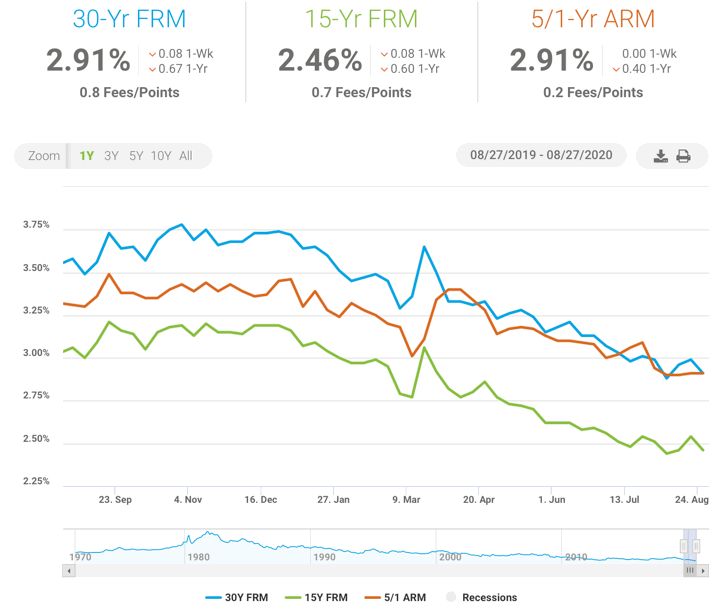
Here is how mortgage rates have changed in just the last 12 months, per Freddie Mac. Would anyone who lived through the 2009 boom-and-bust have expected a 30-year fixed mortgage to cost the same as a 5/1 ARM?

You may not get these rates as they do assume some points, and it may actually work out better for your situation to pay less in upfront closing costs in exchange for a higher interest rate than 2.91%. You can calculate a breakeven point upon which your saved monthly payments completely offset your upfront costs, and also how far you are “ahead” at certain time periods like 3 or 5 years down the road.

Bottom line. Mortgage rates are even lower and many new homeowners will now able to lower their mortgage rates via a refinance. In addition, a new refinance fee that can add thousands to your upfront cost will be added on 12/1. From what I understand, it’s rather hectic right now and refi’s can take over a month, so you will need to start soon and “pack your patience”.

If you are serious, get an accurate full quote with all the costs involved with a reputable mortgage comparison site like LendingTree (tip: they will likely call whatever phone number you choose to enter) or go local and call up your neighborhood broker. You don’t have to provide your Social Security number to get a quote. If you like what you see, lock in the rate as they can change quickly.