Archives for December 2019

My Money Blog Portfolio Income Update – December 2019 (Q4)

dividendmono225

How do you turn a pile of money into income for the rest of your life? I have read hundreds of articles about this topic, and have found no ideal solution. Much of the advice applies to those aged 65+, but what about someone in their 40s with a much longer time horizon?

During the accumulation phase, I believe a 3% withdrawal rate remains a reasonable target for something retiring young (before age 50) and a 4% withdrawal rate is a reasonable target for one retiring at a more traditional age (closer to 65). If you are not close to retirement, your time is better spent focusing on your earning potential via better career moves, investing in your skillset, and/or look for entrepreneurial opportunities where you own equity in a business.

My crude and simple solution is to first build a portfolio designed for total return, and then spend the income. Stock dividends are the portion of profits that businesses have decided they don’t need to reinvest into their business. The dividends may suffer some short-term drops, but over the long run they have grown faster than inflation. Bond interest from high-quality IOUs are more reliable, but won’t rise as quickly.

As you’ll see below, my portfolio distributes about 2.5% in the form of dividends and interest. If we were to stop working, we would then take out another 0.5% by selling a few shares and then we’d have our 3%. Right now, we are both still employed and thus we withdraw less than 2.5%, so we don’t have to sell anything.

I track the “TTM Yield” or “12-Month Yield” from Morningstar, which the sum of a fund’s total trailing 12-month interest and dividend payments divided by the last month’s ending share price (NAV) plus any capital gains distributed over the same period. I prefer this measure because it is based on historical distributions and not a forecast. Below is a very close approximation of my investment portfolio (2/3rd stocks and 1/3rd bonds).

Asset Class / Fund % of Portfolio Trailing 12-Month Yield (Taken 12/24/19) Yield Contribution
US Total Stock
Vanguard Total Stock Market Fund (VTI, VTSAX)
25% 1.71% 0.43%
US Small Value
Vanguard Small-Cap Value ETF (VBR)
5% 1.95% 0.10%
International Total Stock
Vanguard Total International Stock Market Fund (VXUS, VTIAX)
25% 2.92% 0.73%
Emerging Markets
Vanguard Emerging Markets ETF (VWO)
5% 2.71% 0.14%
US Real Estate
Vanguard REIT Index Fund (VNQ, VGSLX)
6% 3.12% 0.19%
Intermediate-Term High Quality Bonds
Vanguard Intermediate-Term Treasury ETF (VGIT)
17% 2.23% 0.38%
Inflation-Linked Treasury Bonds
Vanguard Short-Term Inflation-Protected Securities ETF (VTIP)
17% 1.96% 0.33%
Totals 100% 2.30%


Here is a chart showing how this 12-month trailing income rate has varied over the last five years.

One of the things I like about using this number is that when stock prices drop, this percentage metric usually goes up – which makes me feel better in a bear market. When stock prices go up, this percentage metric usually goes down, which keeps me from getting too euphoric during a bull market. I see it as a very conservative, valuation-based withdrawal rate metric due to our very long retirement horizon of 40+ years.

What’s not shown in the chart above is how the total income rises as the portfolio value rises. I have a chart of my portfolio income as well, but it mixes in my own contributions so it doesn’t present a clear picture.

In practical terms, I let all of my dividends and interest accumulate without automatic reinvestment. I treat this money as my “paycheck”. Then, as with my real paycheck, I can choose to either spend it or reinvest in more stocks and bonds.

The income from our portfolio lets us “work less and live more” now as I now fear running out of time more than running out of money. We use our nest egg to allow us to work less hours in a more flexible manner as parents of young children. We are very fortunate to be in this situation, although I’ve also been working towards this goal steadily for 15 years! Others may use their portfolio income to start a new business, travel around the world, sit on a beach, do charity or volunteer work, and so on.

Domino’s Pizza Gift Cards: 25% Cash Back

MyGiftCardsPlus has a promotion with 25% cash back on Domino’s Pizza gift cards for a limited time. For example, buy a $100 gift card and get $25 cash back. The gift card has no expiration. Limit $1,000 per household. While supplies last. I do enjoy the pure convenience of the Domino’s app!
There are also promos from Delta Airlines (10% cash back), Jersey Mike’s (10% back), Bed Bath and Beyond (10% back), and Fanatics (20% back).

The cash back is in the form of Swagbucks, which you can cash out via PayPal or Visa Prepaid card. Not a member? Join via my Swagbucks referral link and earn a $3 referral bonus + an additional $10 bonus if you spend at least $25 through their shopping portal within 30 days of registration. (Unfortunately, MyGiftCardsPlus purchases do not qualify.)

MMB Portfolio Asset Allocation Update, December 2019 (Q4)

portpie_blank200

Plenty of people will tell you what you should own, but I’d rather they just share what they actually own. Here’s my year-end portfolio update for Q4 2019, including all of our 401k/403b/IRAs, taxable brokerage accounts, and savings bonds but excluding our house, cash reserves, and a few side investments. Dividends tend to arrive on a quarterly basis, and this helps determine where to invest new cash to rebalance back towards our target asset allocation.

Actual Asset Allocation and Holdings

I use both Personal Capital and a custom Google Spreadsheet to track my investment holdings. The Personal Capital financial tracking app (free, my review) automatically logs into my accounts, adds up my balances, tracks my performance, and calculates my asset allocation. I still use my manual Google Spreadsheet (free, instructions) because it helps me calculate how much I need in each asset class to rebalance back towards my target asset allocation.

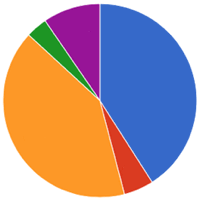
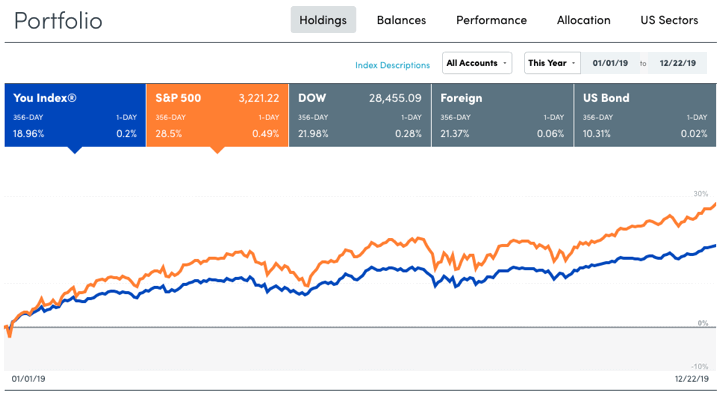
Here are my YTD performance and current asset allocation visually, per the “Allocation” and “Holdings” tabs of my Personal Capital account, respectively:

Stock Holdings
Vanguard Total Stock Market (VTI, VTSAX)
Vanguard Total International Stock Market (VXUS, VTIAX)
WisdomTree SmallCap Dividend (DES)
Vanguard Small Value (VBR)
Vanguard Emerging Markets (VWO)
Vanguard REIT Index (VNQ, VGSLX)

Bond Holdings
Vanguard Limited-Term Tax-Exempt (VMLTX, VMLUX)
Vanguard Intermediate-Term Tax-Exempt (VWITX, VWIUX)
Vanguard Intermediate-Term Treasury (VFITX, VFIUX)
Vanguard Inflation-Protected Securities (VIPSX, VAIPX)
Fidelity Inflation-Protected Bond Index (FIPDX)
iShares Barclays TIPS Bond (TIP)
Individual TIPS securities
U.S. Savings Bonds (Series I)

Target Asset Allocation. I do not spend a lot of time backtesting various model portfolios, as I don’t think picking through the details of the past will necessarily create superior future returns. I mainly make sure that I own asset classes that will provide long-term returns above inflation, distribute income via dividends and interest, and finally offer some historical tendencies to balance each other out. I make a small bet that US Small Value and Emerging Markets will have higher future long-term returns (along with some higher volatility) than the more large and broad indexes, although I could be wrong.

While you could argue for various other asset classes, I believe that it is important to imagine an asset class doing poorly for a long time, with bad news constantly surrounding it, and only hold the ones where you still think you can maintain faith through those fearful times. I simply don’t have strong faith in the long-term results of commodities, gold, or bitcoin.

Stocks Breakdown

  • 38% US Total Market
  • 7% US Small-Cap Value
  • 38% International Total Market
  • 7% Emerging Markets
  • 10% US Real Estate (REIT)

Bonds Breakdown

  • 33% US Treasury Bonds, intermediate
  • 33% High-Quality Municipal Bonds (taxable)
  • 33% US Treasury Inflation-Protected Bonds (tax-deferred)

I have settled into a long-term target ratio of 67% stocks and 33% bonds (2:1 ratio) within our investment strategy of buy, hold, and occasionally rebalance. I will use the dividends and interest to rebalance whenever possible in order to avoid taxable gains. I plan to only manually rebalance past that if the stock/bond ratio is still off by more than 5% (i.e. less than 62% stocks, greater than 72% stocks). With a self-managed, simple portfolio of low-cost funds, we minimize management fees, commissions, and taxes.

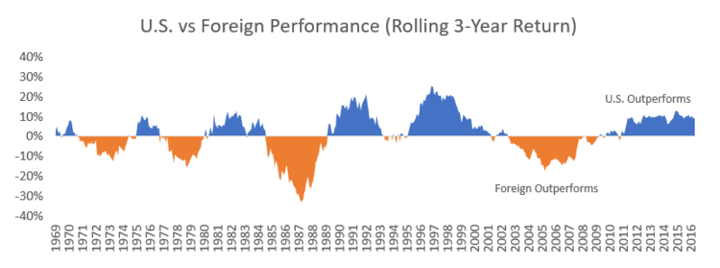
Holdings commentary. I know that US stock valuations are on the higher side, but this year of all-time US highs is another reminder that you still need to stay in the game. My forward expectations for US stock returns are muted, but I’m not selling a single share. International stocks have also hit an all-time high, but nobody really noticed because US stocks have still outperformed by a long shot this decade. I remain satisfied with my mix, knowing that I will own whatever successful businesses come out of the US, Europe, China, or wherever in the future.

On the bond side, my primary objective remains to hold high-quality bonds with a short-to-intermediate duration of under 5 years or so. This means US Treasuries, TIPS, or investment-grade municipal bonds. FDIC or NCUA-insured certificates would also fit in there. I don’t want to worry about my bonds. I then tweak the specific breakdown based on my tax-deferred space available, the tax-effective rates of muni bonds, and the real interest rates of TIPS. Right now, it is roughly 1/3rd Treasuries, 1/3 Muni bonds, and 1/3rd TIPS.

Performance numbers. According to Personal Capital, my portfolio went up +19% so far in 2019. I see that during the same period the S&P 500 has gone up +29%, Foreign Developed stocks up +21%, and the US Aggregate bond index was up about +10%.

An alternative benchmark for my portfolio is 50% Vanguard LifeStrategy Growth Fund and 50% Vanguard LifeStrategy Moderate Growth Fund – one is 60/40 and the other is 80/20 so it also works out to 70% stocks and 30% bonds. That benchmark would have a total return of +20.9% for 2019 YTD.

The goal of this portfolio is to create sustainable income that keeps up with inflation to cover our household expenses. I’ll share about more about the income aspect in a separate post.

Bank of America Free Museum Tickets 2019 Dates (+ New Holiday Dates)

(Update: BofA has added an additional six days of free museum admission in 2019, from 12/26-12/31. In case you need something extra and no-cost to do during the winter break! I just went back to the Thinkery in Austin, TX again recently and it was awesome again but those admissions quickly added up for an entire family.)

bofa_musBank of America is running their Museums on Us program again for 2019, which offers cardholders free admissions to 200+ museums, science centers, and botanical gardens nationwide on the first full weekend of every month (Saturday and Sunday). Each person just needs to show their valid Bank of America or Merrill Lynch credit or debit card and photo ID for free admission.

Each cardholder gets one free general admission for themselves only, so be sure everyone with their own cards brings them. If you have a BofA credit card, you may consider adding family members (of any age) as a free authorized user. Another option is to open a Kids Savings Account with no monthly fee and also comes with a debit card. You may need to open this in a physical branch.

2019 Calendar Dates (Check specific museum for hours)

  • January 5th & 6th
  • February 2nd & 3rd
  • March 2nd & 3rd
  • April 6th & 7th
  • May 4th & 5th
  • June 1st & 2nd
  • July 6th & 7th
  • August 3rd & 4th
  • September 7th & 8th
  • October 5th & 6th
  • November 2nd & 3rd
  • December 7th & 8th

Here is the full list of participating locations [pdf]. One of the available museums is the Thinkery in Austin, Texas. We found it to be a fun and interactive children’s science center. The admission was $12 per person including kids (23 months and under free), which means this could have saved our family of five $60 for that one day. I’ve seen other museums on their list with $20 admission prices.

While I wouldn’t open a new bank or credit card account for this feature, it is a nice perk if you already have such accounts. You can also sign-up for a free text reminder before each free weekend. I signed up and haven’t gotten any spam texts from BofA, just the reminders.

Long Cycles and Hot Asset Classes: Large Cap Growth vs. Value Stocks

As this decade comes to an end, I find it noteworthy that Large-Cap Growth stocks have outperformed Large-Cap Value stocks during most of the the 2010s. When I first started learning about investing in the previous decade of the 2000s, much was made of how Large-Cap Value stocks historically outperformed Growth. You can see this cyclical behavior below, taken from this Morningstar article:

Similar to economic cycles, growth and value stocks have alternated leadership roles based on past performance, as shown here over the rolling three-year periods starting 1973. While value beat growth during the 2000s, the trend reversed in the 2010s as growth outperformed value and continues to post large gains year-to-date 2019. Nonetheless, it’s challenging to predict whether the growth’s premium over value will persist, given the irregularity of the cycles.

Nowadays, when I read about some factor that provides a superior long-term average return, I often wonder if its simply that a hot streak of recent outperformance has tilted it towards one side over another. What if it’s just part of a long cycle that eventually goes the other way? It was only after 2009 that long-term bonds and gold came back as desirable asset classes. Before that, it was commodities. Of course, there are all the ways that stocks are split up – US/International, Large/Small, Value/Growth, Momentum, Volatility, and so on.

From a previous post US vs. International Stocks: Historical Cycles of Outperformance:

us_intl_cycle

Bottom line. Large Value stocks did great during the 2000s, but Large Growth stocks dominated the 2010s. Have some healthy skepticism regarding “hot” asset classes, as the trend may not last and indeed may turn around just as you make the switch.

Stocks, Bonds, and Gold: Historical Charts Since 1800

StarCapital Research has shared a series of interesting long-term charts comparing the long-term returns, drawdowns, and volatility of stocks, bonds, and gold over the last 220 years. There are also some stats on relative market valuations and forward return expectation for different countries and regions. You must accept some terms before viewing, but it is available to US individual investors.

Here is a sample chart of the return distributions of stocks, bonds, and gold since 1800, depending on holding period, along with their takeaway, via Norbert Keimling @CAPE_invest:

Conclusion: For periods of 10 years or more, stocks are safer than bonds or gold!

This is because for a 10-year holding, the worst inflation-adjusted performance of stocks (-5.9% annually) was better than the worst performance for bonds (-6.4%) and gold (-10.1%). The problem is that during a specific 10-year timeframe where stocks did that poorly, it’s quite likely that bonds or gold did great! Which means that it would still be quite difficult to keep holding stocks through such a period of poor performance. In a fearful environment, “sell stocks and wait things out” will start sounding like much wiser advice than “buy and hold”.

Of course, stocks can recover quite quickly and you might miss it while you’re waiting:

(There is also an ongoing debate about the validity of “time diversification”. Do stocks really become “safer” the longer you hold them? They can still go down 50% at any given time, so if you need to sell in the near future, they are never really safe.)

After doing this for a while, I don’t know if someone can simply read a book and “learn” how to keep the faith during the scary bits. It takes some time and making some mistakes to develop a portfolio where you understand its limitations and how long and how badly it can act in the short-term. I’m still learning.

Keep or Close Old Bank Accounts? How To Manage Multiple Bank Accounts

In 2019, I opened new accounts at the following banks and credit unions in order to earn higher interest on my cash reserves. Some of the offers are now expired, but the idea is to show you that I do accumulate new accounts every year:

For the most part, I keep these new accounts. I also profited from these promotions via accounts I opened prior to 2019:

I’ve gotten a few questions about what I do with all of these accounts. Do I keep them forever? Close them immediately? Here’s my thought process.

Opening new accounts. In general, I will consider opening a new bank account or credit union account if the following conditions are met: Is the net benefit is roughly $100 or higher? Are the monthly fees avoidable? Is my money not already tied up elsewhere? Does it incur a hard credit check upon opening? Most banks do not perform a hard credit check for new accounts. Many credit unions do, however, as their business model is strongly dependent on lending between members. This used to matter more when you could open 20 credit cards in a year and thus you’d want to avoid having too many inquiries on your report, but nowadays the credit card issuers have limits based specifically on your credit card history and less about your number of inquiries.

However, a lot of it also depends on soft factors. Does it seem like it will be a hassle to collect the bonus? Does this bank/CU offer a history of competitive rates and offers? Does it have a reputation for good customer service?

For inactive bank accounts that you don’t care about. For a bank that is no longer offering me something useful and doesn’t look like it will in the future, I will set it to paperless statements, remove all external bank account links, and withdraw all my money. Usually, if there is no activity and $0.00 inside for over a year, the bank will quietly close the account for me. If not, there is minimal ongoing mental load and I’ll usually just let it sit idle indefinitely. If the account charges a monthly fee or somehow causes me hassle, I will go ahead and close it manually.

For inactive bank accounts that you want to keep open. For a bank where I don’t keep my cash there anymore, but I still want to keep it open in case the interest rate improves, a future promotion pops up, or to maintain a perk like free notary service, I will keep at least $10 in the account and also make a $1 in/out transaction once every 12 months. This keeps the account active so that they won’t close it without at least some sort of warning.

Finally, I track all my bank accounts using Mint and Personal Capital. I also use a password manager to keep complex, distinct passwords at each financial institution. Enable two-factor authentication where available.

By monitoring all of my open accounts using such services, I help guarantee that I will stay well within the 60-day window provided by Regulation E to notify the bank of any unauthorized activity. If you lose your debit card (“access device”) and report it lost or stolen no more than two days after becoming aware of the theft, your liability is limited to $50. If you experience an unauthorized ACH transfer, you must report it within 60 days of the statement. Here’s an example from ConsumerFinance.gov:

For example, a consumer’s account is electronically debited for $200 without the consumer’s authorization and by means other than the consumer’s access device. If the consumer notifies the institution within 60 days of the transmittal of the periodic statement that shows the unauthorized transfer, the consumer has no liability. However, if in addition to the $200, the consumer’s account is debited for a $400 unauthorized transfer on the 61st day and the consumer fails to notify the institution of the first unauthorized transfer until the 62nd day, the consumer may be liable for the full $400.

Solo 401k vs. SEP IRA Contribution Limit Example For $50,000 Income

I use a Solo 401k plan because it lets you contribute the most tax-deferred money for a modest amount of self-employed income. At the end of each year, I can more clearly estimate my total income for 2019 and thus my maximum contribution limits. There are several online calculators out there (try Dinkytown or BCM Advisors), although I would cross-check your answers to make sure they agree. Your Solo 401k contribution has two components:
  • Employee salary deferral contribution. Employees may defer up to 100% of their compensation, up to $19,000 for the 2019 tax year ($25,000 for employees age 50 or older).
  • Employer profit sharing contribution. Employers may contribute up to 25% of compensation (sole proprietorships must make a special calculation), up to a combined total of $56,000 for the 2019 tax year ($62,000 if age 50 or older).

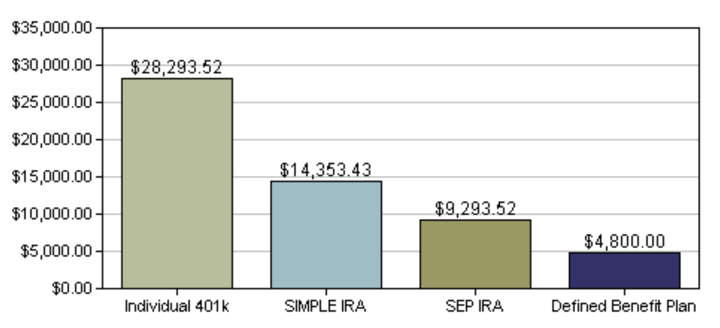
Here are some sample numbers if you are under age 50 with $50,000 in Schedule C income as an unincorporated sole proprietorship. The numbers are a bit tricky because you have to do things like take out half of the self-employment tax paid, etc. Let the calculator figure out the details, but you can still see that the Solo 401k (aka Individual 401k, aka Self-Employed 401k) offers a much higher contribution limit than a SEP IRA or SIMPLE IRA.

Here are some sample numbers if you are under age 50 had a $50,000 W-2 income from your S-Corporation. These numbers are a bit cleaner, as when you run payroll the employer side of payroll taxes are taken out of the employee paycheck.

Being able to defer up to 63% of your income ($31,500 out of $50,000) into tax-advantaged accounts is great for aggressive savers. In addition, both Traditional Pre-tax and Roth versions are allowed for the employee portion of contributions as long as your administrator supports it. Note that if you are already making employee contributions to a 401k-type plan from another job, you are still responsible for staying under the $19,000/$25,000 total cap across all your jobs. If you are consistently maxing out your 401k salary deferral in another job, then it may make more sense to stick with the SEP-IRA as it comes with less paperwork.

Best Interest Rates on Cash – December 2019

Here’s my monthly roundup of the best interest rates on cash for December 2019, roughly sorted from shortest to longest maturities. I track these rates because I keep a full 12 months of expenses as a cash cushion and also invest in longer-term CDs (often at lesser-known credit unions) when they yield more than bonds. Check out my Ultimate Rate-Chaser Calculator to see how much extra interest you’d earn by moving money between accounts. Rates listed are available to everyone nationwide. Rates checked as of 12/9/19.

High-yield savings accounts
While the huge megabanks like to get away with 0.01% APY, it’s easy to open a new “piggy-back” savings account and simply move some funds over from your existing checking account. The interest rates on savings accounts can drop at any time, so I list the top rates as well as competitive rates from banks with a history of competitive rates. Some banks will bait you with a temporary top rate and then lower the rates in the hopes that you are too lazy to leave.

Short-term guaranteed rates (1 year and under)
A common question is what to do with a big pile of cash that you’re waiting to deploy shortly (just sold your house, just sold your business, legal settlement, inheritance). My usual advice is to keep things simple and take your time. If not a savings account, then put it in a flexible short-term CD under the FDIC limits until you have a plan.

  • No Penalty CDs offer a fixed interest rate that can never go down, but you can still take out your money (once) without any fees if you want to use it elsewhere. My eBanc has a 11-month No Penalty CD at 2.00% APY with a $100,000 minimum deposit. Marcus Bank has a 7-month No Penalty CD at 1.90% APY with a $500 minimum deposit. Ally Bank has a 11-month No Penalty CD at 1.90% APY with a $25,000 minimum deposit. CIT Bank has a 11-month No Penalty CD at 1.85% APY with a $1,000 minimum deposit. You may wish to open multiple CDs in smaller increments for more flexibility.
  • Quontic Bank has a 12-month CD at 2.25% APY ($1,000 minimum).

Money market mutual funds + Ultra-short bond ETFs
If you like to keep cash in a brokerage account, beware that many brokers pay out very little interest on their default cash sweep funds (and keep the difference for themselves). The following money market and ultra-short bond funds are not FDIC-insured, but may be a good option if you have idle cash and cheap/free commissions.

  • Vanguard Prime Money Market Fund currently pays an 1.72% SEC yield. The default sweep option is the Vanguard Federal Money Market Fund, which has an SEC yield of 1.60%. You can manually move the money over to Prime if you meet the $3,000 minimum investment.
  • Vanguard Ultra-Short-Term Bond Fund currently pays 2.06% SEC yield ($3,000 min) and 2.16% SEC Yield ($50,000 min). The average duration is ~1 year, so there is more interest rate risk.
  • The PIMCO Enhanced Short Maturity Active Bond ETF (MINT) has a 2.05% SEC yield and the iShares Short Maturity Bond ETF (NEAR) has a 2.15% SEC yield while holding a portfolio of investment-grade bonds with an average duration of ~6 months.

Treasury Bills and Ultra-short Treasury ETFs
Another option is to buy individual Treasury bills which come in a variety of maturities from 4-weeks to 52-weeks. You can also invest in ETFs that hold a rotating basket of short-term Treasury Bills for you, while charging a small management fee for doing so. T-bill interest is exempt from state and local income taxes.

  • You can build your own T-Bill ladder at TreasuryDirect.gov or via a brokerage account with a bond desk like Vanguard and Fidelity. Here are the current Treasury Bill rates. As of 12/6/19, a 4-week T-Bill had the equivalent of 1.52% annualized interest and a 52-week T-Bill had the equivalent of 1.57% annualized interest.
  • The Goldman Sachs Access Treasury 0-1 Year ETF (GBIL) has a 1.83% SEC yield and the SPDR Bloomberg Barclays 1-3 Month T-Bill ETF (BIL) has a 1.44% SEC yield. GBIL appears to have a slightly longer average maturity than BIL.

US Savings Bonds
Series I Savings Bonds offer rates that are linked to inflation and backed by the US government. You must hold them for at least a year. There are annual purchase limits. If you redeem them within 5 years there is a penalty of the last 3 months of interest.

  • “I Bonds” bought between November 2019 and April 2020 will earn a 2.22% rate for the first six months. The rate of the subsequent 6-month period will be based on inflation again. More info here.
  • In mid-April 2020, the CPI will be announced and you will have a short period where you will have a very close estimate of the rate for the next 12 months. I will have another post up at that time.

Prepaid Cards with Attached Savings Accounts
A small subset of prepaid debit cards have an “attached” FDIC-insured savings account with exceptionally high interest rates. The negatives are that balances are capped, and there are many fees that you must be careful to avoid (lest they eat up your interest). Some folks don’t mind the extra work and attention required, while others do. There is a long list of previous offers that have already disappeared with little notice. I don’t personally recommend nor use any of these anymore.

  • The only notable card left in this category is Mango Money at 6% APY on up to $2,500, but there are many hoops to jump through. Requirements include $1,500+ in “signature” purchases and a minimum balance of $25.00 at the end of the month.

Rewards checking accounts
These unique checking accounts pay above-average interest rates, but with unique risks. You have to jump through certain hoops, and if you make a mistake you won’t earn any interest for that month. Some folks don’t mind the extra work and attention required, while others do. Rates can also drop to near-zero quickly, leaving a “bait-and-switch” feeling. I don’t use any of these anymore, but the Orion offer is worth consideration.

  • Consumers Credit Union Free Rewards Checking (my review) has up to 5.09% APY on balances up to $10,000 if you meet make $500+ in ACH deposits, 12 debit card “signature” purchases, and spend $1,000 on their credit card each month. Orion FCU Premium Checking (my review) has 3.00% APY on balances up to $15,000 if you meet make $500+ in direct deposits and 8 debit card “signature” purchases each month. Find a locally-restricted rewards checking account at DepositAccounts.
  • If you’re looking for a high-interest checking account without debit card transaction requirements, the rate won’t be nearly as high, but take a look at MemoryBank at 0.90% APY.

Certificates of deposit (greater than 1 year)
CDs offer higher rates, but come with an early withdrawal penalty. By finding a bank CD with a reasonable early withdrawal penalty, you can enjoy higher rates but maintain access in a true emergency. Alternatively, consider building a CD ladder of different maturity lengths (ex. 1/2/3/4/5-years) such that you have access to part of the ladder each year, but your blended interest rate is higher than a savings account. When one CD matures, use that money to buy another 5-year CD to keep the ladder going. Some CDs also offer “add-ons” where you can deposit more funds if rates drop.

  • You could build a CD ladder at Lafayette Federal Credit Union (LFCU) at 3.03% APY for 5-years, 2.78% APY for 4-year, 2.52% APY for 3-year, 2.27% APY for 2-year, and 2.02% APY for 1-year. As with many credit union deals, this likely won’t last long. Anyone can join this credit union via partner organization ($10 one-time fee).
  • Andrews FCU still had their special 7-year certificate at 3.05% APY. Anyone can join this credit union via partner organization.
  • You can buy certificates of deposit via the bond desks of Vanguard and Fidelity. You may need an account to see the rates. These “brokered CDs” offer FDIC insurance and easy laddering, but they don’t come with predictable early withdrawal penalties. The rates are not competitive right now. Watch out for higher rates from callable CDs listed by Fidelity.

Longer-term Instruments
I’d use these with caution due to increased interest rate risk, but I still track them to see the rest of the current yield curve.

  • Willing to lock up your money for 10+ years? You can buy long-term certificates of deposit via the bond desks of Vanguard and Fidelity. These “brokered CDs” offer FDIC insurance, but they don’t come with predictable early withdrawal penalties. I don’t see anything noteworthy. Watch out for higher rates from callable CDs from Fidelity.
  • How about two decades? Series EE Savings Bonds are not indexed to inflation, but they have a unique guarantee that the value will double in value in 20 years, which equals a guaranteed return of 3.5% a year. However, if you don’t hold for that long, you’ll be stuck with the normal rate which is quite low (currently a sad 0.10% rate). I view this as a huge early withdrawal penalty. You could also view it as a hedge against prolonged deflation, but only if you can hold on for 20 years. As of 12/9/19, the 20-year Treasury Bond rate was 2.13%.

All rates were checked as of 12/9/19.

Fidelity Charitable Donor-Advised Fund (DAF) Opening Process Review

It took me an extra year to get around to it, but it only took me about 15 minutes to actually open and fund my new Fidelity Charitable Donor-Advised Fund (DAF). I even donated stocks instead of just cash, but the donating appreciated securities were from an existing Fidelity taxable brokerage account. Here’s a brief review of the process.

Step 1: Create Fidelity account. Provide personal details, including name, address, and Social Security Number. Similar to opening a new bank or brokerage account. They need this information for tax purposes. If, for example, you make 20 donations of $100 all to different charities, you will only have one $2,000 tax receipt at the end of the year. If you already have a Fidelity account log-in, it links easily.

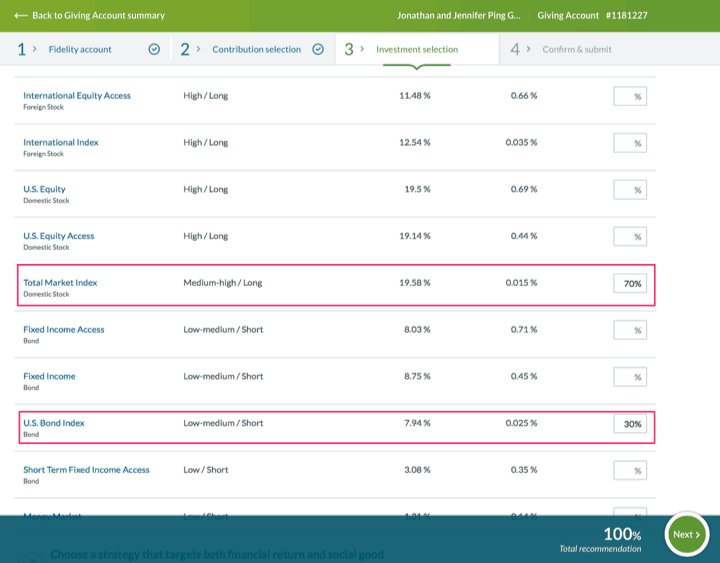
Step 2: Contribution selection. If donating from a Fidelity brokerage account, they have a special tool that searches for tax lots with the largest unrealized gains. This maximizes the tax advantage of your donation. This ability to find specific lots is neat and overrides your usual default setting for tax lots (ex. First-in, First-out). You can also enter you desired donation amount and it will tell you how many shares you should donate to approximate that amount (final number will depend on market price). For now, I chose to donate enough to satisfy the minimum opening amount of $5,000. Here’s a screenshot:

Step 3: Investment selection. Pre-packaged or customized allocation. One of the benefits of a DAF is that you can invest your money in between the time of initial contribution and eventual distribution. I did not spend a lot of time agonizing over this choice, as I don’t plan on keep a large amount of funds in there. We are not talking about an obscene amount of money here, so I feel better about distributing it sooner and helping out now. I am mainly using the DAF for the bonus tax savings and thus making my effective contribution larger.

Still, I was happy to see that I could create a custom allocation using low-cost index fund choices, including a Total US Stock Market Index at 0.015% annual expense ratio and US Bond Index at 0.025% annual expense ratio. Keep in mind there is also a 0.60% annual administrative fee (minimum $100). I mostly hope that the market gains will more than offset the maintenance fees.

Step 4. Confirm and Submit. The overall user experience was smooth and my choices were summarized in a clear and concise manner. The actual sale of my shares will take a few business days. It is made clear that this is an irrevocable charitable contribution. This means I am eligible to take an itemized deduction for this contribution immediately.

You can also choose to donate stocks from an outside brokerage account, but that process will take more time (and possibly more work). I plan on trying this out later, to test out that experience.

Amazon Prime Photos: Free $15 Amazon Credit for First-Time Users

One of the perks of Amazon Prime membership is that you get unlimited cloud storage of your photos in full resolution.

Amazon Photos is currently offering targeted users a free $15 Amazon promo credit if you download the Amazon Photos app (iOS, Android, or desktop) and upload at least one photo for the first time. Offer expires at 11:59pm Pacific on December 31, 2019.

The Double Tax Advantage of Donating Appreciated Stocks Directly

If you own stocks in a taxable brokerage account and make charitable donations, consider donating your stocks this year instead of just writing a check. Why? Given the all-time market highs, your stocks, mutual funds, and/or ETFs probably have unrealized capital gains. When you donate an appreciated security that you’ve held for at least a year, you’ll both avoid paying long-term capital gains tax AND get a tax deduction for the full current market value.

This HCR Wealth Advisors graphic shows the benefit using the example of donating $50,000 of stock to charity with an original cost basis of $30,000. It assumes the highest long-term capital gains tax rate of 23.8% (20% plus the 3.8% Medicare surtax for high-income earners).

Here is a similar graphic from Fidelity using the example of donating $50,000 of stock to charity with an original cost basis of $20,000.

The size of your benefit is your unrealized gain times your tax rate. This basic idea still applies if you’re only donating a smaller amount of stock at the lower long-term capital gains rate of 15%. If you bought a stock for $1,000 and it’s now worth $2,000, donating it directly will save you $150 to $238 in taxes ($1,000 x 15% or 20% or 23.8%). If someone didn’t know and simply changed the order (sell stock, then immediately donate the cash proceeds), that tax savings would disappear.

The problem is that not all individual charities are equipped to accept such stock donations. That’s where donor-advised funds (DAFs) come in handy. Fidelity, Vanguard, and Schwab all have donor-advised funds that can accept such donations, get you that tax deduction upfront, and allow you to make a cash grant to your individual charities. DAFs do charge for their services – an administration fee of about 0.60% of assets annually on top of investment expense ratios. There is also a minimum initial donation of between $5,000 and $25,000. You can then weigh the options of investing your donations for growth, or distributing it immediately to charities for immediate impact.

I am fortunate to have some appreciated stocks, so this year I plan to open an account with Fidelity Charitable. I chose them because they seem to have been in the game the longest and are also the most flexible with a $5,000 minimum initial donation, no minimum requirement for future donations, and a low $50 minimum grant size. Their administrative fees are also comparable with Schwab and Vanguard. I hope that I can finish the process by year-end.