Archives for June 2023

Oxygen Fintech App: $100 Bonus for Personal Accounts, Free LLC Incorporation for Business Accounts

Oxygen is a fintech app that offers “tools and services for extraordinary entrepreneurs and business owners”, letting you have one app that easily alternates between personal and business bank accounts. Banking services are through The Bancorp Bank, Member FDIC. The app design is very modern and slick, but let’s be honest, I’m here for the features and perks.

For personal accounts, you can get a $100 bonus if you open a new account via referral link (example, please contact me if you’d like a fresh one) and then:

  • Receive a payroll direct deposit of $500 or more, and
  • make 5 debit card purchases within 60 days of opening an account.

The sign-up process is on the app, so you should either open the link via mobile device, or scan the QR code. The opening process was very easy and fast more me, I did not have to upload any additional scans of photo ID or similar. There was no credit check. I expect to knock out the debit card purchases quite easily between parking fees, Target Drive-Up orders, and Amazon reloads. I was able to sign-up and had my account and routing numbers in under 5 minutes. The referrer gets $100 as well for each successful referral, up to $1,000.

For business accounts, they offer a free LLC/S-Corp/C-Corp incorporation service, which can be worth $100+ as well. No special link required. Here are a few significant quotes of what they include:

  • “Incorporate your new business right from the Oxygen platform wherever you are in the US. We take care of the hard stuff, so you can focus on what matters. Building your business.”
  • “Choose between LLC, C-Corp and S-Corp. Get the setup that is right for your business type and size.”
  • “Our team of formation experts will verify your business name availability, prepare your Articles of Organization, coordinate filing all required documents with your Secretary of State, and digitally return all confirmations directly to your personalized dashboard.”
  • “Incorporation services include Articles of Organization, Federal Tax ID (EIN), one year free registered agent service, and a custom operating agreement.”

I don’t think I’ve seen free LLC formation as a “perk” before, so that is interesting.
Simple Personal Finance Lessons and Quotes from Harry Markowitz (1927-2023)

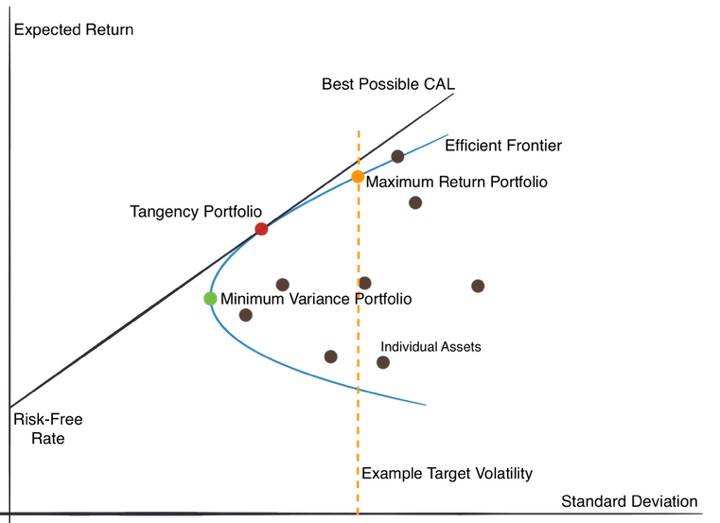
Harry Markowitz, who received the 1990 Nobel Prize in Economics for his contributions in creating modern portfolio theory, passed away recently. He introduced the use of mathematical methods to illustrate the power of diversification and how you can combine multiple different components into a portfolio that can achieve the highest expected return while taking on the minimum amount of risk. This NY Times obituary outlines his long list of achievements.

These days, anyone can run many backtests to optimize for a historically optimal portfolio using a number of different asset classes (as of today, it will be different in 5 or 10 years). However, if you listen to many of his interviews, Markowitz doesn’t necessarily think the average investor needs optimize relentlessly. Here are some useful quotes that don’t require any advanced math.

From his landmark 1959 book Portfolio Selection: Efficient Diversification of Investments:

A good portfolio is more than a long list of good stocks and bonds. It is a balanced whole, providing the investor with protections and opportunities with respect to a wide range of contingencies.

How did Harry Markowitz actually run his own personal portfolio? From Jonathan Zweig’s NYT article about emotions and investing:

Mr. Markowitz was then working at the RAND Corporation and trying to figure out how to allocate his retirement account. He knew what he should do: “I should have computed the historical co-variances of the asset classes and drawn an efficient frontier.” (That’s efficient-market talk for draining as much risk as possible out of his portfolio.)

But, he said, “I visualized my grief if the stock market went way up and I wasn’t in it — or if it went way down and I was completely in it. So I split my contributions 50/50 between stocks and bonds.” As Mr. Zweig notes dryly, Mr. Markowitz had proved “incapable of applying” his breakthrough theory to his own money. Economists in his day believed powerfully in the concept of “economic man”— the theory that people always acted in their own best self-interest. Yet Mr. Markowitz, famous economist though he was, was clearly not an example of economic man.

From a Chicago Tribune interview by Gail MarksJarvis:

Early in his career, he did not take the risks some investment advisers suggest for young investors to maximize returns. Rather, he saved regularly and put half his money into stocks and half into bonds to grow while controlling risks. When he thought he had accumulated too much in either category, he stopped putting money there for a while and directed savings to the neglected group. […]

“I never sold anything,” he said. If stocks were increasing in value, he would let that portion grow for a while, but eventually he would stop stock purchases and beef up the bonds. The idea: The bonds would insulate him from the downturns that crush stocks from time to time without clear warning. […]

“Say you were 65, and invested $1 million, with 60 percent in stocks and 40 percent in bonds,” he said. “It became $800,000 [during the financial crisis], and you are not happy, but you lived to invest another day.”

From this Business Insider article via Bogleheads forum post (emphasis mine):

In an interview with Personal Capital, Markowitz was asked, “What are the top pieces of advice you give people about money?”

“I only have one piece of advice: Diversify,” he replied. “And if I had to offer a second piece of advice, it would be: Remember that the future will not necessarily be like the past. Therefore we should diversify.

From ThinkAdvisor:

“Perhaps the most important job of a financial advisor is to get their clients in the right place on the efficient frontier in their portfolios,” he told me. “But their No. 2 job, a very close second, is to create portfolios that their clients are comfortable with. Advisors can create the best portfolios in the world, but they won’t really matter if the clients don’t stay in them.

Thank you, Mr. Markowitz, for your contributions to economics, behavioral finance, and investing. Thanks also for the simple, actionable lessons that don’t require a degree in mathematics or economics: keep saving regularly, maintain a diversified portfolio of both stocks and bonds, rebalance when it gets off, and stick with it for a long time (don’t panic sell).

Image credit: Quantpedia

Ranked: Things vs. Experiences vs. Things That Keep Creating Good Experiences

You’ve probably heard the advice that you get more happiness when you spend money on experiences (e.g. vacation), not material possessions (e.g. watch/jewelry). But what about purchases that have aspects of both (e.g. a swimming pool or home remodel)? The study What Makes People Happy? Decoupling the Experiential-Material Continuum (via Klement on Investing) takes data from multiple studies and places hundreds of items along two separate continuums:

  • Material happiness qualities. Happiness derived from the primary intention of acquiring a material possession – a tangible object that one obtains and maintains possession.
  • Experiential happiness qualities. Happiness derived from the primary intention of acquiring a life experience.

Some items are low on both spectrums, like tax software or insurance (low-low). Some are high on one spectrum and low on the other (high-low, low-high). Finally, some are high on both scales (high-high). The study has found that the happiness derived from the experiential and material sides are additive and not dilutive, so you can get even more total happiness this way.

The chart below takes only the goods that rated in the top 10% of highest anticipated happiness (out of 370 total goods), and then plotted them on two scales of material vs. experiential qualities.

This excerpt summarizes the conclusions well:

Therefore, the experiential advantage advice is correct in that if consumers must choose between material and experiential qualities, they should choose experiential consumption. However, when consumers can seek both qualities, such as when “high-material high-experiential” mixed consumption is available, it can provide as much as or even more happiness than purely experiential consumption.

The benefit of material goods is that they don’t go away after the experience ends (food is eaten, cruise ends, etc). The best material goods are those that keep generating new positive experiences and memories. A swimming pool or kitchen/deck remodel where family and friends can gather for many years. Of course, these things are also quite expensive!? I suppose we could skip a vacation and save up to fix up the deck instead.

Fidelity Investments: $100 New Account Offer Includes IRAs, New and Existing Customers

Updated. Fidelity Investments is offering a $100 bonus for opening a Fidelity taxable brokerage account (“The Fidelity Account”), Cash Management Account (“CMA”), Roth IRA, or traditional IRA. You can also do the “Starter Pack” (Fidelity Account + CMA), but you can also open just a single account of any type. Hat tip to reader Chuck.

Open with the promo code FIDELITY100 and deposit $50 or more within 15 calendar days after opening your account. Fidelity will give you a $100 bonus within 25 days after opening your account. You must then maintain the bonus award (minus any losses related to trading or market volatility, or margin debit balances) in the account for at least 90 days from the date on which the bonus award is credited to the account.

Per the fine print, this is available to both new and existing customers who haven’t taken advantage of this offer before. Basically, you can already have other Fidelity accounts; they just want you to open an additional new account. You just can’t have done this bonus before.

This offer is valid for new or existing Fidelity Brokerage Services LLC or Fidelity Personal and Workplace Advisors LLC (“Fidelity”) customers who open through the following link https://www.fidelity.com/go/starter-pack and fund a new, eligible Fidelity account with a minimum of $50 on or after 3/9/2023 and have not otherwise previously taken advantage of Fidelity’s $50 for $100 cash offer, or Fidelity’s $50 for $150 cash offer. Offer is limited to one bonus award per individual.

You should receive a confirmation email:

As a confirmation of your registration, an email will be sent to the email address you provided during the account opening process after the eligible account has been established in good order.

Right now, I don’t know of any alternative Fidelity bonuses for transferring over new account assets from another broker.

This is a relatively simple and straightforward bonus, and the Fidelity Account offers solid customer service and a good feature set (decent cash sweep, no stock/ETF commissions, ability to buy Treasury bonds and brokered CDs). I would personally much rather trade stocks at Fidelity than deal with Robinhood customer service, for example. There are also bonuses available for their fintech Bloom and Youth brokerage accounts (13-17yo).

Treasury Bonds vs. TIPS vs. Lifetime Income Annuities Compared

These days, when I see an article titled The Best Current Sources of Retirement Income, I expect to be pitched some sort of options-based ETF with 12% yield or high-yield junk bonds with a 9% yield. However, this Morningstar article actually provided a reasonable comparison of three high-quality options for “guaranteed” income:

  • Traditional US Treasury Bonds, which offer a fixed interest payment for the remaining term of the bond (plus return of principal).
  • Treasury Inflation Protected Securities (TIPS), which offer a variable interest payment that is a fixed amount above an inflation-linked index (plus return of principal).
  • Single Premium Income Annuities, where you put up all your money upfront and then receive a fixed amount for the rest of your lifetime.

There are some additional assumptions, but here is a chart assuming a $100,000 investment, starting at age 65 with a 20-year time horizon that experiences 2.4% annual inflation (2.4% is the average long-term prediction of future inflation):

The chart seems to suggest that if you buy an annuity and then die the next year, you would lose your entire $100,000. That can be the case, but every SPIA annuity quote that I’ve seen offers the option to guarantee a certain minimum number of payments like 5 or 10 years of income, or a complete return of premium ($100,000 in this case). You do pay for this additional rider in the form of a lower monthly payout, but it is a popular option.

Don’t forget about Social Security. The article reminds us that an alternative option for government-guaranteed, inflation-adjusted income is to delay your Social Security start date and increase your future monthly payments for the rest of your life. Your cost is using your own funds to replace your income during those additional delayed years before claiming.

The results are about as you might expect, but it’s nice to see it illustrated using charts. My lightning recap:

  • Moderate inflation (2.4%) + Average Lifespan: Mostly a tie.
  • High inflation (5%) + Average Lifespan: TIPS win.
  • Low inflation (1%) + Average Lifespan: Treasury bonds win.
  • Moderate inflation + Extended Lifespan: SPIA lifetime annuity wins.

Since we don’t know the future, there is no “best” option. However, this comparison helps you understand why you’d own each option. If everything goes as forecasted, it won’t really matter what you pick. But I bother with owning all three types because I like knowing that I am covered in all of the more extreme scenarios. I don’t plan on buying a lot of private annuities, however, as Social Security is already an annuity that offers lifetime inflation-adjusted income. If needed, I plan to simply delay my Social Security claim date if I wish to increase my annuity allocation.

Amazon Shop With Points Promos (Targeted): Use 1 Point, Save up to 40%

Amazon lets you “Shop with Points” using many different loyalty programs including Chase Ultimate Rewards, American Express Membership Rewards, Citi ThankYou, and Discover. They also offer targeted promotions from time to time, and they seem to come back periodically even if you’ve used them before. I recommend quickly clicking on each of the links below to see if you are targeted at the moment and activate for an additional discount for redeeming a single penny’s worth of points. If you’re not targeted (I wasn’t this round), then just wait until next time.

(Note: If you are reading this in an email/RSS reader, unfortunately I am not allowed to include any Amazon affiliate links in e-mails, so they have been removed. Just click here to view the links.)

“Shop with Points” promo links

Homebuying Struggles: Low Inventory, High Prices, Highest Ever Mortgage Payments

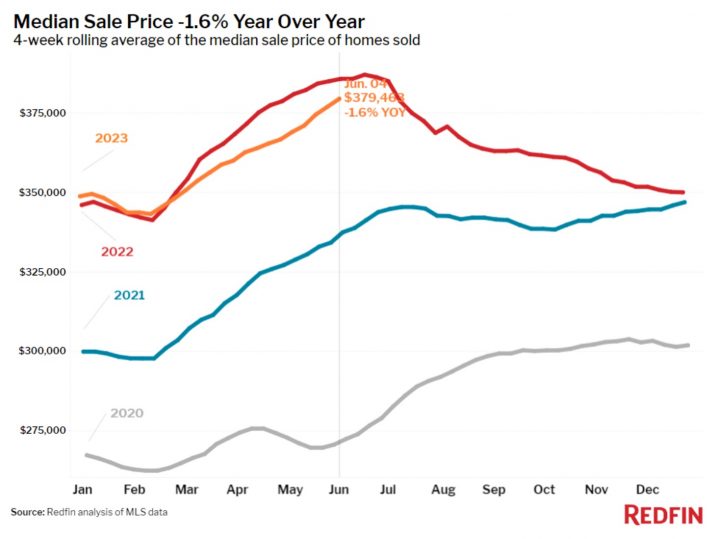
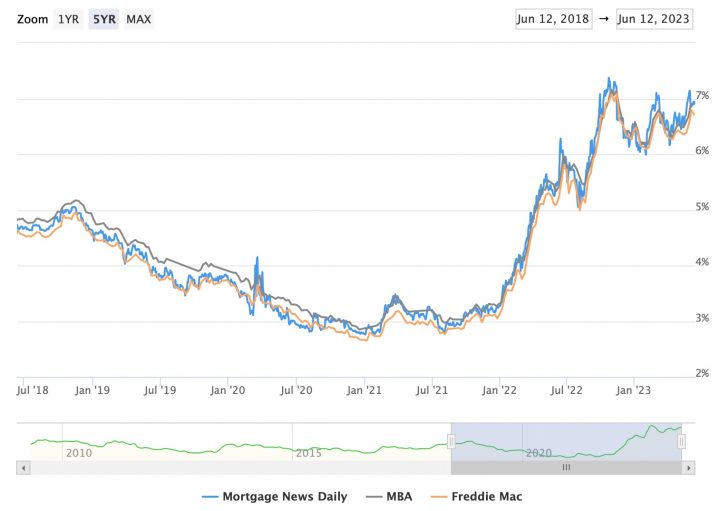
I definitely feel for prospective homebuyers in the current market. My parents are one of them, looking for a place in retirement. According to Redfin and Mortgage News Daily, we currently have low inventory (partially due to people with sub-6% mortgages), sticky high prices (both asking and actual sales), and the highest mortgage rates in a long time, all of which are combining to create the highest ever mortgage payment required to purchase the median-priced home.

It’s especially bad if you’ve been searching for a while, perhaps passing on certain purchases while things just keep getting more out of reach (even as you seemingly keep compromising on what you “need”). My parents have widened their geographic search area, lowered their size requirements, and of course raised their spending budget.

These charts have handy color-coded years, which only heightens the potential regret.

Here are 30-year fixed rates over the past 5 years.

I’m definitely surprised that the monthly payment has gone up roughly 15% in the last year alone – I don’t even want to calculate the change from 2020 or 2021…

Why I Don’t Use Covered Calls As a Retirement Income Strategy

Eventually, you will be presented with the idea of writing covered calls on your portfolio and earning “easy income” from this strategy. I already know intuitively that there must be a cost to this “passive income” and that the net effect is worse performance than simply holding the same index fund or stock for the long term. However, the pushback is usually that you can get a more reliable cashflow in exchange for giving up some of your upside.

The article The Hidden Cost of Covered Call Writing (via Abnormal Returns) does a good job of explaining why there is unfortunately no “free lunch” with this strategy, even if your goal is to create steady income.

Many investors focus on the call premium as a source of portfolio “income” while still participating in a limited amount of appreciation of the stock. As long as the stock stays below the strike price and the call expires worthless, the strategy can generate positive portfolio income, making it ideal for flat or down markets. However, trying to time when stocks and markets will be flat or down is extremely difficult, particularly given the long-term upward bias of the equity markets. As such, there is a hidden cost of covered call writing, which is the potentially significant opportunity cost of having the stock go above the strike price causing lost portfolio appreciation.

Covered calls work great when they work out, since you get to keep your stock and the “free income”. Giving up your upside may seem like a good deal, but you must realize that much of the stock market’s return comes from lumpy periods where it shoots up without warning.

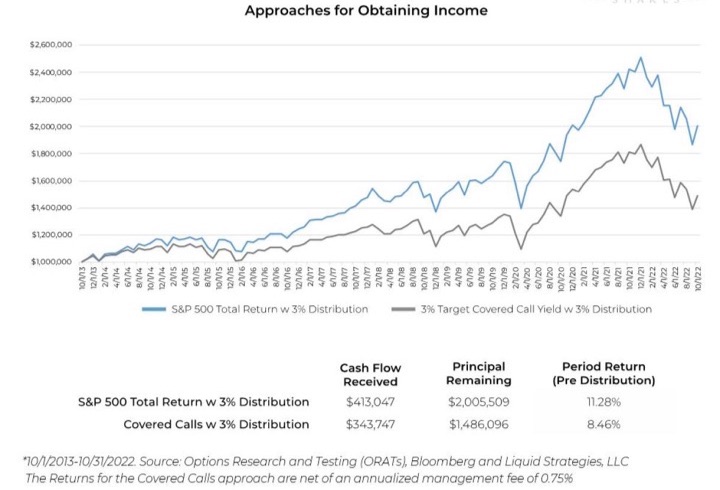
The chart below from the article compares the performance results between simply withdrawing 3% a year from your S&P 500 portfolio from 2013 to 2022, as opposed to writing covered calls with a 3% yield on your S&P 500 portfolio. The chart does add a 0.75% annual management fee for this approach, but even if you add that back in, the difference is still 11.3% vs. 9.2% annualized return.

Lower volatility is also commonly cited as a benefit of a covered call strategy. Well, yeah, if you limit your upside every time the strike price is exceeded, then you will have lower volatility.

In a rising market, covered calls may actually reduce upside portfolio volatility, which is the type of volatility that investors benefit from. As such, when evaluating covered call strategies that show lower volatility statistics than the broader market, investors should be mindful of where that volatility reduction may be coming from.

Am I willing to give up 2% in annual returns for a steady income? Nope. I mean, 2% is already roughly the entire dividend yield of the S&P 500. The problem is that most people who use this strategy aren’t properly tracking their performance and probably won’t know if they are lagging behind simple buy and hold. The call premium income comes in most of the time, so it’s easy not to realize the true cost of missing out on the gains.

There are certainly scenarios where if you think you have an information edge, knowing how to structure an option can help you make the right bet. But they aren’t magic! I am very skeptical of the idea of any options strategy that will somehow give you reliable income without a significant cost of hurting your total returns. That just gives me the same feeling of someone who claims to invent a machine that defies a basic law of physics.

Bank of America Premium Rewards Card Review – 60,000 Point Offer, Best with Preferred Rewards

The Bank of America Premium Rewards Credit Card is the mid-tier premium card in the line-up, with added perks in exchange for an $95 annual fee. (Comparable with the Chase Sapphire Preferred and American Express Green cards.) This card also participates in the Preferred Rewards program, which gives you better rewards if you let BofA hold of your assets. Here are the highlights:

  • Earn 60,000 bonus points ($600 value) after making $4,000 in purchases in first 90 days of account opening.
  • Earn 2 points per dollar spent on travel and dining purchases.
  • Earn 1.5 points for each dollar spent on all other purchases.
  • 10% customer bonus when you have an active Bank of America checking or savings account.
  • If you’re a Preferred Rewards client, you can increase that bonus to 25% – 75%. See details below.
  • Up to $100 annual airline incidental statement credit for qualifying travel purchases such as seat upgrades, baggage fees, in-flight services and airport lounge fees.
  • Up to $100 airport security statement credit towards TSA Precheck or Global Entry Application fee, every four years.
  • No foreign transaction fees.
  • $95 annual fee.
  • No limit to earning points, and points don’t expire.

Preferred Rewards bonus. The Preferred Rewards program is designed to rewards clients with multiple account and higher assets located at Bank of America banking, Merrill Edge online brokerage, and Merrill Lynch investment accounts. Here is a partial table taken from their comparison chart (click to enlarge):

bofa_pref1

Let’s consider the options. Bank of America’s interest rates on cash accounts tend to be lower than highest-available outside banks, so moving cash over to qualify may result in earning less interest on your cash deposits. Merrill Lynch advisory accounts also usually come with management fees. The sweet spot is if you have brokerage assets like stocks, mutual funds, and ETFs.

In the past, moving over to Merrill Edge at the Platinum and Platinum Plus levels also led to 30 to 100 free online stock trades every month. Fast forward to now, and nearly all major online brokers offer commission-free trades anyway.

Personally, I moved over $100k of brokerage assets to Merrill Edge to qualify for Platinum Honors. This can include your existing ETFs and mutual funds held elsewhere (Vanguard, Fidelity, Schwab, etc). I realize not everyone will have this level of assets to move around, but if you do then it is worth considering. Keep in mind that it will take a while for your “3-month average combined balance” to actually reach the $100k level and officially qualify for Platinum Honors. You might become Gold first, then Platinum, and so on. After that, the 25%-75% rewards bonus on credit card rewards kick in.

Once you reach a certain tier, BofA guarantees that you will stay there for a year no matter what, even if your balance fluctuates. Note that the terms state “The Preferred Rewards bonus will replace the customer bonus”, which means that you will lose the 10% customer bonus when you qualify for the 25% to 50% bonus.

Here’s are the cash back rates after the Preferred Rewards bonuses:

  • Platinum Honors (75% bonus): 3.5% cash back on travel and dining, 2.625% cash back on all other purchases.
  • Platinum (50% bonus): 3% cash back on travel and dining, 2.25% cash back on all other purchases.
  • Gold (25% bonus): 2.5% cash back on travel and dining, 1.875% cash back on all other purchases.

Rewards comparison. This card has a more flexible rewards structure than their BankAmericard Travel Rewards card in that the points don’t have to offset a travel purchase. You can redeem at a flat 1 point = 1 cent value towards a statement credit or deposit into eligible Bank of America or Merrill Lynch® accounts (including deposit, investment or 529 accounts).

Getting a flat 2.625% (Platinum Honors) or 2.25% cash back (Platinum) on all purchases is a very solid base earning level. In terms of the competition, there are now multiple cash back cards in the 2% cash back range such as the Citi Double Cash Card with no annual fee. That means I wouldn’t bother with this card for everyday purchases if I wasn’t Platinum or Platinum Honors.

Also note that you can also earn similar levels of everything rewards (minus the travel/dining bonus category) but restricted to offsetting a travel-related purchase with the BankAmericard Travel Rewards card – except with no annual fee. The question then reverts back to if you can offset that $95 annual fee with the $100 annual incidental airline credit good towards seat upgrades, baggage fees, in-flight services and airport lounge fees. (Sadly, everything seems to be an added fee these days.) If you can get max value out of that airline incidental credit every year, then that removes the major disadvantage when compared to the BofA Travel Rewards card. You can then enjoy the added perks like the $500 value sign-up bonus, $100 Global Entry/TSA PreCheck credit once every 4 years, and the higher rewards on travel/dining bonus.

Bottom line. The Bank of America Premium Rewards Credit Card is rather average in basic form, but is elevated into an excellent card if you can qualify for the Platinum or Platinum Honors tiers of their Preferred Rewards program for up to 3.5% cash back on travel and dining and 2.625% cash back on all other purchases. Note the the $95 annual fee is not waived for the first year. Consider your ability to use up the $100 annual incidental airline credit.

Also see: Top 10 Best Credit Card Bonus Offers.

Best Interest Rates on Cash – June 2023

Here’s my monthly roundup of the best interest rates on cash as of June 2023, roughly sorted from shortest to longest maturities. There are often lesser-known opportunities available to individual investors. Check out my Ultimate Rate-Chaser Calculator to see how much extra interest you could earn from switching. Rates listed are available to everyone nationwide. Rates checked as of 6/6/2023.

TL;DR: 5% APY available on liquid savings. 5% APY available on multiple short-term CDs. Compare against Treasury bills and bonds at every maturity.

Fintech accounts
Available only to individual investors, fintech companies often pay higher-than-market rates in order to achieve fast short-term growth (often using venture capital). “Fintech” is usually a software layer on top of a partner bank’s FDIC insurance.

  • 5.05% APY ($1 minimum). SaveBetter lets you switch between different FDIC-insured banks and NCUA-insured credit unions easily without opening a new account every time, and their liquid savings rates currently top out at 5.05% APY from multiple banks. See my SaveBetter review for details. SaveBetter does not charge a fee to switch between banks.
  • 5.10% APY (before fees). MaxMyInterest is another service that allows you to access and switch between different FDIC-insured banks. You can view their current banks and APYs here. As of 5/1/23, the highest rate is from Customers Bank at 5.10% APY. However, note that they charge a membership fee of 0.04% per quarter, or 0.16% per year (subject to $20 minimum per quarter, or $80 per year). That means if you have a $10,000 balance, then $80 a year = 0.80% per year. You are allowed to cancel the service and keep the bank accounts, but then you may lose their specially-negotiated rates and cannot switch between banks anymore.

High-yield savings accounts
Since the huge megabanks STILL pay essentially no interest, everyone should have a separate, no-fee online savings account to piggy-back onto your existing checking account. The interest rates on savings accounts can drop at any time, so I list the top rates as well as competitive rates from banks with a history of competitive rates. Some banks will bait you with a temporary top rate and then lower the rates in the hopes that you are too lazy to leave.

  • The leapfrogging to be the temporary “top” rate continues. Salem Five Direct at 5.01% APY. CIT Platinum Savings at 4.85% APY with $5,000+ balance.
  • SoFi Bank is now up to 4.20% APY + up to $275 new account bonus with direct deposit. You must maintain a direct deposit of any amount each month for the higher APY. SoFi has their own bank charter now so no longer a fintech by my definition. See details at $25 + $250 SoFi Money new account and deposit bonus.
  • There are several other established high-yield savings accounts at 3.85%+ APY that aren’t the absolute top rate, but historically do keep it relatively competitive for those that don’t want to keep switching banks.

Short-term guaranteed rates (1 year and under)
A common question is what to do with a big pile of cash that you’re waiting to deploy shortly (plan to buy a house soon, just sold your house, just sold your business, legal settlement, inheritance). My usual advice is to keep things simple and take your time. If not a savings account, then put it in a flexible short-term CD under the FDIC limits until you have a plan.

  • No Penalty CDs offer a fixed interest rate that can never go down, but you can still take out your money (once) without any fees if you want to use it elsewhere. CIT Bank has a 11-month No Penalty CD at 4.90% APY with a $1,000 minimum deposit. Ally Bank has a 11-month No Penalty CD at 4.25% APY for all balance tiers. Marcus has a 13-month No Penalty CD at 4.25% APY with a $500 minimum deposit. You may wish to open multiple CDs in smaller increments for more flexibility.
  • Blue FCU via SaveBetter has a 9-month No Penalty CD at 5.00% APY. Minimum opening deposit is $1. No early withdrawal penalty. Withdrawals may be made 30 days after opening.
  • CFG Bank has a 12-month certificate at 5.28% APY. $500 minimum. Early withdrawal penalty is 180 days of interest.

Money market mutual funds + Ultra-short bond ETFs*
Many brokerage firms that pay out very little interest on their default cash sweep funds (and keep the difference for themselves). * Money market mutual funds are regulated, but ultimately not FDIC-insured, so I would still stick with highly reputable firms. I am including a few ultra-short bond ETFs as they may be your best cash alternative in a brokerage account, but they may experience losses.

  • Vanguard Federal Money Market Fund is the default sweep option for Vanguard brokerage accounts, which has an SEC yield of 5.04%. Odds are this is much higher than your own broker’s default cash sweep interest rate.
  • The PIMCO Enhanced Short Maturity Active Bond ETF (MINT) has a 5.25% SEC yield and the iShares Short Maturity Bond ETF (NEAR) has a 5.36% SEC yield while holding a portfolio of investment-grade bonds with an average duration of ~6 months.

Treasury Bills and Ultra-short Treasury ETFs
Another option is to buy individual Treasury bills which come in a variety of maturities from 4-weeks to 52-weeks and are fully backed by the US government. You can also invest in ETFs that hold a rotating basket of short-term Treasury Bills for you, while charging a small management fee for doing so. T-bill interest is exempt from state and local income taxes.

  • You can build your own T-Bill ladder at TreasuryDirect.gov or via a brokerage account with a bond desk like Vanguard and Fidelity. Here are the current Treasury Bill rates. As of 6/6/23, a new 4-week T-Bill had the equivalent of 5.09% annualized interest and a 52-week T-Bill had the equivalent of 5.23% annualized interest.
  • The iShares 0-3 Month Treasury Bond ETF (SGOV) has a 4.96% SEC yield and effective duration of 0.10 years. SPDR Bloomberg Barclays 1-3 Month T-Bill ETF (BIL) has a 4.75% SEC yield and effective duration of 0.08 years.

US Savings Bonds
Series I Savings Bonds offer rates that are linked to inflation and backed by the US government. You must hold them for at least a year. If you redeem them within 5 years there is a penalty of the last 3 months of interest. The annual purchase limit for electronic I bonds is $10,000 per Social Security Number, available online at TreasuryDirect.gov. You can also buy an additional $5,000 in paper I bonds using your tax refund with IRS Form 8888.

  • “I Bonds” bought between May 2023 and October 2023 will earn a 4.30% rate for the first six months. The rate of the subsequent 6-month period will be based on inflation again. More on Savings Bonds here.
  • In mid-October 2023, the CPI will be announced and you will have a short period where you will have a very close estimate of the rate for the next 12 months. I will have another post up at that time.
  • See below about EE Bonds as a potential long-term bond alternative.

Rewards checking accounts
These unique checking accounts pay above-average interest rates, but with unique risks. You have to jump through certain hoops which usually involve 10+ debit card purchases each cycle, a certain number of ACH/direct deposits, and/or a certain number of logins per month. If you make a mistake (or they judge that you did) you risk earning zero interest for that month. Some folks don’t mind the extra work and attention required, while others would rather not bother. Rates can also drop suddenly, leaving a “bait-and-switch” feeling.

  • Genisys Credit Union pays 5.25% APY on up to $7,500 if you make 10 debit card purchases of $5+ each, and opt into receive only online statements. Anyone can join this credit union via $5 membership fee to join partner organization.
  • Pelican State Credit Union pays 5.50% APY on up to $10,000 if you make 15 debit card purchases, opt into online statements, and make at least 1 direct deposit, online bill payment, or automatic payment (ACH) per statement cycle. Anyone can join this credit union via partner organization membership.
  • The Bank of Denver pays 5.00% APY on up to $25,000 if you make 12 debit card purchases of $5+ each, receive only online statements, and make at least 1 ACH credit or debit transaction per statement cycle. Thanks to reader Bill for the updated info.
  • All America/Redneck Bank pays 5.30% APY on up to $15,000 if you make 10 debit card purchases each monthly cycle with online statements.
  • Presidential Bank pays 4.62% APY on balances between $500 and up to $25,000 (3.625% APY above that) if you maintain a $500+ direct deposit and at least 7 electronic withdrawals per month (ATM, POS, ACH and Billpay counts).
  • Find a locally-restricted rewards checking account at DepositAccounts.

Certificates of deposit (greater than 1 year)
CDs offer higher rates, but come with an early withdrawal penalty. By finding a bank CD with a reasonable early withdrawal penalty, you can enjoy higher rates but maintain access in a true emergency. Alternatively, consider building a CD ladder of different maturity lengths (ex. 1/2/3/4/5-years) such that you have access to part of the ladder each year, but your blended interest rate is higher than a savings account. When one CD matures, use that money to buy another 5-year CD to keep the ladder going. Some CDs also offer “add-ons” where you can deposit more funds if rates drop.

  • NASA FCU has special 49-month CD at 4.85% APY and 15-month CD at 5.45% APY and 9-month at 5.65% APY. $10,000 minimum of new money. The early withdrawal penalty for the 5-year is 365 days of interest. Anyone can join this credit union via partner organization.
  • Lafayette Federal Credit Union has a 5-year certificate at 4.68% APY ($500 min), 4-year at 4.73% APY, 3-year at 4.84% APY, 2-year at 4.89% APY, and 1-year at 4.99% APY. They also have jumbo certificates with $100,000 minimums at even higher rates. The early withdrawal penalty for the 5-year is very high at 600 days of interest. Anyone can join this credit union via partner organization ($10 one-time fee).
  • You can buy certificates of deposit via the bond desks of Vanguard and Fidelity. You may need an account to see the rates. These “brokered CDs” offer FDIC insurance and easy laddering, but they don’t come with predictable early withdrawal penalties. Right now, I see a 5-year non-callable CD at 4.50% APY (callable: no, call protection: yes). Both Vanguard and Fidelity will list higher rates from callable CDs, which importantly means they can call back your CD if rates drop later.

Longer-term Instruments
I’d use these with caution due to increased interest rate risk, but I still track them to see the rest of the current yield curve.

  • Willing to lock up your money for 10 years? You can buy long-term certificates of deposit via the bond desks of Vanguard and Fidelity. These “brokered CDs” offer FDIC insurance, but they don’t come with predictable early withdrawal penalties. You might find something that pays more than your other brokerage cash and Treasury options. Right now, I see a 10-year CDs at (none available, non-callable) vs. 3.70% for a 10-year Treasury. Watch out for higher rates from callable CDs where they can call your CD back if interest rates drop.
  • How about two decades? Series EE Savings Bonds are not indexed to inflation, but they have a unique guarantee that the value will double in value in 20 years, which equals a guaranteed return of 3.5% a year. However, if you don’t hold for that long, you’ll be stuck with the normal rate, currently 2.50% for EE bonds issued from May 2023 to October 2023. As of 6/6/23, the 20-year Treasury Bond rate was 4.02%.

All rates were checked as of 6/6/2023.

Andrews FCU 7.5-Month Certificate at 5.75% APY

afcu_logo

Andrews FCU is celebrating their 75th anniversary with a special 7.5 month certificate at a very competitive 5.75% APY. $1,000 minimum opening deposit, $250,000 maximum. Limit one certificate per membership. Early withdrawal penalty is 90 days of interest, per their Truth in Savings disclosure.

Previous short-term special term certificates have automatically been set to renew at the 12-Month share certificate rate and term upon maturity. You must manually tell them if you want to simply withdraw, be sure to do so within the grace period of 10 days after the date of maturity.

Credit union membership eligibility. From their page on membership eligibility:

Our field of membership includes Washington, DC, civilian and military personnel of Joint Base Andrews, Joint Base McGuire-Dix-Lakehurst, and military installations in central Germany, Belgium, and The Netherlands; as well as over 200 employer groups throughout Maryland, Virginia and New Jersey. We also have nationwide membership eligibility through the American Consumer Council.

As I do not live the in DC area and do not qualify otherwise, I joined the American Consumer Council (ACC), a non-profit organization dedicated to consumer education, advocacy and financial literacy. Sounds like something worth supporting! You can join through the website. I believe the cost is a one-time $8, although there is a promo code “consumer” that has worked in the past to get the membership fee waived. They will send you an e-mail shortly with your ACC membership number, which you can use to join Andrews FCU.

Note that applying for this credit union will result in a hard credit inquiry. Andrews FCU has useful promos from time to time and you may find their other financial loan products useful. I am already a member from a previous promotion.

Target: Buy $100 in Choice Gift Cards, Get $10 Target Gift Card

Target is running a promotion where if you get a $10 Target GiftCard with $100 “Choice” gift card purchase, in-store or online. Promo ends June 10th.

I’m guessing this is related to Father’s Day. (The Mother’s Day promo was better, what’s up?!) There are many eligible retailers to choose from: Regal/AMC Theaters to REI to Lowe’s/Home Depot.

Disclosure: This post contains affiliate links and I will be compensated if you make a purchase after clicking on my links.