Archives for September 2022

AnnualCreditReport.com: Free Weekly Credit Reports Extended Through End of 2023

Extended again through 2023. AnnualCreditReport.com remains the official government-mandated source of free credit reports. Usually, you can only request a free copy of your credit report every rolling 12 months from each credit reporting company. For example, if you request an Experian report in September 2022, then you must wait until September 2023 to request another Experian report. You could also spread things out by staggering requests, for example Experian every April, Equifax every August, and TransUnion every December.

From now until December 2023, you can request all 3 major credit reports as often as once every week at no cost for any reason. Consumer Reports called out that the weekly reports were set to expire at the end of 2022, and this 9/23/22 press release confirmed that they would extend it by another 12 months.

The three nationwide credit reporting agencies – Equifax® (NYSE:EFX), Experian (LON:EXPN) and TransUnion (NYSE:TRU) – are taking joint action to continue offering free weekly credit reports to consumers in the United States through the end of 2023.

This higher frequency may also come in handy for anyone who has requested some relief on their mortgages, auto loans, student loans, credit cards, and so on. If you agree to a forbearance or some other COVID-related relief agreement with your lender, you will want to make sure that your credit reports are still marked as current and that your credit will not be adversely affected as part of that agreement.

According to Consumer Reports, mistakes on credit reports are the No. 1 consumer complaint so far this year.

Last year, CR asked a panel of nearly 6,000 volunteers to review their credit reports for mistakes. In almost a third of cases, participants found at least one error.

And in a January 2021 CR nationally representative survey (PDF) of 2,223 adults, 12 percent of people who had ever checked their credit report said they found at least one mistake.

In addition, Consumer Reports offers the following advice if you need to file a dispute for a correction:

Create a paper trail. Tempting as it may be, don’t file the dispute online, because that doesn’t provide a written record that you can rely on later if needed. And avoid the standardized online forms provided by the credit bureaus, which might oversimplify your dispute by requiring you to choose among predetermined check boxes. Further, by submitting your dispute online, you could unwittingly waive your right to sue as an individual or in a class action. Instead, write a letter explaining the problem. Use this sample letter from the CFPB (PDF).

Free full reports upon manual request are nice, but I have been quite happy with my “suite” of additional services that continuously and passively monitor my credit reports for new credit inquiries and other changes.

Interest Rate Watch: Regular Treasury vs. TIPS vs. Breakeven Inflation Rates

There continues to be a lot of interest rate movement in savings accounts, CDs, and other cash equivalents. I find the most interesting corner right now to be the rise of real yields on TIPS (Treasury Inflation-Protected Securities) and their relationship with traditional Treasury bonds. Roughly 1/3rd of my bond allocation is to TIPS.

TIPS can be a bit complicated, but basically they are priced based on their real yield. As of 9/26/22, the closing real yield on a 5-year TIPS was 1.82%. This is the highest real yield since the 2008 Financial Crisis, and we’ve had negative yields for much of the last decade. (Source: FRED)

(As an inflation-linked bond, a TIPS with a 1.82% real yield means that if the CPI-U inflation is 3%, then your total yield will be 4.82%. “Real” means after adjusting for inflation. TIPS thus “protect” you from unexpectedly high inflation. If inflation ends up being 10%, you’ll get 11.82%. However, if inflation is very low, your yield will also be affected the other way.)

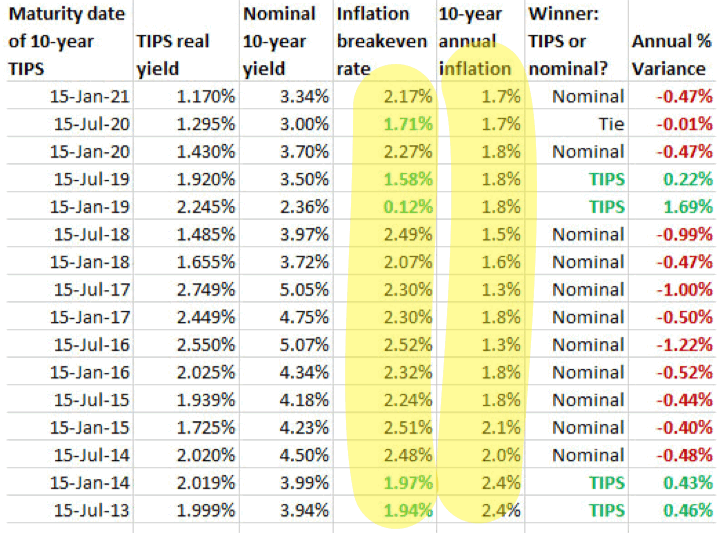
As of 9/26/22, the closing nominal yield on a regular 5-year Treasury was 4.15%. That means the 5-year “breakeven” inflation rate was 2.33%. If you bought equal amounts of both the 5-year Treasury and 5-year TIPS today, the winner after 5 years will depend on whether the future inflation rate ends up being higher or lower than 2.33% over the next 5 years. This creates a market-based estimate of future inflation rates. Here’s the historical 5-year breakeven inflation rate for the last 10 years:

Looking back, TIPS underperformed regular Treasuries for 11 out of the 16 10-year periods ending 2013-2021, as inflation was usually lower than the breakeven rate. Image credit to TIPSWatch.

At this moment, there are 5-year brokered CDs at 4.20% (non-callable) and the 5-year Treasury at 4.15%. Purely my opinion, but I would consider the 5-year TIPS over both of those options as I like the combination of a decent 1.83% real rate and a modest 2.33% breakeven rate. I would take the risk of underperforming regular Treasuries by a little bit in exchange for the insurance against high inflation. This is why I usually hold mix of TIPs and Treasuries for the bond allocation of my portfolio.

Note that current Savings I Bonds only have a 0% real rate and we’ll see how much they raise it in November (my bet: not nearly as high as the 5-year TIPS). So TIPS would even beat savings bonds right now in my book (as a long-term bond holding). However, the situation is changing daily and I don’t know what the rates will look like when I actually have significant cash available to re-invest.

Your Workplace Is Not Your Family. You Will Be Replaced Immediately. (Why F- You Money is Awesome)

A big takeaway from my time on the Early Retirement Forums is that while many posters struggle with the decision to leave their jobs, those that have done so rarely look back. If you are a hard-working, competent employee, it’s very likely your boss will be highly reluctant for you to leave. Employers may demand a full year of notice before leaving (only to let you go early once a replacement was found), plead and guilt you about abandoning your “family”, or simply abuse you until you break.

My wife used to be a very loyal employee that genuinely enjoyed going to work. However, over the years, that changed. The COVID pandemic only accelerated the problem. If you read this NYT article about how “non-profit” hospitals actually make huge profits (gift article), you can get an idea of what happened:

More than half the nation’s roughly 5,000 hospitals are nonprofits like Providence. They enjoy lucrative tax exemptions; Providence avoids more than $1 billion a year in taxes. In exchange, the Internal Revenue Service requires them to provide services, such as free care for the poor, that benefit the communities in which they operate.

But in recent decades, many of the hospitals have become virtually indistinguishable from for-profit companies, adopting an unrelenting focus on the bottom line and straying from their traditional charitable missions.

She didn’t want to leave. She wanted to feel like a valued worker in a safe environment that actually followed their claimed “mission statement”. When that failed, she just wanted an unpaid leave of absence. They denied her that too. The best way to tell this story is through a role play:

Worker: I need to voice my concern that the recent policy changes are detrimental to employee safety and patient care, even though you say that patients are your top priority.

Employer: No, of course not! You are a greatly valued employee. Have a company-branded mug!

[months pass]

Worker: Why did all the lower level staff receive a pay cut when none of the executive team received a pay cut?

Employer: We hear your concerns and will take them into consideration in the future! Would you like a company-branded backpack?

[months pass]

Worker: Dear Management, I am burned out.

Employer: Everyone is burned out! We are a team! Let’s go team!

[months pass]

Worker: It’s been several months. I feel worse. I request an unpaid leave of absence.

Employer: You are a critical part of our team. You will hurt the rest of your team if you quit. We need you!

[two weeks pass]

Worker: I am still very burned out. I am concerned about my physical and mental wellbeing. I officially request an unpaid leave of absence. I don’t want benefits. I just need a break. Please.

Employer: We officially deny your request. Please read this glossy pamphlet on how much we value “Employee Mental Wellness”. See you at work on Monday!

Worker: Okay. Well, I quit. Here is my official letter of resignation.

Employer: What?!? Really? Okay, okay, you can have the leave of absence. Sheesh.

Worker: Too late. I quit.

Employer: Wait, wait, wait. You win! We will give you a 3 month paid leave of absence! With benefits! Stay! Please? Pretty please?

Worker: I decline your offer. You already showed your true colors.

Employer: This is outrageous! You are just being unreasonable!

[a week passes]

Employer: We already hired someone to replace you. We had to pay them double what we paid you. Don’t forget to turn in your name badge.

(I tried to add some humor, but all this stuff actually happened. I can show you the backpack.)

Many co-workers and friends advised her to just take the three months of “free” money and then quit again afterward. But things had changed. She wanted a leave of absence to take a break and re-assess. She was unsure. When she was denied that simple and reasonable request, she no longer had to re-assess. She now knew that she would never go back to work for this current management team. Perhaps they should have read this Linkedin article Don’t beg employees to stay as they leave:

It’s disrespectful to the employee. When employers don’t consider an employee’s request for something to change to make their work environment better, the employee feels devalued. I’m speaking, of course, about high performers. You may not ever be able to make everyone happy but the worst thing you can do to your highest performers is to make them feel less than what they really are to you. Waiting until they threaten to leave to make a change doesn’t help. It takes a lot of energy for them to look for another job and go through interviewing processes. It is completely disrespectful to them when you make them an offer to stay only when you realize they can go somewhere else. […]

I’m not suggesting you give employees everything they want, not even your highest performers. The point is you need to take off the blurry glasses and at least take a hard look at what’s going on in your workplaces, how you are treating your best employees and consider making meaningful changes before you lose them.

The power of having F— You Money the ability to jump ship when you know it’s sinking, as you know you’ll be okay no matter what. She could explore her options, and already has a new position lined up. Otherwise, you may have to start your search while still working. But don’t let your employer convince you to stay longer with guilt trips and meaningless words. If your company treats workers like cogs in a machine, something to be constantly tracked and monitored, then they won’t hesitate to find replacement parts (even if those replacement parts cost them double due to their short-sightedness).

CIT Bank Promo: Free 1 Year Amazon Prime Membership (EXPIRED)

Update: This offer is now expired. Please visit this page for current CIT Bank products and rates.

Expired offer details:

CIT Bank is an FDIC-insured bank (now a division of First Citizens Bank) that has offered competitive interest rate options to savers in the past including the Savings Builder and No-Penalty CDs, so you may already have an account with them.

The CIT Bank Money Market account has launched a new Amazon Prime deposit promotion: when a new or existing customer makes a deposit of $15,000 from an external funding source and keeps it there for at least 60 days, they get an additional bonus of a 1-year Amazon Prime subscription (cash value of $139). Additional details:

  • Open a CIT Bank Money Market account here using the promo code AMZN22.
  • Fund your account with at least $15,000 within 15 days and keep a minimum balance of at least $15,000 for 60 days following the 15-day funding period.
  • Within 30 days following the end of the funding period, if you’ve fulfilled the requirements, CIT Bank will send you an email with your Prime membership code.
  • Yes, this works for existing Amazon Prime users. Customers who are already Amazon Prime members can use the one year of Amazon Prime to renew their membership for an additional year.
  • Existing CIT Bank members are eligible, but you have to open a new Money Market account (you can have more than one) and fund with “new money” outside of CIT Bank.

Bonus math. If you assume the bonus is worth $139, this is a ~0.93% bonus on $15,000. Let’s assume an overly-conservative minimum holding period of 90 total days, which makes it the equivalent of ~3.71% APY annualized. The bonus is on top of the standard interest rate, currently 1.55% APY as of 11/30/22. This total of roughly 5.26% APY over 90 days makes it a great short-term rate at that balance size. CIT Bank also has a decent history of offering competitive products and promotions on their savings account and CD products.

I plan on grabbing this year of Amazon Prime – I already have accounts at CIT Bank and I already have idle liquid cash elsewhere sitting at effectively the same base APY. Nice to see another bank itching to gather deposits.

Fifth Third Bank $250 New Checking Account Bonus w/ Direct Deposit (Expired)

Expired: This offer is no longer available.

Fifth Third Bank has a $250 new checking bonus when you open an eligible Fifth Third checking account and make direct deposits totaling $1,000 or more within 90 days of account opening. Note that Fifth Third Bank usually only accepts applications from the geographic area where they have physical branches, including the following 10 states: Florida, Georgia, Illinois, Indiana, Kentucky, Michigan, North Carolina, Ohio, South Carolina, Tennessee, West Virginia.

Opening online should automatically populate the Offer Code, or you can request an e-mail with a unique code to bring to a physical branch. Here the fine print:

To qualify for the $250 checking bonus, provide the offer code, open a Fifth Third Momentum® Checking, or Preferred2 checking account by 12/31/2022 and make qualifying direct deposits totaling $1,000 or more within 90 days of account opening. Account(s) must be funded within 45 days of account opening or account may be closed, and you may not be eligible for the bonus. The $250 checking bonus does not require any additional activities. A qualifying Direct Deposit is an Automated Clearing House (ACH) credit, which may include payroll, pension or government payments (such as Social Security). The cash bonus will be deposited into your new account within 10 business days of completing qualifying activity requirements. In order to receive the cash bonus, your checking account must be open and in good standing. Offer is not available to existing Fifth Third checking customers or to those with a Fifth Third Checking account that has been closed within the last 12 months. Bank reserves the right to limit each customer to one new account-related gift incentive per calendar year. Eligibility may be limited based on your account type and ownership role. Account must be funded within 45 days of account opening. No minimum deposit required to open a checking account. Bonus may be taxable as interest income and reported on IRS Form 1099-INT. Consult your tax advisor. UNIQUE OFFER CODE MUST BE PRESENTED AT ACCOUNT OPENING TO RECEIVE THE BONUS. See your banker for details. Not valid with any other offer.

The Fifth Third Momentum Checking account has no minimum balance, no monthly service fees, and fee-free ATM access on the Allpoint, Presto!, and 7-Eleven ATM networks.

Stuck on a Hard 50/50 Decision? Pick the Change, Avoid the Status Quo

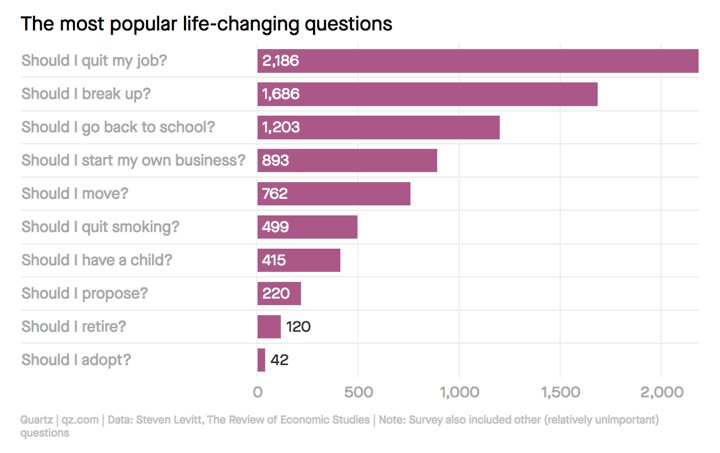
The recently-republished Quartz article An economist’s rule for making tough life decisions draws from research by Steven Levitt, perhaps best-known for being co-author of the book Freakonomics.

The study asked people who were having a hard time making a decision to participate in a randomized digital coin toss on the website FreakonomicsExperiments.com. People asked questions ranging from “Should I quit my job?” to “Should I break up with my significant other?” and “Should I go back to school?” Heads meant they should take action. Tails, they stuck with the status quo.

Ultimately, 20,000 coins were flipped—and people who got heads and made a big change reported being significantly happier than they were before, both two months and six months later.

Here’s the takeaway, direct from Steven Levitt:

A good rule of thumb in decision making is, whenever you cannot decide what you should do, choose the action that represents a change, rather than continuing the status quo.

Here’s another version of the takeaway, per the article author Sarah Todd:

If the choice is between action and inaction, and you’re genuinely unsure about what to do, choose action.

Again, this should be the tie-breaker. Obviously, if you are completely happy with the status quo, then there is no reason for change.

The Real Cost of Zero Commission Stock Brokers + Why Are Some Cheaper Than Others?

In a recent study, the authors opened accounts at six different brokerages with their own money and executed 85,000 market orders. They discovered some interesting details about the actual costs of making trades using “zero commission” stock brokers. Here is the research paper The ‘Actual Retail Price’ of Equity Trades as well as coverage by WSJ and Matt Levine. A few takeaways:

“Zero-commission” does not mean “free” trading. There is always a cost due to the gap between buying and selling prices (bid-ask spread). If you bought and sold the exact same share of stock again immediately, you will almost always end up with less money than before. For example, you might buy a share for $100 but only be able to sell it for $99.95.

How much? The study found the average round trip trade cost ranged from –0.07% to –0.46%; the average price improvement varied from $0.03 to $0.08 per share (~$100 value). If you are an individual buying a low-cost index ETF and holding onto it indefinitely, this remains a small concern.

Heavy traders still face an uphill battle. However, if you are repeatedly trading for an extended period of time, the transaction costs of your “free” trades are still going to add up rather quickly and your odds of profit will diminish significantly. Here’s what happened when they repeated kept trading $100 back and forth on Interactive Brokers Pro and TD Ameritrade.

In fact, the authors of the paper had to reduce their standard trade size from $1,000 to $100 because they knew they were going to lose too much (of their own) money. (They first confirmed that the trading costs in terms of percentages was basically the same for $100, $1,000 and $5,000 trade sizes.)

The difference between the “best” and “worst” broker was 5 cents per $100 roundtrip trade. Will the average individual trader switch brokers over this amount? I would value things like customer service over this small cost. Yet, if you add up all the trades that happen during a year, it is billions of dollars going somewhere. Here are the six brokers ranked (graphic via WSJ article).

The study found almost no relationship between the amount of Payment for Order Flow (PFoF) accepted and lower execution prices. In fact, IBKR Lite is the arm of Interactive Brokers that accepts payment for order flow (PFoF), while IBKR Pro does not accept any PFoF. Yet, IBKR Pro had the worst execution for the authors’ $100 trades.

The strangest finding was that the market makers are giving different prices to different brokers for the exact same trades. This is the “industry secret” they uncovered. One implication is that each broker is negotiating “when” the market maker overcharges you or undercharges you based on their customer base. For example, Interactive Brokers implies that their “Pro” customers have larger average trade amounts, and thus they may offer those types of customers better execution (while giving worse pricing to the small trades, thus their poor showing in this study).

Bottom line. PFOF may not be huge deal for any individual investor, but there are still billions to be made skimming off pennies on every trade, and thus weird shenanigans arise. However, if you are an active trader, there is still a steady transaction cost to every stock trade which may not be readily apparent. You think you can trade in and out for “free”, but don’t see that the real cost is that you are pursuing the wrong way to invest.

How many people do you know that got rich by buying and selling stocks hours, days, or weeks later? I certainly don’t know of any. Meanwhile, I noticed the following in my Public app stock feed (see transfer bonus) for Berkshire Hathaway. I’m sure there may be good reasons in some instances, but it’s concerning to see how short these holding times are for a stock like Berkshire which is built for long-term, patient ownership.

Quiet Confessions of Options Trading, Rental Real Estate, Crypto

People are usually quite eager to share their stories of amazing wealth and riches. If you bought Apple in the early years or Bitcoin at $40, why not mention that at a party? Folks are usually much more quiet about their failures. But you can find such admissions thanks to the anonymous nature of social media. Reading these confessions can hopefully provide a clearer perspective of potential dangers.
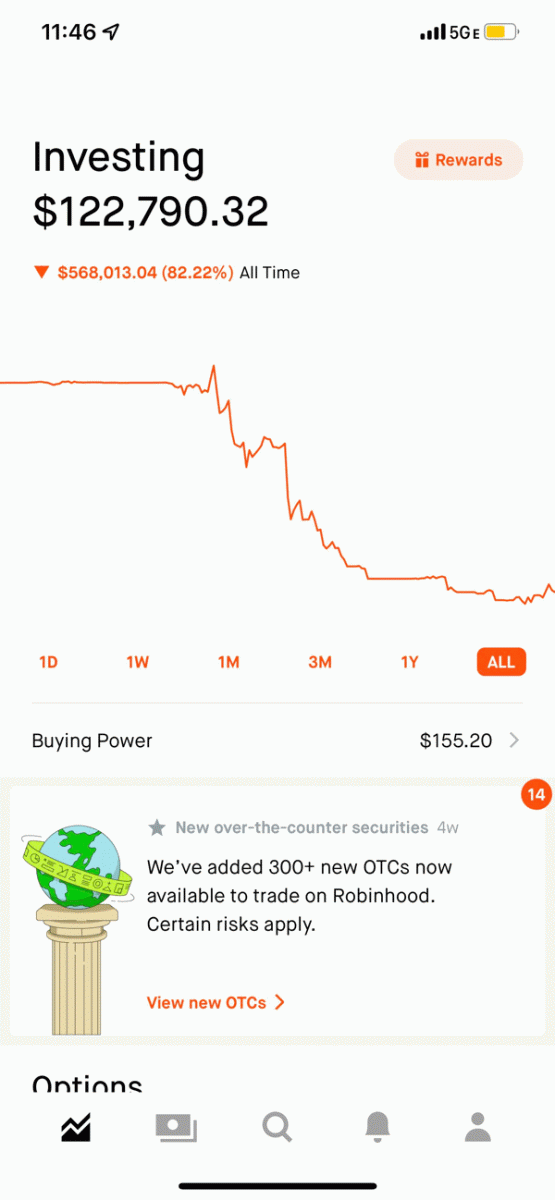
Options trading. Meme stock mania was born as people learned the power of leveraged positions, but others ended up being the joke instead.

How do you get $100,000? You start with $700,000 and make a bunch of aggressive options trades: My losses, your gains. My unfortunate journey thus far.

That’s not even the worst part. The user admits in the comments (verified by their previous post history) that they ended up borrowing $200,000 at 10% interest:

Unfortunately I lost in options. I borrowed money and now I am paying 10% on 200k.

Assuming that is the full picture, they are negative $100,000 and the juice is still running.

Rental real estate. Many people do build wealth over time with rental real estate, but things can still go wrong. No landlord rents to a squatter that they have to evict on purpose: Lessons from a former accidental landlord…

While I’ve seen plenty of threads on having rentals at part of a FIRE strategy, I’ve rarely seen comments from experienced landlords that outline the challenges or negative outcomes that can come along with being a landlord.

I sold my rental property a couple of months ago, ending my 11-year stint as an accidental landlord. I thought this would be a good time to provide my experience. And before all the “rental moguls” show up to shit on this post, let me qualify that I am not claiming to be an expert. In hindsight there were a lot of things I would have done differently/better. However, I feel I can provide real world examples of what a new landlord can experience.

If done correctly, there can be a lot of financial upside. However, being a landlord is not as hassle/risk free as most people think it is – and there is no guarantee you will make money.

Crypto. The Twitter account @coinfessions shares “anonymous crypto confessions”. These days, there are many people afraid to tell even their spouses how much they lost betting on crypto.

I thought about these stories when reading about the growing popularity of DraftKings and FanDuel: DraftKings Is Coming for Your Dumb Money at Wrigley Field. This is not a net positive development for our society. The Chicago Cubs (and soon your favorite team as well) just can’t say no to the easy money, but also prefer to ignore where it will come from. My children will be told that gambling addiction runs in their family history (there’s my little confession) and that the best path is to never bet at all, even casually (and to never marry someone who gambles). Don’t be the dumb money.

Tellus App: “High-Yield Savings” That Isn’t FDIC-Insured, Backed by Vague Promises

A few readers asked about the Tellus app, which compares itself to savings accounts and pays 3.00% APY with no caps. (4.50% APY is only up to $2,500.) Here’s a quick explanation of why it’s an easy pass. Tellus investments are not FDIC-insured and they only provide a very vague description how your money is actually invested. From their FAQ:

How does Tellus afford to pay me such a high interest rate?

Tellus generates its revenues as a non-bank lender. We provide mortgages – loans secured by residential real estate. We use technology and proprietary data to choose opportunities so that we can minimize loss and fraud; this lets us pass the profits onto you in the form of highly competitive yields.

That’s a lot of fancy words, but my translation is “Tellus lends your money out at a lot more than 3.00% APY on unknown residential real estate of unknown quality, in unknown geographic areas, at unknown loan-to-value ratios”.

Mystery underlying investments. Think of all the properties in the world that could fall under “US-based real estate”. With a more transparent structure like that of Peerstreet, I can choose the exact address of the house or building that I am investing in. I can see the original appraisal. I see the borrower terms and interest rate. I can find the purchase history, the tax records, and look up comparable properties nearby. I know I’m earning 7-9% interest rates and Peerstreet is taking about 1%. With Fundrise, I get updates with the address and pictures of the exact apartment building they just bought, and they are SEC-registered private REITs. With Tellus, I have none of this. They are asking for a lot of trust for a new startup company. Are the loans wrapped in a bankruptcy-remote vehicle? Are they registered with the SEC?

Questionable promises of safety. When lending out on residential real estate, I also accept that I can lose money on the deal, because that’s how the world works. That’s honest. From their FAQ:

Is my money safe? Can I always get my money back?
Yes, your money is safe. All transactions and personal identifying data is protected by bank-level, 256-bit AES encryption. You can trust that your money and data are secure with Tellus. You will always get your money back and you can withdraw at any time.

In my opinion, this is not honest. If you’ve paid attention at all during the crypto crisis, you know that “You will always get your money back and you can withdraw at any time” really means “Your money is really the assets of a young start-up company, and if something bad happens then we may instantly freeze all withdrawals”. Real estate loans can go bad. Startup companies can go bankrupt.

This reminds me of the biggest red flag from peer-to-peer lending: The more profusely someone promises to pay you back, the less likely they are to pay you back.

Low returns for level of risk. Even if I knew Tellus lent money using conservative underwriting and everything goes perfectly, you will never get more than the promised APY. 3% APY is far too low. A 90-day Treasury bill pays more than 3%. I would expect at least double their interest rate for the risk involved in real estate lending, which means Tellus might be taking a big cut for themselves (they don’t disclose their cut either). I regularly post FDIC-insured deals at effective rates of 4%+ APY with 100% certainty that I will get 100% of my money back.

Tellus could be run by well-meaning, honest geniuses, but there is no way I’m taking this much risk for limited upside with my hard-earned money. Look beyond the slick marketing and stock photos of happy families. There are many alternatives earning a higher return with more easy assessable level of risk.

Bottom line. Tellus advertises “high yield” and “safety”, when in my opinion it offers the opposite: relatively low returns for the level of risk you are taking on (which is completely unknowable since you have no idea what they are investing in). You are risking complete loss of your investment in a young startup that is not FDIC-insured, and thus it is an easy pass for me. Be careful.

The “No Risk” Portfolio: Stock Upside Exposure with 100% Money Back Guarantee

Everyone loves a 100% money-back guarantee. A popular option on insurance policies is the “Return of Premium” rider. Let’s say you buy a $1,000,000 term life insurance for 30 years at $1,000 a year. At the end of 30 years, if you’re still alive, the insurance policy will no longer pay you the $1,000,000 if you die, but it will return all the premium you paid ($30,000). In your mind, you could think of it as “no risk” because you’ll get your $30,000 back no matter what!
Similarly, a very popular option on income annuities is the “Return of Principal” rider. Let’s say you pay $100,000 upfront in exchange for them paying you $7,000 in annual income for the rest of your life. What about the unlikely but possible chance that you die early in the first few years? A “return of principal” rider will guarantee that your survivors will at least get that $100,000 back. In your mind, you could think of it as “no risk” because you’ll get $100,000 back no matter what!

Create your own 100% Money Back Guarantee Portfolio. Insurance companies already sell complicated equity-indexed annuities that extend a form of this “no principal loss” to investing. But why not apply it to DIY investing? You may already see the flaw in the “no risk” terminology, but if you still like the psychological benefit of knowing you’ll have at least the same number of dollar bills come back to you after 10 years, read on to create your own “no risk” investment portfolio. Allan Roth writes about this in the AARP article Stock Market Investing for the Faint of Heart.

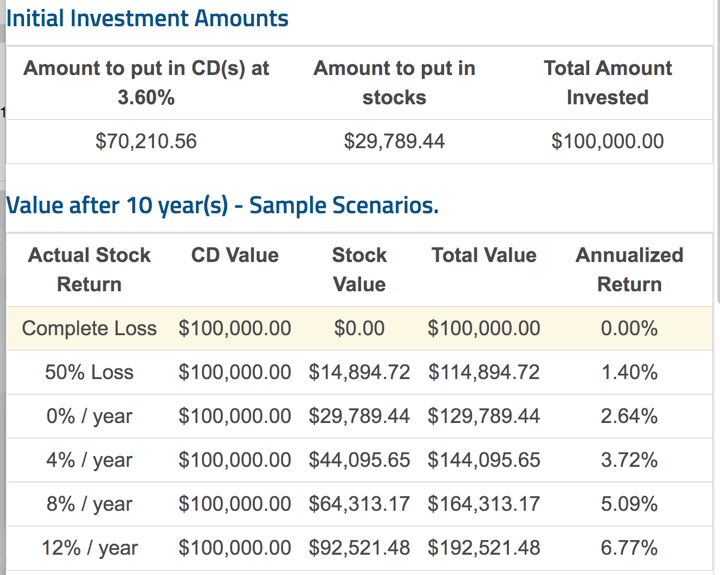
Let’s say you have $100,000. Right now, I see a 10-year FDIC-insured CD paying 3.60% APY (non-callable!) available from Vanguard. Using the Zero Risk Investment calculator from DepositAccounts, I know that I could put $70,210.56 into that CD today, and at the end of 10 years, I will be able to withdraw $100,000 no matter what. That means, I can take the remaining $29,789.44 today and buy stocks. Even if those stocks implode and lose every single penny of value, I will still have $100,000 at the end of 10 years. 100% Money Back Guarantee!

From that perspective, whatever you get from stocks is upside. This chart shows how much of the stock return I would still be exposed to. If stocks alone returned 8% annually, the overall portfolio would still go up about 5% annually, and my total at the end of 10 years would be $164,313.17.

If this level of safety sounds good to you, look more closely. That’s basically a 30% stocks/70% bank CD portfolio, and bank CDs are very similar to high-quality bonds. This is also why I prefer investing in US Treasury bonds and bank CDs for the bond part of my portfolio, I like having a portion of my portfolio that I don’t have to worry about at all. You could also use Treasury STRIPS (zero-coupon bonds) to guarantee a certain future payout.

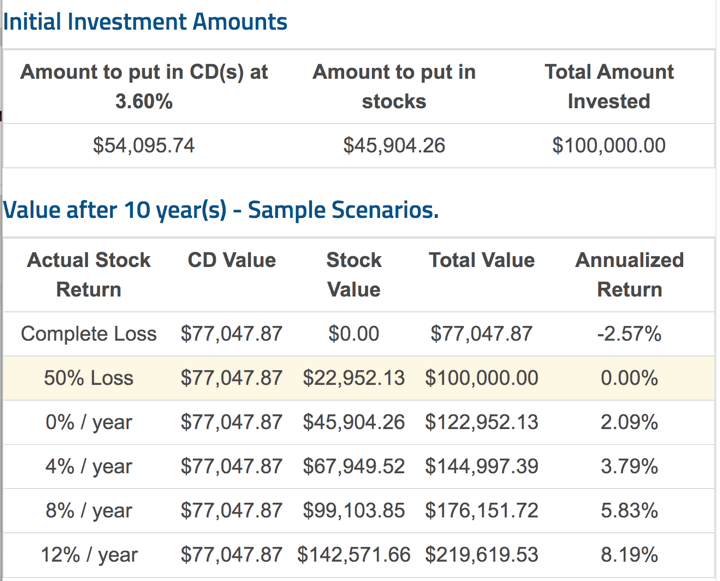
What if you had a little more faith and just wanted a money back guarantee against the possibility of a 50% stock market loss after 10 years? That would allow you even more stock market exposure at roughly 45% stocks and 55% bank CDs:

This is an interesting alternative viewpoint for deciding your stock/bonds ratio. Personally, I think having even a 50% decline over a full 10-year span is very unlikely, but having a 50% decline over a 1 or 2 years span is very likely. That sharp decline (and all the real-world events causing that decline) is what makes people panic. If you have more faith in the resiliency of stocks, you can own more stocks. Only want to protect from a 10% loss after a 10-year span? Then you could hold 80% stocks to guarantee your money back in that scenario. If, on the other hand, you believe that stock returns are just a random walk with a greater dispersion in results over longer periods (including the possibility of the S&P 500 ending at 1,000 or less in 10 years), then you might want to own a lot less stocks.

Insurance companies are happy to sell you “return of premium” and “return of principal” riders (they are not free, they have a cost that either reduces your payout received or increases your premium cost) because know they can invest your money in the meantime and pocket the returns. If interest rates are high, that means inflation is likely high as well, and the buying power of your $100,000 is shrinking over time. So really, you are still exposed to risk: inflation risk.

More investment education can help us better tolerate stock market volatility, but we also need to be honest about our human tendencies. If using this “100% money back guarantee” structure helps you maintain a certain level of exposure to the stock market, then that can be a good thing. The fanciest investment strategy will fail if you can’t stay invested during the inevitable downturns.

Money Magic: 5 Levers To Boost Your Safe Retirement Income By $50k+ a Year

In personal finance, I often think in terms of “levers” to push or pull. Here are five different levers to increase your portfolio safe withdrawal rate in retirement. Here are three levers used increase your final savings balance at retirement:

  • Asset allocation: How are you investing your money?
  • Savings rate: What percentage of your income do you save?
  • Time horizon: How long are you saving for?

Money Magic: An Economist’s Secrets to More Money, Less Risk, and a Better Life by Laurence Kotlikoff has another good example of pulling certain levers involving a couple that comes to him with their proposed retirement plan. By tweaking these five different levers, he is able to increase their allowable monthly spending (above housing) by over $6,000 a month for the rest of their lives (a net present value of over $1.5 million):

  • Delay taking Social Security. “First, they should wait to begin taking their Social Security benefits till age seventy, rather than immediately at sixty-two.”
  • Use your 401(k) to fund your retirement early years instead. “Next, they should start to withdraw from their 401(k) accounts now, rather than wait till seventy.”
  • Buy joint survivor single premium immediate annuities. “They also should take their 401(k) withdrawals in the form of joint survivor annuities.”
  • Downsize your house/condo. “Next, they should downsize their four-bedroom house by half.”
  • Move to a lower-tax state. “And finally, they should move to New Hampshire, which has no state income tax.”

The result:

This retirement makeover will make an amazing difference. In fact, it will more than double the Smith’s sustainable retirement spending! Under their original plan, the Smiths could afford to spend $5,337 per month in addition to covering their housing costs and taxes. Under the new plan, they can spend $11,819 per month in addition. That’s a ginormous increase and adds up to a $1,578,374 increase in lifetime spending measured in present value. In other words, the new plan amounts to handing the Smiths a bag filled with around $1.5 million in cash. This is money magic, pure and simple.

Now, I’m not sure I would use the term “magic”, but these are readily-available choices and the numbers come from the author’s MaxiFi retirement planning software. Living in a two-bedroom condo instead of a four-bedroom house is not the same experience, but at least you should explore it and weigh the costs and benefits. Using single premium immediate annuities to supplement Social Security is a way to guarantee income, and they are the simplest and most transparent form of annuities that are easy to comparison shop directly. I bet that significant percentage of retirees don’t even run a free, no-obligation quote.

I enjoying finding and thinking about the levers in my life. Even if not financially-optimal, it feels good to make a conscious choice and know that your actions matter. I know that I could have made more money by moving to a different state with better job opportunities, lower taxes, and/or lower cost of living. I know that I could have bought a bigger house, but also a much smaller house.

Best Interest Rates on Cash – September 2022 Update

Here’s my monthly roundup of the best interest rates on cash as of September 2022, roughly sorted from shortest to longest maturities. We all need some safe assets for cash reserves or portfolio stability, and there are often lesser-known opportunities available to individual investors. Check out my Ultimate Rate-Chaser Calculator to see how much extra interest you’d earn by moving money between accounts. Rates listed are available to everyone nationwide. Rates checked as of 9/1/2022.

TL;DR: 4% APY on up to $6,000 for liquid savings at Current with no direct deposit requirement. Total Direct at 2.60% APY liquid savings. 1-year CD 3.21% APY. 49-month at 3.85% APY. Compare against Treasury bills and bonds at every maturity (12 month near 3.50%). 9.62% Savings I Bonds still available if you haven’t maxed out limits.

Fintech accounts
Available only to individual investors, fintech companies often pay higher-than-market rates in order to achieve fast short-term growth (often using venture capital). “Fintech” is usually a software layer on top of a partner bank’s FDIC insurance.

  • 4% APY on $6,000. Current offers 4% APY on up to $6,000 total ($2,000 each on three savings pods). No direct deposit required. $50 referral bonus for new members with $200+ direct deposit with promo code JENNIFEP185. Please see my Current app review for details.
  • 3% APY on up to $100,000, but requires direct deposit and credit card spend. HM Bradley pays up to 3% APY on up to $100,000 if you open both a checking and credit card with them, maintain $1,500 in total direct deposits each month, and make $100 in credit card purchases each month. Please see my updated HM Bradley review for details.

High-yield savings accounts
Since the huge megabanks pay essentially no interest, I think every should have a separate, no-fee online savings account to accompany your existing checking account. The interest rates on savings accounts can drop at any time, so I list the top rates as well as competitive rates from banks with a history of competitive rates. Some banks will bait you with a temporary top rate and then lower the rates in the hopes that you are too lazy to leave.

  • Rates rising across the board, while the leapfrogging to be the temporary “top” rate continues. TotalDirectBank at 2.60% APY ($2,500 minimum, must initiate transfer from external bank, no FL residents for some reason). SaveBetter at 2.50% APY ($1 minimum) through Ponce Bank and Liberty Savings Bank.
  • SoFi Bank is now up to 2.00% APY + up to $325 new account bonus with direct deposit. You must maintain a direct deposit each month of any amount for the higher APY. SoFi has their own bank charter now so no longer a fintech by my definition. See details at $25 + $300 SoFi Money new account and deposit bonus.
  • There are several other established high-yield savings accounts at closer to 1.50% APY. Marcus by Goldman Sachs is on that list, and if you open a new account with a Marcus referral link (from reader Paul) you can get an extra 1.00% APY for your first 3 months.

Short-term guaranteed rates (1 year and under)
A common question is what to do with a big pile of cash that you’re waiting to deploy shortly (plan to buy a house soon, just sold your house, just sold your business, legal settlement, inheritance). My usual advice is to keep things simple and take your time. If not a savings account, then put it in a flexible short-term CD under the FDIC limits until you have a plan.

  • No Penalty CDs offer a fixed interest rate that can never go down, but you can still take out your money (once) without any fees if you want to use it elsewhere. CIT Bank has a 11-month No Penalty CD at 2.15% APY with a $1,000 minimum deposit. Ally Bank has a 11-month No Penalty CD at 2.00% APY for all balance tiers. Marcus has a 13-month No Penalty CD at 1.75% APY with a $500 minimum deposit. You may wish to open multiple CDs in smaller increments for more flexibility.
  • Connexus Credit Union has a 12-month certificate at 3.21% APY. $5,000 minimum. Early withdrawal penalty is 90 days of interest. Anyone can join this credit union via partner organization.

Money market mutual funds + Ultra-short bond ETFs*
Many brokerage firms that pay out very little interest on their default cash sweep funds (and keep the difference for themselves). * Money market mutual funds are regulated, but ultimately not FDIC-insured, so I would still stick with highly reputable firms. I am including a few ultra-short bond ETFs as they may be your best cash alternative in a brokerage account, but they may experience short-term losses.

  • Vanguard Federal Money Market Fund is the default sweep option for Vanguard brokerage accounts, which has an SEC yield of 2.14%. Compare with your own broker’s money market rate.
  • Vanguard Ultra-Short-Term Bond Fund currently pays 2.97% SEC yield ($3,000 min) and 3.07% SEC Yield ($50,000 min). The average duration is ~1 year, so your principal may vary a little bit.
  • The PIMCO Enhanced Short Maturity Active Bond ETF (MINT) has a 2.75% SEC yield and the iShares Short Maturity Bond ETF (NEAR) has a 2.85% SEC yield while holding a portfolio of investment-grade bonds with an average duration of ~6 months.

Treasury Bills and Ultra-short Treasury ETFs
Another option is to buy individual Treasury bills which come in a variety of maturities from 4-weeks to 52-weeks and are fully backed by the US government. You can also invest in ETFs that hold a rotating basket of short-term Treasury Bills for you, while charging a small management fee for doing so. T-bill interest is exempt from state and local income taxes.

  • You can build your own T-Bill ladder at TreasuryDirect.gov or via a brokerage account with a bond desk like Vanguard and Fidelity. Here are the current Treasury Bill rates. As of 9/1/2022, a new 4-week T-Bill had the equivalent of 2.33% annualized interest and a 52-week T-Bill had the equivalent of 3.50% annualized interest.
  • The Goldman Sachs Access Treasury 0-1 Year ETF (GBIL) has a 2.07% SEC yield and the SPDR Bloomberg Barclays 1-3 Month T-Bill ETF (BIL) has a 1.80% SEC yield. GBIL appears to have a slightly longer average maturity than BIL.

US Savings Bonds
Series I Savings Bonds offer rates that are linked to inflation and backed by the US government. You must hold them for at least a year. If you redeem them within 5 years there is a penalty of the last 3 months of interest. The annual purchase limit for electronic I bonds is $10,000 per Social Security Number, available online at TreasuryDirect.gov. You can also buy an additional $5,000 in paper I bonds using your tax refund with IRS Form 8888.

  • “I Bonds” bought between May 2022 and October 2022 will earn a 9.62% rate for the first six months. The rate of the subsequent 6-month period will be based on inflation again. More on Savings Bonds here.
  • In mid-October 2022, the CPI will be announced and you will have a short period where you will have a very close estimate of the rate for the next 12 months. I will have another post up at that time.
  • See below about EE Bonds as a potential long-term bond alternative.

Prepaid Cards with Attached Savings Accounts
A small subset of prepaid debit cards have an “attached” FDIC-insured savings account with exceptionally high interest rates. The negatives are that balances are severely capped, and there are many fees that you must be careful to avoid (lest they eat up your interest). There is a long list of previous offers that have already disappeared with little notice. I don’t personally recommend nor use any of these anymore, as I feel the work required and the fees charged if you mess up exceeds any small potential benefit.

  • Mango Money pays 6% APY on up to $2,500, if you manage to jump through several hoops. Requirements include $1,500+ in “signature” purchases and a minimum balance of $25.00 at the end of the month.
  • NetSpend Prepaid pays 5% APY on up to $1,000 but be warned that there is also a $5.95 monthly maintenance fee if you don’t maintain regular monthly activity.

Rewards checking accounts
These unique checking accounts pay above-average interest rates, but with unique risks. You have to jump through certain hoops which usually involve 10+ debit card purchases each cycle, a certain number of ACH/direct deposits, and/or a certain number of logins per month. If you make a mistake (or they judge that you did) you risk earning zero interest for that month. Some folks don’t mind the extra work and attention required, while others would rather not bother. Rates can also drop suddenly, leaving a “bait-and-switch” feeling.

  • Porte fintech app requires a one-time direct deposit of $1,000+ to open a savings account. Porte then requires $3,000 in direct deposits and 15 debit card purchases per quarter (average $1,000 direct deposit and 5 debit purchases per month) to receive 3% APY on up to $15,000. New customer bonus via referral.
  • The Bank of Denver pays 2.50% APY on up to $15,000 if you make 12 debit card purchases of $5+ each, receive only online statements, and make at least 1 ACH credit or debit transaction per statement cycle. If you meet those qualifications, you can also link a Kasasa savings account that pays 1.00% APY on up to $25k. Thanks to reader Bill for the updated info.
  • Presidential Bank pays 2.25% APY on balances between $500 and up to $25,000, if you maintain a $500+ direct deposit and at least 7 electronic withdrawals per month (ATM, POS, ACH and Billpay counts).
  • Evansville Teachers Federal Credit Union (soon Liberty FCU) pays 3.30% APY on up to $20,000. You’ll need at least 15 debit transactions and other requirements every month.
  • Lake Michigan Credit Union pays 3.00% APY on up to $15,000. You’ll need at least 10 debit transactions and other requirements every month.
  • Find a locally-restricted rewards checking account at DepositAccounts.

Certificates of deposit (greater than 1 year)
CDs offer higher rates, but come with an early withdrawal penalty. By finding a bank CD with a reasonable early withdrawal penalty, you can enjoy higher rates but maintain access in a true emergency. Alternatively, consider building a CD ladder of different maturity lengths (ex. 1/2/3/4/5-years) such that you have access to part of the ladder each year, but your blended interest rate is higher than a savings account. When one CD matures, use that money to buy another 5-year CD to keep the ladder going. Some CDs also offer “add-ons” where you can deposit more funds if rates drop.

  • Bread Financial has a 5-year certificate at 3.65% APY ($1,500 min), 4-year at 3.60% APY, 3-year at 3.55% APY, 2-year at 3.50% APY, and 1-year at 3.00% APY. The early withdrawal penalty for the 5-year is 365 days of interest.
  • NASA FCU has special 49-month CD at 3.85% APY. $10,000 minimum of new money. The early withdrawal penalty for the 5-year is 365 days of interest. Anyone can join this credit union via partner organization.
  • You can buy certificates of deposit via the bond desks of Vanguard and Fidelity. You may need an account to see the rates. These “brokered CDs” offer FDIC insurance and easy laddering, but they don’t come with predictable early withdrawal penalties. Right now, I see a 5-year CD at 3.55% APY. Be wary of higher rates from callable CDs listed by Fidelity.

Longer-term Instruments
I’d use these with caution due to increased interest rate risk, but I still track them to see the rest of the current yield curve.

  • Willing to lock up your money for 10 years? You can buy long-term certificates of deposit via the bond desks of Vanguard and Fidelity. These “brokered CDs” offer FDIC insurance, but they don’t come with predictable early withdrawal penalties. You might find something that pays more than your other brokerage cash and Treasury options. Right now, I see a 10-year CD at 3.90% APY vs. 3.30% for a 10-year Treasury. Watch out for higher rates from callable CDs where they can call your CD back if interest rates rise.
  • How about two decades? Series EE Savings Bonds are not indexed to inflation, but they have a unique guarantee that the value will double in value in 20 years, which equals a guaranteed return of 3.5% a year. However, if you don’t hold for that long, you’ll be stuck with the normal rate which is quite low (currently 0.10%). I view this as a huge early withdrawal penalty. But if holding for 20 years isn’t an issue, it can also serve as a hedge against prolonged deflation during that time. Purchase limit is $10,000 each calendar year for each Social Security Number. As of 9/1/2022, the 20-year Treasury Bond rate was 3.53%.

All rates were checked as of 9/1/2022.