Archives for February 2022

Schwab Lifetime Adjustable Income: Flexible Withdrawal Rules Based On Portfolio Survival Chances

One of the perpetual debates in retirement planning circles is withdrawal rates, AKA how much monthly income can you take from a portfolio. Once you nail down a withdrawal rate and retirement spending target, then you get Your Number – how much you need to have saved to retire (after backing out Social Security and other income streams). It’s common to start with the static 4% rule, but that rule also includes some drawbacks. An alternative is a flexible withdrawal rule that adjusts based on market returns. When your portfolio grows, you can spend a little more. If it shrinks, you cut back a little. Sounds reasonable, right?

However, I haven’t seen many real-world examples of flexible withdrawal rules. Schwab has helpfully outlined one proposed method in this memo: Lifetime Adjustable Income vs. the 4% Rule: Can You Spend More in Retirement with Less Risk? This provides the underlying basis behind their robo-advisor feature called Intelligent Income where you can pick a comfort level and the software will tell you how much you can withdraw each year and from which type of account (IRA, Roth IRA, taxable, etc).

In this memo, we compare a flexible withdrawal strategy to the static 4% rule. We recommend a lifetime adjustable income strategy, described in this paper, that can be put into action using an annually updated financial plan, using technology or an advisor. Doing so may help increase spending early in, and over a long, retirement and help ensure your money lasts.

Here’s their example structure for flexible withdrawals:

  • Set an initial withdrawal rate that delivers an 80% probability of success (savings lasting).
  • Adjust spending amounts after each year based on if the probability of savings lasting falls outside the range you decide: here it is below 75% or above 99%. If these thresholds are crossed, increase or decrease spending by the amount that brings the financial plan back to a 99% probability of savings lasting. This results in fewer but more drastic cuts.
  • Add “guardrails”. A minimum and maximum acceptable annual (real) spending amount of $25,000 and $60,000, respectively, meaning that we will always withdraw at least $25,000 (or at most $60,000).

Using these flexible rules, the initial withdrawal rate was about $43,000 instead of $40,000. Across all of the simulated scenarios, the average annual withdrawal was basically 20%, or $10,000 a year, higher: $50,000 a year instead of the $40,000 a year (in today’s dollars). Even better, the likelihood of running out of money dropped.
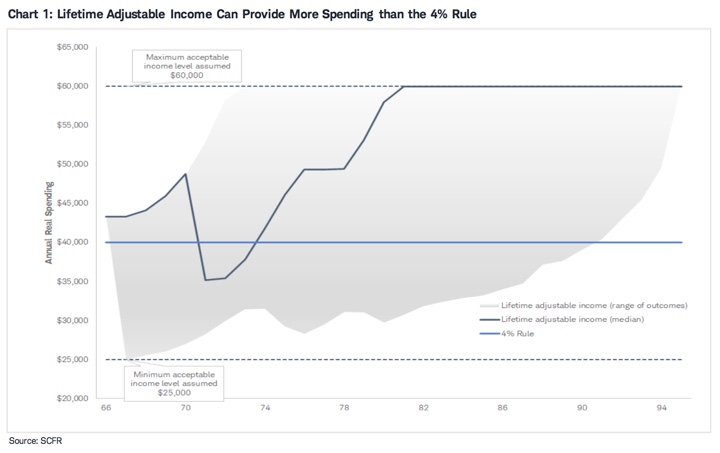
However, you must look past the averages and see that you are now exposed to the extremes. Look at that wide expanse of grey. A significant number of the scenarios involved some extended deep cuts to spending, hitting and hovering just above the $25,000 minimum guardrail. You’ll have to decided if you like this trade-off between probably getting more income but possibly enduring some big cuts. This is why many financially-conservative people would prefer to simply start out at a lower 3% or 3.5% withdrawal rate and adjust upwards if the portfolio keeps growing.

In any case, I found it interesting that Schwab used the probability of portfolio survival rate as the factor used to adjust withdrawal rate. DIY investors can implement a similar system themselves. Here are some tools to estimate portfolio survival probability:

Have You Agreed to Pay the Price Required For Long-Term Stock Returns?

On March 6, 2009, the S&P 500 index hit 666.80, shedding 13 years of gains. 13 years! Guess how long it has been since March 2009? 13 years! Something to ponder as the possibility of more war looms ahead.

I remember my portfolio being halved at the time and thinking… how can it not eventually be back at at 1,000? Should I double down on stocks? Meanwhile, Goldman Sachs released “analyst research” that warned the S&P could fall as low as 400. People were panicked and “get out now and wait until things calm down” started to sound more and more like solid advice. The best I could do was not sell anything.

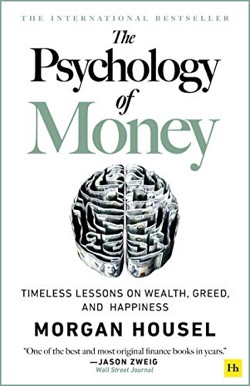
I am re-reading The Psychology of Money by Morgan Housel. In this book of timeless advice about controlling your behavior, he points out that the long-term stock returns that we all expect is not free. There is a price that must be paid.

Like everything else worthwhile, successful investing demands a price. But its currency is not dollars and cents. It’s volatility, fear, doubt, uncertainty, and regret—all of which are easy to overlook until you’re dealing with them in real time.

We should accept this price volatility as an expected cost of doing business, not something to be avoided:

It sounds trivial, but thinking of market volatility as a fee rather than a fine is an important part of developing the kind of mindset that lets you stick around long enough for investing gains to work in your favor. Few investors have the disposition to say, “I’m actually fine if I lose 20% of my money.” This is doubly true for new investors who have never experienced a 20% decline. But if you view volatility as a fee, things look different.

From A Wealth of Common Sense, we can get a better understanding of How Often Should You Expect a Stock Market Correction?

I would add one thing. Accepting price swings after looking at a chart may sound okay in isolation. However, you should also prepare for the fact that there will always be a great reason for those drops. We’ve had housing bubbles and dot-com bubbles and now worldwide pandemics. But the next reason will likely be different. And it will be a widely-accepted, legit, scary reason. I will be scared. You will be scared.

If I mentally agree to pay this price now, hopefully it will help me when the next scary thing inevitably comes along.

Charlie Munger Daily Journal Annual Meeting 2022 Full Video, Full Transcript, and Highlights

Charlie Munger is now 98 years old and still answering questions at the 2022 Daily Journal Annual Shareholder Meeting. Yahoo Finance livestreamed the event again, and you can view the full two-hour recording on YouTube (embedded below, starts at 24:47). You’ll miss out on his snarky tone, but you may prefer to read the entire transcript, kindly provided in PDF form via @DividendGrowth and via Junto Investments.

You don’t have to agree with everything he says, but some of it is just refreshing in that it’s not the same stuff you hear elsewhere. He has a clear opinion. I’ve included a few of my personal highlights below.

One philosophy that I appreciate (but don’t necessarily follow) is to simply stay completely clear of bad things that can destroy either your financial stability or your general happiness. If you don’t own crypto, you can still live a rich and happy life.

  • Avoid treating the stock market like a casino.
  • Avoid speculating in cryptocurrencies.
  • Avoid doing something because you see someone else get rich doing it.
  • Avoid anything so addictive to you that you give up everything else. For some, it could be alcohol. Others, it could be video games.
  • Avoid “pretentious expenditure”.

On the best way to invest:

Well, it may be that you have to choose the least bad of your options. That frequently happens in human decision making. The Mungers have Berkshire stock, Costco stock, Chinese stocks through Li Lu, a little bit of Daily Journal stock, and a bunch of apartment houses. Do I think that’s perfect? No. Do I think it’s okay? Yes. I think the great lesson from the Mungers is that you don’t need all this damn diversification. You’re lucky if you got four good assets. If you’re trying to do better than average, you’re lucky if you have four things to buy. To ask for 20 is really asking for egg in your beer. Very few people have enough brains to get 20 good investments.

On making macro-economic predictions and dealing with the boom and bust cycle:

I figure that I want to swim as well as I can against the tides. I’m not trying to predict the tides.

If you’re gonna invest in stocks for the long term, or real estate, of course there are going to be periods when there’s a lot of agony and other periods when there’s a boom. I think you just have to learn to live through them.

Should we go to cash and wait for better opportunities in the future?

In my whole adult life, I’ve never hoarded cash, waiting for better conditions. I’ve just invested in the best thing I could find. I don’t think I’m going to change now. The Daily Journal has used up its cash.

On living a happy life:

You want to have reasonable expectations and take life’s results good and bad as they happen with a certain amount of stoicism. There’ll never be any shortage of good people in the world. All you got to do is seek them out and get as many of them as possible into your life. Keep the rest the hell out.

Past years:

University of the People: Tuition-Free, Accredited Online Degrees in Computer Science, Business Administration (MBA), Education (M.Ed.)

Did you know that there exists a tuition-free, accredited, online university where you can obtain an Bachelor’s degree in Computers Science, MBA, or Masters in Education for a tiny fraction of the cost of traditional universities? The University of the People was recently profiled by the NYT in How Can This University Charge Nothing for Tuition? (gift article).

Is is really free? Not quite, but I think the structure is very fair as it charges a small fee only when you are ready to earn course credit. From the NYT article:

The University of the People, which he founded in 2009, is an online-only institution that charges nothing for tuition. Students don’t have to pay for textbooks because all the educational material is made available for free online, and there’s no room and board because there’s no campus. They do have to pay $120 for each final exam, which they must pass to earn credits. For 40 courses, that adds up to $4,800 for a bachelor’s degree — although for students who face severe financial hardship, even the exam fees can be waived.

Here are the total approximate costs (not per year!) to earn a UoPeople degree:

Associate Degree: $2,460
Bachelor’s Degree: $4,860
Master of Business Administration (MBA): $2,940
Master of Education (M.Ed.): $3,180
Master of Science in Information Technology (MSIT): $3,660

To put this in context, if you assume four years for the BS/BA, that’s $100 a month. That’s less than the average monthly cable and internet bill.

The extra $60 is from the $60 application fee. You can also obtain transfer credit from your previous coursework and/or other free and low-cost educational sites like Saylor Academy, Sophia.org and Coursera to both speed up your progress and lower your total cost even further.

How is this possible?

How is it possible to make a degree so cheap? The instructors and many of the administrators, including Reshef, work for no pay. The chair of the President’s Council is John Sexton, president emeritus of New York University. Professors from top universities volunteer as deans. The instructors tend to be retired professors or recently minted Ph.D.s who are looking for teaching experience. Foundations and individual benefactors have also chipped in. “The amount of people who are willing to do good for the world is shockingly high,” Reshef told me recently.

This reminds of the intro for book Drive: The Surprising Truth About What Motivates Us by Daniel Pink (same author as Power of Regret), where the author reminds us that in 1996 there would two options for an encyclopedia:

  • Microsoft Encarta, run by a huge and profitable company and written by paid experts.
  • Wikipedia, run by a lean non-profit and written entirely by unpaid volunteers.

Today, I probably check Wikipedia once a day and Encarta has been gone for over a decade. People are not solely motivated by money. We like to be part of a greater purpose. (Although I have tried to contribute to Wikipedia and gotten deleted unceremoniously.)

UoPeople won’t work for everyone, but I find it very fascinating. I wonder if they incorporate volunteer tutors or “TAs” as well to help the students along.

See also: 2020 follow-up article on Georgia Tech Online Master in Computer Science, first mentioned in 2013. Total tuition about $7,000.

Gemini Exchange: Bitcoin Bonus

(Update: After a incorrect trademark infringement claim and takedown request, Gemini has followed up and taken it back. I’ve brought back an edited version of the original post.)

Gemini is a crypto exchange offering a $150 bonus in Bitcoin if you open a new account and invest $1,000+ in crypto within the first 30 days. Buying the Gemini dollar (GUSD) stablecoin worked for me.

To find it, enter “gemini $150 bitcoin bonus” into Google.com. It should be the first result. I am not affiliated with this promotion. If you open a Gemini account through this promotion, I get nothing.

Here were the overall steps that I took:

  • Use the promo link above to start your application as a new customer. You may need to submit a driver’s license photo.
  • Link a bank account via Plaid.
  • Fund Gemini account via ACH. The daily max is $1,000.
  • Purchase $1,000 in crypto. The most conservative choice is GUSD, which is a stablecoin that is (supposed to be) backed 1:1 with US dollars and trades at a stable $1.00 value.
  • This should trigger the bonus, which arrived within 24 hours for me. You get $150 in Bitcoin, which can quickly go up or down in value.
  • I have kept my BTC and GUSD for now, but you can sell it for USD if you want. There are some transaction fees, roughly $3 for a $150 trade with the basic trading structure but possibly less with their ActiveTrader option.

The Four Core Types of Regrets + Thoughts on Financial Regrets

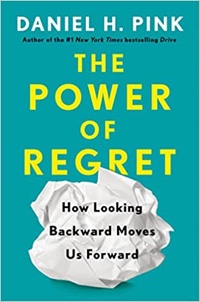
According to the new book The Power of Regret: How Looking Backward Moves Us Forward by Dan Pink, only 1% of people say they never feel regret. Here are the most in-depth articles from the media tour: WaPo, BBC, Atlantic.

In 2020, the author Daniel Pink launched the World Regret Survey, the largest survey on the topic ever undertaken. With his research team, Pink asked more than 15,000 people in 105 countries, “How often do you look back on your life and wish you had done things differently?” Eighty-two percent said regret is at least an occasional part of their life; roughly 21 percent said they feel regret “all the time.” Only 1 percent said they never feel regret.

In the book, Pink identifies these four core types of regret:

  • Foundation regrets involves an irresponsible choice that changed the course of your life. This includes not saving enough money for retirement, not taking care of your health by eating well and exercising, or not putting in proper effort at school or work.
  • Boldness regrets come from being too cautious, and not taking certain risks. This includes staying in a “safe” job instead of going for a career changes more suited to you, or not asking out someone you liked on a date.
  • Moral regrets are when you don’t live up to your own values. You cheated, bullied, lost your temper, or didn’t stand up for something.
  • Connection regrets deal with lost relationships with family members, friends or colleagues. Too often, this happens due to neglect and passivity.

I used to think of regrets as equivalent to mistakes. In our household, we try to look at mistakes as a positive opportunity to “make your brain grow bigger”. This way, they are less afraid of trying something new or challenging. Regrets are simply mistakes, so we should just learn from them and move on, right?

However, now I see regrets as a special sort of mistake. They involve looking at the past and imagining different outcomes. Over time, you realize what kinds of choices are likely to lead to regrets, and what won’t. This can help guide you towards better future decisions. To me, the phrase “no regrets” doesn’t mean I don’t have any regrets. It means I know what will cause regret, and so I do things to avoid it. For example:

  • I won’t regret ditching a little bit of work for dedicated one-on-one time with a child. If you have kids, read The Family Board Meeting.
  • I won’t regret saving a few months of expenses to ride out life’s inevitable bumps.
  • I won’t regret waiting 24 hours to send that angry e-mail.
  • I won’t regret reaching out to a friend, whether it is because you need it or they need it.
  • I won’t regret taking the time to show or tell someone “I love you”.
  • I am much more likely to regret not taking a chance, than taking a risk and failing. In many cases, the downside isn’t so bad, while the upside could be limitless.

In terms of financially-related regrets, the two big ones are the foundational regret “I wish I saved more money when I was younger” and the boldness regret “I wish to took the risk to pursue a career better aligned to my personality and interests”.

A study by the Federal Reserve Bank of New York found that only 27% of college graduates work in a field related to their major. Career paths are long and winding these days. I remembering choosing my college major when I was 17 years old, since some colleges make you pick on your application. Even though I questioned my choice after a few years in college, I felt the “sunk cost” bias and didn’t want to risk the additional time, effort, and tuition to try and change majors. I was also “good” at the major, and so I kept going. That is one of my personal regrets.

In my view, finding the right career path where you get the trifecta of “I am good at this”, “I like doing this”, and “I get paid well for doing this” is like having a jetpack on your pursuit of financial independence. Once you have a job where you wake up and actually look forward to go to work and there is a small but increasing gap between income and expenses, you are ready to blast off and start compounding. You could try and pursue financial independence with a job that is missing any one of those three factors, but the journey will feel like a slow grind instead.

Eventually, the fact that I was missing the “I like doing this” starting bugging me enough, and I was ready to quit and go back to school. But the first thing I had to do was save up a year of expenses (also helped by minimizing those expenses). That little money cushion gave me the courage to make the leap. The “ROI” on that “emergency fund” was more than any index fund or rental property. So that’s what I plan to tell my kids: When you’re young, live simply and always create a cash cushion so that you can keep searching for the jetpack trifecta. This will minimize your financial regrets.

Big List of Social Security Tools: Best Time to Start Claiming Social Security Benefits?

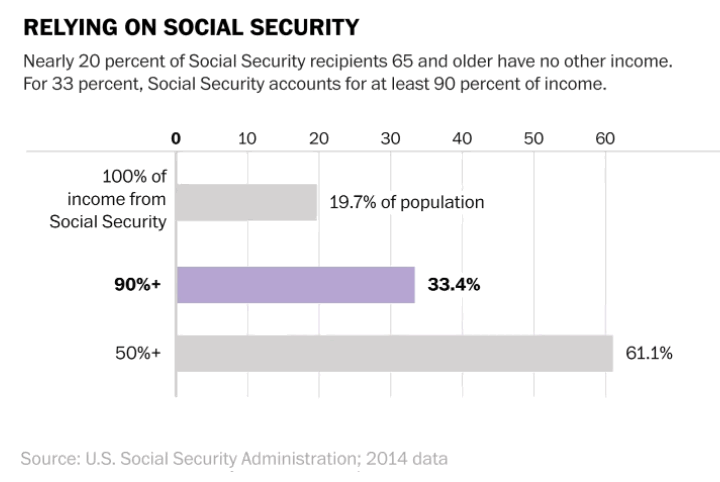
Social Security is the largest source of retirement income for a majority of Americans. For about 1/3rd of them, Social Security makes up 90% or more of their retirement income.

ss_percent

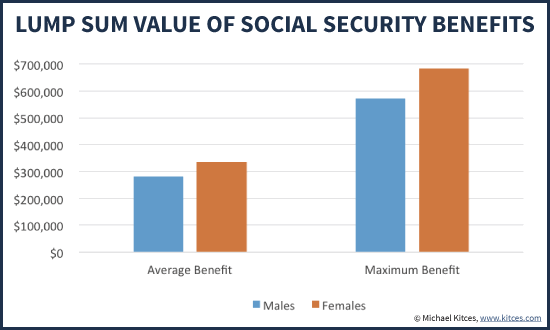
Depending on your assumptions, the “lump sum value” of your Social Security benefits is somewhere between $300,000 and $700,000. (Source: Kitces)

Even this large figure ignores the fact that your Social Security income is guaranteed to rise each year with inflation, something no other private annuity company in the world even offers any longer at any price!

Therefore, spending a little time and money in order to consider the many options for Social Security (especially for those married, divorced, widowed, or disabled) can really make a difference. This NYT article (free, gift article) lists a number of services that help you navigate the rules (at a variety of service levels and price points). In no particular order:

I don’t have any in-depth experience with any of these online tools, but when the time comes I’d probably pony up the money (adds up to less than $100 for all three) and compare the results. If they are properly programmed, they should all agree, right?

The tools below go beyond Social Security claiming strategies and more into overall retirement income planning.

Even if you’re still far away from claiming time, be sure to sign up for your official mySocialSecurity account (before a scammer does) and take a peek at your stats each year. For those that like tinkering, try copy and pasting your anonymous data into the SSA.tools website (free) and play around with different future scenarios.

In the end, you may not follow the software recommendations exactly, but simply knowing about the different options and factors can be helpful. In my experience, many people just end up claiming earlier because they want “their” money sooner rather than later without understanding the potential drawbacks. A retiree may want to have their “own” paycheck again if their partner still works.

Best Interest Rates on Cash – February 2022 Update

Here’s my monthly roundup of the best interest rates on cash as of January 2022, roughly sorted from shortest to longest maturities. I look for lesser-known opportunities earning more than most “high-yield” savings accounts and money market funds while still keeping your principal FDIC-insured or equivalent. Check out my Ultimate Rate-Chaser Calculator to see how much extra interest you’d earn by moving money between accounts. Rates listed are available to everyone nationwide. Rates checked as of 2/6/2022.

Significant changes since last month: 7.12% Savings I Bonds still a good idea if you haven’t done it yet, $100 Marcus new deposit bonus is a good deal (details), HM Bradley 3% APY requirements relaxed a bit, new LFCU 2% APY account opening review. In general, there doesn’t seem to be much upside to locking in a 5-year CD at 1.50% when there are so many short-term options nearly as good (or better) while waiting to see how much rates rise in 2022.

Fintech accounts
Available only to individual investors, fintech companies often pay higher-than-market rates in order to achieve fast short-term growth (often using venture capital). “Fintech” is usually a software layer on top of a partner bank’s FDIC insurance.

  • 4% APY on $2,000/$6,000. Current offers 4% APY on up to $2,000 on each of their “savings pods”. Free users get 1 savings pod, while premium users get 3 savings pods. Potential promos include $50 bonus and “Premium free for life”. Please see my Current app review for details.
  • 3% APY on up to $100,000, but requires direct deposit and credit card spend. HM Bradley pay 3% APY if you open both a checking and credit card with them, and maintain $1,500 in total direct deposit each month and $100 in credit card purchases each month. Please see my updated HM Bradley review for details.
  • 3% APY on 10% of direct deposits + 1% APY on $25,000. One Finance lets you earn 3% APY on “auto-save” deposits (up to 10% of your direct deposit, up to $1,000 per month). Separately, they also pay 1% APY on up to another $25,000 with direct deposit. New customer $50 bonus via referral. See my One Finance review.
  • 3% APY on up to $15,000, requires direct deposit and credit card transactions. Porte requires a one-time direct deposit of $1,000+ to open a savings account. Porte then requires $3,000 in direct deposits and 15 debit card purchases per quarter (average $1,000 direct deposit and 5 debit purchases per month) to receive 3% APY on up to $15,000. New customer bonus via referral. See my Porte review.
  • 1.20% APY on up to $50,000. You must maintain a $500 direct deposit each month for this balance cap, otherwise you’ll still earn 1.20% on up to $5,000. They also pay 4% on USDC stablecoin, but I avoid this as it is not FDIC-insured (and you can get higher rates elsewhere if you did want to hold USDC.) New customer $50 bonus via referral. See my OnJuno review.

High-yield savings accounts
Since the huge megabanks pay essentially no interest, I think every should have a separate, no-fee online savings account to accompany your existing checking account. The interest rates on savings accounts can drop at any time, so I list the top rates as well as competitive rates from banks with a history of competitive rates. Some banks will bait you with a temporary top rate and then lower the rates in the hopes that you are too lazy to leave.

  • T-Mobile Money is still at 1.00% APY with no minimum balance requirements. The main focus is on the 4% APY on your first $3,000 of balances as a qualifying T-mobile customer plus other hoops, but the lesser-known fact is that the 1% APY is available for everyone. Thanks to the readers who helped me understand this. Unfortunately, some readers have reported their applications being denied.
  • Evangelical Christian Credit Union (ECCU) is offering new members 1.01% APY on up to $25,000 when you bundle a High-Yield Money Market Account & Basic Checking. (Existing members can get 0.75% APY.) To join this credit union, you must attest to their statement of faith.
  • There are several other established high-yield savings accounts at closer to 0.50% APY. Marcus by Goldman Sachs is on that list, and if you open a new account with a Marcus referral link (that’s mine), they will give you and the referrer a 1.00% APY for your first 3 months (a 0.50% boost). You can then extend this by referring others to the same offer. They are also offering a $100 new deposit bonus if you move over $10,000 in new money.

Short-term guaranteed rates (1 year and under)
A common question is what to do with a big pile of cash that you’re waiting to deploy shortly (plan to buy a house soon, just sold your house, just sold your business, legal settlement, inheritance). My usual advice is to keep things simple and take your time. If not a savings account, then put it in a flexible short-term CD under the FDIC limits until you have a plan.

  • No Penalty CDs offer a fixed interest rate that can never go down, but you can still take out your money (once) without any fees if you want to use it elsewhere. CFG Bank has a 13-month No Penalty CD at 0.62% APY with a $500 minimum deposit. Ally Bank has a 11-month No Penalty CD at 0.50% APY for all balance tiers. Marcus has a 7-month No Penalty CD at 0.45% APY with a $500 minimum deposit. You may wish to open multiple CDs in smaller increments for more flexibility.
  • Poppy Bank has a 1-year CD at 1.00% APY ($1,000 min). According to DepositAccounts, early withdrawal penalty is 90 days of interest.

Money market mutual funds + Ultra-short bond ETFs
Many brokerage firms that pay out very little interest on their default cash sweep funds (and keep the difference for themselves). Unfortunately, money market fund rates are very low across the board right now. Ultra-short bond funds are another possible alternative, but they are NOT FDIC-insured and may experience short-term losses at times. These numbers are just for reference, not a recommendation.

  • The default sweep option is the Vanguard Federal Money Market Fund which has an SEC yield of 0.01%.
  • Vanguard Ultra-Short-Term Bond Fund currently pays 0.68% SEC yield ($3,000 min) and 0.78% SEC Yield ($50,000 min). The average duration is ~1 year, so your principal may vary a little bit.
  • The PIMCO Enhanced Short Maturity Active Bond ETF (MINT) has a 0.60% SEC yield and the iShares Short Maturity Bond ETF (NEAR) has a 0.64% SEC yield while holding a portfolio of investment-grade bonds with an average duration of ~6 months.

Treasury Bills and Ultra-short Treasury ETFs
Another option is to buy individual Treasury bills which come in a variety of maturities from 4-weeks to 52-weeks. You can also invest in ETFs that hold a rotating basket of short-term Treasury Bills for you, while charging a small management fee for doing so. T-bill interest is exempt from state and local income taxes. Right now, this section isn’t very interesting as T-Bills are yielding close to zero!

  • You can build your own T-Bill ladder at TreasuryDirect.gov or via a brokerage account with a bond desk like Vanguard and Fidelity. Here are the current Treasury Bill rates. As of 2/4/2022, a new 4-week T-Bill had the equivalent of 0.05% annualized interest and a 52-week T-Bill had the equivalent of 0.88% annualized interest.
  • The Goldman Sachs Access Treasury 0-1 Year ETF (GBIL) has a -0.02% SEC yield and the SPDR Bloomberg Barclays 1-3 Month T-Bill ETF (BIL) has a -0.09% (!) SEC yield. GBIL appears to have a slightly longer average maturity than BIL.

US Savings Bonds
Series I Savings Bonds offer rates that are linked to inflation and backed by the US government. You must hold them for at least a year. If you redeem them within 5 years there is a penalty of the last 3 months of interest. The annual purchase limit for electronic I bonds is $10,000 per Social Security Number, available online at TreasuryDirect.gov. You can also buy an additional $5,000 in paper I bonds using your tax refund with IRS Form 8888.

  • “I Bonds” bought between November 2021 and April 2022 will earn a 7.12% rate for the first six months. The rate of the subsequent 6-month period will be based on inflation again. More on Savings Bonds here.
  • In mid-April 2022, the CPI will be announced and you will have a short period where you will have a very close estimate of the rate for the next 12 months. I will have another post up at that time.
  • See below about EE Bonds as a potential long-term bond alternative.

Prepaid Cards with Attached Savings Accounts
A small subset of prepaid debit cards have an “attached” FDIC-insured savings account with exceptionally high interest rates. The negatives are that balances are severely capped, and there are many fees that you must be careful to avoid (lest they eat up your interest). There is a long list of previous offers that have already disappeared with little notice. I don’t personally recommend nor use any of these anymore, as I feel the work required and risk of messing up exceeds any small potential benefit.

  • Mango Money pays 6% APY on up to $2,500, if you manage to jump through several hoops. Requirements include $1,500+ in “signature” purchases and a minimum balance of $25.00 at the end of the month.

Rewards checking accounts
These unique checking accounts pay above-average interest rates, but with unique risks. You have to jump through certain hoops which usually involve 10+ debit card purchases each cycle, a certain number of ACH/direct deposits, and/or a certain number of logins per month. If you make a mistake (or they judge that you did) you risk earning zero interest for that month. Some folks don’t mind the extra work and attention required, while others would rather not bother. Rates can also drop suddenly, leaving a “bait-and-switch” feeling.

  • Lafayette Federal Credit Union is offering 2.02% APY on balances up to $25,000 with a $500 minimum monthly direct deposit to their checking account. No debit transaction requirement. They are also offering new members a $100 bonus with certain requirements. Anyone can join this credit union via partner organization ($10 one-time fee).
  • Quontic Bank is offering 1.01% APY on balances up to $150,000. May be useful for those with high balances. You need to make 10 debit card point of sale transactions of $10 or more per statement cycle required to earn this rate.
  • The Bank of Denver pays 2.00% APY on up to $10,000 if you make 12 debit card purchases of $5+ each, receive only online statements, and make at least 1 ACH credit or debit transaction per statement cycle. If you meet those qualifications, you can also link a Kasasa savings account that pays 1.00% APY on up to $25k. Thanks to reader Bill for the updated info.
  • Presidential Bank pays 2.25% APY on balances between $500 and up to $25,000, if you maintain a $500+ direct deposit and at least 7 electronic withdrawals per month (ATM, POS, ACH and Billpay counts).
  • Evansville Teachers Federal Credit Union pays 3.30% APY on up to $20,000. You’ll need at least 15 debit transactions and other requirements every month.
  • Lake Michigan Credit Union pays 3.00% APY on up to $15,000. You’ll need at least 10 debit transactions and other requirements every month.
  • Find a locally-restricted rewards checking account at DepositAccounts.

Certificates of deposit (greater than 1 year)
CDs offer higher rates, but come with an early withdrawal penalty. By finding a bank CD with a reasonable early withdrawal penalty, you can enjoy higher rates but maintain access in a true emergency. Alternatively, consider building a CD ladder of different maturity lengths (ex. 1/2/3/4/5-years) such that you have access to part of the ladder each year, but your blended interest rate is higher than a savings account. When one CD matures, use that money to buy another 5-year CD to keep the ladder going. Some CDs also offer “add-ons” where you can deposit more funds if rates drop.

  • NASA Federal Credit Union has a special 49-month Share Certificate at 1.70% APY ($10,000 min of new funds). Early withdrawal penalty is 1 year of interest. They also have a 15-month special at 1.05% APY and 9-month at 0.80% APY.
    Anyone can join this credit union by joining the National Space Society (free). However, NASA FCU will perform a hard credit check as part of new member application.
  • American Heritage Credit Union has a 5-year CD at 1.50% APY ($1,000 min). Early withdrawal penalty is 12 months of interest. Anyone can join this credit union via partner organization (free).
  • You can buy certificates of deposit via the bond desks of Vanguard and Fidelity. You may need an account to see the rates. These “brokered CDs” offer FDIC insurance and easy laddering, but they don’t come with predictable early withdrawal penalties. Right now, I see a 5-year CD at 1.70% APY. Be wary of higher rates from callable CDs listed by Fidelity.

Longer-term Instruments
I’d use these with caution due to increased interest rate risk, but I still track them to see the rest of the current yield curve.

  • Willing to lock up your money for 10 years? You can buy long-term certificates of deposit via the bond desks of Vanguard and Fidelity. These “brokered CDs” offer FDIC insurance, but they don’t come with predictable early withdrawal penalties. You might find something that pays more than your other brokerage cash and Treasury options. Right now, I see a 10-year CD at 2.10% APY vs. 1.87% for a 10-year Treasury. Watch out for higher rates from callable CDs from Fidelity.
  • How about two decades? Series EE Savings Bonds are not indexed to inflation, but they have a unique guarantee that the value will double in value in 20 years, which equals a guaranteed return of 3.5% a year. However, if you don’t hold for that long, you’ll be stuck with the normal rate which is quite low (currently 0.10%). I view this as a huge early withdrawal penalty. But if holding for 20 years isn’t an issue, it can also serve as a hedge against prolonged deflation during that time. Purchase limit is $10,000 each calendar year for each Social Security Number. As of 2/4/2022, the 20-year Treasury Bond rate was 2.29%.

All rates were checked as of 2/6/2022.

Amazon Prime Price Hike 2022: Save Money With Gift of Prime Membership

amazon200Amazon Prime has announced the following price increases (note that some links will show up if you are viewing this via e-mail newsletter, please read online):

  • Starting February 18th, 2022, new members will be charged $139/year for an annual Prime membership and $69/year for an annual Prime Student membership.
  • Starting March 25th, 2022, existing Prime members with an annual membership will renew at a rate of $139/year. Prime Student members with an annual membership will renew at a rate of $69/year.

You can still buy a Gift of Prime Membership for $119 (plus applicable taxes). It is unknown when this will increase in price. Here’s the rundown.

  • You can cancel the auto-renewal of your Amazon Prime membership in your account. You may have to go through a lot of “Are you sure?” prompts. They make it feel like you’re canceling your membership right then and there, but again you’re just canceling your auto-renewal. Your Prime membership will still continue through your anniversary date.
  • Buy a Gift of Prime Membership for $119 (plus applicable taxes) and send it to yourself or alternative e-mail. Note that if you try to apply the Amazon Gift of Prime when you have an active membership, it won’t work. You just get the exact value paid (including any taxes) in the form of an Amazon gift card. The goods news it that you can’t ever lose any value.
  • Set a calendar reminder of when your Amazon Prime year expires, and keep that e-mail with the gift membership link (perhaps in a special folder). If you apply the Amazon Gift of Prime the day after your current membership expires, then it will renew you with one year of Amazon Prime. You don’t need to start a new Amazon account or change your e-mail, everything will carry over from before. You’ll simply not have Prime for a day or less. Easy.

You can also choose to buy multiple years of Gift of Prime membership. Again, the worst case it that you redeem it for Amazon credit in the exact amount paid initially.

I also did this when Amazon hiked the price of Prime in 2018:

az_gift

Note that if you have an older grandfathered Amazon Prime that lets you have 5 household members share the benefits, you may not want that to expire.

Amazon Prime has a bunch of features beyond the faster shipping that are useful to me, including the Amazon Video and Amazon Music apps. There are also Prime-only deals throughout the year that try to take advantage of in order to offset the annual membership cost. On the other hand, it has been almost too easy at times to buy things on impulse.

Lafayette Federal Credit Union Review: 2.02% APY on $25,000, $100 Bonus

Update: $100 bonus is expired. Wanted to report that I am had a bad experience with LFCU after being locked out of my account for over a week. Phone hold times were very long, I got routed to a service that promised to call me back, and then never called me back. E-mails also went unreturned. Maybe it’s just me.

Original post, may be outdated:

Lafayette Federal Credit Union (LFCU) has a respectable history of offering competitively-priced banking products. I recently joined and here is a quick review of their current promotions and the application process. Highlights:
  • 2.02% APY Checking account on up to $25,000 balance (details below).
  • $100 bonus for new members (details below)
  • Competitive CD rates: 7-month at 0.70% APY, 3-year at 1.01% APY, 5-year at 1.26% APY

Membership eligibility. You can view your membership eligibility options here, including working/living in the Washington, DC area. Anyone nationwide can join LFCU by joining the Home Ownership Financial Literacy Council (HOFLC) for a one-time $10 fee.

Account opening process. I went to the HOFLC.org website and paid my $10 to join. (I hope to spend more time exploring their resources later.) I had to attach a screenshot of my membership approval e-mail as part of my LFCU application. The LFCU application was finished completely online. I also had to upload a photo scan of my drivers license. My application was approved after a couple of days.

During the application, I was able to charge my initial opening deposit up to $750. This was classified as a purchase on my credit card (worth $15 at 2% cash back). Note that you must keep $50 that is “untouchable” in your Share Savings account as long as you are a member, which is a bit higher than that of other credit unions (usually around $10 to $25).

I applied through this $100 bonus page which includes promo code DD2022. (Update: I honestly can’t remember where I entered the code. You can however secure online message them directly through the membership application portal and confirm that you are signed up for this promotion. I received such a confirmation message promptly.) I must open a checking account and set up a $500+ direct deposit, and I can’t close the account within the first 6 months. Details:

Members who open a checking account and initiate a qualified direct deposit to Lafayette Federal Credit Union will receive a $50 deposit to their savings account. An additional $50 will be awarded after first direct deposit which must be deposited no later than 45 days after account opening. Cannot be combined with any other new member offers. Qualified direct deposit is a recurring direct deposit of a paycheck, pension, Social Security or other periodic payment of at least $500 into a checking account on a month-to-month basis made by an outside organization or agency. Must be eligible for membership. If account is closed within first 6 months, initial $50 promotional deposit will be deducted from account.

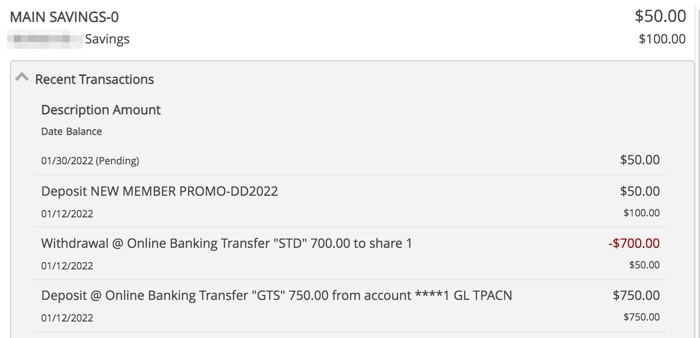
The first $50 showed up quickly:

Checking account 2.02% APY details. With the Checking account, they have “2% for ’22” promotion which pays 2.02% APY with a qualified monthly direct deposit of $500 or more on balances up to $25,000. The checking account otherwise has no minimum balance requirements or monthly maintenance fees.

To earn the 2.02% APY3 bonus rate, member must maintain at least one (1) qualified direct deposit of at least $500 per month. 2Qualified direct deposit is a recurring direct deposit of a paycheck, pension, or Social Security periodic payment of at least $500 into a checking account on a month-to-month basis made by an outside organization or agency.

If I keep $25,000 in there at 2% APY, that’s $500 of interest over a year. That’s also $275 more than it would earn in a 0.5% APY savings account. You can use that metric to judge if it is worth your additional efforts. That rough calculation also assumes both those rates stay constant over the next year.

So far, LFCU has been pleasant to work with and my questions were answered quickly and courteously. I hope that they continue to be aggressive in their banking products.