Archives for October 2020

Example MYGA Fixed Annuity Statement and Purchase Experience

As a follow-up to my post about MYGA fixed annuities, here are the details of my personal purchase to help remove some of the mystery from MYGAs. I bought the Personal Choice Annuity 5 annuity from Sentinel Security Life Insurance Company. Sentinel Security Life has been based in Utah since 1948 and is currently rated B++ by AM Best. Every annuity can be different, even from state-to-state. Here were my highlights:

  • Issue date: 9/30/2015
  • Amount invested: $10,000 (minimum $2,500)
  • Rate guarantee: 3.10% for 5 years
  • Free look period: 30 days (you can get a refund within this period).
  • Early Surrender Charge period: 5 years
  • Market Value Adjustment (MVA) period: 5 years

Basically, there are big penalties if I withdraw earlier than the 5 year period, but none as long as I don’t touch it for those 5 years. This limited liquidity is a part of the reason for the higher interest rates than other products. The main reason I picked this annuity is that it had one of the highest 5-year rates for an insurer rated B+ or higher (“Secure” by AM Best). The 5-year term made it easy to compare rates against either bank CDs or Treasury bond rates. The 5-year term would also be potentially useful for creating an annuity ladder – keep buying one every year, and you’ll eventually have the improved liquidity of an annuity maturing every year.

Purchase process. As noted previously, I went with Stan the Annuity Man. The details are a bit fuzzy as it was five years ago now, but basically his office sent over some snail mail paperwork and I returned it with a paper check. You get a booklet with the annuity contract, a glossy brochure, etc.

Ownership experience. Here is how this annuity balance should grow (compounding tax-deferred) by year:
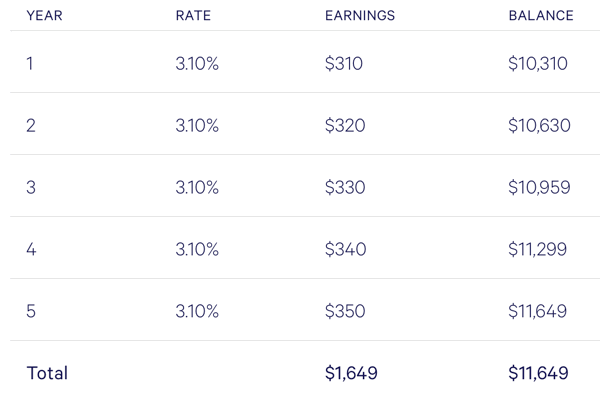
This is pretty much how it worked out for me from September 2015 to September 2020. I basically did nothing for 5 years. It was very nice and quiet! No daily stock quotes, not even monthly statements. I only received a paper statement once a year with my updated balance. There was no additional junk mail or telephone solicitations. Here was my final statement for September 2020:
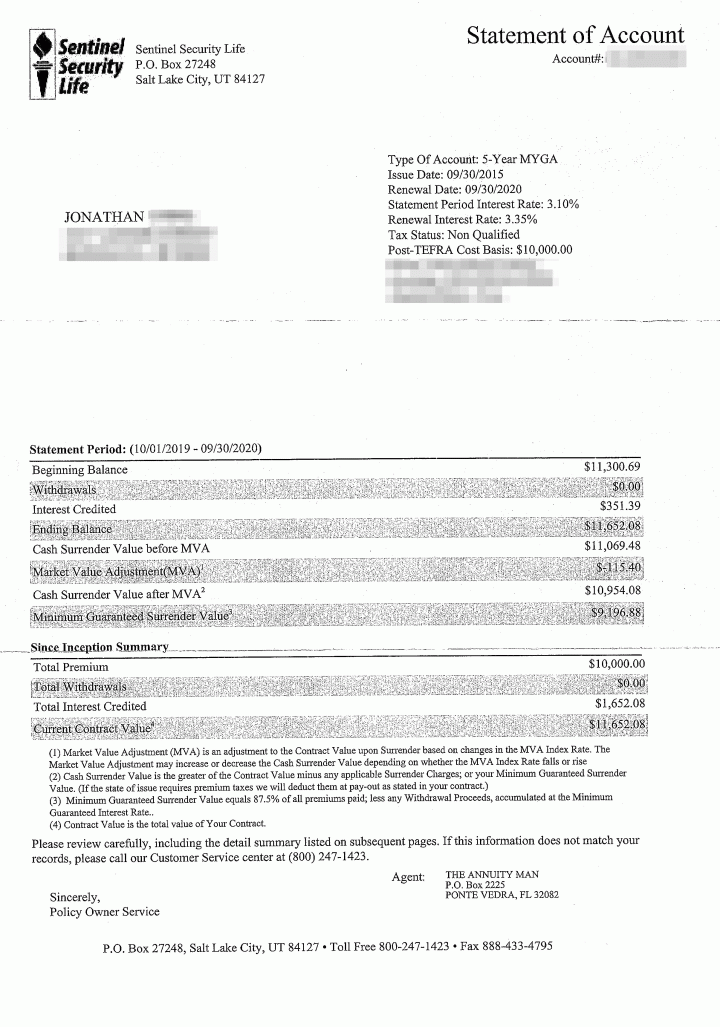
Renewal process. At the time of renewal, I received e-mail and phone reminders from Stan. I decided to just go with another 5-year term with Sentinel at 3.35% as it was still a top rate and it required no additional paperwork. I have been tracking the rates loosely, and the rate on this annuity was actually around 4% during much of 2019, but at the time of renewal it had gone down to 3.35%. As of this writing, the rate is down to 3.15% and is scheduled to drop further to 3.00% as of October 30th, 2020. I could have also exchanged into another annuity from a completely different insurer, which probably would have required a bit more paperwork.

Going forward. I intend to keep renewing at 5-year intervals to a competitive 5-year MYGA until at least I reach age 59.5 to avoid the 10% IRS penalty. The balance gets to grow and compound tax-deferred until withdrawal, and I treat it as part of my bond allocation. Eventually, I will try to time the withdrawals during a period of lower income to minimize the tax hit. I could also chose to convert it into a single-premium immediate annuity (SPIA) and create a lifetime income stream. As of right now, I’m not sure if I will be buying more. It depends on when my CD ladder matures and the competition at that time. I will have to weigh the higher rates and tax-deferral advantages against the added complexity, liquidity concerns, and non-zero default risk.

This was my thinking process as a DIY investor. I am not an insurance professional or investment advisor. This is a small portion of my portfolio and it may or may not be the right product for your situation.

TopCashBack: 6% Cash Back on Sam’s Club Gift Cards ($10 New Member Bonus)

The TopCashBack shopping portal is currently offering 6% cash back on gift cards and 5% cash back on all other items at SamsClub.com for a limited-time. Rakuten ($30 new user bonus) is also offering 3% cash back at Sam’s Club “with no exclusions”. You can buy either Sam’s Club gift cards at face value or their discounted gift cards from restaurants and other retailers (up to 25% off) at SamsClub.com. This also stacks with your credit card rewards, making it a potentially good opportunity to knock out some holiday gifts.

TopCashBack is offering a $10 new user bonus for those that sign up by referral link (that’s mine). The $10 bonus is released when you reach a minimum of $10 cashback at Payable status. This Sam’s Club promo may be a good opportunity to trigger that bonus. The $10 bonus isn’t indicated on the referral link landing page, but it does show up on the next page after you enter your e-mail and chosen password, before making any purchases. You should see this:

tcb10_2

The Groupon deal for a $25 Sam’s Club membership including a free $9.99 pizza is still available.

Chase Sapphire Cards Add $60/$120 Peloton Membership Credits

Chase has announced a new Peloton membership benefits for Chase Sapphire Reserve and Preferred cardholders:

  • Chase Sapphire Reserve card now includes up to $120 in statement credits on Peloton Digital and All-Access Memberships through December 31, 2021.
  • Chase Sapphire Preferred card now includes up to $60 in statement credits on Peloton Digital and All-Access Memberships through December 31, 2021.

Cardmembers can activate their Peloton membership benefit simply by visiting Onepeloton.com/ChaseSapphire and enrolling in an eligible Peloton Membership using their Sapphire card. The statement credits will be applied automatically until reaching the full value offered on that card. Sapphire cardmembers are also invited to join the #SapphireSquad Tag within Peloton to connect to others in the community and find and motivate each other on the Leaderboard.

Peloton Digital membership is $12.99 per month and includes live and on-demand workouts streamed to your smartphone, tablets, and computers across 10 exercise categories including strength, yoga, meditation, cardio, stretching, and others like cycling and running. There is also a free 30-trial for new members that you should taken advantage of first. No Peloton hardware is required.

Peloton All-Access Membership is $39 per month and is their original service that works with the Peloton bike and treadmill.

Free Uber Eats Pass with American Express Gold, Green, and Platinum Cards

American Express has announced new Uber perks for US holders of the American Express Gold Card, the American Express Green Card, or The Platinum Card from American Express. First, consumer Platinum, Gold and Green cardholders can enroll now for a complimentary Eats Pass Membership for up to 12 months. Uber Eats Pass usually costs $9.99 a month ($119 a year) and includes:
  • $0 delivery fee + 5% off restaurant orders of $15+.
  • $0 delivery fee on grocery delivers of $30+
  • Unlike Doordash Dasspass and Grubhub+, these benefits apply to every restaurant available on Uber Eats, not just select participating restaurants.

Note the fine print:

Offer valid thru 12/31/2021 on U.S. subscription. Pass will auto-bill starting 12 months from initial enrollment in this offer, at then-current monthly rate.

If you haven’t signed up for Uber Eats yet, you can first use my referral link to get $20 off your first order of $25+. Or simply apply this promo code at checkout: eats-ubermymoneyblog. Thanks if you use it!

In early 2021, the American Express Gold Card will also be getting $10 a month ($120 annually) in Uber Cash, which works both on Uber Eats orders and Uber rides in the US. For 2021, there will still be the $100 incidental airline credit (baggage fees, etc) but it has been announced as going away in 2022. This is in addition to the other $10 a month ($120 annually) dining credit which works on Grubhub, Seamless, and other select restaurants.

So in 2021, Gold cardholders can get all three credits: $120 Uber Cash, $120 Grubhub/Seamless/dining credit, and $100 Incidental Airline Fee credits. Right now the American Express Gold is also running a 60,000 point limited-time offer (the highest I’ve seen), making this is the best opportunity in a while to apply as a new cardholder.

It certainly looks like American Express is working hard to make their Gold card a better competitor against the Chase Sapphire line-up. This follows closely on the heels of the Chase Sapphire Reserve including Lyft Pink and Grubhub+ memberships, in addition to Dashpass and Doordash credits.

MYGAs: Fixed Annuities with Higher, Guaranteed Rates Like CDs

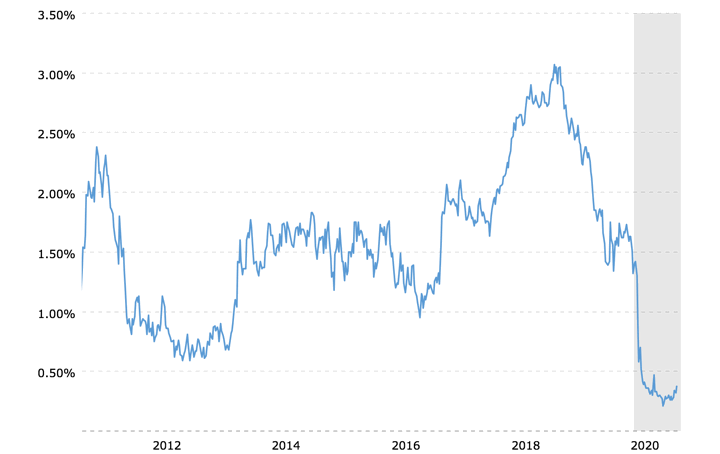
I’ve been seeing a lot of articles about alternatives to traditional bonds and their ultra-low interest rates. The 5-year US Treasury rate is closer to zero than even 1%, an all-time low even considering the past decade (source):

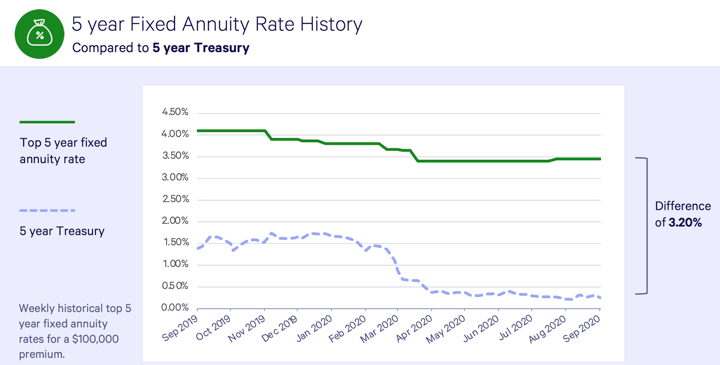
Warnings about the dangers of chasing yield are for good reason. We need to be very skeptical. In a relatively quiet corner of the annuity world, you can get a “guaranteed” rate of 3% and above. This chart from Blueprint Income (via indexfundfan) shows the gap between the top 5-year MYGA rate and a 5-year Treasury, with a rate difference of 3.20% as of September 2020. The gap is slightly smaller as of this writing in late October 2020.

This is a huge gap if the level of safety is comparable. But is it? I actually bought a $10,000 MYGA contract back in 2015 as an educational investment, but never really wrote about it because it is relatively complex and I wasn’t sure it was worth the additional effort when the interest rate gap was much smaller. But given the growing gap, I think a DIY investor should consider at least learn about it as a potential part of their toolkit in 2020.

What are MYGAs? A “MYGA” is a form of fixed deferred annuity that offers a multi-year rate guarantee. For example, they may promise an annual interest rate of 3% for 5 years. This is similar to the rate guarantee from a bank certificate of deposit. However, there are several important differences between a MYGA and an FDIC-insured bank CD.

Annuities are bad though, right? Not all annuities are the same. I like the slogan of Stan “the Annuity Man” Haithcock: “Will do. Not Might do.” In others words, look for concrete promises with no wiggle room, not a “theoretical illustration based on historical returns”. A deferred annuity should state a fixed interest rate (ex. 3% for 5 years). A single-premium immediate annuity should promise you a fixed monthly income for the rest of your life (ex. $1,233 per month). Hard numbers, not a confusing formula based on the stock market (always quietly stripped of dividends).

Annuities also have a bad reputation because many have high commissions to encourage their sale. Often, the worse the annuity, the higher their commissions. However, MYGAs have relatively low commissions, often between 1% and 2.5% upfront (one-time) for the most competitively priced ones. On the flip side, many financial advisors won’t recommend an annuity because they don’t get paid an “assets under management” fee on them (which might be 1% every year, forever!).

Early withdrawal penalties. However, all annuities do have some complications to understand. Once you buy an annuity, you must keep it in an annuity and not withdraw until age 59.5, otherwise you will be subject to a 10% penalty on top of the taxes owed. It is a long-term commitment of funds, similar to an IRA contribution. However, after a 5-year MYGA contract expires, you can simply roll it over into another 5-year MYGA with the same or different provider. This is what I plan to do until I am past age 59.5. If you buy an MYGA with after-tax money, your interest gets to compound tax-deferred until you make a withdrawal. This can be helpful if you have already maxed out your IRA and 401k limits. (You could also convert to a single-premium immediate annuity with a guaranteed income stream.) Upon withdrawal, you will owe income tax on the gains (not principal).

Additional liquidity concerns. An early withdrawal before the end of your fixed term also will be subject to another large penalty, including a market-value adjustment and surrender charges. Some MYGA contracts allow small withdrawals, like 5% or 10% of the purchase amount per year. In general, this is not a good place for “emergency funds”.

“Guarantee”. This word is used frequently with insurance and annuity products. “Guaranteed income.” This only means it is “guaranteed” subject the claims-paying ability of the issuing insurance company. What happens if the insurance company can’t pay? This falls back onto the coverage limits of your state’s Life & Health Guaranty Association. From NOLHGA.com:

State guaranty associations provide coverage (up to the limits spelled out by state law) for resident policyholders of insurers licensed to do business in their state. NOLHGA assists its member associations in quickly and cost-effectively providing coverage to policyholders in the event of a multi-state life or health insurer insolvency.

When an insurer licensed in multiple states is declared insolvent, NOLHGA, on behalf of affected member state guaranty associations, assembles a task force of guaranty association officials. This task force analyzes the company’s commitments to policyholders; ensures that covered claims are paid; and, where appropriate, arranges for covered policies to be transferred to a healthy insurer.

The task force may also support the efforts of the receiver to dispose of the company’s assets in a way that maximizes their value. When there is a shortfall of estate assets needed to pay the claims of covered policyholders, guaranty associations assess the licensed insurers in their states a proportional share of the funds needed.

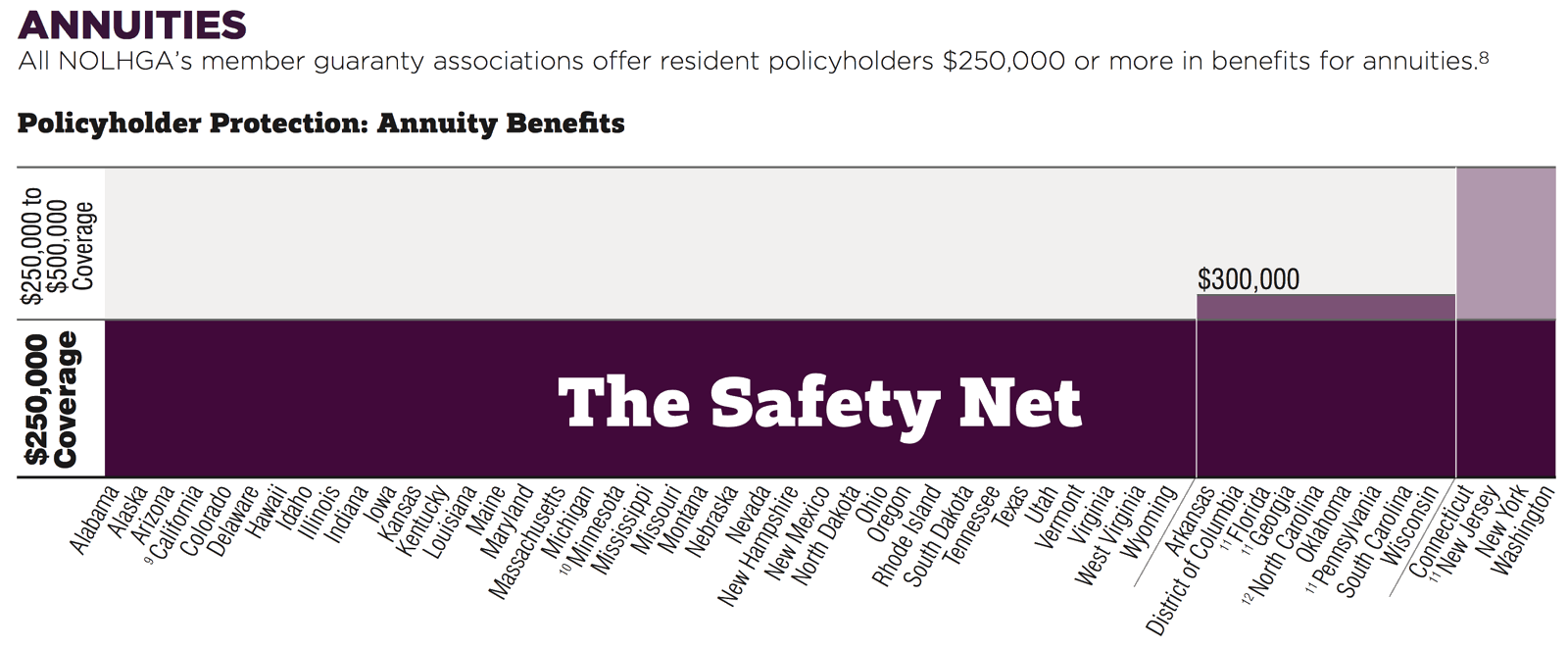
While the coverage limits vary from state to state, virtually all states offer at least $250,000 in coverage for the present value of an annuity contract. (Connecticut, New York, and Washington offer $500,000 in coverage. In California, the limit is only 80% not to exceed $250,000.) Look up your specific state’s limits here and here. Here is a reference chart (click to enlarge, source):

Unfortunately, this is not the same as being backed by the federal government, as with FDIC-insurance. It’s not even a state government backing, as only the member insurance companies have agreed to cover each other in cases of insolvency up to the policy limits. The guaranty system has not resulted in a loss to consumers within the limits since their inception in the 1980s, meaning it worked through the 2000 and 2008 market crashes. In order to be a licensed member of that association, you need to maintain a certain level of financial stability and under regular audits. Each individual insurer also rated by various agencies like AM Best, Moody’s, or Standard & Poors. In the end, there remains a possibility that an extremely large event could happen that would result in the inability of the stronger companies to help all the weaker ones. I recommend reading this paper about how the state guaranty system works in a failure.

It’s hard to put a number on the possibility of a partial loss even with this state guaranty system, but I’d definitely rather be covered with it than without. In this older 2013 post, I wrote about MYGAs and how to structure your accounts to stay within your state’s specific coverage limits.

Higher-rated insurers typically pay lower interest rates, and lower-rated insurers typically pay higher interest rates. There are different strategies on how to navigate this system. One is to decide on the lowest safety rating that you will accept, and then find the highest interest rate available with that minimum rating. Another is to simply trust in the state guaranty system and treat all the insurers as equal as long as you remain below the state-specific coverage limits. In that case, you simply buy the highest interest rate available from a licensed insurer.

If you are trying to understand what the ratings mean, first refer to the AM Best Ratings Guide [PDF], which states that “A Best’s Financial Strength Rating (FSR) is an opinion of an insurer’s ability to meet its obligations to policyholders.” followed by:

  • A++, A+. Assigned to insurance companies that have, in our opinion, a superior ability to meet their ongoing insurance obligations.
  • A, A-. Assigned to insurance companies that have, in our opinion, an excellent ability to meet their ongoing insurance obligations.
  • B++, B+. Assigned to insurance companies that have, in our opinion, a good ability to meet their ongoing insurance obligations.

I don’t know about you, but I would rate that as “Super Vague++”. Marginally more helpful is the fact that in the past, AM Best categorized the following as “Secure” : A++, A+ A, A- B++, B+. Anything below that fell to “Vulnerable”.

Here is another chart from AM Best that lists cumulative impairments over different time periods (via the Bogleheads forum):

It is important to note that an impairment does not necessarily mean that the insurer could not pay out the interest. It simply means that some sort of negative action was taken by a state regulatory agency. The insurer may be put under “administrative supervision” and may later exit while never missing any payments. Or, the insurer may be taken into conservatorship and the assets sold/transferred to a solvent insurer, again never missing any payments.

Again, I would spread out my MYGA contracts across multiple insurers and make sure the final size is well below your state’s contractual limits. For example, if the limit is $100k you put exactly $100k in a single contract at 3% interest for 5 years, at the end you’ll have over $115,000 and thus have $15k of your funds exposed.

Where do I buy a MYGA? I am not a insurance professional and I’ve probably missed some details. But I also get no commission if you buy one of these things. As a consumer, you should know the MYGA commission is baked inside and the upfront price is the same no matter who you buy it from. Back when I bought my MYGA in 2015, I did my own research and chose to buy from “Stan the Annuity Man”. You can find the MYGA section of his site here with rates for your specific state. I had a positive experience and would recommend him, especially if you prefer to have a reliable person-to-person relationship with good communication. I am not affiliated with Stan, other than being a satisfied customer. In 2020, there are more “fintech” options including the Blueprint Income marketplace. Both of those websites are have an educational section with more information about MYGAs in general.

At the end of your MYGA contract, you will have short (30-day?) window where you can make a 1035 transfer to another annuity provider (or renew with the same provider at prevailing rate). I was given plenty of heads up by The Annuity Man team. Again, the price should be same no matter where you buy it, so I would pick the place you think you’ll get better customer service. It might even be a local broker.

Bottom line. This is a brief introduction to a unique annuity product called the MYGA (multi-year guaranteed annuity) that offers a fixed, tax-deferred yield that may be significantly higher than that of other investment-grade bonds like US Treasuries. There are many important factors to understand, including insurer stability ratings, state guaranty limits, liquidity rules, and surrender charges. I’ve probably overlooked something as well. MYGAs are best if you are a motivated DIY investor looking for higher-yielding fixed-income investments and have maxed out your other tax-deferred options like IRAs and 401(k) plans.

What Really Matters In Your Personal Finances

The best sentence about personal finance that I’ve read this week is from Beware of Financial Alchemy by Adam Collins of Movement Capital.

There are only a few things you can control that have a big impact on your finances:

If you’re young, how much you save
If you’re retired, how much you spend
How you behave when markets panic
Your allocation between stocks and bonds
How much you pay in fees

Everything else is a rounding error. The issue is we tend to focus on the rounding errors.

That’s exactly right. I write a lot about rounding errors because otherwise I’d just be saying the above sentence over and over again. Writing about personal finance often boils down to a game where you have to talk about the same 5-10 topics but manage to put a different spin on them so it feels fresh.

However, I try to focus on rounding errors that have a very high probability of helping you out without harming you. A little higher yield on an FDIC-insured bank account. A little more cash back on your existing credit card purchases. A little higher net return through lower cost index funds and no-commission-fee brokerage firms (or those that pay you to move over some assets). Piling on a few more data points on market drops to keep you in the long-term mindset. But don’t get scammed by someone promising what is simply too good to be true:

The truth about investing in 2020 is there isn’t an easy fix for high stock valuations and low bond yields. No strategy can magically transform today’s low return opportunity set into a high return future. So what can you do? Focus on what you can control and don’t get tempted by someone promising they can turn lead into gold.

Chase Sapphire Preferred, Sapphire Reserve: New Benefits November 2020

Newly added and extended benefits as of November 2020. The Chase Sapphire Preferred card and Chase Sapphire Reserve card have been very popular for their generous travel and dining perks, but right now travel and dining aren’t really happening. Chase has adjusted their rewards program for this new environment, including the following:

Chase Sapphire Preferred new changes:

  • New: 2X points at Grocery Stores. 2x total points on up to $1,000 in grocery store purchases per month from November 1, 2020 to April 30, 2021, including pickup and eligible grocery store delivery services. It’s automatic—no activation required.
  • Extended through April 2021: Redeem Ultimate Rewards points at 1.25 cents per points towards grocery store, dining, and home improvement stores. (Previously only travel through their portal.) Through April 30, 2021, your points are worth 25% more when you redeem them for statement credits after using your card at grocery stores and dining at restaurants (including takeout and eligible delivery services), home improvement stores and select charitable organizations. Footnote1(Opens Overlay) Just choose an eligible purchase made with your Sapphire Preferred card from the past 90 days. Then, apply the points for all or part of the purchase and receive a statement credit.
  • 12+ months of included DashPass membership. For a minimum of one year, enjoy a complimentary DashPass, DoorDash’s subscription service that provides unlimited restaurant deliveries with $0 delivery fee and reduced service fees on eligible orders over $12 on DoorDash and Caviar. Activate by December 31, 2021.

If you earn 2x points on a grocery store purchase, and can use those points at 1.25 cents per point towards grocery store purchases using the Pay Yourself Back tool, that works out to 2.5% cashback towards grocery store purchases.

Chase Sapphire Reserve new changes:

  • New: 3X points at Grocery Stores. 2x total points on up to $1,000 in grocery store purchases per month from November 1, 2020 to April 30, 2021, including pickup and eligible grocery store delivery services. It’s automatic—no activation required.
  • Extended through April 2021: Redeem Ultimate Rewards points at 1.50 cents per points towards grocery store, dining, and home improvement stores. (Previously only travel through their portal.) Through April 30, 2021, your points are worth 50% more when you redeem them for statement credits after using your card at grocery stores and dining at restaurants (including takeout and eligible delivery services), home improvement stores and select charitable organizations. Footnote1(Opens Overlay) Just choose an eligible purchase made with your Sapphire Reserve card from the past 90 days. Then, apply the points for all or part of the purchase and receive a statement credit.
  • Extended through June 2021: $300 annual travel credit works on gas station and grocery store purchases. There are more ways to earn your annual $300 Travel Credit. Through June 30, 2021, gas station and grocery store purchases will count toward earning your Travel Credit. You’ll also earn points on these purchases. And, as always, after your first $300 in travel purchases, you’ll immediately start earning 3x points on travel.
  • 12+ months of Dashpass Membership plus $60 in Doordash food credit per calendar year. For a minimum of one year, enjoy a complimentary DashPass, DoorDash’s subscription service that provides unlimited restaurant deliveries with $0 delivery fee and reduced service fees on eligible orders over $12 on DoorDash and Caviar. Activate by December 31, 2021. Plus, earn up to $120 in statement credits on DoorDash purchases through 2021—that’s $60 in statement credits through 2020 and another $60 in statement credits through 2021.
  • Annual fee renewal $100 discount. Sapphire Reserve annual fee renewals through the end of 2020 will be $450 instead of the normal $550. This is only for renewals, not new cardmembers.

If you earn 3x points on a grocery store purchase, and can use those points at 1.5 cents per point towards grocery store purchases, that works out to 4.5% cashback towards grocery store purchases.

$45 of Free Grubhub Food: Rakuten $30 + Grubhub 11% Cash Back / $10 Off

There are three separate deals going on right now that are stackable. Altogether, if you sign up for new accounts for Grubhub and Rakuten, you can effectively get about $45 of food for free!

  • $30 Rakuten bonus. Rakuten (formerly eBates) is a cashback shopping portal. Right now, they have an limited-time $30 new user bonus via referral when you make your first purchase of $30+ through any participating Rakuten retailer within 90 days of joining. The standard non-referral bonus is only $10.
  • $10 off first order of $15+ from Grubhub. New users of Grubhub food delivery can get $10 off your first Grubhub order of $15+ and free delivery if you join via my referral link. This comes from Grubhub itself.
  • 11% Cash Back on first Grubhub order via Rakuten app. Rakuten actually gives cash back on Grubhub purchases, which makes it an easy way to trigger the $30 bonus above. In addition, you can get 11% cash back on your first order and also 2% cash back on future orders. You must order via their app.

Here is a detailed step-by-step breakdown:

  • First, sign up for Grubhub here.
  • Next, sign up for Rakuten here.
  • Download the Rakuten app and sign in.
  • Using Rakuten app, search for Grubhub and order within the app.
  • You should be able to apply your $10 off code and also get free delivery on your first order. Be sure that the net order amount after discounts and before tax and tip is a least $30. So order about $45 of food.
  • This will trigger the $30 Rakuten bonus, and then you’ll also see the 11% cash back afterward in your Rakuten balance.

Let’s say you order $45.45 of food. $10 off from Gruhbub + $30 off from Rakuten + 11% cash back = $45 of free food! These are all my referral links and I will get the referrer credit when you use them. Thanks if you use them!

For future orders, you can still get 2% cash back on Grubhub through Rakuten app, on top of any credit card rewards. In addition, you can also get free Gruhhub+ membership with Lyft Pink membership (included with the Chase Sapphire Reserve card).

Born to Run: Is Running Outdoors Another Deeply-Embedded Human Desire?

Recently, I’ve been attracted to books that talk about common qualities of all humans (as opposed to their differences) – like how humans became the dominant species because of their ability to cooperate (Sapiens) and our shared need for autonomy, competence, and community (Tribe). I’m not an avid runner, but Born to Run: A Hidden Tribe, Superathletes, and the Greatest Race the World Has Never Seen by Christopher McDougall suggests that running is another link in that story. Perhaps this ability to run for long distances (extended outdoor exercise) is another way we can achieve a better balance of our mental, physical, and spiritual selves.

The specific race tale in the book is also suspenseful and exciting (once you get past the slow beginning), making this is a recommended read for that reason alone. I don’t want to give spoilers, so here are some highlights that focus on a better life – which of course is the ultimate goal of financial freedom.

The Tarahumara are an indigneous people that live a secluded life in the Sierra Madre canyons of Mexico. They are known for their running ability, but perhaps they aren’t special, but just the ones that have managed to keep what was once a common skill? Put another way – Why do so many people love running?

That was the real secret of the Tarahumara: they’d never forgotten what it felt like to love running. They remembered that running was mankind’s first fine art, our original act of inspired creation.

Know why people run marathons? he told Dr. Bramble. Because running is rooted in our collective imagination, and our imagination is rooted in running. Language, art, science; space shuttles, Starry Night, intravascular surgery; they all had their roots in our ability to run. Running was the superpower that made us human-which means it’s a superpower all humans possess.

“And you’ve got to ask yourself why only one species in the world has the urge to gather by the tens of thousands to run twenty-six miles in the heat for fun,” Dr. Bramble mused. “Recreation has its reasons.”

And like everything else we love – everything we sentimentally call our “passions” and “desires” – it’s really an encoded ancestral necessity. We were born to run; we were born because we run. We’re all Running People, as the Tarahumara have always known.

Human bodies are actually well-suited for distance running. Not running fast, but running for an extended time, longer than most other mammals. Some of our ancestors hunted by simply chasing and outlasting an animal until it collapsed in exhaustion. Perhaps ultra-marathoners are not so unusual after all.

Ethnographers’ reports he’d read years ago began flooding his mind; they told of African hunters who used to chase antelope across the savannahs, and Tarahumara Indians who would race after a deer “until its hooves fell off.” Lieberman had always shrugged them off as tall tales, fables of a golden age of heroes who’d never really existed. […] You don’t even have to go fast, Lieberman realized. All you have to do is keep the animal in sight, and within ten minutes, you’re reeling him in. If a middle-aged professor can outrun a dog on a hot day, imagine what a pack of motivated hunter-gatherers could do to an overheated antelope.”

The best shoes are the worst. This book is a bit of an antidote to the memoir of Nike founder Phil Knight Shoe Dog (which I still enjoyed). What if thick-soled wedge shoes aren’t really solving a problem, just prolonging it?

Bowerman’s marketing was brilliant. “The same man created a market for a product and then created the product itself,” as one Oregon financial columnist observed. “It’s genius, the kind of stuff they study in business schools.” Bowerman’s partner, the runner-turned-entrepreneur Phil Knight, set up a manufacturing deal in Japan and was soon selling shoes faster than they could come off the assembly line.

“Every great cause begins as a movement, becomes a business, and turns into a racket.”

The Tarahumara run long distances on thin sandals. Perhaps we need more of the posture-improving feedback and foot-strengthening from running barefoot:

The way to activate your fat-burning furnace is by staying below your aerobic threshold-your hard-breathing point-during your endurance runs. Respecting that speed limit was a lot easier before the birth of cushioned shoes and paved roads; try blasting up a scree-covered trail in open-toed sandals sometime and you’ll quickly lose the temptation to open the throttle. When your feet aren’t artificially protected, you’re forced to vary your pace and watch your speed: the instant you get recklessly fast and sloppy, the pain shooting up your shins will slow you down.

Like many other ancient cultures, the Tarahumara have a strong sense of and hospitality. When we help each other without expectation, it makes everyone’s life better.

“The Raramuri have no money, but nobody is poor,” Caballo said. In the States, you ask for a glass of water and they take you to a homeless shelter. Here, they take you in and feed you. You ask to camp out, and they say, “Sure, but wouldn’t you rather sleep inside with us?”

Also like many other ancient cultures, eating a primarily plant-based diet gives you all the nutrition you need and lets your body’s natural feedback system tell you when to stop eating. Engineered junk food like Cheetos/Doritos dust and super-sweet everything are designed to keep your body always wanting more. Chia seeds are the natural “energy food” of the Tarahumara tribe.

The first step toward going cancer-free the Tarahumara way, consequently, is simple enough: Eat less. The second step is just as simple on paper, though tougher in practice: Eat better. Along with getting more exercise, says Dr. Weinberg, we need to build our diets around fruit and vegetables instead of red meat and processed carbs. Anything the Tarahumara eat, you can get very easily,” Tony told me. “It’s mostly pinto beans, squash, chili peppers, wild greens, pinole, and lots of chia.”

Outdoor exercise just seems to make you happier:

“Such a sense of joy!” marveled Coach Vigil, who’d never seen anything like it, either. “It was quite remarkable.” Glee and determination are usually antagonistic emotions, yet the Tarahumara were brimming with both at once, as if running to the death made them feel more alive.

I knew aerobic exercise was a powerful antidepressant, but I hadn’t realized it could be so profoundly mood stabilizing and-I hate to use the word-meditative. If you don’t have answers to your problems after a four-hour run, you ain’t getting them.

“Just move your legs. Because if you don’t think you were born to run, you’re not only denying history. You’re denying who you are.”

Finding happiness is often about wanting less (which has the nice side effect of spending less). Nothing mentioned in this book requires a brand-name consumer product or a huge net worth. Run or walk, preferably outdoors, preferably with other people. If you have back or knee problems, try switching gradually to something closer to barefoot (thinner, flatter soles) but keep on walking outside with friends. Eat mostly plants, or at least more plants. Look to help other people. I might also try going for a jog…

Consumer Reports: Electric Vehicle Total Cost of Ownership Savings Breakdown

Consumer Reports is well-known for their annual survey of customers about their cars’ reliability and ownership costs. While electrical vehicles usually cost more upfront, they also cost less to fuel, maintain, and repair than traditional gas-powered vehicles. But CR has now released much more detailed data about real world results. Here are some highlights from their summary article and full report.

A CR study shows that total ownership cost savings can more than make up for an electric vehicle’s typically higher purchase price.

Maintenance costs. Here are the average maintenance and repair costs over vehicle lifetime.

  • BEV (Battery-Electric Vehicle): $0.03/mile
  • PHEV (Plug-in Hybrid Electric Vehicle): $0.03/mile
  • ICE (Internal Combustion Engine): $0.06/mile

The difference increases with the age of the vehicles, breaking down roughly to 2 cents per mile for the first 100k miles and then 4 cents per miles in the second 100k miles.

Fuel costs. Most EVs cost on average $800 to $1,000 less to fuel up for each 15,000 miles. This adds up to $8,500 to $11,200 savings over the lifetime of the car. (Prices vary, but most are within 10% of this average. Places where gas costs more is also often where electricity costs more.)

Resale value. It’s basically a tie. Both compact and luxury cars of both EV and ICE types lose about 55% of their value over first 5 years, on average.

Here’s my super-simplified take. Take any EV upfront price premium, and offset it with:

  • Maintenance and repair savings. About 2 cents per mile savings in the first 100k miles, and 4 cents per mile savings after that.
  • Fuel cost savings. Calculate yourself using your miles driven, local gas price, MPG, local electricity price, miles/KWh. Lots of fuel calculators out there.
  • Depreciation. This will likely be a wash, so no savings.

In the end, that EV price premium is still the most critical factor to your bottom line, but it is nice to have some hard numbers especially about the difference in overall maintenance and repair costs.

Amazon Prime Day 2020: Big List of Deals and Discounts (Updated)

Amazon Prime Day is over, don’t forget to spend your free credits. Here are their current Holiday Dash Deals of the Day.

Amazon Prime Day 2020 is October 13th and 14th. I’ll try to keep this post updated with the most recent offers. There are usually many opportunities to save some money without buying stuff you don’t need (and thus offset a chunk of that membership fee). I bought a discounted Eero WiFi system last year and it was definitely a worthwhile upgrade.

As the name suggests, most deals require a Prime membership. New members can sign up for a 30-day free trial. If you’ve already done the trial, you can simply buy a month of Prime for $12.99 ($5.99 with EBT or Medicaid card).

Newest Deals

General Deals

Amazon Device Deals

Amazon Partner Deals

Savings I Bonds November 2020 Interest Rate: 1.68% Inflation Rate, 0% Fixed

Update November 2020. The fixed rate will be 0% for I bonds issued from November 1, 2020 through April 30th, 2021. The variable inflation-indexed rate for this 6-month period will be 1.68% (as was predicted). If you buy a new bond in between November 2020 and April 2021, you’ll get 1.68% for the first 6 months. Don’t forget that the purchase limits are based on calendar year, if you wish to max out for 2020. See you again in mid-April for the next early prediction for May 2021.

Original post:

sb_posterSavings I Bonds are a unique, low-risk investment backed by the US Treasury that pay out a variable interest rate linked to inflation. With a holding period from 12 months to 30 years, you could own them as an alternative to bank certificates of deposit (they are liquid after 12 months) or bonds in your portfolio.

New inflation numbers were just announced at BLS.gov, which allows us to make an early prediction of the November 2020 savings bond rates a couple of weeks before the official announcement on the 1st. This also allows the opportunity to know exactly what a October 2020 savings bond purchase will yield over the next 12 months, instead of just 6 months. You can then compare this against a November 2020 purchase.

New inflation rate prediction. March 2020 CPI-U was 258.115. September 2020 CPI-U was 260.280, for a semi-annual increase of 0.84%. Using the official formula, the variable component of interest rate for the next 6 month cycle will be 1.68%. You add the fixed and variable rates to get the total interest rate. If you have an older savings bond, your fixed rate may be very different than one from recent years.

Tips on purchase and redemption. You can’t redeem until 12 months have gone by, and any redemptions within 5 years incur an interest penalty of the last 3 months of interest. A simple “trick” with I-Bonds is that if you buy at the end of the month, you’ll still get all the interest for the entire month as if you bought it in the beginning of the month. It’s best to give yourself a few business days of buffer time. If you miss the cutoff, your effective purchase date will be bumped into the next month.

Buying in October 2020. If you buy before the end of October, the fixed rate portion of I-Bonds will be 0%. You will be guaranteed a total interest rate of 0.00 + 1.06 = 1.06% for the next 6 months. For the 6 months after that, the total rate will be 0.00 + 1.68 = 1.68%.

Let’s look at a worst-case scenario, where you hold for the minimum of one year and pay the 3-month interest penalty. If you theoretically buy on October 31st, 2020 and sell on October 1, 2021, you’ll earn a ~1.04% annualized return for an 11-month holding period, for which the interest is also exempt from state income taxes. If you theoretically buy on October 31st, 2020 and sell on February 1, 2022, you’ll earn a ~1.10% annualized return for an 15-month holding period. Comparing with the best interest rates as of October 2020, you can see that this is slightly higher than a current top savings account rate or 12-month CD.

Buying in November 2020. If you buy in November 2020, you will get 1.68% plus a newly-set fixed rate for the first 6 months. The new fixed rate is unknown, but is loosely linked to the real yield of short-term TIPS. In the past 6 months, the 5-year TIPS yield has been consistently negative! My confident guess is that it will be zero (0%). Every six months, your rate will adjust to your fixed rate (set at purchase) plus a variable rate based on inflation.

If you have an existing I-Bond, the rates reset every 6 months depending on your purchase month. Your bond rate = your specific fixed rate (set at purchase) + variable rate (total bond rate has a minimum floor of 0%).

Buy now or wait? The fixed rate is most likely going to be zero for October and November purchases, and so I would personally wait until November and get the 1.68% inflation and unknown inflation rate after that, betting that it will be higher than 1.06%. Either way, it seems worthwhile to use up the purchase limit for 2020 as the rates will at least be slightly higher than other cash equivalents.

Unique features. I have a separate post on reasons to own Series I Savings Bonds, including inflation protection, tax deferral, exemption from state income taxes, and educational tax benefits.

Over the years, I have accumulated a nice pile of I-Bonds and now consider it part of the inflation-linked bond allocation inside my long-term investment portfolio.

Annual purchase limits. The annual purchase limit is now $10,000 in online I-bonds per Social Security Number. For a couple, that’s $20,000 per year. Buy online at TreasuryDirect.gov, after making sure you’re okay with their security protocols and user-friendliness. You can also buy an additional $5,000 in paper I bonds using your tax refund with IRS Form 8888. If you have children, you may be able to buy additional savings bonds by using a minor’s Social Security Number.

For more background, see the rest of my posts on savings bonds.

[Image: 1946 Savings Bond poster from US Treasury – source]