Archives for October 2020

Guest Opinion Rewards: Earn 10,000 Hilton Points With First Survey

If like many people you haven’t been traveling, you still need to keep an eye on the expiration policies of those airline and hotel points. Most programs offer both dining and survey programs which make it relatively easy to earn a few miles and prevent your points from expiring.

Guest Opinion Rewards works with Hilton Honors points, which expire after 12 months of inactivity. Right now, this special link (not my link) should have text that states “Earn 10,000 Hilton Honors Bonus Points when you take your first survey!”. Hat tip to The Gate. You need to complete a survey within 3 months of enrolling, but I just signed up, verified my e-mail, and completed the shortest survey available all within about 10 minutes. My 10,000 points already show up as pending, and are supposed to arrive in 6-8 weeks.
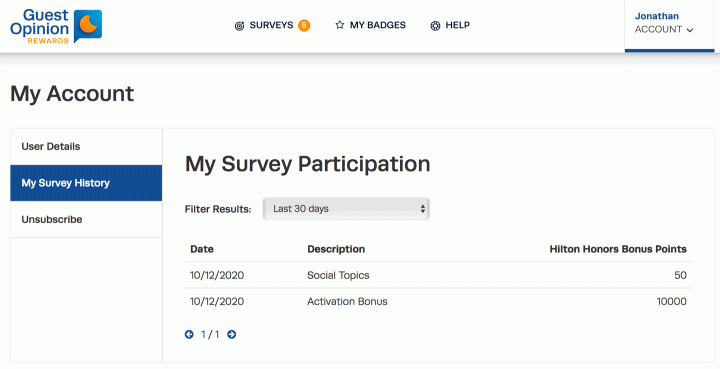
*Bonus Points are only available to newly enrolled members who complete their first survey within 3 months of enrolling, through this offer. Terms and conditions apply and are subject to change; contact Research Now for details.

Your situation may be different, but I don’t participate in most of these paid surveys as they often aren’t a good value for the time spent. But a 5-minute survey that earns even 5 points once a year can keep 100,000 miles/points from expiring. It helps not to wait until the last minute, as they may take a few weeks to post. (Many programs have paused expiration for the moment, but it is still good to create activity as that won’t last forever. Hilton has paused expiration until 12/31/2020.)

I also use The Opinion Terminal for Alaska Air miles and Opinions Take Flight for Hawaiian Air miles. These are the airlines with which I don’t always generate miles every year, but still have a decent miles balance that I wish to keep active.

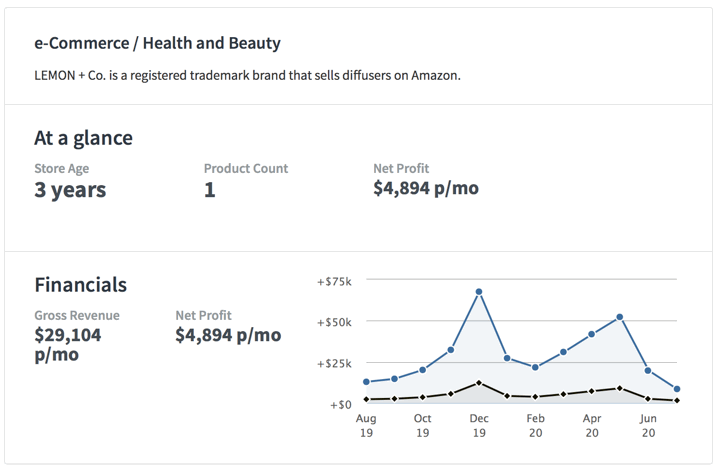
Flippa: Buy and Sell Digital Real Estate Like eCommerce Stores, Amazon Products

Flipping, rehabbing, or rental residential real estate is a popular entrepreneurial activity, but I’ve always been more partial to digital real estate (websites). There are similarities in that anyone can enter the business as long as they are willing to learn quickly and put in the hours. Nobody gets a degree in “landlording”, just as nobody gets a degree in “digital marketing”. Everything is about results, not letters after names. Some own $500 websites, while others own $5,000,000 websites.

You can now also buy and sell digital properties via online marketplaces. I often spend idle moments browsing the email newsletter of the biggest one, Flippa.com, and realized that a beginner could learn a lot about the industry by just reading through the listings. The best way to learn is still to jump in and get your hands dirty, but seeing the inner details of all these properties will accelerate your education. How does their website valuation tool work? What are the ranges in terms of multiples of revenue? How do you verify traffic stats? By signing up for a free account, you can see the non-public listings as well. I’ve learned a lot more about the Amazon ecosystem myself.

Some people love to start websites from nothing and quickly sell them for $1,000 to $10,000. Others like to find a starter drop-shipping site or Amazon product with potential and improve it into a six-figure property. Others are just looking to build a portfolio of properties that creates a steady cashflow with minimal maintenance. The market is a lot more mature than when I was buying domains on small internet forums. Private equity funds and publicly-listed corporations are also increasingly in the game.

You should also know that digital properties are much more volatile in price. A condo in Manhattan, NY or a 4-plex in Portland, OR might double in price in the next 10 years, but it won’t go up 2,000% or drop by 95% either. They also vary widely in the ongoing work involved. Some require hardly any maintenance, while others require ongoing marketing campaigns and a team of independent contractors.

One of the pathways to wealth is to find an asset type that you have a passion for, instead of a consumer product. Some people get $1,000 and spend it on video games, a car modification, or some nice clothes. Others get a kick out of buying another share of BRK, JNJ, or VTI stock. Same for a downpayment toward a rental property, reinvesting into their own private business, or to improve or acquire a digital asset. You also end up increasing your knowledge in that industry, which is highly valuable on its own.

Disclosure: I did sign up to be an affiliate of Flippa, and will receive a commission if someone clicks and lists a site for sale, but not if you just sign up for an account to browse listings.

Simple Credit Card / Brokerage / Bank Promotion Spreadsheet Template (Google Drive)

gsheetsIf you can’t tell by now, I enjoy participating in various credit card, brokerage, and banking promotions throughout the year. I think of it as a profitable hobby, as I enjoy trying out different financial products in addition to the thousands of dollars in extra income each year. Below is the simple spreadsheet that I use to I track all of the various the requirements and deadline dates involved. I also set online calendar reminders using those dates.

I just moved it over to Google Sheets – the first link will allow you to make your own personal copy to edit as you wish. Please don’t ask for access to the original sheet, as that would mess it up for everyone else.


I intentionally keep it rather minimalist. This Reddit template by u/garettg is another example with many more bells and whistles.

See also: MMB Simple Portfolio Rebalancing Spreadsheet Template and How I store my physical credit cards.

Amazon Prime: Spend $20 on eBooks, Get $5 eBook Credit

Amazon has a new promotion for Prime members: Spend $20 on Kindle eBooks, get $5 eBook credit.. You must activate at the link and spend $20 on any eBooks by October 12th, 2020.

Here are (again) my recommended books about early retirement and financial freedom:

Here are all my book reviews in reverse-chronological order.

Free Grubhub+ Membership with Lyft Pink (Chase Sapphire Reserve), $10 Off First Order

Lyft has announced that Lyft Pink members will automatically get a free Grubhub+ membership (or Seamless+ if you live in New York City). Grubhub+ usually costs $9.99 a month and includes:

  • Unlimited free delivery from from nearly 200,000 restaurants ($12 minimum order).
  • Exclusive member discounts featuring free food, dollars-off and more from popular restaurants
  • Donation matching through Grubhub’s Donate the Change program with all proceeds currently going towards the Grubhub Community Relief Fund, supporting communities in need impacted by COVID-19

This is notable because Lyft Pink (reg. $199 a year) is included free with the popular Chase Sapphire Reserve card. This adds another potentially valuable perk to offset that high annual fee.

Receive up to 15% off car rides, plus other benefits, such as priority airport pickups, relaxed cancellations, and exclusive saving opportunities with one year of complimentary Lyft Pink, a $199 minimum value, when you or your authorized user activates with a Sapphire Reserve card by March 31, 2022. Lyft Pink will be registered in the name of the cardmember who first activates the benefits.

If you have not joined Grubhub yet, you can get $10 off your first Grubhub order of $15+ if you join via my referral link. I will get food credits as well. Thanks if you use it!

If you already have both Lyft Pink and Grubhub accounts, link them together and activate here.

The Chase Sapphire Reserve also gives a free year of Dashpass membership (free delivery on DoorDash) along with $60 in statement credits on DoorDash food purchases ($60 in 2020 and $60 in 2021). If you are new customer to DoorDash and sign up via my DoorDash referral link, you will get $10 off your first 3 DoorDash orders over $20 ($30 total savings). I will get food credits as well. Thanks if you use it!

Instacart Express: Free Two-Month Trial Membership with Mastercard

Mastercard has partnered with Instacart to offer a free 2-month membership to Instacart Express when you join with a Mastercard, but after the 2 months you will automatically renew at the $99 annual rate.

Join today with Mastercard® to enjoy Instacart Express member benefits for 2 months at no charge. After 2 months, your Instacart Express membership will automatically renew to an annual plan and $99 will be automatically charged to your default, active and registered Mastercard® on file with your Instacart account at the time of renewal. Starting a membership with your Mastercard® updates your default payment method. See your Instacart Express account page to make changes or cancel your plan.

Instacart Express usually costs $9.99 a month and includes free delivery on $35+ orders and reduced service fees. They claim the average savings is $7 per order. Be sure to set a calendar reminder to cancel.

Best Interest Rates on Cash – October 2020

Here’s my monthly roundup of the best interest rates on cash for October 2020, roughly sorted from shortest to longest maturities. I track these rates because I keep 12 months of expenses as a cash cushion and also invest in longer-term CDs (often at lesser-known credit unions) when they yield more than bonds. Check out my Ultimate Rate-Chaser Calculator to see how much extra interest you’d earn by moving money between accounts. Rates listed are available to everyone nationwide. Rates checked as of 10/4/2020.

High-yield savings accounts
While the huge megabanks pay essentially no interest, it’s easy to open a new “piggy-back” savings account and simply move some funds over from your existing checking account. The interest rates on savings accounts can drop at any time, so I list the top rates as well as competitive rates from banks with a history of competitive rates. Some banks will bait you with a temporary top rate and then lower the rates in the hopes that you are too lazy to leave.

  • Affirm has the top rate at the moment at 1.00% APY with no minimum balance requirements. I wonder how long this will last, as the rate is high but Affirm also charges really high interest to let folks buy jeans on a payment plan. There are several other established high-yield savings accounts at a little below 1% APY for now.
  • As noted in my past two monthly updates, I took a gamble and opened an HM Bradley last quarter, shifted over my direct deposit, didn’t withdraw it, and am now earning 3% APY on up to $100,000 of my liquid savings from October through December 2020. My long-term concerns still linger, but I am impressed that they kept their rates high for this quarter. You can still earn 1% for this quarter (and hopefully qualify for the higher tiers next quarter) if you can move over a direct deposit.

Short-term guaranteed rates (1 year and under)
A common question is what to do with a big pile of cash that you’re waiting to deploy shortly (just sold your house, just sold your business, legal settlement, inheritance). My usual advice is to keep things simple and take your time. If not a savings account, then put it in a flexible short-term CD under the FDIC limits until you have a plan.

  • No Penalty CDs offer a fixed interest rate that can never go down, but you can still take out your money (once) without any fees if you want to use it elsewhere. Marcus has a 7-month No Penalty CD at 0.75% APY with a $500 minimum deposit. AARP members can get an 8-month CD at 0.85% APY. Ally Bank has a 11-month No Penalty CD at 0.60% APY for all balance tiers. CIT Bank has a 11-month No Penalty CD at 0.35% APY with a $1,000 minimum deposit. You may wish to open multiple CDs in smaller increments for more flexibility.
  • CommunityWide Federal Credit Union has a 12-month CD at 0.95% APY ($1,000 min). Early withdrawal penalty depends on how early you withdraw. Anyone can join this credit union via partner organization ($5 one-time fee).

Money market mutual funds + Ultra-short bond ETFs
If you like to keep cash in a brokerage account, beware that many brokers pay out very little interest on their default cash sweep funds (and keep the difference for themselves). The following money market and ultra-short bond funds are NOT FDIC-insured and thus come with a possibility of principal loss, but may be a good option if you have idle cash and cheap/free commissions.

  • The default sweep option is the Vanguard Federal Money Market Fund which has an SEC yield of 0.05%. Vanguard Cash Reserves Federal Money Market Fund (formerly Prime Money Market) currently pays an 0.04% SEC yield.
  • Vanguard Ultra-Short-Term Bond Fund currently pays 0.70% SEC yield ($3,000 min) and 0.80% SEC Yield ($50,000 min). The average duration is ~1 year, so there is more interest rate risk.
  • The PIMCO Enhanced Short Maturity Active Bond ETF (MINT) has a 0.47% SEC yield and the iShares Short Maturity Bond ETF (NEAR) has a 0.64% SEC yield while holding a portfolio of investment-grade bonds with an average duration of ~6 months. Note that there was a sudden, temporary drop in net asset value during the March 2020 market stress.

Treasury Bills and Ultra-short Treasury ETFs
Another option is to buy individual Treasury bills which come in a variety of maturities from 4-weeks to 52-weeks. You can also invest in ETFs that hold a rotating basket of short-term Treasury Bills for you, while charging a small management fee for doing so. T-bill interest is exempt from state and local income taxes. Right now, this section isn’t very interesting as T-Bills are yielding close to zero!

  • You can build your own T-Bill ladder at TreasuryDirect.gov or via a brokerage account with a bond desk like Vanguard and Fidelity. Here are the current Treasury Bill rates. As of 10/2/2020, a new 4-week T-Bill had the equivalent of 0.10% annualized interest and a 52-week T-Bill had the equivalent of 0.12% annualized interest.
  • The Goldman Sachs Access Treasury 0-1 Year ETF (GBIL) has a 0.00% SEC yield and the SPDR Bloomberg Barclays 1-3 Month T-Bill ETF (BIL) has a -0.04% (!) SEC yield. GBIL appears to have a slightly longer average maturity than BIL.

US Savings Bonds
Series I Savings Bonds offer rates that are linked to inflation and backed by the US government. You must hold them for at least a year. There are annual purchase limits. If you redeem them within 5 years there is a penalty of the last 3 months of interest. The annual purchase limit is $10,000 per Social Security Number, available online at TreasuryDirect.gov. You can also buy an additional $5,000 in paper I bonds using your tax refund with IRS Form 8888.

  • “I Bonds” bought between May 2020 and October 2020 will earn a 1.06% rate for the first six months. The rate of the subsequent 6-month period will be based on inflation again. More info here.
  • In mid-October 2020, the CPI will be announced and you will have a short period where you will have a very close estimate of the rate for the next 12 months. I will have another post up at that time.
  • See note about EE Bonds as a potential long-term bond alternative.

Prepaid Cards with Attached Savings Accounts
A small subset of prepaid debit cards have an “attached” FDIC-insured savings account with exceptionally high interest rates. The negatives are that balances are capped, and there are many fees that you must be careful to avoid (lest they eat up your interest). Some folks don’t mind the extra work and attention required, while others do. There is a long list of previous offers that have already disappeared with little notice. I don’t personally recommend nor use any of these anymore.

  • One of the few notable cards left in this category is Mango Money at 6% APY on up to $2,500, along with several hoops to jump through. Requirements include $1,500+ in “signature” purchases and a minimum balance of $25.00 at the end of the month.

Rewards checking accounts
These unique checking accounts pay above-average interest rates, but with unique risks. You have to jump through certain hoops, and if you make a mistake you won’t earn any interest for that month. Some folks don’t mind the extra work and attention required, while others do. Rates can also drop to near-zero quickly, leaving a “bait-and-switch” feeling. If you want rates above 2% APY, this is close to the only game in town.

  • Consumers Credit Union Free Rewards Checking (my review) still offers up to 4.09% APY on balances up to $10,000 if you make $500+ in ACH deposits, 12 debit card “signature” purchases, and spend $1,000 on their credit card each month. The Bank of Denver has a Free Kasasa Cash Checking offering 2.50% APY on balances up to $25,000 if you make 12 debit card purchases and at least 1 ACH credit or debit transaction per statement cycle. If you meet those qualifications, you can also link a savings account that pays 1.50% APY on up to $50k. Thanks to reader Bill for the updated info. Find a locally-restricted rewards checking account at DepositAccounts.

Certificates of deposit (greater than 1 year)
CDs offer higher rates, but come with an early withdrawal penalty. By finding a bank CD with a reasonable early withdrawal penalty, you can enjoy higher rates but maintain access in a true emergency. Alternatively, consider building a CD ladder of different maturity lengths (ex. 1/2/3/4/5-years) such that you have access to part of the ladder each year, but your blended interest rate is higher than a savings account. When one CD matures, use that money to buy another 5-year CD to keep the ladder going. Some CDs also offer “add-ons” where you can deposit more funds if rates drop.

  • The Federal Savings Bank has a 5-year promo certificate at 1.50% APY ($10,000 min), 3-year at 1.20% APY, and 18-month at 1.10% APY. The early withdrawal penalty for the 5-year is 12 months of interest.
  • You can buy certificates of deposit via the bond desks of Vanguard and Fidelity. You may need an account to see the rates. These “brokered CDs” offer FDIC insurance and easy laddering, but they don’t come with predictable early withdrawal penalties. Vanguard has nothing special right now, I see a 5-year at 0.45% APY right now. Be wary of higher rates from callable CDs listed by Fidelity.

Longer-term Instruments
I’d use these with caution due to increased interest rate risk, but I still track them to see the rest of the current yield curve.

  • Willing to lock up your money for 10 years? You can buy long-term certificates of deposit via the bond desks of Vanguard and Fidelity. These “brokered CDs” offer FDIC insurance, but they don’t come with predictable early withdrawal penalties. At this writing, Vanguard has a 10-year at 0.65% APY. Watch out for higher rates from callable CDs from Fidelity.
  • How about two decades? Series EE Savings Bonds are not indexed to inflation, but they have a unique guarantee that the value will double in value in 20 years, which equals a guaranteed return of 3.5% a year. However, if you don’t hold for that long, you’ll be stuck with the normal rate which is quite low (currently 0.10%). I view this as a huge early withdrawal penalty. But if holding for 20 years isn’t an issue, it can also serve as a hedge against prolonged deflation during that time. Purchase limit is $10,000 each calendar year for each Social Security Number. As of 10/2/2020, the 20-year Treasury Bond rate was 1.25%.

All rates were checked as of 10/4/2020.