Archives for July 2019

Equifax Data Breach Settlement: Free Credit Monitoring vs. Reduced Claim

Update. As many of you correctly pointed out, only $31 million was allotted to the $125 alternative payment if you opted out of the free credit monitoring. The FTC has provided an update encouraging people to pick the free monitoring:

I thought I could choose $125 instead of free credit monitoring. What happened?

The public response to the settlement has been overwhelming. Millions of people have visited this site in just the first week. Because the total amount available for these alternative payments is $31 million, each person who takes the money option is going to get a very small amount. Nowhere near the $125 they could have gotten if there hadn’t been such an enormous number of claims filed.

The free credit monitoring provides a much better value, and everyone whose information was exposed can take advantage of it. If your information was exposed in the data breach, and you file a valid claim before the deadline, you are guaranteed at least four years of free monitoring at all three credit bureaus (Equifax, Experian, and TransUnion) and $1,000,000 of identity theft insurance, among other benefits. The market value of this product is hundreds of dollars per year.

You can still choose the cash option on the claim form, but you will be disappointed with the amount you receive and you won’t get the free credit monitoring.

My perspective is that data breaches are happening all the time. (Capital One was breached just this week.) All of them just say “oh my, we’re sorry, here’s some free credit monitoring”. I’ve probably got about 8 different credit monitoring services going on right now, and I’m sure more will be offered shortly. I do NOT value their free monitoring at some “retail value” of hundreds of dollars. You may feel differently. I think that people should be rightly angry if they end up with a few bucks in the end, which hopefully will spur further change and make future penalties more severe. If all these companies care about is money, then isn’t a huge cash penalty a better deterrent to lazy security practices?

Original post:

Equifax has reached a settlement with the Federal Trade Commission, the Consumer Financial Protection Bureau, and 48 out of 50 states over their huge data breach that was discovered in 2017. You can find full details at FTC.gov, where you can confirm the official claim website. You can check your eligibility at this lookup tool. You will need to provide your last name and last 6 digits of SSN.

First, you can get up to 10 years of free credit monitoring or $125 if you decide not to enroll because you already have credit monitoring. No supporting documentation necessary. I am already using these free daily credit monitoring services and they have been working well for me, so I am definitely filing a claim for the cash payment of $125. However, some people may prefer the monitoring. You can file a claim for every person in your household that is 18 or older.

Next, you can be compensated for the time you spent dealing with the claim, at a rate of $25 per hour up to 20 hours. Supporting documentation requirements vary as follows:

  • If you submit a claim for 10 hours or less, you must describe the actions you took and the time you spent doing those things.
  • If you claim more than 10 hours, you must describe the actions you took AND provide documents that show identity theft, fraud, or other misuse of your information.

If you are the type of person that read this website, you probably did spend at least some amount of time dealing with the data breach. For me, these activities mostly happened near the time the breach was discovered in September 2017.

  • You might have spent time reading press releases and news articles about the data breach and how it might impact your financial life and how to avoid identity theft.
  • You might have spent time reading official websites about all of the many differences between a credit freeze and fraud alert.
  • You might have spent time on the phone or online in order to place and/or removing those credit freezes and fraud alerts.
  • Finally, you probably checked all of your credit reports from all three credit bureaus, probably multiple times, in order to make sure there was no fraudulent activity.

For example, if you spent 5 hours doing this total, you can file a claim for an additional $125 (5 times $25) by listing and attesting to your activities but without having to provide physical documentation.

You can also file claims for direct expenses that you paid as a result of the breach (supporting documentation required), including:

  • Losses from unauthorized charges to your accounts
  • The cost of freezing or unfreezing your credit report
  • The cost of credit monitoring
  • Fees you paid to professionals like an accountant or attorney
  • Other expenses like notary fees, document shipping fees and postage, mileage, and phone charges

As with many such settlements, the final amounts may be reduced depending on the number of people who make a claim.

Finally, starting in 2020, all US consumers can get 6 free credit reports per year for 7 years from the Equifax website. That’s in addition to the one free Equifax report (plus your Experian and TransUnion reports) you can get at AnnualCreditReport.com. You can sign up for an email reminder if you want.

The Status Spending Test: Two Simple Questions About Your Car and Home

I feel like I’ve been reading a lot of backlash against the “latte factor”. I agree buying a Starbucks latte every day will not directly lead to poverty, and forgoing it will not make you independently wealthy. However, sometimes a concrete example is more powerful than a vague position like “just prioritize your spending” (which I believe, but sort of like “spend less than you earn”).

Instead of the small stuff, I prefer to start with the biggest expenses and work down from there. You may consider your mortgage and car payments to be a “fixed” expense, but that doesn’t mean they can’t be reduced. Tom Welsh of Humble Dollar has a post Pay to Play which includes a very simple test to see if you are spending an excessive amount on your social status, possibly at the expense of your future basic needs. No calculator required. No budgets.

How can we tell if we’re engaging in heavy social spending? Two simple tests can help you analyze your own degree of social spending.

Test No. 1: Did you pay $57,000 or more for your car – a 50%-plus premium to the average $38,000 new car price?

Test No. 2: How many rooms in your home are used by people every single day? Divide that number by the total number of rooms in your home. Is it 50% or less?

My current vehicle is a 2015 Toyota Sienna, bought used for well under even the average number. It creates zero excitement and is little more than a reliable appliance, but I have come to love it (and its sweet sliding doors) for what it is. We are a family of 5 inside a 2,000 sf house, and every single room is definitely used every single day, often by multiple people at the same time. We prioritized room, safety, and reliability in the car. We prioritized location with the house, with minimal commute time, while also trying to make it smaller (and cheaper) but still allowing for a home office.

Now, a luxury car and a big house may be your prioritized expenses and well within your means. Which is great. But if it isn’t, you may have found something to cut back on that is much more powerful than skipping the Starbucks. Moving is a huge pain, but it’s a one-time change to which you quickly adjust, while potentially improving your overall financial picture for the rest of your life.

Vanguard Personal Advisor Services Portfolio Rebalancing Rules

vglogoIf you read about investing in stocks and bonds, there is a lot of discussion about rebalancing your portfolio. Should you rebalance? When? How often? How much? Carl Ozeck contributes his thoughts on the Vanguard Blog article Capital gains are a good thing. However, sometimes you just like to see what the professionals actually settle on.

In Vanguard Personal Advisor Services®, we use a “time-and-threshold” blend for our rebalancing strategy. We review the portfolio quarterly and rebalance if its asset allocation has deviated by 5 percentage points or more. Blending these triggers results in a more complex strategy, but it has merit. If we use this strategy on a 60% stock, 40% bond portfolio, the average portfolio turnover would be about 1.95%2 and average Sharpe ratio about 0.51. This shows that rebalancing can help you mitigate your risk while spreading out rebalancing events over time.

Vanguard Personal Advisor Services (my review) is an add-on service where they actually manage your portfolio and perform the trades on your behalf. The cost is 0.30% of assets annually. Their paid service performs a quarterly check-in, and rebalances if a 5% threshold band is exceeded. I think this is a good rule to save as a “default” and then adjust as needed for your own circumstances.

For our portfolio, I also perform quarterly check-ins and then rebalance with the free cash from dividends and interest. If possible, investments from work income are also directed in a manner to help rebalance. I only rebalance further if a 5% threshold has still been exceeded after all that for at least two quarterly check-ins.

Which Households Spend More, Less, or Exactly What They Earn? Breakdown by Income Level

In the post How Well Do Americans Balance Income and Spending? by the St. Louis Fed, they examine the breakdown of household spending as compared to income.

In terms of the big picture, 55% of US households were net savers (earned more than they spent), 30% broke even, and 15% ran an income deficit (earned less than they spent). However, that’s everyone across all income levels, and thanksfully they looked deeper in the 2016 Survey of Consumer Finances and broke it down further by income quartile.

It is not surprising that lower income households overall have a harder time spending less than they earn. Instead, I would consider these two observations:

Out of the households in the bottom income quartile earning less than $27,000 per year, roughly 75% of them manage to break even and/or save money each year. This is not to say that households that are earning close to the poverty line ($26k for a family of four) are not struggling. However, I think a family that is “just getting by” on a $100,000 income would appreciate their situation more if they know that so many $26k income families are breaking even at this level, with a third of them even managing a surplus.

Out of the households in the top income quartile earning over $98,000 per year, roughly 25% manage to save nothing or go into debt at the end of each year. Yes, most households with a six-figure income are saving some money. But a quarter of them aren’t saving anything!

I have always been struck by the huge variation in spending by the same number of humans in the same city. The family earning $50,000 finds a way to spend $50,000. The family earning $250,000 finds a way to spend $250,000. If you have a relatively high income, that is a huge opportunity. Don’t waste it. If you create a budget surplus and invest it in productive assets, one day those assets will do the “work” to make money instead of you.

Worthy Bonds Review: 5% Interest, Backed By Small Business Inventory Loans

Worthy Bonds are a fintech startup that offers you 5% interest by “supporting your fellow humans”. You can invest a little bit at a time, even doing “round-ups” of your purchases. However, whenever you see an interest rate well above FDIC-insured accounts, you have to dig deeper! The basic business model is that Worthy will pay you 5% interest and then take that money to loan out to small business owners (inventory-backed loans) at much higher interest rates, with Worthy keeping any difference as their profit. Here’s why I don’t like that structure.

You are buying bonds issued by a single start-up. Worthy Bonds are really just 36-month bonds issued by Worthy Peer Capital, Inc. In other words, it’s a bond backed by a single corporation, in this case a very young startup that has never been profitable. The bonds are not rated and not traded publicly. Worthy is not a bank. Your funds are not FDIC-insured. They do promise to invest your money into “fellow humans”, which in reality are small business loans secured by the value of their inventory. Which brings me to…

Inventory-backed loans are NOT low-risk loans. Worthy makes a big deal about how they make “asset-backed loans” which are amongst the safest loans out there. Yes, these loans are less risky than unsecured loans like credit card debt, but if you perform some basic research about inventory financing, you’ll see that there are still many risks involved. From Investopedia:

Lenders may view inventory financing as a type of unsecured loan because if the business can’t sell its inventory, the bank may not be able to either. This reality may partially explain why, in the aftermath of the credit crisis of 2008, many businesses found it more difficult to obtain inventory financing.

The easiest way to confirm this is to ask the market. A bond backed by Microsoft might yield about 3.5% interest. Now pretend that you are a small business looking for an inventory loans. Online lenders quote rates varying from 10% APR to 100% APR. Now, which is really “low risk”? From Fundbox:

Yes, applying for an inventory loan is an easy and fast process; however, approval isn’t. Because the merchandise purchased will be considered as collateral, lenders will have to assess just how risky your business is. If they determine that you will have a challenging time selling your products, then that means they will have an equally hard time unloading the inventory in the event you can’t repay your loan, and they end up with it. […] Inventory financing typically comes with higher interest rates. Lenders feel they need extra security as there is no personal guarantee or collateral involved other than the inventory.

The loans they have taken out so far have 7.44% to 18% annual interest rates, plus collateral management fees of 6% to 12% annually. This is taken directly from their SEC filings:

As of December 31, 2018 we had entered in to three loan receivable agreements for an aggregate amount of $1,200,000, with small business borrowers. The loans pay interest at varying rates ranging from 0.62% per month to 1.5% per month and collateral management fees ranging from of 0.5% to 1% per month.

Limited upside, unlimited downside. I’m not saying inventory loans are a bad deal, if you are compensated properly for the risk. If Worthy was more of an “access” play, where they took a small cut (maybe 1%) of these risky business loans and gave you the rest, I would be more interested. However, this is more of a “we do fancy stuff in the background, and give you 5% and make you think that’s a good deal” play. Even if their loans work out and they get 10% or 20% or ???, you just get 5%. Meanwhile, if these loans go sour, and Worthy runs out of venture capital, then you may be stuck losing everything you put in. What happens when a company borrows money against their warehouse holding $10 million “value” of fidget spinners, but suddenly they are no longer trendy?

They advertise that you can take your money out at any time, but they don’t advertise as heavily that this is all unless they default. Everything can look great, until one day it doesn’t. There is no FDIC insurance coming to the rescue. Worthy is doubly-exposed in the event of a recession. Inventory loans will default at higher rates, and their venture capital backing may also dry up. At this time, they also don’t have a bankruptcy remote vehicle where the inventory loans are directly connected to your investments.

Bottom line. Worthy Bonds are one of the many fintech startups out there asking for your money. If you look past the 5% interest and slick app, the underlying investment is small business inventory loans, which carry a meaningful risk of loss and usually charge north of 10% annual interest to the borrowers. However, Worthy Bonds limit your upside to 5% interest, while the downside is unlimited.

If you want to invest in corporate bonds for about 5% interest, I would recommend Vanguard High-Yield Corporate Fund Investor Shares (VWEHX). The SEC yield is right about 5%, and you get a diversified portfolio of 500 different bonds from rated businesses after they charge a low .23% expense ratio (less if you buy Admiral Shares). That 0.23% is the only gap between the market returns of the underlying bonds and what you receive.

Peerstreet Case Study #1: 90-Day Late Condo Near-Foreclosure Recovery

I’ve invested over $50,000 of my “alternative” money into PeerStreet real estate notes because of the ability to diversify into 50+ different high-interest loans backed by physical real estate. Here is a case study from one of my first loans where I was worried it was going to turn out badly, but it turned around. This was much different than my experiences with Prosper and LendingClub, where 90-days late almost always eventually results in a total loss. You can find additional case study links and the most recent update to my overall portfolio performance in my Peerstreet review.

Initial investment details.

  • Property: 2 bedroom, 1 bath, 975 sf condo in Salem, MA.
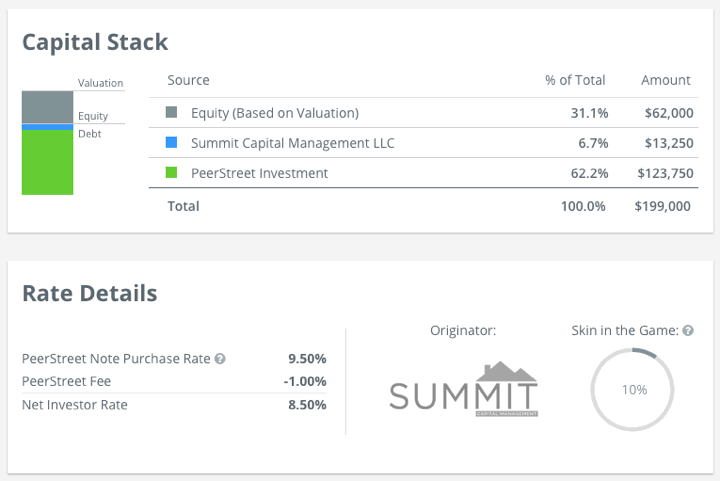
  • Net Investor Rate/Term: 8.50% APR.
  • Amount invested: $1,073.
  • Term: 24 months with extension option.
  • Total loan amount: $123,750 from Peerstreet and $13,250 from loan originator (10% “skin in the game”).
  • Appraised at $199,000 = 62% LTV.
  • Loan secured by the property in first position.
  • Stated goal is buy-to-rent.

Here is the Zillow listing. The buyer appeared to get a condo for a good price ($130k). The unit last sold for $155k in 2016.

Timeline.

  • May 2017. Loan originated. Maturity is set for June 2018.
  • May 2017 to June 2018. Interest-only payments made as agreed upon. (My portion was taken out July 2017.)
  • June 2018. Borrower requests extension.
  • August 2018. 6-month extension approved and extension fee paid.
  • November 2018. Borrower requests another extension. Additional 4-month extension granted.
  • April 2019. Payments stop coming in. Loan is late. Full balance of loan is due.
  • June 2019. Now 60+ days late. Still no payments. Demand letter sent. Foreclosure process initiated.
  • July 2019. At around 90 days late, the loan was suddenly brought current and paid off. All back interest (including default interest) and fees paid.

If you look at the MLS data, they tried to list it in March 2019 for $288,000 and then reduced to $249,000 in May 2019. The listed was removed, so I’m not sure who paid off the loan, perhaps the borrower or the loan originator somehow refinanced it elsewhere. The price wasn’t unreasonable, as the neighboring unit sold for $268,000 in May 2018 (2 bed/1 bath/1,000 sf). Notice that for this note, the loan originator put up 10% of the loan, so it had “skin in the game”. I don’t know if that made a difference.

Final numbers. I invested $1,073 in July 2019 and got paid $192.27 of interest and $1,073 of principal for a total of $1,265.27 as of July 2019. (This was an automated reinvestment which included whatever cash was in my account, thus the odd numbers.) This works out to a 17.92% total return over two years, which is 8.59% annualized return. The number was a little higher than the stated interest rate due the various penalty fees the borrower paid. These numbers are net of all PeerStreet fees.

I haven’t had a Peerstreet loan go through the entire process of foreclosure yet, but will write another update if/when that happens.

Bottom line. The vast majority of my Peerstreet loans have been paid back in full in a timely manner. Some of them end up with issues like late payments, sporadic payments, and/or repeated loan extensions, like this one. This one ended up as an example of an investment that looked like it was heading for foreclosure at nearly 90 days late with little communication, but bounced back and ended up being paid in full.

If you are interested, you can sign up and browse investments at PeerStreet for free before depositing any funds or making any investments. You must qualify as an accredited investor (either via income or net worth) to invest. If you already invest with them, they now sync with Mint.com.

Marcus Bank Promotion: 1% Additional Cash Bonus up to $500 (~6% APY 3-month CD)

Online bank Marcus (formerly Goldman Sachs Bank) has a new Cash Bonus Offer which includes 1% cash bonus (up to $500) on new deposits on top of their existing interest rate (currently 2.15% APY). Valid for both new and existing customers. Given the holding period, this roughly equates to the same total interest paid as a 3-month bank CD at 6% APY.

Here’s how it works:

  • Enroll first at the offer link and designate a specific savings account to be tracked for this promotion.
  • Deposit your new funds ($1,000 minimum) within 10 days of enrollment. Multiple transfers within that 10 days is fine, but funds must be new to Marcus Bank.
  • Maintain your balance at enrollment plus the new funds for 90 days.
  • Receive your 1% cash bonus (up to $500) on your new funds within 14 days after the 90-day period ends.

To be clear, the bonus applies to new funds added after enrollment, not your total balance. Since the 10-day clock starts when you enroll, you may consider waiting until the last day of 7/29/19 if you need some time to gather your new funds together. However, they can also revoke the offer at any time, so I wouldn’t wait any longer than necessary.

This offer is available to new and existing Marcus customers who are not currently enrolled in another Marcus bonus offer. Each customer is limited to one 1% cash back offer, which can only be applied to a single account. For eligibility purposes, each joint owner will be treated as a separate customer. For example, if you apply the bonus offer to a joint account, the remaining joint owner(s) may apply this offer to another account they own if they have not done so already.

Rough math. Given that you can an additional 1% bonus after about 3 months, the bonus itself works out to the equivalent of a 4% annualized yield. 2% + 4% = 6%, so you’re looking at the equivalent of a 3-month CD at 6% APY for new money deposits between $1,000 and $50,000. Alternatively, if you are lazy, you could leave it in there for a year and still earn a bit over 3% APY over that year (assuming the base interest rate stays above 2%). That’s still good compared to a 12-month CD. Either way, the max benefit is $50,000 of new money held there for 90 days to earn a $500 bonus.

This combination makes it a great 3-month rate at that balance size when compared to my most recent update of best interest rates.

Should I move money out of Marcus and back in to qualify? No, it won’t make any difference. Funds deposited in your account prior to enrollment are not eligible for the cash bonus.

I am an existing customer (just recently for their expired $100 promo), and did not see a hard credit check at opening. Since I already have an account, I’ll probably be taking advantage of this one as well.

Bottom line. Marcus Bank has a new promotion to attract new money to their Online Savings Account – a 1% cash bonus (up to $500) on new deposits on top of their existing interest rates. This works out to a 3-month holding period paying roughly 6% annualized interest. You must enroll by 7/29 and transfer over new funds within 10 days of enrollment.

Amazon Prime Day 2019: Big List of Deals and Discounts (Updated)

Last call for deals + good stacking offer: Up to $60 Amazon credit for buying through the app. Amazon Prime Day 2019 is July 15th and 16th. I’ll try to keep this post updated with the most recent offers (and remove the expired ones). There are usually many opportunities to save some money without buying stuff you don’t need (and thus offset a chunk of that membership fee). In fact, if you have any things you’ve been looking for on your Wish List, you should just look them up and see if they are on sale today. (I bought an Eero mesh Wifi system to replace my 5-year-old router.)

As the name suggests, most deals require a Prime membership. New members can sign up for a 30-day free trial. If you’ve already done the trial, you can simply buy a month of Prime for $12.99.

Free Amazon Credit Offers

Site-wide

Specific Items

Amazon Device Deals

Targeted deals

Unison: Your Home Has a ~30% Chance of Being Worth Less in 5 Years

Unison is a “home co-investment” start-up, which means it wants a share of the equity of your home. If your home value goes up, then it wants some of the gain. If your home value drops, then it will absorb some of the loss. In exchange, the benefit to the homeowner is either an increased upfront home downpayment or the ability to cash out your home equity with no monthly payments. Unison is betting that over the long-term, your home value will go up and they will profit when you eventually sell (or when 30 years is up). In addition, they charge a one-time transaction fee at the time of closing (2.5% of proceeds) or at home-equity cash-out (3.9% of proceeds).

That’s the basic idea, although they aren’t technically a co-owner of your home. The arrangement is structured as an options contract with a secured lien on your home, as laid out here (click to enlarge):

In this example, when your home appreciated in value from $500,000 to $600,000, you would only keep 60% of that gain ($60,000), while Unison would take 40% ($40,000). Add in their original $50,000 back, and you get the total of $90,000 back on Unison. This is in addition to the 2.5% upfront ($1,250) you paid as an origination fee.

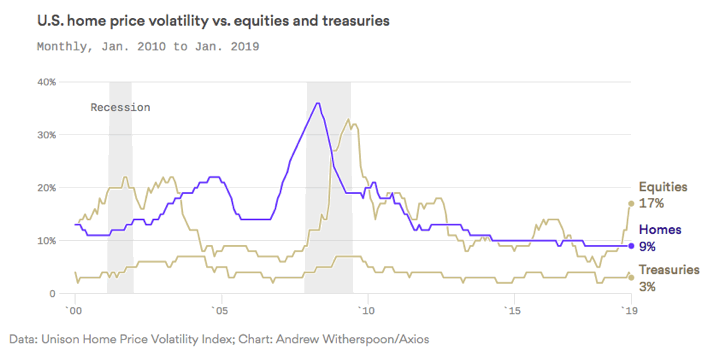
Unison’s business model depends on home prices going up over time in a reasonably-predictable manner, so they’ve done some research about the reliability of rising home prices. Using their data, Felix Salmon at Axios created this volatility chart that illustrates their conclusion that home price volatility is roughly the same order as S&P 500 volatility:

I don’t know if the average consumer really understands what “20% volatility” means (I don’t), so this statement is much more meaningful:

Any given home has roughly a 30% chance of ending up being worth less in five years’ time than it is today. If you can’t afford that to happen, you probably shouldn’t buy.

That’s an interesting statistic to keep in your head. Of course, it also means that you have a 70% chance of having your home price increase in 5 years, which is probably why many experts recommend that you expect to stay in your house for at least 5-7 years before buying. The odds are in your favor, but not overwhelmingly over a 5-year period.

Bottom line. I predict Unison will become successful, as long as they have patient sources of funding. Customers get a much bigger home downpayment upfront, and the payback is not until later and only taken out of profits (less pain). That’s a pretty brilliant idea in the context of behavioral finance. As a homeowner, you are paying a fee to sell off a piece of future upside (or downside) potential, but anything that makes it possible for people to buy a nicer house now is going to be popular.

Our Family Travel Award Redemptions 2019

I’m not a Instagram travel blogger and I’ll never visit every country in the world, but I do earn enough points from navigating the top credit card offers to fund a big chunk of our annual travel each year. We are a family of five including a toddler, so we redeem for domestic economy class tickets to see grandparents instead of business class seats to an over-water Maldives bungalow. We also travel in peak times due to school schedules, so it’s harder to hunt for high value opportunities. I used to worry about this, but now we just earn ’em and burn ’em.
We are heading to Kauai later this month, which included these redemptions:

Economy flights to Hawaii – 15,000 to 40,000 American miles roundtrip each
The actual redemption amount will vary based on dates and times. The interisland flights are 7,500 miles each way (both AA/Hawaiian), and Mainland US to Hawaii are 20,000 miles each way.

You can earn American Airlines miles from multiple credit cards, as there are versions from both Citi and Barclaycard. Sometimes one offer is much better than the other, right now both are solid. Marriott/SPG points also transfer over to American miles. The cards will also let us get free checked bags and priority boarding, saving us more money.

Grand Hyatt Kauai – 25,000 Hyatt points per night
I’m excited to visit what is consistently rated the best resort in Kauai for the first time. You can earn Hyatt points from multiple credit cards as well. There is the Chase World of Hyatt card, and Ultimate Rewards also transfer over on a 1:1 basis instantly to Hyatt. That means the Chase Sapphire Preferred, Sapphire Reserve, Freedom, and Freedom Unlimited all earn points that can lead to a nice resort in Hawaii. (I also got a ton of points from the Ink Business Preferred for small businesses.)

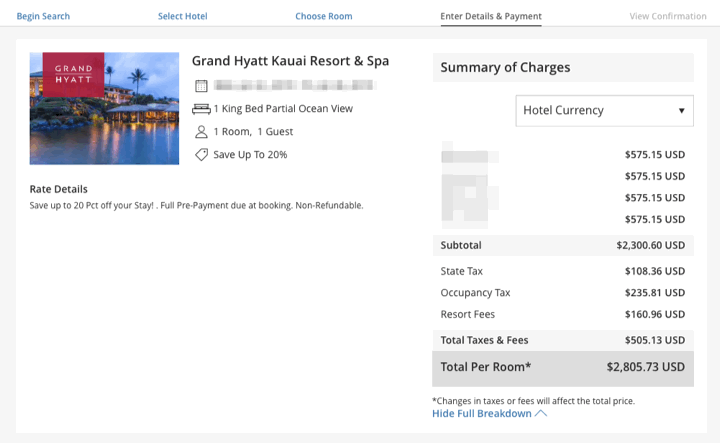
Transferring some Chase points over let me top off the account to reach exactly the number of points needed. Redeeming with Hyatt points also includes all taxes and let me avoid the daily $35/resort fee. Here’s a screenshot showing that the total cash cost for our stay would have been $701 per night (2.8 cents per Hyatt point) after adding in the resort fee:

(I’m also getting 10% of my redeemed points back from this promo, so in the end I’ll be getting more than 3 cents per Hyatt point.)

For the holidays, we are heading to visit family in Austin, Texas:

Economy flights to Austin – 20,000 British Airlines Avios roundtrip each
The flights are actually on American as well, just using Avios. While far from my best Avios redemption, it worked out as British Airways allows you to “household” an account. We had a previous trip so a lot of miles were spread across the kids’ accounts, and this feature lets us pool the points and use them all up. For example, what if you had 18,000 points in five different accounts and the award you wanted was 100,000 points? Avios lets you pool them together, and you could transfer over some American Express Membership Rewards or Chase Ultimate Rewards points to top things off.

Besides past flights, our main source of Avios points was the Chase British Airways card.

SpringHill Suites Austin – 14,000 Marriott points per night
No free scuba lessons or water slides here. This is just a nice suite hotel so that we can fit all five of us in comfort. There is a solid free buffet breakfast, and it’s close to family (and a Rudy’s BBQ).

Marriott also has credit cards from both Chase and American Express that can provide lots of points-earning opportunities.

Both my wife and I apply for a few new cards each year, but we don’t go past that much anymore. Our basic idea is to try out one card at a time. Sometimes the perks are pleasantly much better than expected, and other times they are harder to use than expected.

The Toddler IRA: Should My 3-Year-Old Have a Tax Shelter?

I love my Roth IRAs. They just keep on growing tax-free and never send me any annoying tax documents. Vanguard has a post about Working teens and Roth IRAs. I like the idea of a teenager putting some hours in at Jamba Juice and having the discipline to tuck some away for the future. However, the article suggests that you gift your teenager money in order to fund the Roth IRA (with the teen keeping their earnings).

Why wait until they are teenagers? You could take this further into what I call the Toddler IRA. Basically, you find a way to have your 3-year-old (or 6-year-old, etc.) have some earned income, usually via your small business. Maybe they “model” in an advertising spot. Maybe they did “administrative work” and helped organize some business papers for you. Can they weed or dig? Time to pay them for their lawn maintenance skills. Now that your kid has earned income, they (you) can contribute the same amount into a Roth IRA.

At first glance, it’s a little weird. Can I really justify these payments? I’m inclined to pay them more (so I can stuff more contributions into the Roth IRA), but would I really pay that much money if they weren’t my kid? Some parents go as far as making arrangements with other parents where they pay each other’s kids. In fact, there used to be a website (I forget the name) where your kid did some sort of simple online “work” and they would send your kid a check. (The parents would pay for this passthrough employment service.) Yet another example of government incentives working in unexpected ways.

The math sounds pretty impressive when you compound returns tax-free for 60+ years. $1,000 at 6% annual return times 60 years = $33,000. $1,000 at 8% annual return times 60 years = $100,000! Here’s a simple chart from Vanguard that shows the possibility of your kid getting a $100,000 head start on retirement:

I would add that the effect is exaggerated because doesn’t take inflation into account, but even a 4% real return will make $1,000 into $10,000 after 60 years. You put in $1,000 times 12 years, they end up with close to $100,000 inflation-adjusted after 60 years.

Why my kids don’t have a Toddler IRA. I have a small business. See that cute picture on the top right? I could easily pay them to model for a new photo shoot every month. (Trust me, it’s hard work to get them to all smile at the same time… for me.) I’ve thought about it. In the end, it doesn’t fit in with my personal philosophy about teaching them to fish:

Give a man a fish, and you feed him for a day. Teach a man to fish, and you feed him for a lifetime.

This act is giving them a big pile of fish. It’s a tax-advantaged gift, but still a gift that they’ll know about at a young age. I don’t like the idea of them turning 18 and finding out they have $XX,000 waiting for them without doing any work.

What about “teaching” them to save? If they don’t feel the pain of earning the money and the separate pain of not spending it either, then I don’t really see the educational benefit. When they start to really earn money as teenagers by waiting tables or bagging groceries, then I will consider doing some sort of 401k-like matching program as a “carrot” to letting me teach them about investing and IRAs.

When they are kids, I will instead contribute any money towards college tuition via a 529 plan. I doubt that I’ll be able to cover full tuition and housing for three kids anyhow. Most parents can’t. Above that, I’d still rather give them $500 to start a food stand at the local farmer’s market than stick it into their IRA.

I feel this is a topic where opinions will vary widely. What do you think?

Can You Teach Your Kid To Be Rich?

There is an ongoing debate about personal finance education in school. It sounds like a good idea, but multiple studies have found that financial literacy classes don’t really improve future behavior. It may be too much to expect an easy fix to such a complex problem.

As a parent, how do you best set up your kids for financial success? In the end, how can you really tell if you made a difference anyway? You can only try your best. My personal philosophy boils down to this famous proverb:

Give a man a fish, and you feed him for a day. Teach a man to fish, and you feed him for a lifetime.

Some parents plan on giving their kids a big pile of fish. An inheritance. Real estate. A business to take over and run. That’s out of love, and I am not judging that choice. I might leave them something, but I’m going to tell them to expect nothing. Instead, I hope they will see that I put in a lot of effort to help them develop the tools to go out and “fish”, and that as adults it’s up to them to make money for themselves.

To be clear, this is not the only thing that I am teaching them. Good relationships with family and friends are more important than an early retirement. However, I have observed several specific traits useful in navigating the financial world. As a result, I want to help them:

  • Develop good character traits like self-discipline, gratitude, and perseverance. If they can control their emotions, have empathy for others, and endure hard work, it helps everything else.
  • Obtain quality formal education. If they are going to solve the world’s problems, they need a strong, wide base of knowledge. A solid education and good teachers can really inspire and change a child’s life.
  • Experience entry-level hourly work in the retail, construction, and/or food service industries. They should understand how hard it is to make a living without specialized skills.
  • Create their own business ventures. I plan on helping them start any kind of micro-business that they want. It might be even better as a non-profit, donating the proceeds to the community. Through this, they will learn basic accounting, marketing, and interpersonal skills.
  • Improve interpersonal skills. Across all of their activities, from school projects to extracurriculars (sports/arts/music) to starting their own business, learning how to work with others is key.
  • Feel encouraged to take calculated risks. There are many ways to take asymmetrical risks where the upside is huge and the downside is small. This especially true when you are young and without dependents. I want them to take such risks.

None of the factors above require a ton of money, although private schools can be quite expensive. The best option may be maximizing the public school options available. My parents rented a small apartment in a good school district, as they couldn’t afford buying an expensive house with high property taxes. I only realized this recently when I visited our old duplex and found a house down the street listed for nearly $2,000,000 (median price in this city is $370,000).

I do plan to contribute to a 529 plan and minimize student loan debt. Maybe college tuition will be more sane in 15 years, but I think this is the best use of cash right now – keeping them from having to fight the power of compound interest in reverse. (I also classify paying for education as “teaching them to fish”.) I want to show them that we value education and also strive to avoid debt whenever possible.

Bottom line. How does anyone get rich? Most people who got rich quickly had equity in a business venture. This takes a combination of specialized skill, interpersonal skills, risk-taking, and luck. Most people who got rich over decades got there with a steady career, work ethic, patience, self-discipline when it comes to spending, and investing the difference repeatedly. I’d be happy with my kids taking either path, and tried to think up a list of ways to help promote these traits.