Archives for April 2019

Vanguard ETFs Now Permanently Cheaper Than Admiral Shares (More Examples)

vglogo

Updated with more examples. Up until recently, Vanguard has had a long history of keeping the expense ratios of their corresponding ETFs and Admiral Shares mutual funds the same. As of 2019, this is no longer the case. Inside a Vanguard notice, this was quietly added:

The growing size and scale of our funds have helped fuel operational efficiencies that lower our costs to serve clients, particularly ETF shareholders. As a result, the ETF share class of these ten funds is now lower than their Admiral™ share class counterparts.

Initially, I figured it was just a matter of the reporting dates being staggered and the Admiral Shares expense ratio would soon be updated back to being identical. But Allan Roth at ETF.com interviewed a Vanguard spokesperson who confirmed that the expense ratios of ETFs and Admiral Shares will no longer automatically be matched up:

What’s largely driving these changes is the increasing adoption of ETFs by Vanguard investors as their index vehicle of choice, which has enabled us to pass along the cost savings of scale,” Woerth said. “To put some numbers around it, even though ETFs make up only about 20% of our assets, they’ve garnered more than 35% of Vanguard’s net cash flow over the past three years.”

Another reason given is that the mutual fund structure requires more administrative paperwork than ETFs and thus inherently cost more to run.

The most recent expense ratio update as of 4/26/19 is further evidence of this new stance. The expense ratios of 21 different ETFs were dropped, yet the corresponding mutual fund expense ratios all remained the same.

Expense ratio comparison, ETF vs. Admiral Shares (4/30/19):

Fund ETF expense ratio Admiral Shares expense ratio
US Total Stock
Vanguard Total Stock Market Fund (VTI, VTSAX)
0.03% 0.04%
US Large (S&P 500)
Vanguard 500 Index Fund (VOO, VFIAX)
0.03% 0.04%
Total World Stock
Vanguard Total World Stock Index Fund (VT, VTWAX)
0.09% 0.10%
International Total Stock
Vanguard Total International Stock Market Fund (VXUS, VTIAX)
0.09% 0.11%
International Real Estate
Vanguard Global ex-U.S. Real Estate Index Fund (VNQI, VGRLX)
0.12% 0.14%
Emerging Markets
Vanguard Emerging Markets ETF (VWO, VEMAX)
0.12% 0.14%
Total US Bond Market
Vanguard Total Bond Market Fund (BND, VBTLX)
0.035% 0.05%
Municipal Bonds
Vanguard Tax-Exempt Bond Index Fund (VTEB, VTEAX)
0.08% 0.09%
Total International Bond
Vanguard Total International Bond Index Fund (BNDX, VTABX)
0.09% 0.11%


Should I convert my Admiral Shares to ETFs? Vanguard lets you convert most Vanguard mutual funds held at Vanguard to their ETF version (if it exists) on a tax-free basis. Allan Roth goes on to discuss this question as well. You should first set your tax lot tracking to “SpecID” if you want the cost basis to carry over to every specific share (otherwise they would use average cost basis on all of them).

I always liked the “slow food” feel of mutual fund investing. Your trade doesn’t execute until the end of the day. You just enter your trade whenever, and it gets filled at the end of the next market day. The price is set exactly at net asset value (NAV). There are no high frequency traders involved.

Now, a single basis point (0.01%) is a difference of $1 annually per $10,000 invested. In many cases, the difference may not be worth much attention. However, if you have $1,000,000, that becomes $100 every year. Two basis points is $200 every year. Will the gap widen further?

Sometime this year, I will probably convert my Admiral Shares to ETFs. Vanguard is basically telling me that mutual funds are old technology, and they won’t be spending any more resources on future updates. In the last few years, Vanguard has been aggressively converting people with old mutual fund-only accounts into brokerage accounts.

I’ve kept my primary brokerage account at Vanguard because they offer commission-free trading of mutual funds. However, if I am switching to ETFs, then I can have commission-free trades at many different brokerage firms. I recently opened a new IRA account at M1 Finance because they will give me back free dollar-based transactions of mutual funds (i.e. I can buy exactly $500 via fractional shares) while also adding a free rebalancing service that has Vanguard never offered.

Richard Feynman and Fighting Burnout With Curiosity

While going back through my Kindle highlights, I came across the autobiography of Richard P. Feynman, “Surely You’re Joking, Mr. Feynman!”: Adventures of a Curious Character. Feynman won the Nobel Prize in Physics in 1965 but was also something of a celebrity in his time due to his varied contributions and many eccentric adventures.

To me, the most inspiring thing about him was his almost child-like endless curiosity. He didn’t mind getting into the dirty details of something he found interesting. It could be a radio or a bank safe. In addition to his physics research, he started making art (under a pseudonym) and sold enough pieces that he scored a gallery showing. He played samba in a Carnaval band in Brazil. Feynman liked “authentic knowledge”, meaning learning by tinkering and doing, not by memorizing something in a book.

However, even Feynman felt pressure at times as a professor of physics at a prestigious research university. He was getting burned out:

Then I had another thought: Physics disgusts me a little bit now, but I used to enjoy doing physics. Why did I enjoy it? I used to play with it. I used to do whatever I felt like doing—it didn’t have to do with whether it was important for the development of nuclear physics, but whether it was interesting and amusing for me to play with. When I was in high school, I’d see water running out of a faucet growing narrower, and wonder if I could figure out what determines that curve. I found it was rather easy to do. I didn’t have to do it; it wasn’t important for the future of science; somebody else had already done it. That didn’t make any difference: I’d invent things and play with things for my own entertainment.

[…] So I got this new attitude. Now that I am burned out and I’ll never accomplish anything, I’ve got this nice position at the university teaching classes which I rather enjoy, and just like I read the Arabian Nights for pleasure, I’m going to play with physics, whenever I want to, without worrying about any importance whatsoever.

Eventually, his scientific wanderings led him to his shared Nobel Prize.

My takeaway: We all get burned out sometimes. Try to keep it fun. Look for something that sparks your natural curiosity. Make it a game.

The NY Times has an article right now about Why ‘Find Your Passion’ Is Such Terrible Advice. It’s really just an argument about terminology. We don’t “find” our passions like a lost sock. We develop them over time. It’s hard to get good at anything if you’re not enjoying yourself when early on the learning curve. Your inner curiosity (“passion”?) still matters.

I’m pretty sure I enjoy personal finance more than 99% of the population, but even I get burnt out occasionally. This is often when I take my “fun money” account and look for new investments that might be a learning opportunity. I haven’t written about it yet, but one of my experiments is buying a small multi-year guaranteed fixed annuity (MYGA). (Don’t take this as a recommendation.) I also challenged myself to put together two family vacations for 5 people over 15 nights funded entirely with a hodgepodge of airline miles and hotel points. I combined American miles, Hawaiian miles (also an American Express transfer partner), Hyatt hotel points (also a Chase Ultimate Rewards transfer partner), and Marriott points.

TAB Bank Kasasa Cash Checking Review: 4% APY (Up to $50k) w/ Activity Requirements

Update late January 2019: Reader Steve shares that “TAB Bank is no longer offering Kasasa Cash Checking. But for those already having an account, no changes are planned.”

Original post:

TAB Bank has a Kasasa Cash Checking account that offers 4% APY on balances up to $50,000 if you meet certain deposit activity and debit card transaction requirements. However, they include some vague language that lets them withhold your interest based on their subjective opinion. Details below.

FDIC confirmation and eligibility. I was able to find TAB Bank at FDIC.gov under “Transportation Alliance Bank, Inc. D/B/a Tab Bank” with FDIC certificate #34781 and domain tabbank.com. Since this isn’t a credit union, you don’t need to worry about joining a member organization or maintain a share savings account. Anyone nationwide can apply online and fund using ACH transfer. They also say that they won’t perform a credit inquiry for a checking account.

Monthly requirements. To qualify for the 4% APY on balances up to $50,000 and up to $15 in ATM fee rebates per month, you must have the following during each monthly qualification cycle:

  • At least 1 direct deposit, ACH payment, or bill pay transaction.
  • At least 15 debit card purchases, and each must be $5 or more. When using your card, choose the credit option and bypass using your PIN.

If you don’t meet these requirements, there is no monthly fee but you lose the ATM rebates and your interest rate is only 0.05% APY.

Potential catch? Vague fine print. If you read through their Truth-in-Savings disclosure [pdf], you will find the following vague assertions:

Purpose and expected use of accounts – The Kasasa Cash account is intended to be the accountholder’s primary checking account in which payroll transactions and day-to-day spending activities including but not limited to grocery, gasoline, apparel, shopping, dining, sporting and entertainment transactions are posted and settled.

[…] You will automatically qualify for the account’s rewards during your account’s first statement cycle. If the account is closed before rewards are credited, you will forfeit the rewards.

[…] Commensurate with the spending activities identified above, we expect the account’s debit card to be used frequently throughout each month and for transaction amounts to reflect a wide dollar range. Small debit card transactions conducted on the same day at a single merchant and/or multiple transactions made during a condensed time period particularly near the end of a Monthly Qualification Cycle are not considered normal, day-to-day spending behavior. These types of transactions appear to be conducted with the sole purpose of qualifying for the account’s rewards and thus will be deemed inappropriate transactions and will not count toward earning the account’s rewards.

[…] TAB Bank reserves the right to determine if the Kasasa Cash account is being maintained for a purpose other than day-to-day, primary use. Accountholders who persist in making debit card transactions in a calculated and limited fashion in order to meet their monthly qualifications may have their accounts converted to a different checking account or closed altogether.

Basically, they reserve the right to change up the requirements to whatever they want. We know that banks make money when we use your debit card. However, if you want your customers to use it more, then just make your requirements higher. You already added the $5 minimum per transaction. Just say you want 15 transactions with a combined total of $1,000 or similar. Make the rules fair, clear, and transparent.

Good deal? The interest rate is good, but the vague rules make this account not worth the bother. They are allowed to judge what I am “supposed” to buy on a day-to-day basis as a “normal” person? Pass! If you put in a sizable balance, that’s $100+ of monthly interest that they can withhold for no solid reason (and are actually incentivized to do so as it saves them money).

For now, I would compare with the Orion FCU 4% APY checking account, which doesn’t play such games, is more upfront and understandable. If they make the rules transparent (even if more restrictive), I would reconsider.

Bottom line. TAB Bank has a rewards checking account called Kasasa Cash Checking that offers 4% APY on balances up to $50,000 if you meet certain deposit activity and debit card transaction requirements. However, they hide in the fine print that they can withhold your interest based on their subjective opinion. If they judge you ineligible, you will earn virtually no interest (0.05% APY).

Here are the rest of the Best Interest Rates on Cash.

Book Notes: Year of Yes by Shonda Rhimes

I’d never heard of Shonda Rhimes before stumbling across Year of Yes: How to Dance It Out, Stand In the Sun and Be Your Own Person. Apparently, she created some huge TV shows (Grey’s Anatomy, Scandal, How to Get Away With Murder). However, the title caught my eye and the preview sounded interesting:

With three children at home and three hit television shows, it was easy for Shonda to say she was simply too busy. But in truth, she was also afraid. And then, over Thanksgiving dinner, her sister muttered something that was both a wake up and a call to arms: You never say yes to anything. Shonda knew she had to embrace the challenge: for one year, she would say YES to everything that scared her.

After finishing the book, I can see why Rhimes is such a successful writer because she skillfully weaves complex human feelings into what feels like a casual conversation. Here are some quotes and my takeaways:

The most important thing is to take action.

I think a lot of people dream. And while they are busy dreaming, the really happy people, the really successful people, the really interesting, powerful, engaged people? Are busy doing.

Maybe you know exactly what you dream of being. Or maybe you’re paralyzed because you have no idea what your passion is. The truth is, it doesn’t matter. You don’t have to know. You just have to keep moving forward. You just have to keep doing something, seizing the next opportunity, staying open to trying something new. It doesn’t have to fit your vision of the perfect job or the perfect life. Perfect is boring, and dreams are not real. Just . . . DO.

You must do the things you think you cannot do. —ELEANOR ROOSEVELT

Things I agree with.

#StopPretendingHashtagsAreTheSameAsDoingSomething

ANYONE WHO TELLS YOU THEY ARE DOING IT ALL PERFECTLY IS A LIAR. […] If I am killing it on a Scandal script for work, I’m probably missing bath and story time at home. If I am at home sewing my kids’ Halloween costumes, I am probably blowing off a script I was supposed to rewrite. If I’m accepting a prestigious award, I’m missing my baby’s first swim lesson. If I am at my daughter’s debut in her school musical, I am missing Sandra Oh’s last scene ever being filmed at Grey’s Anatomy. If I am succeeding at one, I am inevitably failing at the other. That is the trade-off.

Once I said Yes to difficult conversations, once I said Yes to saying No, I made an interesting discovery. That discovery was: happy, whole people are drawn to happy, whole people, but nothing makes a toxic person more miserable and destructive than a happy, whole person. Unhappy people do not like it when a fellow unhappy person becomes happy. I am absolutely sure that this is true.

Happiness.

Happiness comes from living as you need to, as you want to. As your inner voice tells you to. Happiness comes from being who you actually are instead of who you think you are supposed to be. Being traditional is not traditional anymore. It’s funny that we still think of it that way. Normalize your lives, people. You don’t want a baby? Don’t have one. I don’t want to get married? I won’t. You want to live alone? Enjoy it. You want to love someone? Love someone. Don’t apologize.

This is the real goal of financial independence, financial freedom, early retirement, whatever label you want to apply. You can do what you want, even it it doesn’t pay especially well. Most negative coverage of financial independence focuses on the idea of depriving yourself. We live in tiny houses, eat lentils and ketchup packets, and never have any fun. In other words, saying NO. However, I’ve always thought of it as the pursuit of being able to spend your time doing exactly what you want! It’s turning your inner desires from “maybe someday” (AKA never) into YES.

Bottom line. This book is another example that we all have our own hidden struggles, and all we can do is choose to face them and take action. Life isn’t fair. Your struggles are hard. Rhimes lost some toxic friends and made many new ones. I’ll repeat my favorite quote here – “You just have to keep doing something, seizing the next opportunity, staying open to trying something new. It doesn’t have to fit your vision of the perfect job or the perfect life. Perfect is boring, and dreams are not real. Just . . . DO.”

Spending Diary: The Most Commonly Ignored Personal Finance Advice?

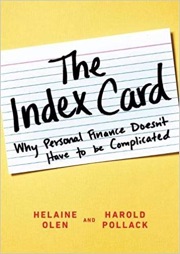
After finishing The Index Card: Why Personal Finance Doesn’t Have to Be Complicated by Helaine Olen and Harold Pollack, I found it to be a solid all-around personal finance book that joins others like If You Can by William Bernstein and The Richest Man in Babylon by George Clason in the category of “recommended books about money that are short and easily digestible”. All good ideas for gifts for recent graduates.

They don’t shy away from what I think is the most commonly-ignored financial advice: TRACK YOUR SPENDING FOR THREE MONTHS. Even if you don’t track your budget closely after that, this initial spending diary can be eye-opening. Yes, it takes a bit of effort and can be rather uncomfortable psychologically. Here are some book highlights:

Track ALL of your spending…

For three months, keep track of everything you spend money on, no matter how small. That $1.50 bag of Cape Cod Waffle Cut Sea Salt potato chips? It counts, just as much as your four-figure mortgage or health insurance payment.

… for THREE MONTHS.

If you monitor only one month of spending, you won’t gain a full picture of where your money goes. Routine but sporadic expenses such as car repairs, doctor bills, and the emergency trip to the cat’s vet are more likely to occur over a several-month period.

Now, you can pick your “must keep or I’ll wither away” purchases and the things what won’t hurt as much to cut.

You need to determine what day-to-day spending is necessary and unavoidable, what is a luxury but helps you get through the day, and, finally, what is excess. Only then can you avoid falling prey to spending traps.

This allows you to make trade-offs: I’ll take advantage of the office coffee machine, but I’ll use the money I saved to travel to Italy next summer to attend my best friend’s wedding. I’ll drop my landline phone to pay for my gym membership or boost my child’s college savings.

Final tips. You can put everything on a single credit card or debit card, and then go through your purchases line-by-line. If you use cash, take a picture of your receipts and/or purchases on your phone. If you feel comfortable with it, link your account to Mint.com (or similar) and they will help you categorize things automatically. You’ll need to spend a few weeks teaching it (check in every few days), but it gets better over time.

If you can manage to track everything for three months to get an honest (if uncomfortable and scary!) view of your finances, you may find a big gap between what you think you spend vs. what you really spend. Where does your money go every month?

The Personal Finance Index Card: Book Version Differences

After rediscovering the young adult versions of fitting personal finance advice on an index card, I decided to go back and read the book The Index Card: Why Personal Finance Doesn’t Have to Be Complicated by Helaine Olen and Harold Pollack. (I was able to find it via library eBook.)

I noticed that the book version of the “index card” was slightly different. The original card had 9 items, but two of them were merged away into each other (401k/IRAs) and (Pay Attention to Fees/Buy Index Funds). I bolded the new additions below. (You can see all chapters on the Amazon page.)

  1. Strive to Save 10 to 20 Percent of Your Income
  2. Pay Your Credit Card Balance in Full Every Month
  3. Max Out Your 401(k) and Other Tax-Advantaged Savings Accounts
  4. Never Buy or Sell Individual Stocks
  5. Buy Inexpensive, Well-Diversified Indexed Mutual Funds and ETFs
  6. Make Your Financial Advisor Commit To a Fiduciary Standard
  7. Buy a Home When You Are Financially Ready
  8. Insurance – Make Sure You’re Protected
  9. Do What You Can To Support the Social Safety Net
  10. Remember The Index Card

Here again is the original:

Here are my notes on the newly-addressed topics of home-buying and insurance.

Home-buying. This will always be a hard topic because it mixes in emotion, personal history, peer pressure, and all that fuzzy stuff. If you want to own a home, you need to make sure the purchase won’t blow up your overall financial picture. Nothing really surprising, but still good advice.

  • Get your debt under control first.
  • Save up as close to a 20% down payment as you can.
  • Stick with a 15 or 30 year fixed-rate mortgage.
  • Prioritize what you really want and need in a home. Stay within your budget.
  • Location, location, location.

Insurance. There are low-probability events that can destroy decades of hard work, and that’s why humans invented insurance to spread the risk. Here are their cut-to-the-chase bullet points:

  • Emergency fund – Maintain one!
  • Life insurance – If you’re young(ish), just buy 30-year level term insurance.
  • Property insurance – Raise your deductible as high as you can handle.
  • Health insurance – Always sure you stay in-network.
  • Liability insurance – Coverage for at least twice your net worth.

I’m glad that this book still retained its “quick-and-dirty” nature. No single rule will cover every scenario, but it’s good to have a clear and concise collection of the big points along with just enough explanation that you understand the basic reasoning behind it.

Blue Zones: Financial Lessons From the World’s Oldest People

While learning about Okinawan centenarians, I also came across the idea of Blue Zones – places where a high concentration of people live past 90 without chronic illnesses. While the eating habits of Blue Zone residents have been mentioned a lot, Richard Eisenberg of NextAvenue wrote a three-part series focusing on the financial aspects of their longevity. Here is Part 1, Part 2, and Part 3.

Rather than focusing on the residents’ diets, he reports on how the oldest people in the Blue Zones make their money last and what Americans and America can learn from this.

Here are my notes:

The Nicoya Peninsula of Costa Rica

  • Close-knit family structure. Rely on immediate and extended family members. Nursing homes and assisted living facilities are rare.
  • Government-run public health care system with minimal out-of-pocket expenses.
  • Small government-run pension systems.
  • Low cost-of-living. Lower spending due to low consumerism. Rarely travel.
  • Rare to find elderly that own stocks or mutual funds.

Okinawa, Japan

  • They form a “moai”, which is a group of about 20 close-knit older friends who look out for each other both financially and emotionally. This acts as a replacement for assistance from blood relatives.
  • Government-run public health care system with minimal out-of-pocket expenses.
  • Low cost-of-living. Low consumerism. Low debt.

Sardinia, Italy

  • Close-knit family structure. Rely on immediate and extended family members. There are no long-term care facilities in Sardinia.
  • Government-run public health care system with minimal out-of-pocket expenses.
  • Low cost-of-living. Low spending due to self-reliant farming culture.

Ikaria, Greece

  • Close-knit family structure. Rely on immediate and extended family members. Nursing homes and assisted living facilities are rare.
  • Government-run public health care system, but no long-term care program.
  • Low cost-of-living. Low consumerism. Low spending due to self-reliant farming culture.

Loma Linda, California, USA

  • Technically, the Blue Zone consists of the members of the Seventh Day Adventist religious community.
  • Close-knit religious group that helps each other out.
  • Has a culture of self-discipline, planning, and preparation.
  • Tend to be wealthier with significant investments.
  • Tend to have frugal spending habits.

Commentary. One common thing that I notice about this list is that many are small, isolated communities, either by geography (islands), ethnicity, or religion. I feel that smaller groups more acutely appreciate the advantages of helping each other out. You can have long-term trust that you will raise your kids when they are young, and they will in turn watch over you when they are adults. When you get into larger cities, people seem to separate and start worrying mostly about themselves.

Of course, a bigger version of this is government-run health care, where everyone pitches in and agrees that nobody will become destitute due to a hospital bill. The American healthcare system is so complex and ingrained with powerful inertia that the idea of efficient, transparent, high-quality healthcare remains a huge puzzle waiting be (even partially) solved.

(I’m not saying we need the same system as Japan or Greece. But even billionaire capitalists Jeff Bezos, Warren Buffett, and Jamie Dimon realize that our bloated healthcare system is hurting our economy. Their new combined venture Haven has a goal of “simplified, high-quality and transparent health care at a reasonable cost.”)

On the smaller front, many familiar concepts still apply. Start saving early and plan ahead. Practice self-discipline in spending and lower your consumeristic appetites. If possible, move to a place where there is a lower cost-of-living. It’s so much easier to spend less when everyone around you spends a lot less! Get yourself involved in a close-knit community, whether based on blood, ethnicity, neighborhood, or religion.

How Often Should You Cook at Home on Weeknights?

I subscribe to a NY Times e-mail newsletter called Five Weeknight Dishes, which sends – you guessed it – five weekly “fresh dinner ideas for busy people who want something great to eat”. However, one of the recent newsletters was titled How Often Should You Cook? and you might be surprised at the answer:
One question I’ve gotten a lot since I started writing this newsletter is how many nights I cook dinner during the workweek. The answer is not five.

I typically cook a meal from scratch on two weeknights, maybe three. You don’t need to do more than that! Pick at least one recipe that makes good leftovers, doubling or stretching them with eggs, vegetables, toast or grains if necessary. Or supplement with something else in the fridge or cabinet. Dinner can be a fun, crazy mishmash; photographers will not be showing up to document the meal.

As for the other nights: My partner cooks, or occasionally we order chicken parm or go out (luxuries of urban and suburban life), or eat our preferred brand of freezer pizza with a nice big salad.

There is no single “right” answer to this question, but I still found it reassuring. I used to try to cook close to 4-5 nights per week, but now it is also closer to 2-3 nights per week. Sometimes it feels good to eat something green (or otherwise colorful), fresh, and healthy. It always feels good to share a meal with family and friends. I get the same good, wholesome feeling when I eat something where I know exactly what went into my food. It feels like hitting the reset button, and I always find that it helps keep my weight down. Saving money is secondary, but still a welcome result.

Food delivery apps are making things so convenient now, but it’s usually not very good for my bank account nor my health.

Vanguard to Launch Low-Cost Commodity Strategy Fund

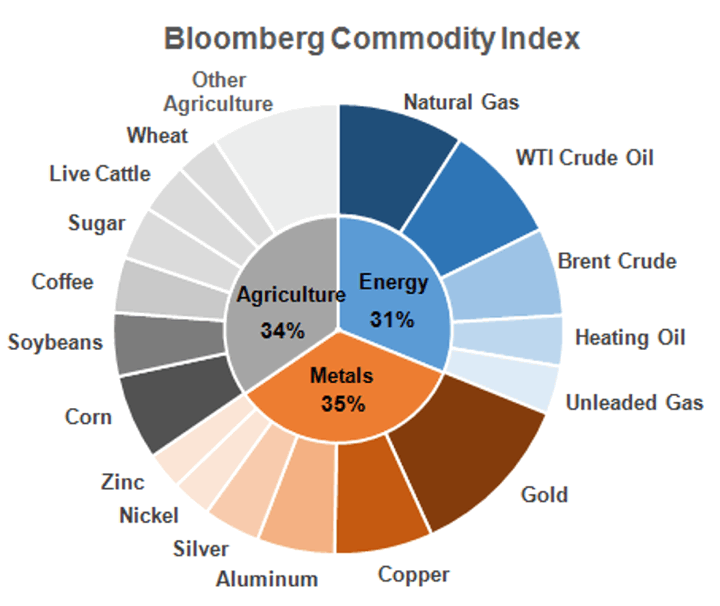
Vanguard announced in a press release that it is creating a new actively-managed mutual fund using the Bloomberg Commodity Total Return Index as a benchmark. The Vanguard Commodity Strategy Fund will have an estimated 0.20% expense ratio and June 2019 launch date.

bcom

The fund will at least initially not be directly targeted at retail investors, as it will only be available as Admiral Shares with a $50,000 investment minimum. Considering that commodities are usually only included in portfolio as a hedge at around 5% allocation, you would need a $1 million portfolio to justify putting $50,000 into commodities.

The direct competition is the PIMCO Commodity Real Return Strategy Fund (PCRIX) which has a 1.24% expense ratio and about $5 billion in assets. GraniteShares also released some low-cost commodity ETFs in 2017, including the GraniteShares Bloomberg Commodity Broad Strategy No K-1 ETF (COMB) with a 0.25% expense ratio. This means that the new Vanguard fund will become the lowest-cost commodity fund available by a small margin.

Here’s a quick summary of the Bloomberg Commodity Total Return index:

The Bloomberg Commodity Total Return index is composed of futures contracts and reflects the returns on a fully collateralized investment in the BCOM. This combines the returns of the BCOM with the returns on cash collateral invested in 13 week (3 Month) U.S. Treasury Bills.

BCOM is the Bloomberg Commodity Index, which incudes aluminum, coffee, copper, corn, cotton, crude oil, gold, diesel, lean hogs, live cattle, natural gas, nickel, silver, soybeans, sugar, unleaded gas, wheat, and zinc (image source).

There is active debate as to whether commodities should be included in your portfolio. My take is that commodities futures may offer the draw of being a diversification and/or inflation hedge, but I don’t want to pay the price of possibly lower returns, higher volatility, and higher complexity. As in other areas of life, sometimes the “insurance” is worth the cost, and sometimes it isn’t.

Bottom line. Vanguard is launching a commodities fund. If you like low-cost access to the commodities asset class, this looks to be a positive development even though right now it has a $50,000 investment minimum. Where will Vanguard expand to next with its growing appetite for assets?

The Lifestyle Secrets of Okinawan Centenarians

CNN has a new series called “Chasing Life with Dr. Sanjay Gupta”, and its first episode examines the lifestyles of the impressive centenarians of Okinawa, Japan.

Nearly two-thirds of the residents of Okinawa are still functioning independently at age 97. That meant they were in their own homes, cooking their own meals and living their lives fully — at nearly 100 years old!

Here are three factors noted in the show:

Ikigai. This means having a sense of purpose in life. Gupta says that one way to figure this out is to first imagine that you no longer needed to do anything for money. In that case, what would you regret not doing with your life? What do you love, and what does the world need?

ikigai

Here is a previous post on Ikigai – Finding Your “Reason For Being”. I have noticed that many people who seek out financial independence feel something “wrong” about their current trade-your-life-for-money environment. They are not living a life aligned with their “ikigai”.

Moai. This means having a social group within the community that has common interests and can provide both financial and emotional support. Family is important, but this appears to be an additional support system. This social component of longevity is critical and should not be overlooked.

Hara hachi bu. This means that you should stop eating when you are 80% full (and thus still a little bit hungry). People in Okinawa eat fewer calories in general, and the calories that they do eat tend to come from sweet potatoes, soybeans (legumes), a variety of vegetables, and only a little meat.

Okinawans centarians have also been examined in the book Blue Zones: 9 Lessons for Living Longer From the People Who’ve Lived the Longest (which I have not yet read). Here is another Venn diagram from the Wikipedia entry that shows the common characteristics between Okinawa and two other Blue Zones (Loma Linda, USA and Sardinia, Italy).

Bottom line. It’s not just living for a long time, but it’s living an active, engaged, happy life for a long time. You won’t get this by taking the right pills from orange bottles. You need to spend your time doing something that you feel matters to the world. You need love and support from other humans. You need to eat natural foods, but not too much.

Buying The Haystack: Sleeping Well Because I’ll Own The Winners

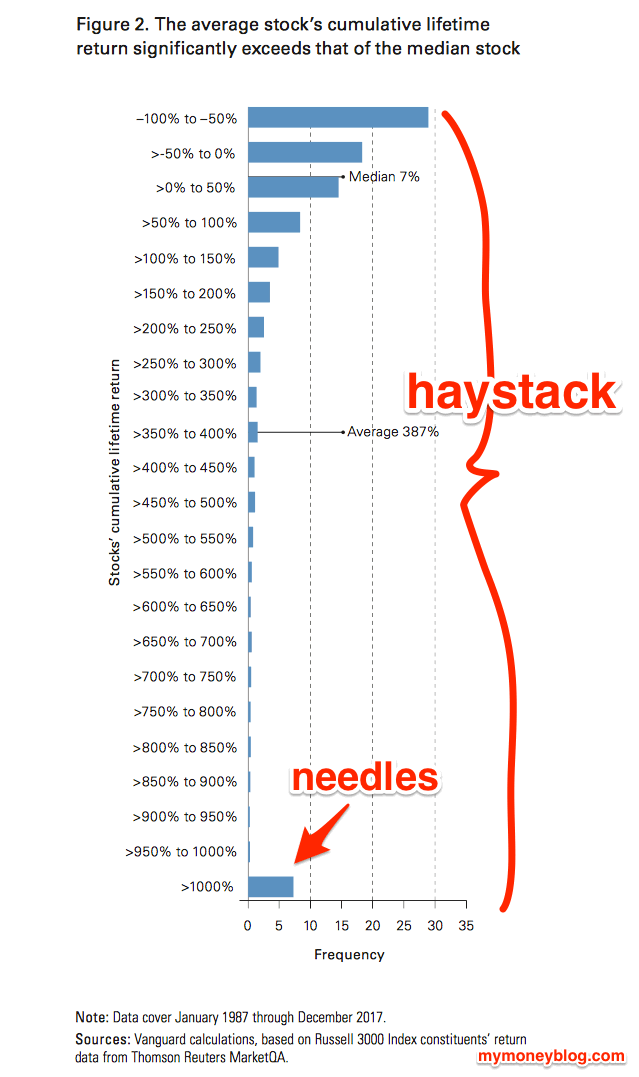
Vanguard has a new research paper on How to increase the odds of owning the few stocks that drive returns [pdf], found via How Concentration Affects Portfolio Performance by Michael Batnick. Inside, there is a chart that sorts the individual returns of the US stock market (Rusell 3000) over the last 30 years (1987-2017) into total performance buckets. What happens to the stock prices of individual companies over 30 years? Lots of big losers. A few huge winners.

The whitepaper has a lot of math and investment jargon that you can read for yourself. Let’s skip to the conclusion here:

Historical cumulative returns of individual stocks are skewed whereby overall market returns are determined by a small minority of stocks. Therefore, all else being equal, a more diversified portfolio is more likely to hold these outperforming stocks while displaying a lower dispersion of portfolio returns. We conducted simulations of various portfolio sizes and showed that those portfolios with fewer holdings underperformed those with more holdings, leading to a higher return hurdle to overcome.

As the late Jack Bogle told us: “Don’t look for the needle in the haystack. Just buy the haystack.”

I don’t know which will be the most successful US companies in the future, but I know that I will own them via the total US index fund in my portfolio. I will own the next Amazon, Google, Facebook, Apple, or Visa. I’ll also own whoever disrupts them after that. Since I own a big chunk of global stocks inside the Vanguard Total International Stock Index fund, I’ll be covered if they come from the other side of the world.

Now, when you own the entire haystack, you will get the losers as well as the winners. Also, I won’t be as rich as if I invested in them when operated out of a dorm room. It just turns out that in this capitalist structure, owning them all still works out pretty darn well. I will own shares of all these businesses in proportion to their market value, and by extension a share of their profits. Some of those profits will be reinvested for future growth, and some will be sent to me as cash dividends every three months. I’ll happily spend those dividends, and the let rest grow into more dividends in the future.

Schwab Commission-Free ETF List Review (Updated 2019)

ETFs are surpassing mutual funds as the standard building blocks of stock and bond portfolios. Here’s a closer look at the latest updates to the Charles Schwab commission-free ETF list. While the commercials often focus on quantity instead of quality, I will do the opposite. Here are the factors that I think are important:

  • Total Assets. This is a measure of popularity and reputation. A more popular ETF will have a smaller bid/ask spread and won’t have to liquidate in a bear market. A more reputably ETF manager will have lower index tracking error. However, ETF size isn’t everything.
  • Index/Asset Class. What index does it track? Does that index cover an asset class that I want to include??
  • Cost. What is the expense ratio? Low costs are important.

Schwab Commission-Free ETF full list. This Schwab ETF OneSource page includes a full list of their 503 commission-free ETFs.

Brief history of changes. In early February 2019, Schwab announced that it would increase the number of commission-free ETFs on their list to 503 as of March 1st, 2019, including no early redemption fees (no minimum holding period). Here is the list of 246 added ETFs, including 90 iShares ETFs.

Schwab’s ETF OneSource started in February 2013 with 103 commission-free ETFs including many in-house ETFs. Schwab has become very competitive with Vanguard and iShares by developing their own brand of low-cost, index ETFs. Outside providers now include: Aberdeen Standard Investments, ALPS Advisors, DWS Group, Direxion, Global X ETFs, IndexIQ, Invesco, iShares ETFs, John Hancock Investments, J.P. Morgan Asset Management, OppenheimerFunds, PIMCO, State Street Global Advisors SPDR® ETFs, USCF, WisdomTree and Charles Schwab Investment Management.

In March 2017, Schwab dropped their standard stock commission to $4.95 per trade + $0.65 per options contract. In addition, expenses for the Schwab market cap-weighted index mutual funds were lowered to match their Schwab ETF equivalents. Schwab Index mutual funds now have no investment minimum.

Largest ETFs on Schwab Commission-Free ETF list. Here are the top 20 most popular ETFs on their list, sorted by largest total assets. Also listed are the asset class and expense ratios.

ETF Name (Ticker) Asset Class Expense Ratio
iShares Core U.S. Aggregate Bond ETF (AGG) US Total Bond 0.05%
iShares iBoxx $ Investment Grade Corporate Bond ETF (LQD) US Corporate Bonds 0.15%
iShares Edge MSCI Min Vol USA ETF (USMV) US Low Volatility 0.15%
iShares TIPS Bond ETF (TIP) US Inflation-Protected Bond 0.19%
iShares 1-3 Year Treasury Bond ETF (SHY) Short-Term Treasury Bond 0.15%
iShares J.P. Morgan USD Emerging Markets Bond ETF (EMB) Emerging Markets Bond 0.39%
Schwab International Equity ETF (SCHF) International Developed 0.06%
iShares MBS ETF (MBB) US Mortage-Backed Bonds 0.09%
iShares MSCI Japan ETF (EWJ) International Country Stock 0.47%
iShares iBoxx $ High Yield Corporate Bond ETF (HYG) US High-Yield Corporate Bond 0.49%
Invesco S&P 500® Equal Weight ETF (RSP) US Large-Capk 0.20%
Schwab U.S. Large-Cap ETF (SCHX) US Large Cap Blend 0.03%
Schwab U.S. Broad Market ETF (SCHB) US Total Stock 0.03%
iShares 7-10 Year Treasury Bond ETF (IEF) Interm-Term Treasury Bond 0.15%
iShares National AMT-Free Muni Bond ETF (MUB) Municipal Bond 0.07%
iShares 20+ Year Treasury Bond ETF (TLT) Long-Term Treasury Bond 0.15%
iShares Edge MSCI Min Vol EAFE ETF (EFAV) International Developed Stock 0.20%
iShares Short-Term Corporate Bond ETF (IGSB) US Short-Term Corporate Bond 0.06%
Invesco S&P 500® Low Volatility ETF (SPLV) US Large-Cap Stock 0.25%
iShares Edge MSCI USA Quality Factor ETF (QUAL) US Large-Cap Stock 0.15%


Lowest Expense Ratio ETFs on Schwab Commission-Free ETF list. Here are the top 20 cheapest ETFs on their list, sorted by lowest expense ratio.

ETF Name (Ticker) Asset Class Expense Ratio
Schwab U.S. Broad Market ETF (SCHB) US Total Stock 0.03%
Schwab U.S. Large-Cap ETF (SCHX) US Large Cap Blend 0.03%
SPDR Portfolio Large Cap ETF (SPLG) US Large Cap Blend 0.03%
SPDR Portfolio Total Stock Market ETF (SPTM) US Total Stock 0.03%
SPDR Portfolio Developed World ex-US ETF (SPDW) International Developed Stock 0.04%
Schwab U.S. Aggregate Bond ETF (SCHZ) International Developed Large Cap Blend 0.04%
SPDR Portfolio Aggregate Bond ETF (SPAB) US Total Bond 0.04%
Schwab U.S. Large-Cap Growth ETF (SCHG) US Large-Cap Growth 0.04%
SPDR Portfolio S&P 500 Growth ETF (SPYG) US Large-Cap Growth 0.04%
Schwab U.S. Large-Cap Value ETF (SCHV) US Large-Cap Value 0.04%
SPDR Portfolio S&P 500 Value ETF (SPYV) US Large-Cap Value 0.04%
Schwab U.S. Mid-Cap ETF (SCHM) US Mid-Cap 0.04%
Schwab U.S. Small-Cap ETF (SCHA) US Small-Cap 0.04%
Schwab U.S. TIPS ETF (SCHP) US Inflation-Protected Bond 0.05%
Schwab 1000 Index ETF (SCHK) US Large-Cap Blend 0.05%
SPDR Portfolio Mid Cap ETF (SPMD) US Mid-Cap 0.05%
SPDR Portfolio Small Cap ETF (SPSM) US Small-Cap 0.05%
SPDR Bloomberg Barclays Corporate Bond ETF (CBND) US Corporate Bond 0.06%
Schwab International Equity ETF (SCHF) International Developed 0.06%
Schwab Intermediate-Term U.S. Treasury (SCHR) US Treasury Bond 0.06%


Commentary. Overall, Schwab’s OneSource ETF list does include a good mix of Schwab ETFs with good management, low costs, and low bid/ask spreads. There are also a few good iShares and SPDR ETFs that could be potential ETF pairs for tax-loss harvesting. A DIY investor should find it easy create a diversified portfolio of ETFs according to their desired asset allocation, if you know what you are looking for. With 500+ ETFs, many will be short-lived duds, while still others are ETFs that track a very similar index but are much more expensive than the competition.