Archives for May 2025

Merrill Edge + BofA Preferred Rewards = Up to $1,000 ACAT Transfer Bonus, Improved Credit Card Rewards

Updated May 2025. Merrill Edge is the self-directed brokerage arm formed after Bank of America and Merrill Lynch merged together. They are currently offering an increased cash bonus of up to $1,000 for moving “new money” or assets over to them from another brokerage firm. The offer code is 1000PR. Offer valid for both new and existing IRAs and taxable brokerage accounts (they call them Cash Management Accounts).

Here’s an overview along with my personal experience as I’ve had an account with them for a few years now.

Cash bonus. If you are holding shares of stock, ETFs, or mutual funds elsewhere, you can simply perform an “in-kind” ACAT transfer over to Merrill Edge. Your 100 shares of AAPL will remain 100 shares of AAPL, so you don’t have to worry about price changes, lost dividends, or tax consequences. Any cost basis should transfer over as well. Make a qualifying transfer and/or deposit to your new account within 45 days and maintain your balance for at least 90 days. The fine print version:

  1. You must enroll by entering the offer code in the online application during account opening or by providing it when speaking with a Merrill Financial Solutions Advisor at 877.657.3847.
  2. Fund your account with at least $20,000 in qualifying net new assets within 45 days of account opening. Assets transferred from other accounts at MLPF&S, Bank of America Private Bank, or 401(k) accounts administered by MLPF&S do not count towards qualifying net new assets.
  3. You must be enrolled in Preferred Rewards as of 90 days from meeting the funding criteria described in Step 2.
  4. After 90 days from meeting the funding criteria described in Step 2, your cash reward will be determined by the qualifying net new assets in your account (irrespective of any losses or gains due to trading or market volatility) as follows:
  • $100 bonus with $20,000+ in new assets
  • $200 bonus with $50,000+ in new assets
  • $400 bonus with $100,000+ in new assets
  • $1,000 bonus with $250,000 or more in new assets

Customers not enrolled in Preferred Rewards as of 90 days after funding will receive the following cash reward: qualifying net new assets of $20,000 to $49,999 receive $100; for $50,000-$99,999, receive $150; for $100,000-$249,999, receive $250; for $250,000 or more, receive $600.

Note that Preferred Rewards tiers usually requires a while to reach, unless you satisfy their “fast track” requirements:

You can enroll, and maintain your membership, in the Bank of America Preferred Rewards® program if you have an active, eligible personal checking account with Bank of America® and maintain the balance required for one of the balance tiers. The balance tiers are $20,000 for the Gold tier, $50,000 for the Platinum tier, $100,000 for the Platinum Honors tier, and $1,000,000 for the Diamond Honors tier. Balances include your combined, qualifying Bank of America deposit accounts (such as checking, savings, certificate of deposit) and/or your Merrill investment accounts (such as Cash Management Accounts, 529 Plans). You can satisfy the combined balance requirement for enrollment with either:

– a three-month combined average daily balance in your qualifying deposit and investment accounts, or
– a current combined balance, provided that you enroll at the time you open your first eligible personal checking account and satisfy the balance requirement at the end of at least one day within 30 days of opening that account.

After I did a similar bonus a couple years ago with a partial transfer (just enough to satisfy one of the tiers), a Merrill Edge rep contacted me and offered me a custom bonus to move even more assets over. (The bonus ratios were about the same, but higher limits.) Therefore, if you are considering this and happen to have more than $250,000 to transfer over, you may want to give them a call and see if they can offer even more money.

(Additional Outgoing ACAT Fee Reimbursement: Merrill Edge will also reimburse you any outgoing ACAT transfer fee or final closure fees that your old broker may charge you. You will need to contact Merrill directly and then send them a copy of your final statement with the fee shown.)

You can even transfer in Admiral Shares of Vanguard mutual funds – they won’t let you buy any additional shares, but you can only hold or sell them. You can, however, buy more shares of the corresponding Vanguard ETF if you wish. (Alternatively, you should consider having Vanguard convert your Admiral share into ETFs on a one-time basis that will preserve your original cost basis. After you have ETFs, you can move those over to Merrill Edge and trade them as you wish.)

The features for the account itself seem like most other online brokerages. Unlimited commission-free online stock, ETF and options trades (+ $0.65 per-contract fee). You can trade ETFs, fixed income, mutual funds, and options.

Preferred Rewards bonus. The Preferred Rewards program is designed to rewards clients with multiple account and higher assets located at Bank of America banking, Merrill Edge online brokerage, and Merrill Lynch investment accounts. Here is a partial table taken from their comparison chart (click to enlarge):
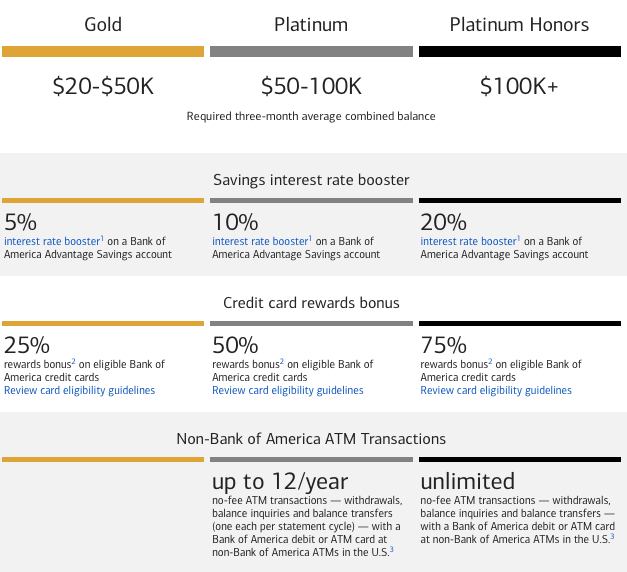
BofA checking accounts. With Gold status ($20k in assets) and above, you’ll get the monthly maintenance fee on up to 4 checking or savings accounts waived. That means you no longer have to worry about a minimum balance or maintaining direct deposit, depending on your account type. You’ll also get waived ATM fees at non-BofA ATMs at Platinum and above (12/year at $50k assets, unlimited at $100k). Free cashier’s checks.

Credit card rewards. With the Preferred Rewards boost, you can get up to 2.6% cash back on all your purchases with the Bank of America Unlimited Cash Rewards card, or 2.6% towards travel and no foreign transaction fees with the Bank of America Travel Rewards Card. You can also get 5.2% cash back on the first $2,500 in combined grocery/wholesale club/gas purchases each quarter with the Bank of America Customized Cash Rewards Card.

My personal experience. In terms of Merrill Edge, I’ve had an account with them for several years now and my lightning review is that they have a “okay/good” user interface and solidly “good” customer service (i.e. real, informed humans available 24/7 on the phone, not email-only customer service that takes hours to days like Robinhood). I am not an active trader and only make about 10-15 trades a year, but have been quite satisfied with the account. I can also move money instantly between my Merrill Edge and Bank of America checking accounts, making it relatively easy to sweep out idle cash into an external savings account, as their default cash sweep pays nearly zero interest. Don’t leave too much cash there!

The biggest financial benefit to this BofA/Merrill Edge combo with Preferred Rewards has probably been the 75% boost to their credit card rewards, allowing me to get a flat 2.625% cash back on virtually all my daily purchases. The second biggest benefit has probably been this cash bonus, and the third is the waived checking and ATM fees.

The ongoing credit card rewards would be the main reason to do this deposit offer, as the bonus percentages alone aren’t that high. For example, a $400 bonus on a $100,000 transfer amount is only 0.4%. Other brokerage transfer bonuses can be 1%, even 2%, and up.

Bottom line. Merrill Edge is currently offering up to $1,000 if you move over new assets to their self-directed brokerage. This can simply be mutual fund or ETFs shares currently being held elsewhere. When you keep enough assets across Bank of America and Merrill Edge, their Preferred Rewards program can offer ongoing perks like waived bank account fees and boosted credit card rewards.

Bank of America Unlimited Cash Rewards Card Review: 2% Cash Back for First Year (Up to 3.12% With Preferred Rewards)

New limited-time offer. The Bank of America Unlimited Cash Rewards Card is the most simple, straightforward, no-annual-fee credit card in the Bank of America line-up. If you are a Preferred Rewards client, you can increase the cash back earned by 25% to 75%. Right, they are also offering a special offer during the first year. Here are the highlights:

  • New customers: $200 cash rewards bonus after $1,000 in purchases in the first 90 days.
  • 2% cash back on purchases for the first year from account opening. After that, the standard structure is unlimited 1.5% cash back on all purchases. Redeem as a statement credit, deposit to BofA bank account, or deposit to Merrill brokerage account (including 529).
  • Bank of America Preferred Rewards® members earn 25%-75% more cash back on every purchase. However, Preferred Rewards bonuses are not applied to the 0.5% first-year bonus. Details below.
  • 0% Introductory APR offer. See link for details.
  • 3% foreign transaction fee.
  • No annual fee.

During the current limited-time offer, the cash back rewards are boosted to 2% for the first year. The 75% Preferred Rewards bonus for Platinum members does not apply to the extra 0.5%, so the net cash back during the first year for Platinum members would be 1.5% * 1.75 + 0.5% = 3.125% cash back on everything during the first year. I wonder if this is in response the recent US Bank Smartly card changes… now that new applicants can’t get a similar deal at 4% cash back, this might be the best deal in town again.

Preferred Rewards bonus basics. The Preferred Rewards program is designed to rewards clients with multiple account and higher assets located at Bank of America banking, Merrill Edge online brokerage, and Merrill Lynch investment accounts. Here is a partial table taken from their comparison chart (click to enlarge):

bofa_pref1

Let’s consider the options. Bank of America’s interest rates on cash accounts tend to be lower than highest-available outside banks (read: nearly zero), so moving cash over to qualify may result in earning less interest on your cash deposits. Merrill Lynch advisory accounts also usually come with management fees. The sweet spot is therefore the Merrill Edge self-directed brokerage, where you can move over your existing brokerage assets like stocks, mutual funds, and ETFs held elsewhere (Vanguard, Fidelity, Schwab, etc).

In the past, moving over to Merrill Edge at the Platinum and Platinum Plus levels also led to 30 to 100 free online stock trades every month. Fast forward to now, and nearly all major online brokers offer commission-free trades anyway.

Personally, I moved over $100k of brokerage assets from Vanguard to Merrill Edge to qualify for Platinum Honors. You should ask Merrill Edge if they will cover any ACAT transfer fees involved. I realize not everyone will have this level of assets to move around, but if you do then it is worth considering. Keep in mind that it will take a while for your “3-month average combined balance” to reach the $100k level and officially qualify for Platinum Honors. (In certain cases, when you open a new Merrill Edge account and new BofA Checking with a asset transfer bonus offer, you may be eligible to “fast track” to a higher tier.) You might become Gold first, then Platinum, and so on. After that, the 25%-75% rewards bonus on credit card rewards kick in. Once you reach a certain tier, BofA guarantees that you will stay there for a year no matter what, even if your balance fluctuates.

Boosted cash back percentages with Preferred Rewards. The standard structure is a flat 1.5% cash back on all purchases. Here’s how the numbers work out after you reach each tier:

  • Platinum Honors: 2.625% cash back on all purchases (75% bonus).
  • Platinum: 2.25% cash back on all purchases (50% bonus).
  • Gold: 1.875% cash back on all purchases (25% bonus).

I consider the bar set at 2% cash back to be considered a “great” rewards card. The Platinum and Platinum Honors levels allow you to surpass that bar. Again, not everyone will have this level of assets to move around, and so this offer is not available to everyone. BofA is willing to pay such high cash back on the credit card because they hope to make it back through their other products (banking, brokerage, loans).

Their plan worked on me because Bank of America has managed to convince me to go from only having a checking account with them to now also having a Merrill Edge brokerage account and a Bank of America credit card.

Comparison against other BofA credit cards. Not all Bank of America consumer credit cards qualify for Preferred Rewards. Other cards of interest that do qualify are:

Honestly, these are all solid cards if you qualify for Preferred Rewards. I can see any one of them being a good choice for those that want relatively simple rewards after setting up a “relationship” with BofA.

My slight personal favorite is the Travel Rewards credit card. The rewards structure on the Travel Rewards is similar to the Unlimited Cash Rewards card including the 1.5% back (up to 2.62% with Preferred Rewards) earning rate and no annual fee, except that the rewards can only be used to offset past travel and dining purchases made on the card in the past 12 months. I have redeemed thousands of dollars in statement credits and never run out of travel/dining purchases to offset. Their redemption process is quick and easy. One difference is that the Travel Rewards has no foreign transaction fee, while this Unlimited Cash Rewards card has a 3% foreign transaction fee. Together, this makes the Travel Rewards card a great “catch-all” card that I always have in my wallet. You may prefer the Unlimited Cash Rewards card if you have very little travel/dining charges.

The Premium Rewards card may be better if you can reliably utilize the $100 annual Airline Incidentals credit (seat upgrades, baggage fees, lounge fees) to offset the $95 annual fee, as then the increased cash back on travel/dining is all net profit. The Customized Cash Rewards cards with its 3/2/1 structure is also tempting as a companion to the Travel/Unlimited Cash, but you may prefer other rewards card for specific categories.

Bottom line. The Bank of America Unlimited Cash Rewards Credit Card is an “okay” cash back rewards card with a 1.5% cash back on everything structure, but turns into an “excellent” 2.62% cash back rewards card if you can take full advantage of their Preferred Rewards program. If you transfer $100,000 of existing brokerage assets (could be ETFs or mutual funds) over to Merrill Edge, you can qualify for the highest Platinum Honors tier. This won’t be a good option for everyone, but something to be aware of if you can swing it.

During the current limited-time offer, the cash back rewards are boosted to 2% for the first year. The 75% Preferred Rewards bonus for Platinum members does not apply to the extra 0.5%, so the net cash back during the first year for Platinum members would be 1.5% * 1.75 + 0.5% = 3.12% cash back on everything during the first year.

Bank of America Customized Cash Rewards Card Review: 6% Cash Back in One Category for First Year (Up to 8.25% with Preferred Rewards)

New limited-time offer. The Bank of America Customized Cash Rewards Credit Card is the “3-2-1” cash back rewards credit card in the Bank of America line-up. If you are a Preferred Rewards client, you can increase the cash back earned by 25% to 75%. Right, they are also offering a special offer during the first year. Here are the highlights:

  • New customers: $200 cash rewards bonus after $1,000 in purchases in the first 90 days.
  • Earn 1% cash back on every purchase, 2% at grocery stores and wholesale clubs, and 3% on your choice category up to the first $2,500 in combined grocery/wholesale club/choice category purchases each quarter. During the first year, you’ll get an extra 3% cash back on the choice category.
  • Cardholders will be able to choose their 3% cash back category from one of these 6 options: gas and EV charging stations; online shopping, including cable, internet, phone plans and streaming; dining; travel; drug stores and pharmacies; or home improvement and furnishings.. You can change your category once each calendar month in-app or online. Do nothing and it will stay the same.
  • Bank of America Preferred Rewards® members earn 25%-75% more cash back on every purchase. However, Preferred Rewards bonuses are not applied to the 3% first-year bonus. Details below.
  • 0% Introductory APR offer. See link for details.
  • No annual fee.

During the current limited-time offer, the cash back rewards on your special choice category are boosted by an additional 3% for the first year. The 75% Preferred Rewards bonus for Platinum members does not apply to the extra 3%, so the net cash back during the first year for Platinum members would be 3% * 1.75 + 3% = 8.25% cash back on your Choice Category during the first year, subject to the $2,500 cap per quarter which includes grocery/wholesale club purchases. You would also get 3.5% cash back on your grocery/wholesale club purchases during the first year, again subject to the $2,500 cap per quarter which includes any purchases in your Choice Category.

Theoretically, if you only used your card for the Choice Category and spent exactly $2,500 in that Choice Category per quarter, in one year you would rack up $825 in rewards from $10,000 in purchases. This would be separate from the one-time $200 new customer cash bonus.

Personally, I think the “Online Shopping” category is the most flexible. Per this page: “Online Shopping category includes purchases made online via a website or a digital application (an app). Here are the provided examples of eligible merchants: Amazon, Walmart, Comcast, Etsy, Netflix, Nordstrom, Ticketmaster.

Preferred Rewards bonus basics. The Preferred Rewards program is designed to rewards clients with multiple account and higher assets located at Bank of America banking, Merrill Edge online brokerage, and Merrill Lynch investment accounts. Here is a partial table taken from their comparison chart (click to enlarge):

bofa_pref1

Let’s consider the options. Bank of America’s interest rates on cash accounts tend to be lower than highest-available outside banks (read: nearly zero), so moving cash over to qualify may result in earning less interest on your cash deposits. Merrill Lynch advisory accounts also usually come with management fees. The sweet spot is therefore the Merrill Edge self-directed brokerage, where you can move over your existing brokerage assets like stocks, mutual funds, and ETFs held elsewhere (Vanguard, Fidelity, Schwab, etc).

In the past, moving over to Merrill Edge at the Platinum and Platinum Plus levels also led to 30 to 100 free online stock trades every month. Fast forward to now, and nearly all major online brokers offer commission-free trades anyway.

Personally, I moved over $100k of brokerage assets from Vanguard to Merrill Edge to qualify for Platinum Honors. You should ask Merrill Edge if they will cover any ACAT transfer fees involved. I realize not everyone will have this level of assets to move around, but if you do then it is worth considering. Keep in mind that it will take a while for your “3-month average combined balance” to reach the $100k level and officially qualify for Platinum Honors. You might become Gold first, then Platinum, and so on. After that, the 25%-75% rewards bonus on credit card rewards kick in. Once you reach a certain tier, BofA guarantees that you will stay there for a year no matter what, even if your balance fluctuates. (In certain cases, when you open a new Merrill Edge account and new BofA Checking with a asset transfer bonus offer, you may be eligible to “fast track” to a higher tier.)

Cash Back Rewards after Preferred Rewards bonus (standard):

Recall that the basic structure is “1/2/3”; you get 1% cash back on every purchase, 2% at grocery stores and wholesale clubs and 3% on choice category for the first $2,500 in combined grocery/wholesale club/gas purchases each quarter (1/2/3). Here’s how the bonuses work out:

  • Platinum Honors: 1.75% cash back on every purchase, 3.5% at grocery stores and wholesale clubs, and 5.25% on choice category for the first $2,500 in combined grocery/wholesale club/gas purchases each quarter.
  • Platinum: 1.5% cash back on every purchase, 3% at grocery stores and wholesale clubs, and 4.5% on choice category for the first $2,500 in combined grocery/wholesale club/gas purchases each quarter.
  • Gold: 1.25% cash back on every purchase, 2.5% at grocery stores and wholesale clubs, and 3.75% on choice category for the first $2,500 in combined grocery/wholesale club/gas purchases each quarter.

Not all Bank of America consumer credit cards qualify for Preferred Rewards. Other cards of interest that do qualify are:

Bottom line. The Bank of America Cash Rewards Credit Card is an “okay” cash back rewards card with a 1/2/3 structure, but turns into an “excellent” rewards card if you are willing to do deal with the added complexity of tracking purchase categories and can take full advantage of their Preferred Rewards program. If you transfer $100,000 of existing brokerage assets over to Merrill Edge, you can qualify for the highest Platinum Honors tier. This won’t be a good option for everyone, but something to be aware of if you can swing it.

During the current limited-time offer, the Choice Category purchases are boosted by an additional 3% for the first year. The 75% Preferred Rewards bonus for Platinum members does not apply to the extra 3%, so the net cash back during the first year for Platinum members would be 3% * 1.75 + 3% = 8.25% cash back on your Choice Category during the first year, subject to the $2,500 purchase cap per quarter which includes any grocery/wholesale club purchases.

More Details on Warren Buffett Stepping Back

I’m not sure how many of you follow Warren Buffett and Berkshire Hathaway closely, but here are a couple of significant updates as a follow-up to the 2025 Annual Shareholder Meeting where he announced that he was stepping down as CEO at the end of 2025:

As he will no longer be CEO, I am assuming this means that he will also not write anything in the annual Letter to Shareholders, which means that his public interactions will be severely limited to whatever few interviews he grants, if any. The end of an era.

Big List of 529 College Savings Plan Promotions: 529 Day 5/29 2025

College savings plans that are looking to grow assets tend to have promotions on May 29th, aka “529 Day”. I started gathering up these bonuses from various plans even before having kids, and eventually consolidated them into one single plan. The bonus amounts tend to be pretty modest, and transfers do involve extra legwork, so getting more than one is mostly for the highly-motivated.

Here’s a list of bonuses that include guaranteed amounts; I’m less interested in drawings. I’m listing the state, but you do not have to be a resident of that state to open a 529 account there. You can have multiple 529s from different states, and often you can usually get the bonus once for each child/beneficiary. However, you may need to be a resident to qualify for a specific bonus, or there may be an age restriction on the beneficiary, etc.

  • CaliforniaCA Scholarshare. Open a ScholarShare 529 account between May 20 and May 31, 2025, and receive a $50 bonus. Use promo code 529Day25.
  • FloridaFlorida Prepaid 529. Open a Florida 529 Savings Plan by June 30, 2025, and get $50 added to your account.
  • GeorgiaPath2College 529. Open a Georgia Path2College 529 account between May 20 and May 31, 2025, and receive a $50 bonus! Use promo code 529Day25.
  • KansasLearning Quest 529. Nothing on their site yet, but might be one coming closer to 5/29.
  • MichiganMichigan Education Trust. Purchase a new MET from 5/29/25 to 6/1/25 and get a $50 bonus. A minimum $250 contribution during online enrollment is required, use coupon code 529DAY during enrollment to qualify.
  • MinnesotaMN Saves 529. Open a Minnesota 529 College Savings Plan account between May 20 and May 31, 2025, and receive a $50 bonus! Use promo code 529Day25.
  • NebraskaNEST 529. Nothing on their site yet, but might be one coming closer to 5/29.
  • PennsylvaniaPA 529. There is only a drawing, but wanted to note that all PA children born after January 1, 2019, have a $100 investment available for them in a Keystone Scholars account. You must activate to claim.
  • UtahUtah My529. To be eligible to receive a $25 matching contribution from my529, open an account for a beneficiary who is new to my529 and contribute $25 or more to the new account between May 1 and May 31, 2025. Use the code 529DAY25 during the account setup process. my529 will match the $25 contribution on or around June 16, 2025. Account owners must be Utah residents. The beneficiary does not need to be a Utah resident.
  • VirginiaNEST 529. For one day only, open a new Invest529 account on May 29th and use the gift code 529DAY2025 to receive a bonus initial contribution of $25.

529 plans can now pay for K-12 tuition, apprenticeships, and other educational expenses beyond college tuition and room/board. You can even pay to up to $10,000 of student loans (including your own). Check your own state rules to ensure they enable this option, though. Finally, opening a plan and making any contribution also starts the 15-year clock on potential future 529-to-Roth IRA rollovers.

Most 529 plans also now have convenient contribution links to share with friends and family. Please let me know if you find others.

Sources: NY Times, CollegeSaving.org, specific state websites.

Photo credit: Modified from Pawel Czerwinski on Unsplash

Webull Brokerage: Deposit Promos, Free WSJ Subscription, 3.5% IRA Match w/ Premium

Brokerage app Webull is running a “7 Years of Webull” anniversary promo (full terms) that includes some decent bonuses that are stackable. This offer is targeted at selected existing customers who have a funded account as of 5/20/25. Check your app or desktop account if you didn’t get a notification.

Offer #1: 30 Days of Webull Premium. If you deposit $100+, you get 30 days of Webull Premium, their new upgrade tier that is similar to Robinhood Gold.

Offer #2: Deposit Bonus. Pays out automatically in 12 equal monthly installments. First payment will be within 45 days of 6/30/25, so your hold time will be up to 15 months or so. The ratios are pretty good at the lower end; for example $200 for $2,000 is a 10% ratio.

Offer #3: 12-month subscription to The Wall Street Journal. Must deposit $10,000+. You need Webull Premium to keep this going, which costs $40 for a year. This is still a steep discount to the usual pricing (intro ~$100 a year for the first year, ~$500 a year ongoing).

Stacking example: If you deposit $10,001 in new funds (and invest it there for 13-15 months) and pay $40 for a year of Webull Premium, you can get both a $400 deposit bonus and 12 months of WSJ. With Webull Premium, you also make available 4.1% APY on cash sweep, 3.5% bonus on IRA contributions, and 3% bonus on IRA transfers (5-year minimum hold period for both). I’m more here for the short-term promos though, as I’m not a big fan of Webull customer service in general.

MYGA Fixed Annuity Warning: Choosing The Highest Rate Can Be Stressful

I’ve written a little about about Multi-year guaranteed annuity (MYGA) fixed deferred annuities in the past, and I actually bought one as one of my “$10,000 Experiments” way back in 2015. I bought the MYGA with the highest available interest rate at the time from a company called Sentinel Security Life. Owning a MYGA is very quiet, I only get a mailed statement once a year and the only action required is to roll it over every 5 years. In 2020, Sentinel still offered the highest rate, so I rolled it over to them again. More quiet…

Fast forward to early 2025, and after my recent post about private equity entering the world of MYGAs, I decided to check in on ole’ Sentinel Security Life. Turns out they have been going through some major drama recently!

  • In December 2024, the Utah Insurance Department issued an emergency order prohibiting Sentinel Security Life, along with its affiliates Haymarket Insurance and Jazz Reinsurance, from issuing new policies after December 31, 2024.
  • In mid-March 2025, a Utah judge paused this emergency order, and allowed them to start issuing policies again, pending the result of a trial to start in May 2025.
  • In March 2025, Utah Insurance Commissioner Jonathan Pike petitioned for Sentinel to be placed into “rehabilitation”, stated that it had a “years-long history of self-dealing, conflicts of interest, and obfuscation.” For example, allegedly, Sentinel Insurance would make substantial risky loans to entities also owned by the same controlling party (Kenneth King and Advantage Capital Partners, known as A-Cap). They also have additional insurance companies in South Carolina that are having similar issues with regulators.

“Drama” and your insurance/annuity provider are not a good combo. I knew that going for the highest interest would involve buying from a riskier insurance company, but went for it anyway because that was the entire point of the experiment. The reason to go for a MYGA instead of an FDIC-insured bank CD is to earn a significantly higher net rate due to the combination of the rate gap and the tax deferral benefits during accumulation. Along with that is the assumption that insurance department will require the insurance companies have proper reserves, and that your state guaranty association will cover you in the unlikely case that your insurance company does fail.

While in the accumulation stage, I feel that I can be more aggressive in using a higher-interest-paying, lower-credit-rating company since my exposure will be limited to the next 5 years. But eventually if I choose to convert the final amount to an annuitized income stream, I would be more conservative since my exposure would be potentially for decades. If I was relying on Sentinel to provide my monthly paycheck in retirement, that would be very stressful.

As it stands, my current 5-year MYGA contract ends in less than 5 months (September 2025), and I will be looking to transfer to another 5-year MYGA from a different insurance provider. Honestly, I’ll still probably be comparison shopping amongst the highest rates. I worry that if I tried to buy only from some old, stodgy traditional insurance company, these days it could be bought out by some private equity firm and transformed within a year anyway.

In the end, like many insurance and annuity products, MYGAs are very complex with a lot of variables and grey areas. As a finance geek, this actually intrigues me, but on the flip side this means they are not very consumer-friendly. I personally don’t view their benefits to justify the added complexity to my overall portfolio, so I have not bought any additional MYGAs since my first and only purchase.

If you do decide to pursue MYGAs, I encourage you to research State Guaranty Associations and be careful to stay under your applicable state limits. Since their beginnings in the 1970s, no state guaranty association has failed to pay a covered claim. However, nobody knows what would happen if there was a large crisis. They are not backed by any Federal guarantee like FDIC or NCUA insurance.

Check the Cost Basis Tracking in Your Brokerage Account

When you sell your shares of stocks/ETFs/mutual funds in a taxable brokerage account, your broker will also record the specific shares and the original value at purchase (cost basis) at which you bought them. Even if you don’t expect to sell your shares very often, it can still be important how you set the cost basis tracking option inside your brokerage account.

Allan Roth has a useful ETF.com article about why your choice of cost basis tracking could possibly make a difference of thousands of dollars or more. Here’s his real-world example:

Not too long ago, a very seasoned and knowledgeable investor shared a story of a mistake he recently made. He meant to buy 300 shares of the Vanguard Total Stock Market ETF (VTI) but mistakenly punched an extra zero and bought 3,000 instead.

He quickly realized his mistake and sold the 2,700 shares he accidentally bought. The ETF was only up slightly, and he used the Minimum Tax (MinTax) cost basis method on Vanguard’s brokerage platform. He was shocked to learn he just realized a long-term capital gain of about $150,000. […] Because the recently purchased lot of VTI had a tiny short-term gain, it was last in the prioritization of sales and his prior lots with large long-term gains were sold.

Are your current settings still the default? For example, at Vanguard, the default cost basis method appears to be:

  • Average cost (AvgCost) as the default cost basis method for mutual funds at Vanguard.
  • First-in, first-out (FIFO) as the default cost basis method for all investments other than mutual funds.

You can usually change this setting. Here’s what I see as my available options at Vanguard:

At Fidelity, the default cost basis method appears to be First-in, first-out (FIFO) as well for brokerage accounts. Here’s what I see as my available options at Fidelity:

Roth suggests that the best practice is to manually choose specific tax lots. In my experience, using the SpecID setting at Vanguard will force you to choose the “specific shares” that you want to sell when you enter the order. This has come in handy for me, forcing me to think about the tax consequences before I submit. Roth also shares a recent change that Vanguard only allows market orders (no limit orders) on SpecID sales. He decides that it is more important to get the tax basis right than the small added safety of a limit order. I would agree.

At Fidelity, when you sell the shares, on the order ticket there is either a “Sell Specific” action option, or after “Sell” you can click on a small link to “Specify shares”. Unfortunately, I don’t see an option that forces you to manually pick a specific tax lot. Fidelity does a good job of presenting the tax lots clearly on your Positions screen, but you’ll still have to remember on your own when the time comes.

However, if you do forget but remember quickly afterward, I found these instructions to reassign the tax lots before settlement:

Follow these steps to specify tax lots AFTER a trade is placed but before settlement:

– Log into Fidelity.com and Select “Accounts & Trade,” then choose “Account Positions”
– Navigate to the “Closed Positions” link above the “Symbol” column
– Click on “Select Action” next to the appropriate account and choose “Reassign Lots”

Most major brokerage firms should have a similar option, although some of the new ones may not. For example, Robinhood only added their Tax Lots feature in December 2024, more than a decade after starting out. Yet even they admit the potential benefits:

Tax Lots allow customers to choose specific assets to sell—whether it’s the ones held long term, the ones with the lowest or highest cost basis, or the ones that might have experienced the greatest loss. This gives customers the ability to make more informed decisions and manage their tax bill.

In any case, I used this as a timely reminder to be double-check all of your current brokerage account settings.

US Bank Self-Directed Brokerage: Enabling Automatic Dividend Reinvestment

For those that are newer members of the US Bank checking/savings/credit card/brokerage ecosystem, most likely for the up to 4% cash back rewards from their Smartly credit card (current terms for new applicants are poor, but the grandfathered terms are still excellent), you may choose to park some assets in their self-directed brokerage arm in order to meet the (grandfathered) qualification requirements. I personally did, and it has been working out fine.

Notably, as with many brokerage firms, US Bank pays rather pathetic rates on idle cash (0.23% APY as of 5/15/25). The cash sweep that we forget about is a reliable profit source for them. I tend to forget, everyone tends to forget.

Thus, when I need to move assets to a new brokerage, my two preferred options are my holdings of Berkshire Hathaway (BRKB) because they don’t pay out any dividends at all and iShares 0-3 Month Treasury Bond ETF (SGOV) because it pays a competitive yield from T-Bills (that’s also exempt from state/local taxes). The final touch is to set up automatic dividend reinvestment on the shares to avoid losing interest on idle cash sweep. This way, each month the interest paid out is automatically reinvested into more shares of SGOV at the current market price.

Earning a ~5% return from SGOV over the last year was much better (20X better!) than earning ~0.25%.

For US Bank brokerage, there is no online option available to set this up. You must call them on the phone and request it manually. The phone number for US Bank Wealth Management Brokerage Services is 800-888-4700. There were no sales-related hassles and it only took about 5 minutes. Worth the effort. Now I don’t have to worry about making manually trades or manually transferring out the idle cash every month.

Best Interest Rates Survey: Savings Accounts, Treasuries, CDs, Money Markets, ETFs – May 2025

Here’s my monthly survey of the best interest rates on cash as of May 2025, roughly sorted from shortest to longest maturities. Banks love taking advantage of our idle cash, and you can often earning more money while keeping the same level of safety by moving to another FDIC-insured bank or NCUA-insured credit union. Check out my Ultimate Rate-Chaser Calculator to see how much extra interest you could earn from switching. Rates listed are available to everyone nationwide. Rates checked as of 5/14/2025.

TL;DR: Savings account interest rates are stable overall. Short-term T-Bill rates at around 4.3%. Top 5-year CD rates are ~4.25% APY, while 5-year Treasury rate is ~4.15%.

High-yield savings accounts*
Since the huge megabanks still pay essentially no interest, everyone should at least have a separate, no-fee online savings account to piggy-back onto your existing checking account. The interest rates on savings accounts can drop at any time, so I list the top rates as well as competitive rates from banks with a history of competitive rates and solid user experience. Some banks will bait you with a temporary top rate and then lower the rates in the hopes that you are too lazy to leave.

  • The top saving rate at the moment: Axos One Savings at 4.66% APY (no min). Roger.bank is right behind at 4.65% APY (no min), but does require an additional companion checking account. OnPath FCU has a new account paying 5.00% APY but requires $25,000 min and has some ACH withdrawal hoops. CIT Platinum Savings is now at 4.10% APY with $5,000+ balance, but also has a $225/$300 deposit bonus you can stack on top. There are many banks in between.
  • SoFi Bank is at 3.80% APY + up to $325 new account bonus with direct deposit. You must maintain a direct deposit of any amount (even $1) each month for the higher APY. SoFi has historically competitive rates and full banking features. See details at $25 + $300 SoFi Money new account and deposit bonus.
  • Here is a limited survey of high-yield savings accounts. They aren’t the top rates, but a group that have historically kept it relatively competitive such that I like to track their history.

Short-term guaranteed rates (1 year and under)
A common question is what to do with a big pile of cash that you’re waiting to deploy shortly (plan to buy a house soon, just sold your house, just sold your business, legal settlement, inheritance). My usual advice is to keep things simple and take your time. If not a savings account, then put it in a flexible short-term CD under the FDIC limits until you have a plan.

  • No Penalty CDs offer a fixed interest rate that can never go down, but you can still take out your money (once) without any fees if you want to use it elsewhere. Marcus has a 7-month No Penalty CD at 4.00% APY ($500 minimum deposit) and 13-month at 3.90% APY. Farmer’s Insurance FCU has 9-month No Penalty CD at 4.25% APY ($1,000 minimum deposit). Kinecta FCU has 9-month Liquid CD at 4.25% APY ($10,000 minimum) that allows for daily penalty-free withdrawals of up to 50% of the start of day balance. Consider opening multiple CDs in smaller increments for more flexibility.
  • Security State Bank has a 12-month certificate special at 4.65% APY ($25,000 min). Early withdrawal penalty is 180 days of interest.

Money market mutual funds
Many brokerage firms that pay out very little interest on their default cash sweep funds (and keep the difference for themselves). Note: Money market mutual funds are highly-regulated, but ultimately not FDIC-insured, so I would still stick with highly reputable firms.

  • Vanguard Federal Money Market Fund (VMFXX) is the default sweep option for Vanguard brokerage accounts, which has an SEC yield of 4.20% (changes daily, but also works out to a compound yield of 4.28%, which is better for comparing against APY). Odds are this is much higher than your own broker’s default cash sweep interest rate.
  • Vanguard Treasury Money Market Fund (VUSXX) is an alternative money market fund which you must manually purchase, but the interest will be mostly (100% for 2024 tax year) exempt from state and local income taxes because it comes from qualifying US government obligations. Current SEC yield of 4.23% (compound yield of 4.31%).

Treasury Bills and Ultra-short Treasury ETFs
Another option is to buy individual Treasury bills which come in a variety of maturities from 4-weeks to 52-weeks and are fully backed by the US government. You can also invest in ETFs that hold a rotating basket of short-term Treasury Bills for you, while charging a small management fee for doing so. T-bill interest is exempt from state and local income taxes, which can make a significant difference in your effective yield.

  • You can build your own T-Bill ladder at TreasuryDirect.gov or via a brokerage account with a bond desk like Vanguard and Fidelity. Here are the current Treasury Bill rates. As of 5/14/25, a new 4-week T-Bill had the equivalent of 4.32% annualized interest and a 52-week T-Bill had the equivalent of 4.14% annualized interest.
  • The iShares 0-3 Month Treasury Bond ETF (SGOV) has a 4.17% SEC yield (0.09% expense ratio) and effective duration of 0.10 years. SPDR Bloomberg Barclays 1-3 Month T-Bill ETF (BIL) has a 4.13% SEC yield (0.136% expense ratio) and effective duration of 0.15 years. The new Vanguard 0-3 Month Treasury Bill ETF (VBIL) has a 4.20% SEC yield (0.07% expense ratio) and effective duration of 0.10 years.

US Savings Bonds
Series I Savings Bonds offer rates that are linked to inflation and backed by the US government. You must hold them for at least a year. If you redeem them within 5 years there is a penalty of the last 3 months of interest. The annual purchase limit for electronic I bonds is $10,000 per Social Security Number, available online at TreasuryDirect.gov.

  • “I Bonds” bought between May 2025 and October 2025 will earn a 3.98% rate for the first six months. The rate of the subsequent 6-month period will be based on inflation again. More on Savings Bonds here.
  • In mid-October 2025, the CPI will be announced and you will have a short period where you will have a very close estimate of the rate for the next 12 months. I will post another update at that time.

Rewards checking accounts
These unique checking accounts pay above-average interest rates, but with unique risks. You have to jump through certain hoops which usually involve 10+ debit card purchases each cycle, a certain number of ACH/direct deposits, and/or a certain number of logins per month. If you make a mistake (or they judge that you did) you risk earning zero interest for that month. Some folks don’t mind the extra work and attention required, while others would rather not bother. Rates can also drop suddenly, leaving a “bait-and-switch” feeling.

  • OnPath Federal Credit Union (my review) pays 7.00% APY on up to $10,000 if you make 15 debit card purchases, opt into online statements, and login to online or mobile banking once per statement cycle. Anyone can join this credit union via $5 membership fee to join partner organization. You can also get a $100 Visa Reward card when you open a new account and make qualifying transactions.
  • Genisys Credit Union pays 6.75% APY on up to $7,500 if you make 10 debit card purchases of $5+ each per statement cycle, and opt into online statements. Anyone can join this credit union via $5 membership fee to join partner organization.
  • La Capitol Federal Credit Union pays 5.75% APY on up to $10,000 if you make 15 debit card purchases of at least $5 each per statement cycle. Anyone can join this credit union via partner organization, Louisiana Association for Personal Financial Achievement ($20).
  • First Southern Bank pays 5.50% APY on up to $25,000 if you make at least 15 debit card purchases, 1 ACH credit or payment transaction, and enroll in online statements.
  • Credit Union of New Jersey pays 6.00% APY on up to $25,000 if you make 12 debit card purchases, opt into online statements, and make at least 1 direct deposit, online bill payment, or automatic payment (ACH) per statement cycle. Anyone can join this credit union via $5 membership fee to join partner organization.
  • Andrews Federal Credit Union pays 5.50% APY (down from 6%) on up to $25,000 if you make 15 debit card purchases, opt into online statements, and make at least 1 direct deposit or ACH transaction per statement cycle. Anyone can join this credit union via partner organization.
  • Find a locally-restricted rewards checking account at DepositAccounts.

Certificates of deposit (greater than 1 year)
CDs offer higher rates, but come with an early withdrawal penalty. By finding a bank CD with a reasonable early withdrawal penalty, you can enjoy higher rates but maintain access in a true emergency. Alternatively, consider building a CD ladder of different maturity lengths (ex. 1/2/3/4/5-years) such that you have access to part of the ladder each year, but your blended interest rate is higher than a savings account. When one CD matures, use that money to buy another 5-year CD to keep the ladder going. Some CDs also offer “add-ons” where you can deposit more funds if rates drop.

  • Mountain America Credit Union (MACU) has a 5-year certificate at 4.25% APY ($500 minimum), 4-year at 4.20% APY, 3-year at 4.15% APY, 2-year at 4.00% APY, and 1-year at 4.20% APY. Early withdrawal penalty for the 4-year and 5-year is 365 days of interest. Anyone can join this credit union via partner organization American Consumer Council for a one-time $5 fee (or try promo code “consumer”).
  • Lafayette Federal Credit Union (LFCU) has a 5/4/3/2/1-year certificates at 4.28% APY ($500 min). Slightly higher rates with jumbo $100,000+ balances. Note that the early withdrawal penalty for the 5-year is a relatively large 600 days of interest. Anyone nationwide can join LFCU by joining the Home Ownership Financial Literacy Council (HOFLC) for a one-time $10 fee.
  • You can buy certificates of deposit via the bond desks of Vanguard and Fidelity. You may need an account to see the rates. These “brokered CDs” offer FDIC insurance and easy laddering, but they don’t come with predictable early withdrawal penalties. Right now, I see a 5-year non-callable brokered CD at 4.20% APY (callable: no, call protection: yes). Be warned that both Vanguard and Fidelity will list higher rates from callable CDs, which importantly means they can (and will!) call back your CD if rates drop significantly later.

Longer-term Instruments
I’d use these with caution due to increased interest rate risk (tbh, I don’t use them at all), but I still track them to see the rest of the current yield curve.

  • Willing to lock up your money for 10 years? You can buy long-term certificates of deposit via the bond desks of Vanguard and Fidelity. These “brokered CDs” offer FDIC insurance, but they don’t come with predictable early withdrawal penalties. You might find something that pays more than your other brokerage cash and Treasury options. Right now, I see a 10-year CDs at 4.05% (non-callable) vs. 4.53% for a 10-year Treasury. Watch out for higher rates from callable CDs where they can call your CD back if interest rates drop.

All rates were checked as of 5/14/25.

* I no longer recommend fintech companies due to the possibility of loss due to poor recordkeeping and lack of government regulation. (Ex. Evergreen Wealth at 5% APY is a fintech.)

Photo by insung yoon on Unsplash

Apple Siri Class Action Settlement: “Lopez Voice Assistant” Email

Apple has settled a class-action lawsuit that their voice-activated Siri assistant violated users’ privacy by recording conversations and sending them to third-party contractors. Eligibility includes those that “owned or purchased a Siri-enabled device and experienced an unintended Siri activation during a confidential or private communication between September 17, 2014 and December 31, 2024.”

If this applies to you, first check your inbox (including Spam folder!) for an email from “Lopez Voice Assistant Settlement Administrator” [info@lopezvoiceassistantsettlement.com] with the subject line “Lopez Voice Assistant Class Action Settlement”. At the top of the e-mail, you should find a Claimant Identification Code and Confirmation Code that will make it easier to file a claim. My e-mail arrived on 5/11/25. Here are a few useful details:

  • You can get up to $20 per device, for up to 5 devices (up to $100 total) where you attest under penalty of perjury that you “experienced an unintended Siri activation during a conversation intended to be confidential or private”.
  • Eligible devices include iPhone, iPad, Apple Watch, MacBook, iMac, HomePod, iPod touch, or Apple TV.

Submit your claim online at www.lopezvoiceassistantsettlement.com. Claim form must be submitted no later than July 2, 2025. You don’t need to have received the e-mail to file a claim, but the codes may help confirm your eligibility.

Based on my past experience, I would simply submit a claim right away… and then forget about it. Choose a payment method that you are confident will still work years from now. I could only pick from direct deposit or eCheck, so here pick a bank account you know you won’t close. Let yourself to be surprised on the upside later down the road. Then either buy some Starbucks or some fractional AAPL shares with the money. 😜

WisdomTree Prime Crypto: $100 Bonus w/ $1000 Deposit for 45 Days

New crypto exchange WisdomTree Prime is offer a $100 bonus in crypto after the following:

  1. Open a new WisdomTree Prime account.
  2. Deposit $1,000 into your account and maintain an average balance of $1,000 — based on deposits and withdrawals — for a 45 day period.
  3. We’ll deposit your reward of $100 in value into your WisdomTree Prime account in approximately 5 business days after you have met all of the reward requirements.

You’ll technically get your $100 reward in WUSD (WisdomTree Dollar Token), a stablecoin that is meant to be exchangeable for one U.S. dollar. Offer currently set to expire 5/18. Interesting that it doesn’t require any trades. Just remember that this is still a crypto exchange and is thus not FDIC-insured. Based on this tweet, WisdomTree Prime does appear to be affiliated with the more well-known WisdomTree ETF provider with over $81 billion in AUM.