Archives for May 2025

Gemini Crypto: $50 Bonus after Trading $100 (Referral Promo Code)

Update: Bonus now $50.

Crypto exchange Gemini has upped their referral offer for a limited-time to a $50 bonus in crypto after you open a new account and trade $100. You should see the info on the link landing page. Above is a screenshot from my app. You can do something as simple as trade something buy and sell $100 of USDC or GUSD stablecoin (which is what I did), if you want something with minimal volatility although it’s still crypto and not FDIC-insured. You should get confirmation of the bonus after a day or so. That’s my referral link, which should auto-populate with the promo code pv7x7gy39; Thanks if you use it!

You’ve been invited to Gemini!
Sign up and trade at least $100 to earn $50 in the crypto of your choice. The more you trade, the more you and your friend will earn!

Get another $75 in Crypto: If you haven’t already, Kraken also has a $75 bonus after trading $200 in crypto.

By the way, always be careful with crypto apps. Many scam e-mails will involve a crypto app, and now that you have an actual account with them, you might think the e-mail is legit.
Best vs. Worst Mortgage Rates: How Much Are You Overpaying If You Don’t Shop Around?

If you are looking at mortgages and figure that the market must be competitive and that all lenders should offer similar interest rates, then you should check out this Axios article and Tomo Mortgage whitepaper “The Truth about Mortgages” (via Abnormal Returns).

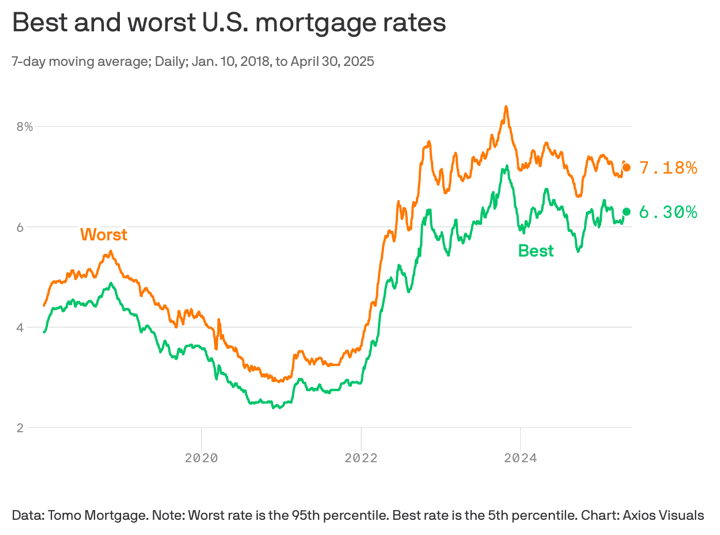
Here’s a chart comparing the best and worst mortgage rates over the past several years. (Best is the 5th percentile, Worst is the 95th percentile.) The gap has been as narrow as 0.5% and as wide as 2%. Right now, the gap is closer to 1%.

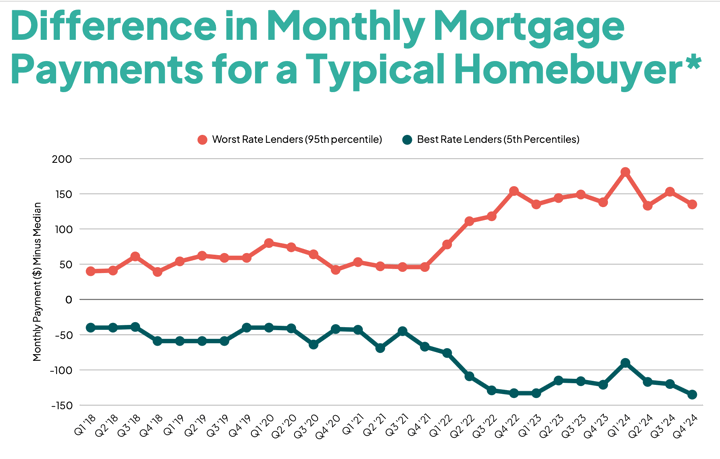
This difference between getting a top and bottom rate equates to a difference of ~$300 per month on a 30-year fixed mortgage. $300 a month, every month, for up to 30 years! That’s a potential $3,000+ every year that you’re overpaying just because you didn’t shop around adequately.

I’m not familiar with Tomo, but they do offer some easy rate shopping that includes both their rates and those of competitors. Tomo is only available in certain states.

Capital One Venture Rewards Credit Card: 75,000 Miles (Worth $750 in Travel)

card_name

The card_name is a premium travel rewards card with a flat 2 Miles per dollar on all purchases. 75,000 miles can be redeemed as a $750 credit towards any travel purchase made with the card (any airline website, any hotel website, AirBNB stays, Uber rides, no blackout dates). Here are the highlights:

  • 75,000 Miles once you spend $4,000 on purchases within the first 3 months of account opening – that’s equal to $750 in travel.
  • 2x miles on every purchase, every day.
  • 5x miles on hotels, vacation rentals and rental cars booked through Capital One Travel. They offer a Price Match Guarantee.
  • Up to a $120 credit for Global Entry or TSA PreCheck®.
  • Enjoy two complimentary visits per year to Capital One Lounges or to 100+ Plaza Premium Lounges through the Partner Lounge Network. This perk is valid through December 31, 2024.
  • Use your miles to get reimbursed for any travel purchase-or redeem by booking a trip through Capital One Travel.
  • Transfer your miles to your choice of 15+ travel loyalty programs
  • Miles won’t expire for the life of the account and there’s no limit to how many you can earn.
  • $50 experience credit and other premium benefits with every hotel and vacation rental booked from the Lifestyle Collection.
  • No foreign transaction fees.
  • $95 annual fee.

Note the following about existing or previous cardholders:

Existing or previous cardmembers are not eligible for this product if they have received a new cardmember bonus for this product in the past 48 months.

(Capital One’s “ultra-premium” card is the Capital One Venture X Rewards Credit Card, which has more perks including Priority Pass airport lounge access and a $300 annual travel credit through Capital One Travel, but also a higher $395 annual fee. This Venture card is more directly competitive with the Chase Sapphire Preferred, while the Venture X competes more directly with the Chase Sapphire Reserve.)

Redemption details. Capital One “miles” can be redeemed directly for a cash statement credit on a 1 mile = $0.01 basis when offsetting any travel purchase made on the card within the past 90 days. In other words, 50,000 miles = $500 toward travel. That means you can fly on any airline or stay at any hotel, pay with this card, and then “erase” that purchase using your miles balance later. This even includes AirBnB vacation rentals, car rentals, and Uber rides.

This means that earning 2 miles on every $1 in purchases essentially makes this a 2% back card when applied towards travel. You also have the option of booking travel through their travel portal, similar to Chase Ultimate Rewards, but you are not required to do so. You have the flexibility of booking through them or making the purchase directly through the airline, hotel, car rental counter, etc. This makes it easy to combine and spend all your Capital One miles.

Miles transfer options. Capital One now allows you to transfer your “miles” into select airline miles programs as well. Here are the airline transfer partners:

  • Aeromexico
  • Air France/KLM
  • Air Canada Aeroplan
  • Cathay Pacific Asia Miles
  • Avianca Lifemiles
  • British Airways Avios
  • Emirates Skywards
  • Etihad
  • EVA
  • Finnair
  • Qantas
  • Singapore Airlines Krisflyer
  • TAP Air Portugal
  • Turkish Airlines
  • Virgin Red

Hotel partners

  • Accor Live Limitless
  • Choice Hotels

If you know how to leverage one of these international airline miles programs (my favorites are Aeroplan and Avios since you can combine family points), this can be a very valuable option. Otherwise, it’s nice to know you can always get a certain level of value by redeeming against any travel purchase.

Bottom line. The card_name earns 2x miles on every purchase, which you can either redeem against any travel purchase or transfer to one of their airline/hotel partners.

Due to the $700+ potential first-year value, I will be adding this card to my list of Top 10 Best Credit Card Bonus Offers.

2025 Berkshire Hathaway Annual Shareholder Meeting Video, Transcript, and Notes

The 2025 Berkshire Hathaway Annual Shareholder Meeting occurred on May 3rd, 2025, and you’ve probably already heard the big news: Warren Buffett will step down as the CEO at the end of the year, to be replaced by Greg Abel (recent Fortune profile). He will remain Chairman of the Board. This is a big deal, but I view it more as a step change. This will allow Abel to directly manage all of their wholly-owned subsidiary companies with full authority, while still having Buffett around to make big deals in the event of a market crisis opportunity. I doubt Buffett’s day-to-day routine will change drastically.

In any case, I still enjoyed watching and listening to the entire Q&A session with Warren Buffett, Greg Abel, and Ajit Jain. The absence of Charlie Munger was still noticeable.

CNBC again has the broadcast rights. You can find the full 6+ hour live re-broadcast on CNBC YouTube and they have also uploaded most of it to the CNBC Buffett Archives site. Their official transcript is not yet available, but you can find a helpful transcript from Steady Compounding or listen to the audio podcast version here. Personally, I like to listen to the audio in the car once, and then read through the transcript for the second round.

Here are a few personal takeaways and notes.

Nothing new regarding the cash pile. They only swing when it’s a fat pitch. They remain disciplined and remain patient and opportunistic. From Greg Abel:

Looking at our balance sheet, as Warren commented, we will have a fortress of a balance sheet. I thought Sue Decker, our lead director, said it well yesterday. We’ve got a significant amount of cash right now, but it’s an enormous asset to have that and that will continue to be a philosophy. When we can deploy it, we’ll deploy it well. We recognize it as a strategic asset that allows us to weather difficult times and not be dependent on anybody.

From Buffett:

We don’t think it’s improper for passive investors to make a few simple investments and sit with them for life. But we’ve made the decision to be in the business, so we think we can do a little better by behaving in a very irregular manner.

To young workers: find people you respect and really want to work for. Don’t worry about the salary as much.

You really want to work at something you enjoy. I’ve had five bosses in life and I liked every one of them – they were all interesting. I still decided that I’d rather work for myself than anybody else. But if you find people that are wonderful to work with, that’s the place to go. I’ve told my kids basically that you don’t get lucky like I did when I found what interested me at seven or eight years of age. It could have taken a lot longer, but you want to find what you love.

Alternatively, find a good teacher or mentor in an area you are passionate about:

People that teach, in general, love having a young student who’s actually really interested in the subject, and they’ll spend extra time with you. I ran into that. I had Graham and Dodd at Columbia. Dave Dodd treated me like a son basically. But I was interested in what they were saying and they found it kind of entertaining that I was so interested, so I would look around at what really fascinates you. I wouldn’t try and be somebody else.

On crypto and trying to get rich quick without creating any value. Much of crypto is based on the Greater Fool theory.

If very stupid things are happening around you, you do not want to participate. If people are making more money because they’re borrowing money or participating in securities that are pieces of junk but they hope to find a bigger sucker later on, you have to forget that. That’ll bite you at some point. The basic game is so good, and you’ve been so lucky to be born now.

A temporary 15% drop in the stock market is nothing.

If it had gone up 15% instead of down 15%, people would take that with remarkable grace. But if it makes a difference to you whether your stocks are down 15% or not, you need to get a somewhat different investment philosophy because the world is not going to adapt to you. You’re going to have to adapt to the world.

You will see a period in the next 20 years that will be a “hair curler” compared to anything you’ve seen before. That just happens periodically. The world makes big mistakes, and surprises happen in dramatic ways. The more sophisticated the system gets, the more the surprises can come out of left field.

Meanwhile, paying 1% annually constantly every year for investment management fees is a lot.

Incidentally, if all of you were paying 1% for investment management fees at Berkshire last year, you would have paid $8 billion for managing, and you really wouldn’t have had to do it. Investment management is a very good game because other people put up the capital and you charge them for the capital whether they do well or not, and then you charge them a lot more if they do well. It’s a well-designed business for the people who practice it – and who can blame them? That is capitalism.

Most of the time, nobody has much of an edge.

Charlie always pointed out that we made most of our money out of about eight or nine ideas over 50 years. We talked about it every day and read every report and did everything else. But if you think you can get an idea a day from listening to your broker or reading financial information, forget it. Every now and then you get extraordinary opportunities, and most of the time you don’t have much of an edge.

Overall, listening to this session as a Berkshire shareholder reminds me that the company retains a long-term mindset, thinking in decades and not quarters. A lot of companies say things like they think for the long-term, they put shareholder interests first, but their actions don’t match.

I am thankful for these reminders of how things should be done. Of course, it’s sad that things are changing, and Buffett’s increasing age does remind me of my own. I can’t believe how long he’s been at this. Carpe Diem.

Past BRK meetings:

Private Equity Creating Attractive Rates For MYGAs / Life Insurance?

One of the lessons from the 2025 Berkshire Hathaway Annual Meeting was that you never know where your next investment idea will come from, so you should “turn every page”. For example, I like to read the entire transcript of the Q&A session (thanks to Steady Compounding) instead of just reading the WSJ or CNBC articles. Take this question and answer came up from Ajit Jain, their head of insurance:

Becky Quick: This question is from Peter Shen in New Jersey. It’s for Mr. Buffett and Mr. Jain. In recent years, large private equity firms like Blackstone, Apollo, and KKR have aggressively expanded into insurance, raising permanent capital, managing float, and aiming to replicate the model that Berkshire pioneered decades ago. Given that these firms are now directly competing for insurance assets, often using higher leverage and more aggressive investment strategies, how do you view their impact on Berkshire’s insurance operations and underwriting discipline? Do you believe that the private equity model poses risks to policyholders in the broad financial system, and has this competition made it more challenging for Berkshire to find and price insurance opportunities safely and profitably today?

Ajit Jain: Part of the question is very easy. There’s no question the private equity firms have come into the space, and we are no longer competitive in the space. We used to do a fair amount in this space, but in the last 3-4 years, I don’t think we’ve done a single deal.

You should separate this whole segment into two parts: the property casualty end of the business and the life end of the business. The private equity firms you mentioned are all very active in the life end of the business, not the property casualty end.

You are right in identifying the risks these private equity firms are taking on both in terms of leverage and credit risk. While the economy is doing great and credit spreads are low, these firms have taken the assets from very conservative investments to ones where they get a lot more return. As long as the economy is good and credit spreads are low, they will make money – they’ll make a lot of money because of leverage.

However, there is always the danger that at some point the regulators might get cranky and say they’re taking too much risk on behalf of their policyholders, and that could end in tears. We do not like the risk-reward that these situations offer, and therefore we put up the white flag and said we can’t compete in this segment right now.

Basically, Berkshire can’t compete in life insurance right now because private equity firms are flush with money and are expanding into insurance and competing very aggressively on rates. The only real insurance-as-investment product that interests me (I do have term life insurance) are multi-year guaranteed annuity (MYGAs), so I decided to check the current rates.

Sure enough, a new name called Knighthead Life is at the top of the charts at Blueprint Income. Their rates will vary by state and investment amount, but I saw 7-year MYGAs at 6.80% and 5-year MYGAs at 6.55% (simple interest). Knighthead Life even has a relatively solid A- rating for financial strength from AM Best. Usually, the top rate will be offered by an insurer with a lower B++ rating.

Digging further, we find that private equity firm Knighthead Capital Management/Knighthead Insurance Group recently completed a $550 million capital raise, acquired Merit Life Insurance in January 2025, and quickly rebranded it as Knighthead Life.

Another top MYGA provider on the list, Revel One, was founded in 1980 and acquired by private equity firm Axar Capital in 2022.

I’m still trying to keep my investments simple, but these MYGA rates are a pretty significant 2%+ spread above current bank CD rates and Treasuries. They are not directly comparable, but they are comparable. MYGA are much more complicated and there are pitfalls to avoid. Please do your own research before investing.

In addition, perhaps this also makes it a good time to shop for term life insurance rates. I haven’t shopped around in a while. We got ours set up at a reasonable cost before having kids and I’m always happy to know that it is there for my family if they need it.

I wonder if looking back, this will have been an opportunity to take advantage of the consumer-friendly rates resulting from the current rush of money into private equity, or if the risks of “higher leverage and more aggressive investment strategies” will eventually create a crisis event if some of these insurance companies start to fail. (How long will that shiny A- rating last?)

Savings I Bonds May 2025: 1.10% Fixed Rate, 2.88% Inflation Rate (3.98% Total for First 6 Months)

Update: Savings I Bonds bought from May 1, 2025 through October 31, 2025 will have a fixed rate of 1.10% and inflation rate of 2.88%, for a total composite rate of 3.98% for the first 6 months. Compare the total rate with the current short-term Treasury yields (1-year @ ~3.9%), and compare the fixed rate with the short-term TIPS real yields (5-year @ ~1.5%).

Every existing I Bond will earn this inflation rate of ~2.88% eventually for 6 months; you will need to add your own fixed rate that was set based the initial purchase month. See you again in mid-October for the next early prediction for November 2025.

Original post from 4/11/25:

Savings I Bonds are a unique, low-risk investment backed by the US Treasury that pay out a variable interest rate linked to inflation. With a holding period from 12 months to 30 years, you could own them as an alternative to bank certificates of deposit (they are liquid after 12 months) or bonds in your portfolio.

New inflation numbers were just announced at BLS.gov, which allows us to make an early prediction of the May 2025 savings bond rates a couple of weeks before the official announcement on the 1st. This also allows the opportunity to know exactly what an April 2025 savings bond purchase will yield over the next 12 months, instead of just 6 months. You can then compare this against a May 2025 purchase.

New inflation rate prediction. September 2024 CPI-U was 315.301. May 2025 CPI-U was 319.799, for a semi-annual inflation rate of 1.43%. Using the official composite rate formula:

Composite rate formula: [Fixed rate + (2 x semiannual inflation rate) + (fixed rate x semiannual inflation rate)]

This results in the variable component of interest rate for the next 6 month cycle being ~2.86 to 2.88%, depending on the fixed rate.

Tips on purchase and redemption. You can’t redeem until after 12 months of ownership, and any redemptions within 5 years incur an interest penalty of the last 3 months of interest. A simple “trick” with I-Bonds is that if you buy at the end of the month, you’ll still get all the interest for the entire month – same as if you bought it in the beginning of the month. It’s best to give yourself a few business days of buffer time. If you miss the cutoff, your effective purchase date will be bumped into the next month. (You should always sell at the very beginning of the month.)

Buying in April 2025. If you buy before the end of April, the fixed rate portion of I-Bonds will be 1.20%. You will be guaranteed a total interest rate of 1.20 + 1.91 = 3.11% for the next 6 months. For the 6 months after that, the total rate will be 1.20 + 2.88 = 4.08%.

Buying in May 2025. If you buy in May 2025, you will get ~2.88% plus a newly-set fixed rate for the first 6 months. The new fixed rate is officially unknown, but is loosely linked to the real yield of short-term TIPS with some reductions. In the previous 10 days, 5-year TIPS real rates have ranged from 1.25% to 1.72%. That’s a nearly 50 basis point swing! If I had to guess, I’d put a new fixed rate somewhere between 1.0 to 1.3%, for a total rate of about 4%. Every six months after your purchase, your rate will adjust to your fixed rate (set at purchase) plus a variable rate based on inflation.

If you have an existing I-Bond, the rates reset every 6 months depending on your specific purchase month. Everyone will eventually get this variable rate. Your bond rate = your specific fixed rate (based on purchase month, look it up here) + variable rate (total bond rate has a minimum floor of 0%).

Buy now or wait? Between those two options, I’m actually not sure. In the short-term, the rates are no better than T-bills. If you are a long-term holder, you might grab the 1.2% fixed rate “bird in the hand”. But the inflation rate will be higher in May by nearly a whole 1%, and so I’d personally just wait and see what happens in mid-October to buy my limit.

Also consider that 30-year TIPS rates on 4/10/25 were at 2.68%! If you really intend to hold for 30 years, that might be a better deal. I plan to fill out my TIPS ladder a bit more if the rates stay this high.

Unique features and considerations. I have a separate post on reasons to own Series I Savings Bonds, including inflation protection, tax deferral, exemption from state income taxes, and potential tax benefits if used toward qualified educational expenses.

The main drawback is hassle. You can only buy new savings bonds through TreasuryDirect.gov, which is limited in its customer service resources and features. But as there is no option for paper tax forms nor statements, so your heirs may never know they exist! If they do find it, it may take them several months to close out all the estate paperwork. If your password is compromised, they will not replace any lost or stolen savings bonds. The juice may not be worth the squeeze when you can own individual Treasury bonds or TIPS within any full-service brokerage account.

Annual purchase limits. The annual purchase limit is now $10,000 in online I-bonds per Social Security Number. For a couple, that’s $20,000 per year. As of 2024. you can only buy online at TreasuryDirect.gov, after making sure you’re okay with their security protocols and user-friendliness. (No more tax refund savings bonds.) Technically, the purchase limits are per Social Security Number or Employer Identification Number. For those looking for another way to expand their purchasing power, that means you can also buy for a child, grandchild, LLC, or a trust.

Bottom line. Savings I bonds are a unique, low-risk investment that are linked to inflation and only available to individual investors. You can now only purchase them online at TreasuryDirect.gov. For more background, see the rest of my posts on savings bonds.

[Image: 1942 US Savings Bond poster – source]

AI Pioneer Divides Assets Across Multiple Banks and Brokerages

I’m trying (and failing) to keep up with AI developments, but inside this interview with AI pioneer Geoffrey Hinton (Wikipedia names him the Godfather of AI) was an interesting tidbit that relates to personal finance. Here is an excerpt from a transcript of the interview (emphasis mine):

GEOFFREY HINTON: Among the AI researchers, people are more aware of it. So the people I know who are kind of most depressed about it are serious AI researchers. I have started doing practical things because AI is going to be very good at designing cyber attacks. I don’t think the Canadian banks are safe anymore.

So Canadian banks are about as safe as you can get. They’re very well regulated compared with US banks. But over the next 10 years, I wouldn’t be at all surprised if there was a cyber attack that took down a Canadian bank.

BROOK SILVA-BRAGA: What does take down mean?

GEOFFREY HINTON: Suppose that the bank holds shares that I own. Right. Suppose the cyber attack sells those shares. Now my money’s gone. So I actually now spread my money between three banks. Okay. So that’s the first practical thing I’ve done because I think if a cyber attack takes down one Canadian bank, the others will get a lot more serious.

BROOK SILVA-BRAGA: Okay. Anything else like that? What else?

GEOFFREY HINTON: That’s the main thing. That’s where I noticed I actually did something practical that flowed from my belief that very scary times are coming.

In that context, Hinton is not just talking about separating his assets across multiple banks but also brokerage accounts that own shares of companies.

I believe this idea of keeping your assets separated into different silos is a good one. I plan to also avoid linking information from one brokerage account to another brokerage firm (either to initiate funds transfers, or to use in data-sharing services like “Full View”). Assume that any one major bank or brokerage firm may eventually go down in a complete mess, and it may take a very long time to clean up that mess. Hinton’s choice of three different places seems like a reasonable number.

It’s good to have some actionable advice, as opposed to pondering his concerns about bad actors using “lethal autonomous weapons”. 😨