Archives for July 2022

Capital One Cardholders: Free Global Museum Tickets via The Cultivist

Capital One credit cardholders can get 6 months of free access to 100+ museums worldwide via The Cultivist (valid for cardholder & up to three guests). Visit thecultivist.com/capitalone and input the 16 digits of your eligible Capital One credit card in the checkout process to receive 6 months of complimentary Enthusiast level membership (usually $40 a month, so technically a $240 value).

The Membership Offer is only available to Capital One cardholders, age 18 or older, with an eligible U.S.-issued, Capital One branded, consumer or small business credit card (“Eligible Capital One Cardholders”). Limit one Membership Offer per Eligible Capital One Cardholder. Offer provides one hundred eighty (180) days of complimentary membership for the enrolled Eligible Capital One Cardholder in ‘The Enthusiast’ level of membership with The Cultivist (the “Membership Offer”).

Warning: The ongoing monthly membership fee of $40 will be automatically billed after complimentary membership expires. Set a calendar reminder. You may cancel at any time. Since it only lasts for 6 months, you may wish to delay the activation of your 6-month free membership until later and also allowing you to cancel earlier.

Here is their full Museum list. The list is subject to change, but here are just a few examples:

  • New York City – Guggenheim and The Met
  • San Francisco – SFMOMA
  • Chicago – Art Institute of Chicago
  • London – National Portrait Gallery
  • Paris – Louvre (7-day advance notice) and Musee D’Orsay

Even a single museum visit can save your household a good chunk of money. For some museums, you just have to show your Cultivist membership card at the entrance. For others, you must contact them and have them issue free, skip-the-line tickets for you. There are reports that they are a bit overwhelmed right now, so definitely put in your request as early as possible. Pack your patience, but if urgent consider giving them a phone call them to expedite.

If you have any sort of Capital One consumer or small business card, you can input your 16-digit card number and see if it works. Looks like I can wring yet another benefit out of my Capital One Venture X Rewards card! 🤑

Bank of America Free Museum Tickets Nationwide 2022 Dates

The next eligible Museums on Us weekend is August 6th & 7th. Bank of America is running their Museums on Us program again for 2022, which offers debit and credit cardholders free admission to 225+ museums, science centers, and botanical gardens nationwide on the first full weekend of every month (Saturday and Sunday). Each person just needs to show their valid Bank of America or Merrill Lynch credit or debit card and photo ID for free admission.

Each individual cardholder gets ONE free general admission for themselves only, so be sure everyone with their own BofA cards brings them. If you have a BofA credit card, you may consider adding family members (of any age) as a free authorized user. Another option is to open a Kids Savings Account with no monthly fee and also comes with a debit card. You may need to open this in a physical branch.

Remaining 2022 Calendar Dates (Check specific museum for hours)

  • August 6-7
  • September 3-4
  • October 1-2
  • November 5-6
  • December 3-4

Here is the full list of participating locations. Excludes fundraising events, special exhibitions and ticketed exhibitions. One of the available museums is the Thinkery in Austin, Texas. We found it to be a fun and interactive children’s science center. The admission was $12 per person including kids (23 months and under free), which means this could have saved our family of five $60 for that one day. I’ve seen other museums on their list with $20 admission prices.

Improving Your Everyday Negotiating Skills (Never Split The Difference Book Notes)

Initially, I viewed Never Split the Difference: Negotiating As If Your Life Depended On It by Chris Voss as a tactical financial book for specific situations: buying a car, negotiating a salary, buying a home, renegotiating rent, or any number of business transactions. After all, the author is the “FBI’s lead international kidnapping negotiator”!

Instead of a win/lose mentality, this book helps you find out what the other person really wants overall, what they will accept specifically within your own acceptable range, and to do it in a way that everyone feels respected. I found myself using the advice every day for all the little negotiations in life: getting the kids out the door in the morning, finding out why someone was mad at me, and so on. Admittedly, I had (and still have) a lot of room for improvement, but this book helped improve my communication and listening skills. I highly recommend reading the entire book, but here are a few selected highlights and excerpts.

What are the goals after learning these skills?

What were needed were simple psychological tactics and strategies that worked in the field to calm people down, establish rapport, gain trust, elicit the verbalization of needs, and persuade the other guy of our empathy. We needed something easy to teach, easy to learn, and easy to execute.

It all starts with the universally applicable premise that people want to be understood and accepted. Listening is the cheapest, yet most effective concession we can make to get there. By listening intensely, a negotiator demonstrates empathy and shows a sincere desire to better understand what the other side is experiencing.

Mirroring. Here’s a very simple tactic that you can try today (really! try it on your very next conversation) to help get more information, called “mirroring”:

It’s almost laughably simple: for the FBI, a “mirror” is when you repeat the last three words (or the critical one to three words) of what someone has just said. Of the entirety of the FBI’s hostage negotiation skill set, mirroring is the closest one gets to a Jedi mind trick. Simple, and yet uncannily effective.

It’s just four simple steps:  

1. Use the late-night FM DJ voice.
2. Start with “I’m sorry . . .”
3. Mirror.
4. Silence. At least four seconds, to let the mirror work its magic on your counterpart.

Here’s a short YouTube video with examples.

Labeling. We want to get on the same page. People want to be heard and understood. We can try to confirm a perception gently, show that we are listening, and validate their emotions with “It seems like…” phrases.

There are fill-in-the-blank labels that can be used in nearly every situation to extract information from your counterpart, or defuse an accusation: It seems like _________ is valuable to you. It seems like you don’t like _________. It seems like you value __________. It seems like _________ makes it easier. It seems like you’re reluctant to _________. As an example, if you’re trying to renegotiate an apartment lease to allow subletters and you know the landlord is opposed to them, your prepared labels would be on the lines of “It seems as though you’re not a fan of subletters” or “It seems like you want stability with your tenants.”

Here is an example from a grouchy relative at Thanksgiving:

“We don’t see each other all that often,” you could say. “It seems like you feel like we don’t pay any attention to you and you only see us once a year, so why should you make time for us?” Notice how that acknowledges the situation and labels his sadness? Here you can pause briefly, letting him recognize and appreciate your attempts to understand what he’s feeling, and then turn the situation around by offering a positive solution. “For us this is a real treat. We want to hear what you have to talk about. We want to value this time with you because we feel left out of your life.”

“How” and “What” questions are much more gentle and respectful ways to guide the conversation along. It frames it is as a collaborative effort and asking for help, not being accusatory or demanding was “Why”.

Here are some other great standbys that I use in almost every negotiation, depending on the situation:  

What about this is important to you?
How can I help to make this better for us?
How would you like me to proceed?
What is it that brought us into this situation?  
How can we solve this problem?  
How am I supposed to do that?

Instead of “No”:

The first step in the “No” series is the old standby: “How am I supposed to do that?” You have to deliver it in a deferential way, so it becomes a request for help. Properly delivered, it invites the other side to participate in your dilemma and solve it with a better offer. After that, some version of “Your offer is very generous, I’m sorry, that just doesn’t work for me” is an elegant second way to say “No.”

Used properly, these little things can really improve your everyday life. Learning about “negotiating” doesn’t mean you like fighting or painful conflict, it can actually mean less painful conflict:

If this book accomplishes only one thing, I hope it gets you over that fear of conflict and encourages you to navigate it with empathy. If you’re going to be great at anything—a great negotiator, a great manager, a great husband, a great wife—you’re going to have to do that. You’re going to have to ignore that little genie who’s telling you to give up, to just get along—as well as that other genie who’s telling you to lash out and yell.

US Bank $400 New Checking Account Bonus

US Bank has a $400 new checking promotion when you open a new Platinum, Gold or Easy U.S. Bank checking account with $25 minimum and complete the following:

  • Enroll in online banking or the U.S. Bank Mobile App within 60 days of opening your account.
  • Complete two or more direct deposits within 60 days of opening your account totaling $4,000 or more.

Must open by August 8th, 2022 and use the promo code 2022JUL. This offer may be restricted to those states where US Bank has a physical branch presence.

You may still be considered a “new” account even if you had a US Bank account years ago:

Offer is not valid if you or any signer on the account has an existing U.S. Bank consumer checking account, had a U.S. Bank consumer checking account in the last two years, or received other U.S. Bank bonus offers within the past two years.

The most basic option is the Easy Checking account, which has a $6.95 monthly fee which that is waived with any one of the following:

  • Your combined monthly direct deposits total $1,000 or more.
  • You keep an average account balance6 of $1,500 or more.
  • You are age 65 or greater.

All in all, a relatively straightforward checking promotion with decent bonus size. Good potential Project Free IRA fodder. Worth a look if you are in their geographic area.

S&P 500 Bear Market Time to Recovery? Average vs. Worst-Case Scenario

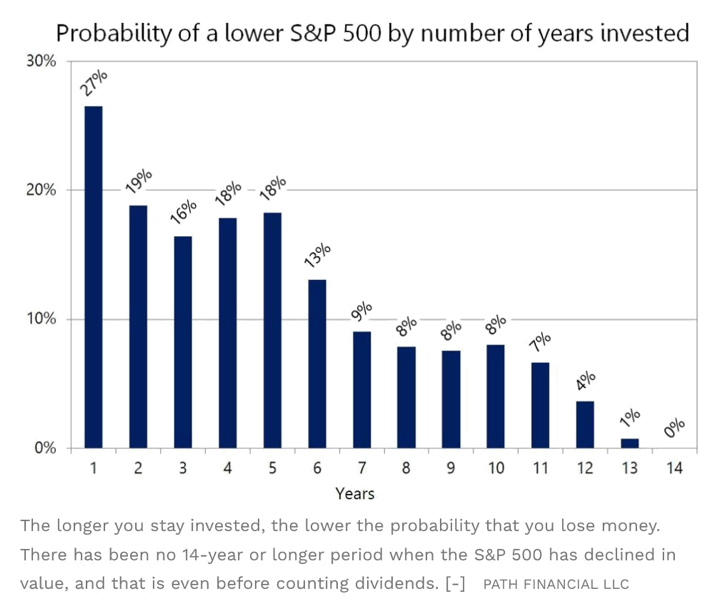
How long will this bear market last? What is the longest that the S&P 500 index number we always see on TV (which doesn’t include dividends) stayed below its initial value? Here is an interesting chart “Probability of a lower S&P 500 by number of years invested” via @GRDecter:

The text below the chart is a bit small, but it reads:

The longer you stay invested, the lower the probability that you lose money. There has been no 14-year or longer period when the S&P 500 has declined in value, and that is even before counting dividends.

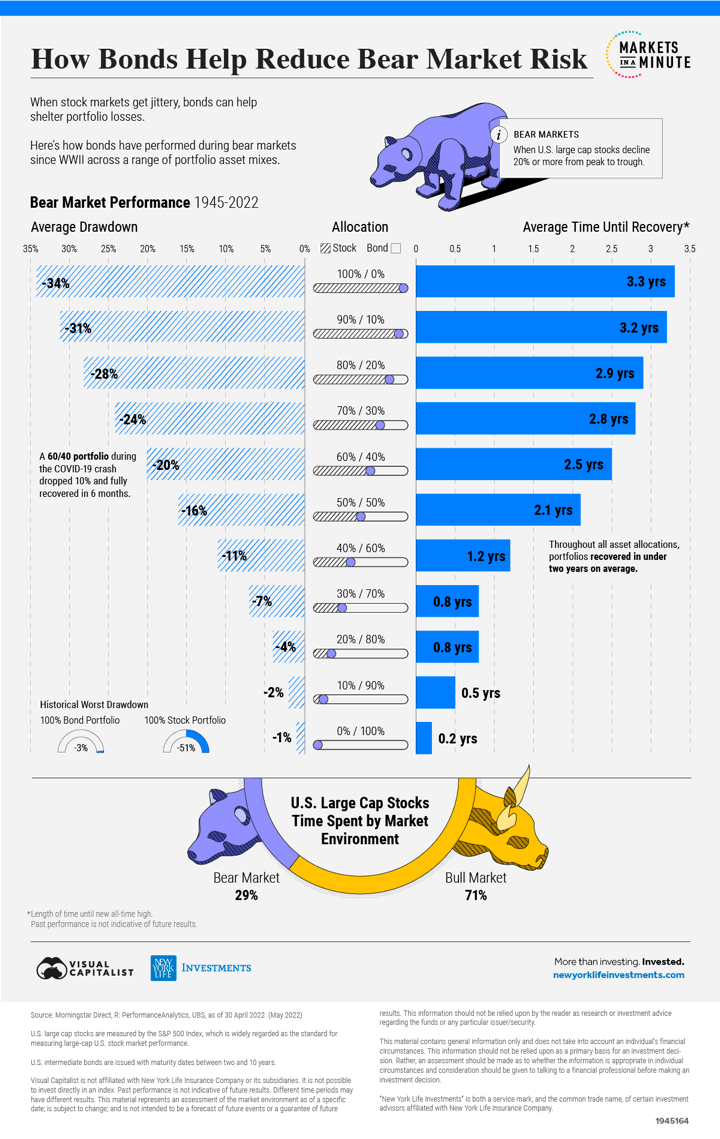
While that suggests this chart supports the idea of owning stocks long-term, it is also an important education for managing expectations; This information might actually make stock ownership worse than you initially thought. If you asked the average stock investor how long before their stocks recover from a bear market, I’d guess the average answer would be 1-3 years. This can be supported in graphics like this from Visual Capitalist. See the “Average time to recovery” for 100% stocks (click to see full image at source).

This is the difference between average (3 years to recovery) and historical worst-case scenario (10+ years), not to mention the future could be even worse. It’s tough to design a portfolio around both these parameters. Do you have enough faith in your investing plan to withstand a 10+ year period of just S&P 500 dividends and no capital appreciation?

Reader Question: Buying Individual Corporate Bonds on Secondary Market At 6% APY?

Here’s a good question from reader Elizabeth in response to yesterday’s post about buying Treasury bonds on the open secondary market:

One thing I’m interested in is on that same table you shared – Corporate bonds rated BBB are around 6% for 5 years. Can you write about this? What are the pros and cons?

Here’s my thought process. Yes, us “retail” investors can also buy individual corporate bonds via major brokers with a fixed income desk like Fidelity. (Bond trading is rare on newer trading apps like Robinhood.) The bonds are judged by various rating agencies and usually separated by their grading. Right now, I see a Moody’s BAA3-rated corporate bond with 5 years left until maturity paying 6.78% interest (click to enlarge):

However, corporate bonds are not within my circle of knowledge. The special thing about every single US Treasury bond is that they are all fully-backed by the US government. Same with an FDIC-insured bank CD or NCUA-insured credit union certificate. It’s like comparing all 16 oz. jars of JIF brand peanut butter; I know all of them are the same, so I can just buy on price.

Once you venture into the world of corporate bonds, things get a lot more complicated. There is wide range of potential credit risk from the issuing company. If the company fails, you may not receive your initial principal back. There is call risk from callable bonds where the issuer can redeem your bond early (to their benefit), not to mention several other early redemption wrinkles like “make whole call”, “sinking fund protection”, and “special optional redemptions”.

Baa3 and BBB- rated bonds are still technically “investment-grade”, but they are just one notch above “below investment-grade”, aka “junk”, aka “high-yield” bonds. Here is a quick table of bond ratings from Investopedia:

If take a closer look at the available bonds above, you’ll see that only one bond is paying over 6.7% and it doesn’t even have an S&P rating, which means there might be something funny going on. The rates quickly go back down to the 5.XX% range.

Do I know why one bond has to pay 6.7% interest rate to entice a buyer, while another one only has to offer 4.8%? I must admit that I really have no idea.

Bonds are for safety. In addition, I should remember my reason for holding bonds. They are my safety blanket. They are my next 10 years of expenses that are guaranteed to be there even if bad things happens. What if Russia bombed a NATO country tomorrow? The US would be obligated to go to war. China might then feel that it has to back Russia. Who knows. Hope for the best. Prepare for the worst.

My goal with bonds is to maximize yield without sacrificing safety.

Stocks are for growth and upside potential. Let’s take the bottom bond highlighted – an Ally Financial corporate bond paying 5.6% yield for the next 5 years. Ally Bank is familiar to me, and I am a longtime customer. Why not buy that bond? Well, if I bought that bond, the most that it will ever pay me back is the bond face value and interest. Worst case is still that Ally goes bankrupt and I lose all or most of my entire investment and end up with zero. This has happened, and to much larger companies than Ally.

Up to 6 days before their eventual collapse, Lehman Brothers had an A investment grade rating. The eventual recovery on their bonds was 21 cents on the dollar.

However, I could also buy Ally Financial stock (ticker ALLY). Right now, it is trading at only a 4.72 P/E ratio and is even paying a dividend yield of 3.54%. Five years from now, I could be sitting on a +50% or +100% or +200% total return. In other words, if you want to take on risk for a higher return, you are competing with stocks. There is ongoing debate about the inclusion of high-yield bonds in a portfolio, but I prefer to take risks with stocks and keep my bonds as safe as possible.

Consider a low-cost, diversified mutual fund or ETF. The benefit of holding riskier corporate bonds inside a mutual fund/ETF is that any one corporate bankruptcy won’t wipe you out. You can be diversified across hundreds of companies. Now, you can’t control the maturity as tightly, you’ll still lose some yield to management costs, and you’re still subject to interest rate risk. If you own the Vanguard Total Bond Market ETF (BND) or any Vanguard Target Retirement Fund, you already own corporate bonds inside a fund.

If I had to buy corporate bonds and wanted a stream of higher income without a reckless amount of credit risk, I would consider the Vanguard High-Yield Corporate Fund Investor Shares (VWEHX, $3k min) or Vanguard High-Yield Corporate Fund Admiral Shares (VWEAX, $50k min). VWEHX has a 0.23% expense ratio and a 30-day SEC yield of 6.71% as of 07/18/2022. VWEAX has a 0.13% expense ratio and a 30-day SEC yield of 6.81% as of 07/18/2022.

You are buying a basket of nearly 700 bonds that straddle the line between investment-grade and below investment-grade. This is a bond fund that I would own for the income stream, not if I needed the entire amount in cash soon as it can drop quite a lot during times of market stress. The expense ratio on this Vanguard fund is much lower than the industry average. Just a suggestion for further research. I don’t own this fund. In fact, I don’t own any corporate bonds at all.

Hope that helps!

[Step-by-Step Guide] How To Buy Treasury Bonds on Secondary Market From Fidelity Brokerage

Fidelity fixed income page screenshot

Here is quick walkthrough from buying a (roughly) 1-year Treasury bond on the secondary market via my Fidelity brokerage account. Please note that I am not a professional bond trader nor a tax professional, and I won’t be able to cover every detail. I maintain part of my portfolio bond allocation in roughly a 5-year bond/CD ladder, comparing and buying the top rate amongst US Treasuries, bank CDs, and credit union certificates across the country as they are all fully-backed by the US government. This guarantees that every year, at least 20% of it is liquid and available in adverse conditions like job loss.

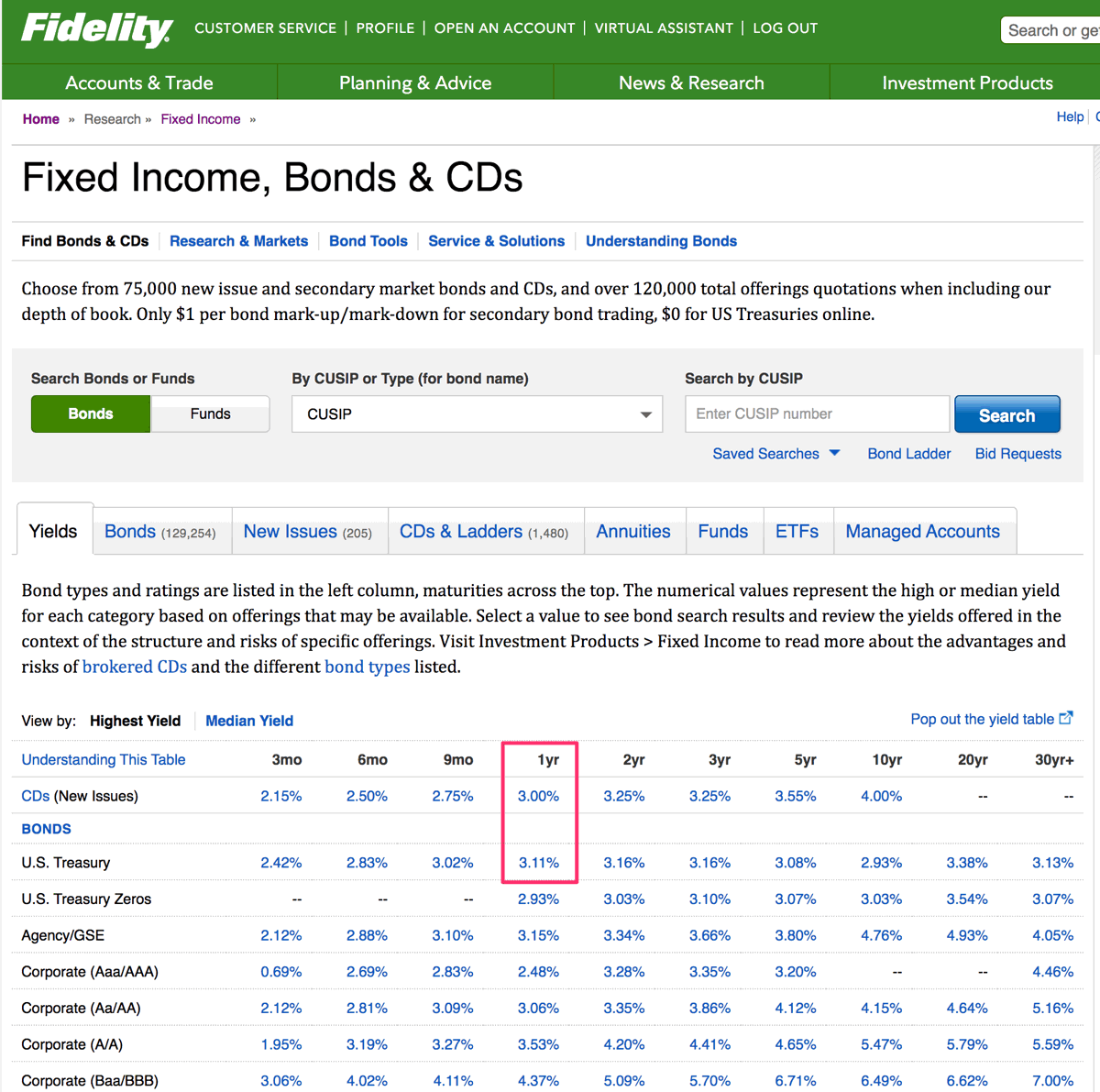
Treasury bonds vs. certificates of deposit. First, you’ll want to compare your Treasury bond effective yield against bank CD rates. At the time of this writing, 1-year Treasury was at ~3.10% while the top brokered 1-year CD was at 3% APY. Due to my local/state tax situation, the after-tax Treasury bond rate was comparable to a 1-year bank CD paying ~3.50%. Right now, the Treasury bond safely wins if held inside a taxable account.

New issue available? For example, if today was 7/15/2022 and I wanted to buy a new 52-week T-Bill from TreasuryDirect or Fidelity, I would look at the official auction schedule see that the next available date for a 52-week T-Bill is on Thursday 8/4/2022 to place an order, 8/9/2022 auction date, and 8/11/2022 settlement date. I have no idea what interest rates will be like then, and for my purposes I wanted to lock in now.

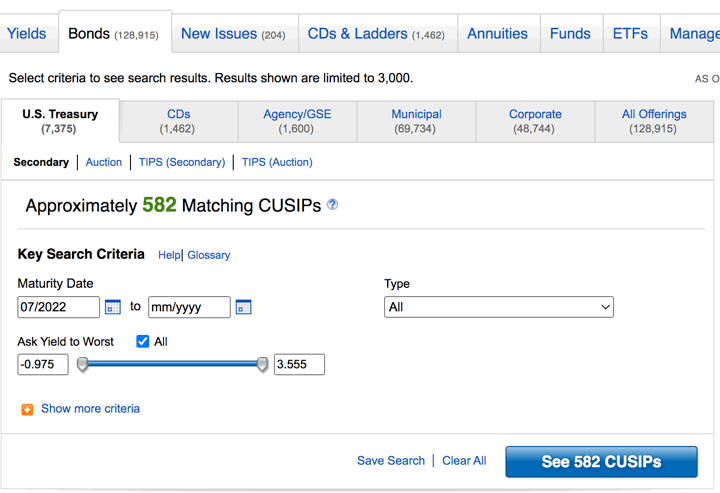
Buying secondary Treasuries on Fidelity. To buy bonds on Fidelity, you must log into your brokerage account and navigate to the “Fixed Income” section, where they will show a quick overview of current rates across roughly 75,000 fixed income investments from brokered CDs to high-yield corporate bonds. (See image at top of post. Click to enlarge.)

Next, click on the “Bonds” tab > US Treasury bonds > Secondary market. This narrows it down to about 578 bond CUSIPs. This search and trade was completed 7/15/2022.

Since I want a Treasury bond with only one year left until maturity, I set the filter for a maturity date between July 2023 and July 2023. That should narrow it down to only 5 bond CUSIPS. Let’s take a look at them (click to enlarge):

These are all “used” bonds that have already been issued and been paying someone else interest at their own rate. The market will adjust the price of these secondary bonds so that everything with a similar maturity ends up paying relatively close to a current “market” rate. Most of these started out paying really low interest rates, so right now you’ll often be buying them at a discount to their face value. (When interest rates go up, prices for existing bond go down since their interest payouts are lower.)

If you hold two bonds with the same “yield to maturity” all the way until it matures and pays you back the principal, you should end up with the same amount of gain at the end even if it is split differently between interest income and capital gain. (If you buy at a discount and have years left until maturity, a pro-rated portion of the discount is reported as income every year until maturity.)

Note that these price quotes are separated into “bid” and “ask”. Bid is what folks are offering to pay, and ask is the price at which folks are offering to sell. There is a spread between them because if there wasn’t, they would have matched up and sold. For example, someone might offer to sell at an effective 3.09% yield, with another offering to buy at 3.14% effective yield.

I’m a small fry, so I just pay attention to the “Ask” and the minimum quantity. Sometimes the offered price looks good but requires you to buy $500,000 of it! (1 bond = $1,000 face value.) Also, the prices are like stocks and fluctuate constantly, so don’t anchor yourself to any specific number. I might wish I could get that 3.20% I saw the day before, but that rate may or may not come back during my buying window.

When you’re ready, you can place a limit order. This lets you set a maximum price you’ll be willing to pay (and thus minimum yield). For example, I chose this Treasury bond that began life as a 5-year bond on 7/31/2018 and matures on 7/31/2023 with an annual coupon of 2.75%. I offered a price of 99.652 each, which guarantees me a minimum effective yield of 3.09% (exempt from state and local taxes). I recommend always using a limit order, just in case.

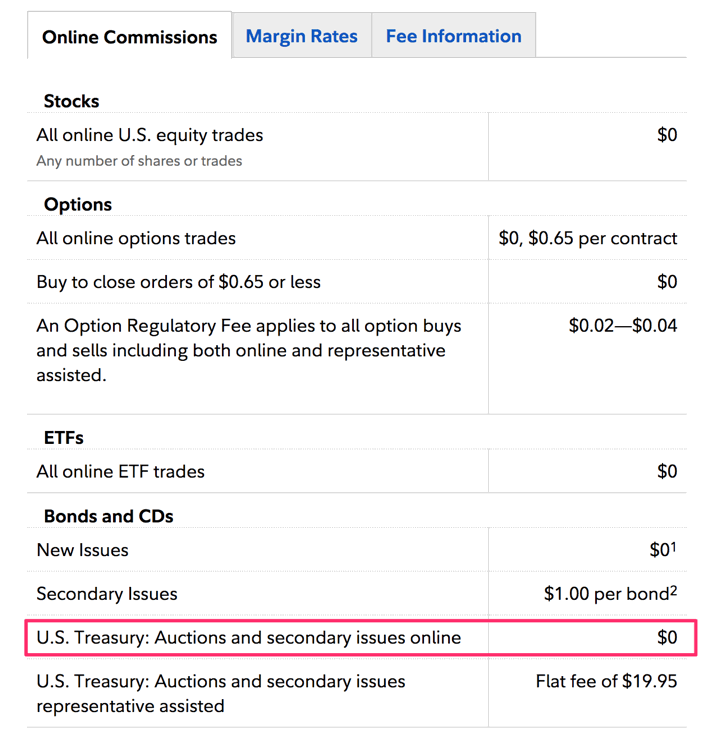
A note on commissions. Fidelity does not charge a commission (or mark-up) on secondary US Treasury bond purchases if performed online. There is still the indirect cost of the bid/ask spread, but that is more of a concern if I was to sell. I believe that Fidelity has close enough to the best order fill available to an individual investor. I haven’t compared them in detail, but be aware that others may charge a mark-up.

My order was successfully filled at $99.652, which means for 10 bonds with $10,000 face value, I paid $9,965.20 for the bonds plus a little more for any accrued interest. US Treasury bonds are not callable and the interest is paid semi-annually. My next interest payments (at the old bond’s lower 2.75% rate) will be on 7/31/2022, 1/31/2023 and 7/31/2023 with the full return of $10,000 face value at maturity. Again, based on my local/state tax situation, my after-tax interest will be comparable to a 1-year bank CD paying 3.50% APY. This compares well to the best available rates on cash right now.

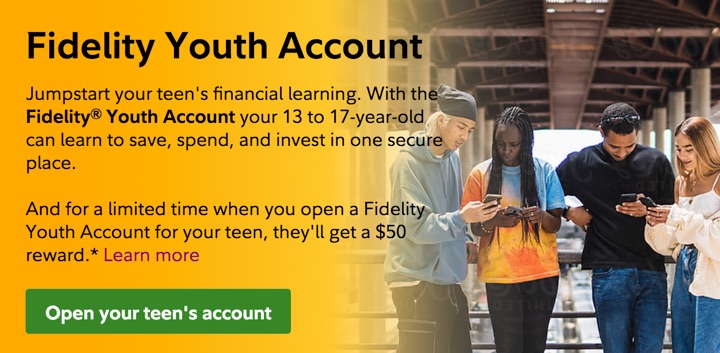
Fidelity Youth Brokerage Account: Free $50 for Teens (13-17yo, No Deposit Required)

Fidelity Investments has a new $50 promotion for their Youth account for teens (aged 13-17). Parents must have their own open Fidelity account before opening a Youth account. After you open a new Youth Account and your teen downloads the Fidelity Mobile® App and activates the new account, your teen will receive a $50 deposit as a reward. No deposit required, no monthly fees, no minimum balance required.

Details from their FAQ:

We are hoping to help your teen jumpstart their financial journey by helping them learn about money. Using our mobile app, they can access the Youth Learning Center, which is a resource created specifically to help teens learn the basics about saving, spending, and investing.

Parent/guardian must have their own Fidelity brokerage account to open an account for their teen.
Parent/guardian must initiate the application process and once completed, the teen will receive instructions on how to download the Fidelity Mobile® App and activate their account.
There are no funding requirements to receive this reward.
No further investment or trading is required to qualify for the offer.

The reward will be deposited directly to the eligible account within 10 calendar days after the teen has downloaded the Fidelity Mobile® App and activated their account (which entails creating a username/password, and logging into the mobile app and accepting account agreements). Amounts deposited by Fidelity in the form of the reward will be initially held in the Fidelity Government Money Market Fund,* the eligible account’s core position.

To open a Youth Account you will need 2 forms of documentation to verify your teen’s identity. Acceptable forms of documentation include:

– Your teen’s Social Security card OR a copy of the first page of your latest filed 1040 tax return. This document should have your teen’s name and Social Security number (SSN) clearly visible.
– An unexpired document with your teen’s name (state-issued driver’s license, passport, birth certificate, or student ID card).

Treasury Bond vs. Bank CD Rates: Adjusting For State and Local Income Taxes

If you are an individual investor that usually buys bank certificates of deposit, right now you may want to compare against a US Treasury bond of similar maturity. Treasury bond rates are traded constantly, but this Vanguard brokered CD page can provide a rough idea if they are worth a closer look (even though their brokered CD may or may not be the best CD rate available). Again, this screenshot is already out of date:
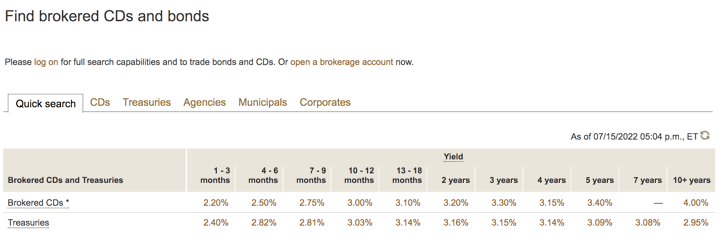
Right now, they are pretty close for many maturity lengths. For example, let’s take a 1-year CD paying 3% APY and a 1-year Treasury bond paying 3%.

(Note: This may not be true by the time you read this. Here are the current Treasury bond rates. In the last two weeks alone, the 1-year Treasury has ranged from 2.79 to 3.21%. In 2022 alone, the low was 0.38%.)

An important consideration is that Treasury bonds are exempt from state and local taxes. This can make the Treasury bond significantly more attractive to some folks, even if the initial rate is the same. This assumes you are investing in a taxable account (not tax-sheltered). US Savings bonds are also exempt from state and local taxes.

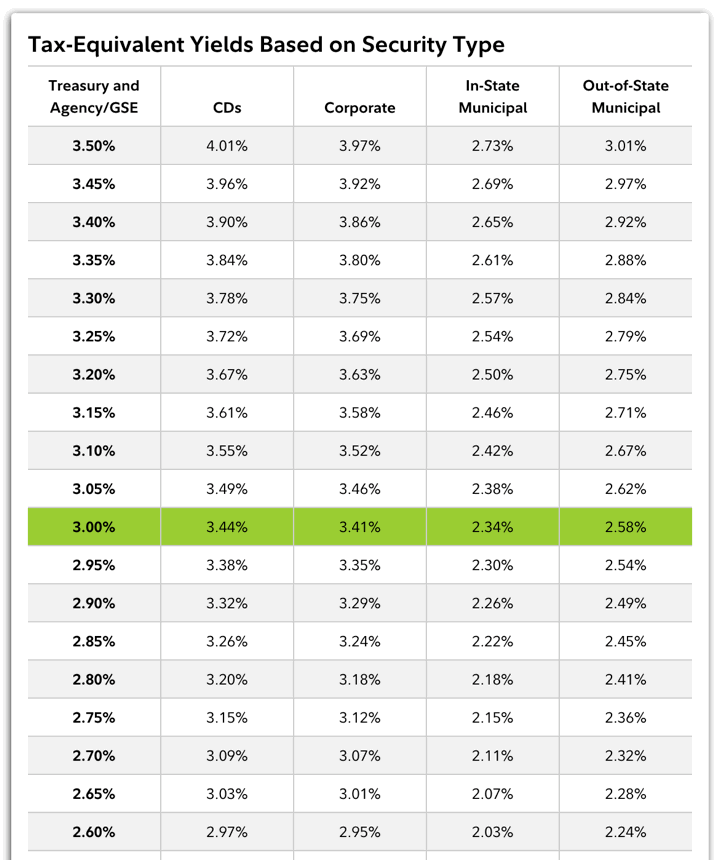
For example, let’s say you are a single resident of California with a taxable income of $80,000 annually. Any easy way to compare the rates is by using a calculator like this Fidelity tax-equivalent yield calculator. Using the example income, it will find that your marginal tax rates are 22% Federal and 9.30% State (CA). I am assuming no local tax rates from your city or county.

What matters in the end is what you are left with after taxes. As such, the calculator supplies the following chart:

For this example person, a Treasury bond earning 3% will pay the same after-tax interest as a bank certificate of deposit paying 3.44%.

Here is a rough check on my part:

$10,000 * 3.44% * (1 – 0.22 – 0.093) = $236 in annual interest, after taxes

$10,000 * 3.00% * (1 – 0.22) = $234 in annual interest, after taxes

I suspect the minor difference has to do with the way that bond yields are quoted for Treasury bonds. This is also why the corporate bond yields are different from the CD yields even though they are subject to the same taxes.

Bond yields, except CDs, are assumed to be twice the semi-annual yield, as is the normal convention for quoting bond yields. CD yield is calculated as ((( corporate bond yield / 2) +1)² ) – 1

From the calculator fine print:

The calculator does not take into account:

– Reductions and limits on federal itemized deductions
– State and local taxes are not deducted from your federal tax rate. Depending on your personal situation, this may cause the resulting yield to be overstated.
– Federal alternative minimum tax (AMT)
– State alternative minimum tax
– Intangibles taxes levied by individual states
– Net Investment Income Tax
– Additional Medicare Tax

For practical purposes, I don’t sweat the minor differences. In order to actually buy many of these Treasury bonds at the time that you want and for the remaining maturity length that you want, you’ll have to buy them on the open secondary market. The available rates will change by the minute. Or, if you buy them as a new issue, you won’t know the rate at all as it is determined at auction. I mostly just want to know that the Treasury bond is preferable to a bank CD by an adequate margin. In this example, I would say that 0.44% higher annually is enough of a margin.

There are other wrinkles… if you don’t hold to maturity, Treasury bonds don’t offer the ability to withdraw early and only pay a preset interest penalty like a bank CD. You’d have to sell again on the open market, where you may lose (or gain) principal.

Armed with this information, you might create your own bond ladder using US Treasuries instead of a CD ladder. This is easy for an individual investor because you don’t need any skill to determine creditworthiness. Both US Treasury bonds and FDIC/NCUA-insured certificates of deposit are backed by the full faith and credit of the US government. (Municipal bonds don’t come with such a guarantee. Some municipalities are in better financial shape than others. I don’t buy individual municipal bonds for this reason.)

Sam’s Club New Membership Deal: $25 + $25 Off 1st Purchase of $25+

sams200bGroupon has brought back their Sam’s Club membership deals, which come around a few times per year and offers a deeply-discounted membership. There are two options.

The $25 option includes:

  • 12-month Sam’s Club membership (retail $45)
  • Household member card
  • $25 discount off first in-club purchase of $25+. (Total must be $25 pre-tax.)

So as long as you buy $25 of stuff at Sam’s Club, your net cost is effectively free ($25 minus $25).

The $25 offer automatically loads to your membership account and it will discount your first in-club purchase of $25 or more. Redeem within 60 days after joining. Offer only works in club on a register or by using Scan & Go on the Sam’s Club app. When you check out, the discount appears between the list of purchased items and the subtotal amount. It will be referenced as “INST SV.” Purchases of alcoholic beverages, tobacco, milk, fuel, pharmacy, gift cards, memberships or shipping costs are not included in this offer. Other restrictions may apply.

The $55 option includes Sam’s Club Plus Membership (Retail Value is $100):

  • 12-month Club membership + 1 Free Complimentary Membership
  • 2% Sams Cash on qualifying in-club purchases**
  • Free shipping. Exclusions apply.
  • Free curbside pickup.
  • Early shopping hours starting 8 a.m. Hours may vary by club.

This deal is for new memberships only, as defined as follows:

Not valid for membership renewals, for those with a current membership, or those who were Sam’s Club members less than 6 months prior to January 11th, 2022.

Some folks like to rotate a year with Sam’s Club and a year with Costco or BJ’s Warehouse, as both usually offer new member deals regularly.

Save even more on your Groupon with a cashback shopping portal. Many offer new customers bonuses if you make a qualifying purchase, including Swagbucks ($10 bonus), MyPoints ($10 bonus), Rakuten (formerly eBates) ($30 bonus currently, varies), TopCashBack (varies), and BeFrugal ($10 bonus). So you could sign-up and stack this Groupon to trigger the bonus. I have cashed out of all of these in the last 12 months.

MMB Portfolio 2022 2nd Quarter Update: Dividend & Interest Income

via GIPHY

Here’s my quarterly update on the income produced by my Humble Portfolio (2022 Q2). I track the income produced as an alternative metric for performance. The total income goes up much more gradually and consistently than the number shown on brokerage statements (price), which helps encourage consistent investing. I imagine them as building up a factory that churns out dollar bills. You can still track your dividend and interest income with a total return portfolio. You don’t need a bunch of high-yield stocks, MLPs, leveraged REITs, or covered call ETFs.

Background: Overall stock market dividend growth. Stock dividends are a portion of net profits that businesses have decided to distribute directly to shareholders, as opposed to reinvesting into their business, paying back debt, or buying back shares directly. The dividends may suffer some short-term drops, but over the long run they have grown faster than inflation.

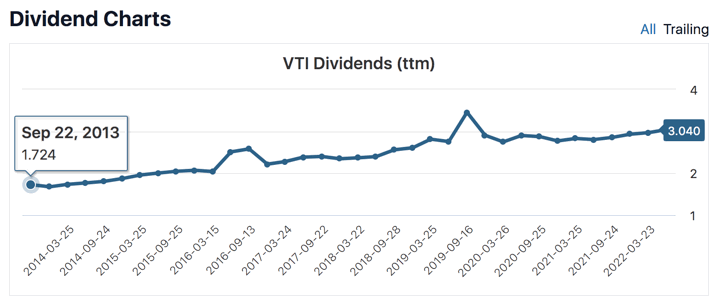
In the US, the dividend culture is somewhat conservative in that shareholders expect dividends to be stable and only go up. Dividend cuts tend to be avoided. Thus the starting yield is lower, but it can grow faster. Here is the historical growth of the trailing 12-month (ttm) dividend paid by the Vanguard Total US Stock ETF (VTI), courtesy of StockAnalysis.com. Currently, 31% of VTI’s net earnings are sent to you as a dividend. Notice how it grows gradually, with the current annual dividend 76% higher than in September 2013:

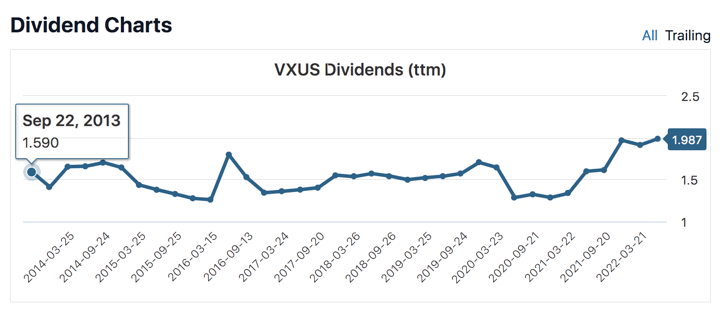
European corporate culture tends to encourage paying out a higher (sometimes fixed) percentage of earnings as dividends, but that means the dividends move up and down with earnings. Thus the starting yield is higher but may not grow as fast. Here is the historical growth of the trailing 12-month (ttm) dividend paid by the Vanguard Total International Stock ETF (VXUS). Currently, 47% of VXUS’s net earnings are sent to you as a dividend. Notice how it stays more stable (but also dropped during 2020 due to COVID), with the current annual dividend only 25% higher than in September 2013:

The dividend yield (dividends divided by price) also serve as a rough valuation metric. When stock prices drop, this percentage metric usually goes up – which makes me feel better in a bear market. When stock prices go up, this percentage metric usually goes down, which keeps me from getting too euphoric during a bull market. Here’s a related quote from Jack Bogle (source):

The true investor will do better if he forgets about the stock market and pays attention to his dividend returns and to the operating results of his companies.

My personal portfolio income history. I started tracking the income from my portfolio in 2014. Here’s what the annual distributions from my portfolio look like over time:

  • $1,000,000 invested in my portfolio as of January 2014 would have generated about $24,000 in annual income over the previous 12 months. (2.4% starting yield)
  • If I reinvested the income but added no other contributions, today in 2022 it would have generated ~$48,000 in annual income over the previous 12 months.

This chart shows how the annual income generated by my portfolio has changed.

TTM income yield. To estimate the income from my portfolio, I use the weighted “TTM” or “12-Month Yield” from Morningstar, which is the sum of the trailing 12 months of interest and dividend payments divided by the last month’s ending share price (NAV) plus any capital gains distributed (usually zero for index funds) over the same period. The trailing income yield for this quarter was 2.99%, as calculated below. Then I multiply by the current balance from my brokerage statements to get the total income.

Asset Class / Fund % of Portfolio Trailing 12-Month Yield Yield Contribution
US Total Stock (VTI) 25% 1.61% 0.40%
US Small Value (VBR) 5% 2.12% 0.11%
Int’l Total Stock (VXUS) 25% 3.87% 0.97%
Emerging Markets (VWO) 5% 3.35% 0.17%
US Real Estate (VNQ) 6% 3.14% 0.19%
Inter-Term US Treasury Bonds (VGIT) 17% 1.25% 0.21%
Inflation-Linked Treasury Bonds (VTIP) 17% 5.59% 0.95%
Totals 100% 2.99%


Commentary. My ttm yield is now ~3%. Both US and international stock prices have gone down, and my ttm dividend yield has gone up. The price of my Treasury bonds have also gone down as nominal rates have gone up, but the yield will eventually go up as the money is reinvested into new bonds at higher rates. My TIPS yield has gone up significantly as CPI inflation has spiked. Of course, the NAV on my TIPS has also gone down, as real yields have gone up (again will be better as money is reinvested). TIPS are a bit complicated like that.

Use as a retirement planning metric. As a very rough goal, I support the simple 4% or 3% rule of thumb, which equates to a target of accumulating roughly 25 to 33 times your annual expenses. I would lean towards a 3% withdrawal rate if you want to retire young (before age 50) and a 4% withdrawal rate if retiring at a more traditional age (closer to 65). It’s just a target, not a number sent down from a higher being. During the accumulation stage, your time is better spent focusing on earning potential via better career moves, improving in your skillset, and/or looking for entrepreneurial opportunities where you can have an ownership interest.

Even if do you reach that 25X or 30X goal, it’s just a moment in time. The market can shift, your expenses can shift, and so I find that tracking income makes more tangible sense in my mind and is more useful for those who aren’t looking for a traditional retirement. Our dividends and interest income are not automatically reinvested. They are another “paycheck”. Then, as with a traditional paycheck, we can choose to either spend it or invest it again to compound things more quickly. Even if we spend the dividends, this portfolio paycheck will still grow over time. You could use this money to cut back working hours, pursue a different career path, start a new business, take a sabbatical, perform charity or volunteer work, and so on. This is your one life and it only lasts about 4,000 weeks.

Amazon Prime Day 2022: 20% Off Gift Cards, Amazon Gift Card Promo, Apple, Bose, 23andMe, Free Grubhub+, Pay w/ Points Promos

Prime Day is live! Amazon Prime Day 2022 is now live: July 12th and 13th (Tuesday and Wednesday). Here are some of the better deals and other low-hanging fruit (and thus offset a chunk of that membership fee). Otherwise, I check on the things I need to buy anyway – from laundry detergent to paper towels, even Amazon-branded toilet paper is on sale.

As the name suggests, most deals require a Prime membership. New members can sign up for a 30-day free trial. If you’ve already done the trial, you can simply buy a month of Prime for $14.99 ($6.99 with EBT or Medicaid card).

(Note: If you are reading this in an email/RSS reader, unfortunately I am not allowed to include any Amazon affiliate links in e-mails, so they have been removed. Just click here to view the links.)

Now Live

Free year of Grubhub+ membership ($120 value)

  • Amazon Prime members can enjoy a free one-year Grubhub+ membership (normally $9.99/month) with their Prime membership.
  • Grubhub+ is a monthly membership offering unlimited $0 delivery fees on orders of $12+ (before tax, tip, and other applicable fees) at eligible restaurants, access to exclusive member perks—like free food and order discounts—and donation matching. See the full Grubhub+ terms and conditions for more information.
  • After your free one-year Grubhub+ membership ends, Grubhub will charge the payment method associated with your Grubhub account on a monthly basis at the then-current rate (currently $9.99/month). You can cancel any time by contacting Grubhub customer support or visiting the “Grubhub+ membership” section in your Grubhub account settings.

$75+ in Bonus Amazon Credit Offers

Amazon Devices

I am quite happy with our Eero mesh WiFi 3-pack bought from a previous Prime Day. The three units working together are definitely a big upgrade from one router, even in our house that is under 2,000 sf.

“Shop with Points” Promos (Targeted)

Misc