
Archives for May 2021

Happiness Exercises: Take Action To Improve Your Well-Being

As I reach the end of the 10-week free Yale Happiness Course, I definitely recommend this course if you are ready to commit time and effort into making yourself feel better mentally. One of the key points is the G.I. Joe fallacy, which is the false notion that knowing about a mental bias is enough to overcome it. Knowing isn’t enough! Taking repeated action is required to achieve lasting change.

As such, much of the course is based on “rewirements”, but I think of them as “happiness exercises” because they only work temporarily for me. When I do them, I feel better immediately and for a little while afterward, but the effect wears off. This is similar to my experience with diets, in that diets don’t work.

Once you go back to your original eating habits, you’ll go back to your original weight. Therefore, any changes you make should be something you can maintain for the rest of your life.

Can you really change your life to include these habits? Well, here are the happiness exercises, along with a short description from the Yale course. Try each one for a week and discover which ones work best for your personal situation. I found the prompts to commit acts of kindness and initiate social connections were the most helpful, and a really do hope to keep them up forever. (I’ve already been working on the sleep and exercise bits for a while.)

Savoring

Savoring is the act of stepping outside of an experience to review and appreciate it. Often we fail to stay in the moment and really enjoy what we’re experiencing. Savoring intensifies and lengthens the positive emotions that come with doing something you love. For the next seven days, you will practice the art of savoring by picking one experience to truly savor each day. It could be a nice shower, a delicious meal, a great walk outside, or any experience that you really enjoy. When you take part in this savored experience, be sure to practice some common techniques that enhance savoring. These techniques include: sharing the experience with another person, thinking about how lucky you are to enjoy such an amazing moment, keeping a souvenir or photo of that activity, and making sure you stay in the present moment the entire time.

Gratitude

Gratitude is a positive emotional state in which one recognizes and appreciates what one has received in life. Research shows that taking time to experience gratitude can make you happier and even healthier. For the next seven days, you will take 5-10 minutes each night to write down five things for which you are grateful. They can be little things or big things. But you really have to focus on them and actually write them down.

Random Acts of Kindness

Research shows that happy people are motivated to do kind things for others. Over the next seven days, you will perform seven acts of kindness beyond what you normally do. You can do one extra act of kindness per day, or you can do a few acts of kindness in a single day. These do not have to be over-the-top or time-intensive acts, but they should be something that really helps or impacts another person. For example, help your colleague with something, give a few dollars or some time to a cause you believe in, say something kind to a stranger, write a thank you note, give blood, and so on.

Social Connection

Our social connections matter. Research shows that happy people spend more time with others and have a richer set of social connections than unhappy people. Studies even show that the simple act of talking to a stranger on the street can boost our mood more than we expect. Over the next seven days, you will try to focus on making one new social connection per day. It can be a small 5-minute act like sparking a conversation with someone on public transportation, asking a coworker about his/her day, or even chatting to the barista at a coffee shop. But you should also seek out more meaningful social connections, too. At least once this week, take a whole hour to connect with someone you care about— a friend who’s far away or a family member you haven’t talked to in a while. The key is that you must take the time needed to genuinely connect with another person.

Exercise

Research suggests that ~30 minutes a day of exercise can boost your mood in addition to making your body healthier. For the next week, you will spend each day getting your body moving with at least 30 minutes of exercise. Set aside a location and time (write it in your calendar!). Then hit the treadmill at the gym, do an online yoga class, or throw on some headphones and dance around your room to cheesy pop songs. This isn’t supposed to be a marathon-level of activity; it’s just to get your body moving a bit more than usual.

Sleep

One of the reasons we’re so unhappy in our modern lives is that we’re consistently sleep deprived. Research shows that sleep can improve your mood more than we often expect. For the next week, you must get at least seven hours of sleep for at least four nights of the next week. I know, I know. You’re super busy this week. There are deadlines to meet, friends to see, errands to run, etc. But sleep is going to make you feel better— both physically and mentally. So pick four nights this week, note them in your calendar, and get ready to get some much needed sleep. Also be sure to practice good sleep hygiene too— no devices before bed and try to avoid caffeine and alcohol on the days you’re getting your sleep on.

Meditate

Meditation is a practice of intentionally turning your attention away from distracting thoughts toward a single point of reference (e.g., the breath, bodily sensations, compassion, a specific thought, etc.). Research shows that meditation can have a number of positive benefits, including more positive moods, increased concentration, and more feelings of social connection. For the next week, you will spend each (at least) 10 minutes per day meditating. Find a quiet spot where you won’t be disturbed while you’re meditating. If you are new to meditation, you can try one of three guided meditations available on SoundCloud. And remember— meditation isn’t about the meditation itself; it’s about building a skill that we can use later. Lots of people find it hard at first, but stick with it and see if it allows you to feel a bit calmer over the course of the week.

For all of these exercises, you should find a way to track them – physical notebook, Notes smartphone app, daily planner, or the unpolished-but-free ReWi app (iOS, Android). By keeping track, you make it much more likely that you’ll maintain a streak and eventually make it a life-changing habit like eating healthier foods or regular exercise.

Also see:

Practical Portfolio Rebalancing Tips from Vanguard (+My Rebalancing Strategy)

Are stocks too overpriced? Is inflation coming to crush bonds? The media is not incentivized to tell you what is often the best advice: do absolutely nothing. If you still want to take action, consider rebalancing your portfolio. If you’ve stayed invested throughout the last several years, your portfolio may have shifted as in the scenario above:

For example, imagine you selected an asset allocation of 50% stocks and 50% bonds. If 4 years go by during which stocks return an average of 8% a year and bonds 2%, you’ll find that your new asset mix is more like 56% stocks and 44% bonds.

Here are some quick tips about rebalancing your portfolio back towards your target risk level, taken from Vanguard article #1 and Vanguard article #2.

Here are three possible rebalancing strategies:

  • Time: Rebalance your portfolio on a predetermined schedule such as quarterly, semiannually, or annually (not daily or weekly).
  • Threshold: Rebalance your portfolio only when its asset allocation has drifted from its target by a predetermined percentage.
  • Time and threshold: Blend both strategies to further balance your risk.

Here are three practical tips from Vanguard to rebalance with minimal tax drag:

  • Focus on tax-advantaged accounts. Selling investments from a taxable account that’s gained value will most likely mean you’ll owe taxes on the realized gains. To avoid this, you could rebalance within your tax-advantaged accounts only.
  • Rebalance with portfolio cash flows. Direct cash inflows such as dividends and interest into your portfolio’s underweighted asset classes. And when withdrawing from your portfolio, start with your overweighted asset classes. (If you’re age 72 or over, take your required minimum distribution (RMD) from your retirement account(s) while you’re rebalancing your portfolio. You can then reinvest your RMDs in one of your taxable accounts that has an underweighted asset class.)
  • Be mindful of costs. To minimize transaction costs and taxes, you could opt to partially rebalance your portfolio to its target asset allocation. Focusing primarily on shares with a higher cost basis (in taxable accounts) or on asset classes that are extremely overweighted or underweighted will limit both taxes and transaction costs associated with rebalancing.

These tips are very closely related to my own simple rebalancing system. Here’s what my process looks like these days:

  • Only peek once a quarter. I update my Google portfolio spreadsheet and log into Personal Capital once a quarter. Otherwise, try not to track daily movements in my portfolio or the stock market in general. Consuming more information is not always better, as you start to confuse noise vs. signal.
  • Rebalance first with available cash. In my Solo 401k and taxable brokerage accounts, this includes bond interest, dividends, and capital gains distributions. During the accumulation stage, this included regular savings from job income.
  • If the stock/bond ratio is still off by more than 5%, then rebalance more using tax-advantaged accounts. I have multiple asset classes, but for triggering rebalancing, I focus on the overall stocks/bonds ratio during my quarterly check-up. My equities are all “risk on” (including Small Cap Value, Emerging Markets, and REITs) and my bonds are all “risk off” (US Treasuries, TIPS, and FDIC/NCUA-insured CDs only). I can use my 401k balance (including brokerage window), IRAs, and Solo 401k brokerage plan to make adjustments with no capital gains.
  • If absolutely required in a rare case, make taxable sale using specific ID of tax lots. I select the “Specific ID” method at Vanguard to identify the tax lots when selling. I can thus choose to realize a bigger gain when my tax rates are low, and a lesser gain when my tax rates are high.

Rebalancing should be a relatively minor adjustment, but selling 5% can be enough to feel like you took some positive action. (I try to avoid large, sudden changes for any reason, even though I do feel the fear at times.) If stocks go down, you can be happy you sold some stocks while they were “up”. If stocks keep going up, you’ll still be mostly invested and participating in those gains.

Emergency Broadband Benefit: $50/Month Off Home Internet For Low-Income, Job Loss, and Furloughed Workers

The Emergency Broadband Benefit Program provides a temporary discount on monthly broadband bills for qualifying households. This program is separate and in addition to the the existing Lifeline program. They have only been running for a week and over 1 million households have signed up. Learn more and apply at GetEmergencyBroadband.org and this FCC Consumer FAQ. Here’s an excerpt on eligibility (emphasis mine).

A household is eligible if one member of the household meets at least one of the criteria below:

Has an income that is at or below 135% of the Federal Poverty Guidelines or participates in certain assistance programs, such as SNAP, Medicaid, or Lifeline;
Approved to receive benefits under the free and reduced-price school lunch program or the school breakfast program, including through the USDA Community Eligibility Provision in the 2019-2020 or 2020-2021 school year;
Received a Federal Pell Grant during the current award year;
Experienced a substantial loss of income due to job loss or furlough since February 29, 2020 and the household had a total income in 2020 at or below $99,000 for single filers and $198,000 for joint filers; or
Meets the eligibility criteria for a participating providers’ existing low-income or COVID-19 program.

I bolded the part that I believe includes a broader group that may not realize they qualify for this assistance. Here is the documentation that they will require you to submit if you experienced job loss or furlough:

If you experienced a substantial loss of income since February 29, 2020 because you lost your job or were furloughed, you may qualify for the EBB Program.

You will have to show proof of the job loss or furlough, like a termination letter or furlough notice, as well as proof of your total income, like a tax return or official documentation containing income information when you apply for the EBB Program. To qualify in this way, your total household income in 2020 must be at or below $99,000 (for single tax filers) and $198,000 (for joint tax filers).

Here’s a quick summary of the benefits:

The Emergency Broadband Benefit will provide a discount of up to $50 per month towards broadband service for eligible households and up to $75 per month for households on qualifying Tribal lands. Eligible households can also receive a one-time discount of up to $100 to purchase a laptop, desktop computer, or tablet from participating providers if they contribute more than $10 and less than $50 toward the purchase price.

Not every single broadband provider offers the Emergency Broadband Benefit, but most do; Look for your provider here. Some providers may force you to switch to a different plan.

Once approved, the $50/month discount will appear automatically on your broadband bill. You can get the discount even if you have a past due balance, and you can sign up for new service if you don’t have existing service.

PFS Buyers Club: NEW US Mint Coin Arbitrage Opportunity ($290+ Net Profit)

(Update: This 5/24 opportunity is no longer available. You can still sign up for an account and be alerted of the next opportunity roughly 48 hours prior.)

New deal May 24th, 2021. The US Mint regularly releases limited-edition coins to collectors. The coin sets are often limited by household. PFS Buyers Club is a website broker that recruits regular folks to buy their allotted coin set with a set markup amount, with the agreement that they will sell only to PFS Buyers Club. For example, you might pay $300 for a coin and they’ll agree to pay you $350 for it – a fixed profit of $50.

On Monday, May 24th at 12:00 pm Noon Eastern Time, there is a new guaranteed profit opportunity. You can buy up to 10 sets of two different limited-edition Morgan Silver dollars. You can buy 10 of each coin at $85 each plus $4.95 shipping, which should cost you $854.95. PFS will pay you $1000 ($145.05 commission) for those 10 coins. If you do this for both of the two sets, you will spend $1,709.90 and get paid $2,000 for a total profit of $290.10. One minor wrinkle on this offer is that they don’t expect to ship until October, but they also won’t charge your card until October.

Note that the eventual value of the set may exceed that elsewhere – you may be able to get $120 for each coin on eBay, for example – but if you want to make that bet, don’t promise to sell to PFS Buyers Club. Just buy it on your own and try to sell it yourself. Keep in mind that eBay seller fees can be quite high, and you’ll be responsible for other costs like the proper shipping with adequate insurance. PFS Buyers Club will send you a free prepaid mailing label (including insurance) and pay you via eCheck, paper check, or PayPal.

You’ll also earn credit card rewards on your purchase (worth another $34.20 here at 2% cash back), or also possibly satisfying the requirements for some $500+ value credit card bonuses. This makes the total net profit safely over $300. Note the October wrinkle above though for timing purposes. (Added: There is concern that American Express and Fidelity credit cards might not award points on US Mint purchases, so to be safe I would use alternative cards.)

My past experience. I used PFS back in March for the first time, and everything went smoothly and I was paid my money in full without issue. The amount of communication was great and better than expected; I was kept up-to-date every step of the way. The total time commitment was about 30 minutes for $400+ profit, including the stop at the Fedex store to drop off the box with prepaid label. The eCheck option worked great – I printed the check out at home and deposited immediately via mobile app. PFS has a very solid reputation online, and I referred several blog readers last time and did not receive a single complaint. (Some folks were unable to buy the coins from the US Mint itself.)

Here are the two coins: Morgan 2021 Silver Dollar w/ O Mark and Morgan 2021 Silver Dollar w/ CC Mark. Here is a direct quote of the deal text:

On Monday, May 24th, at 12:00PM ET the US Mint will be releasing two limited edition Morgan Silver Dollars. Each has a purchase limit of ten per household, so you’re able to buy ten of each. The cost of each Silver Dollar is $85.00, and when adding the $4.95 shipping charge, each order will total $854.95.

You will have each order shipped to your own house or office and then ship it to PFS Buyers Club with a prepaid shipping label that we will provide for you. Please note: The Mint only intends on shipping these “beginning in October”. They will not charge your credit card until they ship.

PFS will be offering a commission of $145.05 for each order for a total payout of $1,000.00. To be clear, you have the opportunity to place two orders of $854.95 each or $1,709.90 in total, and we’ll be paying you $2,000.00 for a total profit of $290.10! This is also a great opportunity to earn valuable points/miles on your credit cards, as well as meet any spending thresholds..

If you want to jump on this, you can sign up to join PFS Buyers Club here. Sometimes these deals fill up, so I would sign-up and opt-in sooner rather than later. You can still opt out of the deal until an hour prior to the coins going on sale. They will provide very detailed instructions. Follow them carefully, and it was pretty easy for me as a first-time buyer. If you use that link, I will receive a referral fee if you successfully sell your coin for a profit. Thanks for those that use it, and for those that already used it last time! I will be opting in myself as well.

Big List of Car Demand Notes (GM, Ford, Toyota) & Other Non-FDIC Deposit Accounts: Up to 1.50% Interest

Interest rates remain very low, which makes people more willing to take some risk for “just a little bit higher” interest rates. This has renewed interest in the financing arms of many automotive brands that offer “demand notes” which they use to fund the loans and leases they need to make to sell cars. (Can you imagine how much fewer new cars would be sold without financing?)

These demand notes allow you to “demand” your money back at any time, while they can also end the program at any time (as Ally recently did). Importantly, they pay a higher variable interest rate than most FDIC-insured high-yield savings accounts. Equally importantly, although it functions like a bank, it is not a bank and thus your money is not covered by FDIC insurance. You are buying unsecured debt backed by a finance company (not necessarily the actual car maker), and if it struggles, you may lose principal. Here is a list of some available options on the market:

GM Financial Right Notes

  • Current interest rate: 1.50% (as of 5/17/21)
  • Minimum initial investment: $500
  • Fitch credit rating: BBB-
  • Restricted to GM/GM Financial US employees and retirees, US employees of GM dealerships, GM customers, and GM stockholders.

The GM Financial Right NotesSM program is a direct investment in demand notes issued by General Motors Financial Company, Inc. Right Notes pay a variable rate of interest and are redeemable at any time. An investment in the Right Notes does not create a bank account or a money market fund and is not FDIC insured.

Toyota IncomeDriver Notes

  • Current interest rate: 1.35% (as of 5/17/21)
  • Minimum initial investment: $500
  • Fitch credit rating: A+

The IncomeDriver Notes® program is a direct investment in senior notes issued by Toyota Motor Credit Corporation (“TMCC”). IncomeDriver Notes® pay a variable rate of interest and are redeemable at any time. IncomeDriver Notes® are not a bank account or a money market fund and are not FDIC insured.

Mercedes-Benz First Class Notes

  • Current interest rate: 1.10% (as of 5/17/21)
  • Minimum investment: $10,000 to avoid $5 monthly fee
  • Fitch credit rating: n/a
  • Restricted to accredited investors only.

An investment in the First Class Demand Notes program does not create a FDIC insured bank account. All investments are senior, unsecured debt obligations of Mercedes-Benz Financial Services and are not insured or guaranteed by anyone else.

Ford Interest Advantage Notes

  • Current interest rate: 0.45% to 0.65% (depending on balance, as of 5/17/21)
  • Minimum investment: $1,000
  • Fitch credit rating: BB+

The Notes issued under the Ford Interest Advantage Program are unsecured debt obligations of Ford Motor Credit Company LLC. They are not insured by the Federal Deposit Insurance Corporation, they are not guaranteed by Ford Motor Company, and they do not constitute a bank account.

Caterpillar PowerInvestment Notes

  • Current interest rate: 0.05% to 0.20% (depending on balance, as of 5/17/21)
  • Minimum investment: $250
  • Fitch credit rating: A

An investment in the Cat Financial PowerInvestment notes allows individuals and institutions to benefit from the financial strength of Caterpillar Financial Services Corporation. It is important to note that Cat Financial PowerInvestment is not a money market account, which is typically a diversified fund consisting of short-term debt securities of many issuers. An investment in the PowerInvestment notes does not meet the diversification and investment quality standards set forth for money market funds by the Investment Company Act of 1940.

Dominion Energy Reliability Investment Notes

  • Current interest rate: 1.25% to 1.50% (depending on balance, as of 5/17/21)
  • Minimum investment: $1,000
  • Fitch credit rating: BBB+

Dominion Energy Reliability Investment is not considered to be a deposit or other bank account, and is not subject to the protection of Federal Deposit Insurance Corporation (FDIC) regulation or insurance, or any other insurance. The investments are direct purchases of new debt obligations of Dominion Energy.

Duke Energy PremierNotes

  • Current interest rate: 0.45% to 0.65% (depending on balance, as of 5/17/21)
  • Minimum investment: $1,000 to avoid $10 monthly fee
  • Fitch credit rating: Withdrawn

No, the notes are not equivalent to a deposit or other bank account, and are not subject to the protection of Federal Deposit Insurance Corporation (FDIC) regulation or insurance, or any other insurance. The notes are direct investments in new debt obligations of Duke Energy.

Also see: WSJ article #1, WSJ article #2, Bogleheads forum discussion, Early Retirement forum discussion.

Financial advisers, however, often advise clients against tying up their money in one company. Those who rely on fixed-income payments as a form of income, such as retirees, should particularly avoid such concentration, says Larry Swedroe, chief research officer at Buckingham Strategic Wealth.

“I would want to buy a huge portfolio of hundreds of these so I wouldn’t have the idiosyncratic risk of Toyota,” he said. “The average investor buying this stuff is not going to be able to analyze the risk in each of these floating rate notes.”

My take. Given that US Treasury rates out to 1 year maturity are only paying 0.06% right now and most online savings account are paying around 0.50%, it’s easy to see how these rates can be attractive. However, not only are these notes not FDIC-insured, they are not even as safe as money market funds, which are diversified amongst multiple different investment-grade companies. With these demand notes, you are investing in the unsecured debt of a single company. I don’t feel like having to pay attention to the credit rating of a company for my cash. In 2008, Lehman Brothers’ bonds were rated AA by S&P just days before they went bankrupt. The eventual recovery rate on Lehman bonds was only about 20 cents on the dollar. Stuff happens.

In addition, bank accounts are regulated differently than securities sold through prospectus (where they detail all potential risks). For example, Regulation E provides the following consumer protection: As long as I notify the bank within a timely fashion, my liability for an unauthorized electronic fund transfers, including those arising from loss or theft of an access device, is limited to $50. Fifty bucks. These demand notes are not covered by the same consumer protections.

Finally, you have to consider all your available options. I personally have no plans to invest in any of these demand notes as with similar effort, I can get higher interest rates on my cash from FDIC-insured sources. I’m already earning 3% APY on up to $100,000 by moving over part of my direct deposit, with other additional options available. See my latest monthly interest rate roundup (future updates linked on right sidebar or in the Banking category). If the Toyota demand notes were paying over 3%, I might become interested.

Bottom line. The financial arms of major car makers (and a few energy companies) are offering higher interest rates through accounts that function like a savings account (flexible deposits and withdrawals, limited checkwriting). However, these are not FDIC-insured, but really unsecured debt involves the possible loss of principal. You have to decide if that added risk is adequately compensated by the higher interest. If you’re willing to open a new account to chase higher rates, there may be other options available that maintain FDIC insurance.

Tether Reserves Breakdown: A Clear Example of Stablecoin Risk

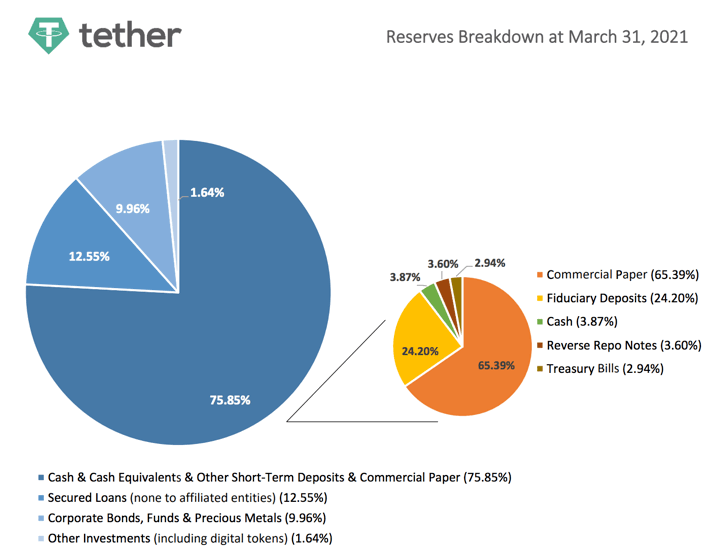
Tether is the largest US dollar stablecoin in the world, with a market cap of about $58 billion. Stablecoins are supposed to be backed by an equal amount of fiat money held in a trust account. 1 USDT should be backed by $1 USD. But how do you know? Tether just released a report outlining the collateral backing its stablecoin as of 3/31/2021, and it’s…. a huge warning sign. Less than 7% is held in cash and Treasury bills, with the rest being a mix of vague commercial paper, loans to unknown entities, and honestly who-knows-what.

Alignment of interest. Keep in mind the concept of alignment of interest from David Swensen. Tether wants to seem as credible and legitimate and “NOT A SCAM” as possible. Everything they say will try to put them in the best light possible. In fact, Tether is only doing this because of a legal settlement with the New York Attorney’s General Office after being fined $18 million for lying in the past. (As recently as March 2019, Tether claimed it was backed by 100% USD cash.) Yet… this is the best they can do?

A single glance at this chart and I know that Tether is not taking my US dollar and whisking it away safely into a trust account at a regulated US bank. Instead, the people running Tether are using the collateral for their own personal gain. They are making loans, earning interest, all things that add risk while using other people’s money. Banks are allowed to do that within a highly-regulated environment. Tether is not a bank.

Liquidity risk. There is a reason why Warren Buffett only holds Treasury bills when he says “cash” and not commercial paper. When the poo hits the fan – and it will sooner or later – “cash” means you get your money out immediately and reliably. Tether will not be able to do this, given the composition of its reserves. This op-ed on the future of stablecoins covers a lot of related concerns.

As the volume and velocity of stablecoins grow, the liquidity risk, of course, will grow too. For this reason, it will become increasingly important for the banks managing stablecoin cash to be nonlending banks or perhaps liquid asset banks that ring-fence the investments in segregated, bankruptcy-remote accounts — and, again, invest the assets backing stablecoin deposit liabilities in 100 percent risk-free, short-term, and liquid assets. Indeed, one reason why Wyoming chose its Special Purpose Depository Institution (SPDI) charter to be a nonlending charter is precisely because leverage and digital assets do not mix. Let me pause and repeat that — leverage and digital assets do not mix. Digital assets generally settle in minutes and with settlement finality, which means leveraged financial institutions that handle them could quickly find themselves in trouble if they don’t manage the liquidity risk well — digital assets move fast. So, there’s a fundamental reason why digital assets should interface with the traditional financial system via nonleveraged banks whose demand deposit liabilities are 100 percent backed by risk-free, short-term, liquid assets.

Instead of 100% risk-free, short-term, liquid assets, Tether is less than 7% risk-free, short-term, liquid assets. Commercial paper? Backed by whom exactly? Fiduciary account? At which remote offshore bank owned by a third-party? They could be pointing to a half-eaten sandwich and calling it collateral.

As a result, I would never own Tether, and if such behavior continues to be allowable, it would make me more skeptical of the other stablecoins like USD Coin (USDC) and Gemini Dollar (GUSD), even though they do claim to be fully-backed by dollar reserves in a US Bank. (Gemini and Circle are also regulated by the New York State Department of Financial Services, while Tether is not.) Regulation around stablecoins is so limited that we’ll probably have to experience some sort of major loss event before this gets addressed, just as we had to suffer deposit losses from failed banks before FDIC-insurance came around.

Having a clear stance on cryptocurrencies is tricky. On one hand, it is definitely a “Wild West” situation and there is certainly fraud and shady practices involved. On the other hand, this is how disruption works, and I don’t like anyone confidently telling me the future when nobody knows the future. I would rather try to learn about it, look for opportunities, but also remain very skeptical and careful. If you are holding a lot of Tether, possibly due to the high 8%+ interest rates available, please consider yourself warned.

Also see: Potential Risks of High Interest Stablecoin Savings Accounts

Thank You, David Swensen, For These Important Investing and Life Lessons

unconventional180I was saddened to hear the news of the passing of David Swensen, a well-known investor, endowment fund manager, and educator. From the NY Times obituary:
David Swensen, a money manager who gave up a lucrative Wall Street career to oversee Yale University’s endowment and proceeded to revolutionize endowment investing, in the process making Yale’s the best-performing fund in the country over a 20-year period, died on Wednesday in New Haven, Conn. He was 67.

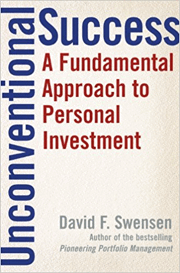
In addition to “revolutionizing” endowment investing, he also wrote a book for the average individual investor called Unconventional Success: A Fundamental Approach to Personal Investment which I read at a very formative period in my investing education. Even though he is best known for being an early adopter of alternative asset classes like hedge funds, private equity, and direct real estate ownership farmland and timber, he recommended something different for those without the time, skill, and existing money (access). From an interview with the Yale Alumni magazine:

That’s why the most sensible approach is to come up with specific asset allocation targets that you can implement with low-cost, passively managed index funds and rebalance regularly. You’ll end up beating the overwhelming majority of participants in the financial markets.

Here is a brief summary of the important lessons that I learned from his book:

Alignment of interests is key. There are many conflicts of interest in the financial world. Learning to spot them is an important skill. For example, in terms of asset classes, owning shares of businesses (equities) are good because your interests are aligned as a shareholder. However, in the case of high-yield bonds, your interests are not aligned. The borrower wants the lowest interest rate possible, so their job is to seem as safe as possible even if there are significant hidden risks. This is why Swensen recommends sticking only with FDIC-insured cash and Treasury bonds (nominal and TIPS). Take your risks as an owner.

Stick with these six core asset classes. Swensen identified core asset classes that you should invest in. These share three main characteristics:

  1. They rely on market-generated returns, not from active management skill (as it is a very rare attribute and hard to separate from luck).
  2. They add a valuable and differentiable characteristic to a portfolio.
  3. They come from broad, highly-liquid markets.

The six core asset classes he identified are:

  • US Equity
  • Foreign Developed Equity
  • Emerging Market Equity
  • Real Estate
  • U.S. Treasury Bonds
  • U.S. Treasury Inflation-Protected Securities (TIPS)

Swensen shared this sample model portfolio asset allocation:

30% Domestic US Equity
15% Foreign Developed Equity
10% Emerging Markets
15% Real Estate
15% U.S. Treasury Bonds
15% Inflation-Protected Securities

This also meant he was recommending against investing in the following:

  • US Corporate Bonds
  • High-Yield “Junk” Corporate Bonds
  • Asset-Backed Securities (like mortgage-backed bonds)
  • Tax-Exempt Bonds
  • Foreign Bonds
  • Hedge Funds
  • Private Equity

Not that they are horribly bad, it’s just that you don’t need them. They either have increased risk that isn’t adequately compensated, added management fees and costs that aren’t adequately compensated, or aren’t different enough to add extra return. Don’t make things more complex without a good reason.

Tips on active management. If you still want to pay someone to pick stocks for you, he recommended looking for the following in a manager:

  • Hold a limited number of stocks. Bet boldly on fewer companies (high “active share”), as opposed to being a “closet index fund”.
  • High rate of internal investment. The managers should have a high percentage of their own net worth in the same funds that they ask you to invest in. They should “eat their own cooking.”
  • Limit assets under management. If there is more money flowing in than they can invest efficiently, they should close the fund to avoid asset bloat. This requires them to turn down more money!
  • Reasonable management fees. Active management hash higher internal costs than a passive strategy, but you can still charge less than average.

Money isn’t everything. Find a purpose. Finally, David Swensen walked the walk. He could have made billions by staying on Wall Street instead of moving to Yale. He could have made tons of money being a “money guru” on CNBC, etc. The guy didn’t even bother to publish a second edition or “revised” edition of his book, even though that would have also been easy money. He found a mission. More quotes from Swenson (same NYT article):

Mr. Swensen was particularly proud of how the growing endowment had helped the university contribute to financial aid.

“One of the things that I care most deeply about is that notion that anyone who qualifies for admission can afford to go to Yale, and financial aid is a huge part of what the endowment does,” he said in an interview for this obituary in 2014.

“People think working for something other than the most money you could get is an odd concept, but it seems a perfectly natural concept to me.”

Morningstar Target Date Retirement Fund Report 2021: Getting Better But Still Under-Appreciated

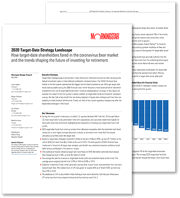
There are now trillions of dollars held by Target Date Funds (TDFs) inside employer-sponsored retirement plans like 401k’s and 403b’s, but you still don’t see much coverage on them in the financial media. Perhaps they are too boring to grab clicks or too unprofitable to market to individuals. Morningstar just released their 2021 Target-Date fund report (email required), and this year it seems even more focused on the employer institutional side and less on the actual employees that use it. However, Christine Benz (also of Morningstar) makes up for this with her article In Praise of Target-Date Funds.

Oftentimes, target-date critics are selling some type of investment advice themselves; they may not admit it, but they view target-date funds as competition.

My second thought when I see target-date funds coming in for criticism is to wonder: Are you seeing what I’m seeing? Because from where I sit, target-date funds have been nothing short of the biggest positive development for investors since the index fund.

Here is a summary of the benefits of Target Date funds:

  • TDFs take advantage of the behavioral inertia that encourages inaction during times of crisis. There was relatively little TDF selling activity during the March 2020 market drop. In fact, the automatic rebalancing may have improved returns compared to self-directed investors.
  • TDFs provide reasonable investment advice for a very low cost, and investors actually follow it. You get an age-appropriate asset mix which gradually gets more conservative over time, and the default is that people follow the advice. Many people would otherwise not be able to afford or seek out similar quality advice, and many people who can afford it don’t follow it.
  • TDFs will automatically improve over time, thanks to the trend toward lower costs over time and the accessibility of new asset classes as technology and costs also decrease.

Here are some broad takeaways from the Morningstar industry report:

  • The COVID-19 pandemic lowered overall retirement savings contributions by an estimated 60% when you compare 2020 net contributions vs. 2019 net contributions. This unfortunate result was due to a combination of company’s suspending or lowering employer contributions and workers lowering their salary deferrals.
  • Assets continue to flow from higher-cost TDFs to lower-cost TDFs. For example, Fidelity Freedom Index funds have gained about $50 billion in assets over the last five years, while the more expensive, actively-managed Fidelity Freedom funds have lost $35 billion during those same five years.
  • Competition is good. The BlackRock LifePath Index series collected the most net new money among target-date series. 2021 is the first year since 2008 that Vanguard Target Retirement hasn’t won that title. There is now a lot of competition in the low-cost, well-diversified, index-based TDF arena.

Curious what’s inside your Target Date fund? Here is the average glide path across 53 different TDF series. (M* didn’t update this chart for 2021 again, so this is taken from 2019 report.) On average, most TDFs have an asset allocation close to 90% equity and 10% bonds in the early years, with the equity percentage dropping (and bond percentage rising) as time goes on. At the year of retirement, the average asset allocation is roughly 45% equity and 55% bonds.

One important option to remember is that you don’t have to choose the TDF corresponding to the date that you turn 65. If you wish, you can pick a different year to somewhat adjust your risk level.

Gold or Silver-rated Target Date Funds. A detailed explanation and full rankings are in the report. Here are the gold/silver-rated funds for 2021:

  • Blackrock LifePath Index
  • Blackrock LifePath Dynamic
  • PIMCO RealPath Blend
  • JPMorgan SmartRetirement Blend
  • JPMorgan SmartRetirement
  • T. Rowe Price Retirement
  • MassMutual Select Retirement
  • Fidelity Freedom Index
  • Fidelity Freedom
  • State Street Target Retirement
  • Vanguard Target Retirement
  • American Funds Target Date

Bottom line. Target Date funds (TDFs) are probably under-appreciated for the benefits that they provide. For the most part, workers don’t get to choose which TDF series they can invest in, so there is little point worrying about slight differences in glide paths, recent performance, or Morningstar ratings. As long as you have one from a reputable firm with reasonable costs, you are receiving the major benefits of TDFs listed above. People who “satsifice” by settling for “good enough” tend to be happier in life than “maximizers”, so perhaps that extends here as well.

(If your fund is one of the bottom-dwellers, you may want to send this report to the HR department. Employee activism are part of the reason that these options are getting better over time.)

Chase Co-Branded Credit Cards: Free 12 Months of DoorDash DashPass

Chase has expanded their partnership with DoorDash (and Caviar) to offer free DashPass membership for 12 months to co-branded Chase credit cards. DashPass is a subscription service that offers a $0 delivery fee and reduced service fees for subscribers when ordering $12 or more from any DashPass-eligible restaurant (look for the checkmark). The regular price is $9.99/month. Eligible cards include:

  • Chase Southwest cards
  • Chase Marriott cards
  • Chase United cards
  • Chase Disney cards
  • Chase IHG cards
  • Chase British Airways cards
  • Chase Aer Lingus cards
  • Chase Iberia cards
  • Chase World of Hyatt cards

You must activate here. Note that after those free 12 months, you’ll automatically be charged $9.99/month for continued membership unless you cancel DashPass.

If you have a Chase Sapphire Reserve or Sapphire Preferred credit card, you can also get free DashPass benefits on eligible orders for at least 12 months (and a maximum of 24 months) after activation. Sapphire Reserve cardholders also get $60 in statement credits towards DoorDash in 2021.

If you have a Chase Freedom or Slate credit card, you can free DashPass benefits on eligible orders for 3 months after activation. After the first 3 months, the user will be auto-enrolled for the next 9 months in DashPass with a 50% discount applied to the then current membership rate. You can cancel at any time.

If you are new customer to DoorDash and sign up via my DoorDash referral link, you will get $10 off your first 3 DoorDash orders over $15 ($30 total savings). I will get food credits as well. Thanks if you use it!

U.S. Bank Altitude Connect Visa Signature Card Review: 50,000 Point Bonus + 4X Points on Travel/Gas

US Bank continues its credit card expansion with the new U.S. Bank Altitude Connect Visa Signature Card, a premium travel rewards card which has a headline feature of 4X points on travel and gas stations, plus 2X points on dining and grocery stores. There is also a launch offer of 50,000 bonus points worth $500 cash via statement credits. Here are the details:

  • 50,000 bonus points after you spend $2,000 in the first 120 days. 50,000 points can be redeemed for a $500 statement credit.
  • 4X points per dollar spent on travel and gas stations.
  • 2X points per dollar spent on grocery stores, grocery delivery, dining and streaming services.
  • 1 point per dollar spent on all other eligible net purchases.
  • Up to $100 towards TSA PreCheck® or Global Entry® application fee reimbursement via statement credit, once every four years.
  • $30 annual streaming credit. $30 credit for annual streaming service purchases such as Netflix and Spotify®.
  • Cell phone protection. Up to $600 reimbursement if your cell phone is stolen or damaged when you pay your monthly cell phone bill with your card.
  • No foreign transaction fees
  • $0 annual fee the first year, $95/year thereafter.

$30 annual streaming bonus details. If you charge at least one eligible video or music streaming service ever month onto this card, you’ll get 2X points per dollar spent, and also a $30 streaming service credit after 11 months of streaming service purchases. Eligible services include Netflix, HBO Max, Hulu, Disney+, Sling TV, YouTube TV, Vudu, AT&T TV Now, Apple Music, Google Music, Spotify, Amazon Music Unlimited, Tidal, SiriusXM, and Pandora. A clever little incentive to keep you actively using this card.

An automatic statement credit of $30 per 12-month period will be applied to your U.S. Bank Altitude Connect Visa Signature Card Account within 2 statement billing cycles following 11 consecutive calendar months of eligible streaming service purchases, such as Netflix, Hulu, Apple Music, if the Account is in good standing (open and able to use).

Overall thoughts. Even beyond the attractive sign-up bonus, this card looks very solid. Most of the major spending categories are covered by the 2X/4X tiers: travel, gas stations, grocery stores, dining out, and streaming. The TSA PreCheck fee reimbursement, $30 annual streaming credit, and cell phone protection also add ongoing value. The annual fee is waived during the first year, so there is no upfront cost to trying this card out.

Based on the rewards structure and annual fee, this cards will compete directly with the highly-popular Chase Sapphire Preferred card. Note that earning Ultimate Rewards points may be more attractive to those that can maximize the value of airline miles and/or hotel points. However, if you prefer to redeem for straight cash (statement credits), this US Bank card has higher multipliers on travel and gas stations, and thus likely higher rewards when comparing cash back amounts.

You may also compare this with the U.S. Bank Altitude Reserve Credit Card, which has more rewards but also a much higher annual fee.

Bottom line. The new U.S. Bank Altitude Connect Visa Signature Card offers a competitive 4X points on travel and gas stations, plus 2X points on dining out and grocery store purchases. Right now, new applicants can score a sign-up bonus worth $500 with the annual fee waived during the first year. This is definitely going on the Top 10 Best Credit Card Bonus Offers, especially as it is one of the few that I don’t already have.

Chase Business Complete Checking: $300 Bonus

Run a small business? Chase Bank has a Business Complete Checking account promotion offering a $300 bonus for new customers. You enter your e-mail address, and you should be sent a unique promo offer code for your online application. Some of the language suggests you should reside near a physical Chase branch, but the link lets you apply online. If you already have a Chase business credit card or other Chase business profile, the application can be pre-filled. Here are the requirements for the bonus:

  • Open a new Chase Business Complete Checking account using the offer shown below. This offer expires 4/21/22.
  • Deposit a total of $2,000 or more in new money within 30 days of coupon enrollment and maintain a $2,000 balance for 60 days.
  • Complete 5 qualifying transactions within 90 days of coupon enrollment. Qualifying transactions include debit card purchases, Chase QuickAccept deposits, Chase QuickDeposit, ACH (Credits), wires (Credits and Debits).

Note the following fine print:

* You can receive only one new business checking account opening related bonus every two years from the last enrollment date and only one bonus per account.

Account Closing: If the checking account is closed by the customer or Chase within six months after coupon enrollment, we will deduct the bonus amount for that account at closing.

Avoid the $15 monthly service fee on Business Complete Checking when you do at least one of the following each statement period.

  • Maintain a minimum daily balance of $2,000 in your account as of the beginning of each day of the statement period; OR
  • Spend at least $2,000 in purchases (minus returns or refunds) using your Chase Ink® Business Card(s) that shares a business legal name with the Chase Business Complete Checking account, using each of their most recently completed monthly card billing period(s); OR,
  • Deposit $2,000 into your Chase Business Complete Checking account from your QuickAccept and/or other eligible Chase Merchant Services transactions at least one business day prior to the last day of your bank account statement period; OR,
  • Maintain a linked Chase Private Client Checking? account.

Sole proprietorships and single-member LLCs are eligible (see below). If the application process is similar to their business credit cards, they may ask for documentation such as Articles of Incorporation.

Note: Only privately held businesses structured as sole proprietorships, corporations or limited liability companies (LLCs) managed by a single member or manager can apply online at this time.

Bottom line. If you run a small business, Chase is offering a very solid bonus on their Complete Business checking account. You can earn a $300 cash bonus with a $2,000 deposit held for 60 days, generating 5 transactions, and maintaining a $2,000+ balance for another 4 months after that to avoid the monthly service fees. You can find the offer below.

Best Interest Rates on Cash – May 2021

Here’s my monthly roundup of the best interest rates on cash as of May 2021, roughly sorted from shortest to longest maturities. Included are some lesser-known opportunities to improve your yield while keeping your principal FDIC-insured or equivalent. Check out my Ultimate Rate-Chaser Calculator to see how much extra interest you’d earn by moving money between accounts. Rates listed are available to everyone nationwide. Rates checked as of 5/9/2021.

Fintech accounts
Available only to individual investors, fintech accounts oftentimes pay higher-than-market rates in order to achieve high short-term growth (often using venture capital). I define “fintech” as a software layer on top of a different bank’s FDIC insurance. These do NOT require a certain number debit card purchases per month. Although I do use some of these after doing my own due diligence, read about the Beam app for potential pitfalls and best practices.

  • 3% APY on up to $100,000. The top rate is 3% APY for April through June 2021, and they have not indicated any upcoming rate drop. HM Bradley requires a recurring direct deposit every month and a savings rate of at least 20%. See my HM Bradley review.
  • 3% APY on 10% of direct deposits + 1% APY on $25,000. One Finance lets you earn 3% APY on “auto-save” deposits (up to 10% of your direct deposit, up to $1,000 per month). Separately, they also pay 1% APY on up to another $25,000 with direct deposit. New customer $50 bonus via referral. See my One Finance review.
  • 3% APY on up to $15,000. Porte requires a one-time direct deposit of $1,000+ to open a savings account. New customer $50 bonus via referral. See my Porte review.
  • 2.15% APY on up to $5k/$30k. Limited-time offer of free membership to their higher balance tier for 6 months with direct deposit. See my OnJuno review.

High-yield savings accounts
While the huge megabanks pay essentially no interest, it’s easy to open a new “piggy-back” savings account and simply move some funds over from your existing checking account. The interest rates on savings accounts can drop at any time, so I list the top rates as well as competitive rates from banks with a history of competitive rates. Some banks will bait you with a temporary top rate and then lower the rates in the hopes that you are too lazy to leave.

  • T-Mobile Money is still at 1.00% APY with no minimum balance requirements. The main focus is on the 4% APY on your first $3,000 of balances as a qualifying T-mobile customer plus other hoops, but the lesser-known perk is the 1% APY for everyone. Thanks to the readers who helped me understand this. There are several other established high-yield savings accounts at closer to 0.50% APY.

Short-term guaranteed rates (1 year and under)
A common question is what to do with a big pile of cash that you’re waiting to deploy shortly (just sold your house, just sold your business, legal settlement, inheritance). My usual advice is to keep things simple and take your time. If not a savings account, then put it in a flexible short-term CD under the FDIC limits until you have a plan.

  • No Penalty CDs offer a fixed interest rate that can never go down, but you can still take out your money (once) without any fees if you want to use it elsewhere. Marcus has a 7-month No Penalty CD at 0.45% APY with a $500 minimum deposit. AARP members can get an 8-month CD at 0.55% APY. Ally Bank has a 11-month No Penalty CD at 0.50% APY for all balance tiers. CIT Bank has a 11-month No Penalty CD at 0.30% APY with a $1,000 minimum deposit. You may wish to open multiple CDs in smaller increments for more flexibility.
  • Lafayette Federal Credit Union has a 12-month CD at 0.80% APY ($500 min). Early withdrawal penalty is 6 months of interest. Anyone can join this credit union via partner organization ($10 one-time fee).

Money market mutual funds + Ultra-short bond ETFs
Many brokerage firms that pay out very little interest on their default cash sweep funds (and keep the difference for themselves). Unfortunately, money market fund rates are very low across the board right now. Ultra-short bond funds are another possible alternative, but they are NOT FDIC-insured and may experience short-term losses in extreme cases. These numbers are just for reference, not a recommendation.

  • The default sweep option is the Vanguard Federal Money Market Fund which has an SEC yield of 0.01%. Vanguard Cash Reserves Federal Money Market Fund (formerly Prime Money Market) currently pays 0.01% SEC yield.
  • Vanguard Ultra-Short-Term Bond Fund currently pays 0.37% SEC yield ($3,000 min) and 0.47% SEC Yield ($50,000 min). The average duration is ~1 year, so your principal may vary a little bit.
  • The PIMCO Enhanced Short Maturity Active Bond ETF (MINT) has a 0.29% SEC yield and the iShares Short Maturity Bond ETF (NEAR) has a 0.41% SEC yield while holding a portfolio of investment-grade bonds with an average duration of ~6 months.

Treasury Bills and Ultra-short Treasury ETFs
Another option is to buy individual Treasury bills which come in a variety of maturities from 4-weeks to 52-weeks. You can also invest in ETFs that hold a rotating basket of short-term Treasury Bills for you, while charging a small management fee for doing so. T-bill interest is exempt from state and local income taxes. Right now, this section isn’t very interesting as T-Bills are yielding close to zero!

  • You can build your own T-Bill ladder at TreasuryDirect.gov or via a brokerage account with a bond desk like Vanguard and Fidelity. Here are the current Treasury Bill rates. As of 5/7/2021, a new 4-week T-Bill had the equivalent of 0.01% annualized interest and a 52-week T-Bill had the equivalent of 0.05% annualized interest.
  • The Goldman Sachs Access Treasury 0-1 Year ETF (GBIL) has a -0.01% SEC yield and the SPDR Bloomberg Barclays 1-3 Month T-Bill ETF (BIL) has a -0.12% (!) SEC yield. GBIL appears to have a slightly longer average maturity than BIL.

US Savings Bonds
Series I Savings Bonds offer rates that are linked to inflation and backed by the US government. You must hold them for at least a year. If you redeem them within 5 years there is a penalty of the last 3 months of interest. The annual purchase limit is $10,000 per Social Security Number, available online at TreasuryDirect.gov. You can also buy an additional $5,000 in paper I bonds using your tax refund with IRS Form 8888.

  • “I Bonds” bought between May 2021 and October 2021 will earn a 3.51% rate for the first six months. The rate of the subsequent 6-month period will be based on inflation again. More info here.
  • In mid-October 2021, the CPI will be announced and you will have a short period where you will have a very close estimate of the rate for the next 12 months. I will have another post up at that time.
  • See below about EE Bonds as a potential long-term bond alternative.

Prepaid Cards with Attached Savings Accounts
A small subset of prepaid debit cards have an “attached” FDIC-insured savings account with exceptionally high interest rates. The negatives are that balances are severely capped, and there are many fees that you must be careful to avoid (lest they eat up your interest). There is a long list of previous offers that have already disappeared with little notice. I don’t personally recommend nor use any of these anymore, as I feel the work required and risk of messing up exceeds any small potential benefit.

  • Mango Money pays 6% APY on up to $2,500, if you manage to jump through several hoops. Requirements include $1,500+ in “signature” purchases and a minimum balance of $25.00 at the end of the month.

Rewards checking accounts
These unique checking accounts pay above-average interest rates, but with unique risks. You have to jump through certain hoops which usually involve 10+ debit card purchases each cycle, a certain number of ACH/direct deposits, and/or a certain number of logins per month. If you make a mistake (or they judge that you did) you risk earning zero interest for that month. Some folks don’t mind the extra work and attention required, while others would rather not bother. Rates can also drop suddenly, leaving a “bait-and-switch” feeling.

  • The Bank of Denver pays 2.00% APY on up to $25,000 if you make 12 debit card purchases of $5+ each, receive only online statements, and make at least 1 ACH credit or debit transaction per statement cycle. The rate recently dropped. If you meet those qualifications, you can also link a Kasasa savings account that pays 1.00% APY on up to $50k. Thanks to reader Bill for the updated info.
  • Devon Bank has a Kasasa Checking paying 2.50% APY on up to $10,000, plus a Kasasa savings account paying 2.50% APY on up to $10,000 (and 0.85% APY on up to $50,000). You’ll need at least 12 debit transactions of $3+ and other requirements every month. The rate recently dropped.
  • Presidential Bank pays 2.25% APY on balances up to $25,000, if you maintain a $500+ direct deposit and at least 7 electronic withdrawals per month (ATM, POS, ACH and Billpay counts).
  • Evansville Teachers Federal Credit Union pays 3.30% APY on up to $20,000. You’ll need at least 15 debit transactions and other requirements every month.
  • Lake Michigan Credit Union pays 3.00% APY on up to $15,000. You’ll need at least 10 debit transactions and other requirements every month.
  • Find a locally-restricted rewards checking account at DepositAccounts.

Certificates of deposit (greater than 1 year)
CDs offer higher rates, but come with an early withdrawal penalty. By finding a bank CD with a reasonable early withdrawal penalty, you can enjoy higher rates but maintain access in a true emergency. Alternatively, consider building a CD ladder of different maturity lengths (ex. 1/2/3/4/5-years) such that you have access to part of the ladder each year, but your blended interest rate is higher than a savings account. When one CD matures, use that money to buy another 5-year CD to keep the ladder going. Some CDs also offer “add-ons” where you can deposit more funds if rates drop.

  • NASA Federal Credit Union has a special 49-month Share Certificate at 1.40% APY ($10,000 min). Early withdrawal penalty is 1 year of interest. Anyone can join this credit union by joining the National Space Society (free). Note that NASA FCU may perform a hard credit check as part of new member application.
  • Lafayette Federal Credit Union has a 5-year CD at 1.26% APY ($500 min). Early withdrawal penalty is 6 months of interest. Anyone can join this credit union via partner organization ($10 one-time fee).
  • You can buy certificates of deposit via the bond desks of Vanguard and Fidelity. You may need an account to see the rates. These “brokered CDs” offer FDIC insurance and easy laddering, but they don’t come with predictable early withdrawal penalties. Right now, I see a 5-year CD at 1.00% APY vs. 0.77% for a 5-year Treasury. Be wary of higher rates from callable CDs listed by Fidelity.

Longer-term Instruments
I’d use these with caution due to increased interest rate risk, but I still track them to see the rest of the current yield curve.

  • Willing to lock up your money for 10 years? You can buy long-term certificates of deposit via the bond desks of Vanguard and Fidelity. These “brokered CDs” offer FDIC insurance, but they don’t come with predictable early withdrawal penalties. You might find something that pays more than your other brokerage cash and Treasury options. Right now, I see a 10-year CD at 1.80% APY vs. 1.60% for a 10-year Treasury. Watch out for higher rates from callable CDs from Fidelity.
  • How about two decades? Series EE Savings Bonds are not indexed to inflation, but they have a unique guarantee that the value will double in value in 20 years, which equals a guaranteed return of 3.5% a year. However, if you don’t hold for that long, you’ll be stuck with the normal rate which is quite low (currently 0.10%). I view this as a huge early withdrawal penalty. But if holding for 20 years isn’t an issue, it can also serve as a hedge against prolonged deflation during that time. Purchase limit is $10,000 each calendar year for each Social Security Number. As of 5/7/2021, the 20-year Treasury Bond rate was 2.17%.

All rates were checked as of 5/9/2021.