Archives for November 2020

Wishing You a Hopeful and Happy Thanksgiving

Imagine an aeroplane makes an emergency landing and breaks into three parts. As the cabin fills with smoke, everybody inside realises: we’ve got to get out of here.

What happens?

On Planet A, the passengers turn to their neighbours to ask if they’re okay. Those needing assistance are helped out of the plane first. People are willing to give their lives, even for perfect strangers.

On Planet B, everyone’s left to fend for themselves. Panic breaks out. There’s lots of pushing and shoving. Children, the elderly and people with disabilities get trampled underfoot.

Now the question: which planet are we living on?

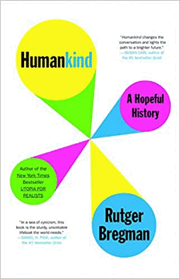
According to the book Humankind: A Hopeful History by Rutger Bregman, about 97% of people believe that we live on Planet B. This book systemically breaks down all of the various “evidence” supporting that assumption, and shows us that the historical evidence actually shows that we live on Planet A. The daily news machine loves to focus on the negative and outrageous. (I switched the letters initially, too sleepy from late-night Thanksgiving food prep!)

Let’s take Lord of the Flies. Most of us think we understand the story of those feral kids, but that’s a fictional book! Meanwhile, we have a real-world example of what happens when a group of young boys get marooned on a remote and uninhabited island. This excerpt from Humankind was republished in The Guardian: The real Lord of the Flies: what happened when six boys were shipwrecked for 15 months.

I haven’t finished the book, but the basic idea is that the world could look very different if we assume that people are basically decent and naturally look to help others. Many things in life are self-fulfilling. Prisons are presented as an opportunity to implement. In the same way, perhaps we can change our own lives by assuming that others are basically decent. If someone cuts us off in traffic, perhaps they aren’t just a jerk but distracted and/or late for a job interview because their child is sick. (Besides, getting angry only hurts us and not them.) Assuming the good in people allows you to ask others for help, and makes you more likely to help others. This can lead to better job opportunities, better friends, who knows? A better life? You may get burned once in a while, but on the whole it is better to lean toward the positive, virtuous cycle. (Don’t be reckless, of course.)

I’m sure that many of you have had an extraordinarily difficult year, in ways that I can’t even imagine. Still, there are many reasons to be hopeful. Thank you for reading. Happy Thanksgiving!

Upsolve: Nonprofit Helps You File Chapter 7 Bankruptcy For Free

Upsolve is a nonprofit 501(c)(3) organization that helps anyone file for bankruptcy on their own behalf. They are not a legal service, but more of a free self-service software tool and step-by-step guide. Essentially “TurboTax for Bankruptcy”, given that both are overly complex (although TurboTax is definitely for-profit while Upsolve never asks for payment). Users can also interact with each other on a Facebook group, although no lawyers are involved. Found via Time’s Best Inventions of 2020.

Upsolve focuses on Chapter 7 bankruptcies, which are generally involve less-complex situations and households with below-median incomes. Chapter 7 can generally discharge unsecured debts, including credit card debt and medical bills. According various sources, the average cost to pay an attorney for file Chapter 7 is about $1,500. Now, that might be worth it if you have a more complex situation (and the ability to pay), but perhaps those with a simple situation might want to take a shot at representing themselves.

In 2019, Upsolve got 80% of their funding from government funding and charitable contributions, and 20% from accepting payments from private independent attorneys that pay to be mentioned for a free consultation if you require professional assistance. You can also support them by making a tax-deductible donation. They are very young so they are not rated by Charity Navigator or Guidestar.

I admittedly know very little about this process, but I figure it’s good to spread the word about free assistance offered to those with limited resources during these difficult times.

Consumer Reports: Top 10 Most Reliable Car Brands and Models 2020

Consumer Reports provided some updated results from their 2020 Car Owner Survey in the public articles Who Makes the Most Reliable Cars?, 10 Most Reliable Cars, and 10 Least Reliable Cars. There are a few minor surprises, including a new brand in the top spot. Here are some highlights and a partial excerpt of the Top 10 most reliable brands.
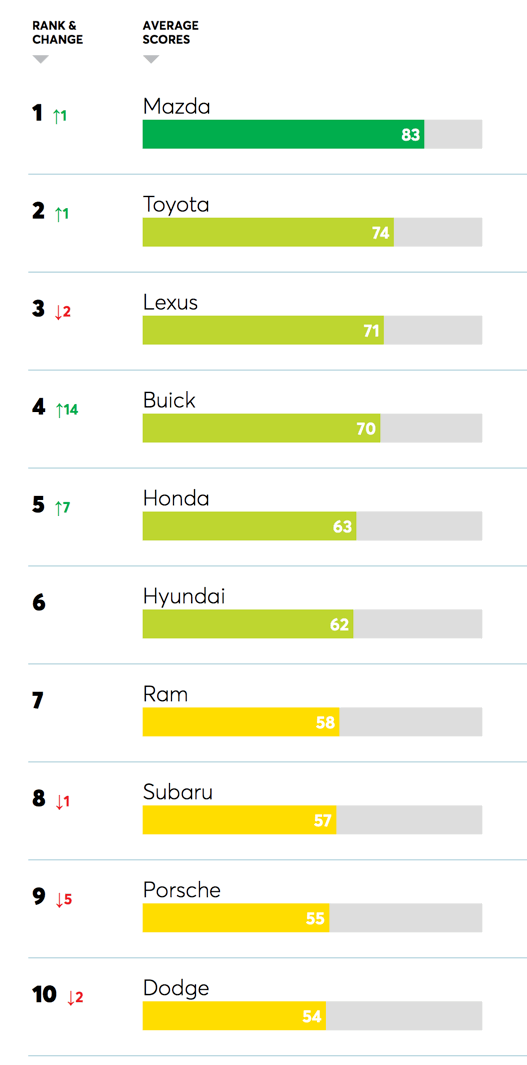
  • Most reliable: Mazda is the new #1, up from #2 last year.
  • Most improved ranking (in the Top 10): Honda and Buick.
  • Biggest ranking drops (overall): Mini and Lincoln.

A few quick thoughts:

  • Despite providing these brand rankings, Consumer Reports recommends that you shop by vehicle and not just by brand. Reliability problems often occur with a new model with a new engine and/or drivetrain system. This is why Toyota is very incremental with their changes – to maintain reliability.
  • The best new car for Uber/Lyft/DoorDash etc. drivers must be the Toyota Prius. Top reliability scores + top gas mileage + reasonable depreciation = lowest per-mile cost of ownership. (A used one might be even better, as the battery actually has a working life of 10+ years…) If you drive a lot and just want to get from A to B at the lowest per-mile cost, buy a Prius.
  • Everyone seems to love their Teslas, but the reliability scores are rather poor. Is it because most Tesla cars are still rather new and Tesla is fixing all these issues under warranty? I also wonder what parts exactly are breaking down since electric vehicles cost less to maintain overall partially due to having much fewer parts than internal-combustion vehicles. You would think the reliability would be higher by default.

Financial Planning Advice From Allan Roth’s 40 Years of Experience

Allan Roth is one of the financial planners whose independent opinions I have come to respect, and he shares seven takeaways from 40 years of financial planning. Financial Planning is an industry trade magazine targeted at (obviously) professional financial planners, but many of the articles are quite useful for DIY investors as well.

Read the article first, but here are my personal interpretations of his lessons (not his words):

  • A solid income and frugality both matter, but either one is not enough. He’s advised a high-income doctor with a net worth smaller than an emergency fund, and a 10X millionaire who is still afraid to spend their money. Both needed help.
  • Many people overestimate their ability to handle real-world risk. He has seen firsthand how clients answer the theoretical, as compared to how they later react during a real-world market crisis. Same idea as how paper trading is not real trading.
  • Indexing and low fees = higher returns. Some things take time to work out, especially when billions are spent on marketing against it.
  • You can’t predict the future. Other people can’t predict the future. Market cap indexing means that you will own the winners, many of which will be companies that don’t even exist today. Own bonds for safety, and accept whatever yield there is. You can’t predict rates either. The problem is that someone will always get it right any given time, and they’ll be loud about it.
  • The CFP designation doesn’t mean much (good or bad). CFP wants to be the gold standard for a professional financial planners, but they don’t do enough to put the clients first. It just means they have a minimum level of education, 2 years of industry experience, and chose to pay the annual dues that year. You could be a great planner without being a CFP, or a bad planner with multiple complaints and still be a CFP.
  • Financial planners provide the greatest value in: “real planning, improving tax-efficiency, behavioral coaching, and insurance analysis.” That means this stuff is harder and often benefits from an outside perspective. Note that this list excludes stock-picking and market-timing.

Emergency Funds Are The First Building Block For Retirement

The Blackrock article Emergency Savings = Better Retirement? comes from Blackrock’s department that helps companies manage their retirement plans. They propose the idea of creating a separate “sidecar savings account” in order to prevent early withdrawals via 401k loans (and often defaults):

A “sidecar savings” account may help build short-term stability, giving participants the confidence to commit to long-term retirement goals. […] Plan sponsors could help participants meet short-term financial needs by taking steps to help reduce [401k loan] defaults.

In other words, they want to give employees an emergency fund! Not exactly a new idea, but it supports the idea that the highest priority should be a short-term emergency fund, even if the real goal is higher retirement savings balances.

At the recent BlackRock Retirement Summit, Rachel Schneider of the Aspen Institute Financial Security Program explained that if participants have confidence about near-term stability through access to emergency cash, it may improve long-term behavior. “If they have more security today,” she said, “It should translate into more long-term savings.”

Build up your financial fortress in stages:

  • Looking past the next payday. Going from paycheck-to-paycheck to having $1,500 in the bank lets many things become minor speed-bumps instead of derailing your life. Do whatever you can to create this fund. For example, I’d even deliver Uber Eats/Doordash/Instacart in my open hours.
  • Looking past your current job. Going from having a minimal emergency fund to ~$10,000 gives you the ability to take career risks and thus the opportunity to turbo-boost your income. You might deliver on Uber Eats to build up this fund, but Uber Eats won’t take to you financial freedom. You need to build up valuable skills and/or business equity.
  • Reaching the point of inevitable financial freedom. Finally, going from $10,000 to $100,000 is amazing because that’s when you realize that reaching financial independence is a matter of WHEN, not IF. It’s a sign that you’ve put in the dirty work and developed the habits and structure required. The only remaining component is time, so now you can make some more minor adjustments to make that time more enjoyable. Similar job with more flexible hours? Less hours? Less politics? Better boss? “The first $100,000 is a b****.”

I prefer the comfort of cash in the bank, but you just need something that you know will float you in the short-term, be it cash or a stock portfolio or whatever else you’re willing to sell. I’ve heard various things like “I can just use my credit cards” or “I can just take a home-equity loan”. Unfortunately, 2020 has shown us that long-term unemployment and long-term depressed wages can happen out of nowhere. Taking on debt when you don’t even have enough income to make the payments can quickly spiral out of control.

One Finance Review (3% APY Offer Expired)

Update September 2022: The ONE app feature set has been changed. They now offer only up to 1% APY on all balances and pockets. As such, this app no longer offers a competitive savings interest rate and I no longer use it. I will leave the original review up for context as to why I used to talk about it, but please consider it outdated.

Expired review:

One Finance is an app that USED TO offer up to 3% APY on select balances and replaces overdraft fees with a line-of-credit. Thanks to reader Matt for the tip. FDIC insurance is provided by their partner bank, Coastal Community Bank.

Let’s cut straight to what earns the 3% APY in their “Auto-Save Pocket”:

  • Paycheck Auto-Save. Add your paycheck direct deposit and contribute up to 10% of each paycheck. Up to $1,000/month.
  • Debit card automated round-ups. Round up every One card purchase to the next dollar and deposit the difference.

If you have any sort of Direct Deposit, you can earn 1% APY on up to another $25,000 (“Save Pocket”). If you don’t have Direct Deposit, you earn 1% APY on up to $5,000.

This structure is rather clever, as it directly incentives real-world savings while inherently limiting the balance on which they pay 3% APY. Even if you made 100 debit card purchases a month, you’d only average $50 a month in savings via roundups. Most people would also have to move over their entire direct deposit to take full advantage of the paycheck deferral portion. It would take $10,000 in monthly direct deposits to max it out.

(There is also no cash back or round-up matching on those debit card purchases, so you’d be giving up potentially valuable cashback/points/miles rewards to get that 3% APY. I’d prefer the 2% cash back, personally.)

Another somewhat unique feature is the no-fee line-of-credit for overdraft protection (charges 12% APY). There is no interest at all if you repay any negative balance by the end of the same month. Even at 12% APY, this can be a lot less painful than a $35 flat fee if you only overdraft by a few dollars for a few days. For example, overdrafting by $500 for a week would cost nothing if you went back up by the end of the month, or about $1.15 if you didn’t. I’m guessing that most other big banks don’t do this because charging those $35 fees is much more profitable.

Additional features.

  • No monthly fees, no minimum balances.
  • Fee-free access to Allpoint ATM network.
  • Free debit Mastercard.
  • Person-to-person payment system.

Finally, they promise “World-Class Live Customer Service”. That is a bold claim coming from a crowd of startups trying to get by with the bare minimum of customer service *cough* Robinhood *cough*. It’s truly refreshing whenever I speak to a knowledgeable, caring customer service rep these days. I hope they pull it off, a la Zappos.

Citi Credit Cards: 5% Back on up to $500 of Online Purchases

If you have an existing Citi credit card, log into your account at Citi.com and see if you are targeted for 5% back on up to $500 of online purchases ($25 max per card). It appears to be widely available on a variety of Citi-branded consumer and small business credit cards including the popular Citi Double Cash and Citi Costco cards (but not all of them). The offer does not start until 11/24 and ends on 11/30. However, you must enroll to get the bonus, so it is important to activate first.

Here’s what it looks like for my Citi Double Cash card:

If you don’t see it upon login or accidentally click past it, try to look under “Rewards & Benefits” and then “Offers for You”. You can also try this link. The wording suggests that this stacks on top of your normal earnings of cash back, miles, or points, so you could really be getting for example 7% cash back total (2% + 5%). Remember that you can enroll multiple cards as well, but you must activate each one individually.

Best Interest Rates on Cash – November 2020

Here’s my monthly roundup of the best interest rates on cash for November 2020, roughly sorted from shortest to longest maturities. I track these rates because I keep 12 months of expenses as a cash cushion and also invest in longer-term CDs (often at lesser-known credit unions) when they yield more than bonds. Check out my Ultimate Rate-Chaser Calculator to see how much extra interest you’d earn by moving money between accounts. Rates listed are available to everyone nationwide. Rates checked as of 11/9/2020.

High-yield savings accounts
While the huge megabanks pay essentially no interest, it’s easy to open a new “piggy-back” savings account and simply move some funds over from your existing checking account. The interest rates on savings accounts can drop at any time, so I list the top rates as well as competitive rates from banks with a history of competitive rates. Some banks will bait you with a temporary top rate and then lower the rates in the hopes that you are too lazy to leave.

  • Chime has the top rate at the moment at 1.00% APY with no minimum balance requirements. You can also get a $75 cash bonus if you open their checking account and make a payroll direct deposit of $200+ within the first 45 days of new account opening. There are several other established high-yield savings accounts at closer to 0.50% APY for now.
  • I opened an account with HM Bradley last quarter, shifted over part of my direct deposit, didn’t withdraw it, and am now earning 3% APY on up to $100,000 of my liquid savings from October through December 2020. My long-term concerns still linger, but I am impressed that they kept their rates high for this quarter. You can still earn 1% APY for this quarter (and hopefully qualify for the higher tiers next quarter) if you can move over a direct deposit.
  • See my recent post on the frozen deposits at Beam for a cautionary tale and tips on avoiding shady banking practices.

Short-term guaranteed rates (1 year and under)
A common question is what to do with a big pile of cash that you’re waiting to deploy shortly (just sold your house, just sold your business, legal settlement, inheritance). My usual advice is to keep things simple and take your time. If not a savings account, then put it in a flexible short-term CD under the FDIC limits until you have a plan.

  • No Penalty CDs offer a fixed interest rate that can never go down, but you can still take out your money (once) without any fees if you want to use it elsewhere. Marcus has a 7-month No Penalty CD at 0.55% APY with a $500 minimum deposit. AARP members can get an 8-month CD at 0.65% APY. Ally Bank has a 11-month No Penalty CD at 0.60% APY for all balance tiers. CIT Bank has a 11-month No Penalty CD at 0.30% APY with a $1,000 minimum deposit. You may wish to open multiple CDs in smaller increments for more flexibility.
  • CommunityWide Federal Credit Union has a 12-month CD at 0.90% APY ($1,000 min). Early withdrawal penalty depends on how early you withdraw. Anyone can join this credit union via partner organization ($5 one-time fee).

Money market mutual funds + Ultra-short bond ETFs
If you like to keep cash in a brokerage account, beware that many brokers pay out very little interest on their default cash sweep funds (and keep the difference for themselves). The following money market and ultra-short bond funds are NOT FDIC-insured and thus come with a possibility of principal loss, but may be a good option if you have idle cash and cheap/free commissions.

  • The default sweep option is the Vanguard Federal Money Market Fund which has an SEC yield of 0.03%. Vanguard Cash Reserves Federal Money Market Fund (formerly Prime Money Market) currently pays an 0.04% SEC yield.
  • Vanguard Ultra-Short-Term Bond Fund currently pays 0.63% SEC yield ($3,000 min) and 0.73% SEC Yield ($50,000 min). The average duration is ~1 year, so there is more interest rate risk.
  • The PIMCO Enhanced Short Maturity Active Bond ETF (MINT) has a 0.39% SEC yield and the iShares Short Maturity Bond ETF (NEAR) has a 0.66% SEC yield while holding a portfolio of investment-grade bonds with an average duration of ~6 months. Note that there was a sudden, temporary drop in net asset value during the March 2020 market stress.

Treasury Bills and Ultra-short Treasury ETFs
Another option is to buy individual Treasury bills which come in a variety of maturities from 4-weeks to 52-weeks. You can also invest in ETFs that hold a rotating basket of short-term Treasury Bills for you, while charging a small management fee for doing so. T-bill interest is exempt from state and local income taxes. Right now, this section isn’t very interesting as T-Bills are yielding close to zero!

  • You can build your own T-Bill ladder at TreasuryDirect.gov or via a brokerage account with a bond desk like Vanguard and Fidelity. Here are the current Treasury Bill rates. As of 11/6/2020, a new 4-week T-Bill had the equivalent of 0.10% annualized interest and a 52-week T-Bill had the equivalent of 0.12% annualized interest.
  • The Goldman Sachs Access Treasury 0-1 Year ETF (GBIL) has a -0.01% SEC yield and the SPDR Bloomberg Barclays 1-3 Month T-Bill ETF (BIL) has a -0.04% (!) SEC yield. GBIL appears to have a slightly longer average maturity than BIL.

US Savings Bonds
Series I Savings Bonds offer rates that are linked to inflation and backed by the US government. You must hold them for at least a year. If you redeem them within 5 years there is a penalty of the last 3 months of interest. The annual purchase limit is $10,000 per Social Security Number, available online at TreasuryDirect.gov. You can also buy an additional $5,000 in paper I bonds using your tax refund with IRS Form 8888.

  • “I Bonds” bought between November 2020 and April 2020 will earn a 1.68% rate for the first six months. The rate of the subsequent 6-month period will be based on inflation again. More info here.
  • In mid-April 2021, the CPI will be announced and you will have a short period where you will have a very close estimate of the rate for the next 12 months. I will have another post up at that time.
  • See below about EE Bonds as a potential long-term bond alternative.

Prepaid Cards with Attached Savings Accounts
A small subset of prepaid debit cards have an “attached” FDIC-insured savings account with exceptionally high interest rates. The negatives are that balances are capped, and there are many fees that you must be careful to avoid (lest they eat up your interest). Some folks don’t mind the extra work and attention required, while others do. There is a long list of previous offers that have already disappeared with little notice. I don’t personally recommend nor use any of these anymore.

  • One of the few notable cards left in this category is Mango Money at 6% APY on up to $2,500, along with several hoops to jump through. Requirements include $1,500+ in “signature” purchases and a minimum balance of $25.00 at the end of the month.

Rewards checking accounts
These unique checking accounts pay above-average interest rates, but with unique risks. You have to jump through certain hoops, and if you make a mistake you won’t earn any interest for that month. Some folks don’t mind the extra work and attention required, while others do. Rates can also drop to near-zero quickly, leaving a “bait-and-switch” feeling. If you want rates above 2% APY, this is close to the only game in town.

  • Consumers Credit Union Free Rewards Checking (my review) still offers up to 4.09% APY on balances up to $10,000 if you make $500+ in ACH deposits, 12 debit card “signature” purchases, and spend $1,000 on their credit card each month. The Bank of Denver has a Free Kasasa Cash Checking offering 2.50% APY on balances up to $25,000 if you make 12 debit card purchases and at least 1 ACH credit or debit transaction per statement cycle. If you meet those qualifications, you can also link a savings account that pays 1.50% APY on up to $50k. Thanks to reader Bill for the updated info. Find a locally-restricted rewards checking account at DepositAccounts.

Certificates of deposit (greater than 1 year)
CDs offer higher rates, but come with an early withdrawal penalty. By finding a bank CD with a reasonable early withdrawal penalty, you can enjoy higher rates but maintain access in a true emergency. Alternatively, consider building a CD ladder of different maturity lengths (ex. 1/2/3/4/5-years) such that you have access to part of the ladder each year, but your blended interest rate is higher than a savings account. When one CD matures, use that money to buy another 5-year CD to keep the ladder going. Some CDs also offer “add-ons” where you can deposit more funds if rates drop.

  • Hiway Federal Credit Union has a 5-year certificate at 1.35% APY ($25k minimum) and 1.25% APY with a $10,000 minimum. Early withdrawal penalty is 1 year of interest. 4-year at 1.20% APY, and 3-year at 1.10% APY ($25k minimum). Anyone can join this credit union via partner organization ($10 one-time fee).
  • You can buy certificates of deposit via the bond desks of Vanguard and Fidelity. You may need an account to see the rates. These “brokered CDs” offer FDIC insurance and easy laddering, but they don’t come with predictable early withdrawal penalties. Vanguard has nothing special right now, I see a 5-year at 0.45% APY right now. Be wary of higher rates from callable CDs listed by Fidelity.

Longer-term Instruments
I’d use these with caution due to increased interest rate risk, but I still track them to see the rest of the current yield curve.

  • Willing to lock up your money for 10 years? You can buy long-term certificates of deposit via the bond desks of Vanguard and Fidelity. These “brokered CDs” offer FDIC insurance, but they don’t come with predictable early withdrawal penalties. At this writing, Vanguard has a 10-year at 0.75% APY. Watch out for higher rates from callable CDs from Fidelity.
  • How about two decades? Series EE Savings Bonds are not indexed to inflation, but they have a unique guarantee that the value will double in value in 20 years, which equals a guaranteed return of 3.5% a year. However, if you don’t hold for that long, you’ll be stuck with the normal rate which is quite low (currently 0.10%). I view this as a huge early withdrawal penalty. But if holding for 20 years isn’t an issue, it can also serve as a hedge against prolonged deflation during that time. Purchase limit is $10,000 each calendar year for each Social Security Number. As of 11/6/2020, the 20-year Treasury Bond rate was 1.37%.

All rates were checked as of 11/9/2020.

Beam App Complaints: Frozen Bank Deposits and Lessons Learned

(Follow-up 11/27: CNBC reports that progress had been made towards customers getting their funds back, although not everything has been resolved.)

Beam Financial was yet another fintech app that promised a high interest rate along with (what they think are) clever hurdles to get it. They’ve had various hiccups since their delayed launch in 2019, but most recently many customers found themselves unable to withdraw their own funds. This certainly sounds like a nightmare! As more news has slowly trickled out, important details of the story have emerged – see CNBC, American Banker #1 (paywall?), American Banker #2 (paywall?), Google app complaints, and BBB complaints.

To be blunt, it seems that Beam simply didn’t know how to run a bank properly. Here are the highlights:

  • Beam opened some sort of commercial custody account with Huntington Bank (a real FDIC-insured bank), but that account didn’t allow withdrawals (!). Beam apparently didn’t know that before they opened the account (!!).
  • Beam then added Dwolla as their ACH provider (to provide transfers, not to hold any money), but Dwolla terminated their agreement as of October 1st, 2020 with a (disputed) one month of notice for violating their agreement.
  • Dwolla was supposed to manage transfers between Huntington and another deposit network provider R&T (which also provides FDIC insurance). R&T also terminated their relationship with Beam at the end of October 2020 for violating their agreement.
  • Beam used to list Wells Fargo, Citigroup, Morgan Stanley, and US Bank as examples of banks they work with on their website. When contacted, none of those banks stated they had a relationship with Beam. Those names are now gone.
  • Beam lost up to $300,000 due to a deposit chargeback scam that seemed easily avoidable (details below).
  • BBB complaints about account access started as early as December 2019. They were officially investigated by the Federal Trade Commission (FTC) for the second time by May 2020.
  • Beam says the money is all just stuck somewhere now, with no way to get it back to their rightful owners. They have given no date as to when this will be fixed.

Within its first 3 months of existence, Beam was apparently defrauded out of about $300,000 by the modern version of check kiting. A malicious customer would initiate an ACH transfer of funds to Beam, and then Beam would let them withdraw it to another account before it fully cleared. Meanwhile, the malicious customer would cancel their initial ACH transfer. Net result: No money in, just money out! I guess they never saw the movie Catch Me If You Can. This is why most banks have clear funds availability policies to protect themselves.

Why didn’t I open an account with Beam? After searching my emails, I found that I did submit my email for the Beam waitlist in August 2017. They invited me to their private beta in April 2018. I declined. I didn’t know any of this would happen, but I do remember that they were vague about the name of their partner bank that would provide FDIC-insurance, despite so many loud emails with emojis and a very aggressive referral program. So much hype, but so many delays. I thought they’d be “vaporware” forever. When it did finallly arrive, I didn’t like their confusing model of offering 7% interest for a single day if I jumped through their hoops. How was I supposed to track that? I usually only like to share offers that I’d take advantage of myself, so I never mentioned it here (thankfully).

I would have found more red flags if I did open an account…

What are some quick checks to perform before depositing substantial amount of money? Here are some steps that I take when dealing with a new financial account. My most recent account opening was HM Bradley, so let’s run through them as an example.

If they are a banking app, what financial institution is providing the FDIC insurance? What is the certificate number and what is the name on it? These days, many banks have multiple names or they offer deposit services to other financial companies.

The HMBradley website claims says that “All deposit accounts are provided by Hatch Bank, Member FDIC.” The FDIC BankFind website shows certificate #25803 for Hatch Bank in San Marcos, CA. There is one location, which per Google Maps is a strip mall with the name “Rancho Santa Fe Thrift & Loan” as of April 2019. According to this announcement:

Rancho Santa Fe Thrift & Loan Association changed its name to Hatch Bank, effective April 12, according to the California Department of Business Oversight’s monthly bulletin.

The San Marcos, Calif.-based bank is a subsidiary of Conshohocken, Pa.-based Firstrust Savings Bank, and Semperverde Holding Co. is the ultimate parent of both.

Fun fact: Firstrust Bank was started in 1934 and is the largest family-owned bank in the Philadelphia region and the official bank of the Philadelphia Eagles.

Beam would not provide an FDIC certificate and just stated that they use a “network” of banks including US Bank, Citibank and Wells Fargo (all of which denied any relationship with Beam when contacted).

Does that named financial institution actually acknowledge the named fintech app somewhere? Either verify via phone call, website link, press release, something to confirm this claim from both directions.

On the Hatch Bank website, HM Bradley is clearly mentioned and linked to on the front page.

After signing up for the account, does the routing number match up with the promised bank?

The routing number provided was 322286188. According to the official site of ABA routing numbers, ABA.com, this matches up with Hatch Bank.

Based on my research, Beam would NOT provide a routing number, ostensibly so they could maintain their overall $15,000 deposit limit and $5,000 maximum deposit per day.

If I link the account to another savings account (ex. Ally Bank), can I push/pull funds without issue?

Ally Bank allows a high number of linked banks, and it is free to simply push and pull $1 to/from an external account. HMBradley lets me push and pull from Ally and other external banks with no issue.

Beam would NOT give you a routing number and account number, so you couldn’t link it other accounts and push/pull. You can only initiate transfers within the Beam app itself. This is a HUGE red flag and instant deal-breaker in my opinion.

Does the bank have a working customer service phone number? If not, how responsive are they to email or Live Chat?

If they have a phone number, just call it and ask for something mundane, like verifying your account balance. Phone customer service is expensive, but it’s still very nice to have. HM Bradley does not have a phone number that I can find, but it does have Live Chat from 9-5pm Pacific, Monday through Friday. I have contacted them via both Live Chat and e-mail support (support@hmbradley.com) multiple times and have gotten satisfactory support. Mostly, I bug them to mark my direct deposit as such to qualify for the higher savings tiers.

Beam had no phone number or live chat, only an e-mail address.

How much venture capital have they received? When? From whom?

These banks may have various business models with fancy projections, but honestly, in the beginning your interest is being paid out of venture capital. HM Bradley apparently got $3.5 million from 6 VC firms in a seed round in November 2019. PayPal founder Max Levchin is an investor through his HVF Labs.

I could not find any evidence that Beam Financial received any substantial venture capital at all. Note that there is a startup called Beam Solutions that raised $9M of venture capital before recently being acquired, but that is not Beam Financial.

A high interest rate doesn’t automatically mean danger. There are definitely many different sources of revenue in the banking world, and I have (and continue to) receive much higher interest in my bank accounts than if I just kept it in Bank of America or Chase, earning nothing. ING Direct was a young start-up once, and it changed the entire industry. Banks have paid me over ten thousand dollars to switch to them. Rewards checking accounts come and go, oftentimes with very high rates. Prepaid debit cards gave me 5% to 6% APY for a long time. Credit unions offered me long-term CDs at interest rates double or triple the national average, all because they have unique funding needs. I have literally earned tens of thousands of dollars in extra interest by taking advantage of offers that are only available to individuals (not huge institutions) and for a limited-time. This is not a highly “efficient” market, not least because most people hate changing banks.

There is always some risk involved. Doing all of the above doesn’t mean that HM Bradley or any financial institution won’t have problems in the future. In the end, there is always some risk of bad actors at least delaying access to your money. Don’t put all your eggs in one basket. While the “smell” test is important, I focus on making sure that my funds are landing in an FDIC-insured account. It remains to be seen if Beam will make all of their customers whole without government intervention. I certainly hope so. I hope this added publicity brings more attention to their plight.

* Beam’s website at MeetBeam(dot)com still says nothing about their issues. They are still gathering e-mail addresses for new sign-ups. That is not right, and so I’m not linking to their site.

** I have no financial interest in Beam or HMBradley, in terms of you opening an account. My only “skin in the game” is that I have my own cash at HMBradley. Please do your own due diligence.

My Money Blog Portfolio Income Update – November 2020

dividendmono225

While my investment portfolio is designed for total return, I also track the income produced. Stock dividends are the portion of profits that businesses have decided they don’t need to reinvest into their business. The dividends may suffer some short-term drops, but over the long run they have grown faster than inflation. Interest from bonds and bank deposits are steadier, but these days it’s a struggle to simply keep up with inflation.

I track the “TTM” or “12-Month Yield” from Morningstar, which is the sum of the trailing 12 months of interest and dividend payments divided by the last month’s ending share price (NAV) plus any capital gains distributed over the same period. I prefer this measure because it is based on historical distributions and not a forecast. Below is a close approximation of my portfolio (2/3rd stocks and 1/3rd bonds).

Asset Class / Fund % of Portfolio Trailing 12-Month Yield (Taken 12/24/19) Yield Contribution
US Total Stock
Vanguard Total Stock Market Fund (VTI, VTSAX)
25% 1.72% 0.43%
US Small Value
Vanguard Small-Cap Value ETF (VBR)
5% 2.22% 0.11%
International Total Stock
Vanguard Total International Stock Market Fund (VXUS, VTIAX)
25% 2.60% 0.65%
Emerging Markets
Vanguard Emerging Markets ETF (VWO)
5% 2.76% 0.14%
US Real Estate
Vanguard REIT Index Fund (VNQ, VGSLX)
6% 3.86% 0.23%
Intermediate-Term High Quality Bonds
Vanguard Intermediate-Term Treasury ETF (VGIT)
17% 1.72% 0.29%
Inflation-Linked Treasury Bonds
Vanguard Short-Term Inflation-Protected Securities ETF (VTIP)
17% 1.25% 0.21%
Totals 100% 2.06%


Trailing 12-month yield history. Here is a chart showing how this 12-month trailing income rate has varied since I started tracking it in 2014.

Reality check. One of the things I like about using this number is that when stock prices drop, this percentage metric usually goes up – which makes me feel better in a bear market. When stock prices go up, this percentage metric usually goes down, which keeps me from getting too euphoric during a bull market. I see it as a conservative, valuation-based indicator of how much I can withdraw perpetually, due to our very long retirement horizon of 40+ years. During 2020, the lower income rate suggests that while the value of my portfolio is up, the future returns also look lower due to high valuations and low interest rates.

Despite reading countless articles debating this topic, I still feel a 3% withdrawal rate remains a reasonable target for planning purposes if you want to retire young (before age 50) and a 4% withdrawal rate is a reasonable target if retiring at a more traditional age (closer to 65). If you are not close to retirement, your time is better spent focusing on earning potential via better career moves, investing in your skillset, and/or looking for entrepreneurial opportunities where you own equity in a business.

For the past few years, our portfolio has distributed about 2% to 2.5% in the form of dividends and interest. If we were to stop working, we would then take out another 0.5% to 1% by selling a few shares and then we’d have our 3%. Right now, we are both still generating some employment income (though significantly less in 2020) and withdraw less than this income number, so we don’t have to sell anything.

Practical and personal implications. I let all of our dividends and interest accumulate without automatic reinvestment. I treat this money as our “paycheck”. Then, as with a real paycheck, we can choose to either spend it or reinvest in more stocks and bonds.

Instead of trying to purely live off the income, we use it to enable us to have more flexible working hours as parents of three young kids. On a good day, we look forward to a day of work with adults (who can wipe their own butts) and then we look forward to the next day of spending all day with the kids (who can experience pure joy and wonder). If we’re being honest, I don’t think either of us truly wants to be a full-time stay-at-home parent while the other works for money full-time. Nor do we want to be the full-time worker while the other stays at home. There would likely be resentment issues both ways.

But the portfolio income is what makes it all possible. We are very thankful for this financial flexibility, which has been both a result of conscious preparation over 15+ years and good fortune. Others may use their portfolio income to pursue their passions, start a new business, travel around the world, sit on a beach, do charity or volunteer work, and so on. I may not be “retired”, but I am still glad we seriously pursued financial freedom before having kids.

MMB Portfolio Asset Allocation Update, November 2020

portpie_blank200

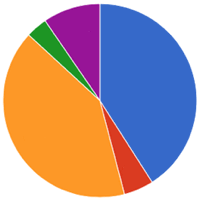
I support the idea of skin in the game, and I wish more “experts” would simply share what they actually own. Here’s my current portfolio update as of November 2020, including all of our 401k/403b/IRAs, taxable brokerage accounts, and savings bonds but excluding our house, cash reserves, and a few side investments. I use these updates to help determine where to invest new cash to rebalance back towards our target asset allocation.

Actual Asset Allocation and Holdings

I use both Personal Capital and a custom Google Spreadsheet to track my investment holdings. The Personal Capital financial tracking app (free, my review) automatically logs into my different accounts, adds up my various balances, tracks my performance, and calculates my overall asset allocation. I still use my manual Google Spreadsheet (free, instructions) because it helps me calculate how much I need in each asset class to rebalance back towards my target asset allocation.

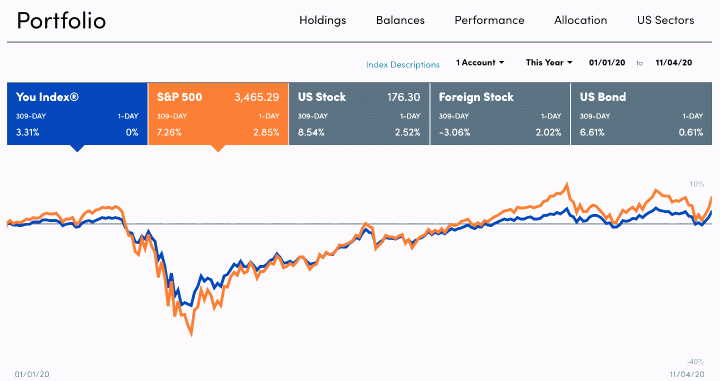
Here are my YTD performance and current asset allocation visually, per the “Allocation” and “Holdings” tabs of my Personal Capital account, respectively:

Stock Holdings
Vanguard Total Stock Market (VTI, VTSAX)
Vanguard Total International Stock Market (VXUS, VTIAX)
Vanguard Small Value (VBR)
Vanguard Emerging Markets (VWO)
Vanguard REIT Index (VNQ, VGSLX)

Bond Holdings
Vanguard Limited-Term Tax-Exempt (VMLTX, VMLUX)
Vanguard Intermediate-Term Tax-Exempt (VWITX, VWIUX)
Vanguard Intermediate-Term Treasury (VFITX, VFIUX)
Vanguard Inflation-Protected Securities (VIPSX, VAIPX)
Fidelity Inflation-Protected Bond Index (FIPDX)
iShares Barclays TIPS Bond (TIP)
Individual TIPS securities
U.S. Savings Bonds (Series I)

Target Asset Allocation. I do not spend a lot of time backtesting various model portfolios, as I don’t think picking through the details of the recent past will necessarily create superior future returns. I mainly make sure that I own asset classes that will provide long-term returns above inflation, distribute income via dividends and interest, and finally offer some historical tendencies to balance each other out. I make a small bet that US Small Value and Emerging Markets will have higher future long-term returns (along with some higher volatility) than the more large and broad indexes, although I could be wrong.

While you could argue for various other asset classes, I believe that it is important to imagine an asset class doing poorly for a long time, with bad news constantly surrounding it, and only hold the ones where you still think you can maintain faith through those fearful times. I simply don’t have strong faith in the long-term results of commodities, gold, or bitcoin.

Instead of staying with my fixed 50/50 target, I am explicitly letting my US/international ratio float with the total world market cap breakdown. I think it’s okay to have a slight home bias (owning more US stocks than the overall world market cap), but I want to avoid having an international bias. I just want to maintain the balance of the total world market cap, which has become roughly 60% US and 40% international. This also means less need for rebalancing.

Stocks Breakdown

  • 46% US Total Market
  • 7% US Small-Cap Value
  • 30% International Total Market
  • 7% Emerging Markets
  • 10% US Real Estate (REIT)

Bonds Breakdown

  • 33% US Treasury Bonds, intermediate (or FDIC-insured CDs)
  • 33% High-Quality Municipal Bonds (taxable)
  • 33% US Treasury Inflation-Protected Bonds (tax-deferred)

I have settled into a long-term target ratio of 67% stocks and 33% bonds (2:1 ratio) within our investment strategy of buy, hold, and occasionally rebalance. I will use the dividends and interest to rebalance whenever possible in order to avoid taxable gains. I plan to only manually rebalance past that if the stock/bond ratio is still off by more than 5% (i.e. less than 62% stocks, greater than 72% stocks). With a self-managed, simple portfolio of low-cost funds, we minimize management fees, commissions, and taxes.

Holdings commentary. 2020 has been… well… you know. Many times I just have to keep reminding myself that I cannot predict the future, even there appears to be impending doom around the corner. There is no possible way I will know how the stock market will react in a week, a month, or a year. Some businesses will fail and new businesses will start. I just have to trust in capitalism, human ingenuity, human resilience, and our system of laws to allow capital to flow where it can work best over time.

When my equities had dropped significantly and my unrealized gains were low, I thought about moving towards simplicity and selling my positions in the US Small Value (VBR) and Emerging Markets (VWO) classes. However, I realized I actually liked having some extra moving pieces that didn’t move in concert with my relatively large VTI and VXUS positions. I did sell some tax lots of Wisdomtree ETF positions and swapped over to the closest Vanguard ETF equivalents.

I was not disappointed in my decision to hold only the highest-quality bonds and cash equivalents. US Treasuries, TIPS, investment-grade municipal bond funds, FDIC or NCUA-insured certificates of deposit, US savings bonds.

Performance numbers. According to Personal Capital, my portfolio went up about 3% so far in 2020, although the ride has not been nearly as boring as that sounds! I see that during the same period the S&P 500 has gone up +7%, Foreign Developed stocks down -3%, and the US Aggregate bond index was up about +6.6%. These numbers could change quite a bit in a week, so it’s not very useful information.

An alternative benchmark for my portfolio is 50% Vanguard LifeStrategy Growth Fund and 50% Vanguard LifeStrategy Moderate Growth Fund – one is 60/40 and the other is 80/20 so it also works out to 70% stocks and 30% bonds. That benchmark would have a total return of +3.8% for 2020 YTD as of 11/3/2020.

The goal of this portfolio is to create sustainable income that keeps up with inflation to cover our household expenses. I’ll share about more about the income aspect in a separate post.

Amazon App: $10 Off $20+ Purchase (Targeted)

Amazon is offering targeted customers $10 off your next $20+ purchase when you activate the promo and make a purchase via Amazon app. Note: I was only able to activate this promo by clicking the promo link on my smartphone browser. Items must be sold and shipped by Amazon. Qualifying purchase must be completed before 11:59 p.m. (PT) December 31, 2020.