Archives for April 2020

Should I Roll Over My 401k into an IRA? How to Decide

The WSJ article What to Do With a 401(k) When Leaving a Job did a good job summarizing the various things to consider when that time comes. Here is a chart showing what happens to the 401k and 403b plans held across Vanguard-sponsored employer plans:

Now, Vanguard-sponsored 401k plans are mostly from big employers and are highly likely to have both low-cost investment options and reasonable fees. I don’t know if these percentages apply to all 401k and 403b plans in general. I’ve seen some pretty bad ones with absurdly high fees, although that was several years ago. Here’s a summary of the right questions to ask:

Investment selection? Are the available investments better in your 401k or in your choice of IRA custodian? Some 401ks offer choices not available to retail investors. For example, access to mutual funds from Dimensional Fund Advisors (DFA). Or institutional shares of certain funds with low expense ratios. Or stable value funds with higher interest rates than retail bond funds. On the other side, you may be itching to buy something like real estate in a self-directed IRA. These days, both probably have some sort of all-in-one Target retirement fund, but is yours a low-cost option from Vanguard (Target Retirement) or Fidelity (Freedom Index)?

Account fees? Part of the total cost picture is the expense ratio of the funds inside, but you may also be subject to overall account management fees or maintenance fees. Some 401k plans have zero or minimal management fees. Other 401k plans have crazy-high fees on the order of 1.75% of assets annually. Nearly all of the major IRA providers now offer no annual fees and commission-free ETF trades.

Need Advice? Some 401k plans offer some level of included advice that you may value. Other people have their own personal advisor that would love to customize that IRA.

Age 55 Rule (Early withdrawal?). Starting in the year that you turn 55, you can make a withdrawal from your 401k without the 10% early withdrawal penalty. You will still owe income taxes for a pre-tax 401k withdrawal, just not 10% penalty. For IRAs, you would have to wait until age 59.5. Potential early retirees may value these 4.5 years of additional flexibility.

Asset protection needs? There is a lot of legal fine print here, but 401k plans in general appear to offer some of the highest levels of asset protection. IRAs do offer a certain level of asset protection as well, just not quite as high as a 401(k). The difference will probably not matter much for the vast majority of workers, but it may matter for high-income professionals with liability concerns like doctors.

Non-deductible / Backdoor IRA contributions? The article didn’t cover why I didn’t roll over my last 401k plan into an IRA when leaving the employer. My situation is admittedly somewhat uncommon, but not unheard of. Call it “finding-yeast-in-April-2020” uncommon.

Due to my higher income level at the time, I contributed to a non-deductible IRA each year and then converted that to a Roth IRA. (This is also known as a Backdoor Roth IRA.) However, when you do the conversion, if you have any other pre-tax “traditional” IRAs, your conversion must include the pre-tax IRA amount as well on a pro-rated basis. For example, if you had a $20,000 pre-tax deducted IRA and a $5,000 non-deductible IRA, and then decided to convert $5,000 into a Roth IRA it would be considered 80% from the pre-tax IRA and only 20% non-deductible. You’d have to pay taxes on the entire pre-tax IRA amount (contribution + gains) since you never paid taxes initially. By keeping my pre-tax 401k at the employer, I am able to take full tax advantage of all annual Backdoor Roth contributions. Thankfully, the old 401k was at Fidelity with solid investment options and no annual fees.

How much do you value simplicity? If you do a lot of job-hopping, then do you really want to juggle five old 401k accounts? Merging them all into one IRA can save you time and hassle. On top of keeping tabs on your investments and asset allocation, you’d have to do all the mundane things like keep all your contact info and beneficiaries up to date. I would worry also that my spouse would forget about an old 401k plan if I something happened to me.
People Are Switching Homes Less Often, Housing Inventory At Historic Lows

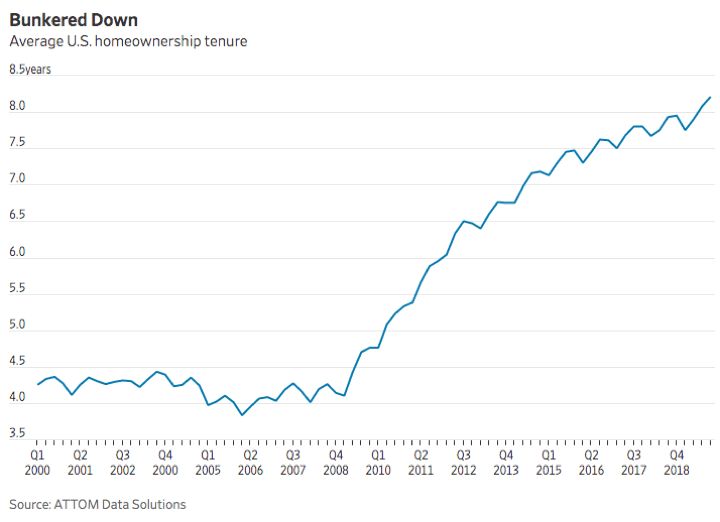
Tucked inside a WSJ article about Zillow and Opendoor cutbacks, there was a chart of the average tenure of US homeowners. I wasn’t aware of this trend. The average homeowner now stays put for 4 years longer than before the 2008 crisis (8.2 vs. 4.2 years).

A different WSJ article revealed that the amount of housing inventory available for sale is the lowest in 37 years on a per capita basis (the entire time this data series has been tracked). However, the two charts don’t fully match up. From 2000-2008, people consistently switched homes about every 4 years, but the inventory went up and up. After the 2008 recession, people both started staying in place and the inventory went down.

If the economy was improving from 2009 to 2019 (up until recently of course), why did homeowners move less and less often? Mortgage interest rates? Mortgage underwriting standards? Boomers choosing to age in place? Millennials preferring to rent, not buy? Lack of new housing construction? I feel like there is something meaningful behind all of this, but I don’t know what it is.

Red Pocket Mobile: iPhone SE $299 with 2 Years Service (Starts At $10/Month)

(One more iPhone SE deal! Apologies if these bore you; I have no more planned. They do also happen to be the cheapest MVNOs for anyone with an existing phone. Compare with Visible and Mint Mobile.)

Red Pocket Mobile is an MVNO with very competitive pricing that doesn’t stick with any single network. You can choose which one you want: AT&T (GSMA), Sprint (CDMAS), T-Mobile (GSMT), and Verizon (CDMA). They aren’t allowed to actually use the trademarked names on their pages, but it’s an easy conversion. Note that the pricing for certain plans differs by the network chosen, and they often shift the pricing around with limited-time offers. If bringing over your own device and you want to switch networks, use their compatibility checker first.

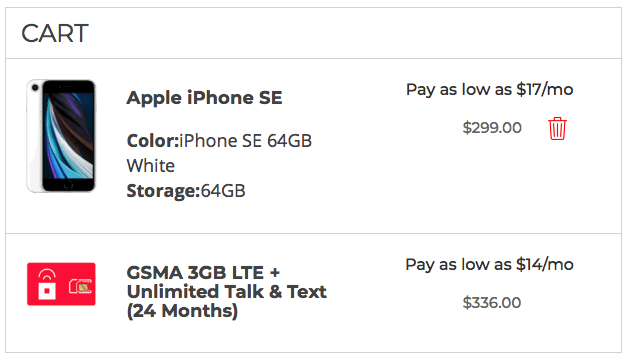
Their current front page deal is the iPhone SE for regular price ($399) but with 6 months of free 3GB service. At $14/month, this could be seen as a $84 discount. However, if you proceed to the iPhone SE purchase page and agree to a 12 month or 24 month term, you can get alternative discounts on the phone itself instead as well as long-term discounts on the service. If you commit to 2 years, you can get the iPhone SE for $299 ($100 off) and have a choice of several monthly plans.

Example: iPhone SE + 2 years of Unlimited talk, text, and 3 GB LTE data = $299 + $336 = $635 for 2 years. This works out close to $26.50 per month. Breaks down to $12.50/month for the phone and $14/month for service. GSMA network (AT&T). You can upgrade to 7GB LTE for $20/month, 15 GB LTE for $30/month, or Unlimited LTE for $45/month. You could also downgrade to 1,000 minutes, unlimited text, and 1 GB LTE data for $10/month. After you reach your LTE data allotment each month, you still get unlimited data at slower 2G speeds. Looks like a little bit more if you finance it over monthly payments. UPS Ground shipping is free.

iPhone SE 2020 quick take. Apple’s new $400 iPhone SE may be called a “budget” phone, but it is a “parts bin” phone that saves money not by using lower-quality ingredients, but instead by combining high-quality parts from other iPhones. If you’re okay with the older body style (might be what you already have), this phone is a great value at $400 (64 GB). Check out the review from your favorite tech site, but here are the basics:

  • Screen/Body: iPhone 8. Same outer shape as iPhone 6/7/8. Retina 4.7″ screen. Touch ID (no Face ID).
  • Latest CPU: iPhone 11 Pro. Same A13 Bionic chip as inside the current iPhone 11 Pro that costs $1,000. These fast internals mean this phone won’t be obsolete for 4+ years.
  • Camera: iPhone XR+. The hardware specs are like the iPhone XR which still costs $600 today. However, combined with the faster internals, Apple added software improvements to make it take better photos (better portrait mode, etc). Still an upgrade over the iPhone 6/7/8 cameras.

Visible Promo: iPhone SE $184 Net Price After Paying 2 Months Service

(After I wrote this up, the iPhone SE went out of stock. If you want this deal, I would check back regularly as it might be going to be in and out of stock for a while.)

Visible is one of multiple discount MVNOs that use the Verizon network, but they are the only one directly owned by Verizon (smart move, VZ). Their current promo gives you a $100 Prepaid card to bring over your own existing device after paying for two months of service. However, if you can also buy the iPhone SE 2020 for $384 + get a $200 Prepaid Mastercard after paying for two months of service. That’s a net price of $184, although Visible may cost more on a monthly basis than you might pay with another MVNO like Mint Mobile. You should compare the all-in total prices over two years, along with other factors like data usage, network preference, and upfront costs vs. monthly payments.

Visible costs $40 a month and includes unlimited talk, text, and LTE data. Right now, the first month is $25/month. Verizon network. No contracts. Online customer service only. Mobile hotspot included for one tethered device at up to 5 Mbps max. Data may be slowed during network congestion. Visible also has a Party Pay feature where if you can join with a group of two, three, or four, you can get it down to $25/month. Each person manages their Visible account and their bill separately. You can join a Party at any time after becoming a Visible customer. Try the r/VisiblePartyPay subreddit to join with some random people on the internet (which appears to be within the rules).

iPhone SE 2020 quick take. Apple’s new $400 iPhone SE may be called a “budget” phone, but I prefer to think of it as a “parts bin” phone that saves money not by using cheaper, low-quality ingredients, but instead by RE-using high-quality parts from other iPhones. If you’re okay with the older body style (might be what you already have), this phone is a great value at $400 (64 GB). Check out the review from your favorite tech site, but here’s my take:

  • Screen/Body: iPhone 8. Same size as iPhone 6/7/8. Retina 4.7″ screen. Touch ID (no Face ID).
  • Latest CPU: iPhone 11 Pro. Same A13 Bionic chip as inside the current iPhone 11 Pro that costs $1,000. These fast internals mean this phone won’t be obsolete for 4+ years.
  • Camera: iPhone XR+. The hardware specs are like the iPhone XR which still costs $600 today. However, combined with the faster internals, Apple added software improvements to make it take better photos (portrait mode, etc). The camera is still significantly better than iPhone 6/7/8.

Here is the fine print on the promo. Just know that it is a rebate that you have to wait a bit for, as opposed to getting the discount upfront or via a monthly payment plan.

Buy an eligible device from us, pay for your first two months of service, and you’ll get a Prepaid Mastercard Virtual Account sent to you via email. Purchase a device over $400 and you’ll get a $200 Prepaid Mastercard Virtual Account. The Apple iPhone SE is also eligible for the $200 Prepaid Mastercard Virtual Account. Purchase a device under $400, but still more than $50, and you’ll receive a $100 Prepaid Mastercard Virtual Account*. Certain Samsung devices are not eligible. Already have a phone you love? No problem. If it’s compatible with Visible, just activate it, pay for two months of service, and we’ll email you a $100 Prepaid Mastercard Virtual Account too.

Mint Mobile Bundle Discount: iPhone SE $15/Month, Service $15/Month

Mint Mobile has a new iPhone SE bundle promotion where you can get the new iPhone SE 2020 for $15/month + their $15/month cell service = $30/month total. You save $40 off the iPhone SE price and you lock in their bulk discount on data plans. Details below.

Apple’s new $400 iPhone SE may be called a “budget” phone, but I prefer to think of it as a “parts bin” phone that saves money not by using cheaper, low-quality ingredients, but instead by RE-using high-quality parts from other iPhones. Check out the review from your favorite tech site, but here’s a short take:

  • Screen/Body: iPhone 8. Same size as iPhone 6/7/8. Retina 4.7″ screen. Touch ID (no Face ID).
  • Latest CPU: iPhone 11 Pro. Same A13 Bionic chip as inside the current iPhone 11 Pro that costs $1,000. These fast internals mean this phone won’t be obsolete for 4+ years.
  • Camera: iPhone XR+. The hardware specs are like the iPhone XR which still costs $600 today. However, combined with the faster internals, Apple added software improvements to make it take better photos (portrait mode, etc). The camera is still significantly better than iPhone 6/7/8.

If you’re okay with the older body style (might be what you already have), this phone is a great value at $400 (64 GB).

$15/month for unlimited talk, text, and 3 GB of LTE data. We are in our second year of using Mint Mobile for cell phone service, an MVNO which runs on the T-Mobile network. One of us is on the $15 a month plan ($180 a year) for unlimited talk, text, and 3 GB of LTE data. The other pays $20 a month for unlimited talk, text, and 8 GB of data. You lock in this discount by paying for a year upfront.

In response to COVID-19, Mint Mobile offered their existing customers unlimited data (via free data add-ons) since March and going through May 14th, 2020.

New 2020 iPhone SE for $15/month. Mint Mobile combines these two into a new iPhone SE bundle promotion where you can also get the iPhone SE for $15/month for two years when you agree to also buy two years of service. This works out to $360 total for the phone, a $40 discount on the $400 retail price. You also get the free year of Apple TV+ streaming service included with all new iPhones.

End result: iPhone SE and unlimited talk/text/3GB data service for $30 a month total. Quite the frugal minimalist combo. You could also upgrade to the 8 GB data plan for $35/month total. This offer is for new Mint customers, although existing Mint customers can get 0% financing on the iPhone SE for $16.66 a month (you don’t save the $40 over 2 years).

Investing In Stocks Requires Both Short-Term Courage and Long-Term Patience

Many investing articles basically keep telling you “Don’t worry! stocks always go up!”, but I appreciated the added perspective from the Morningstar article What Prior Market Crashes Can Teach Us About Navigating the Current One by Paul D. Kaplan and The Risk of a Lost Decade For Stocks by Movement Capital. Here is the growth of $1 in the US stock market since 1871, adjusted for inflation.

The first takeaway is that severe stock market drops are not uncommon. Having the emotional fortitude that the drops are not permanent is important.

This historical stock market return data provides clear evidence that market crashes aren’t as unique as one might have thought. The term “black turkey” is more apt, since they appear every so often—and today’s coronavirus-caused crash is only the most recent example.

The second takeaway is that there are many red periods where the stock market doesn’t reach the previous high-water mark for a decade or longer. You also need the patience to ride out those discouraging periods.

I think the average investor has an overly optimistic base case for how stocks perform over 10-year horizons. The S&P 500 has spent one-tenth of the time since 1900 with a negative inflation-adjusted return over the prior decade.

The 54% drop from August 2000 to February 2009, also known as the Lost Decade. The second-worst drop on the chart, this period started when the dot-com bubble burst. The market began recovering but not enough to get the cumulative value back to its August 2000 level before the crash of 2007-09. It didn’t reach that level until May 2013—almost 12 and a half years after the initial crash.

So often the takeaway from these long-term stock market charts is simply that the line always goes up eventually. Yes, but the line can also go nowhere for a decade or more. I’m not saying that this will happen now, but these are the hardships that create the “equity risk premium”. If stocks gave us stable price increases, they wouldn’t provide such high returns. As stock investors, we have to prepare for both the sudden shocks and the long, painful “lost” decades.

10 Free eBooks For World Book Day

Amazon is celebrating World Book Day 2020 by giving away 9 free Kindle books from around the world covering a variety of genres, from contemporary fiction to true crime to a children’s book. “Buy” them for free by Friday 4/24 and you can own them forever. This is different than the Amazon Prime or Kindle Unlimited lists, where you are only borrowing them while paying the subscription fee.

Barnes and Noble also has the Evie in the Jungle NOOK eBook free for World Book Day. This is on top of the 1000s of free NOOK books otherwise available for free (would say “forever” but all bets are off if BN goes bankrupt).

Grab them now and read later. You can read both Kindle and NOOK eBooks on your smartphone or tablet. In fact, phones are turning out to be my favorite way to read. I rarely use my Kindle device anymore. The convenience of being able to read and highlight text whenever you have a few free minutes outweighs everything else.

Why You (Still) Shouldn’t Bet on Higher Oil Prices Using the USO ETF

Updated for crazy 2020. The big news yesterday was that one measure of crude oil prices actually went negative, because futures were coming due and nobody had any place to store the oil upon delivery.

Why did this happen? Part of the reason is that too many people had the following plan:

  1. Crude oil has dropped to $18 a barrel. These prices are multi-decade lows.
  2. Oil prices must go up again… eventually… right? Look at that historical chart!
  3. The futures market is kinda complicated… I know! I’ll buy an ETF like USO.
  4. Profit!?!?

Here are a few things you should know first about the United States Oil Fund (USO) and similar oil ETPs.

You aren’t the only one who’s thought of this. Billion of dollars have come and gone into oil ETFs in the past few years. Here are articles from 2014 and 2015 when oil dropped to below $50 a gallon after being over $100:

In April 2020, USO ended up having to actually change how the ETF operated in order to avoid some the market distortions that the speculation caused.

The usual market timing questions apply. Sure, the price will go up, but how long is “eventually”? It might be 1,3,5, or 10 years. If you have a specific time-frame in mind, then you can go out on the futures market and then buy a specific contract. But if oil hasn’t risen enough at that time – maybe it peaked earlier and dropped, or it peaks further in the future – you’ll have lost money.

If you buy the ETF, when is a good time to sell? $40 a barrel? $80? $100? What if you sell and then it rises another 50%?

What if it takes a while? The longer you have to hold these ETFs, the less likely they will track the price of oil (see below). Meanwhile, the ETF provider is happily collecting their annual expense ratios of 0.50% to 1%. At the current asset level of $4 billion times the 0.45% management fee, that’s $18 million a year in fees.

Your commodities futures ETF may not track the price of oil very well at all. To properly track the price of oil, you’d need to buy some oil and store it somewhere (and pay storage and security costs). These ETFs don’t do that, instead they buy oil futures contracts and keep rolling them over into new ones when they expire. That’s not the same thing. USO is designed to track daily price movements in the price of oil, not long-term movements!

Oil prices doubled from in 2009-2010. USO went nowhere. Visually, here’s a chart from Attain Capital that compares the change in USO share price (purple) as compared to the spot price of crude oil (red) when oil prices doubled between the start of 2009 and the end of 2010 (blue line adjusts USO underperformance for roll costs):

uso1

From the Bloomberg article above:

Since USO launched in April 2006, it has returned -71 percent, while the spot price of oil returned -26 percent. The last time oil roared back from a bottom was in 2009, when it returned 78 percent on the year. USO returned just 14 percent.

If you don’t understand the terms “backwardation”, “contango”, and “roll costs” then you don’t understand commodities futures. If you don’t understand something, you probably shouldn’t buy it. The more people crowd into this trade, the weirder the futures markets get. Who would think that you could get paid to take oil from someone? Take it straight from a USO executive:

John Hyland, chief investment officer of USO, says the fund is a “tactical trading vehicle predominately used by professional traders,” and not meant to be a buy-and-hold investment.

In the end, such a play is a speculative bet and it may just pay off, who knows. But it certainly isn’t a wise investment, especially if the tool you’re using doesn’t even do what you want it to do.

The Subtle Art of Caring About Fewer, Better Things (Book Notes)

With it’s loud title and bright orange cover, this book has been on the “recommended” list of my Audible and Kindle pages several times. However, when something tries so hard to get my attention, I instinctually tend to ignore it. I’m glad that I got over this initial reaction, as it ended up being full of useful old messages wrapped in new language.

Obviously, if you can’t tolerate reading a lot of expletives, you shouldn’t read something titled The Subtle Art of Not Giving a F*ck: A Counterintuitive Approach to Living a Good Life by Mark Manson. You might not want to read this post either, as I’ll be including some excerpts and I’m too lazy to edit them out. F-bombs ahead!

This book isn’t about not caring at all. It’s about caring deeply about what matters to you, while ignoring what doesn’t.

I believe that today we’re facing a psychological epidemic, one in which people no longer realize it’s okay for things to suck sometimes.

You are constantly bombarded with messages to give a fuck about everything, all the time. Give a fuck about a new TV. Give a fuck about having a better vacation than your coworkers. Give a fuck about buying that new lawn ornament. Give a fuck about having the right kind of selfie stick. Why? My guess: because giving a fuck about more stuff is good for business.

The key to a good life is not giving a fuck about more; it’s giving a fuck about less, giving a fuck about only what is true and immediate and important.

So far in 2020, we have gotten an involuntary lesson on this topic. Some of the things we cared so much about were taken away, and we realize it didn’t really matter that much. Meanwhile, many things we took for granted are sorely missed. Simply sharing a coffee/beer with a group of friends in an outdoor cafe/bar. Instead of focusing on the negatives of various tasks, I realize many things that I should have appreciated.

The solution is to consciously choose and accept the hard problems that we want to solve.

Wanting positive experience is a negative experience; accepting negative experience is a positive experience. It’s what the philosopher Alan Watts used to refer to as “the backwards law”—the idea that the more you pursue feeling better all the time, the less satisfied you become, as pursuing something only reinforces the fact that you lack it in the first place. The more you desperately want to be rich, the more poor and unworthy you feel, regardless of how much money you actually make.

True happiness occurs only when you find the problems you enjoy having and enjoy solving.

Who you are is defined by what you’re willing to struggle for. People who enjoy the struggles of a gym are the ones who run triathlons and have chiseled abs and can bench-press a small house. People who enjoy long workweeks and the politics of the corporate ladder are the ones who fly to the top of it. People who enjoy the stresses and uncertainties of the starving artist lifestyle are ultimately the ones who live it and make it.

Happiness is not a destination on a game board. You can’t achieve permanent happiness with a certain job title, net worth number, or any single act. We need to keep solving problems. It’s a continuous process that never ends. (As a goal-oriented person, I’m still rather disappointed in this, but I have come to realize it is true.) This is also why it helps to find something to care about greater than yourself.

Life isn’t fair. I also ran across this familiar poker analogy in the book:

We all get dealt cards. Some of us get better cards than others. And while it’s easy to get hung up on our cards, and feel we got screwed over, the real game lies in the choices we make with those cards, the risks we decide to take, and the consequences we choose to live with. People who consistently make the best choices in the situations they’re given are the ones who eventually come out ahead in poker, just as in life. And it’s not necessarily the people with the best cards.

Stop caring about the things that don’t matter. Find the things that do matter, and focus on those. Accept that bad things may happen to you out of your control, but realize you control your response. Take action. Keep taking action. Timeless advice, but good reminders all the same as it is easily forgotten.

Official IRS Tool to Check Status of Stimulus Check

The IRS has released an official tool to check the status of your stimulus check, otherwise known as Economic Impact Payment / Coronavirus Tax Relief. It seems like you can also add your bank account information for direct deposit if they don’t have it on file, definitely if you were not required to file a 2018 or 2019 tax return. Data is updated once every night. You may need information from your 2018/2019 tax return for identification purposes.

Couch Potato Portfolios: Simple, Cheap, and Diversified Still Works

Scott Burns of the Dallas News is known for his “Couch Potato Portfolios”. These are literally the simplest, laziest, easiest portfolios that you will ever see. The Basic Couch Potato Portfolio is 50% Total US Stock and 50% Total US Bond funds/ETFs. The Margarita version is 1/3rd US Stocks, 1/3 International Stocks, and 1/3 Bonds. Can’t get much easier to remember than that! You may be surprised at how well they have performed despite their simplicity.

Indeed, Burns recently provided another update on his Couch Potato portfolios, this time for theoretical retirees from various periods including those who retired in the year 2000 to the end of March 2020 (emphasis mine):

In this scenario, you’d be:

– Retiring just as the Internet bust was starting.
– Getting run over by the 2008-09 financial crisis.
– And ending with the coronavirus crash through the end of March.

In spite of all that, you wouldn’t be broke.

Here is a chart of how a 65-year-old couple would have done if they retired in various years from 1989 to 2015 and went with a 4% withdrawal rate (adjusted annually for inflation).

These retirees may not be shopping for a yacht, but they are still hanging in there. Simple, cheap, and diversified does much of the heavy lifting required. I appreciate that he included the likelihood that one or both of the couple would survive until 2020 as well. You may be surprised by how long your portfolio might have to last, but we also have to balance the risk of running out of time with the risk of running out of money.

Free HBO: 500 Hours Free To Stream During April 2020

For the month of April, HBO is making 500 hours of programming available to stream for free (without ads) for a limited time on HBO Now and HBO Go services without a subscription. You can download the HBO Go or HBO Now apps for iOS and Android, and I was able to use the HBO app in my Smart TV without issue. Click on the link for the list of available shows (not everything is free). I wonder if I can finish “Big Little Lies” before the end of April.

For the month of April, watch some of HBO’s most beloved shows and documentaries, plus a selection of movies — entirely for free. Just head to HBO GO or HBO NOW or On Demand to watch every episode of series like The Sopranos, Veep and The Wire along with documentaries including McMillion$ and I Love You, Now Die and movies like Crazy. Stupid. Love. and Blinded by the Light, no subscription required. See the full list of available shows, documentaries and movies below.