Archives for April 2020

My Unconventional Best Work-From-Home Gear Guide (What’s Yours?)

I’m quite familiar with working from home in my tiny 78 sq. ft. “office”, but after looking at some online WFH gear guides recently, it’s all about standing desks, latest laptop models, and USB hubs. Eh? My desk is a basic folding table and my laptop is a 2015 Macbook Pro (with real scissor keyboard and real moving trackpad) that recently underwent DIY battery replacement surgery (way too complicated, Apple!).

My favorite WFH gear is different. Maybe yours is too? These are real things that I bought with my own money and I would buy them again if I had to do it all over again.

Quiet, Please! – 3M PELTOR X5A Over-the-Head Ear Muffs

I wear these every day to help me focus. They have the highest noise reduction rating (31 dB) available on the market. You even have to certify that you are using them for “professional/commercial use” (which I am while working for money, as far as I am concerned). At ~$30, they are also about $10 more expensive than other similar models, but I think the extra $10 is well spent to know you have the quietest experience possible. If you have kids running around the house, you need all the help you can get. They are “over ear”, which means they don’t put pressure on your ears and I can wear them for a relatively long time without discomfort. (I try to take regular breaks anyway.)

Budget Noise-canceling Headphones – Mpow H5 Active Noise Cancelling Headphones
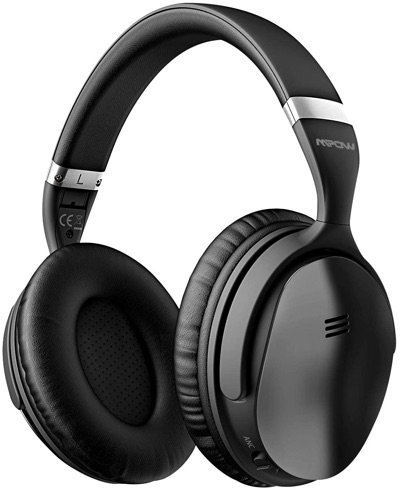
After a certain member of the house (ahem) stole my trusty old pair of wired Bose QC25 headphones, I decided to try out a budget pair of $50 bluetooth noise-cancelling headphones. These over-hear headphones worked out quite well and I really don’t miss the old Bose ones. I’d say they are 80% as good while under 20% the price of new Bose QC35 headphones.

Note: I do own a pair of regular Airpods, which I got as a nice gift. I do like them and use them for phone calls around the house and outside, but I use the Mpow headphones while at my desk listening to music or editing things.

Dependable Printer – Brother Monochrome Laser Printer

This thing is the workhorse of my home office, and yet also the oldest electronic item here at over 10 years old. Which is rather crazy, given that it has moving parts and is used constantly to scan PDFs, make copies, and of course print. These Brother black-and-white laser printers are like the Toyota Corollas of the printer world – cheap yet reliable. The cost per page can be very low thanks to generic toner cartridges (that link is for two of them) if you don’t mind a slight decrease in quality.

Dry Erase Whiteboard – Magnetic Dry Erase Whiteboard

Another inexpensive but important addition for a variety of reasons. Sometimes drawing it out in real space is just better than the digital alternative. This one is lightweight and thus easy to remove from the wall and move it around. You can also put up complex equations or obscure drawings and put it behind you during those Zoom and Webex meetings and impress/confuse/scare your colleagues. I like these BIC markers as they are higher quality and have finer points.

Looking around my desk, other random things that I probably like more than I should are my TI-85 calculator, classroom-grade pencil sharpener, and an ancient Swingline stapler (sadly not the red 747). The only thing that I have been thinking about upgrading is my office chair. Any suggestions?

Bank of America Paycheck Protection Program (PPP) List of Required Documentation

As a follow-up to my initial post on the Paycheck Protection Program (PPP), there has been a some speculation as to the specific documentation required to prove your eligibility and payroll numbers. Each lender may have some discretion as to exactly what they require, but here is what Bank of America has listed as required documentation to submit:
Organizations with employees who file Tax Form 940:

  • Tax Form 940 from 2019
  • Bank of America Paycheck Protection Program Loan Amount Template
  • Bank of America Paycheck Protection Program Application Addendum
  • Tax form 941 or Payroll processor records for the period including Feb 15, 2020

Documents for Sole Proprietors or Self Employed, who do not file Tax Form 940:

  • 1040 Schedule C, if filed for 2019 OR
  • Draft 1040 Schedule C for 2019 if not filed
  • Bank of America Paycheck Protection Program Application Addendum

Documents for All Other Small Businesses:

  • Form 1099-MISC for 2019, for services rendered as an independent contractor
  • Bank of America Paycheck Protection Program Application Addendum

As far as I can tell, the BofA Application Addendum contains the same certifications and questions as the paper PPP application.

Hopefully, this will help you get your documents in order ahead of time so that you can get your applications approved more quickly.

US Stocks vs. International Stocks vs. US Bond Index Returns Since 2000

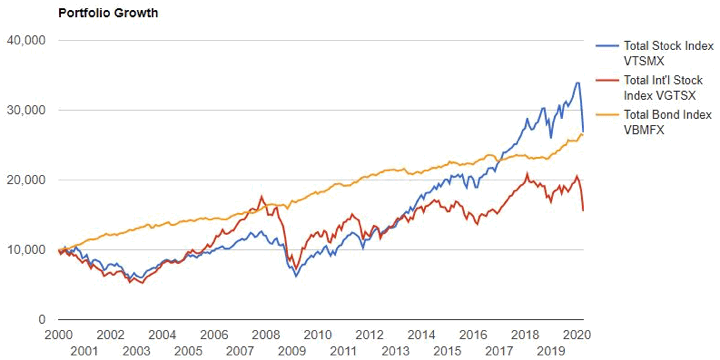
If you can take it, here is some more humbling food for thought. Here is a comparison of the growth of $10,000 invested in either the Total US stock, Total International Stock, or Total US bond index fund from the beginning of this century (1/1/2000) until the end of last week. The story is the same if you compare the S&P 500 and the US Aggregate Bond Index total returns. Via Allan Roth and the WSJ article Bonds Are Now Outperforming Stocks in Battle for Returns This Century.

These types of charts will always look rather different depending on the start date chosen. 1/1/2000 happens to be a nice round start date (and also happens to be the year I graduated college). Given the market swings these days, it may look very different again soon.

Still, who could have predicted in January 2000 that bonds would have outperformed US stocks (barely) and International stocks (by a lot) after 20 years? We do the best we can with the historical data that we have, but we should remember how much remains out of our control.

Paycheck Protection Program (PPP): Forgivable SBA Loans For 2.5x Monthly Payroll

If you are a small business impacted by COVID-19, including self-employed and independent contractors, you have hopefully been following the developments of the Paycheck Protection Program (PPP) and the Economic Injury Disaster Loan Emergency Advance (EIDL) being rolled out by the Small Business Administration (SBA) and U.S. Treasury. Details are still being ironed out, but PPP could cover up to 2.5 months of your payroll costs. Here are some general highlights from the Treasury PPP overview PDF along with some details from the Bank of America PPP application:

Loan Amount = 2.5 times Average Monthly Payroll. “The Paycheck Protection Program provides small businesses with funds to pay up to 8 weeks of payroll costs including benefits. Funds can also be used to pay interest on mortgages, rent, and utilities.” In the Bank of America PPP application, two possible options given were to use 2019 payroll or 2019 1099-MISC totals, and then multiple the average monthly payroll by 2.5. So if you averaged $6,000 per month, you can ask for a loan for $15,000. Income over $100,000 annually per employee isn’t covered. Here are some details:

For purposes of calculating “Average Monthly Payroll”, most Applicants will use the average monthly payroll for 2019, excluding costs over $100,000 on an annualized basis for each employee. For seasonal businesses, the Applicant may elect to instead use average monthly payroll for the time period between February 15, 2019 and June 30, 2019, excluding costs over $100,000 on an annualized basis for each employee. For new businesses, average monthly payroll may be calculated using the time period from January 1, 2020 to February 29, 2020, excluding costs over $100,000 on an annualized basis for each employee.

Fully Forgiven. “Funds are provided in the form of loans that will be fully forgiven when used for payroll costs, interest on mortgages, rent, and utilities (due to likely high subscription, at least 75% of the forgiven amount must have been used for payroll). Loan payments will also be deferred for six months. No collateral or personal guarantees are required. Neither the government nor lenders will charge small businesses any fees.”

In my Bank of America, the details are given that it is a 2-year loan at fixed 1% interest. As noted, payments are deferred for the first 6 months. If you use the money in an eligible manner (see below), it is fully forgiven and not treated as taxable income.

Must Keep Employees on the Payroll—or Rehire Quickly. “Forgiveness is based on the employer maintaining or quickly rehiring employees and maintaining salary levels. Forgiveness will be reduced if full-time headcount declines, or if salaries and wages decrease.” In other words, this is supposed to encourage companies to keep employees and is separate from unemployment insurance.

All Small Businesses Eligible. “Small businesses with 500 or fewer employees—including nonprofits, veterans organizations, tribal concerns, self-employed individuals, sole proprietorships, and independent contractors— are eligible. Businesses with more than 500 employees are eligible in certain industries.”

Businesses are limited to one PPP loan. Each loan will be registered under a Taxpayer Identification Number at the Small Business Administration (SBA) to prevent multiple loans to the same entity. Owners with more than one business may apply for a separate loan for each entity.

Application Dates and Details. “Starting April 3, 2020, small businesses and sole proprietorships can apply. Starting April 10, 2020, independent contractors and self-employed individuals can apply. We encourage you to apply as quickly as you can because there is a funding cap. […] You can apply through any existing SBA 7(a) lender or through any federally insured depository institution, federally insured credit union, and Farm Credit System institution that is participating.”

While technically you can apply at any SBA 7(a) lender, as of 4/5 many of them don’t even have any formal application process at all! Bank of America started accepting applications early, but first required both an existing BofA business checking relationship AND a BofA loan relationship as of 2/15/20. They later relaxed the rules to require at least an existing BofA business checking relationship as of 2/15/20. Most banks are limiting the applications to existing clients, but I’ve tried to list a few that don’t have such a restriction.

In addition, the US Treasury now has a paper application that you can submit to any eligible lender. I have no idea what will be the best. Small local bank? Mega bank? I would assume that if you have an existing relationship with a bank, they would be able to just deposit the money into your primary business account. But I’ve learned to stop making assumptions in 2020!

The funds are supposed to go out first come, first served, although they may expand the amount available. I’m sure that is not helping the chaos. No documentation was required upfront for BofA, but I would get your payroll documentation ready to submit as soon as they ask for it.

Best Interest Rates on Cash – April 2020

The Federal Reserve further cut their target Fed Funds Rate to zero in March, so we continue to see a steady stream of rate drops on cash savings. I hope that some of you got a nice rate locked-in if you tried to refinance your mortgage.

Here’s my monthly roundup of the best interest rates on cash for April 2020, roughly sorted from shortest to longest maturities. I track these rates because I keep 12 months of expenses as a cash cushion and also invest in longer-term CDs (often at lesser-known credit unions) when they yield more than bonds. Check out my Ultimate Rate-Chaser Calculator to see how much extra interest you’d earn by moving money between accounts. Rates listed are available to everyone nationwide. Rates checked as of 4/2/2020.

High-yield savings accounts
While the huge megabanks make huge profits while paying you 0.01% APY, it’s easy to open a new “piggy-back” savings account and simply move some funds over from your existing checking account. The interest rates on savings accounts can drop at any time, so I list the top rates as well as competitive rates from banks with a history of competitive rates. Some banks will bait you with a temporary top rate and then lower the rates in the hopes that you are too lazy to leave.

Short-term guaranteed rates (1 year and under)
A common question is what to do with a big pile of cash that you’re waiting to deploy shortly (just sold your house, just sold your business, legal settlement, inheritance). My usual advice is to keep things simple and take your time. If not a savings account, then put it in a flexible short-term CD under the FDIC limits until you have a plan.

  • No Penalty CDs offer a fixed interest rate that can never go down, but you can still take out your money (once) without any fees if you want to use it elsewhere. Marcus has a 7-month No Penalty CD at 1.70% APY with a $500 minimum deposit. Ally Bank has a 11-month No Penalty CD at 1.55% APY with a $25,000 minimum deposit. CIT Bank has a 11-month No Penalty CD at 1.70% APY with a $1,000 minimum deposit. You may wish to open multiple CDs in smaller increments for more flexibility.
  • CIT Bank has a few competitive term CDs at similar rates: 12-month CD at 1.86% APY ($1,000 min), 13-month at 1.82% APY, and 18-month at 1.85% APY.

Money market mutual funds + Ultra-short bond ETFs
If you like to keep cash in a brokerage account, beware that many brokers pay out very little interest on their default cash sweep funds (and keep the difference for themselves). The following money market and ultra-short bond funds are not FDIC-insured, but may be a good option if you have idle cash and cheap/free commissions.

  • Vanguard Prime Money Market Fund currently pays an 1.07% SEC yield. The default sweep option is the Vanguard Federal Money Market Fund which has an SEC yield of 0.68%. You can manually move the money over to Prime if you meet the $3,000 minimum investment.
  • Vanguard Ultra-Short-Term Bond Fund currently pays 2.08% SEC yield ($3,000 min) and 2.18% SEC Yield ($50,000 min). The average duration is ~1 year, so there is more interest rate risk.
  • The PIMCO Enhanced Short Maturity Active Bond ETF (MINT) has a 2.57% SEC yield and the iShares Short Maturity Bond ETF (NEAR) has a 3.16% SEC yield while holding a portfolio of investment-grade bonds with an average duration of ~6 months. Note that the higher yield came from a drop in net asset value during the recent market stress.

Treasury Bills and Ultra-short Treasury ETFs
Another option is to buy individual Treasury bills which come in a variety of maturities from 4-weeks to 52-weeks. You can also invest in ETFs that hold a rotating basket of short-term Treasury Bills for you, while charging a small management fee for doing so. T-bill interest is exempt from state and local income taxes. Right now, this section probably isn’t very interesting as T-Bills are yielding close to zero!

  • You can build your own T-Bill ladder at TreasuryDirect.gov or via a brokerage account with a bond desk like Vanguard and Fidelity. Here are the current Treasury Bill rates. As of 4/2/2020, a new 4-week T-Bill had the equivalent of 0.09% annualized interest and a 52-week T-Bill had the equivalent of 0.14% annualized interest.
  • The Goldman Sachs Access Treasury 0-1 Year ETF (GBIL) has a 1.42% SEC yield and the SPDR Bloomberg Barclays 1-3 Month T-Bill ETF (BIL) has a 0.88% SEC yield. GBIL appears to have a slightly longer average maturity than BIL. Expect these yields to drop significantly as they are updated.

US Savings Bonds
Series I Savings Bonds offer rates that are linked to inflation and backed by the US government. You must hold them for at least a year. There are annual purchase limits. If you redeem them within 5 years there is a penalty of the last 3 months of interest.

  • “I Bonds” bought between November 2019 and April 2020 will earn a 2.22% rate for the first six months. The rate of the subsequent 6-month period will be based on inflation again. More info here.
  • In mid-April 2020, the CPI will be announced and you will have a short period where you will have a very close estimate of the rate for the next 12 months. I will have another post up at that time.

Prepaid Cards with Attached Savings Accounts
A small subset of prepaid debit cards have an “attached” FDIC-insured savings account with exceptionally high interest rates. The negatives are that balances are capped, and there are many fees that you must be careful to avoid (lest they eat up your interest). Some folks don’t mind the extra work and attention required, while others do. There is a long list of previous offers that have already disappeared with little notice. I don’t personally recommend nor use any of these anymore.

  • The only notable card left in this category is Mango Money at 6% APY on up to $2,500, but there are many hoops to jump through. Requirements include $1,500+ in “signature” purchases and a minimum balance of $25.00 at the end of the month.

Rewards checking accounts
These unique checking accounts pay above-average interest rates, but with unique risks. You have to jump through certain hoops, and if you make a mistake you won’t earn any interest for that month. Some folks don’t mind the extra work and attention required, while others do. Rates can also drop to near-zero quickly, leaving a “bait-and-switch” feeling. I don’t use any of these anymore.

  • Consumers Credit Union Free Rewards Checking (my review) still offers up to 5.09% APY on balances up to $10,000 if you make $500+ in ACH deposits, 12 debit card “signature” purchases, and spend $1,000 on their credit card each month. Elements Financial has dropped to 2% APY on balances up to $20,000 if you make 15 debit card “signature” purchases or other qualifying transactions per statement cycle. Find a locally-restricted rewards checking account at DepositAccounts.

Certificates of deposit (greater than 1 year)
CDs offer higher rates, but come with an early withdrawal penalty. By finding a bank CD with a reasonable early withdrawal penalty, you can enjoy higher rates but maintain access in a true emergency. Alternatively, consider building a CD ladder of different maturity lengths (ex. 1/2/3/4/5-years) such that you have access to part of the ladder each year, but your blended interest rate is higher than a savings account. When one CD matures, use that money to buy another 5-year CD to keep the ladder going. Some CDs also offer “add-ons” where you can deposit more funds if rates drop.

  • Pen Air Federal Credit Union has a 5-year certificate at 2.20% APY ($500 minimum). Early withdrawal penalty is 180 days of interest. Their other terms are competitive as well, if you want build a CD ladder. Anyone can join this credit union via partner organization ($3 one-time fee).
  • You can buy certificates of deposit via the bond desks of Vanguard and Fidelity. You may need an account to see the rates. These “brokered CDs” offer FDIC insurance and easy laddering, but they don’t come with predictable early withdrawal penalties. Vanguard and Fidelity both have a 5-year at 1.60% APY right now. Be wary of higher rates from callable CDs listed by Fidelity.

Longer-term Instruments
I’d use these with caution due to increased interest rate risk, but I still track them to see the rest of the current yield curve.

  • Willing to lock up your money for 10 years? You can buy long-term certificates of deposit via the bond desks of Vanguard and Fidelity. These “brokered CDs” offer FDIC insurance, but they don’t come with predictable early withdrawal penalties. Vanguard has a 10-year at 1.50% APY right now. Watch out for higher rates from callable CDs from Fidelity.
  • How about two decades? Series EE Savings Bonds are not indexed to inflation, but they have a unique guarantee that the value will double in value in 20 years, which equals a guaranteed return of 3.5% a year. However, if you don’t hold for that long, you’ll be stuck with the normal rate which is quite low (currently a sad 0.10% rate). I view this as a huge early withdrawal penalty. You could also view it as a hedge against prolonged deflation, but only if you can hold on for 20 years. As of 4/2/2020, the 20-year Treasury Bond rate was 1.04%.

All rates were checked as of 4/2/2020.

National Emergency Library: Free Digitized Book Access During Pandemic

It is estimated that 1 in 5 students across the world are currently unable to attend school. In response, the Internet Archive opened the National Emergency Library, which suspends the normal lending waitlists on its 1.4 million digitized books. Your local library also has an eBook section, but only has a finite number of copies that it can lend out at one time. (I’m still waiting patiently to read Ali Wong’s Dear Girls…) The National Emergency Library is essentially lending out unlimited copies through June 30, 2020, or the end of the US national emergency, whichever is later.

Announcing the National Emergency Library, a collection of books that supports emergency remote teaching, research activities, independent scholarship, and intellectual stimulation while universities, schools, training centers, and libraries are closed.

Here are their Frequently Asked Questions.

This may be is another helpful resource for those that can’t utilize their normal libraries.You won’t necessarily find the current bestsellers, but there are a number of classic books and good options for children. I randomly checked a few investing geek books that are relatively rare and expensive to buy, and they even have scans of Poor Charlie’s almanack : the wit and wisdom of Charles T. Munger and Margin of Safety by Seth Klarman.