Archives for February 2020

Coronavirus + Mortgage Rates at 8-Year Lows = Refinance Boom

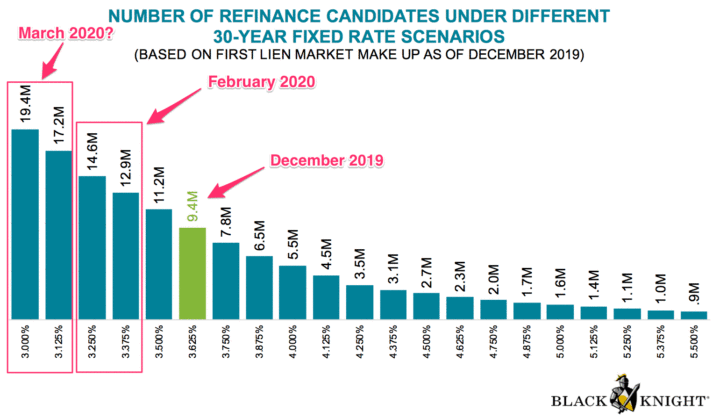
Update March 2020: 30-year fixed rates on 3/4 were at 3.0%-3.25%. If you’re looking for some good news to distract you right now, check out refinancing your mortgage. In November 2018, the average 30-year mortgage rate was nearly 5%. Right now, you can find 30-year rates at around 3.25% and lower with zero points. Mortgage rates are at all-time lows again, with the previous lows back in 2016 and 2012 (source):

At these lower rates, millions more homeowners can save money by refinancing rates, even after taking into account the loan fees (source). This is based on industry data on the rates of existing mortgages.
If you are refinancing, try to see if you can lower your rate, how much your lower monthly payment will be, and how long it will take to break even with the refinancing costs. Here is an example scenario from the WSJ:

WHEN IT IS WORTH REFINANCING
– Home buyer puts 20% down on a home worth $266,300, the median home price in January.
– No plans to move soon.
– Pays a 4% rate, resulting in a monthly payment excluding taxes, fees and insurance of $1,017.09, according to LendingTree.
– Dropping to a 3.25% rate would decrease the payment from $1,017.09 to $927.16. The homeowner would save around $90 a month, with exclusions.
– Assuming refinancing costs of $2,000, this homeowner would need to stay in the home for a little less than two years to make it worth the money.

If you are willing to take a slightly higher rate (negative points), you can even get a “no cost” refinance where the negative points cover your refinance costs. This way, your monthly costs go down with no upfront cost at all.

Bottom line. Due to coronavirus fears, interest rates are now at or nearing all-time lows. This also means that millions more homeowners may be able to lower their mortgage rate via a refinance. If you are serious, get an accurate full quote with all the costs involved with a reputable comparison site like LendingTree (tip: they will likely call whatever phone number you choose to enter) or go local and call up your neighborhood broker. If you are just curious, try an “instant quote” that doesn’t require any upfront information. If you do like what you see, lock in the rate as they can pop back up quickly.

My Grand-Aunt’s Mailbox Money from ExxonMobil

While helping a 92-year-old relative with her estate planning last week, I discovered that she receives dividend checks from ExxonMobil mailed to her every quarter. I also discovered she was an early retiree herself, retiring at age 50 with a government pension and these Exxon shares. What a long retirement! She has the literal mailbox money that Jack Bogle was talking about!

I went home and ran some quick numbers. I’m not going to disclose how much she owns, these are just some round numbers. In 1980, the Exxon quarterly dividend averaged 8.45 cents per share. As of 2019, the quarterly dividend has grown to 87 cents per share. (Thank you Divdata.com.) That means that the dividend has grown roughly 10X in the last 40 years, roughly 6% annualized. That’s if you spent the dividend every 3 months without any reinvestment at all and completely ignoring any increase in the share price!

That means if she was cashing checks for $1,000 a year in annual dividends in 1980, she’d have all that income for 40 years while still cashing checks for $10,000 a year today. ExxonMobil is a Dividend Aristocrat, which means it has raised dividend payouts for 25 consecutive years or more. (It’s actually raised dividends every year for the last 37 years.)

This was even greater coincidence because just a week earlier, I had bought additional ExxonMobil (XOM) shares in my “Fun Money” account – my only individual stock purchase so far in 2020. The XOM share price has been struggling in the short-term, due to a variety of reasons (lots of natural gas = low crude oil prices, large reinvestments = low free cash flow, etc). However, I believe it to be cyclical and haven’t seen any reason to doubt its long-term prospects. If somehow we discover a cheap, limitless source of energy that makes oil worthless, I would happily take that win for society and see my Exxon holdings go to zero.

This is not meant as a recommendation to buy ExxonMobil stock, as my Fun Money account is more of an educational tool for myself and someday my children. I want them to understand that stocks are parts of real businesses. This story about their favorite great-grand-auntie will be a great reminder that while the news is often scary, we can’t forget the benefits of a long-term perspective.

How Many People Save, Even Without High Incomes?

If you are living paycheck-to-paycheck, by definition you aren’t saving and buying any assets. The folks who do have assets, those assets keep growing and compounding away. Left alone, that gap just widens relentlessly. Meanwhile, building up assets from nothing can feel agonizingly slow in the beginning.

So if you don’t make at least six figures already, should you just give up? It’s not your fault, and you can’t do anything about it, so why bother? I worry that this is the underlying message of certain media articles. As a small antidote, check out this chart that shows the percentage of households with a positive savings rate, broken down by income quartiles.

The data is taken from a 2016 survey by the US Bureau of Labor Statistics. Source: Personal savings: A look at how Americans are saving by Deliotte Insights.

Let’s use real numbers to add some clarity:

  • A household in the 20th percentile earns about $24,000 per year. Yet, according this chart, ~30% of households that earn less than $24k manage to spend less than they earn.
  • The 2nd quintile (20th-40th percentile) household earns between roughly $24k and $45 per year. A little over 40% of these households manage to spend less than they earn.
  • The 3rd quintile (40th-60th percentile) household earns between roughly $45k and $75k per year. Close to 60% of these households manage to spend less than they earn.
  • Let’s skip to the 80th to 90th percentile, where households earn between ~$120,000 and $170,000 per year. This is between 5X and 7X the 20th percentile and more than double the middle quintile. Yet even here, only a little over 70% of households have a positive savings rate.

It should not be surprising that households with higher incomes have a higher savings rate. Of course it is easier to reach financial freedom if you have a higher income. That’s just a mathematical fact.

Nearly 30% of households that earn between ~$120,000 and $170,000 per year spend everything they earn and then some. A higher income does not guarantee that you are not living paycheck-to-paycheck. When you look beyond the broad averages, you start to see the ability of households to differ. Everyone with a low income is not spending the same. Everyone with a high income is not spending the same.

This supports the notion that your actions still matter. Use your money to invest in yourself, increasing your skills and the ability to find more rewarding work. You can prioritize your expenses. It won’t be easy, and yes there will be setbacks and roadblocks in your way. In fact, it’s probably better to expect that it won’t be easy. As we should tell our children, success is not a straight line. “More often, a meandering and unexpected path is what leads to success”.

Berkshire Hathaway 2019 Annual Letter by Warren Buffett

Berkshire Hathaway (BRK) has released its 2019 Letter to Shareholders. I highly recommend sitting down and reading the entire thing straight from the source. It’s only 13 pages long this year and written in a straightforward and approachable manner. Here are my notes with quoted excerpts. In my opinion, the overall theme of the letter was “Here’s why Berkshire will be fine without Warren Buffett”.

Buffett reviewed the various unique points of BRK and why he make it that way. Allowing their wholly-owned companies to retain earnings lets them grow exponentially like compound interest. Each company is run by their own management with great freedom. Their insurance side has both exceptional underwriting skill and effective investment of the float. If you can’t own an entire company, you can own part of it through common stocks. The shares of companies that BRK owns have high returns on net tangible equity capital (solidly profitable) and do not hold a lot of debt.

In other words, Berkshire is (still) built to survive and thrive beyond the next recession. None of these things are dependent on Buffett or Munger.

“Your company is 100% prepared for our departure.” If you didn’t read between the lines, Buffett straight up says it.

The two of us base our optimism upon five factors. First, Berkshire’s assets are deployed in an extraordinary variety of wholly or partly-owned businesses that, averaged out, earn attractive returns on the capital they use. Second, Berkshire’s positioning of its “controlled” businesses within a single entity endows it with some important and enduring economic advantages. Third, Berkshire’s financial affairs will unfailingly be managed in a manner allowing the company to withstand external shocks of an extreme nature. Fourth, we possess skilled and devoted top managers for whom running Berkshire is far more than simply having a high-paying and/or prestigious job. Finally, Berkshire’s directors – your guardians – are constantly focused on both the welfare of owners and the nurturing of a culture that is rare among giant corporations. (The value of this culture is explored in Margin of Trust, a new book by Larry Cunningham and Stephanie Cuba that will be available at our annual meeting.)

I remember a quip by Charlie Munger on this topic that went like this: “Do you really think Warren will mess this up?”

Stocks and interest rates. BRK owns a lot of stocks and zero 30-year Treasury bonds at 2%. I look to their actions as well as reading their words:

Forecasting interest rates has never been our game, and Charlie and I have no idea what rates will average over the next year, or ten or thirty years. Our perhaps jaundiced view is that the pundits who opine on these subjects reveal, by that very behavior, far more about themselves than they reveal about the future.

What we can say is that if something close to current rates should prevail over the coming decades and if corporate tax rates also remain near the low level businesses now enjoy, it is almost certain that equities will over time perform far better than long-term, fixed-rate debt instruments.

The catch. Individual investors should read this carefully:

Anything can happen to stock prices tomorrow. Occasionally, there will be major drops in the market, perhaps of 50% magnitude or even greater. But the combination of The American Tailwind, about which I wrote last year, and the compounding wonders described by Mr. Smith, will make equities the much better long-term choice for the individual who does not use borrowed money and who can control his or her emotions. Others? Beware!

Personally, I do agree that Buffett has spent a lot of time on the “estate plan” for Berkshire Hathaway. I applaud that, as it is another example of his rationality. People usually hate thinking about their death and put off making wills, etc. He has done everything in his power to keep the Berkshire culture going for decades to come. As a shareholder myself, I really do hope that he is successful. I don’t plan to sell any shares upon his death. However, I’m comfortable that most of my money is in index funds as any company culture can erode over time.

Past shareholder letters.

  • 1977-2019 are free on the Berkshire Hathaway website (PDF). 1965-2018 are $2.99 at Amazon (Kindle). Three bucks seems pretty reasonable for a permanent copy with the ability to make searchable highlights using Kindle software.
  • 2018 Letter discussed using debt very sparingly and the importance of holding productive assets over a long time.
  • 2017 Letter discussed patience, risk, and why they have so much cash.
  • 2016 Letter touched on the rarity of skilled-stock pickers and some insight on his own stock-picking practices.
  • 2015 Letter discussed his optimism in America and his “Big 4” stock holdings.
  • 2014 Letter discussed the power of owning shares of productive businesses (and not just bonds).
  • 2013 Letter included Buffett’s Simple Investment Advice to Wife After His Death.

Berkshire’s 2020 annual meeting will take place on Saturday, May 2nd. Last year, I again enjoyed listening to it in the car via the Yahoo Podcast. Here are the many ways you can access Berkshire Hathaway Shareholder Meeting Full Videos, Transcripts, and Podcasts.

Stupidity, Humility, and Stock Picking

XCKD’s latest comic is about stock picking and the efficient market hypothesis:

The hidden hover text goes on – On the news a few days later: “Buzz is building around the so-called ‘camping Roomba’ after a big investment. Preorders have spiked, and…”

XKCD is finding humor in the idea that stupidity can be made profitable. But highly efficient markets really do take away the effects of stupidity, because the prices are already adjusted accordingly. You can’t be convinced to buy Apple at $500 a share when it’s trading at $320. On the other hand, if you find success in picking stocks, it’s really hard to separate luck and skill. Humility is in order.

I would also extend the idea of humility to also include skepticism. The promise of easy money solutions anywhere should always ring alarms. It really hurts to read about people being told that buying another new car is the solution to not being able to afford their current car. We have doctors convincing other doctors within Facebook groups to lose millions in a cryptocurrency hedge fund where instead of brokerage statements, they accepted phone screenshots.

Edges are rare. Why does your edge exist? What is your evidence that it exists? Why has nobody else thought of it? How much will it cost to make the bet? If it does exist today, how long will it last? Why is it durable?

In addition, remember the Kelly Criterion and adjust your bet size with the size/confidence level of your edge. Even if you knew with 100% certainty that a coin was biased 60% heads and 40% tails, you could still go bankrupt if you bet improperly! I make some “Fun Money” bets, but they are very small portion of my net worth.

What I like about my retirement portfolio is that I could not touch it for 50 or 100 years, and I wouldn’t worry too much. I can be a little stupid; I don’t need to watch it like a hawk or be a hedge fund genius. My bets are relatively humble.

Fort Bragg Federal Credit Union Certificate Deal: 5-year at 2.99% APY

Fort Bragg Federal Credit Union has some solid rates on their term share certificates, most notably the 5-year jumbo certificate at 2.99% APY ($25,000 minimum) and 2.89% APY ($5,000 minimum). Available both in regular taxable and IRAs. These are even “step-up” CDs where you can bump up the rate once if the advertised rates rise. NCUA-insured. Found via DepositAccounts.

This is a relatively small credit union, so this rate probably won’t last very long. I would also expect it to require a little effort to be opened if you don’t live near their branches in North Carolina. Even their 2.99% APY is a bit odd. When it’s a loan where you pay interest, you always see APRs of 2.99% or 9.99%. When it’s a bank account where you get paid interest, you always see APYs of 2.00% or 2.05%. It’s almost like they don’t want people to notice that they have the highest 5-year CD rate in the country by a decent margin.

Membership eligibility. Credit union membership is open to:

  • Active-Duty or Retired military service member
  • Family member of primary member
  • Regularly works on Fort Bragg
  • Most persons who live, work, worship, or attend school in, and businesses and other legal entities in Cumberland County, NC
  • Members of the Braxton Bragg Chapter of AUSA

The last option makes membership open to anyone nationwide. Here is the PDF application which shows the cost of $40 for a 2-year membership, but you may wish to try and apply over the phone at 855-246-6269. Be sure to join the Braxton Bragg Chapter. You will need your AUSA membership number before they can finish your credit union application.

Many credit unions do a hard credit pull upon joining, but I’m not sure about Fort Bragg.

Early withdrawal penalties and limitations. Please note the following language taken from the Full membership agreement (PDF). The penalty is short (3 months), but there may be restrictions for early withdrawals.

Early Withdrawal Penalties – All Term Share Certificate Accounts. You have agreed to leave the principal of this account on deposit for the full term stated in your Certificate. If all or part of the principal is withdrawn before the maturity date, the Credit Union may charge you a penalty. Withdrawal of the principal amount of your Certificate may be made only with the consent of the Credit Union. Unless stated otherwise, owners of non-IRA Term Share Certificate accounts shall forfeit an amount equal to three (3) months dividends on the amount withdrawn. Owners of IRA Term Share Certificate accounts shall forfeit an amount equal to three (3) months AND assessed an Administrative Fee, refer to Term Share/IRA Certificates Rates for current fee. The penalty may be calculated at the rate paid on the deposit at the time of the withdrawal. The penalty will, if necessary, be taken from the principal amount of the deposit.

Bottom line. Fort Bragg FCU has a 5-year share certificate at 2.99% APY. As of 2/19/2019, a 5-year Treasury bond currently yields only about 1.4%. The SEC yield of the Vanguard Total Bond Market ETF (BND) is only 2.14% and it has a longer duration. This margin means this rate won’t last very long. The possible credit check and $40 entry fee make it better for high balances to make it worth the trouble.

I am skipping this one as I don’t have any CDs maturing soon. Still, this is another example of smaller credit unions offering up a very high rate for a limited-time. Such opportunities only available to motivated individual investors and not big institutions.

Prudential Instagram Ads For Early Retirement

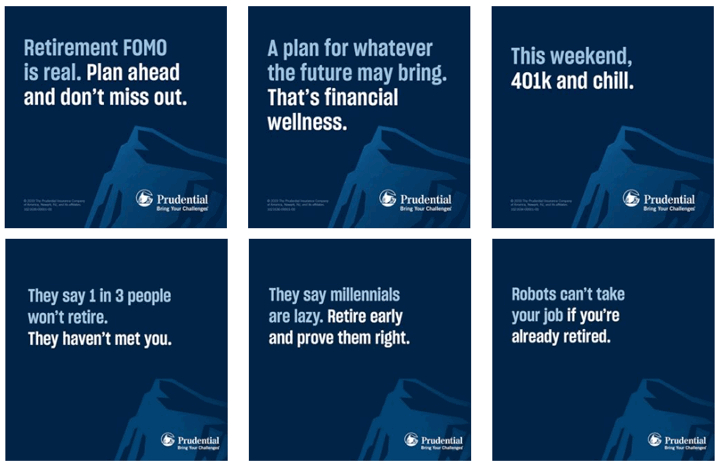
I had no idea @prudential existed until today (and this post is not sponsored by them in any way) but apparently they have a series of Instagram-specific ads targeting younger workers. They even have some that reference early
retirement. Do you think they hit the mark?

Prudential Ad Image

While I found the ads amusing, the Prudential website itself still consists of the usual vanilla articles about retirement, annuities, and life insurance. So the products are the same old stuff, nothing new. I often wonder about the best way to help people to improve their financial situation. Will Fintech really make a difference? But I guess the first thing is to catch their attention.

Charlie Munger Daily Journal Annual Meeting 2020 Full Video, Full Transcript, and Notes

If you like hearing Warren Buffett and Charlie Munger talk at the Berkshire Hathaway (BRK) annual meeting, you should also watch or listen to Charlie Munger at the Daily Journal (DJCO) annual meeting. DJCO is his personal pet project, and each year he does a Q&A session where he answers any questions by himself. CNBC recorded the full 2020 DJCO annual meeting live (embedded below). I watched the entire 2+ hour session – it’s good but long… might be better as a podcast (although I like to take notes too).

Adam Blum of ValueWalk has generously shared his full transcript as well. It’s very complete so I am too lazy to compete with that. Instead, here are my (often paraphrased) personal notes and highlights:

  • Munger has no idea what the consequences will be that the biggest shareholder in all the biggest companies are index funds.
  • Munger likes the Daily Journal and Costco because it they try to do right by their customers, as opposed to casinos for example that make money by tricking people. You should always take the high road if you can. It’s less crowded.
  • Newspaper are going away, except for maybe the Wall Street Journal and New York Times. This is bad, as now you have misleading opinion media on both sides that just keep spewing hatred. Politics is even sillier than business.
  • Chinese companies are stronger with better growth prospects than US companies. Munger is invested there (and he jokes that you aren’t). Fish where the fish are.
  • Munger is partial to Canada and their working single-payer health care system, especially how they pay lower pharmaceutical prices.
  • There is too much wretched excess in investment management. There are troubles coming.
  • Index funds will still work best for most people, if you can be patient. He notes that the average holding period among Chinese investors is very short. This is not good. He is not a fan of the popularity of gambling among the Chinese.
  • Be a survivor, not a victim. Advocating for reform is important, but on a personal level it is important to to keep plugging along. Munger doesn’t like politicians that get ahead by trying to make everyone feel like a victim. Recognize you are in a bad situation and work to make it better.
  • Munger only knows enough about Crypto to know that he should avoid it. “Too hard” pile.
  • Regarding inflation and interest rates, we should all be modest about our knowledge of economics.
  • No new book recommendations.
  • Munger does not have a hostile attitude towards China. The US should try to get along with China. China should try to get along with the US. As an aside, Munger has admiration for Japan during their 25 years of economic stasis.
  • Learn to change your mind when you are wrong.
  • Tesla – Munger will never buy it, but also never sell it short. Don’t underestimate a man that overestimates himself.
  • We should appreciate our current living standards. What is extra money really going to do for you after you have enough to eat? Medicine has greatly improved. Even with more technological advances, will life be that much better?
  • Munger has no secrets to share about his longevity.
  • His only advice on parenting is to be a good example. Preaching to his kids never worked.
  • On negative interest rates, having worked once, governments will of course try it again, likely to excess.
  • The inversion process. Figure out the easiest ways to make yourself bankrupt, and then avoid them. (Consumer debt? Medical debt?)
  • Munger is known for being rational, yet he 96 years old, enormously rich, and cares a lot about what happens to a little company called the Daily Journal. He calls it insane.
  • Having a two-party political system is good. Power corrupts. It’s better when no one side gets too much power. The ebb and flow is good.
  • American healthcare, in many ways it’s the best in the world. It is powered by a lot of smart hard-working people. However, there is a huge amount of totally unnecessary activity that costs a lot and does nothing or even causes harm. Why? There are big financial incentives to make money with unnecessary care. Change the incentives. The insurance reimbursement system is too opaque. Kaiser system is an example of doing less unnecessary care.
  • People who are deferred gratifiers do better than the impulsive ones that demand immediate gratification. He is afraid the tendency towards one or the other might be genetic.

I actually appreciate when someone admits they don’t know something, as opposed to others who seem to form a strong opinion on everything under the sun. One of Munger’s lessons is that it is important to accept what you don’t know, and make strong bets only on what you do know. That’s the only way to get outsized results.

Do Not Buy List: Healthcare Sharing Ministry As Health Insurance Alternative

I am creating a “Do Not Buy” list as part of my estate planning to help my family avoid potentially dangerous financial products. These things are not illegal “scams”, but may have hidden risks where it is better to simply avoid them. In addition to equity-indexed universal life Insurance, I am also including health-care sharing ministries (HCSM). The bigger names in this group include Samaritan, Medi-Share, Christian Healthcare Ministries, Trinity/Aliera, and Liberty.

I’ve been reading about these off and on, and they are often mentioned as a cost-saving option for the self-employed and/or those in early retirement. Read this NY Times article It Looks Like Health Insurance, but It’s Not, this Seattle Times article Washington state orders ‘sham’ health-care sharing ministries to halt, and this Consumer Reports article to get some background.

I can definitely see the appeal of the lower monthly costs and the positive feelings from being part of a cooperative community. I can accept that many (but not all) require a strong religious affiliation. I might overlook the fact that they usually don’t cover and basic preventative care like screening exams (mammograms, colonoscopies), flu shots, and other vaccines. However, I cannot accept the following:

  • HCSMs are not health insurance. This also means they are not overseen by state insurance agencies. There no government oversight, nobody to appeal to and have them say “hey that’s not right, you can’t do that”.
  • HCSMs provide no guarantee of payment. Legally, they are just a charity. The ministry looks at each claim and has sole discretion as to whether they want to provide payment.
  • HCSMs do not have to accept or cover pre-existing conditions.
  • HCSMs do not have to cover prescriptions drugs. Read their rules very carefully.
  • HCSMs can cap lifetime payments at relatively low amounts like $250,000. Read their rules very carefully. ACA-compliant health insurance plans have no lifetime limits.

The problem is that by design, yes, MOST people will be satisfied by these programs. MOST people get their bills paid. MOST people can thus leave a positive review. MOST people won’t have an extreme event that requires $500,000 of medical care over time. However, that is not the point of insurance! Insurance is there to protect you from bankruptcy due to a catastrophic event out of your control. Insurance is based on strict contracts, and you should notice that all forms of real insurance (life, health, auto, homeowners, etc) are tightly regulated. What happens if they run into some sort of financial difficulty, perhaps in a recession or from a rogue employee or executive?

Think of the importance of only putting your cash in an FDIC-insured bank or NCUA-insured credit union. The vast, vast majority of the time, banks don’t fail. I’ve never had a bank fail on me. I don’t know anyone who has had money in a truly failed bank where the FDIC had to step in. But I still know that having the proper checks and backstops is important. Sometimes things are great for long time… until they aren’t.

Also, don’t forget that if a healthcare sharing ministry rejects a child’s claims and the family is bankrupt and desperate, they’ll likely end up falling back on taxpayer-funded Medicaid to cover their healthcare needs. Is this how we want the system to work?

My recommendation is to steer clear of all healthcare sharing ministries. I do not doubt that most have good intentions and happy customers, but things can happen that may even be out of their control. HCSMs are charities, not insurance. They can fail as much as any business. Yes, real insurance costs more, but at least you have a clear contract with defined rules and legal options as a backup. If you are my loved one and are reading this, please protect yourself fully and make sure you are buying true health insurance.

Reminder: File a Claim For Yahoo Data Breach Class Action Settlement

I thought I’d mentioned this already, but apparently not. If you had a Yahoo account (including Yahoo Fantasy Sports, Yahoo Finance, Tumblr, or Flickr) between January 1, 2012, and December 31, 2016, you are a member of the Yahoo! Inc. Customer Data Security Breach Litigation Settlement. This was the biggest hack in history at the time, but there have been so many since you’ve probably forgotten about it like myself. The claim form deadline is July 20th, 2020.

You can make a claim for either 2 years or credit monitoring OR you can opt for a cash payment if you already have credit monitoring or identity protection services. I am up to my ears in free credit monitoring, so I am filing for the cash payment – might be $100, might be less, might be up to $358 supposedly. (I’m keeping my expectations low.) If you suffered fraud or identity theft, you can also claim reimbursement for up to $25,000 in out-of-pocket expenses (documentation required).

I don’t get too excited about these settlements, but if I am eligible then I will take a minute and fill out a claim… and promptly forget about the whole thing. A year or more later, a check will show up in my mailbox. Some are much bigger than expected, some are much smaller, but the checks eventually do add up.

Keep Hawaiian Miles From Expiring By Taking A Single Survey (Opinions Take Flight)

otf0

Opinions Take Flight is a consumer survey panel that pays out Hawaiian Airlines Miles instead of cash. New members get 350 HawaiianMiles for joining and completing the first survey. I usually find these survey panels too tedious to participate in regularly, but I do at least one survey with them a year (per account) to keep my Hawaiian miles from expiring. Hawaiian miles otherwise expire after 18 months of inactivity.

You’ll need to verify your e-mail, fill out some profile information, and then they will ask you survey qualification questions. The good news is that even if you don’t qualify for a particular survey (which happens a lot), OpinionsTakeFlight.com will still give you 5 miles for trying.

otf1

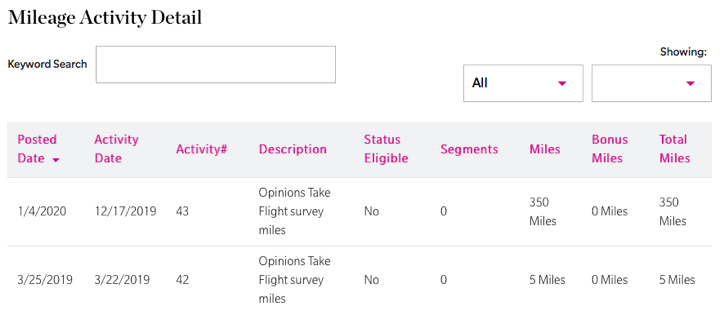
Since my primary goal is to score any amount of quick miles to reset my miles expiration, I was happy with that. I’d rather get 5 miles (and expiration extension) for 5 minutes of work rather than 350 miles (and expiration extension) for 24 minutes of work anyway. Here is a screenshot of my account that shows my OTF miles keeping my Hawaiian miles active for the past two years:

Note the delay between “Activity date” and “Miles posted date” varied between 3 days and over 2 weeks. I recommend trying a survey every 11.5 months or so, as I don’t want them to close my account down due to inactivity if I don’t do any surveys in a 1-year period.

Bottom line. If you need a free and easy way to keep Hawaiian Airlines miles from expiring, sign up for Opinions Take Flight and try to take a survey at least once a year (I think they might mark your account inactive otherwise). You’ll get a least 5 miles, which will reset your 18-month expiration countdown.

Best Interest Rates on Cash – February 2020

Here’s my monthly roundup of the best interest rates on cash for February 2020, roughly sorted from shortest to longest maturities. I track these rates because I keep 12 months of expenses as a cash cushion and also invest in longer-term CDs (often at lesser-known credit unions) when they yield more than bonds. Check out my Ultimate Rate-Chaser Calculator to see how much extra interest you’d earn by moving money between accounts. Rates listed are available to everyone nationwide. Rates checked as of 2/4/2020.

High-yield savings accounts
While the huge megabanks make huge profits while paying you 0.01% APY, it’s easy to open a new “piggy-back” savings account and simply move some funds over from your existing checking account. The interest rates on savings accounts can drop at any time, so I list the top rates as well as competitive rates from banks with a history of competitive rates. Some banks will bait you with a temporary top rate and then lower the rates in the hopes that you are too lazy to leave.

Short-term guaranteed rates (1 year and under)
A common question is what to do with a big pile of cash that you’re waiting to deploy shortly (just sold your house, just sold your business, legal settlement, inheritance). My usual advice is to keep things simple and take your time. If not a savings account, then put it in a flexible short-term CD under the FDIC limits until you have a plan.

  • No Penalty CDs offer a fixed interest rate that can never go down, but you can still take out your money (once) without any fees if you want to use it elsewhere. Marcus has a 11-month No Penalty CD at 2.00% APY with a $500 minimum deposit. My eBanc has a 11-month No Penalty CD at 2.00% APY with a $100,000 minimum deposit. Ally Bank has a 11-month No Penalty CD at 1.90% APY with a $25,000 minimum deposit. CIT Bank has a 11-month No Penalty CD at 1.75% APY with a $1,000 minimum deposit. You may wish to open multiple CDs in smaller increments for more flexibility.
  • Marcus (GS Bank) has a 12-month CD at 2.15% APY ($500 minimum).

Money market mutual funds + Ultra-short bond ETFs
If you like to keep cash in a brokerage account, beware that many brokers pay out very little interest on their default cash sweep funds (and keep the difference for themselves). The following money market and ultra-short bond funds are not FDIC-insured, but may be a good option if you have idle cash and cheap/free commissions.

  • Vanguard Prime Money Market Fund currently pays an 1.64% SEC yield. The default sweep option is the Vanguard Federal Money Market Fund which has an SEC yield of 1.51%. You can manually move the money over to Prime if you meet the $3,000 minimum investment.
  • Vanguard Ultra-Short-Term Bond Fund currently pays 1.93% SEC yield ($3,000 min) and 2.03% SEC Yield ($50,000 min). The average duration is ~1 year, so there is more interest rate risk.
  • The PIMCO Enhanced Short Maturity Active Bond ETF (MINT) has a 1.86% SEC yield and the iShares Short Maturity Bond ETF (NEAR) has a 2.14% SEC yield while holding a portfolio of investment-grade bonds with an average duration of ~6 months.

Treasury Bills and Ultra-short Treasury ETFs
Another option is to buy individual Treasury bills which come in a variety of maturities from 4-weeks to 52-weeks. You can also invest in ETFs that hold a rotating basket of short-term Treasury Bills for you, while charging a small management fee for doing so. T-bill interest is exempt from state and local income taxes.

  • You can build your own T-Bill ladder at TreasuryDirect.gov or via a brokerage account with a bond desk like Vanguard and Fidelity. Here are the current Treasury Bill rates. As of 2/3/2020, a 4-week T-Bill had the equivalent of 1.56% annualized interest and a 52-week T-Bill had the equivalent of 1.46% annualized interest.
  • The Goldman Sachs Access Treasury 0-1 Year ETF (GBIL) has a 1.83% SEC yield and the SPDR Bloomberg Barclays 1-3 Month T-Bill ETF (BIL) has a 1.37% SEC yield. GBIL appears to have a slightly longer average maturity than BIL.

US Savings Bonds
Series I Savings Bonds offer rates that are linked to inflation and backed by the US government. You must hold them for at least a year. There are annual purchase limits. If you redeem them within 5 years there is a penalty of the last 3 months of interest.

  • “I Bonds” bought between November 2019 and April 2020 will earn a 2.22% rate for the first six months. The rate of the subsequent 6-month period will be based on inflation again. More info here.
  • In mid-April 2020, the CPI will be announced and you will have a short period where you will have a very close estimate of the rate for the next 12 months. I will have another post up at that time.

Prepaid Cards with Attached Savings Accounts
A small subset of prepaid debit cards have an “attached” FDIC-insured savings account with exceptionally high interest rates. The negatives are that balances are capped, and there are many fees that you must be careful to avoid (lest they eat up your interest). Some folks don’t mind the extra work and attention required, while others do. There is a long list of previous offers that have already disappeared with little notice. I don’t personally recommend nor use any of these anymore.

  • The only notable card left in this category is Mango Money at 6% APY on up to $2,500, but there are many hoops to jump through. Requirements include $1,500+ in “signature” purchases and a minimum balance of $25.00 at the end of the month.

Rewards checking accounts
These unique checking accounts pay above-average interest rates, but with unique risks. You have to jump through certain hoops, and if you make a mistake you won’t earn any interest for that month. Some folks don’t mind the extra work and attention required, while others do. Rates can also drop to near-zero quickly, leaving a “bait-and-switch” feeling. I don’t use any of these anymore.

  • Consumers Credit Union Free Rewards Checking (my review) has up to 5.09% APY on balances up to $10,000 if you make $500+ in ACH deposits, 12 debit card “signature” purchases, and spend $1,000 on their credit card each month. Elements Financial has 3% APY on balances up to $20,000 if you make 15 debit card “signature” purchases or other qualifying transactions per statement cycle. Find a locally-restricted rewards checking account at DepositAccounts.
  • If you’re looking for a high-interest checking account without debit card transaction requirements, the rate won’t be nearly as high, but take a look at MemoryBank at 0.90% APY.

Certificates of deposit (greater than 1 year)
CDs offer higher rates, but come with an early withdrawal penalty. By finding a bank CD with a reasonable early withdrawal penalty, you can enjoy higher rates but maintain access in a true emergency. Alternatively, consider building a CD ladder of different maturity lengths (ex. 1/2/3/4/5-years) such that you have access to part of the ladder each year, but your blended interest rate is higher than a savings account. When one CD matures, use that money to buy another 5-year CD to keep the ladder going. Some CDs also offer “add-ons” where you can deposit more funds if rates drop.

  • Hiway Federal Credit Union has a 5-year certificate at 2.71% APY ($25k minimum) and 2.61% APY with a $10,000 minimum. Early withdrawal penalty is 1 year of interest. Anyone can join this credit union via partner organization ($10 one-time fee).
  • Navy Federal Credit Union has a special 17-month CD at 2.25% APY ($50 minimum + add-on feature up to $75k), but you must have a military affiliation to join (includes being a relative of a veteran).
  • Andrews FCU still has their special 84-month certificate at 3.05% APY. Anyone can join this credit union via partner organization.
  • You can buy certificates of deposit via the bond desks of Vanguard and Fidelity. You may need an account to see the rates. These “brokered CDs” offer FDIC insurance and easy laddering, but they don’t come with predictable early withdrawal penalties. The rates are not competitive right now. Be wary of higher rates from callable CDs listed by Fidelity.

Longer-term Instruments
I’d use these with caution due to increased interest rate risk, but I still track them to see the rest of the current yield curve.

  • Willing to lock up your money for 10+ years? You can buy long-term certificates of deposit via the bond desks of Vanguard and Fidelity. These “brokered CDs” offer FDIC insurance, but they don’t come with predictable early withdrawal penalties. I don’t see anything noteworthy. Watch out for higher rates from callable CDs from Fidelity.
  • How about two decades? Series EE Savings Bonds are not indexed to inflation, but they have a unique guarantee that the value will double in value in 20 years, which equals a guaranteed return of 3.5% a year. However, if you don’t hold for that long, you’ll be stuck with the normal rate which is quite low (currently a sad 0.10% rate). I view this as a huge early withdrawal penalty. You could also view it as a hedge against prolonged deflation, but only if you can hold on for 20 years. As of 2/3/2020, the 20-year Treasury Bond rate was 1.84%.

All rates were checked as of 2/4/2020.