What Percentage Of Your Portfolio Should Be In Stocks?

One of the basic ways to adjust the risk and return characteristics of your investment portfolio is to decide what percentage to hold in stocks and bonds. This is another one of those hard questions for which there is no single best answer for everyone. You must take into account risk acceptance and time horizon amongst other factors.

An old rule of thumb is that your stock allocation percentage should be 100 minus your age. That is, a 30-year old should have 70% stocks/30% bonds, and a 70-year old should have 30% stocks/70% bonds. This was not just taken out of thin air, and has a basis from historical returns. As you near retirement, you want to have more bonds as that reduces overall volatility. More recently, others have altered this to a more aggressive “110-age” or even “120-age”.

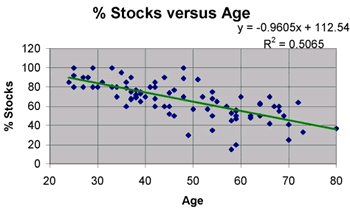
Members of the Diehards investment forum recently performed a informal survey of member’s asset allocations versus their age, and here are the results:
Credit: Diehards Form

As you can see, there is definitely a lot of scatter in the data. However, if you made a linear fit, it roughly corresponds to a formula of stock percentage = 112.5 – age.

This made me curious – what about all those Target Retirement Funds? Their job is to decide an asset allocation that works for as many people as possible based on their retirement date. If I assume that people retire at 65 years old, here is what the asset allocation versus age looks like for three of the more popular fund families: Vanguard, Fidelity, and T. Rowe Price:
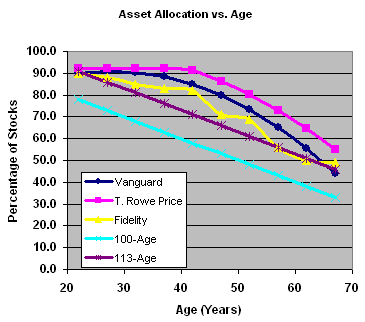
Target Retirement Fund Asset Allocation vs. Age

As you can see, the funds are actually pretty aggressive. (I covered previously how T. Rowe Price is more aggressive than Vanguard.) If one did force linear fits for all three fund families, it would correspond roughly to stock percentage of 119 – age. However, they don’t really adjust linearly with time. If I use a 2nd order curve fit instead, I can make a little tool that estimates their stock percentages for any age:

Input Your Age: Years
Percentage in Stocks
Vanguard Model:   %
Fidelity Model:   %
T. Rowe Price Model:   %
120 – Age:   %
113 – Age:   %

None of this is investment advice, it’s just an observation of what’s out there. Next, I’ll try to find some historical return and standard deviation numbers for another view of how to answer this question. What do you think of all this?

Do You Have a 403(b) Plan? Don’t Miss 403bWise.com

I’ve always thought of 403(b)s as identical to 401(k)s, just for non-profit and educational institutions. But upon discussing this with a teacher, I found out that they can have their own unique problems: primarily high-priced annuities. Did you know that 80% of 403(b) funds are currently invested in fixed or variable annuities? This is really surprising, considering that annuities are usually only a good idea for high-income people who’ve already maxed out all their other tax-deferred options – why put a tax-deferred product inside another tax-deferred product?

If you’re not sure what you have in your 403(b) accounts, I would definitely recommend reading up at 403bWise.com. Started by teachers, it has a wealth of information about your investment options. Did you know that if you summed up all the various annuity costs you could be losing 3% to fees every year? If you are stuck with a bad administrator, you may be able to do what is called a “90-24 transfer” to a low-cost provider like Fidelity, Vanguard, T. Rowe Price, or TIAA-CREF. There are some upcoming law changes and this transfer ability expires at the end of 2007, so compare your options soon. Another route is follow other teachers and fight for a change from within.

There is also 457bWise for 457(b) holders.

Tax Efficient Mutual Fund Placement For Maximum Return

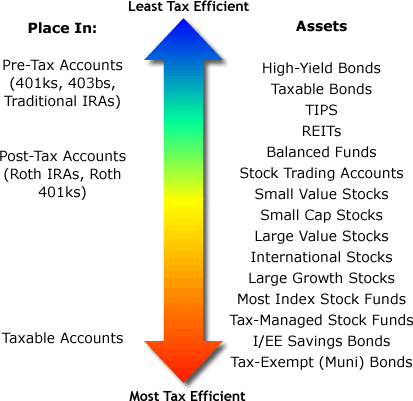
After choosing your asset allocation, it is still important to think carefully about where to place each type of investment. After all, what you actually keep is your return after taxes. For example, a stock index fund that tracks the S&P 500 will have low turnover and primarily pay qualified dividends which are taxed at the lower long-term capital gains rate (max 15%). On the other hand, REITs and bonds tend to distribute a significant amount of their return annually as unqualified dividends, which are then taxed as ordinary income (max 33%). Therefore, you should try to take advantage of your tax-sheltered accounts as much as possible by placing the least tax-efficient assets there.

Below is a chart that shows the major asset classes sorted by tax efficiency. It is based on information from the fine books Bogleheads’ Guide To Investing and The Four Pillars of Investing.

Chart of Relative Tax Efficiency of Assets

Let me clarify the chart above. You should start with the least tax-efficient assets and place them in your pre-tax accounts (Regular 401ks, 403bs, Traditional IRAs) first. Then the next least efficient assets should into the post-tax accounts (Roth IRA, Roth 401k). Only what is left after this should end up in taxable accounts.

In general, bonds should go into tax-deferred accounts, leaving stocks for your taxable accounts. There are even special “tax-managed” mutual funds which work hard to minimize any capital gains distributions and are designed specifically to be placed in taxable accounts.

This article is part of my Rough Guide To Investing.

Fidelity MyPlan: Should Good Savers Invest Less Aggressively?

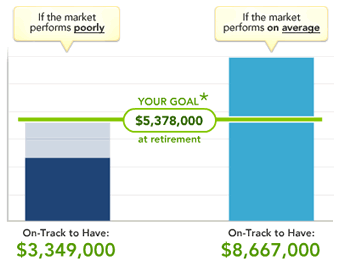
Fidelity has a new tool called the myPlan retirement calculator. It’s very soothing and is only 5 questions long, why not give it a whirl? What I like about it is that it doesn’t just deal with average numbers. People like to use round numbers like 8% annually and pretend like they are a sure thing, but the fact is with some bad timing we could end up doing a lot worse.
Using some rough numbers from our own situation – age 28, $100k income, $100k saved so far, $2,500 saved monthly, Aggressive Growth investment style, we get the following result:

myPlan Screenshot

Not bad, right? If the market performs on average, we will easily exceed what we need to retire on. (Yes, the numbers are huge!) If the market performs poorly however, we’ll be significantly short. Now, what if we change the investment style from Aggressive to Conservative?
[Read more…]

February 2007 Investment Portfolio Snapshot

It’s time for another bi-monthly update on my investment portfolio.

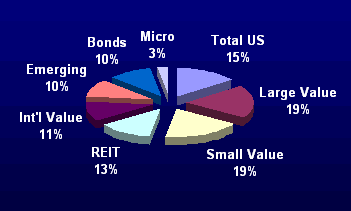
2/07 Portfolio Breakdown
 
Retirement Portfolio
Fund $ %
FSTMX – Fidelity Total Stock Market Index Fund $11,212 15%
VIVAX – Vanguard [Large-Cap] Value Index $14,057 19%
VISVX – V. Small-Cap Value Index $14,184 19%
VGSIX – V. REIT Index $9,781 13%
VTRIX – V. International Value $8,052 11%
VEIEX – V. Emerging Markets Stock Index $7,814 10%
VFICX – V. Int-Term Investment-Grade Bond $7,631 10%
BRSIX – Bridgeway Ultra-Small Market $2,109 3%
Cash – Unreinvested Dividends $500
Total $75,340
 
December and January Fund Transactions
$500 deposited in 401k, not yet invested

Thoughts
Another two months with little activity in my low-maintenance portfolio. I don’t get the joy of reading about my fund picks in magazines, but I don’t worry about choosing the wrong one either.

I am still ironing out a slightly tweaked asset allocation, one that has a more balanced domestic/international distribution and something I hopefully won’t mess with again for a long time. I’m reviewing the model portfolio comparisons and the books they came from, including Ferri’s new book All About Index Funds.

You can see some older posts on how this portfolio came to be here, as well as my previous portfolio snapshots here.

Starting Your Own Portfolio Out With Limited Funds

All of these suggested portfolios were developed by smart people who did their homework. But none of them are the same! This is because every single one also made compromises based on their interpretation of current research, simplicity, availability of suitable investments, costs, and also to some measure their overall predictions of the future. We have to do the same thing on our end.

For example, many people are starting with smaller amounts. Some of these model portfolios have 8 funds or more! Just by the fund minimums alone, you’d be looking at a minimum balance of $24,000 or so. And even then, you’d be looking a various low balance and maintenance fees. So what do you to minimize fees? Here are a few ideas:

1) Buy an all-in-one fund, and split it up later. Since many fund companies have all-in-one target-dated funds, you can simply buy one of these until you have enough to split into other funds. Here are some specific fund suggestions, starting at only $50 per month. The fund’s asset allocation may not be exactly what you want, but it will be well-diversified, and still much better than other high-cost alternatives. Here’s what the Vanguard Target 2045 Fund looks like:

Vanguard Target 2045 Breakdown

I built up about $50,000 in Vanguard Target funds (VTIVX and VTTHX) before splitting it up into 8 funds last year. Since they were held in IRAs/401ks, I didn’t have to worry about any tax consequences. This choice is my favorite because it’s the most simple – just buy the same fund for a few years!
[Read more…]

Model Portfolio #5: A Random Walk Down Wall Street

(This is the fifth in my series of Model Portfolio Comparisons.)

First written in 1973, Burton Malkiel’s A Random Walk Down Wall Street (my review) has become an investing classic, pioneering the controversial idea that stock prices are random and thus a monkey throwing darts would be just accurate as any stock-picker. Below is a recommended asset allocation from the book for an investor in their “mid-twenties”.

Bold Investor Model Portfolio

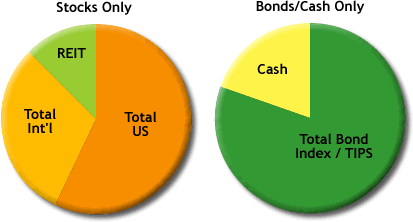
Asset Allocation Pie Chart, A Random Walk Down Wall Street

Asset Allocation for suggested 75% Stocks/25% Bonds ratio
43% Total US Stock Market
22% Total International Stock Market
10% REIT
20% Treasuries/TIPS/High-Quality Corporate Bonds
5% Cash

This breakdown looks very similar to the basic “Early Saver” portfolio from All About Asset Allocation. See the rest of the model portfolios for example mutual funds and ETFs for each asset classes.

As you age, the recommended percentage of stocks goes down to 65% at age 40 and 40% in late retirement. It is interesting to note that while Malkiel consistently recommends real estate as part of your portfolio, REITs were not explicitly included in the recommended portfolios until recently. I noticed this when comparing my personal copy (published in 1996) to the most recent edition. I’m guessing the growing availability of index funds that track REITs is the reason behind this.

Model Portfolio #1: Couch Potato Portfolio

(This is the first in my series of Model Portfolio Comparisons.)

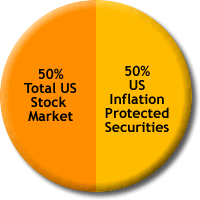
The Couch Potato Portfolio is the invention of Scott Burns, a personal finance columnist at the Dallas Morning News. Originally, the portfolio consisted of just two funds – the Vanguard S&P 500 Index Fund (VFINX) and the Vanguard Total Bond Index Fund (VTBMX). That was over 15 years ago, and it has beaten most balanced funds in the meantime. The current version is below.

Asset Allocation (All Ages)
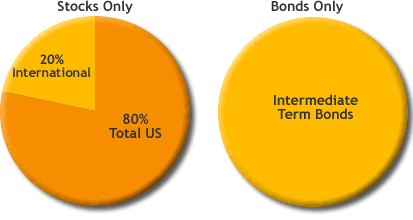
50% Total US Stock Market
50% US Inflation-Indexed Securities.

Pie Chart for Couch Potato Portfolio

There are many ways that people find fault with this portfolio – low stock allocation, no risk adjustment with time, no international exposure, no REIT fund. Partially in response to these, Burns has also introduced other variations like the Margarita Portfolio and Four Square Portfolio. The Margarita Portfolio is 33% Total US Stock Market, 33% Total International Stock Market, and 34% Inflation Protected Securities. But still, you can’t beat the simplicity.

Model Retirement/Investment Portfolios: A Comparison

In my rough guide to investing, I suggested some all-in-one mutual funds for beginners. But what if you want to go a step further and design your own portfolio? Or you have a 401k with only limited choices?

Of course, the best answer is always to read some good books. But another idea I’ve been meaning to do for a while is to collect the model portfolios from lots of different reputable books and sources and compare them to each other. You won’t see any individual stock picks here, all the sources will be based (at least loosely) upon modern portfolio theory and thus focus on optimizing the risk/reward ratio using proper asset allocation.

I think it should go without saying that since these are model portfolios, they are imperfect by design and at most should serve as rough guidelines for your own investing. Everyone has a different time horizons and situations. Use them as one part of your own research.

One way to tailor these portfolios to your own use is to adjust the stock/bond ratio according to how aggressive you wish to be. Accordingly, I have tried to separate the stock and bond components.

Completed Model Portfolios

  1. Couch Potato Portfolio
  2. Boglehead’s Guide To Investing
  3. All About Asset Allocation
  4. The Intelligent Asset Allocator
  5. A Random Walk Down Wall Street
  6. FundAdvice.com by Merriman
  7. Unconventional Success by Swensen
  8. Columnist Ben Stein

Future Model Portfolios (in progress)

Here are the remaining sources that I have in mind so far. Please feel free to suggest others.

  • The Four Pillars of Investing by Bernstein (Review)
  • Common Sense on Mutual Funds by Bogle (Review)
  • The Informed Investor by Armstrong (Review)
  • Index Funds: The 12-Step Program for Active Investors by Hebner (Review)
  • Coffeehouse Portfolio by Schultheis

This index of posts has been added to my Rough Guide To Investing.

Dollar Cost Averaging: A Poor Way To Reduce Risk?

Dollar Cost Averaging (DCA) involves investing a fixed amount at a regular interval. Lump-Sum Investing (LSI) involves putting in all the money you have available to invest at once. These are not mutually exclusive! If you are investing a portion of your paycheck every month, you are both Dollar Cost Averaging and Lump Sum Investing. The following is not about such habitual savings.

However, a different situation arises if you have a larger amount of money. Maybe you received an inheritance, an early retirement payout, or you just sold your house. Do you invest the entire amount immediately, or buy a little at a time? Due to the overall upward trend of the markets, lump-sum investing outperforms DCA about 2/3rd of the time. The argument then, is that DCA is a risk-reduction mechanism; You get less performance, but also less exposure to those ups and downs. But is DCA the best way to lower risk?

This question was examined in this academic paper titled Nobody Gains from Dollar Cost Averaging by Knight and Mandell. Here’s a sample of their results. Let’s say you have $100,000 to invest, and you want to achieve a portfolio of 90% stocks (modeled as the S&P 500) and 10% bonds (T-Bills). But that sounds risky to you. You decide to instead invest gradually over 10 years, every month putting a little bit more in, until you finally put $90,000 into stocks.

But what if you instead put everything at once into 50% stocks and 50% bonds, and kept those 50/50 proportions for the entire 10 years instead? That would also reduce your risk. You may be surprised to find out that historically the 50/50 rebalanced portfolio actually had the same amount of volatility than the 90/10 dollar cost averaged portfolio, but with a higher average return (8.37% vs. 8.05%).

So if you are keeping money out of the market because you don’t want to be exposed to a crash, it may simply be better to invest in a less aggressive investment mix. But if you are already regularly investing what you can each month, keep it up! This doesn’t apply to you.

For more academic papers on why DCA is not the best way to reduce risk, see this AltruistFA reading list. Thanks to reader Craig for sending me this article.

For my overall thoughts on investing for beginners, please see my Rough Guide to Investing.

Does Your Income Vary? Get Around Roth IRA Income Limits

In my post about Roth IRA conversions, commenter JT pointed out a good way to get around the Roth IRA income limits if your income varies from year to year. Simply put contribute to a non-deductible Traditional IRA, and wait until your modified AGI drops below the $100,000 limit to do the conversion into a Roth. Maybe you plan on going back to school or are cutting back your hours to stay home with the kids? Although the limits go away in 2010 anyways, it’s something to consider.

For example, in 2005 I made too much to fully fund my Roth (phase out) but I?d be making less than $100K MAGI (salary – 401k) in 2006, so before April 15th in 2006 I put the excess contribution (4000 – what I was able to contribute directly to my Roth) into a Non-Deductible IRA then did an immediate Roth Conversion (no taxes since there was no gain). Full Roth Contribution even though I was in the phase-out range?

An important note – when you do a Roth Conversion the IRS sees all of your traditional IRAs as a pool, so if you have a traditional IRA from a 401(k) rollover then the above trick doesn?t work since you will owe taxes on a portion of the money?

My Traditional to Roth IRA Conversion Decision Process

For the best site that I’ve found to the Traditional-to-Roth IRA conversion process (and more clear than the IRS instructions), see the Fairmark guide. Reading through it, you can see there are a ton of variables to consider, including evaluating your current situation and predicting future legislation. Here’s a summary of my decision process after reading the guide:

Am I Allowed To Convert?
My main concern was the income limits. No matter if you are single or married, your total combined modified adjusted gross income (MAGI) cannot be over $100,000. The definition of MAGI is pretty confusing – either read Pub 590 or better yet Fairmark again for the details. But one way to lower your MAGI is to make contributions to your employer’s retirement plan (401k, 403b). Making more pre-tax contributions to enable you to convert pre-tax contributions to post-tax contributions may seem a bit paradoxical, but I just see it all as increasing your retirement savings.

Note that the income limits are scheduled to be removed in 2010.

What Types Of IRAs Can I Convert?
You can convert both a SEP-IRA or Traditional IRA into a Roth IRA. You can also convert an old 401k/403b/457 plan from your employer to a Traditional IRA, and then convert that to a Roth IRA if you satisfy all of the conditions. My current Traditional IRA is a mishmash of all three of these – an old Rollover 401k, straight Traditional IRA contributions, and a SEP-IRA.
[Read more…]