 While reading this month’s issue of Kiplinger’s Personal Finance magazine, I found that UC Irvine offers a free online course on the Fundamentals of Personal Financial Planning:
This course was produced by a generous grant from the Certified Financial Planner Board of Standards and by the Distance Learning Center at the University of California, Irvine under the OpenCourseWare Initiative. The purpose is to make widely available to the general public a course designed to provide a comprehensive but easily understood overview of personal financial planning.
This course is not intended to replace the professional financial planner, but to help to make the general public better consumers of financial planning advice. It tries to help those who cannot afford extensive planning assistance to better understand how to define and reach their financial goals and provides basic understanding so they can make informed decisions. The course can also be seen as a reference for individual topics that are part of personal financial planning.
While it seems to be a pretty good basic resource for novice investors, I was actually disappointed as I was hoping to see some of the actual courses one would have to take to become a Certified Financial Planner (CFP). Is it heavy on the math? Mostly memorization? I’ve toyed with the idea of becoming a financial planner before, but it always seems like it would be hard to start out anywhere else besides a commission-based sales job.
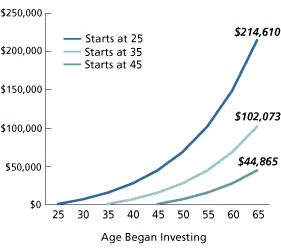 and one at age 45, investing a total of $20,000. Each earns 7 percent per year and, for purposes of this illustration, the effects of taxes and inflation are ignored.
  Vanguard has just announced some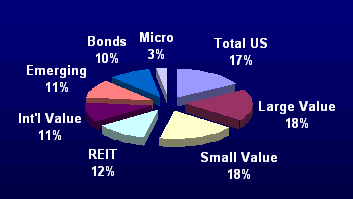
 I’ve been trying recently to try and make some minor adjustments to the target asset allocations of my portfolio. I want to create something that I won’t be tempted to change again for many years. While attempting this, I keep noticing how hard it is for a beginning investor to try and figure out where to put their hard-earned money. So many websites, books, magazines, television shows… and the amount of information being thrown at you just seems to multiply daily. Everybody has an opinion, including me. Am I right?
  One
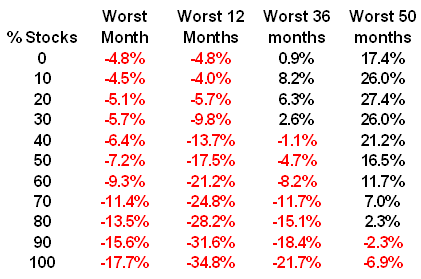
One 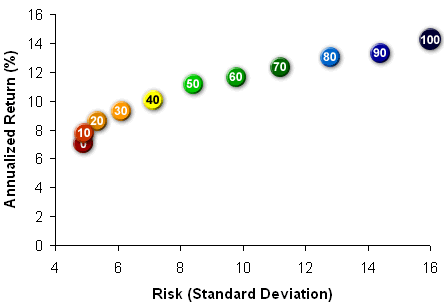
 The Best Credit Card Bonus Offers – 2026
 Big List of Free Stocks from Brokerage Apps
 Best Interest Rates on Cash - 2026
 Free Credit Scores x 3 + Free Credit Monitoring
 Best No Fee 0% APR Balance Transfer Offers
 Little-Known Cellular Data Plans That Can Save Big Money
 How To Haggle Your Cable or Direct TV Bill
 Big List of Free Consumer Data Reports (Credit, Rent, Work)