If you own a target retirement fund, you probably own a decent chunk of international stocks. However, these days it’s harder to find people telling you to own international stocks when you build your own portfolio, mostly because of the outperformance of US stocks over non-US stocks for long time now. The article International Diversification – Still Not Crazy after All These Years does a good job of reminding us why owning some international stocks is still a good idea. Here’s the brief summary:
International diversification has hurt US-based investors for over 30 years, but the long-run case for it remains relevant. Both financial theory and common sense favor international diversification, which is buttressed by empirical evidence that is very supportive at longer horizons and for active strategies. Finally, it would be dangerous to extrapolate the post-1990 outperformance of US equities, as it mainly reflects rising relative valuations. If anything, the current richness of US equities may point to prospective underperformance.
For one, the diversification benefits in times of market crashes are still there… as long as you expand your time horizon. The major risk for a US-only portfolio is a prolonged recession in the US, while the rest of the world recovers more quickly. The “insurance” analogy still applies as historically there has definitely been a cushioning effect over time from spreading your bets.
Exhibit 1 shows that over short horizons, global portfolios (dashed) can suffer almost as much as an average local portfolio (dot- ted); but once you look out a couple years or so, global portfolios fare much better.

Exhibit 2 tracks the Shiller CAPE ratio (Cyclically-Adjusted Price/Earnings ratio) of US stocks and EAFE developed international stocks. The red line represents ratio between the US and EAFE valuations. Much of the historical outperformance of the US over EAFA stocks since 1990 was not earnings growth itself, but expansion of the P/E ratio (how much you pay for those earnings).
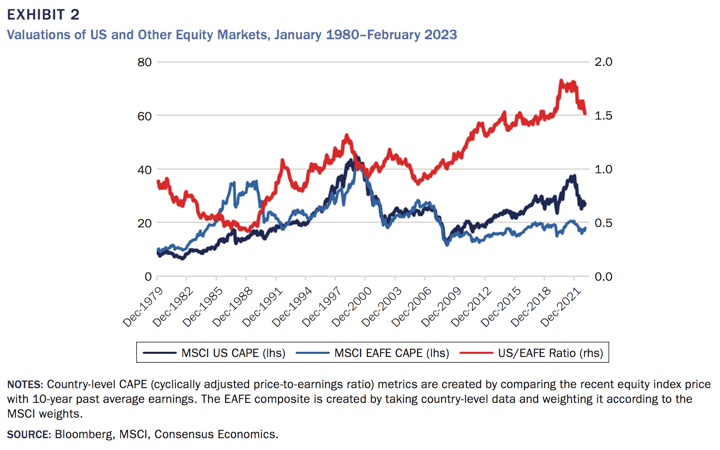
Will US stocks permanently maintain a P/E ratio that is 50% higher than international stocks? I have no idea, but it’s definitely not a sure thing. I let my portfolio asset allocation float with the market weightings (with a slight US tilt since I live here), so I don’t really worry about it because if US stocks keep growing faster than international stocks, then I’ll just gradually end up owning more US stocks while paying a sort of insurance premium hit for owning the international stocks. But if international stocks end up making even a minor improvement like a return to valuation ratios pre-2010, my portfolio can still benefit.


 One of the concerns about contributing to 529 plan for college savings is that you won’t end up using all the money and end up being hit with additional taxes (at ordinary income rates) and penalties on an non-qualified withdrawal. The funds potentially would have been better off simply invested in a taxable brokerage account (and long-term capital gains rates).
  Here’s my monthly roundup of the best interest rates on cash as of May 2023, roughly sorted from shortest to longest maturities. We all need some safe assets for cash reserves or portfolio stability, and there are often lesser-known opportunities available to individual investors. Check out my
  Savings I Bonds are a unique, low-risk investment backed by the US Treasury that pay out a variable interest rate linked to inflation. With a holding period from 12 months to 30 years, you could own them as an alternative to bank certificates of deposit (they are liquid after 12 months) or bonds in your portfolio.

 Becky Quick had another CNBC interview with the Warren Buffett and Greg Abel of Berkshire Hathaway, likely as a preview to the annual shareholder meeting that is coming up soon in May. You can watch a replay of the interview via this
  William Bernstein has a new article titled
  The Best Credit Card Bonus Offers – 2026
 Big List of Free Stocks from Brokerage Apps
 Best Interest Rates on Cash - 2026
 Free Credit Scores x 3 + Free Credit Monitoring
 Best No Fee 0% APR Balance Transfer Offers
 Little-Known Cellular Data Plans That Can Save Big Money
 How To Haggle Your Cable or Direct TV Bill
 Big List of Free Consumer Data Reports (Credit, Rent, Work)