Archives for March 2024

MMB Portfolio Asset Allocation & Performance Update – April 2024 (Q1)

Here’s my 2024 Q1 update for our primary investment holdings (numbers taken after market close 3/29), including all of our combined 401k/403b/IRAs and taxable brokerage accounts but excluding our house and side portfolio of self-directed investments. Following the concept of skin in the game, the following is not a recommendation, but a sharing of our real-world, imperfect, low-cost, diversified DIY portfolio.

“Never ask anyone for their opinion, forecast, or recommendation. Just ask them what they have in their portfolio.” – Nassim Taleb

How I Track My Portfolio
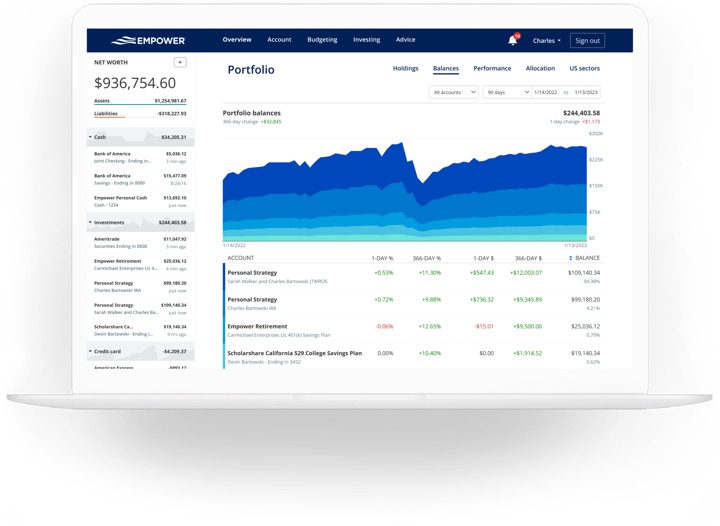
Here’s how I track my portfolio across multiple brokers and account types. There are limited free advanced options after Morningstar discontinued free access to their portfolio tracker. I use both Empower Personal Dashboard (previously known as Personal Capital) and a custom Google Spreadsheet to track my investment holdings:

  • The Empower Personal Dashboard real-time portfolio tracking tools (free) automatically logs into my different accounts, adds up my various balances, tracks my performance, and calculates my overall asset allocation daily. Formerly known as Personal Capital.
  • Once a quarter, I also update my manual Google Spreadsheet (free to copy, instructions) because it helps me calculate how much I need in each asset class to rebalance back towards my target asset allocation. I also create a new tab each quarter, so I have a personal archive of my holdings dating back many years.

2024 Q1 Asset Allocation and YTD Performance
Here are updated performance and asset allocation charts, per the “Holdings” and “Allocation” tabs of my Empower Personal Dashboard.

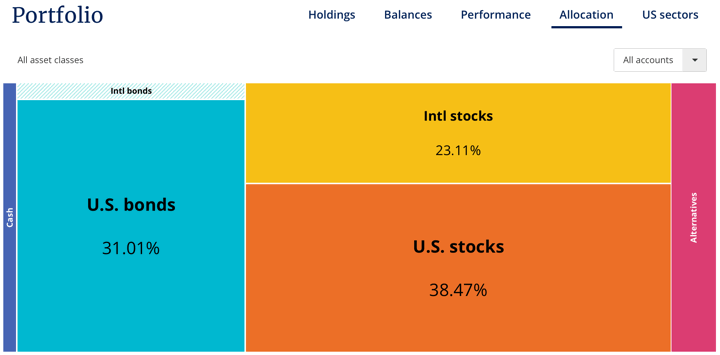
I own broad, low-cost exposure to productive assets that will provide long-term returns above inflation, distribute income via dividends and interest, and finally offer some historical tendencies to balance each other out. I have faith in the long-term benefit of owning businesses worldwide, as well as the stability of high-quality US Treasury debt. My stock holdings roughly follow the total world market cap breakdown at roughly 60% US and 40% ex-US. I add just a little “spice” to the broad funds with the inclusion of “small value” factor ETFs for US, Developed International, and Emerging Markets stocks as well as diversified real estate exposure through US REITs.

By paying minimal costs including management fees, transaction spreads, and tax drag, I am trying to essentially guarantee myself above-average net performance over time.

The portfolio that you can hold onto through the tough times is the best one for you. Every asset class will eventually have a low period, and you must have strong faith during these periods to earn those historically high returns. You have to keep owning and buying more stocks through the stock market crashes. You have to maintain and even buy more rental properties during a housing crunch, etc. A good sign is that if prices drop, you’ll want to buy more of that asset instead of less. I don’t have strong faith in the long-term results of commodities, gold, or bitcoin – so I don’t own them.

I do not spend a lot of time backtesting various model portfolios, as I don’t think picking through the details of the recent past will necessarily create superior future returns. You’ll usually find that whatever model portfolio is popular at the moment just happens to hold the asset class that has been the hottest recently as well.

I have settled into a long-term target ratio of roughly 70% stocks and 30% bonds within our investment strategy of buy, hold, and occasionally rebalance. My goal has evolved to more of a “perpetual income portfolio” as opposed to a “build up a big stash and hope it lasts until I die” portfolio. My target withdrawal rate is 3% or less. Here is a round-number breakdown of my target asset allocation along with my primary ETF holding for each asset class.

  • 35% US Total Market (VTI)
  • 5% US Small-Cap Value (VBR)
  • 15% International Total Market (VXUS)
  • 5% International Small-Cap Value (AVDV)
  • 10% US Real Estate (REIT) (VNQ)
  • 15% US “Regular” Treasury Bonds or FDIC-insured deposits
  • 15% US Treasury Inflation-Protected Bonds (or I Savings Bonds)

Performance details. According to Empower, my portfolio is up about 5% so far in 2024. The S&P 500 is up about 10% YTD, while the US Bond index is down around 1%. I hold enough bonds and international stocks that I’m always going to be lagging the hottest sector, and I’m pretty much used to that now.

As usual, not much action. These quarterly updates are mostly for me to manually log into all my accounts to make sure they still exist. I didn’t sell a single share of anything. I did reinvest some dividends and interest into TIPS and Treasury bonds to bring me back towards my target numbers. I also made my 2024 contributions to a Backdoor Roth IRA and bought VNQ in it.

I’ll share about more about the income aspect in a separate post.
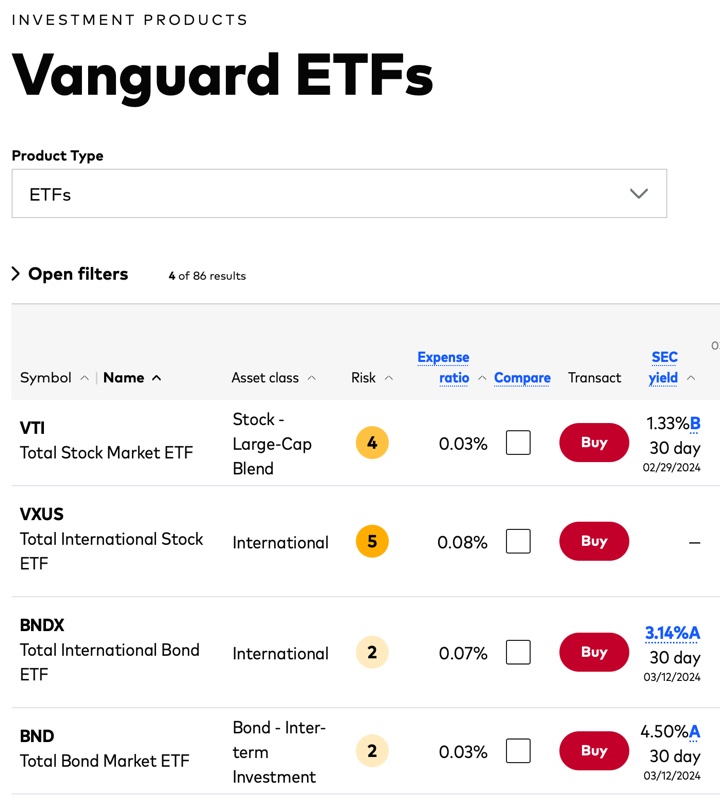
Finally Converted my Vanguard Mutual Fund Admiral Shares to ETF Equivalents in 2024

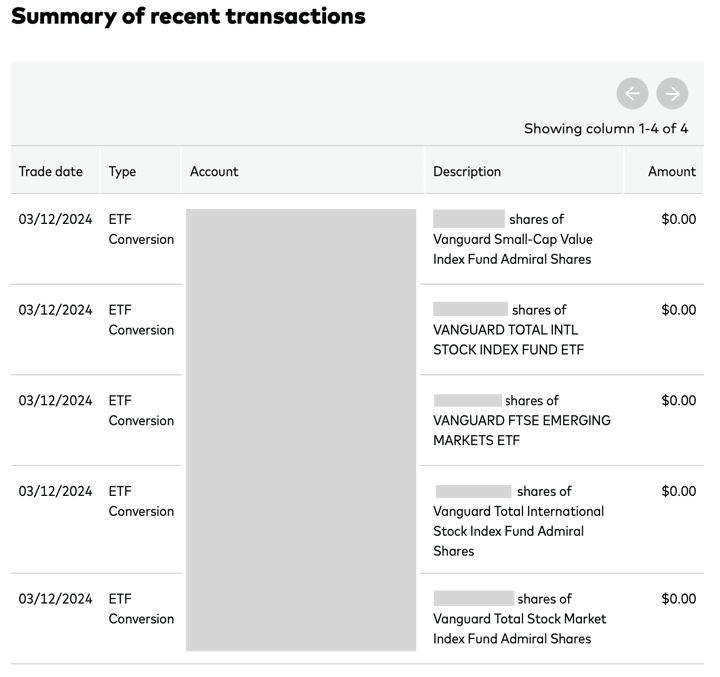
I recently decided to convert my Vanguard mutual fund shares into each of their respective ETF equivalents. These were all held inside a Vanguard.com brokerage account. I remember first considering this mutual fund to ETF option way back in 2010 (aspects of that article may now be outdated). Instead of covering all of the possible decision factors, here I’ll just document my own personal factors and my experience completing the process.

Why did it take 14 years for me to convert my Vanguard mutual fund shares?

Back in 2010, here was my rationale for staying put:

  • I had no plans to ever leave Vanguard as my primary brokerage custodian. Everything worked well enough; I had no complaints. My personal financial situation was also relatively simple.
  • Vanguard was still simple. Minimal annoying fees. Things were somewhat barebones but everything worked for the most part. A human answered the phone relatively quickly. They sent me paper statements for free. My account only allowed mutual funds, no individual stocks. Vanguard had the vibe that “We’re different and that’s fine. People aligned with our views will find us.”
  • The expense ratios for ETFs and mutual funds were either identical or nearly idential and both had the same tax-efficiency due to their share class construction. For a long time, the Admiral and ETFs remained at pretty much the same cost. When you buy ETFs, there are also bid/ask spreads and premiums/discounts to NAV to navigate. Any tiny difference in performance could be wiped out by all this “noise”.
  • I preferred the simplicity and ease of dollar-based transactions. For example, back then if I had $1,000 to invest in VTI, at the current share price of $256, I would only be able to purchase three VTI shares and the remaining would remain in $232 cash.

Fast forward to 2024, and things were a little different:

  • I am seriously considering leaving Vanguard as my primary brokerage custodian. This came after a few frustrating incidents and long hold times, in which I felt that it would be easier on my spouse if our assets were located at a place committed to top customer service. Essentially, an estate planning issue after handling my parent’s finances. There are definitely good and helpful people at Vanguard, but the level of service is not nearly as consistent as with Fidelity. If I consolidated, then there would also be one less major account to manage. Many outside brokerages won’t trade Vanguard mutual funds (besides full sales), so this was the main reason for converting to ETFs.
  • Vanguard is trying to grow assets as hard as everyone else. Vanguard still has a low-cost structure, but now it just seems like it wants more, more, more. The CEO is leaving under questionable circumstances without a replacement ready from within, so they are likely hiring an outsider. (Tim Buckley started as Jack Bogle’s research assistant 33 years ago!) The Vanguard now serves me more browser pop-up windows (e-statements) and upsell ads (Advisory services) than both Fidelity and Schwab. For example, Fidelity mails me paper statements for free. This is helpful for older people that may lose track of accounts. Vanguard wants $25 a year for every single account unless I have $5 million. In that case, why not simply own Vanguard ETFs inside a Fidelity brokerage account? If Vanguard hires a CEO from another brokerage company, that just shows the direction the ship is heading.
  • The expense ratio spread has widened slightly to the range of 0.01% up to 0.06% (VWO). This is still not a big deal to me, but it is apparent that Vanguard gave up trying to maintain parity and in the future the ETFs will always be cheaper. The trend is a wider gap over time, not a narrower one. I rarely sell (or even buy) these days, so I have minimal transaction costs.
  • Vanguard now supports fractional share ownership for ETFs. Today, If I had $1,000 to invest in VTI, at the current share price of $256, I would be able to invest every penny and end up with 3.906 shares of VTI. Therefore, even if I do stay with Vanguard, I can still perform dollar-based transactions. The conversion is not a taxable event, so there is no tax impact.

Which Vanguard mutual funds can your convert? Although it hasn’t been updated since 2019 and thus may be outdated, this Vanguard PDF listing which mutual funds are convertible to ETFs may still be useful. Here are the specific mutual fund and ETF pairings (with expense ratios) that I converted and their expense ratios as of March 2024:

  • Vanguard Total Stock Market Index: VTSAX (0.04%) to VTI (0.03%). Difference of 0.01%.
  • Vanguard Total International Stock Index: VTIAX (0.12%) to VXUS (0.08%). Difference of 0.04%.
  • Vanguard Small-Cap Value Index: VSIAX (0.07%) to VBR (0.08%). No difference.
  • Vanguard Emerging Markets Stock Index: VTIAX (0.14%) to VWO (0.08%). Difference of 0.06%.
  • Vanguard Intermediate-Term Treasury Index VSIGX (0.07%) to VGIT (0.04%). Difference of 0.03%.

Again, the absolute differences in expense ratios aren’t that significant in my opinion unless you are talking in the millions. But the direction of the trend is pretty clear, and I do hope to have millions in each eventually. 🤑

Quick rundown of actual conversion process:

  • Download all cost basis information. You should log into your account and download all of the cost basis information for all your mutual fund shares. This is especially true for non-covered shares. The cost basis for covered shares should carry over, but it’s better to be safe.
  • I had to call Vanguard on the phone to initiate the conversion. Use the phone in your account or try 866-499-8473. (I could not find a way to do it online.) It took a couple jumps to find the right person, but after that the process was straightforward. As long as the request is entered before market close, it should go through at the end of that same day. Otherwise, it’ll be the next day. You will acknowledge that this is a one-way, non-reversible conversion. Again, you are not selling anything, so there is no taxable event.
  • The next day, my shiny new ETF holdings were available in my account. and I was also able to confirm that all of the tax lots for cost basis carried through without an issue. The conversion was done at the net asset value (NAV) of the funds at market close. All of my mutual fund shares were converted, and I was issued fractional shares of ETFs.

Typical Target Date Fund Glide Path vs. Simple Fixed Asset Allocation?

John Rekenthaler questions the industry-standard Target Date Fund glide path in the Morningstar article Should Target-Date Funds Allot More to Equities?. He runs tests comparing the traditional target date glide path alongside two alternatives:

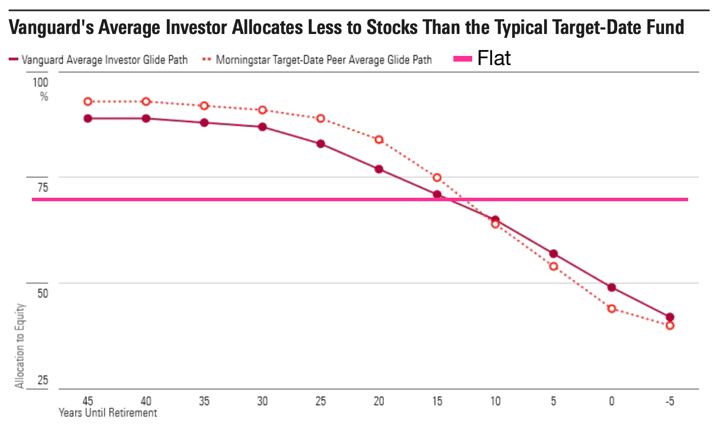
  • “Traditional” Target Date Glide Path: 85% stocks/15% bonds from ages 25 to 35. Stock % gradually decreases to 48% stocks from ages 35 to 65 (averages out to 70% stocks over the entire 40-year career).
  • Flat Glide Path: 70% stocks/30% bonds constant for all 40 years.
  • “Reverse” Target Date Glide Path: As another data point to explore, this starts at 48% and gradually increases to 85% stocks from 25 to 55 and then stays at 86% for age 55 yo 65 (last 10 years). Again, averages out to 70% stocks over the entire 40-year career.

This caught my eye because that’s pretty much my personal asset allocation: a fixed 70% stock/30% bond allocation that I intend to keep more or less forever. My background reasons are somewhat different, as my goal is a lower “perpetual” withdrawal rate from an earlier starting age than 65.

At the top of this post is a chart showing the average industry glide path alongside Vanguard’s popular fund series, also from Morningstar. I added the hot pink “Flat” line for illustration.

The article discusses many different wrinkles, but here is a chart summarizing the results based on the percentile scenario (99th is the 10th worst total return, 1st is nearly the best total return). Annual contributions start at $5,000, increase over the next 10 years to $10,000, increase again over the next 10 years to $15,000, and stay there (they also increase to adjust with inflation).

One way to summarize the results is that the Traditional glide path is relatively better in low return, worst-case scenarios. The Reverse glide path is relatively better in high return, best-case scenarios. The Flat strategy is in the middle, worse than Traditional in the low-return scenarios, but better than Traditional in the higher-return scenarios. The Traditional glide path is the most conservative with the most downside protection, which sounds like a reasonable choice for a default investment to me.

However, my personal takeaway is that there is less difference than you might think between the Flat and Traditional scenarios. Either one will work for the most part, as long as you stay invested the entire time. The most important factor is to pick the asset allocation method that lets you stay invested the entire time. For most people, I’d guess that is the default target date fund in their 401(k) plan. For me, I prefer my “perpetual” flat asset allocation that is closer to a classic balanced fund.

(I don’t see the Reverse scenario being very popular, but it might encourage some people to elevate their stock holdings over their entire career.)

Cummins & Atmus Filtration Odd Lot Tender Opportunity (Final Result: $4,819 Profit)

Final update 3/19/24: Cummins has released the final results of this exchange offer. See original post below for past details, although the opportunity has passed. The final proration factor was ~6.99%. However, those with “odd lots” of 99 shares or less were not subject to proration, which created an opportunity for smaller individual investors.

Here are my stats:

  • Bought 99 shares of CMI @265.86 (2/26) for $26,320.14
  • Tendered all 99 shares, exchanged for 1190.95 shares of ATMU.
  • Received 1190 ATMU shares and $25.24 cash for the partial shares of ATMU (3/19).
  • Sold 1190 shares of ATMU @26.15 and 26.14 for $21,076.68 and $10,037.66, respectively (3/19).

Net profit of $4,819.44. This took a total of 23 calendar days, so that works out to an internal rate of return of 1527.59% 🤑 according to my financial calculator. (At 5% APY, my return over 23 days would be about $80.) The absolute ROI is 4819/26320 = 18.3%. Not bad for less than a month! I hope that it worked out just as well for everyone who chose to participate.

Update 3/15/24: This exchange offer is now expired and the preliminary results have been released. The final exchange ratio was 12.0298, which means 99 CMI shares will be exchanged for 1190.95 ATMU shares. Out of the 5,574,050 shares that will be accepted for tender, 1,006,609 of those shares were from odd lot holders. That’s a relatively high amount, but still less than 20% of the total and odd lot holders won’t be pro-rated. On the other hand, everyone else who held more than 99 shares will be pro-rated down to approximately 6.7% of tendered shares.

ATMU has been seeing a lot of short interest, and may even be experiencing a bit of a “short squeeze” right now. This may be partially due to people hedging their bets on the stock. ATMU stock is up about 17% since this exchange was announced in mid-February. You might have made more money simply buying ATMU at the announcement rather than participating in the exchange! (You could have even made more money letting people borrow those shares to short.) As I said, this is as much an educational opportunity as a profit opportunity. I’ll have to keep an eye out for the ATMU shares showing up in my account. The two choices are to (1) sell all shares immediately, or (2) hold the ATMU shares for a couple months until the short interests and other market pressures subside. I’ll probably do the former, but here is another opinion on the latter.

I have no idea what the value of ATMU will be when the shares arrive (rough guess 0-2 weeks) and when I sell, so I won’t bother to post speculative numbers. I will provide a final update after selling.

Original post from 2/25/24:

Back in May 2023, Cummins (CMI) spun off a company called Atmus Filtration Technologies (ATMU) which makes products for commercial vehicles and equipment (think big rigs, agricultural machines, and yellow construction equipment). Cummins still owns about 80% of ATMU and are trying to complete the split-off via an exchange offer to CMI shareholders: tender $100 of CMI and receive $107.53 of ATMU in return.

Similar to the Johnson & Johnson odd lot tender from last year, this ~7.5% premium is meant to incentivize the deal and make sure it happens successfully, and as a result it may be “oversubscribed” with tenders having to be pro-rated. However, there is an “odd lot” provision in the deal, where if you only have 99 shares of less of CMI and tender them all, you won’t be subject to pro-ration. This is a corner of the market where small individual investors have an advantage that the bigger money can’t access.

Please know upfront that I’m not an expert on this stuff, and there are risks involved. The following two articles and the official informational site explain the various details and risks in much better detail.

From the official site above that tracks the share prices for the exact tender ratio (upper limit not in effect at time of writing):

If the Exchange Offer is oversubscribed and Cummins cannot accept all tenders of Cummins Common Stock at the exchange ratio, then all shares of Cummins Common Stock that are validly tendered will generally be accepted for exchange on a pro rata basis in proportion to the number of shares validly tendered, which is referred to as “proration.” Stockholders who beneficially own “odd-lots” (less than 100 shares) of Cummins Common Stock and who validly tender all of their shares will not be subject to proration. Direct or beneficial holders of 100 or more shares of Cummins Common Stock will be subject to proration.

For each $100 of Cummins Common Stock accepted in the Exchange Offer, you will receive approximately $107.53 of Atmus Common Stock, subject to an upper limit of 13.3965 shares of Atmus Common Stock per share of Cummins Common Stock. The Exchange Offer does not provide for a lower limit or minimum exchange ratio. See “The Exchange Offer — Terms of the Exchange Offer” in the Prospectus. IF THE UPPER LIMIT IS IN EFFECT, YOU MAY RECEIVE LESS THAN $107.53 OF ATMUS COMMON STOCK FOR EACH $100 OF CUMMINS COMMON STOCK THAT YOU TENDER, AND YOU COULD RECEIVE MUCH LESS.

To quickly summarize the potential deal:

  • Buy 99 shares* of CMI at your broker, for an approximate cost of $26,133 (as of market close 2/23, will change daily).
  • Tender ALL your shares through your broker. You can’t own 100+ shares and only tender 99. The deadline is supposed to be March 13, 2024, but some brokers may require your tender instructions earlier than that. (At Fidelity, it is 03/12/2024 7:00 PM ET.) Your broker may have an online form to fill out (look for “Corporation Actions”, or you’ll have to call them).
  • If all goes smoothly (not guaranteed!), then you’ll get ~$28,100 of ATMU approximately 7 business days after the deadline. You can then sell the shares for cash if you are not interested in actually holding the stock as an investment. At the 7.5% premium, the potential profit is ~$1,960. You may get less depending on the relative share prices of CMI and ATMU.
  • * You can buy less than 99 shares for less financial commitment (and less upside), but you have to tender them all.

This is the type of deal that I find both interesting and educational, on top of having a positive expected value. Warren Buffett today wouldn’t bother with this deal, but Warren Buffett age 14 might. This is a calculated gamble, rather than a fixed return. There is risk involved, including either the deal being canceled somehow (you end up with 99 shares of CMI at whatever market price) or the limit ratio being reached and you get less than a 7.5% premium of ATMU shares. This is also an area where a broker with good customer service is useful (I use Fidelity). You should perform your own due diligence.

Disclosure: I ended up deciding to participate and bought 99 shares of CMI after publication of this post (which was on a Sunday night). During mid-day trading on Monday, I bought 99 shares at $265.xx a share. This is not a recommendation to buy.

Axos Bank Cashback Checking $300 Bonus w/ Direct Deposit

Updated with new offer. Axos Bank has a $300 bonus with relatively straightforward requirements using promo code FREEDOM300. You must open a new Cashback Checking account by 7/31/2024 and fund within 30 days of account opening. Set up direct deposit of $1,000+ each calendar month, and that will earn you $100 per month for 3 months ($300 total). Historically, they have been pretty flexible on what is considered direct deposit.

The fine print:

To be eligible to earn all or a portion of the cash incentive as part of the “FREEDOM300″ $300 promotion, an Axos Bank CashBack Checking account that includes the promotional code ” FREEDOM300″ must be opened between November 1, 2023, at 12 a.m. PST and July 31, 2024, at 11:59 p.m. PST. Axos Bank reserves the right to limit each primary account holder to one (1) checking account promotional offer per year, and customers who have held primary ownership of an Axos Bank or Axos Bank for Nationwide checking account at any time in the past 12 months may be disqualified from the “FREEDOM300” offer. Promotional terms and conditions are subject to change or removal without notice. Bonus cash may be taxable and reported on IRS Form 1099-MISC. Consult your tax advisor. After meeting the initial requirements mentioned above, the amount of cash bonus earned will depend on meeting the additional requirements outlined below:

To earn up to a $300 bonus, you must be approved for your new Axos Bank CashBack Checking account, fund it within 30 days of account opening, and have qualifying direct deposits that total at least $1,000.00 each calendar month. A cash bonus of up to $300 can be earned in the following manner during the first four (4) statement cycles. A statement cycle is a calendar month consisting of the days your account was open during that month. A maximum of three (3) payouts of $100 for each calendar month that the CashBack Checking account is receiving the direct deposit requirement, the bonus can be earned during the first four (4) statement cycles, and the bonus will be deposited into your Axos Bank CashBack Checking account within 10 business days following the end of the statement cycle in which the direct deposit requirement was met. Your Axos Bank CashBack Checking account must be open and in good standing at the time the bonus is paid to be eligible to receive the bonus, and your Axos Bank CashBack Checking account must remain open for 120 days, or an early closure fee of up to $300 may apply, equal to the amount of the total bonus earned up to $300.

I’ve done a few Axos Bank bonuses in the past (too recent for me to qualify for this), and the good news is that they do pay out reliably in my experience.

First Tech Credit Union: $300 Rewards Checking Account Bonus

Updated with new bonus details. First Tech Federal Credit Union has a new $300 checking bonus. This new promo is set to run through 6/30/24, but is specifically for their new Reward Checking account that pays up to 5.00% APY (on up to $15,000 balance) if you meet a bunch of different hoops including 20 debit card transactions with $500+ in monthly spend. However, you can still get the $300 without meeting the 5.00% APY requirements. This promo is also valid for existing First Tech Rewards checking account owners who have not set up a direct deposit yet.

Here’s how to make it happen:

1) Open a First Tech Reward Checking account. Already have one? You’re set!
2) Set up a new payroll direct deposit to your First Tech Rewards Checking of $1,000+ per month for a minimum of three months.
3) Earn your $300 bonus!

When I applied for a previous promo, First Tech CU paid the $8 membership fee for the partner organization on my behalf so that I could join the credit union, although they mentioned it might be eventually be reported on 1099-INT. I did not experience a hard credit check, although they did a soft check on Experian.

The monthly requirements for earning the 5.00% APY interest (on up to $15,000 balance) are:

  • 20 card transactions with $500+ in monthly spend.
  • Electronic statements
  • ACH / direct deposit $1,000+ monthly

Offer valid for enrollment between February 26, 2024 and June 30, 2024 for members without an existing direct deposit. Members with existing direct deposits or who are already enrolled in a First Tech direct deposit campaign are not eligible. Participant is defined as 18 years of age or older and the primary account owner on a First Tech Rewards Checking (FTRC) account. Direct deposits are considered new if there has been no direct deposit activity in the Participant’s share accounts on which they are the Primary Owner within the previous 18 months. Membership is required and is subject to approval. Fees could reduce earnings on the account. FTRC accounts must be personal accounts. Fiduciary, trust, business, or organization accounts are not eligible. Participant will be enrolled in the promotion upon receipt of new direct deposit transaction into the FTRC account (“Enrollment”). In order to receive any bonus payout, in addition to satisfying the payout conditions set forth in this disclosure, the Membership Savings account must be in good standing (not in default, closed, inactive, or otherwise not in good standing) during the period of time commencing with Enrollment and ending with the applicable date of payout. Any inquiries or disputes must be received by January 31, 2025.

New Direct Deposit Offer: New direct deposit must occur at least on New Direct Deposit Offer: New direct deposit must occur at least once per calendar month from the Participant’s employer payroll into the First Tech Rewards Checking (FTRC) account of which the Participant is the primary account owner. Direct deposits from a non-employer payroll source do not qualify. The monthly aggregate amount of all qualifying direct deposits must equal to at least $1,000 to earn the $300 bonus. Enrollment is the date of the initial direct deposit transaction. During the period of time commencing with Enrollment and ending 120 calendar days after Enrollment (“Enrollment Period”), at least one direct deposit transaction must occur each calendar month starting with the initial direct deposit transaction. A minimum of three direct deposit transactions must be received during the Enrollment Period. (EXAMPLE: If a member’s initial direct deposit is March 1, 2024, additional required direct deposits must occur at least once in each subsequent calendar month following the month in which the initial direct deposit is made, the last direct deposit must be received by June 29, 2024.) Only the Participant will receive credit for the direct deposits. Any qualifying bonus will be deposited to the Participant’s Membership Savings account the first week following the Enrollment Period. Bonuses will be considered dividends and may be reported on IRS form 1099-INT.

Social Security Optimizer by T. Rowe Price: New Free Retirement Income Tool

T. Rowe Price (TRP) announced a new free tool called Social Security Optimizer to help decide when to start claiming Social Security benefits. You enter information like age, marital status, life expectancy, spousal information, and “Monthly Benefit Amount At Full Retirement Age”. It will ask you to register with your email address, but it is otherwise free. (After you register, you also get access to other free TRP tools.)

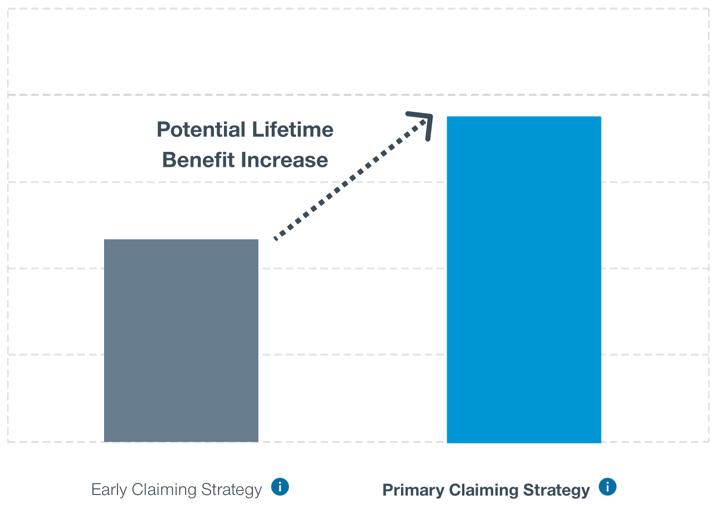
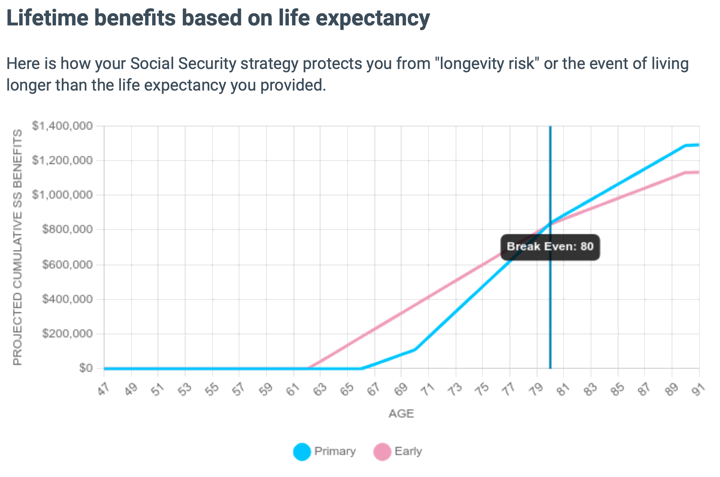
The new tool, which provides tailored insights through analysis of an individual’s specific circumstances, estimates when to begin claiming Social Security and how much they should expect to receive. Social Security Optimizer can also model life expectancy to see what claiming strategies will yield the most amount of money over time based on the inputted life expectancy. Individuals are guided through a short series of questions. The tool will then estimate the optimal age to take Social Security, the optimal age for their partner to take Social Security, and the amount of benefit the individual (and their partner) will receive, given their assumed life expectancy. The Social Security Optimizer also pairs broader education and resources to help individual investors and plan participants make more informed decisions.

Based on my initial tests, the tool is on the basic side. They do recommend a specific claiming strategy and provide some useful background information about how Social Security works, but it doesn’t go into much detail about all of the possible scenarios. I was honestly hoping for something more full-featured given that in March 2023, T. Rowe Price announced that it was acquiring Retiree Inc., which included several advanced software tools for both individuals and professional financial advisors like SSAnalyzer.com, Income Solver®, and Social Security Solutions™.

I’d still recommend checking it out, as Social Security claim timing is a big decision and I think exploring and using all available information is a good idea. These tools can introduce a lot of people to ideas that they would have not otherwise considered, like perhaps having one spouse claim as early as possible (age 62), and then have the other claim as late as possible (age 70).

Other free third-party Social Security tools that I recommend trying out include Open Social Security and SSA.tools.

A reminder that this tool (and all the others) will help to maximize the total income that you receive from Social Security. Often this means one or both spouses delay their claim date to age 70. This works out fine if you have alternative sources of income while you delay your claim start date. However, if you need the Social Security income to retire sooner (often now), then that is a new variable to work in. Income that lets you retire and stop working today when you are younger and healthier may be worth more than what comes out of some discounted interest rate analysis.

I’ve also found there is often a behavioral psychology element. For example, if one spouse stops working first while the other continues to work, the non-working spouse may feel an urge to have their “own income” and want to start claiming Social Security as soon as possible.

Self-Paced CFP: Common Examples of Negligence by Financial Advisors (Course Notes #2)

In keeping with my goal of finishing one course per month from the University of Georgia Self-Paced CFP education program, I wrapped up the first course “Fundamentals of Financial Planning” in February (barely). Here were the topics covered (source):

  • The Personal Financial Planning Process
  • Economic Concepts and Consumer Protection Laws
  • Personal Financial Statements
  • Managing Cash Flow and Debt
  • Using the HP-12C Calculator
  • Using the HP-10bII Calculator
  • Educational Savings Techniques
  • Educational Aid and Funding Calculation
  • Regulation of Financial Planners
  • CFP Board Regulatory Requirements

I previously covered the official 7-Step Financial Planning Process in Notes #1, which was enlightening. I ended up spending the most time overall on the HP-12C calculator section, as it took several reps to learn and memorize how to use all of the specialized buttons for the financial calculator.

I personally didn’t learn much new in the Educational Savings and Aid sections, given my previous research as a parent and owner of multiple 529 plans. It did provide a good generic overview for those that haven’t gone down that rabbit hole.

In terms of new practical information, I again found it helpful when they showed me the perspective of practicing advisors. The course wisely warns potential CFPs of the most common mistakes that have resulted in negligence lawsuits…

  • Failure to address risk of disability.
  • Failure to address risk of property loss and attached liability.
  • Failure to timely process a client’s deposit check, resulting in the loss of potential investment gains.
  • Recommending unsuitable investments.
  • Recommending only those products which result in high fees to the planner.
  • Failure to adequately educate the client regarding investment risks, costs, and benefits.
  • Charging fees that were not first disclosed and agreed upon with the client.
  • Failure to monitor investments on the schedule agreed upon in the engagement letter.

In turn, these items can be flipped to create a checklist for the individual client:

  • Do you have adequate disability insurance?
  • Do you have adequate homeowners/rental/landlord insurance, car/boat/vehicle insurance, umbrella liability insurance?
  • After sending in money, did you follow-up to confirm that your funds were deposited and invested as promised?
  • Do you feel that you fully understand the investments made on your behalf? Do you understand why they are better than other alternatives?
  • Did you receive a clear list of all the fees charged?
  • Are you receiving updates that your investments being monitored as promised?

Photo by Reba Spike on Unsplash

Point.me x American Express Membership Rewards: Free Award Flight Search Tool

American Express has partnered with the Point.me award travel tool to provide free flight searches for the airline loyalty programs that work with American Express Membership Rewards points. The special site is AmEx.Point.me, where you must log into your American Express account.

With point.me for Membership Rewards® points, eligible Card Members have access to a real time reward-flight search engine. POINT.ME makes it easy to see all of the options, and choose the flight that works best for you before transferring Membership Rewards® points to eligible airline loyalty programs through your Membership Rewards® account.

I am hopeful for this new service, as Membership Rewards has a lot of transfer partners but it can be hard to find the best flights across them all. (Bilt Rewards has also partnered with Point.me for free award searches.) The searches can take a while to finish, but hopefully it’s still better than searching manually. The full version of the Point.me website usually costs $12 a month or $129 a year for all airlines (first 3 searches free). There is also a more expensive Concierge service where a human expert will handle everything for $200/person.

Loyalty programs have been around for decades, especially in the airline industry. However, booking award travel can feel cumbersome, like you’re jumping through multiple hoops just to book a flight! This is where point.me comes in. We’re the first company to offer a tool that makes it easier to use miles and points for air travel. Not only does our tool show you flight options that are bookable using your points, we also guide you step-by-step to book the flight yourself!

Also see: Top 10 Best Credit Card Bonus Offers.

Top 10 Best Small Business Card Bonus Offers.

Greenlight Debit Card For Kids: Free Subscription for PSECU Members ($60/year Value)

Greenlight is a popular reloadable debit card service for kids, where parents can manage and track their kids spending. You can also add an allowance, payments for recurring chores or one-time jobs, and teach them compound interest via “parent-paid interest”. I suppose its wise to show the kids how handle digital spending before the credit card offers arrive.

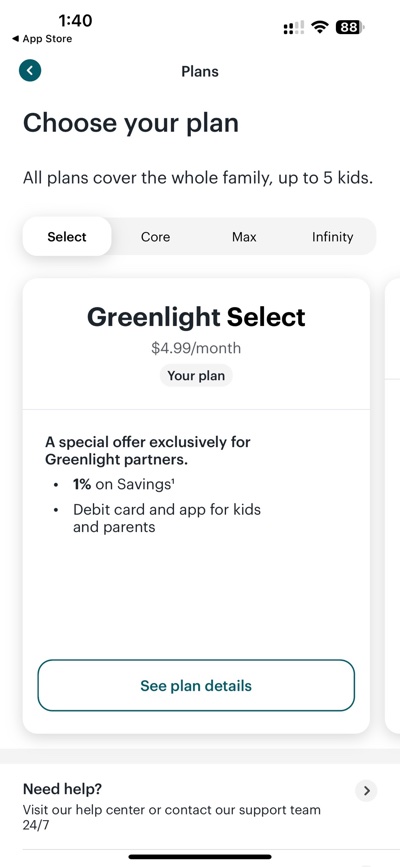
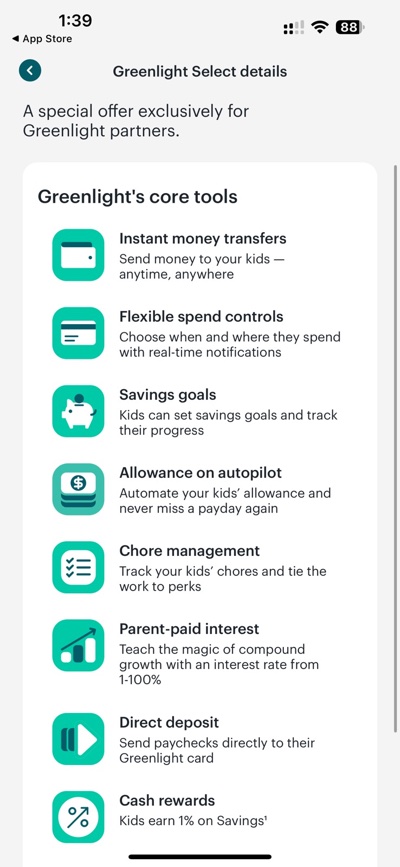
I decided to try out the new PSECU perk that offers the basic tier of Greenlight for free. (I did the PSECU $300 checking promo first.) You must enroll at Greenlight.com/PSECU and link a PSECU checking account in order to get the benefit. The “Greenlight Select” membership is a special tier for such partners, but is mostly comparable to the “Greenlight Core” tier on their website, which costs $4.99 a month. Included in the “Greenlight Select” membership:

  • Debit Mastercards for up to 5 kids. Send money instantly and keep tabs on spending with real-time notifications.
  • Educational app. The parents have their app where they get notified of every purchase, and the kids have their own app with educational games and short lessons (optional). Kids can divide their money into “savings” or “giving” baskets as well as create specific savings goals.
  • Parental controls. Created automated allowance payments. Set category and store-level spending limits.
  • 1% APY interest. This is the lowest tier and the lowest interest, although some other apps don’t pay any interest at all. You can get up to 5% APY on $5,000 if you upgrade to the $15/month tier.
  • Roundup feature. You can set it to round up purchases to the next dollar and put the difference in a savings account.
  • No overdraft fees. Does not allow overdrafts, so no overdraft fees.
  • Banking services provided by Community Federal Savings Bank, member FDIC.

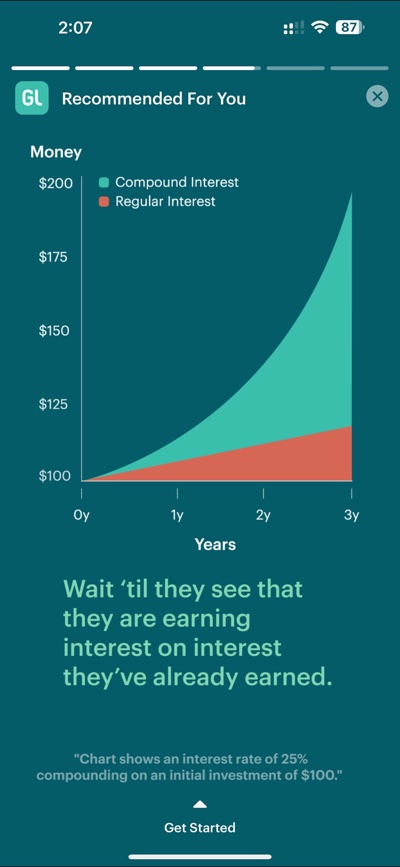
Teaching compound interest with higher interest rates. It can be hard to visualize compound interest at low interest rates, so parents can increase it by paying a higher “interest” rate out of their own pockets. For example, here is an illustration of $100 earning a 25% interest rate (paid by the parent) as opposed to a 5% interest rate. It makes the idea of earning interest on interest more immediate and tangible. Ideally, this can teach them that delayed gratification turns it into future rewards. You can set interest rates from 1% up to 100%.

Unfortunately, to add on investments, I would have to upgrade to the $10 a month tier or higher. If I had a teen ready for investing, I’d probably use the Fidelity Youth account instead (available for age 13-17 only, and my kids aren’t that old yet).

For kids under 13, I think that Greenlight would serve as a nice alternative to piggy banks. (Greenlight has no minimum age requirement.) While I suppose $5 a month isn’t a lot of money for all these features, I still like “free” better. After a few quick internet searches for “Greenlight Select”, I found multiple local banks and credit unions in my area that offered this free tier of service. If you plan on paying for it, there is $30 bonus available with a 1-month free trial (bonus not stackable with this free offer).

UBS Global Investment Returns Yearbook 2024: The Haystack Keeps Changing

The 25th edition of the UBS Global Investment Returns Yearbook is available for free download in a 56-page PDF Summary Edition version on the UBS website. (Credit Suisse took over the publication of this yearbook in 2009, and UBS was voluntold to acquire Credit Suisse in 2023.) Hat tip to Abnormal Returns. This publication provides a nice “big picture” overview of the long-term performance of global financial assets:

With the depth and breadth of the financial database that underpins it, the UBS Global Investment Returns Yearbook is widely recognized as the unrivalled authority on long-term investment returns. We present a historical record of the real returns from equities, bonds, cash and currencies for 35 markets, spanning developed and emerging markets and stretching back to 1900.

The late Jack Bogle was often credit with the saying: “Don’t look for the needle in the haystack. Just buy the haystack.”

If you look at the entire haystack of individual companies, over time there are a lot of losers and a few big winners. If you buy the entire investable US stock market, or the entire investable world stock market, you can be sure that you own all the eventual winners. Even if you bought the S&P 500 index in the 80s or 90s, you would eventually own Apple, Google, Nvidia, and so on. For example, who knows who the final winner in the AI battle will be?

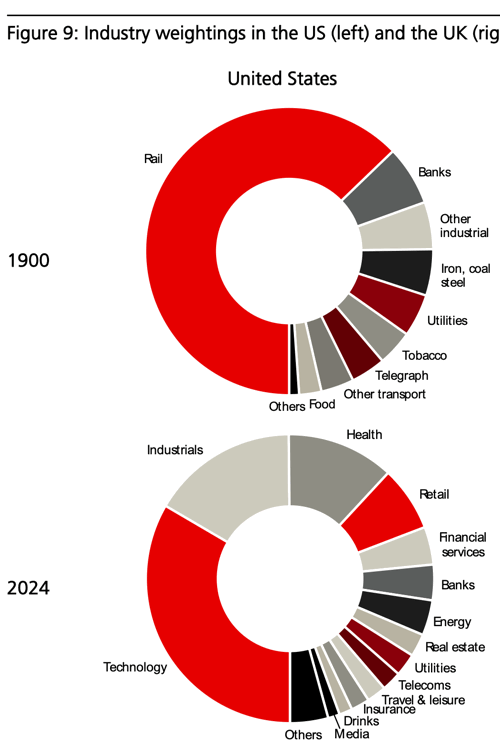
I recommend scrolling through the Yearbook Summary just to look at the cool charts with data from 1900. Check out how different the US stock market looked in 1900 vs 2024:

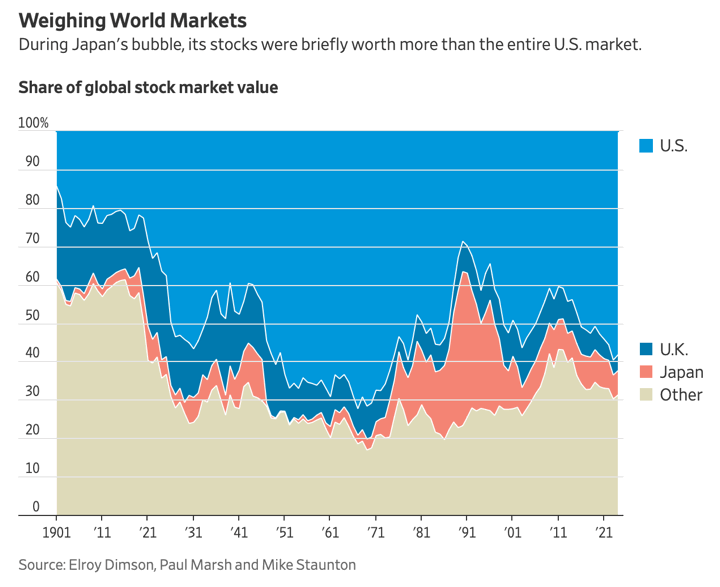
I think about international diversification in a similar way. Inside a recent WSJ article (gift article) about Japan’s Nikkei stock index reaching its previous high from 1989, there was an updated chart of the historical breakdown of global stock market value between the US and the rest of the world. Upon closer inspection, I realized that the chart is based on one from the UBS Yearbook.

The US made up only about 15% of the world’s market cap in 1900, had a recent low of about 40% in 2010, but after the recent run is now over 60%. What will happen in the future? If you think US stocks will outperform the rest of the world over the next decade or longer, you are then betting that this 60% number will continue to increase. And it might! It’s been as high as about 70% in the past.

As for me, I simply don’t know. I’ll hopefully have 40+ more years being invested in the stock market, and the haystack will continue to change. I choose to maintain diversification and “own the haystack” when it comes to both individual US companies and global countries. I prefer to know I’ll own the needles and have less worry, even at the cost of potentially somewhat lower returns.

Best Interest Rates on Cash Roundup – March 2024

Here’s my monthly roundup of the best interest rates on cash as of March 2024, roughly sorted from shortest to longest maturities. There are lesser-known opportunities available to individual investors, often earning you a lot more money while keeping the same level of safety by moving to another FDIC-insured bank or NCUA-insured credit union. Check out my Ultimate Rate-Chaser Calculator to see how much extra interest you could earn from switching. Rates listed are available to everyone nationwide. Rates checked as of 3/4/2024.

TL;DR: Mostly minor movements. Still 5%+ savings accounts and short-term CDs, but no more 5-year CDs at 5% APY. Compare against Treasury bills and bonds at every maturity, taking into account state tax exemption.

Fintech accounts
Available only to individual investors, fintech companies often pay higher-than-market rates in order to achieve fast short-term growth (often using venture capital). “Fintech” is usually a software layer on top of a partner bank’s FDIC insurance.

  • 5.30% APY ($1 minimum). Raisin lets you switch between different FDIC-insured banks and NCUA-insured credit unions easily without opening a new account every time, and their liquid savings rates currently top out at 5.30% APY. See my Raisin review for details. Raisin does not charge depositors a fee for the service.
  • 5.36% APY (before fees). MaxMyInterest is another service that allows you to access and switch between different FDIC-insured banks. You can view their current banks and APYs here. As of 12/6/23, the highest rate is from Customers Bank at 5.36% APY. However, note that they charge a membership fee of 0.04% per quarter, or 0.16% per year (subject to $20 minimum per quarter, or $80 per year). That means if you have a $10,000 balance, then $80 a year = 0.80% per year. This service is meant for those with larger balances. You are allowed to cancel the service and keep the bank accounts, but then you may lose their specially-negotiated rates and cannot switch between banks anymore.

High-yield savings accounts
Since the huge megabanks STILL pay essentially no interest, everyone should have a separate, no-fee online savings account to piggy-back onto your existing checking account. The interest rates on savings accounts can drop at any time, so I list the top rates as well as competitive rates from banks with a history of competitive rates and solid user experience. Some banks will bait you with a temporary top rate and then lower the rates in the hopes that you are too lazy to leave.

  • The top rate at the moment is at Poppy Bank at 5.50% APY. BrioDirect at 5.35% APY. I have no personal experience with Poppy or Brio, but they are the top rates at the moment. (Milli dropped to 4.75%.) CIT Platinum Savings at 5.05% APY with $5,000+ balance.
  • SoFi Bank is now up to 4.60% APY + up to $325 new account bonus with direct deposit. You must maintain a direct deposit of any amount each month for the higher APY. SoFi has historically competitive rates and full banking features. See details at $25 + $300 SoFi Money new account and deposit bonus.
  • Here is a limited survey of high-yield savings accounts. They aren’t the highest current rate, but historically have kept it relatively competitive and I like to track their history.

Short-term guaranteed rates (1 year and under)
A common question is what to do with a big pile of cash that you’re waiting to deploy shortly (plan to buy a house soon, just sold your house, just sold your business, legal settlement, inheritance). My usual advice is to keep things simple and take your time. If not a savings account, then put it in a flexible short-term CD under the FDIC limits until you have a plan.

  • No Penalty CDs offer a fixed interest rate that can never go down, but you can still take out your money (once) without any fees if you want to use it elsewhere. Raisin has a 4-month No Penalty CD at 5.30% APY with $1 minimum deposit and 30-day minimum hold time. CIT Bank has a 11-month No Penalty CD at 4.90% APY with a $1,000 minimum deposit. Ally Bank has a 11-month No Penalty CD at 4.00% APY for all balance tiers. Marcus has a 13-month No Penalty CD at 4.70% APY with a $500 minimum deposit. Consider opening multiple CDs in smaller increments for more flexibility.
  • Bask Bank has a 1-year certificate at 5.40% APY ($1,000 min). There is a 90-day interest penalty if you withdraw your CD funds before maturity.
  • CIBC Agility Online has a 13-month CD at 5.36% APY. Reasonable 30-day penalty if you withdraw your CD funds before maturity.

Money market mutual funds + Ultra-short bond ETFs
Many brokerage firms that pay out very little interest on their default cash sweep funds (and keep the difference for themselves). Note: Money market mutual funds are highly-regulated, but ultimately not FDIC-insured, so I would still stick with highly reputable firms. I am including a few ultra-short bond ETFs as they may be your best cash alternative in a brokerage account, but they may experience losses.

  • Vanguard Federal Money Market Fund is the default sweep option for Vanguard brokerage accounts, which has an SEC yield of 5.27% (changes daily, but also works out to a compound yield of 5.40%, which is better for comparing against APY). Odds are this is much higher than your own broker’s default cash sweep interest rate.
  • The PIMCO Enhanced Short Maturity Active Bond ETF (MINT) has a 5.34% SEC yield and the iShares Short Maturity Bond ETF (NEAR) has a 5.09% SEC yield while holding a portfolio of investment-grade bonds with an average duration of ~6 months.

Treasury Bills and Ultra-short Treasury ETFs
Another option is to buy individual Treasury bills which come in a variety of maturities from 4-weeks to 52-weeks and are fully backed by the US government. You can also invest in ETFs that hold a rotating basket of short-term Treasury Bills for you, while charging a small management fee for doing so. T-bill interest is exempt from state and local income taxes, which can make a significant difference in your effective yield.

  • You can build your own T-Bill ladder at TreasuryDirect.gov or via a brokerage account with a bond desk like Vanguard and Fidelity. Here are the current Treasury Bill rates. As of 3/4/24, a new 4-week T-Bill had the equivalent of 5.38% annualized interest and a 52-week T-Bill had the equivalent of 4.99% annualized interest.
  • The iShares 0-3 Month Treasury Bond ETF (SGOV) has a 5.19% SEC yield and effective duration of 0.10 years. SPDR Bloomberg Barclays 1-3 Month T-Bill ETF (BIL) has a 5.20% SEC yield and effective duration of 0.08 years.

US Savings Bonds
Series I Savings Bonds offer rates that are linked to inflation and backed by the US government. You must hold them for at least a year. If you redeem them within 5 years there is a penalty of the last 3 months of interest. The annual purchase limit for electronic I bonds is $10,000 per Social Security Number, available online at TreasuryDirect.gov. You can also buy an additional $5,000 in paper I bonds using your tax refund with IRS Form 8888.

  • “I Bonds” bought between November 2023 and April 2024 will earn a 5.27% rate for the first six months. The rate of the subsequent 6-month period will be based on inflation again. More on Savings Bonds here.
  • In mid-April 2023, the CPI will be announced and you will have a short period where you will have a very close estimate of the rate for the next 12 months. I will have another post up at that time.

Rewards checking accounts
These unique checking accounts pay above-average interest rates, but with unique risks. You have to jump through certain hoops which usually involve 10+ debit card purchases each cycle, a certain number of ACH/direct deposits, and/or a certain number of logins per month. If you make a mistake (or they judge that you did) you risk earning zero interest for that month. Some folks don’t mind the extra work and attention required, while others would rather not bother. Rates can also drop suddenly, leaving a “bait-and-switch” feeling.

  • OnPath Federal Credit Union pays 7.00% APY on up to $10,000 if you make 15 debit card purchases, opt into online statements, and login to online or mobile banking once per statement cycle. Anyone can join this credit union via $5 membership fee to join partner organization. You can also get a $100 Visa Reward card when you open a new account and make qualifying transactions.
  • Credit Union of New Jersey pays 6.00% APY on up to $25,000 if you make 15 debit card purchases, opt into online statements, and make at least 1 direct deposit, online bill payment, or automatic payment (ACH) per statement cycle. Anyone can join this credit union via $5 membership fee to join partner organization.
  • Andrews Federal Credit Union pays 6.00% APY on up to $25,000 if you make 15 debit card purchases, opt into online statements, and make at least 1 direct deposit or ACH transaction per statement cycle. Anyone can join this credit union via partner organization.
  • Pelican State Credit Union pays 6.05% APY on up to $20,000 if you make 15 debit card purchases, opt into online statements, log into your account at least once, and make at least 1 direct deposit, online bill payment, or automatic payment (ACH) per statement cycle. Anyone can join this credit union via partner organization membership.
  • Orion Federal Credit Union pays 6.00% APY on up to $10,000 if you make electronic deposits of $500+ each month (ACH transfers count) and spend $500+ on your Orion debit or credit card each month. Anyone can join this credit union via $10 membership fee to partner organization membership.
  • All America/Redneck Bank pays 5.30% APY on up to $15,000 if you make 10 debit card purchases each monthly cycle with online statements.
  • Find a locally-restricted rewards checking account at DepositAccounts.

Certificates of deposit (greater than 1 year)
CDs offer higher rates, but come with an early withdrawal penalty. By finding a bank CD with a reasonable early withdrawal penalty, you can enjoy higher rates but maintain access in a true emergency. Alternatively, consider building a CD ladder of different maturity lengths (ex. 1/2/3/4/5-years) such that you have access to part of the ladder each year, but your blended interest rate is higher than a savings account. When one CD matures, use that money to buy another 5-year CD to keep the ladder going. Some CDs also offer “add-ons” where you can deposit more funds if rates drop.

  • First Internet Bank has a 5-year CD at 4.61% APY. 4-year at 4.55% APY. 3-year at 4.76% APY. 2-year at 4.86% APY. 1-year at 5.36% APY. $1,000 minimum. The early withdrawal penalty (EWP) for CD maturities of 2 years or more is 360 days of interest. For CD maturity of 1 year, the EWP is 180 days of interest.
  • BMO Alto has a 5-year CD at 4.60% APY. 4-year at 4.60% APY. 3-year at 4.60% APY. 2-year at 4.75% APY. 1-year at 5.15% APY. No minimum. The early withdrawal penalty (EWP) for CD maturities of 1 year or more is 180 days of interest. For CD maturities of 11 months or less, the EWP is 90 days of interest. Note that they reserve the right to prohibit early withdrawals entirely (!). Online-only subsidiary of BMO Bank.
  • You can buy certificates of deposit via the bond desks of Vanguard and Fidelity. You may need an account to see the rates. These “brokered CDs” offer FDIC insurance and easy laddering, but they don’t come with predictable early withdrawal penalties. Right now, I see a 5-year non-callable CD at 4.25% APY (callable: no, call protection: yes). Be warned that now both Vanguard and Fidelity will list higher rates from callable CDs, which importantly means they can call back your CD if rates drop later.

Longer-term Instruments
I’d use these with caution due to increased interest rate risk, but I still track them to see the rest of the current yield curve.

  • Willing to lock up your money for 10 years? You can buy long-term certificates of deposit via the bond desks of Vanguard and Fidelity. These “brokered CDs” offer FDIC insurance, but they don’t come with predictable early withdrawal penalties. You might find something that pays more than your other brokerage cash and Treasury options. Right now, I see a 10-year CDs at [n/a] (callable: no, call protection: yes) vs. 4.22% for a 10-year Treasury. Watch out for higher rates from callable CDs where they can call your CD back if interest rates drop.

All rates were checked as of 3/4/2024.

Photo by micheile henderson on Unsplash