Archives for January 2024

MMB Portfolio Asset Allocation & Performance Update – Year-End 2023

Here’s my year-end 2023 update for my investment holdings (published January 2024), including all of our combined 401k/403b/IRAs and taxable brokerage accounts but excluding our primary residence and side portfolio of self-directed investments. Following the concept of skin in the game, the following is not a recommendation, but a sharing of our real-world, imperfect, low-cost, diversified DIY portfolio.

“Never ask anyone for their opinion, forecast, or recommendation. Just ask them what they have in their portfolio.” – Nassim Taleb

How I Track My Portfolio
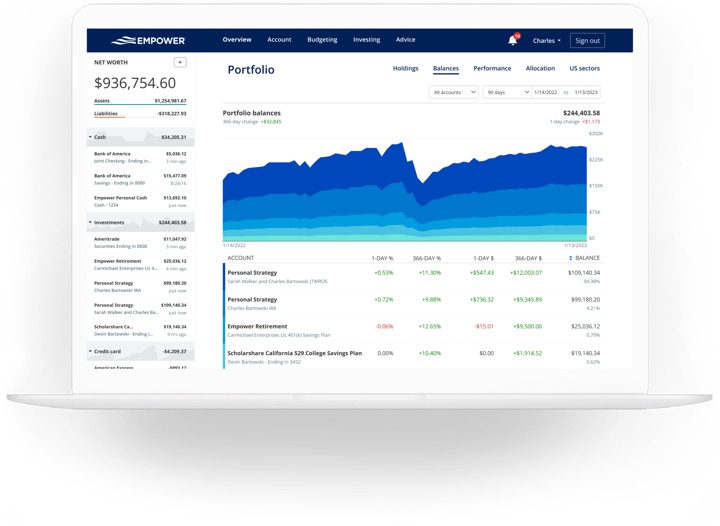
Here’s how I track my portfolio across multiple brokers and account types. There are limited free advanced options after Morningstar discontinued free access to their portfolio tracker. I use both Empower Personal Dashboard (previously known as Personal Capital) and a custom Google Spreadsheet to track my investment holdings:

  • The Empower Personal Dashboard real-time portfolio tracking tools (free) automatically logs into my different accounts, adds up my various balances, tracks my performance, and calculates my overall asset allocation daily. Formerly known as Personal Capital.
  • Once a quarter, I also update my manual Google Spreadsheet (free to copy, instructions) because it helps me calculate how much I need in each asset class to rebalance back towards my target asset allocation. I also create a new tab each quarter, so I have an archive of my holdings dating back many years.

2023 Year-End Asset Allocation and YTD Performance
Here are updated performance and asset allocation charts, per the “Holdings” and “Allocation” tabs of my Empower Personal Dashboard.

Humble Portfolio Background. I call this my “Humble Portfolio” because it reminds me to accept the repeated findings that the ability to know when stocks or bonds will outperform is exceedingly rare. Charlie Munger believes that only 5% of professional money managers have the skill required to consistently beat the index averages after costs.

Instead, by paying minimal costs including management fees, transaction spreads, and tax drag, you can essentially guarantee yourself above-average net performance over time.

I own broad, low-cost exposure to productive assets that will provide long-term returns above inflation, distribute income via dividends and interest, and finally offer some historical tendencies to balance each other out. I have faith in the long-term benefit of owning businesses worldwide, as well as the stability of high-quality US Treasury debt. My stock holdings roughly follow the total world market cap breakdown at roughly 60% US and 40% ex-US. I add just a little “spice” to the broad funds with the inclusion of “small value” factor ETFs for US, Developed International, and Emerging Markets stocks as well as diversified real estate exposure through US REITs.

I strongly believe in the importance of knowing WHY you own something. Every asset class will eventually have a low period, and you must have strong faith during these periods to earn those historically high returns. You have to keep owning and buying more stocks through the stock market crashes. You have to maintain and even buy more rental properties during a housing crunch, etc. A good sign is that if prices drop, you’ll want to buy more of that asset instead of less. I don’t have strong faith in the long-term results of commodities, gold, or bitcoin – so I don’t own them.

I do not spend a lot of time backtesting various model portfolios, as I don’t think picking through the details of the recent past will necessarily create superior future returns. You’ll find that whatever model portfolio is popular at the moment just happens to hold the asset class that has been the hottest recently as well.

Find productive assets that you believe in and understand, and just keep buying them through the ups and downs. Mine may be different than yours.

I have settled into a long-term target ratio of roughly 70% stocks and 30% bonds (or 2:1 ratio) within our investment strategy of buy, hold, and occasionally rebalance. My goal has evolved to more of a “perpetual income portfolio” as opposed to the more common “build up a big stash and hope it lasts until I die” portfolio. My target withdrawal rate is 3% or less. Here is a round-number breakdown of my target asset allocation along with my primary ETF holding for each asset class.

  • 30% US Total Market (VTI)
  • 5% US Small-Cap Value (VBR)
  • 20% International Total Market (VXUS)
  • 5% International Small-Cap Value (AVDV)
  • 10% US Real Estate (REIT) (VNQ)
  • 15% US “Regular” Treasury Bonds or FDIC-insured deposits
  • 15% US Treasury Inflation-Protected Bonds (or I Savings Bonds)

Performance details. According to Empower, my portfolio is up about 15.1% for 2024. The S&P 500 is up about 25% YTD, while the US Bond index is up around 6%. My overall return lagged the US broad market due to my international stock holdings and bond holdings, but I am still happy with my risk positioning (also see above regarding ups and downs).

Yet again, there was little action on my part this year. I didn’t sell a single share of anything, and that’s how I like it. I did reinvest some dividends and interest into TIPS, but the timing plus the year-end bull run of the US stock market still left me again with a higher stock percentage. Unless something extreme happens, I plan to use my future cashflows to rebalance back into bonds.

I’ll share about more about the income aspect in a separate post.

Chase Freedom Unlimited® Card Review

The Chase Freedom Unlimited® Credit Card is a no-annual-fee rewards card which earns a flat 1.5% cash back on all non-bonus purchases (or a possibly more valuable 1.5 Ultimate Rewards points per dollar spent). This is a different card from the new Chase Freedom Flex, which has 5% cash back on rotating categories, on up to $1,500 in purchases each quarter. Here are the highlights for new cardholders:

  • $250 bonus (25,000 Ultimate Rewards points) after you spend $500 on purchases in the first 3 months from account opening.*
  • 0% Intro APR for 15 months from account opening on purchases and balance transfers. 3% intro balance transfer fee when you transfer a balance during the first 60 days your account is open, with a minimum of $5. After that, the fee for future balance transfers is 5% of the amount transferred, with a minimum of $5.

Here is the standard rewards structure, before the new cardholder offer:

  • 5X points (5% cash back) on travel purchased through Chase TravelSM.
  • 3X points (3% cash back) on dining out, take-out, and eligible delivery services.
  • 3X points (3% cash back) on drugstore purchases.
  • Earn unlimited 1.5% cash back on all purchases.
  • No minimum to redeem for cash back. You can choose to receive a statement credit or direct deposit into most U.S. checking and savings accounts. Cash Back rewards do not expire as long as your account is open!
  • Cash back does not expire as long as your card is open.
  • No annual fee.

1.5% cash back on all purchases is better than the 1% cash back you see from a lot of cards, but there are now multiple 2% back back cards out there.

But wait, you actually get Ultimate Rewards Points! The lesser-known perk of this card is that you actually earn Ultimate Rewards points, which are in turn redeemable for cash back at a rate of 100 points = $1 in cash back, or 1 cent per point. But you don’t have to do that. Ultimate Rewards points are worth collecting because of their flexibility. (I hope Chase doesn’t forget this fact.) This is important because there are many ways in which Ultimate Rewards points can be worth much more than 1 cent per point.

If you have also have the Chase Sapphire Preferred, Chase Sapphire Reserve, or Ink Business Preferred Card, then you can pool all of your Ultimate Rewards points together (even with your spouse/partner as an authorized user) and thus utilize all of the same transfer partners with the following results:

  • Earn 1.5 United Mileageplus miles per dollar spent on ALL purchases.
  • Earn 1.5 Hyatt points per dollar spent on ALL purchases.
  • Earn 1.5 British Airways Avios per dollar spent on ALL purchases.
  • Earn 1.5 Southwest Rapid Rewards points per dollar spent on ALL purchases.

Notice that you are earning more miles and points on ALL purchases than even the specific co-branded cards from United or Hyatt themselves! Most of them just offer 1 point/mile per dollar spent on all purchases.

If you placed a perceived value of 1.5 cents on each United Airlines mile or Hyatt hotel point, then you’d receive 2.25 cents of perceived value per dollar spent with this card. Your actual numbers will depend on your own specific redemption choices, but you can see that you can definitely exceed 2% cash back value on an ongoing basis with the Sapphire Preferred/Freedom Unlimited combo.

With the Sapphire Reserve, you can also redeem for travel through the Chase TravelSM portal at 1.5 cents per point value, which means 20,000 Ultimate Rewards points = $300 towards airfare, hotel, car rentals booked through Chase Travel. 5% cash back on groceries turns into 7.5% potential value back, and so on.

If you would like the opportunity to earn 5% cash back on rotating bonus categories each quarter, compare with the Chase Freedom Flex card. You can have both a Freedom and a Freedom Unlimited card, but you’ll have to apply for each card separately. I think this is actually a great combo if you plan to keep a Sapphire Preferred/Sapphire Reserve/Ink Preferred cards as well.

Restrictions. This card is subject to “5/24” restrictions, which means that your application will be automatically denied if you have opened 5 or more credit cards in the last 24 months (check your credit reports). Our household strategy is to have one person only apply for Chase 5/24 cards, and the other person applies for everything else. There is also this language on the consumer card:

This product is available to you if you do not have this card and have not received a new cardmember bonus for this card in the past 24 months.

Bottom line. The Chase Freedom Unlimited® Credit Card> is a unique card that works best in combination with either the Chase Sapphire Preferred, Sapphire Reserve, or Ink Preferred Business cards. The combination of earning 1.5 Ultimate Rewards points per dollar spent on all purchases plus the unique redemption options from those other cards can create a value exceeding that of 2% cash back. You also get a bonus category of 3X points on dining out and drugstore purchases.

The information for the Chase Freedom Unlimited® Credit Card has been collected independently by My Money Blog. The card details on this page have not been reviewed or provided by the card issuer.

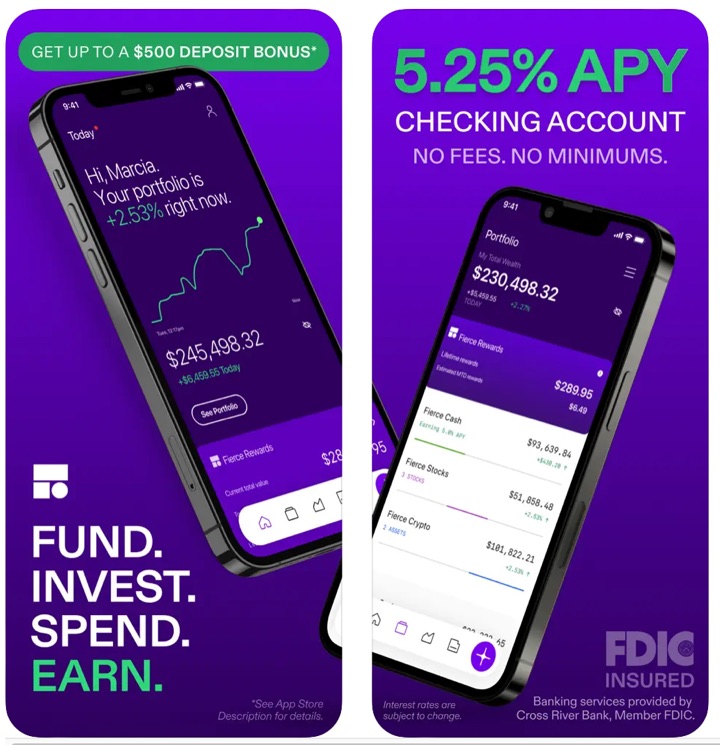
Fierce Finance App Review: 5.25% APY + New Deposit/Referral/Trade Bonuses

Update January 2024: If you opened an account with Fierce previously, keep a lookout for e-mails with new promotions. In addition to the new account bonuses detailed below, I have received the following promos: a $25 bonus for setting up recurring $100+ deposits for 90 days (doesn’t have to be “direct deposit”), and another $25 bonus for making 10 stock purchase orders of $10+ before the end of the quarter. (Note: The roundtrip cost of an SGOV buy/sell trade of a single share has been only a penny in my experience during the trading day.)

Here is the fine print from my e-mail. I am not sure if they are targeted.

*To qualify for the $25 Bonus, you are required to set up Direct Deposit or Recurring Deposits to your Fierce Cash account with a value of $100 or greater per deposit for a minimum of 90 days from your first deposit. After your first successful Direct Deposit or Recurring Deposit transaction, the $25 Bonus will be credited to your Fierce Cash account at the end of the following month. Normal account service charges and miscellaneous charges may apply to the Fierce account, which may reduce earnings.

*To qualify for the $25 Bonus, you are required to execute 10 or more stock purchase orders of $10 or greater before 11:59pm ET on March 31st, 2024. The $25 Bonus will be credited to your Fierce Cash account at the end of the following month. Normal account service charges and miscellaneous charges may apply to the Fierce account, which may reduce earnings. The $25 Bonus offer cannot be used in combination with any other Fierce promotional offer.

Original post with new account bonuses:

Fierce Finance is another new fintech with big ambitions. Currently available as an iPhone app (Android “coming soon”), it combines a checking account, stock trading, and crypto. Notably, the checking account pays 5.25% APY and offers a few different bonus opportunities, which they say don’t stack but I’ve still been offered them one after another. Additional details below.

Banking

  • 5.25% APY (as of 1/3/24) on the Fierce Checking Account.
  • No monthly fees, no minimum balance requirement.
  • Banking services provided by Cross River Bank, Member FDIC.
  • Uses the Allpoint ATM network of 55,000 surcharge-free ATMs worldwide.
  • “Live Support via phone, email, or live chat.”

Investing

  • It says “zero management fees”, I can only guess they also have zero stock commissions like nearly everyone else.
  • Brokerage services provided by FIN2, member FINRA and SIPC.
  • “Earn yield on your stocks” – I’m guessing this is also just fully paid securities lending.
  • Regulated Crypto Trading in all 50 states.

Deposit Bonus details (EXPIRED). If you open a new Fierce account and reach one of the deposit tiers below within 30 days of account opening, keep it there for 180 days, and keep your account open for 210 days, you can receive the following bonus amount:

  • $25 for deposits of $1,000+
  • $100 for deposits of $10,000+
  • $200 for deposits of $30,000+
  • $500 for deposits of $100,000+

If everything goes perfectly, the $100 for $10,000 deposit tier would add about 2% to your APY over that period (in reality probably a little less). As long as they maintain their currently competitive interest rate, it’s not a bad combined total return for 6-7 months.

Fine print from their website:

The Deposit Bonus offer is only available to new customers that meet all current account opening requirements. To qualify for the Deposit Bonus, you are required to open a new Fierce account and initiate cumulative new money deposits, according to the table below, within 30 days of account opening. The cumulative value or greater must remain in your Fierce account for a minimum of 180 days. The Deposit Bonus will be credited to your Fierce Cash account at the end of the following month. Accounts must be kept open for 210 days from the time of qualifying. Normal account service charges and miscellaneous charges may apply to the Fierce account, which may reduce earnings.

Deposit Bonus:
$25 for deposits of $1k+
$100 for deposits of $10k+
$200 for deposits of $30k+
$500 for deposits of $100k+

The Deposit Bonus offer cannot be used in combination with any other Fierce promotional offer. For tax purposes, the value of the bonus will be reported to the IRS on Form 1099-INT. Fierce reserves the right to limit an individual to one account-related gift incentive per rolling 12-month period. Accounts closed at the time of bonus payment are not eligible. Offer is subject to cancellation without notice and cannot be combined with any other bonus offer. Fierce is not responsible for, and will not honor, promotional offers that appear on third-party websites that are not authorized by Fierce.

$25 Referral Bonus details. If you open via a referral link (opening on iPhone recommended, my link), you will get a $25 bonus if you open a new account and deposit $250. The terms suggest you can’t combine this with the deposit bonus below, so I would just do this bonus if you don’t want to deposit $10,000+ for the deposit bonus. Swagbucks also has their own bonus (currently I see 3,000 SB for a $25 deposit).

Fine print from their website:

The $25 Referral Bonus offer is only available to customers that meet all current account opening requirements. To qualify for the $25 Referral Bonus, the referrer is required to have a Fierce account in good standing with a balance of $250 or more. The referred customer must initiate cumulative new money deposits totaling $250 or more into their Fierce Cash Account within 30 days of account opening. A cumulative value of $250 or more must remain in their Fierce account for a minimum of 30 days. The $25 bonus will be credited to the referrer’s Fierce Cash account at the end of the following month. Accounts must be kept open for 90 days from the time of qualifying. Normal account service charges and miscellaneous charges may apply to the Fierce account, which may reduce earnings. Limited to 10 Referral Bonuses payments or $250 in bonus payments per customer.

The $25 Referral Bonus offer cannot be used in combination with any other Fierce promotional offer. For tax purposes, the value of the bonus will be reported to the IRS on Form 1099-INT. Fierce reserves the right to limit an individual to one account-related gift incentive per rolling 12-month period. Accounts closed at the time of bonus payment are not eligible. Offer is subject to cancellation without notice and cannot be combined with any other bonus offer. Fierce is not responsible for, and will not honor, promotional offers that appear on third-party websites that are not authorized by Fierce.

Trading bonus details. This appears to be their advertised bonus on their front page at the moment (January 2024), but it was sent to me via email after opening up my account so I feel they should be stackable in my situation. I would open up using the deposit or referral bonus above, and then keep a lookout. $10 bonus for your first $10+ stock purchase, and a separate $10 bonus for your first $10+ crypto purchase. Total $20.

Fine print from website:

The Trading Bonus offer is only available to customers that meet all current account opening requirements and have not previously purchased stock or crypto on Fierce.

To qualify for the Trading Bonus, you are required to have a Fierce account in good standing that has not previously purchased stock or crypto. The customer must initiate cumulative new stock or crypto orders, according to the Trading Bonus table below, between the time the offer is received and 11:59 pm ET on October 31st 2023. The cumulative value or greater must remain in your Fierce Stock or Fierce Crypto account for a minimum of 30 days. The Trading Bonus will be credited directly to your Fierce Cash account at the end of the following month. Accounts must be kept open for 90 days from the time of qualifying. Normal account service charges and miscellaneous charges may apply to the Fierce account, which may reduce earnings. Limited to 1 Stock Trading Bonus payment per customer and 1 Crypto Trading Bonus payment per customer, or a total of $20 in bonus payment per customer.
Trading Bonus:
$10 cash bonus for stock purchases equalling $10 or greater.
$10 cash bonus for crypto purchases equalling $10 or greater.

The Trading Bonus offer cannot be used in combination with any other Fierce promotional offer. For tax purposes, the value of the bonus will be reported to the IRS on Form 1099-INT. Fierce reserves the right to limit an individual to one account-related gift incentive per rolling 12-month period. Accounts closed at or prior to the time of bonus payment are not eligible. Offer is subject to cancellation without notice and cannot be combined with any other bonus offer. Fierce is not responsible for, and will not honor, promotional offers that appear on third-party websites that are not authorized by Fierce.

Fidelity Bloom App: Fintech App from Traditional Broker

Update July 2024: Looks like Fidelity is ending this little experiment. They are no longer accepting new applications. It was fun to try out and collect the various incentives.

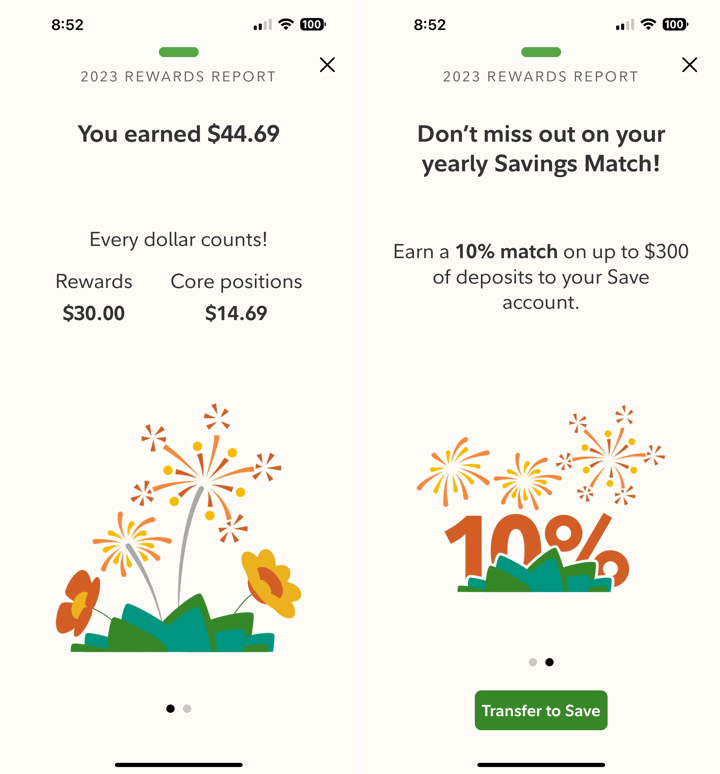
Update January 2024: If you have the Fidelity Bloom app, this is a reminder that the 10% annual savings match is reset and you can again get $30 for a $300 transfer into your Fidelity Bloom Save account. If you use the SPAXX option for cash sweep, you are also earning close to the equivalent of 5% APY (as of 1/3/24). Here is a screenshot of my 2023 rewards:

Full review:

Fidelity Bloom is a new(er) app from Fidelity Investments targeted at helping young adults become more financially aware and develop better savings habits. iOS and Android. Fidelity has included many “behavioral psychology” features from other fintech startup apps like a match on savings transfers, debit card cash back rewards, rounding-up purchases and saving the difference, and shopping portal cashback. The highlights:

  • (No new user bonus at the moment. Was $100.)
  • 10% annual savings match (up to $30). Get a 10% match on the first $300 saved into their Bloom Save account (up to a $30 match on $300 of new money deposited).
  • 10 cents from Fidelity with every debit card purchase. Fidelity will automatically deposit a fixed 10 cents into the Fidelity Bloom Save account every time customers use the Fidelity Bloom debit card. Reminds me of the Citi Rewards+ credit card.
  • Automatically round up purchases into savings. Customers can automatically round up purchases to the nearest dollar and have the difference moved to savings from their Fidelity Bloom Spend to their Fidelity Bloom Save account.
  • Up to 25% cashback through shopping portal. Receive up to 25% cash back into your Fidelity Bloom Save account when you shop in-app with 1,100+ participating retailers.

Interest rate is competitive (up to ~5% as of 1/3/24 with SPAXX), but it’s a brokerage account. Is it a bank account? Is it a brokerage account? It’s a SIPC-insured brokerage account:

The Fidelity Bloom App is designed to help with your saving and spending behaviors through your Save and Spend accounts, which are brokerage accounts covered by SIPC insurance. They are not bank accounts and therefore are not covered by FDIC insurance.

You do get a routing number and account number for your two accounts, but the cash is held like their other non-retirement accounts. During the sign-up process, you can pick between one of three options for your core position:

  • Fidelity® Interest-Bearing Option (FCASH)
  • Fidelity Government Money Market Fund (SPAXX)
  • Fidelity Treasury Money Market Fund (FZFXX)

Although I have confidence in Fidelity’s long-term experience and conservatism in running these money market mutual funds, the lack of FDIC coverage is something to note. The rates may change daily. View current rates here.

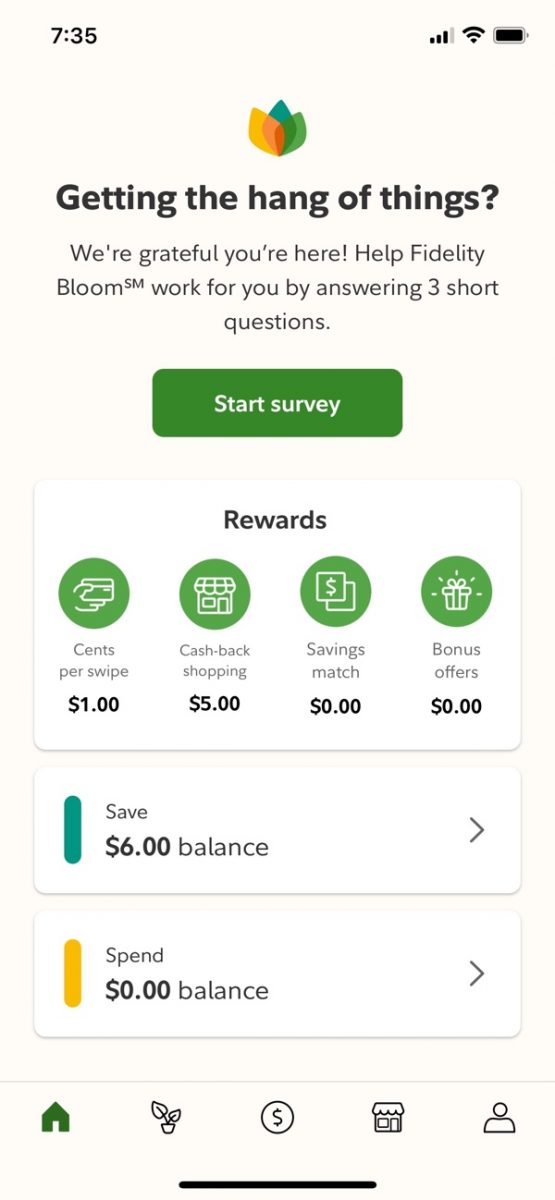
After you open via app, you can see the account balances at Fidelity.com but you’ll still need the app to change any settings. Here’s a screenshot from my app.

Fidelity recently shut down another of its experimental apps called “Fidelity Spire”, so we’ll see if this one catches on a bit better.

For posterity, here are the terms & conditions for the (expired) $100 limited-time offer:

This offer is valid for new or existing Fidelity Brokerage Services LLC (“Fidelity”) customers who make an initial total deposit of at least $50 (“Qualifying Deposit”) into their Fidelity Bloom Spend account or Fidelity Bloom Save account on or after August 13, 2023 through the Fidelity Bloom app. This offer is limited to one cash award per individual. For clarity, existing Bloom clients who have not yet made any deposits into either of their Fidelity Bloom Spend or Fidelity Bloom Save accounts can participate in this offer by making a Qualifying Deposit by August 27, 2023. Existing Fidelity customers who have previously made deposits into their Fidelity Bloom Spend or Save accounts, including individuals who have already participated in the Bloom $50 offer, are not eligible for this offer.

2024 Retirement and Benefit Plan Limit Increases: 401k, 403b, IRA, HSA, DCFSA

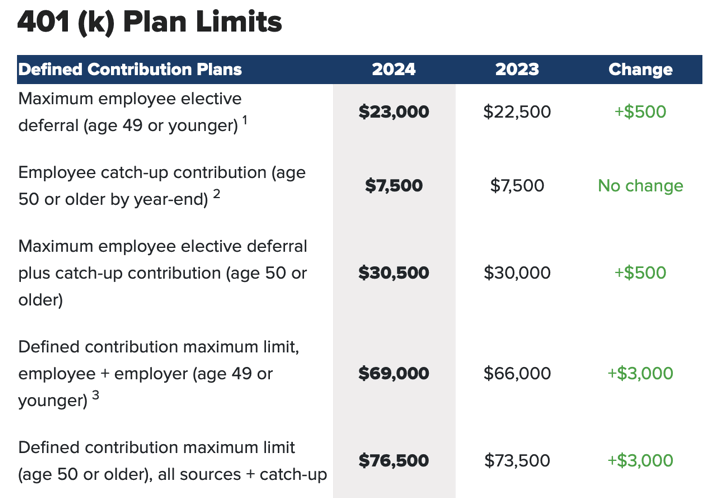
The beginning of the year is also a good time to check on the new annual contribution limits for retirement and benefit accounts, many of which are indexed to inflation. Our respective incomes have been quite variable these last few years, so I regularly adjust our paycheck deferral percentages based on expected income for the year. I still try to max things out if I can, or at least stay on pace to do so. This 2024 SHRM article and this 2024 IRS article have a nice summary of 2024 vs. 2023 numbers for most employer-based retirement and benefit accounts.

401k/403b Employer-Sponsored Accounts.

For example, you could break down your applicable limit down into monthly and bi-weekly amounts:

  • $23,000 annual limit = $1,916.67 per monthly paycheck.
  • $23,000 annual limit = $884.61 per bi-weekly paycheck.

The higher maximum limits are useful are for those folks that have the ability to contribute extra money into their 401k accounts on an after-tax basis (and then potentially perform an in-service Roth rollover), or those self-employed persons with SEP IRAs or Self-Employed 401k plans.

If you are contributing to a pre-tax account instead of a Roth, you could also use a paycheck calculator to find the detailed impact to your after-tax “take home” pay.

Even if you aren’t hitting the limits, consider increasing your salary deferral contribution rate 1% higher than last year. This can still make a substantial difference if you keep it up.

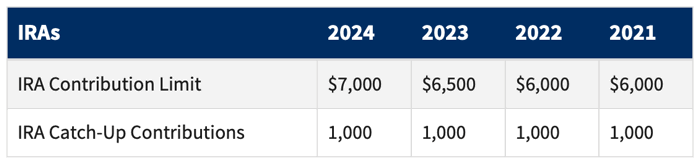
Traditional/Roth IRAs. The annual contribution limits are up $500 from last year, now $7,000 with an additional $1,000 allowed for those age 50+.

  • $7,000 annual limit = $583.33 per monthly paycheck.
  • $7,000 annual limit = $269.23 per bi-weekly paycheck.

Most brokerage accounts (Vanguard, Fidelity, M1 Finance) will allow you to set up automatic investments on a weekly, biweekly, or monthly basis. As long as you have enough money in your linked checking account, the broker will transfer the cash over and then invest it on a recurring basis. You may even be able to sync it to take out money the very same or next business day as when your paycheck hits (for example, every other Monday after your paycheck hits every other Friday).

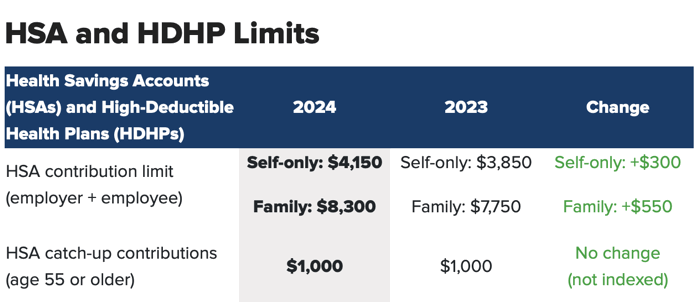
Health Savings Accounts are often treated as the equivalent of a “Healthcare IRA” due the potential triple tax benefits (tax-deduction on contributions, tax-deferred growth for decades, and tax-free withdrawals towards qualified healthcare expenses). This assumes that you have a high-deductible health insurance plan (more popular every year as they are cheaper for employers too), you can cover your current healthcare expenses out-of-pocket, and you can still afford to contribute to the HSA. Up a little for 2024.

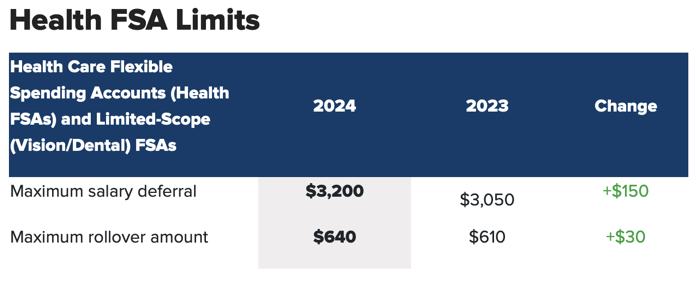
Healthcare Flexible Spending Accounts are still an commonly-available option for others. Up a little for 2024.

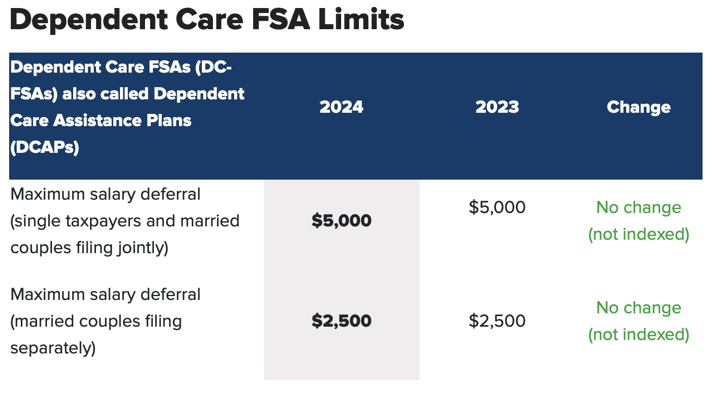
Dependent Care FSAs are easy tax savings if you have children in daycare and/or preschool. These are not indexed to inflation. They can also be used to pay for before and afterschool supervision and summer day camps.

2023 Year-End Review: Annual Broad Asset Class & Target Fund Returns

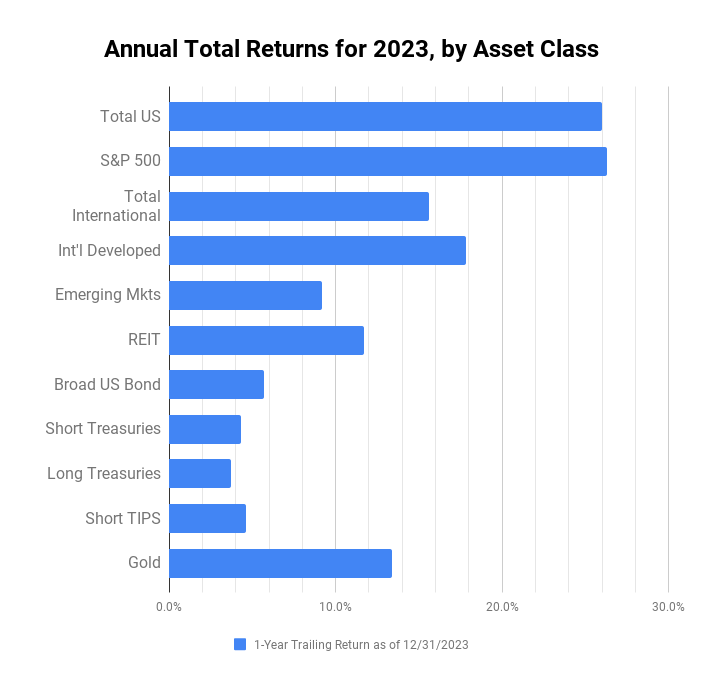
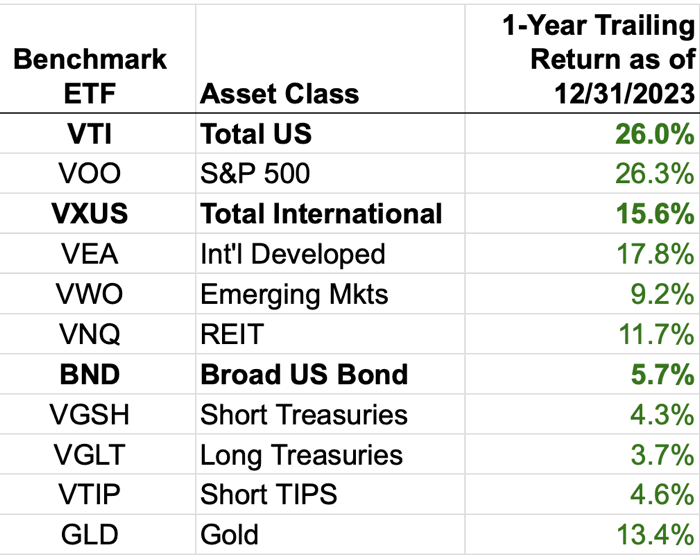
Happy New Year! 🎉 🥳 It’s time to take a look back and see how the year went for the broad asset classes that I track. Per Morningstar, here are the total annual returns (includes price appreciation and dividends/interest) for select asset classes as benchmarked by popular ETFs after market close 12/29/23.

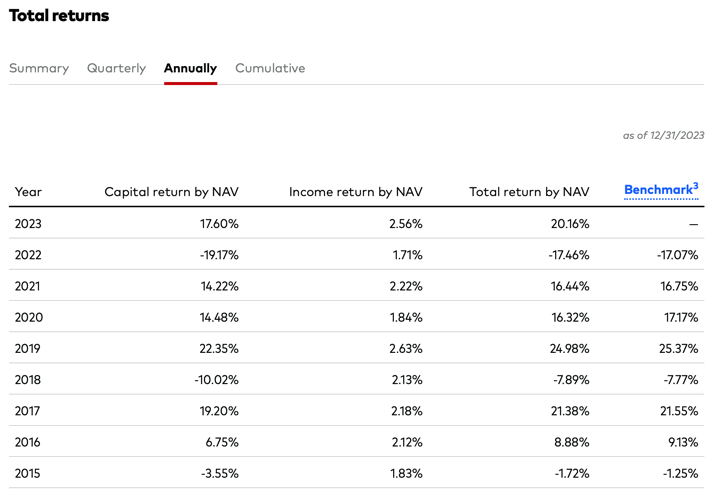
The “set and forget” Vanguard Target Retirement 2055 fund (VFFVX) , currently consisting of roughly 90% diversified stocks and 10% bonds, was up 20.2% in 2023, almost but not quite overcoming the drop in 2022.

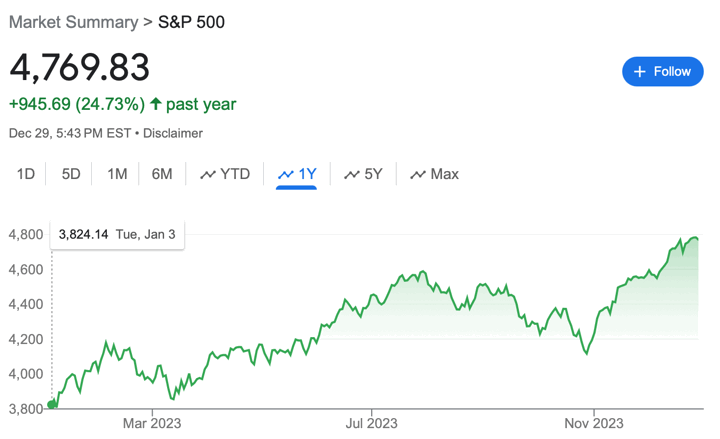
Commentary. Historically, the S&P 500 annual return is negative in roughly every 1 in 4 years. In 2020 and 2021 nearly everything went up, while in 2022 nearly everything went down.

Even as of late October, it wasn’t clear if 2023 would end with positive returns:

For most of us, the best we can do is to “stay the course” and enjoy the up years while knowing that the down years will inevitably be sprinkled in there. I try my best not to listen to predictions, or even listen to daily market close announcements. If you stand by the roulette table and stare long enough at the red and black numbers that come up, your mind will start to find patterns where they don’t exist.

Instead, I prefer to dig around for these “long view” numbers. For example, if you had been a steady investor in the popular Vanguard Target Retirement 2055 fund over the past several years, your cumulative returns have been solid despite the many problems of the world: