Archives for October 2023

Target RedCard 5% Off Purchases, $50 Off For New Applicants (New Reloadable Version)

(Update: New $50 limited-time offers for new RedCards, including new Reloadable version with no credit check. Offer expires 12/9/23.)

The Target RedCard offers 5% off all Target purchases both online and in-store (Target gift cards excluded, in-store Starbucks included) and free 2-day shipping on qualifying items at Target.com. You also get an additional 30 days for returns and exchanges. No annual fee.

There are now three versions of RedCard: Credit, Debit, and Reloadable. Debit and Reloadable have no credit check and I never carry a balance, so the credit card doesn’t interest me at all. There is a new limited offer for each that includes $50 savings on a $50+ Target purchase. The Debit and Reloadable version do not perform a hard credit check on the three major credit bureaus. There are a bunch of restrictions on big brands (see below), but I can easily spend $50 on food and other household goods. I plan on going for the new Reloadable version this time around.

Full fine print copied below. Usually I just make my pick-up order at Target and make sure the coupon works in the app before checking out. The Reloadable $50 bonus is much less finicky.

Save $50 on a future qualifying purchase over $50 when approved for credit or debit RedCard

RedCard Debit or Credit: Get a coupon for $50 off of one future qualifying purchase over $50 when you are approved for a debit or credit RedCard in-store or at Target.com between 10/29/23-12/9/23. The coupon will be mailed to the approved cardholders with their RedCard and will be valid through 1/8/24. Must upload coupon to Target App and be fully enrolled in Target Circle™ to redeem coupon. Excludes items sold by Target Plus™ Partners, alcohol, Apple products, Barbie camper and houses, Beats, Black History Month, Bose, Bratz Collector and Designer Dolls, Bullseye’s Playground, Cards Against Humanity, Casper, clinic & pharmacy, Cricut, dairy milk, Disney Princess Castle, Dockers, Do-a-Dot, Doona, DSLR cameras & lenses, Dynamic Coins, Dyson, Elf on the Shelf, Fisher Price Laugh n Learn, Fitbit, Funko Standard Pop, gift cards, GilletteLabs Heated Razor Starter Kit by Gillette – 3ct, Google, Hair Appliances, HALO Baby, Hasbro Games (Classic Monopoly, Connect Four, Jenga, Sorry, Trouble), Healthy Roots Dolls, HP Inc., ICU reading glasses, Infant Optics, JBL, Latino Heritage Month, LEGO, Levi’s Red Label, LG OLED and QNED TVs, Lights From Anywhere (Junior), limited-time designer partnerships, Lovevery, Marvin’s Magic Drawing Board and Pens, Mega Bloks, Meta Oculus and Portal, mobile contracts, Motrin baby, Nintendo hardware and Switch games, Polder, Philips Avent, Plan B, power shave, power dental, prepaid cards, Play-Doh Ice Cream Truck Playset, PlayStation – consoles, virtual reality and accessories, Pride, Revival, Samsung TVs, Shipt Membership, simplehuman, Sonos, Sony Electronics, Take Action, Target Optical, Tempur-Sealy, Trading Cards, Tylenol (and baby) pain relief, Ulta Beauty at Target Brands, Umbrellas, Unlocked phones, Vera Bradley handbags, Weber, What Do You Meme?, WonderFold.

Get a $50 credit when you open a RedCard Reloadable Account & spend $50 at Target.

RedCard Reloadable Account: Get a $50 credit when you open a RedCard Reloadable Account and spend $50 at Target. To receive a $50 statement credit for the RedCard Reloadable Account, you must successfully register online at redcardreloadable.com for a new account between 10/29/23-12/9/23, then activate the permanent card once received in the mail and spend $50 (net of reversals/returns) at Target (“$50 transaction”) within 45 days of registration. The statement credit will be posted to the account within 30 days of the $50 transaction. The $50 transaction must occur in one transaction at a Target location or at Target.co; if you get cash back at the register during the purchase, the transaction will not qualify for this promotion. Limit one (1) $50 credit per customer. Offer is subject to change or cancellation at any time.

We’ve become regular users of the Target app and their Drive-Up option. No markups, well-organized, dedicated parking area, and minimal waiting. The online stock available is mostly accurate, better than Walmart in our experience which has more frequent, often-imperfect substitutions. If only Costco had a similar service! (Sam’s Club does have a pickup option.)
PeerStreet Bankruptcy News: 95% of Uninvested Cash Released (Updated October 2023)

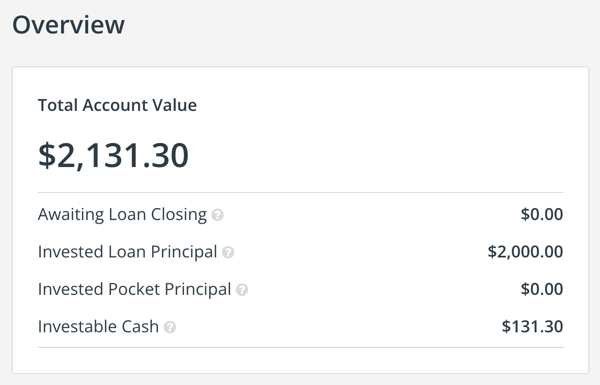
Update October 2023: Peerstreet e-mailed creditors on 10/18/23 that you can get 95% of your “investable cash” back by logging into your account and manually requesting a withdrawal. It will not be done automatically, so be sure to make that request! I successfully received my funds on 10/24/23, about $100 in interest that I didn’t sweep out before their sudden bankruptcy.

On October 17, 2023, the bankruptcy court approved PeerStreet’s motion to allow retail investors to withdraw 95% of their Investable Cash balance held in PeerStreet’s retail customer “FBO” (for the benefit of) account (the “Retail Customer FBO Account”).

[…] The order provides for a three-day grace period for PeerStreet to re-enable the platform to permit the withdrawal of these funds. Starting on Friday, October 20, 2023, PeerStreet investors can log on to their PeerStreet account at peerstreet.com and withdraw 95% of the amount attributable to that investor (“Withdrawable Cash”). The withdrawals will be processed via ACH and investors should receive their funds into their bank accounts within 3-5 business days after their request.

This Business Insider article (paywall) covered the bankruptcy and also included some interesting information. It pointed out how having Michael Burry as an early investor helped their profile, and Andreessen Horowitz was also an investor with their funding totaling over $120 million! Michael Burry is also a creditor to the tune of $600,000:

Burry declined to comment for our story, but bankruptcy filings show that he, too, has a lot to lose. In addition to his investment in the company, he was a user of the site with over $600,000 in investments and about $9,000 in cash in his PeerStreet account.

The article also speculates that Peerstreet was partially a victim of its own success:

According to Ippolito, it’s a common story: A crowdfunding company grows in popularity to the point where deals are fully funded in 30 minutes or less, prompting it to increase the number of deals on the platform. Skyrocketing demand for deals comes with “a temptation to reduce the underwriting,” he said.

Unfortunately, other than this, I haven’t learned any new actionable information from browsing Reddit and other internet forums, other than the process is still moving forward. There is a contingent pushing for the outstanding loans to be transferred to a third-party servicer and have them “run out”.

Original post:

PeerStreet, a startup that tried to scale up real-estate backed “hard money loans” and was open to “accredited investors”, abruptly filed for Chapter 11 bankruptcy in late June 2023. If you log into your investor account, you’ll see the following notice:

Peer Street, Inc. and its affiliated companies (“PeerStreet”) filed for protection under chapter 11 of the United States Bankruptcy Code in the United States Bankruptcy Court for the District of Delaware on Monday, June 26, 2023.

Are we creditors? I would point out that there are multiple “investors/customers” in this situation. There are the investors and owners of the company itself, which include big VC names like Andreessen Horowitz, World Innovation Lab, Colchis Capital, and Michael Burry. Then there are vendors and suppliers where PeerStreet owes them money, their employees who are owed paychecks, and finally us customers of PeerStreet that purchased interests in their securitized loans.

This HousingWire article provides some additional context. An interesting paragraph:

According to the court filings, PeerStreet has an estimated 100-199 creditors, and its assets and liabilities are between $50 million and $100 million. However, as of Monday, the group had $4.4 million in cash – in addition to $18.5 million in its mortgage business.

These low numbers may suggest that PeerStreet note-holders are not considered “creditors”, and the notes that we hold are not considered their assets? I’m pretty sure they have way more than 200 accountholders and have originated over a billion dollars of notes since inception. Ideally, the notes that we hold are separate securities, and PeerStreet is just the custodian.

Next steps? First, I would like to stress that I am not a lawyer, and all of the following is just a best guess on my part as a small-time Peerstreet customer who still has fractional ownership of outstanding loans and some uninvested funds. While I have put a decent amount of my “self-directed play money” into PeerStreet in the past, I am relatively fortunate in that currently I only have two outstanding loans with a $1,000 balance each, along with about $100 in interest payments that I did not withdraw in time. The money still in limbo is less than the $5,000+ in interest that I have already earned on the platform. I feel sympathetic to those with six-figure amounts still stuck at PeerStreet.

Critically, I don’t think this money will disappear, but it will take a long time to figure out. That’s really the main lesson of PeerStreet in general, honestly. The headache of illiquidity. Foreclosure proceedings can take forever. I doubt bankruptcy proceeding are much faster.

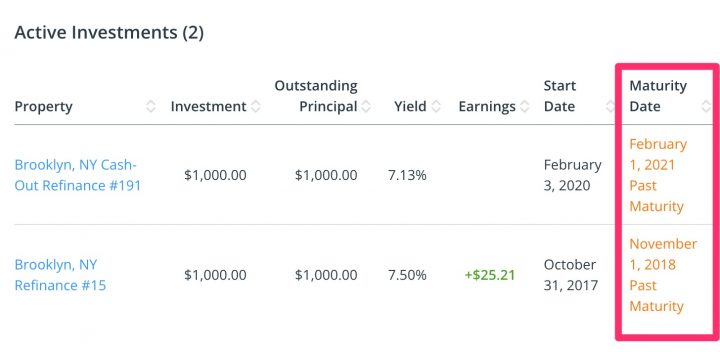
The borrowers on my loan are certainly benefiting from this fact. The notes are for a tri-plex and a four-plex in Brooklyn NY, and my suspicion is that they are happily collecting rent from their tenants while not paying a single penny toward the mortgage note. These notes matured in 2018 and 2021! The thing is, the property value has gone up, and will eventually still cover the loan balance. But in the meantime, awesome cashflow numbers for them! Not very ethical, but that’s another lesson as well. They have no incentive to hurry things up at all. Who knows when these loans would have been paid back even if PeerStreet stayed in business! As such, it took me a few weeks to get up the energy to read through all these boring bankruptcy documents.

Stretto is the “bankruptcy management solution provider” that is coordinating the process. Here is are pertinent quotes from the Stretto FAQ:

Does this mean Peer Street is going out of business?
While a Chapter 11 case is pending, the debtor may continue to operate its business and remain in possession of its property. Until a sale of its assets, Peer Street will preserve the value of all of its assets for the benefit of its stakeholders, including identifying additional assets that can be monetized. Peer Street’s continued operation after a sale of the business depends on the structure of the sale. While in chapter 11, Peer Street will continue to monitor and service its assets, and customers will continue to have the same access to the Peer Street platform to monitor their investments that they had prior to the Chapter 11 filing. However, withdrawals or returns on investments will be suspended absent further order from the Bankruptcy Court, which would include an order confirming a chapter 11 plan that provides the treatment for all claims against the Peer Street entities.

Have you secured financing during the Chapter 11 cases? How can you be sure you have the financial resources to complete the process successfully?
Peer Street has sufficient cash on hand and from anticipated collection to fund its day-to-day operations during the Chapter 11 process. To support ongoing operations, we have negotiated with our pre-petition secured lenders for the consensual use of cashflows from our business. This will help to ensure we are able to meet our go-forward commitments to employees and vendors.

[Customers] When will I get my investments/money back?
Any investments made through the Peer Street platform, including cash on deposit, funds invested with respect to the ownership of fractional interest in loans, and funds invested in Peer Street’s other investment opportunities, such as Pocket, Portfolio and/or Opportunity Fund, will only be returned pursuant to an appropriate order of the Bankruptcy Court, which may include an order confirming a chapter 11 plan. Peer Street hopes to pursue confirmation of a chapter 11 plan expeditiously.

You will periodically receive notices from the Bankruptcy Court, including emails sent by Stretto, the Court approved noticing agent in the Chapter 11 Cases. It is important that you review and take appropriate action in response to any notice you receive related to the Bankruptcy Cases.

Peer Street and its advisors cannot give you personal legal advice so you may want to consult your own
counsel.

Do I need to file a proof of claim in the bankruptcy to withdraw my investments?
Yes. If you believe you have a claim against Peer Street, please follow the instructions for filing a proof of claim.

Now, you may recall that PeerStreet told us that they would put the loans in a “bankruptcy-remote vehicle”. So we’re good, right?

What investor protections does PeerStreet have in place?
Investments in loans are held in a bankruptcy-remote entity that is separate from our primary corporate entity. In the unlikely event PeerStreet no longer remains in business, a third-party “special member” will step in to manage pending loan investments and ensure that investors continue to receive interest and principal payments. Additionally, from the time funds are received in an investor account until an investment closes (but not while funds are invested), investor funds are held in an Investors Trust Account with Wells Fargo and FDIC insurance of up to $250,000.

Well, the problem is the part where is says “In the unlikely event PeerStreet no longer remains in business”. Technically, PeerStreet is still in business. Therefore, Peerstreet and the lawyers still have control over the loans and any cash payments. These loans are still backed by real-estate, and real-estate prices have still risen significantly in general over the past few years, so I am still hopeful that most of the money will still be returned.

In the meantime, do we file a claim? My take is that it should not hurt to file a claim, and at least do so before any deadline occurs. Here is the link to file a claim. I don’t see any deadline at this time.

I decided to file a claim electronically to the best of my ability now (mostly so I don’t forget about this entire thing). Again, not a lawyer and I’m not going to hire one for this small amount. I downloaded and saved all of the promissory notes and background information for each of my outstanding loans from the PeerStreet website, and attached them to the claim form as supporting documentation. The debtor for my notes was Peer Street Funding, LLC, EIN 47-1789485 (may not be the same as yours).

There is a newly-formed subreddit called r/Peerstreet_Creditors and Bogleheads thread that may offer more useful information (but know that it may be speculative as well). Please let me know if you know of any other active discussion forums on the topic.

Treasury Bills + State Income Tax Exemption = 6%+ Effective APY (October 2023)

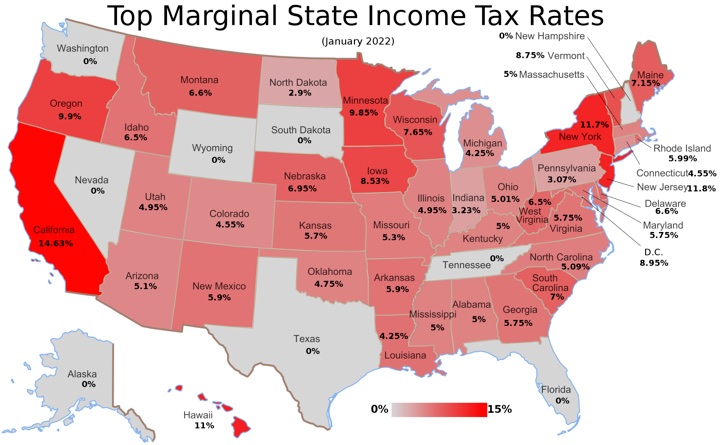
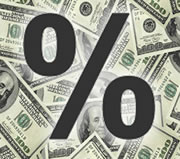
I’ve mentioned this before, but here’s a quick reminder as the tax-equivalent yields are now at 6% APY in most states with income taxes (anything 5% and up, see above graphic). Due especially to high state income taxes, my cash is mostly held in Treasury bills and money market funds that contain 90%+ treasury bills. Both can be owned within most major brokerage accounts that allow the purchase of individual bonds from either auction or secondary markets. (Treasury Direct allows purchase at auction, but I don’t like the user interface or customer service.)

So while I enjoy keeping track of new fintech apps, unless there is a good upfront bonus, it’s hard for me to justify another application at current rates. I skipped Milli when it hit 5.25% APY in August 2023. I skipped Elevault when it hit 5.50% APY in October 2023. I will likely skip Domain Money at 6% APY.

Treasury bond interest is exempt from state incomes taxes, which gives them a comparative boost over interest from banks. If you are subject to state income taxes, use a tax-equivalent yield calculator to compare Treasury bill/bond yields with interest rates from bank accounts and other bonds.

For example, if you are single with $70,000+ taxable income in California, your marginal state income tax rate is at least 9.3%. That means the 5.57% interest from a 4-week Treasury bill is equivalent to a bank account paying 6.42% interest or higher!

Be sure to check and make sure your “Treasury” money market fund is holding 90%+ Treasuries and not repurchase agreements. I’ve noticed that Vanguard Treasury Money Market Fund is now back to 94% Treasuries and only 4% repos, but that could change again in the future, so I’m keeping an eye on it.

Finally, at tax time be sure to look up the appropriate U.S. government obligations income information and use it when filing your state income taxes. You may need to nudge your accountant along with supplying this information.

[Top image credit – Wikipedia]

Domain Money: 6% APY Savings Account (No Longer Available On Free Tier)

Update: As of 10/27/23, the 6% APY savings account is no longer showing as available on the free tier. You must be on the $79/month tier to get it now. I wonder if they will grandfather the existing users, otherwise that is a bad look for a supposedly reliable firm that you are trusting with financial advice… Definitely will avoid now.

Original post:

Let’s welcome Domain Money to the “small fintech with big ambitions” club. Their primary goal is to provide a suite of financial services including unlimited advice from CFPs (Certified Financial Planners) and income tax preparation, all for a flat $79 a month. However, some of their perks including model portfolios and a 6% APY savings account are available at no monthly fee as a sort of teaser:

6% APY is a nice number, and this is the first savings account I’ve seen reach it (other than some rewards checking accounts that require a bunch of debit card transactions, hat tip to Doctor of Credit), but it comes with some concerns. They are a relatively new startup that recently pivoted from crypto and stock trading. The terms stipulate that you can only initiate fund transfers from within the app, and it must be to/from a linked bank account that they approve. Cash and check deposits are not allowed. (They do not provide a routing number or account number.) It’s a savings account, so the interest rate can change at any time. 6% APY is high enough over the current funds rate that it essentially a “bonus” in that they are losing money, so taken altogether it is a big question as to how long the rate will last. Cash deposits are held with Georgia Banking Company, Member FDIC.

On the positive side, I did notice that the founder was previously Head of Product at Marcus by Goldman Sachs, and I liked the user interface over at Marcus. They must also have some good relationships with folks within the Apple App Store, as they have earned “App of the Day”, “Best Apps for Investing”, and “Essential Finance Apps” honors despite a very short track record.

TIPS vs. Treasuries vs. Total Bond Funds, Historical Performance 2008-2023

I hold close to 50/50 US Treasuries and TIPS for the bond portion of my portfolio. This is an area where my portfolio differs significantly from most “model portfolios” you’ll find from the major fund companies and robo-advisors. While buying more TIPS recently due to their historically high real yields, I decided to run a quick backtest comparing three intermediate-term fund options:

  • Vanguard Inflation-Protected Securities Fund (VIPSX)
  • Vanguard Intermediate-Term Treasury Fund (VFITX)
  • Vanguard Total Bond ETF (BND)

Basically, an intermediate-term fund of TIPS, US Treasuries, or the Total Bond Index that tracks all investment-grade taxable bonds. You will get different results based on the timeframe, but I decided to look back through roughly the last 15 years.

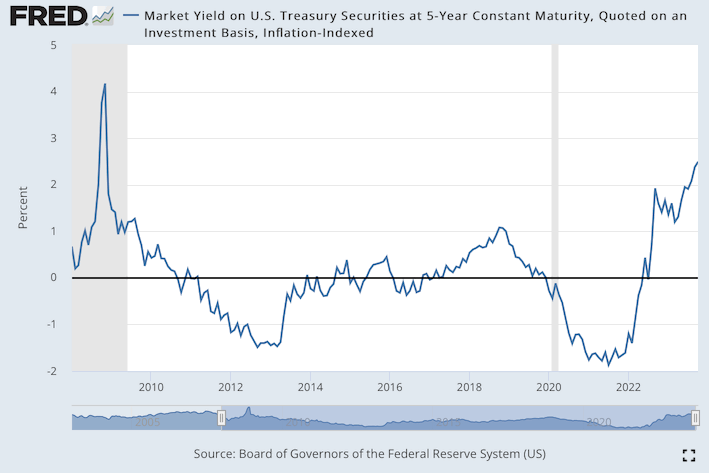
Here is the real yield for 5-year TIPS during the that time period (2008-2023). While there was a brief spike during the 2008 financial crisis, I would guesstimate the average real yield during this entire period as… zero.

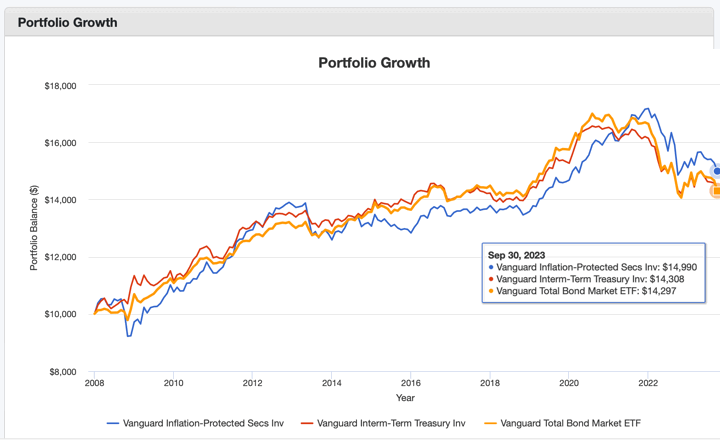
Here is the growth of a $10,000 investment starting in January 2008 through September 2023 via Portfolio Visualizer:

Nobody who held bonds over this time period is celebrating in hindsight, but I’m only comparing these three against each other. There is no clear, dominant winner. Visually, sometimes one would be winning slightly, and then another would be winning slightly. If I changed the start and end dates, the winner may be different each time.

However, I would also note that there was no extended bout of high inflation either. Given our current monetary system, high inflation is much more likely than deflation. Historically, high inflation is much more common as well. My opinion is that TIPS offers an insurance component against unexpectedly high inflation, and it appears that even during a period of “normal” to “low” inflation where it only offered a zero real yield, TIPS didn’t really “cost” me anything to hold. Total bond funds usually yield more since they contain corporate bonds, yet TIPS and Treasuries both still kept up.

If you stretch the time period back to 2000, when TIPS offered a higher real yield, you can see it actually did even better on a relative basis. I’m not saying that this will happen again in the future now with high real yields again, but overall I remain satisfied with holding 50/50 TIPS/Treasuries for my bond holdings. I continue to view owning some TIPS as low-cost insurance against unexpectedly high inflation.

Optimal Asset Location For Different Types of Stocks (US vs. International, Active vs. Passive)

There is asset allocation (what asset classes to buy and how much) and then there is asset location (where to put those asset classes). In general, there are three overall types: pre-tax accounts (Regular 401ks, 403bs, Traditional IRAs), post-tax accounts (Roth IRA, Roth 401k), and taxable brokerage accounts.

Here are two Vanguard research papers and associated articles which dig into the details. (I always download these PDFs because sometimes Vanguard takes them down after a while.) I won’t rehash the entire topic here, I’m just going to drop some links with the major highlights.

Major takeaways:

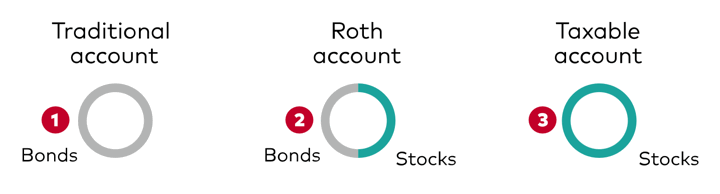
  • The first paper found that even super-simple asset location principles such as placing taxable bonds in pre-tax-deferred and stocks in taxable/Roth account can still boost returns between 0.05% and 0.30% a year.
  • The second paper concludes that “additional return that can be attained from asset location according to three equity subclass characteristics: region (ex-U.S., U.S.), dividend yield (growth, high dividend yield) and management style (passive, active).”
  • Specifically, the second paper advises that “for most investors, ex-U.S., growth, and passive equity are best placed first in a taxable account, while U.S., high-dividend-yield, and active equity are best placed first in a tax-advantaged account.”

Here is an example chart and quote that summarizes their analysis as to why international (ex-US) stocks should have a slight preference in a taxable account.

We find that investors can potentially add up to 10 bps of additional after-tax return to their portfolio by thoughtful asset location of ex-U.S. equities. For most investors, preferentially placing ex-U.S. equity in a taxable account is the asset location strategy that maximizes after-tax return. The higher end of the added value is associated with portfolios that have both high levels of qualified dividend income and high foreign withholding rates. Only investors in the top tax bracket, who hold relatively tax-inefficient ex-U.S. equities, may find it beneficial to shield their ex-U.S. equity in a tax-advantaged account.

These conclusions still align very well my this rough “rule of thumb” graphic that I created way back in 2007 (been doing this for too long! 😱):

Microsoft / Activision Blizzard Merger Arbitrage $10,000 Experiment – Final Results

In January 2022, Microsoft (MSFT) announced an agreement to acquire Activision Blizzard (ATVI) for $95 per share, in an all-cash $68.7 billion transaction. However, the market placed some uncertainty about this event actually happening, which meant the ATVI share price stayed in the $70 to $80 range for most of 2022.

This created a potential event-driven opportunity. If the deal did work out, you would be cashed out at $95 per share, a ~20% premium. In my previous post Warren Buffett’s Activision Merger Arbitrage Deal, I compared his bet to a credit card bonus for us mere mortals. It was small fries to him, but still a fun and profitable thing to do.

As another educational “$10,000 experiment”, I decided to buy roughly $10,000 of ATVI (131 shares @ $76.65) on May 19, 2022.

All I had left to do was wait and see how things would unfold. This was where the education came in. It can be hard to keep holding during a constant stream of media articles about how various powerful governments were trying to block to deal. New blocks and lawsuits usually meant the ATVI stock price dropped a lot. As issues resolved, the stock price would jump back again.

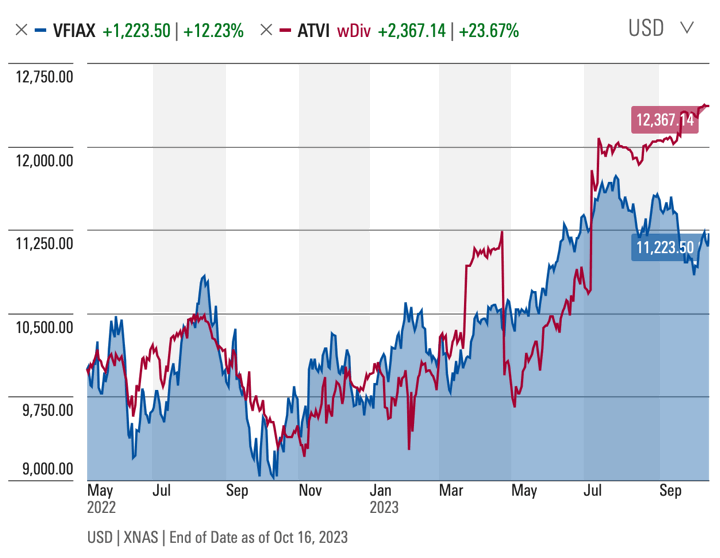
Here is a Morningstar chart that tracked the growth of $10,000 invested in either ATVI (red) or the Vanguard S&P 500 index fund (blue) from May 2022 to October 2023.

The transaction was initially marked to close around June 2023. After lengthy negotiations with US, EU, and UK regulators, the acquisition finally closed on October 18th, 2023 after Microsoft made various concessions and promises to maintain competitiveness in the gaming industry. I received my cash payment on 10/13/23.

Microsoft was a stable buyer and patient negotiator, and Warren Buffett’s instincts that this would eventually work out were correct. In the end, I received an ATVI dividend of $129.69 on 8/17/23 and my final payout of $12,445 ($95 a share x 131 shares):

ATVI never actually traded at the full $95 on the exchanges, so my final numbers were a bit better than the chart above. My net profit on my $10,040 initial investment was $2,534, as compared to the $1,357 that I could have earned from owning the S&P 500 over the same time period. That’s an extra difference of $1,177. Using the XIRR function, I calculated a 17.4% annualized rate of return.

(Side note: Warren Buffett actually sold most of his ATVI stock before this final closing, between Q3 2022 and Q2 2023. I actually don’t know how much he gained from this purchase, it appears he sold a chunk when ATVI was about $85 a share in Q2 2023.)

Best Interest Rates on Cash – October 2023

Here’s my monthly roundup of the best interest rates on cash as of October 2023, roughly sorted from shortest to longest maturities. There are often lesser-known opportunities available to individual investors. Check out my Ultimate Rate-Chaser Calculator to see how much extra interest you could earn from switching. Rates listed are available to everyone nationwide. Rates checked as of 10/10/2023.

TL;DR: Mostly minor movements upwards this month. 6% APY now (barely) available with 12-month CD and rewards checking accounts. More 5%+ savings accounts. Compare against Treasury bills and bonds at every maturity, taking into account state tax exemption.

Fintech accounts
Available only to individual investors, fintech companies often pay higher-than-market rates in order to achieve fast short-term growth (often using venture capital). “Fintech” is usually a software layer on top of a partner bank’s FDIC insurance.

  • 5.27% APY ($1 minimum). Raisin lets you switch between different FDIC-insured banks and NCUA-insured credit unions easily without opening a new account every time, and their liquid savings rates currently top out at 5.27% APY amongst multiple banks. See my Raisin review for details. Raisin does not charge depositors a fee for the service.
  • 5.36% APY (before fees). MaxMyInterest is another service that allows you to access and switch between different FDIC-insured banks. You can view their current banks and APYs here. As of 10/10/23, the highest rate is from Customers Bank at 5.36% APY. However, note that they charge a membership fee of 0.04% per quarter, or 0.16% per year (subject to $20 minimum per quarter, or $80 per year). That means if you have a $10,000 balance, then $80 a year = 0.80% per year. This service is meant for those with larger balances. You are allowed to cancel the service and keep the bank accounts, but then you may lose their specially-negotiated rates and cannot switch between banks anymore.

High-yield savings accounts
Since the huge megabanks STILL pay essentially no interest, everyone should have a separate, no-fee online savings account to piggy-back onto your existing checking account. The interest rates on savings accounts can drop at any time, so I list the top rates as well as competitive rates from banks with a history of competitive rates. Some banks will bait you with a temporary top rate and then lower the rates in the hopes that you are too lazy to leave.

  • The top rate at the moment is at Elevault (app only) at 5.50% APY, but there are catches. I see that it is only valid on balances up to $40k with a $2,500 daily deposit limit? Why? Unsure if that applies to externally-initiated transfers. BrioDirect at 5.35% APY. CIT Platinum Savings at 5.05% APY with $5,000+ balance.
  • SoFi Bank is now up to 4.50% APY + up to $275 new account bonus with direct deposit. You must maintain a direct deposit of any amount each month for the higher APY. SoFi has their own bank charter now so no longer a fintech by my definition. See details at $25 + $250 SoFi Money new account and deposit bonus.
  • There are several other established high-yield savings accounts at 4.25%+ APY that aren’t the absolute top rate, but historically do keep it relatively competitive for those that don’t want to keep switching banks.

Short-term guaranteed rates (1 year and under)
A common question is what to do with a big pile of cash that you’re waiting to deploy shortly (plan to buy a house soon, just sold your house, just sold your business, legal settlement, inheritance). My usual advice is to keep things simple and take your time. If not a savings account, then put it in a flexible short-term CD under the FDIC limits until you have a plan.

  • No Penalty CDs offer a fixed interest rate that can never go down, but you can still take out your money (once) without any fees if you want to use it elsewhere. Raisin has a 16-month No Penalty CD at 5.40% APY with $1 minimum deposit. CIT Bank has a 11-month No Penalty CD at 4.90% APY with a $1,000 minimum deposit. Ally Bank has a 11-month No Penalty CD at 4.55% APY for all balance tiers. Marcus has a 13-month No Penalty CD at 4.60% APY with a $500 minimum deposit. Consider opening multiple CDs in smaller increments for more flexibility.
  • Credit Human Federal Credit Union has a 12-month CD at 6.00% APY. Minimum opening deposit is $500. Early withdrawal penalty is a whopping 270 days interest (or $50, whichever is greater). Anyone can join this credit union via partner organization.

Money market mutual funds + Ultra-short bond ETFs*
Many brokerage firms that pay out very little interest on their default cash sweep funds (and keep the difference for themselves). * Money market mutual funds are regulated, but ultimately not FDIC-insured, so I would still stick with highly reputable firms. I am including a few ultra-short bond ETFs as they may be your best cash alternative in a brokerage account, but they may experience losses.

  • Vanguard Federal Money Market Fund is the default sweep option for Vanguard brokerage accounts, which has an SEC yield of 5.28% (works out to a compound yield of 5.41%, which is better for comparing against APY). Odds are this is much higher than your own broker’s default cash sweep interest rate.
  • The PIMCO Enhanced Short Maturity Active Bond ETF (MINT) has a 5.53% SEC yield and the iShares Short Maturity Bond ETF (NEAR) has a 5.74% SEC yield while holding a portfolio of investment-grade bonds with an average duration of ~6 months.

Treasury Bills and Ultra-short Treasury ETFs
Another option is to buy individual Treasury bills which come in a variety of maturities from 4-weeks to 52-weeks and are fully backed by the US government. You can also invest in ETFs that hold a rotating basket of short-term Treasury Bills for you, while charging a small management fee for doing so. T-bill interest is exempt from state and local income taxes, which can make a significant difference in your effective yield.

  • You can build your own T-Bill ladder at TreasuryDirect.gov or via a brokerage account with a bond desk like Vanguard and Fidelity. Here are the current Treasury Bill rates. As of 10/6/23, a new 4-week T-Bill had the equivalent of 5.43% annualized interest and a 52-week T-Bill had the equivalent of 5.42% annualized interest.
  • The iShares 0-3 Month Treasury Bond ETF (SGOV) has a 5.28% SEC yield and effective duration of 0.10 years. SPDR Bloomberg Barclays 1-3 Month T-Bill ETF (BIL) has a 5.25% SEC yield and effective duration of 0.08 years.

US Savings Bonds
Series I Savings Bonds offer rates that are linked to inflation and backed by the US government. You must hold them for at least a year. If you redeem them within 5 years there is a penalty of the last 3 months of interest. The annual purchase limit for electronic I bonds is $10,000 per Social Security Number, available online at TreasuryDirect.gov. You can also buy an additional $5,000 in paper I bonds using your tax refund with IRS Form 8888.

  • “I Bonds” bought between May 2023 and October 2023 will earn a 4.30% rate for the first six months. The rate of the subsequent 6-month period will be based on inflation again. More on Savings Bonds here.
  • In mid-October 2023, the CPI will be announced and you will have a short period where you will have a very close estimate of the rate for the next 12 months. I will have another post up at that time.
  • See below about EE Bonds as a potential long-term bond alternative.

Rewards checking accounts
These unique checking accounts pay above-average interest rates, but with unique risks. You have to jump through certain hoops which usually involve 10+ debit card purchases each cycle, a certain number of ACH/direct deposits, and/or a certain number of logins per month. If you make a mistake (or they judge that you did) you risk earning zero interest for that month. Some folks don’t mind the extra work and attention required, while others would rather not bother. Rates can also drop suddenly, leaving a “bait-and-switch” feeling.

  • Credit Union of New Jersey pays 6.00% APY on up to $25,000 if you make 15 debit card purchases, opt into online statements, and make at least 1 direct deposit, online bill payment, or automatic payment (ACH) per statement cycle. Anyone can join this credit union via $5 membership fee to join partner organization.
  • Pelican State Credit Union pays 6.05% APY on up to $10,000 if you make 15 debit card purchases, opt into online statements, log into your account at least once, and make at least 1 direct deposit, online bill payment, or automatic payment (ACH) per statement cycle. Anyone can join this credit union via partner organization membership.
  • Orion Federal Credit Union pays 6.00% APY on up to $10,000 if you make electronic deposits of $500+ each month (ACH transfers count) and spend $500+ on your Orion debit or credit card each month. Anyone can join this credit union via $10 membership fee to partner organization membership.
  • Genisys Credit Union pays 5.25% APY on up to $7,500 if you make 10 debit card purchases of $5+ each, and opt into receive only online statements. Anyone can join this credit union via $5 membership fee to join partner organization.
  • The Bank of Denver pays 5.00% APY on up to $25,000 if you make 12 debit card purchases of $5+ each, receive only online statements, and make at least 1 ACH credit or debit transaction per statement cycle. Thanks to reader Bill for the updated info.
  • All America/Redneck Bank pays 5.30% APY on up to $15,000 if you make 10 debit card purchases each monthly cycle with online statements.
  • Find a locally-restricted rewards checking account at DepositAccounts.

Certificates of deposit (greater than 1 year)
CDs offer higher rates, but come with an early withdrawal penalty. By finding a bank CD with a reasonable early withdrawal penalty, you can enjoy higher rates but maintain access in a true emergency. Alternatively, consider building a CD ladder of different maturity lengths (ex. 1/2/3/4/5-years) such that you have access to part of the ladder each year, but your blended interest rate is higher than a savings account. When one CD matures, use that money to buy another 5-year CD to keep the ladder going. Some CDs also offer “add-ons” where you can deposit more funds if rates drop.

  • Farmer’s Insurance FCU has their 3, 6, 9, 12, 18, 24, 36, 48, or 60 month CDs ALL at 5.00% APY for a limited-time. $1,000 minimum. The early withdrawal penalty for all terms longer than a year is 180 days of dividends OR half of the remaining term’s daily dividends, whichever is greater. Anyone can join this credit union via partner organization.
  • United States Senate FCU has a 60-month CD at 4.86% APY $1,000 minimum. Jumbo CDs have slightly higher rates ($100k+, $200k+). The early withdrawal penalty is 360 days of interest. Anyone can join this credit union via partner organization.
  • You can buy certificates of deposit via the bond desks of Vanguard and Fidelity. You may need an account to see the rates. These “brokered CDs” offer FDIC insurance and easy laddering, but they don’t come with predictable early withdrawal penalties. Right now, I see a 5-year non-callable CD at 4.85% APY (callable: no, call protection: yes). Be warned that now both Vanguard and Fidelity will list higher rates from callable CDs, which importantly means they can call back your CD if rates drop later.

Longer-term Instruments
I’d use these with caution due to increased interest rate risk, but I still track them to see the rest of the current yield curve.

  • Willing to lock up your money for 10 years? You can buy long-term certificates of deposit via the bond desks of Vanguard and Fidelity. These “brokered CDs” offer FDIC insurance, but they don’t come with predictable early withdrawal penalties. You might find something that pays more than your other brokerage cash and Treasury options. Right now, I see a 10-year CDs at 4.50% (callable: no, call protection: yes) vs. 4.66% for a 10-year Treasury. Watch out for higher rates from callable CDs where they can call your CD back if interest rates drop.
  • How about two decades? Series EE Savings Bonds are not indexed to inflation, but they have a unique guarantee that the value will double in value in 20 years, which equals a guaranteed return of 3.5% a year. However, if you don’t hold for that long, you’ll be stuck with the normal rate, currently 2.50% for EE bonds issued from May 2023 to October 2023. As of 10/10/23, the 20-year Treasury Bond rate was 5.13%, I’d wait to see what the new rate is for November 2023.

All rates were checked as of 10/10/2023.

MMB Portfolio Dividend & Interest Income Update – October 2023

Here’s my quarterly income update as of October 2023 for my MMB Portfolio. I prefer to track the income produced as an alternative metric to performance. The total income goes up much more gradually and consistently than the number shown on brokerage statements (price), which helps encourage consistent investing.

Here is the historical growth of the S&P 500 total dividend, which tracks roughly the largest 500 stocks in the US, updated as of Q3 2023 (via Yardeni Research):

That is a much smoother ride than the price index. I imagine my portfolio as a factory that churns out dollar bills, or a tree that gives dividend fruit.

More details on dividends. Stock dividends are a portion of profits that businesses have decided to distribute directly to shareholders, as opposed to reinvesting into their business, paying back debt, or buying back shares. The dividends may suffer some short-term drops, but over the long run they have grown faster than inflation.

In the US, the dividend culture is somewhat conservative in that shareholders expect dividends to be stable and only go up. Thus the starting yield is lower, but grows more steadily with smaller cuts during hard times. Here is the historical growth of the trailing 12-month (ttm) dividend paid by the Vanguard Total US Stock ETF (VTI) via StockAnalysis.com.

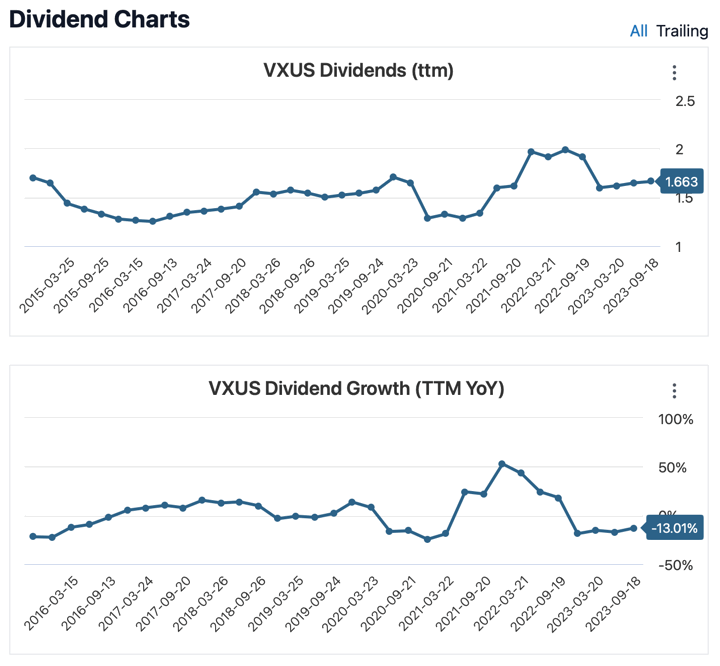
European corporate culture tends to encourage paying out a higher (sometimes fixed) percentage of earnings as dividends, but that also means the dividends move up and down with earnings. The starting yield is currently higher but may not grow as reliably. Here is the historical growth of the trailing 12-month (ttm) dividend paid by the Vanguard Total International Stock ETF (VXUS).

The dividend yield (dividends divided by price) also serve as a rough valuation metric. When stock prices drop, this percentage metric usually goes up – which makes me feel better in a bear market. When stock prices go up, this percentage metric usually goes down, which keeps me from getting too euphoric during a bull market. Here’s a related quote from Jack Bogle (source):

The true investor will do better if he forgets about the stock market and pays attention to his dividend returns and to the operating results of his companies. – Jack Bogle

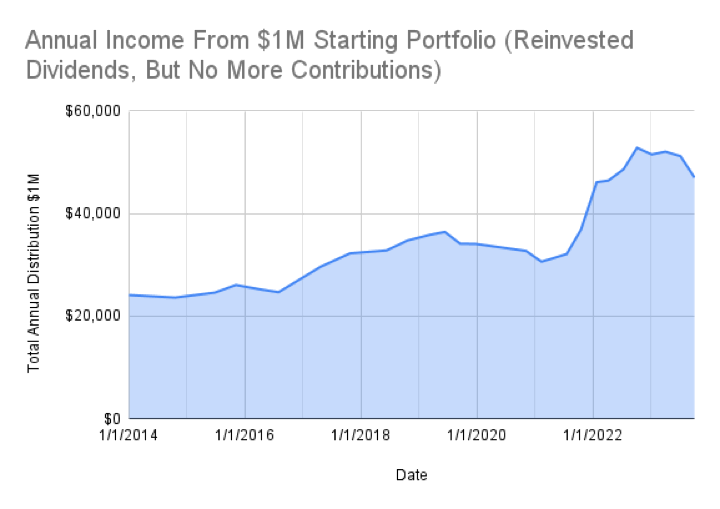
My portfolio income history. I started tracking the income from my portfolio in 2014. Here’s what the annual distributions from my portfolio look like over time:

  • $1,000,000 invested in my portfolio as of January 2014 would started out paying ~$24,000 in annual income over the previous 12 months. (2.4% starting yield)
  • If I reinvested the dividends/interest every quarter but added no other contributions, as of October 2023 it would have generated ~$47,000 in annual income over the previous 12 months.
  • If I spent all the dividends/interest every quarter and added no other contributions, as of October 2023 it would have generated ~$36,000 in annual income over the previous 12 months.

This chart shows how the annual income generated by my portfolio has increased over time and with dividend reinvestment.

I’m using simplified numbers to explain things, but isn’t that a more pleasant way to track your progress?

TTM income yield. To estimate the income from my portfolio, I use the weighted “TTM” or “12-Month Yield” from Morningstar (checked 10/2/23), which is the sum of the trailing 12 months of interest and dividend payments divided by the last month’s ending share price (NAV) plus any capital gains distributed (usually zero for index funds) over the same period.

My ttm portfolio yield is now roughly 2.69%, a bit lower than last quarter’s value. That means if my portfolio had a value of $1,000,000 today, I would have received $26,900 in dividends and interest over the last 12 months.

What about the 4% rule? For goal planning purposes, I support the simple 4% or 3% rule of thumb, which equates to a target of accumulating roughly 25 to 33 times your annual expenses. I would lean towards a 3% withdrawal rate if you want to retire young (closer to age 50) and a 4% withdrawal rate if retiring at a more traditional age (closer to 65). I really believe too much time is spent on this number. It’s just a quick and dirty target, not a number sent down from the heavens!

During the accumulation stage, your time is better spent focusing on earning potential via better career moves, improving in your skillset, and/or looking for entrepreneurial opportunities where you can have an ownership interest.

As a semi-retired investor that has been partially supported by portfolio income for a while, I find that tracking income makes more tangible sense in my mind and is more useful for those who aren’t looking for a traditional retirement. Our dividends and interest income are not automatically reinvested. They are another “paycheck”. Then, as with a traditional paycheck, we can choose to either spend it or invest it again to compound things more quickly. Even if we spend the dividends, this portfolio paycheck will still grow over time. You could use this money to cut back working hours, pursue a different career path, start a new business, take a sabbatical, perform charity or volunteer work, and so on.

Right now, I am trying to fully appreciate the “my kids still think I’m cool and want to spend time with me” period of my life. It won’t last much longer. (I’m actually dreading when I have to delete this sentence from my updates!) I am consciously choosing to work when they are at school but also consciously turning down work that doesn’t fit my priorities and goals. This portfolio income helps me do that.

Criminals Are Cashing in Fake Savings I Bonds With Authentic Serial Numbers

Many of us have bought Series I Savings Bonds in the past, and it appears criminals have also been taking notice. From the CNBC article California woman pleads guilty in $1.6 million counterfeit Series I savings bond scheme:

A California woman pled guilty to helping process more than $1.6 million in counterfeit Treasury Department Series I savings bonds through financial institutions around the United States, the Department of Justice said Thursday.

Summer Marie Creech, 45, forged counterfeit I bonds using authentic bond numbers and sent them to co-conspirators who used stolen identification to redeem the forgeries at financial institutions in south Texas and elsewhere, according to the DOJ.

A concerning detail here is that the articles states she used authentic bond serial numbers. Where did she get them? Are they issued in some sort of predictable order or algorithm? Did they find some banks that just paid out cash?

How do I know that someone else hasn’t already redeemed a counterfeit savings bonds with MY serial number(s) on it? I can only look up the value based on issue date at TreasuryDirect.gov Paper Savings Bond Calculator (you can enter any serial number you like). There is no way to confirm if my specific serial number has already been cashed in (by me or by someone else). This may be another reason for me to convert the paper savings bonds into the electronic version and track it online. I’ve been turned off by the very long wait times recently along the possibility of it being lost in the mail, but I may have to bite the bullet.

American Express Centurion “Black” Card Lawsuit: Charged $1 Million and Walked Away

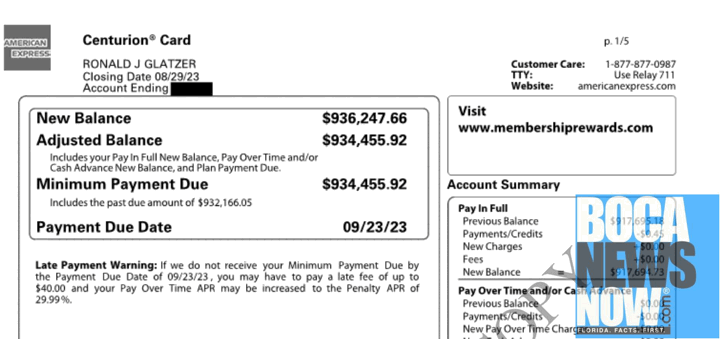
Forget trying to grab a few credit card bonuses and maximizing your cash back, an Florida ophthalmologist allegedly decided to go much bigger. According to BocaNewsNow.com, American Express is suing Ronald Glatzer for an unpaid $934,455.92 balance (now over $936,247.66 with interest and fees) on his American Express Centurion Card. 😳

This handily beats out all of the other ~$50,000 to ~$300,000 AmEx lawsuits that I’ve read about, from Lil Wayne to Iggy Azalea to Charlie Sheen.

In Florida, if a creditor files a lawsuit and obtains a judgment in court, they can garnish your wages to pay back your credit card debt. Unless he files for bankruptcy, I’m not sure what the endgame will be.

Also known as the “AmEx Black Card”, this famous invitation-only card is known for requiring at least $250,000 in annual purchases and/or a $1 million in annual income. If approved, you still have to pay a $10,000 initiation fee and a $5,000 annual fee. Of course, it is also known for not having a hard credit limit… I wonder if he redeemed his Membership Rewards points first before walking away?

Costco Now Sells 1 oz. Gold Bars (But Usually Out of Stock)

Time to clear out some of these browser tabs with interesting/funny stories that have come up this week. First up, Costco has been selling 1 ounce gold bars on its website (only pops up for a second for me), but inventory is sporadic and they sell out quickly (limit 2 per member). Per multiple media articles, the Costco CFO even addressed it in an official quarterly earnings call:

In a quarterly earnings call last week, Costco chief financial officer Richard Galanti told investors that the bars have been flying off the shelves, reported CNBC, saying, “I’ve gotten a couple of calls that people have seen online that we’ve been selling 1 ounce gold bars. Yes, but when we load them on the site, they’re typically gone within a few hours, and we limit two per member.”

At first I thought this was cute, but then I realized that there are multiple ways that the total savings is even more than just the low cost over spot:

  • First, the cost premium over spot is quite low at Costco, lower than other bullion websites.
  • You still earn credit card rewards. Most other bullion websites will add a surcharge if you pay with a credit card.
  • You can earn an additional 2% rewards if you are an Executive member.
  • You get free shipping.
  • Watch out for taxes at checkout. Depending on your area, you may or may not be subject to sales tax for gold bullion purchases over a certain amount. You may need to contact Costco after purchase to receive a refund of sales tax charged.

This could indeed work out to a good deal if you are in the market for gold bullion, but I have a feeling it’s going to be like trying to grab Taylor Swift tickets after this media coverage.