Archives for October 2023

Verizon Wireless Loyalty Discount $10/mo for 12 Months (Targeted)

If you are a Verizon Wireless customer, you may be interested in this Slickdeals forum post by member gcornett that may save you $120 per line on your cellular bill ($10 a month for 12 months). Here are the simple instructions, which should just take a few moments of your time:

YMMV if it will work for you, but here are the steps to make Verizon think you are ready to leave them.

1. Open your My Verizon app.
2. Click on the Account icon at the bottom of the app.
3. Towards the top, it says “Hi (Your Name)” Click on the “Edit Profile and Settings” link underneath that.
4. On the Account Settings screen, scroll down to the Security section and click Number Lock.
5. On the Number Lock screen, turn off the Number Lock for each line. This enables other carriers to port out your line.
6. Go back to the Account Settings screen and click on Number Transfer Pin.
7. Generate a Number Transfer Pin. Since I already did it, I can’t do it again right now in order to give you step-by-step directions. It was easy. You can figure it out.

And that’s it. Wait a day or two and see if Verizon decides you are also a loyal customer worth giving a $10.00 per line loyalty discount for 12 months. YMMV.

Note: After a few days, go back into the app and turn Number Lock back on, so nefarious characters can’t try to port out your phone number without your consent.

I don’t have Verizon myself, but many forum members have reported success. Seems like it’s worth a try to try and trigger this limited-time automated discount as there is no downside risk. Look for text message that says:

Hi, it’s Verizon. Great news! As a way of saying thanks, we are applying a $10/mo discount to every active phone line on your account for the next 12 months. There is no action needed and you’ll see it in the next 1-2 bill cycles. If you have questions please contact *611 to speak with a rep. Thank you for being a loyal customer!

or:

Hi, it’s Verizon. Great news! As a valued customer, you’re eligible for an exclusive loyalty discount on your current Unlimited plan (no plan change required). This is a limited-time offer, visit m.vzw.com/loyal to accept the offer. Thank you.
Tastyworks/Tastytrade ACAT Transfer Bonus: $500 for $25k, $2,000 for $100k, $5,000 for $1M

Update: New tiers added with higher bonus values, offer extended. Tastyworks is a discount brokerage targeted at active options traders, as they are cheaper than the big brokers for options trading while also having the full fancy options interface. Right now, they have a up to $25,000 ACAT transfer bonus with promo referral code MYNEWBONUS and you must keep the initial funding there for 12 months.

These ratios are pretty competitive, especially the $2,000 for $100,000 tier (2% of assets), but hey if you have more than that, why not grab more money even at a lower ratio.

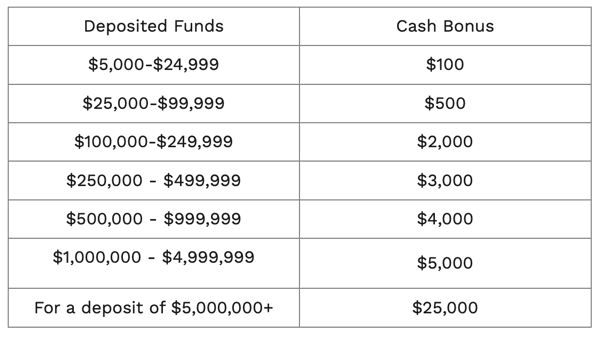
New customers who open and fund a tastytrade account with $5,000 or more in cash or by an account transfer (ACATS) and enter MYNEWBONUS into their referral code field when initially registering with tastytrade will receive a cash bonus. The bonus amount is dependent on the initial funding amount. There is a 12-month withdrawal hold on the initial funding amount to retain the cash bonus. You can find each tier’s funding threshold and resulting payout in the table below.

  • $100 with $5,000+ in transferred assets or deposits
  • $500 with $25,000+ in qualifying new money
  • $2,000 with $100,000+ in qualifying new money
  • $3,000 with $250,000+ in qualifying new money
  • $5,000 with $1,000,000+ in qualifying new money
  • $25,000 with $5,000,000+ in qualifying new money

Eligible account types include individual (cash or margin), joint (cash or margin), LLC, Partnerships, S-Corp, C-Corp (cash or margin), and Autotrade enabled accounts. IRAs, trust accounts, and international customers are not eligible. Promotion extended to March 31st, 2024. Note their definitions:

WHEN CAN I WITHDRAW MY AWARDED CASH?
The deposit ($5,000+ cash deposit or account transfer) plus the value of the awarded cash are required to remain in the account for a minimum of 12 months. As mentioned previously, any principal fluctuations due to trading will not preclude you from keeping the awarded position value after 12 months.

IF MY ACCOUNT DROPS BELOW THE FUNDING REQUIREMENT, WILL I BECOME INELIGIBLE?
Principal fluctuations due to trading will not affect your eligibility to keep your awarded cash value. As long as you keep your original $5,000+ deposit in your account, then you will be able to keep your awarded cash.

WILL I BE PENALIZED IF MY ACCOUNT DROPS BELOW MY FUNDING AMOUNT?
Principal value fluctuations are not considered. As long as the initial $5,000 (or more) remains in the account for 12 months, then the awarded cash value will not be debited from your account.

WHAT HAPPENS IF I NEED TO WITHDRAW MY DEPOSIT BEFORE THE 12-MONTH HOLDING PERIOD END?
You are free to withdraw the deposit you made to your account. However, if the amount withdrawn no longer meets the minimum deposit requirements, then the value of the awarded stock position will be withheld from the withdrawal amount.

CAN I TRANSFER THE CASH OUT OF MY ACCOUNT?
Not until the 12-month hold period has lapsed.

Brokerage Asset Bonuses vs. Bank Deposit Bonuses. There is an important difference between brokerage asset bonuses and bank deposit bonuses. A bank deposit bonus pays you extra interest for holding a certain amount of cash with them. A brokerage asset bonus allows you to transfer over your existing investments like index funds, individual shares of Apple or Berkshire Hathaway, individual shares of REITs, and so on. You still own the asset and it’s still doing its thing. The brokerage bonus is on top.

In this example, if you really wanted to compare it directly against an interest rate, you should at least assume you will be holding a T-Bill ETF like SGOV, GBIL, or BIL (current SEC yield over 5%) and then adding the bonus to that yield. However, the real benefit for patient, long-term investors that you can just keep your existing assets and earn yourself a nice “self-management fee”.

MMB Portfolio Asset Allocation & Performance Update – October 2023

Here’s my quarterly update on my current investment holdings as of October 2023, including all of our combined 401k/403b/IRAs and taxable brokerage accounts but excluding our primary residence and side portfolio of self-directed investments. Following the concept of skin in the game, the following is not a recommendation, but a sharing of our real-world, imperfect, low-cost, diversified DIY portfolio.

“Never ask anyone for their opinion, forecast, or recommendation. Just ask them what they have in their portfolio.” – Nassim Taleb

How I Track My Portfolio
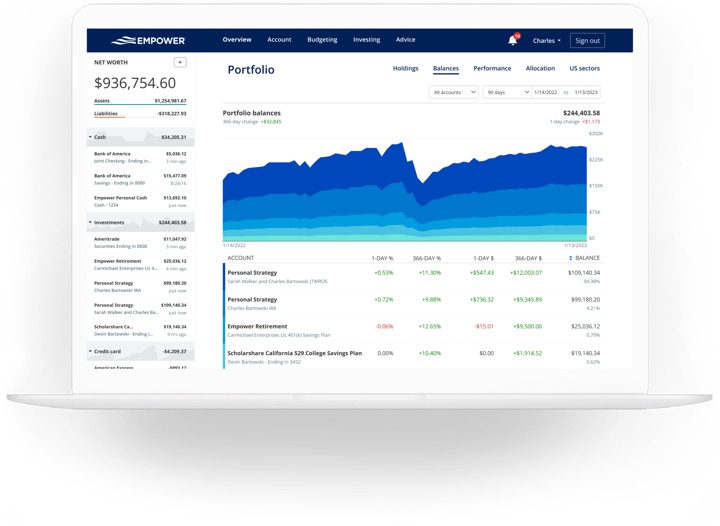
Here’s how I track my portfolio across multiple brokers and account types. There are limited free advanced options after Morningstar discontinued free access to their portfolio tracker. I use both Empower Personal Dashboard (previously known as Personal Capital) and a custom Google Spreadsheet to track my investment holdings:

  • The Empower Personal Dashboard real-time portfolio tracking tools (free) automatically logs into my different accounts, adds up my various balances, tracks my performance, and calculates my overall asset allocation daily.
  • Once a quarter, I also update my manual Google Spreadsheet (free to copy, instructions) because it helps me calculate how much I need in each asset class to rebalance back towards my target asset allocation. I also create a new tab each quarter, so I have an archive of my holdings dating back many years.

2023 Q2 Asset Allocation and YTD Performance
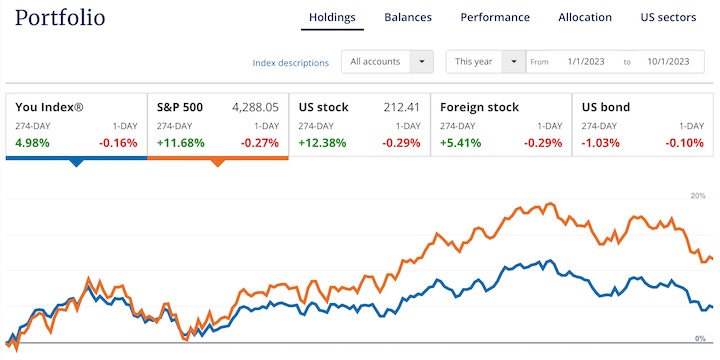
Here are updated performance and asset allocation charts, per the “Holdings” and “Allocation” tabs of my Empower Personal Dashboard.

Humble Portfolio Background. I call this my “Humble Portfolio” because it accepts the repeated findings that the ability to buy and sell stocks and exceed the performance of basically doing nothing is exceedingly rare. Charlie Munger believes that only 5% of professional money managers have the skill required to consistently beat the index averages after costs.

Instead, by paying minimal costs including management fees, transaction spreads, and tax drag, you can essentially guarantee yourself above-average net performance over time.

I own broad, low-cost exposure to productive assets that will provide long-term returns above inflation, distribute income via dividends and interest, and finally offer some historical tendencies to balance each other out. I have faith in the long-term benefit of owning businesses worldwide, as well as the stability of high-quality US Treasury debt. My stock holdings roughly follow the total world market cap breakdown at roughly 60% US and 40% ex-US. I add just a little “spice” to the broad funds with the inclusion of “small value” ETFs for US, Developed International, and Emerging Markets stocks as well as additional real estate exposure through US REITs.

I strongly believe in the importance of knowing WHY you own something. Every asset class will eventually have a low period, and you must have strong faith during these periods to truly make your money. You have to keep owning and buying more stocks through the stock market crashes. You have to maintain and even buy more rental properties during a housing crunch, etc. A good sign is that if prices drop, you’ll want to buy more of that asset instead of less. I don’t have strong faith in the long-term results of commodities, gold, or bitcoin – so I don’t own them.

I do not spend a lot of time backtesting various model portfolios, as I don’t think picking through the details of the recent past will necessarily create superior future returns. You’ll find that whatever model portfolio is popular in the moment just happens to hold the asset class that has been the hottest recently as well.

Find productive assets that you believe in and understand, and just keep buying them through the ups and downs. Mine may be different than yours.

I have settled into a long-term target ratio of roughly 70% stocks and 30% bonds (or 2:1 ratio) within our investment strategy of buy, hold, and occasionally rebalance. My goal is more “perpetual income portfolio” as opposed to the more common “build up a big stash and hope it lasts until I die” portfolio. My target withdrawal rate is 3% or less. Here is a round-number breakdown of my target asset allocation.

  • 30% US Total Market (ex. VTI)
  • 5% US Small-Cap Value (ex. VBR)
  • 20% International Total Market (ex. VXUS)
  • 5% International Small-Cap Value (ex. AVDV)
  • 10% US Real Estate (REIT) (ex. VWO)
  • 15% US Treasury Nominal Bonds or FDIC-insured deposits
  • 15% US Treasury Inflation-Protected Bonds (or I Savings Bonds)

Details. According to Empower, my portfolio is up about 5.0% YTD to 10/1/2023. The S&P 500 is up 11.7% YTD, while the US Bond index is down around 1%.

The most notable action this quarter has been… inaction. There was only minor rebalancing via new purchases with cashflows (mostly dividends) this quarter. I haven’t bought any new ETF tickers or sold a single share of anything. I am considering increasing my estimated tax payments to the IRS to compensate for the extra interest being earned on my FDIC-insured savings accounts and Treasury bonds.

I’ll share about more about the income aspect in a separate post.