Archives for August 2023

FI Calc: Visually-Friendly Retirement Withdrawal Calculator

If you enjoy tinkering with financial calculators, FI Calc is a new one that is visually easy to use and thus potentially more educational. The portfolio inputs are somewhat limited (“stocks” = S&P 500, “bonds” = 10-year US Treasuries) but I enjoy changing up the rest of the variables and seeing how that affects the results. You can support the creator here.

Here’s an example scenario using a 70% stocks/25% bonds/5% cash portfolio (rebalanced annually) along with a 4% withdrawal rate adjusted annually for inflation ($40,000 initially on a $1 million portfolio). The success rate for a 40-year withdrawal period (longer than the usual 30-years) was calculated to be 91.2% (“103 out of 113 retirement simulations were able to sustain withdrawals for the entire retirement.”)

If you scroll down, you can actually see which specific 40-year periods resulted in portfolio successes ✅ (including big successes 💰 ) and failures ❌ (and near failures 🥜).
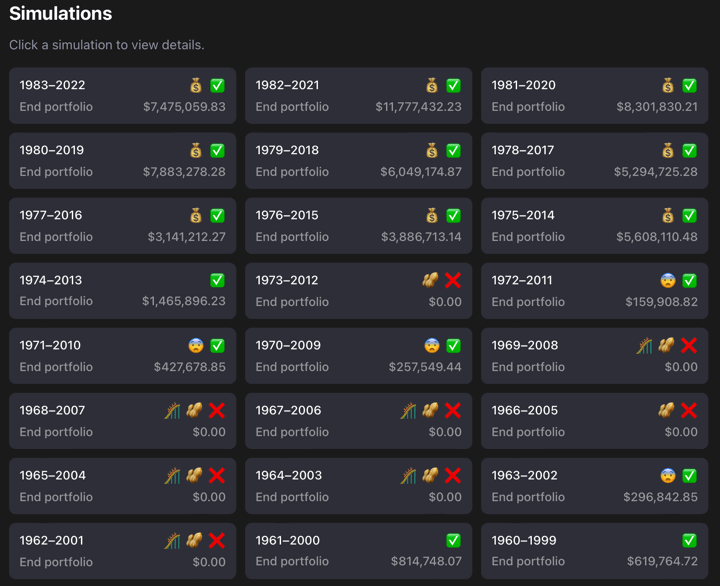
If you click on the 1972-2012 box, you can see how the $1 million portfolio value would have gone down over time, running out of money in 2006.

Yet if you look at the average annual return over that 40-year time period, stocks earned 6.74% real (11.09% nominal) and bonds earned 4.20% real (8.55% nominal). The growth chart for the S&P 500 (shown below) looks great during that same time. It’s just that the “sequence of returns risk” popped up where the returns were low in the beginning of the period and high at the end. If you spend down your portfolio too much in the beginning, it doesn’t have enough money left to come back later.

This also why when people just assume stocks will go up 8% a year, it’s very different than a 8% guaranteed return. The volatility really hurts when you are spending down your assets.

But, when you lower it to a 3.5% withdrawal rate ($35,000 initially on $1 million), your portfolio was able to mount a comeback:

Social Security Claiming Age: Theoretically Optimal vs. Real World Decisions

An important choice in retirement planning is when to start claiming your Social Security benefits. If you claim earlier, your monthly benefits will be reduced for the rest of your life. If you claim later, your monthly benefits will be increased for the rest of your life. Here is how much of the benefit taken at “full retirement age” will change based on your birth year. Taken from Fool.com using data from SSA.gov. Found via Early Retirement Forums.

This can be a complicated question, but if you were to force a rule of thumb*, it would probably be to wait to claim as late as you can in order to maximize your total lifetime benefits. (* Don’t just follow this blindly. There are many online calculators to help you with the details, especially for couples, like the free Open Social Security.)

Social Security is the only place you can “buy” a lifetime of guaranteed inflation-adjusted income. The difficulty is that you have to “buy” it by living off your other investments until your claim age.

Here are some interesting charts from the article The Retirement Solution Hiding in Plain Sight: How Much Retirees Would Gain by Improving Social Security Decisions, which analyzed the “actual Social Security decision and wealth accumulation of 2,024 households in a Social Security Administration sponsored panel survey.”

As you can see, the optimal claim age to maximize total lifetime benefits is mostly tilted towards the maximum age of 70. However, the actual claim age is heavily clustered towards the earliest possible age of 62.

How much difference are we talking about? Here is a chart showing of the average lifetime increase in income if you went for the optimal instead of the actual (in percentages).

Vanguard Cash Plus Account Review: FDIC-Insured, But Missing Useful Features

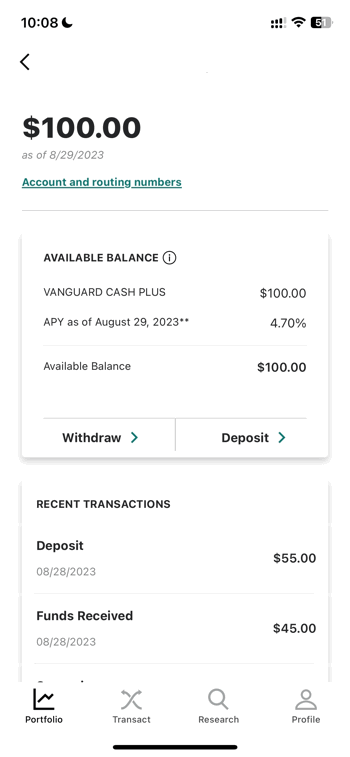
Vanguard has been piloting some new products recently, and I was finally invited to try out the Vanguard Cash Plus Account. I’ve been playing with it for a few days and here are my thoughts. First, it’s important to note that there are two separate FDIC-insured products available from Vanguard:

  • Vanguard Cash Deposit – This is a new option for the settlement fund (default cash sweep) in your brokerage account. The interest rate has historically been lower than Cash Plus. 3.70% APY as of 8/28/23. You can make immediate trades straight from the funds in this account. FDIC insurance up to $1.25 million ($2.5 million for joint accounts).
  • Vanguard Cash Plus Account – This is a separate FDIC-insured account with a historically higher interest rate that is not a settlement account. 4.70% APY as of 8/28/23. It is meant as an alternative to a bank savings account and allows incoming ACH direct deposits and ACH withdrawals. FDIC insurance up to $1.25 million ($2.5 million for joint accounts).

Invitation and opening process. I received a physical mailer with an invitation last week, but the application was all online. The invitations are sent to individuals, and if you want to open a joint account, the joint owner must also have a Vanguard brokerage account. The implication is that this product is meant for existing Vanguard brokerage customers only, not as a standalone product.

Features. This is not a full-featured account, but a pretty minimalist FDIC-insured savings account. No minimum balance, no monthly fees. You get a routing number and account number (routing number is 242071583 which turns out to be PNC Bank NA, their bank partner.

It’s important to note all that is not included:

  • No ATM or debit card. (No ATM rebates.)
  • No checkwriting. (I did find mobile check deposit on the app.)
  • No online bill payment service. (You can use your account number to link at your credit card’s website for example, but there is no in-house system.)
  • No automated recurring transfers.
  • No ability to use your money market fund as a backup overdraft source.

Historical note: For a while, Vanguard did offer an “Advantage” account to select customers which did include all these things, but they abruptly discontinued it in 2019. So Vanguard is definitely intentionally leaving all these features out.

Basically, you get to make ACH direct deposits and ACH withdrawals. This enables the direct deposit of paychecks, Social Security, pensions, PayPal/Venmo transfers, and pay bills through vendor websites.

You might think that since it is a Vanguard account, you could use the funds in Cash Plus directly to buy some Vanguard ETFs or mutual funds. Not quite. First, all accounts must be “like registered” for you to transfer from Cash Plus. I am not allowed to transfer to my trust accounts. Second, you must manually transfer the money over, and then it should be available the same day. I found this statement in one place:

A transfer from a Cash Plus Account into a Vanguard Brokerage Account will settle by the next business day, but will be available for trading immediately.

But a slightly different one on their public FAQ:

How long will it take to move my cash from one account to another?

Transfers (including from one Vanguard account to another) generally take 2–3 business days, but at times may be quicker.

The competition. This is a supplemental Vanguard account meant to add functionality for existing Vanguard customers. However, I must point out that Fidelity has included a much higher level of functionality for its customers for a long time.

The plain taxable Fidelity brokerage account will also provide you account and routing numbers so that you can perform ACH deposits and withdrawals. Their core options (settlement fund) also include an FDIC-insured option with lower interest rate, but you can use a money market mutual fund like SPAXX that currently has a 4.98% yield.

But Fidelity also includes a nice bill payment interface, ATM debit card, checkwriting (with free checks), and mobile check deposit all within their standard brokerage account. (Fidelity also includes domestic and international ATM rebates if you have at least $250k in total assets with them. The alternative Fidelity Cash Management Account does include ATM rebates with no minimum balance requirement, but takes a bit more work to manage the cash optimally by manually purchasing their money market funds. I’ll leave the details for another review.)

Basically, if you are the type to want an all-in-one banking solution, Fidelity has already been doing it for years and years with more features. I feel that Fidelity’s customer service is also much better than Vanguard’s.

The Cash Plus account appeals to a niche customer. You are a loyal Vanguard customer that wants the added functionality from a basic high-yield savings account with bank routing and account numbers. You want one that shows up when you log into Vanguard, so you don’t have to log into another bank. The interest rate is pretty good and should stay that way, but still lower than Vanguard’s own money market funds. Maybe you want that FDIC-insurance. Finally, you are satisfied with Vanguard’s level of customer service these days. In my experience, the differences in hold times between Vanguard and Fidelity is simply night and day.

Will I actually use it? Honestly, it’s kind of hard to get excited that Vanguard is offering a barebones FDIC-insured savings account like ING Direct in 2023. I’d love to see the Cash Plus APY as the standard settlement fund along with account/routing numbers. They could even add the other features like ATM debit cards, but I don’t think they can handle the customer service level required. Instead, we just get this little step forward.

Mostly, I don’t need the FDIC insurance as I have full faith in the Vanguard Federal Money Market Fund (VMFXX, 5.28% yield as of 8/28/23) and Vanguard Treasury Money Market Fund (VUSXX, 5.19% yield as of 8/28/23) which both offer much higher interest rates and partial state income tax deductions. These are perfectly acceptable as my “savings accounts”. Stay lean Vanguard, just take the customer service back to the acceptable levels you had before your huge growth.

For now, my plan is to simply keep my Cash Plus account open with minimal activity in case one day the APY is higher than the money market alternatives.

Johnson & Johnson / Kenvue Odd Lot Tender Arbitrage Deal (Results)

Update 8/24: Here are the final results of this odd lot tender. See original post below for past details, although the opportunity has passed. Per JNJSeparation.com, the final exchange ratio was 1 share JNJ to 8.0324 shares of KVUE. The deal was oversubscribed, with a final proration factor of ~23.2% of shares tendered. However, those with “odd lots” of 99 shares or less were not subject to proration, which created an opportunity for smaller individual investors.

Here are the stats:

  • 8/14 prices (closing), JNJ $173.44 and KVUE $22.94.
  • 99 shares of JNJ @$173.44 = $17,171 (8/14)
  • 8/24 prices (intraday), JNJ $165.36 and KVUE $23.32.
  • 99 shares of JNJ tendered = 795.20 shares of KVUE.
  • 795.20 shares of KVUE @$23.32 = $18,544 (8/24)

Net profit on 99 JNJ shares bought 8/14, tendered, and sold 8/24: ~$1,350. If you sold your resulting KVUE and immediately bought JNJ back again intraday on 8/24, you would end up with ~112 shares of JNJ.

For the curious, the current market caps are JNJ $430 billion and KVUE $44.5 billion. So if you wanted to keeping owning the “original” JNJ components in a weighted manner, that would be roughly 90% JNJ and %10 KVUE. (JNJ still owns about 9.5% of KVUE after this split-off.)

Original post 8/12:

Everyone knows Johnson & Johnson (JNJ), but fewer know that the huge company spun off its consumer health division (Tylenol, Band-Aid, etc) earlier in 2023 and called it Kenvue (KVUE). JNJ kept its pharmaceutical and medtech divisions, but also still owns about 90% of KVUE. Moving forward with the split-off, they are offering JNJ shareholders the option to tender roughly $100 of JNJ and get $107 of KVUE stock in return.

They are incentivizing JNJ shareholders to help them complete the split-off, and it’s a good deal, almost too good as it may be “oversubscribed” and tenders may be pro-rated. However, there is an “odd lot” provision in the deal, where if you only have 99 shares of less of JNJ and tender them all, you won’t be subject to pro-ration. This is a small corner where small individual investors can gain a small advantage that the bigger money can’t access.

Now, I’m not an expert on this stuff by any means, and there are risks involved. The following two articles and the official informational site explain the various details and risks in much better detail.

From the official site above that tracks the share prices for the exact tender ratio (upper limit not in effect at time of writing):

If the Exchange Offer is oversubscribed and Johnson & Johnson cannot accept all tenders of J&J Common Stock at the exchange ratio, then all shares of J&J Common Stock that are validly tendered will generally be accepted for exchange on a pro rata basis in proportion to the number of shares validly tendered, which is referred to as “proration.” Stockholders who beneficially own “odd-lots” (less than 100 shares) of J&J Common Stock and who validly tender all of their shares will not be subject to proration (other than participants who hold odd-lot shares as a participant in the Savings Plans).

To quickly summarize the potential deal:

  • Buy 99 shares* of JNJ at your broker, for an approximate cost of $17,000.
  • Tender *all* your shares through your broker . You can’t own 100+ shares and only tender 99. The deadline is supposed to be 8/18, but some brokers may require your tender instructions earlier than that. (At Fidelity it is 08/17 at 7pm ET.) I’d do it as soon as you can.
  • If all goes smoothly (not guaranteed by me), then you’ll get ~$18,200 of KVUE approximately 7 business days after the deadline. You can sell the shares for cash if you want to realize a potential profit of ~$1,200. You may get a little less depending on the relative share prices of JNJ and KVUE.
  • * You can buy less than 99 shares for less financial commitment (and less upside), but you have to tender them all.

This is the type of deal that I find both interesting and educational, on top of having a positive expected value. Warren Buffett today wouldn’t bother with this deal, but Warren Buffett age 14 might. This is more of a calculated gamble, rather than a fixed return. There is risk involved, including either the deal being canceled somehow (you keep 99 shares of JNJ) or the limit ratio being reached and you get less than 7.5% premium of KVUE. You should perform your own due diligence.

Wallet by BOSS Money $100 Referral Bonus + 3.75% APY Checking/Savings

A new banking app called Wallet by BOSS Money is offering a $100 bonus via referral link (open link via smartphone, that’s mine). You need to set up direct deposits totaling at least $5,000 within 45 days. No minimum hold period. App only (iOS and Android). The referrer gets the same amount. I know that this is a relatively high requirement, and I’m hoping a brokerage transfer of my investment income will satisfy it, but definitely not guaranteed.

There is no minimum hold period and the terms state “Rewards are generally deposited within 14 (fourteen) business days after criteria are met.” Therefore, remember that you don’t actually have to keep the $5,000 in the account. You just need it to show up, and after that you can remove it whenever. You are also earning 3.75% APY in the few days in between as opposed to zero in some cases. (Worst case math: Even if you get $100 + 3.75% APY on $5,000 held for 45 days, that’s the equivalent of nearly 20% annualized return (16% + 3.75%). But I don’t plan on keeping the $5k there.)

Good news is the account opening process was very quick and easy, under 5 minutes, and did not require a hard credit check. So the upfront time commitment can be low. Have your photo ID and a good location with dark background and no glare ready, as the app will ask to take a live picture of your photo ID (and a selfie photo) as part of the application process. I passed without issue and did not have to upload any extra documentation. The account was open and ready less than an hour after application. FDIC insurance through Evolve Bank and Trust (routing number 084106768).

The stated mission of BOSS Money is to “provide accessible, affordable, and secure banking services to everyone, including underserved and unbanked communities.” As such, they do not require a Social Security Number (SSN) or Individual Taxpayer Identification Number (ITIN).

In the US, 22% of adults are either unbanked or underbanked, lacking access to basic financial services like checking or savings accounts. This disproportionately impacts underserved minority communities, including immigrants, independent contractors, freelancers, on-demand workers, and college students. These communities are often excluded from traditional financial systems, leaving them without the tools and resources they need to achieve financial wellness and stability.

Here are the highlights:

  • 3.75% APY on both Checking and Savings accounts.
  • No minimum balance, no monthly fees (even without direct deposit).
  • No credit check.
  • Load cash to your Wallet by BOSS Money account at over 90,000 locations nationwide, including popular retailers like 7-Eleven, CVS, Walgreens, Walmart.
  • Get $2 cashback in your Wallet account when you send money using the Wallet Mastercard® in either the BOSS Money or BOSS Revolution apps.

Here are the full promo terms. If you direct deposit between $500 – $4,999.99, you’ll get $25. Hat tip to Doctor of Credit.

Refer a Friend, Get up to $100 in Wallet Account
Invite Friends to Join Wallet by BOSS Money:

Referral Rewards:
For Direct Deposits between $500 – $4,999.99: You both receive $25.
For Direct Deposits of $5,000 or more: You both receive $100.
Preferred Direct Deposit Method: We recommend connecting with your employer in the app using Argyle, a two-minute process.
Exclusions: Bank ACH transfers, Wallet transfers, verification or trial deposits from financial institutions, peer-to-peer transfers from services such as PayPal, Cash App, or Venmo, mobile check deposits, and cash loads or deposits are not considered qualifying direct deposits.
Reward Timeline: Rewards are generally deposited within 14 (fourteen) business days after criteria are met.
Referral Cap: Referrers may earn no more than $500 in monetary referral rewards per calendar year.
Account Standing: The Referrer’s account must be in good standing to receive the referral reward.
Amendments and Termination: Wallet by BOSS Money may modify or terminate these terms at any time without prior notice.

Another drop in my 2023 IRA challenge bucket.

Crowdfunded Real Estate Investing: Is Due Diligence by Individual Investors Even Possible?

A surprising takeaway from peer-to-peer lending through Prosper and LendingClub was that the borrowers who most strongly promised to pay you back (e.g. “I promise I will pay you back, so help me God, thank you so much”) turned out to also be the most likely to default. If you extend that to crowdsourced real estate investing, this is probably the analogous statement:

“We exclusively work with leading sponsors on commercial real estate offerings that meet our strict marketplace requirements.”

Reading this WSJ article Missing Millions and a Rabbinical Arbitrator: Real-Estate Deal Gone Bad Hits Popular Crowd Funder (gift article, should bypass paywall) about CrowdStreet, you get more of a peek behind the curtain. The strange title? Apparently one of their sour deals has resulted in $63 million of “missing” investor funds while also stipulating that any disputes be settled by a rabbinical court rather than the US legal system. Now that’s a new thing to look for in the fine print.

There is much more information in the full article, but here are a few quotes on Crowdstreet returns:

The Journal analyzed data on expected and realized returns of 104 completed deals from the sale of property or investor redemptions, which the company posted from 2013 to August 2022.

The Journal analysis found that more than half of those investments promoted on CrowdStreet’s platform failed to meet their target returns. Hundreds of CrowdStreet users lost some $34 million on 19 deals that underperformed as of this July, according to the Journal’s analysis. A dozen of those deals lost nearly 100% of investor funds.

CrowdStreet also hosted successful deals. More than 20 deals outperformed projected return rates by at least 10 percentage points. Hundreds of others are still outstanding. It often takes at least three years before investors can realize a return on their investments.

Some of the deals did well, some did awful. You can see their completed deals here. Many of their complete losses were hotel-related (“The 100% loss shown simply represents absolute total loss of capital incurred by investors”, ouch). Houston Red Lion Hotel. Cloverleaf Suites Overland Park. Intellistay Courtyard Tulsa. Four Points Sheraton Little Rock, Arkansas. That sounds like some poor deal structuring if your downside is so extreme.

The stated aim of all these real estate start-ups is to make commercial real estate investing more accessible to individual investors. Unfortunately, in my opinion it has been shown that individual investors simply aren’t given enough information to judge whether the deals are good or not. I would look up property addresses, learn about neighborhoods, try to look up the history of the borrowing groups, read through the comparables, appraisals, and contracts, but in the end, you are trusting the platform to perform most of the due diligence. There are no audited financial reports for me to read. There are no ratings agencies. How can one tell the difference between skill and luck? I have managed positive overall returns with my specific investments with PeerStreet, RealtyShares, Fundrise, Patch of Land, and others, but I had the most faith in PeerStreet’s model and they are likely to end up my worst performer.

The problem is the platform is strongly incentivized to do what is necessarily to maintain a high rate of deal flow and transactions, so they can make fees. When you are “exclusive” and “strict”, you don’t get deal flow now that the boom times have ended. Once the deal flow stops, they are dead in the water. This adds pressure to allow marginal borrowers and questionable deal terms.

I’ve only put relatively small amounts of “play account” funds into these sites, but as I don’t feel I can properly judge the individual deals nor properly judge the deal brokers, it’s probably time for me to avoid this asset class altogether.

Different Types of Taxable Bonds: Long-Term Performance and Returns Comparison

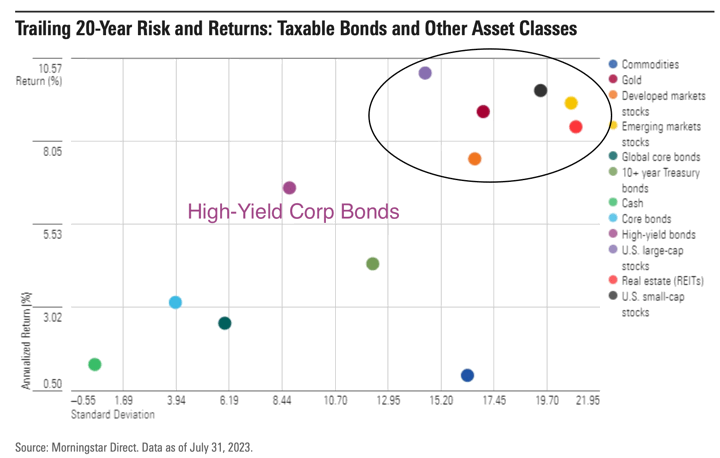
As part of its “Portfolio Basics” series, Morningstar has an educational article on taxable bonds, including corporate bonds, US government bonds, and foreign government bonds, along with their different credit grades and maturity lengths.

Over the last 20 years, things have played out pretty much as the traditional theory would have predicted. The higher the “risk”, the higher the return. High-yield “junk”-rated corporate bonds have had the highest return, but also the bumpiest ride due to their higher credit risk and higher interest rate risk (they are usually of longer maturity). Short-term US Treasury bills (“cash”) has had the lowest return but the lowest credit risk and lowest interest rate risk. Personally, I see this chart and am satisfied with my holdings of intermediate-term US Treasury bonds (green line) that keeps the highest credit risk but with effectively a ladder out to a longer average maturity.

But hey, those high-yield bonds still returned a lot more money over the last 20 years instead. Why not just hold those instead? First, don’t forget to step back and look at the bigger picture:

If you’re going to accept big swings, you might prefer one of the highest returning assets in the top-right corner. (I have no idea which one will be the absolute highest in the next 20 years, but I don’t think it’s an accident that all the stocks are grouped together in that top-right corner.) If you can hold on through the scary periods, the gap between stocks and bonds over the long run (~100 years below) is huge:

This is why many will advise you to own more stocks if you want an overall higher risk/potentially higher return profile, as opposed to riskier bonds. But before you get carried away, read this book excerpt Courage Required from William Bernstein. Bleak times will come again. Safe things have value beyond the rate of return.

Big List of Anti-Lists: Asset Classes NOT Owned By Some Experienced Investors

Every asset class has its energetic supporters, from rental properties to altcoins to gold. Listening to each group, you may feel that you need to own every asset class in order to be “diversified”. However, sometimes less is more, and it can be useful to read about why many seasoned veterans consciously avoid certain corners of the investment world. I find it a refreshingly different perspective, even if I may or may not agree. Everyone’s needs are different, and I own several of the things below myself. Here are a few lists along with supporting arguments.

William Bernstein – MD, author and wealth manager. I compiled this list while listening to the linked interview.

  • Commodities Futures
  • Individual Stocks
  • Corporate bonds
  • Long-term bonds
  • Fixed annuities

Jonathan Clements – financial author and long-time WSJ columnist

  • Savings bonds.
  • Long-term bonds.
  • High-yield “junk” bonds.
  • Municipal bonds.
  • International bonds.
  • Individual stocks.
  • Immediate fixed annuities (but he does plan to buy some eventually).
  • Deferred income annuities.
  • Gold
  • Commodities
  • Real Estate Investment Trusts (REITs)
  • Rental properties.
  • Long-term-care insurance.
  • Life insurance.
  • Disability insurance.
  • Flood insurance.

Amy Arnott – CFA, portfolio strategist for Morningstar Research

  • Actively Managed Funds
  • Real Estate Investment Trusts (REITs)
  • Sector Funds
  • Alternative Investments
  • I Bonds
  • High-Yield Bonds
  • Gold

Let me know if you come across any other “What I Don’t Own” lists.

[Image credit: Amazon]

American Express® Green Card Review: 40,000 Points Welcome Offer

The American Express(R) Green Card is one of AmEx’s classic cards, and they have revamped the rewards structure and added new travel perks. There is also a welcome offer for new cardholders. Here the the highlights:

  • Earn 40,000 Membership Rewards(R) Points after you spend $3,000 on purchases on your new Card in your first 6 months of Card Membership.
  • Earn 3X Membership Rewards(R) points on travel including airfare, hotels, cruises, tours, car rentals, campgrounds, and vacation rentals.
  • Earn 3X Membership Rewards(R) Points on transit purchases including trains, taxicabs, rideshare services, ferries, tolls, parking, buses, and subways.
  • Earn 3X Membership Rewards(R) points on eligible purchases at restaurants worldwide, including takeout and delivery in the US.
  • $189 CLEAR Plus Credit: Receive up to $189 per calendar year in statement credits when you pay for your CLEAR Plus membership (subject to auto-renewal) with the American Express(R) Green Card.
  • $100 LoungeBuddy Credit: No airport lounge membership? No problem! Purchase lounge access through the LoungeBuddy app using the American Express(R) Green Card and receive up to $100 in statement credits annually.
  • Trip Delay Insurance: If a round-trip is paid for entirely with your Eligible Card and a covered reason delays your trip more than 12 hours, Trip Delay Insurance can help reimburse certain additional expenses purchased on the same Eligible Card, up to $300 per trip, maximum 2 claims per eligible account per 12 consecutive month period. Terms, conditions and limitations apply. Coverage is provided by New Hampshire Insurance Company, an AIG Company.
  • No Foreign Transaction Fees.
  • $150 annual fee. (card_name)

Note the following language:

You may not be eligible to receive a welcome offer if you have or have had this Card or previous versions of this Card. You also may not be eligible to receive a welcome offer based on various factors, such as your history with credit card balance transfers, your history as an American Express Card Member, the number of credit cards that you have opened and closed and other factors. If you are not eligible for a welcome offer, we will notify you prior to processing your application so you have the option to withdraw your application.

This card has not been heavily marketed in the past, so many people (including myself) are still eligible for the welcome offer. The application will tell you if they detect that you are not eligible for the bonus based on their records. Given that you can only get the welcome offer once time per lifetime, it is best to apply during a limited-time offer. (Update: I was approved for this card without issue.)

Membership Rewards points can be converted to the following airline and hotel programs (there are more, this is just a selection):

  • Delta SkyMiles
  • Hawaiian Airlines
  • JetBlue
  • ANA Mileage Club (partner of United Airlines)
  • Air Canada (partner of United Airlines)
  • British Airways (partner of American Airlines)
  • FlyingBlue (Air France/KLM)
  • Singapore Airlines
  • Cathay Pacific
  • Emirates
  • Etihad Guest
  • Qantas
  • Virgin Atlantic
  • Choice Privileges
  • Hilton Honors
  • Marriott Bonvoy

They also run limited-time 25% to 40% bonuses on points transfers. You can also transfer to gift cards many retailers at varying rates, but many available at the rate of 10,000 MR points = $100 gift card. My most recent redemption was a $100 Home Depot card for 10,000 points, sometimes less when they run special discount. However, don’t expect the cash-equivalent prepaid credit cards at that rate, it’s usually closer to a 0.6 cent/point ratio.

40,000 Membership Rewards points, worth an estimated $400. Some folks value these points much more highly, but I prefer to stick to a simple and conservative 1 cent per point.

CLEAR Plus membership gets you through airport security significantly faster at 50+ airports nationwide via designated lanes at TSA checkpoints. (CLEAR offers separate and short ID check lines, getting you to the x-ray machines faster. But you should also have TSA PreCheck for optimal speed.) If you value this service, then the recurring $189 value can offset the $150 annual fee at renewal time.

Compared with its siblings at American Express, this card has a tighter focus on frequent fliers (3X on travel, CLEAR Plus membership) and the lowest annual fee:

Bottom line. The American Express(R) Green Card is a premium travel card with a welcome offer, revamped 3X rewards categories, and new travel perks. You’ll have to see if your travel habits match up to the perks that this card offers. (card_name)

Also see: Top 10 Best Credit Card Bonus Offers.

All information about the American Express® Green Card has been collected independently by MyMoneyBlog.com.

What’s Your Retirement Mindset? Escaping From vs. Escaping To

In a recent Outside magazine article, the author examined research about how activities can be either positive or negative, not based on the actual activity itself, but your mindset while doing them. For example, exercising could be negative, while playing video games could be positive.

Stenseng’s view, which he first laid out in a 2012 paper, is that we should broaden our concept of escapism to include both negative and positive elements, which he dubbed self-suppression and self-expansion. The former is when you’re running away from bad feelings; the latter is when you’re seeking out good feelings.

Earlier this year in the journal Frontiers in Psychology, Stenseng and his colleagues published a study of 227 recreational runners, in which they tried to tease out the signs of self-suppressing and self-expanding escapism with a series of questionnaires. Runners who agreed with statements like “When I run, I try to learn new things about myself” or “When I run, I open up for experiences that enrich my life” were demonstrating self-expansion. Those who agreed with “When I run, I shut out the difficult things I do not want to think about,” on the other hand, were self-suppressing.

This concept also connects with the pursuit of financial freedom and retirement:

The most powerful message that I take from Stenseng’s work is the distinction between avoidance and approach—between escaping from and escaping to.

What is your primary reason for pursuing financial freedom? If you’re focusing on the negative aspects of your job – horrible bosses, annoying customers, long hours, stressful work, inadequate paycheck, then you are trying to escape from your bad job. That can be a good initial motivator, but it won’t sustain you for very long. You’ll be miserable and prone to burnout. If you do make it to retirement, you might still find yourself searching to ways to fill the day.

This research supports the idea that healthier approach is to start exploring and finding out where you want to escape to. Commit energy into finding a better job laterally and/or entire career switch. Connect with friends and ask about any opportunities. Look at the hobbies you enjoy and pick apart what you like about them. You have to find the “good enough” job that makes the saving phase more like auto-pilot. Even for very early retirees, you are looking at 15-20 years of work. Don’t spend it with people you don’t like or respect. In the end, it’s the retirees with engaging hobbies and friends that are the happy ones.

The August 2023 issue of Costco Connection profiles the second “what if” careers of several different folks. Bank executive turned woodworker. Teacher turned baker. TV producer turned college professor.

The Scary Clause in Fixed Index Annuity Contracts

Allan Roth takes a closer look at the role of fixed index annuities as part of an “efficient” portfolio, and as usual makes some great observations. The first thing about fixed index annuities is that no two are the same – the insurance companies don’t want to create a standardized product where they have to compete with each other on price. There are surrender charges, confusing indexes, caps, spreads, market value adjustments, participation rates, just to name a few. Even in the analyzed article, they had to use a theoretical FIA product that nobody can actually purchase. (Comparability is what makes MYGAs and SPIAs different than other annuities.)

The second thing about fixed index annuities is that within nearly every contract, the insurance company can significantly change the crediting rules after purchase.

From Annuity.org:

The growth of indexed annuities aligns with the performance of a particular stock index, such as the S&P 500. Interest rate caps denote the maximum amount of interest an annuity can earn — regardless of the change in the index. Insurance companies have the right to adjust these caps every year.

From Roth’s article:

Every FIA contract I’ve reviewed has the unilateral right of the insurance company to change the terms of the contract, such as lowering that 12% cap. Pfau agreed that insurance companies have that right. I asked Pfau how low those caps could go, and he responded, “As low as 1-2%.” I’ve seen 0.25%, meaning the contract owner would get between 0% and 0.25% annually. This right of the insurance company to slash returns was not mentioned in Pfau’s paper.

Here’s some fine print I just pulled off the internet for the first FIA product I could find:

The rates are guaranteed for the length of the crediting period. They are declared at issue and at the end of the crediting period. The minimum monthly cap for the monthly sum with cap crediting method is 0.50%. The minimum annual cap for the annual point-to-point with cap crediting method is 0.25%. The maximum annual spread for the annual point-to-point with spread crediting method is 12%. The minimum participation rate for the annual point-to-point with a participation rate and the 2-year MY point-to-point with a participation rate crediting methods is 5.0%. The minimum interest rate is 0.10%.

Note that the rates are only guaranteed for “the length of the crediting period” (one year is common, but can be up to 5-7 years). As of this writing, the current “annual point-to-point with cap” is 6.5% for the S&P 500 index. But in the next crediting period, they could lower it down to 0.25%. The current “annual point-to-point w/ participation rate” for the PIMCO Tactical Balanced ER Index+ is 120%. But in the next crediting period, the terms reveal they could lower it all the way down to 5%.

FIAs don’t offer easy comparison shopping that encourage consumer-friendly pricing, the index it tracks never includes dividends (that I’ve ever seen), and the insurance company keeps the power to change the return calculations after purchase. Hard pass.

TIPS Real Yields ~2% Across All Maturities; 4.4% Guaranteed 30-Year Withdrawal Rate

One of my regular bookmarks is the TIPS real yield page (along with the regular Treasury yields). I noticed that the real yield on the 30-year TIPS has nudged above the 2% mark:

At the same time, the 30-year regular Treasury is at 4.3%, making the break-even annual inflation rate about 2.3%. Over the next 30 years, I’d take the over on that, or at least take some insurance out on the possibility of high inflation.

In addition, as David Enna of Tipswatch points out, this is the first time in a long while that all the various maturities (5/10/30 year shown below) are all around 2%.

If you wanted to, you can again construct a ladder of TIPS that will provide you a guaranteed inflation-protected income over the next 30 years (including spending down your principal) of over 4% above inflation (~4.4% as of this writing, as rates are higher today that at the time of writing for that post).

That means if you put $1,000,000 into a 30-year TIPS ladder right now, you can create ~$44,000 income for year 1 and then another ~$44,000 adjusted for inflation (CPI-U) annually for the next 29 years. All fully backed by the US government. No stock market volatility. No chance of annuity insurance company failure. Check out TipsLadder.com and Eyebonds.info if you are ready to get deep into the details.

While I am not looking into investing a lump sum into a TIPS ladder, I do own both regular US Treasuries and TIPS to provide the stable, guaranteed growth portion of my portfolio. (I’m roughly 70% stocks and 30% bonds.) If I’m getting guaranteed 5% growth from US Treasuries and guaranteed 2% + inflation from TIPS, I’m pretty happy with that for the safe part of my portfolio.

I am taking this opportunity rebalance my existing bond holdings and free cash to create an overall longer duration for my TIPS. I want to lock in that 2% real yield across longer maturities while it is available. Real yields might go even higher, but I’m more worried about it going lower than higher.