Archives for December 2022

Some Holiday Thoughts on Effort, Results, and Control

Happy Holidays! I hope that everyone reading this is enjoying time with family and friends in their own tradition. This is a time for reflection, but my interest in diving deeply into financial topics has been low recently. As I sit amongst a pile of used wrapping paper and cookie crumbs, allow me to reflect on something else.

By chance, my wife recently met a nurse that worked in the pediatric ICU at the same time that our youngest daughter spent some time there. Nearly exactly four years ago today, she experienced sudden, unexplained seizures that lasted on and off for nearly 48 hours. I’ll never forget the uncontrollable screaming and violent movements, the cage that she was put inside to keep her from climbing out and hurting herself. The feeling of complete helplessness. I won’t go into detail, but the short version is that after years of behavioral and speech therapy (and ongoing anti-seizure medication twice every day), she is now at a mainstream kindergarten school. She is a happy, hilarious, spunky little human. She is a fighter.

Where the nurse comes in is that she remembers both our daughter and another child that came in with the same starting conditions, but for the other child the seizures didn’t stop and they never recovered “normal” brain function. This other child has been on my mind. Both of their lives could have been very different. They were equally innocent. We were lucky. I was overcome again by that same feeling of helplessness.

There is so much we can’t control. I couldn’t choose the country where I was born. I couldn’t choose my parents. I couldn’t choose my genes. I couldn’t choose my gender or race or sexual orientation or decade that I was born. I couldn’t choose to have working eyes, ears, or nervous system.

Yet I crave control. Take this site. I want to control how to make more money. I want to control how to spend less money. I want to find the best way to invest that difference into ownership of businesses and other assets. I want these money factories reliably provide me a stream of income. I want to be be able to walk away from bloated corporations, the blind following of metrics, and self-enriching executives. I want spend my time doing something meaningful and fulfilling. I have worked decades for this ability. I have been very fortunate that for the most part, more work has equalled more results. Yet I would give every single penny up if I was the parent of the other child, in order to switch situations with my child.

So that’s the paradox that I’ve been thinking about. We need to respect that we can’t control the cards of which we’ve been dealt, and neither can anyone else. There would be much more grace and forgiveness in this world if we all remembered that. However, we also need to play our own cards as well as we possibly can. So many people don’t feel like they have a chance, so they don’t bother trying. I feel it is critically important that everyone feels they have a chance. Even if effort and reward are not always directly linked, we need to act as if our efforts are worth it. How do you help encourage yourself and others to keep up the effort?

While trying to work this out internally, I appreciated these quotes from Mahatma Ghandi:

Satisfaction lies in the effort, not in the attainment, full effort is full victory.

Glory lies in the attempt to reach one’s goal and not in reaching it.

You may never know what results come of your actions, but if you do nothing, there will be no results.

Change yourself – you are in control.

Here’s the remarkable story of another amazing child who made the most from what he was given. Even though it was prematurely ended by tragic accident, he lived well and I am both humbled and inspired by his story.

Equifax Data Breach Settlement Payouts Being Sent (Check Your Junk Folder) + Ongoing Benefits Reminder

Update December 2022: You may not even remember that you filed a cash claim in the 2017 Equifax Data Breach Settlement, but the payments are finally being sent out. I nearly deleted the email as it ended up in my Junk Folder.

The settlement administrator has begun sending out payments for out-of-pocket losses, time spent claims, and other cash benefits. You will get your payment in the method you chose—by check, prepaid card, or PayPal payment.

Legitimate emails about the settlement will come from Equifax Breach Settlement Administrator (info@equifaxbreachsettlement.com).

Despite the information from that link quoted above, mine was from “Equifax Breach Settlement” and the email “EquifaxDataBreachSettlement@hawkmarketplace.com”. I also could not open the redemption link in my Chrome browser. It’s almost like someone doesn’t want you to claim the money… I got $21.06 via prepaid card and promptly used it to reload my Amazon gift card balance.

In addition, here is my previous post about the other ongoing benefits from the settlement:

Although the deadline to file a claim for the huge 2017 Equifax Data Breach Settlement has now passed, here is a quick reminder that there are still ongoing benefits available, including the ability to get a free credit report every other month:

Six (6) free Equifax credit reports per year. All U.S. consumers can now get 6 free credit reports per year through 2026 by visiting the Equifax website or by calling 1-866-349-5191. This is in addition to the one free Equifax report (plus your Experian and TransUnion reports) you can get every rolling 12 months at AnnualCreditReport.com.

Free identity restoration services. For at least seven years, you can get free identity restoration services. If you discover misuse of your personal information, call the settlement administrator at 1-833-759-2982. You will be given instructions for how to access free identity restoration services.

Reimbursement for identity theft expenses. You can still file a claim for any expenses you incur between January 23, 2020, and January 22, 2024, as a result of identity theft or fraud related to the breach, such as:

  • Losses from unauthorized charges to your accounts
  • Fees you paid to professionals, like accountants or attorneys, to help you recover from identity theft
  • Other expenses you incurred while recovering from identity theft, like notary fees, document shipping fees, postage, mileage, and phone charges.

Lower Stock Valuations + Higher Interest Rates = Higher 3.8% Base Safe Withdrawal Rate

Investing for the long run is easier if you temper your emotions with the knowledge that lower stock and bond prices today suggest higher future returns (and vice versa). Morningstar has just released the 2022 edition of their research paper The State of Retirement Income (e-mail required, intro article), where they point out this silver lining:

Because equity valuations have declined and cash and bond yields have increased, the forward-looking prospects for portfolios—and in turn the amounts that new retirees can safely withdraw from those portfolios over a 30-year horizon—have enjoyed a nice lift since we explored the topic last year.

Whereas last year’s research suggested that a 3.3% withdrawal rate was a safe starting point for new retirees with balanced portfolios over a 30-year horizon, this year’s research points to 3.8% as a safe starting withdrawal percentage, with annual inflation adjustments to those withdrawals thereafter.

I haven’t processed the entire 29-page paper yet, but here’s a chart summarizing the differences between the future outlooks in 2021 and 2022. Quite a difference in only a year.

None of these numbers are guaranteed of course (in fact they are virtually guaranteed to be wrong), but step back and look and the big picture. Lower P/E ratios and a higher starting interest rate definitely provide a stronger investing base. You are buying businesses at a lower price and your bonds can again provide cushion now that interest rates have room to fall. As long as you are a buyer, this is a good thing.

Fixed Index Annuities: What’s Behind “Market Upside with No Downside”?

My inbox has been seeing an uptick about structured products and fixed indexed annuities that offer “market-linked performance” or “market upside” with “downside protection”. While below is my usual take on these products, I wanted to provide some tools for your own due diligence.

via GIPHY

Any time you have some “magic box” that takes the stock market returns and advertises nearly the same high returns without the volatility and risk, you should know that there is no free lunch. You must pay a price.

The thing is, I might actually be okay with that. Insurance companies are in the risk transfer business. There should be some price at which I would pay for this downside protection. You offer me 90% of the stock market’s long-term return but I’ll never lose money? Sold. The problem is that (1) the actual cost is much higher than that and (2) never explicitly clear.

If the annuity industry was willing to strip away the obfuscation and opaque marketing, they could create a standardized product. For example, it might track the S&P 500 total return (no other index) but with a clear set of withdrawal penalties (surrender charges), annual fees, participation rates, etc. As a transparent and commoditized product, insurance companies would have to compete on price, like what we (somewhat miraculously) have with index funds and index ETFs.

Instead, every single fixed index annuity is different with 25 different variables and a complicated contracts with various ways that they can change many those variables in the future. “Point-to-point”. “Rate spreads”. A high “participation rate” will be advertised, but will only apply to custom “index” that was created last Tuesday but backtested to perfection. A 3% monthly cap or 10% annual cap on returns will be quietly added, knowing that the average buyer won’t know that history shows that cap lowers the overall average returns significantly. The “illustrations” will usually include 2001 and 2009. Oh, and they never include dividends from the index they track.

Now, a fellow personal finance writer was sued out of existence by an insurance company, so I will write this carefully. By the way, here are two current rate cards from two examples of popular products here and here. Notice the multitude of options, confusing terminology, and index names that sound kind of familiar but you really have no idea what’s inside.

Now, let’s say a fictional insurance company offers a 6-year fixed index annuity that tracks the S&P 500 index with a 65% participation rate. This is actually a very competitive rate. (Not any other random index. Always look for S&P 500.) Let’s assume straight-up direct crediting without annual or monthly maps.

The total average annual return of the S&P 500 index from 1926 to present (2022) with dividends reinvested is 10% annually. (Source.) So let’s just assume the stock market goes up by 10% a year. The higher the S&P 500 returns, the more this annuity will lag, so we’ll just go with average.

Every single fixed index annuity I’ve ever seen excludes dividends. If you remove dividends, the historical S&P 500 index price-only return is only about 6.1%. Does the average person on the street know this? Is this fact included in the annuity free steak dinner pitch? 🤥

This is a huge deal! Here’s a comparison of $1 invested in the S&P 500 in 1930 with and without dividends. Yes, the final numbers are ~$200 vs. ~$6,000. (Source: S&P.)

Even for shorter periods, the compounding effect of removing dividends is significant:

We haven’t even multiplied by the participation rate of 65% yet, after which you are only left with 4%. You’ve now gone all the way from 10% annual return to only 4%. You could also reach this number by using an average total return of 8% and dividend yield of 2%. You’d still end up with 4% (take the 6% price-only return and multiply by 0.65).

But wait, my principal is protected, so it’s worth it! That just means your minimum return is 0% if the stock market does poorly. But 0% is not the proper comparison point.

The true downside is the guaranteed rates that you are giving up! For example, today you can find a 6-year plain-vanilla MYGA fixed annuity paying 5.40% guaranteed. At 5.40% annually guaranteed, in MYGA worst-case scenario $100,000 will become over $137,000 after 6 years. Meanwhile, the fixed index annuity might only give you… $100,000.

MYGAs are commoditized annuities that compete based on price (and safety rating) and offer the same tax-deferral possibilities. Since they compete on price, they also pay lower sales commissions than fixed index annuities. Would you want to buy something that would pay 4% if long-term averages hold (0% minimum), or 5.4% guaranteed (5.4% minimum)? MYGAs aren’t perfect either, but at least I can explain how any MYGA works very easily.

This is a simple hypothetical illustration to help you realize the high price you might be paying for “upside potential with principal protection”. I understand the desire to avoid market volatility, but there may be cheaper and more transparent ways to get there. My main issue is not that the price is high, it’s that the price is nearly impossible to pin down due to intentional complexity. If we could see price tags, we could comparison shop!

SkyOne FCU Savings / Checking $400 Bonus w/ Direct Deposit

SkyOne Federal Credit Union has a $100 savings + $300 checking account promotion with qualifying direct deposits. New members only. There is also a separate $300 credit card bonus. Based in Hawthorne, California, membership is open nationwide through membership in a partner organization… and they’ll pay for your membership when you join:

We’re intensely dedicated to serving our members and their communities — and no, that’s not just a line. We’re serious about that passion. That’s why we partner with organizations and non-profits that reflect the values that our members care about.

Choose any one of the organizations we’re partnered with when opening an account with us and we’ll pay your membership dues for that organization.*

They even mention a simple $25 bonus with promo code JOIN, but I think you can only use one promo code. Hat tip to reader Mary and DoC. Offer expires 12/31/22.

$100 Savings Bonus highlights:

  • Must use promo code GIFT
  • Must maintain a $1,000 balance for 3 months.
  • Max APY is 0.05% APY.

$300 Checking Bonus highlights:

  • Must use promo code GIFT
  • Must establish direct deposit within 30 days of account opening, and receive a total of $1,000+ in qualifying direct deposits per statement cycle for six consecutive cycles into your new checking account during the qualification period.
  • Max APY is 0.05% APY.
  • Minimum balance of $2,500 or have monthly aggregate deposits of $1,000 or more to avoid $5 monthly fee.

Full fine print:

1 Get $100: Open an account online from December 9, 2022, to December 31, 2022, use promo code GIFT and deposit the minimum opening balance amount of $5 into a Primary Savings Account, and maintain a $1000 balance for 3 months. This offer is intended for new members only. You are not eligible for this offer if you are a current owner of a SkyOne savings account or if you have closed an account within the last 12 months. Savings Rate is 0.05% APY. APY=Annual Percentage Yield. Rates are effective as of the last dividend declaration date. The rate is variable and may change after the account is opened. A $500 balance is required to earn dividends. Dividends are posted and compounded monthly. Fees may reduce earnings. Please refer to the Fee Schedule and All in One Disclosure for complete details. All account terms and conditions apply.

2 Get $300: Open a new SkyOne Advantage checking account online from December 9, 2022, to December 31, 2022, using promo code GIFT. within 30 days of account opening establish direct deposit and receive a total of $1,000 or more in qualifying direct deposits per statement cycle for six consecutive cycles into your new checking account during the qualification period. A qualifying direct deposit is a direct deposit of your salary, pension, Social Security, or other regular monthly income, electronically deposited through the Automated Clearing House (ACH) network to this checking account. Transfers from one account to another, mobile deposits, or deposits made at a banking location or ATM do not qualify. Advantage Checking earns dividends of .05% APY if the balance requirement is met. APY=Annual Percentage Yield. Rates are effective as of the last dividend and declaration date. The rate is variable and may change after the account is opened. A $2,500 balance is required to earn dividends. Dividends are posted and compounded monthly. Fees may reduce earnings. Please refer to the Fee Schedule and All in One Disclosure for complete details. All account terms and conditions apply. This offer is intended for new checking accounts only. Offer is not available to existing SkyOne checking account holders or those whose accounts have been closed within the last 12 months.

Thinking about this one. I like to open accounts at credit unions that show a commitment to providing competitive products in multiple areas. In addition to the checking and savings promo, SkyOne is also offering a 22-month CD at 5% APY as well as a 15-month CD at 4.50% APY with some flexible withdrawal and add-on features. Too bad their 5-year certificate rates are not nearly as competitive.

Retirement Income and Inflation: 30-Year TIPS Ladder vs. SPIA Annuity + Excess Account

This is inadvertently turning into a multi-part series, mostly revolving about taking advantage of long-term TIPS to build guaranteed inflation-adjusted income. Are the current real TIPS yields worthy of locking in? The previous parts:

Following up on the Gerstein article from that last post, a final chart that was interesting compared the cumulative income from a low start that adjusts with inflation and a higher start that stays fixed. Starting with a $1 million portfolio, consider two simple theoretical scenarios. First, a 4% initial withdrawal rate ($40,000 in Year 1) that adjusts upward to keep up with 4% steady annual inflation. Second, a fixed annuity-style payment of $70,000 a year. Here’s how that plays out:

In such a scenario, their chart shows that the total cumulative income paid out would even out around year 27.

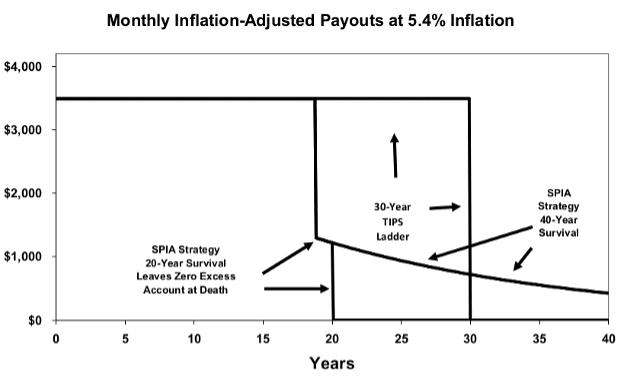
I was happy to see that William Bernstein – highly respected in index investing circles but relatively spare with words these days – wrote a new article Playing Inflation Russian Roulette in Retirement with a lot of good nuggets. He compares the retirement income from a single-premium immediate annuity and a 30-year TIPS ladder.

The comparison gets a bit complicated (see article to fully explain chart below), but I did take away the idea that even if you start with $70,000 annuity income like in the above scenario, you only spend $40,000 and put excess ($30,000 in year 1) rest aside in a “for future inflation” side account. You can still increase your $40,000 a year of spending annually, but keep putting the difference into the excess side account. This excess amount will decrease over time until the inflation-adjusted spending reaches and surpasses $70,000 a year, at which time you start withdrawing from the excess side account. In addition, we should consider the money left over in case of early death.

In the end, Bernstein seems to lean towards the TIPS ladder as he points out the danger of high inflation. He reminds us that “worst-case historically” doesn’t actually mean “worst-case”. How many times recently have we read the words “biggest [something] ever”?

One is reminded of Nassim Taleb’s dictum that “this so-called worst-case event, when it happened, exceeded the worst case at the time.” In other words, 5.4% long-term inflation is nowhere near the worst-case scenario. Even a casual glance at the global history of fiat money in the twentieth century shows that hyperinflation is the rule, not the exception. During the above-mentioned 1966-1995 period, U.S. debt/GDP averaged around 50%; now, it’s more twice that level and rising rapidly, and given the hundreds of trillions of dollars of additional implicit debt (promises to Social Security and Medicare, and to backstop future emergencies – think military aid to Ukraine and weather or terrorism disaster relief) it won’t take much to tip things over into a debt spiral, especially if the Treasury has to roll its debt over at higher interest rates for very long.

He also reminds us that we don’t have to do either one – the easiest way for most of us to access additional inflation-adjusted income is to delay taking Social Security:

It would be nice if one could purchase inflation-adjusted annuities, but those products have gone the way of disco, and I suspect that proposing their revival would not be a career enhancing move for any insurance company executive who suggests it. The best that one can do in this regard is to “purchase” the inflation-adjusted annuity offered by spending down one’s retirement assets to defer Social Security until age 70.

Finally, I wanted to include his relatively-conservative views on safe withdrawal rates:

The single most important factor that determines how to do that is the nest-egg burn rate (your annual spending divided by the size of your retirement portfolio). I suggest the following rule of thumb: if your burn rate is below 2% at age 60, below 3% at age 70, or below 4% at age 80, a standard stock/bond portfolio will nicely see you through your retirement, and you have no need to annuitize your assets.

I plan to keep an eye on real TIPS yields, and may readjust within the bond portion of my portfolio to purchase individual TIPS at longer maturities.

Robinhood IRA: 1% Bonus Match on Retirement Contributions

I have to hand it to Robinhood, they are good at marketing. It took years, but Robinhood is finally offering Individual Retirement Accounts (IRAs) with the unique feature of giving you an extra 1% on every dollar you contribute, every year. Traditional and Roth IRAs are available. The 2022 IRA contribution limits are $6,000 ($7,000 if you are age 50+), which means a bonus of up to $60-$70 annually. Right now, you have to sign up on their waitlist, with actual rollout in January 2023. If you wait until then, you could do both your 2022 and 2023 contributions in early 2023.

Some important items after reading through their IRA Match FAQ:

  • Make sure you make your IRA contributions from a linked external bank account only up to the annual IRA contribution limits. Contributions from your Robinhood brokerage or spending accounts don’t earn the IRA Match. Rollovers don’t count either.
  • You must keep the funds that earned the match in the account for at least 5 years to avoid the possibility of a clawback fee when withdrawn.
  • IRA Match counts as interest income in your IRA and doesn’t count toward your annual IRA contribution limit.
  • Outgoing $100 ACAT transfer fee applies if you transfer to another broker later using Automated Customer Account Transfer Service. This fee is currently set at $100.

I’m a little conflicted about this. On the one hand, IRA contributions are so limited and precious, it would be nice to effectively put in a little extra and have it grow tax deferred for 20-30 years, even if it is only about $60 a year. On the other hand, IRAs have more paperwork requirements and I don’t know if I trust Robinhood’s barebones customer service to properly deal with my annual “Backdoor” IRA conversions and such.

Sustainable Portfolio Withdrawal Rates During High-Inflation Periods

As a follow-up to my previous post on historical inflation (10-year rolling averages), how do periods of high inflation affect safe withdrawal rates for retirement portfolios? I reference a paper about Sustainable Portfolio Withdrawal Rates During High-Inflation Periods by Gerstein Fisher research, but in the middle of writing this post the source document and the entire GersteinFisher.com domain went down. (Update: Here it is on the Wayback Machine. Thanks to reader Peter for the link.)

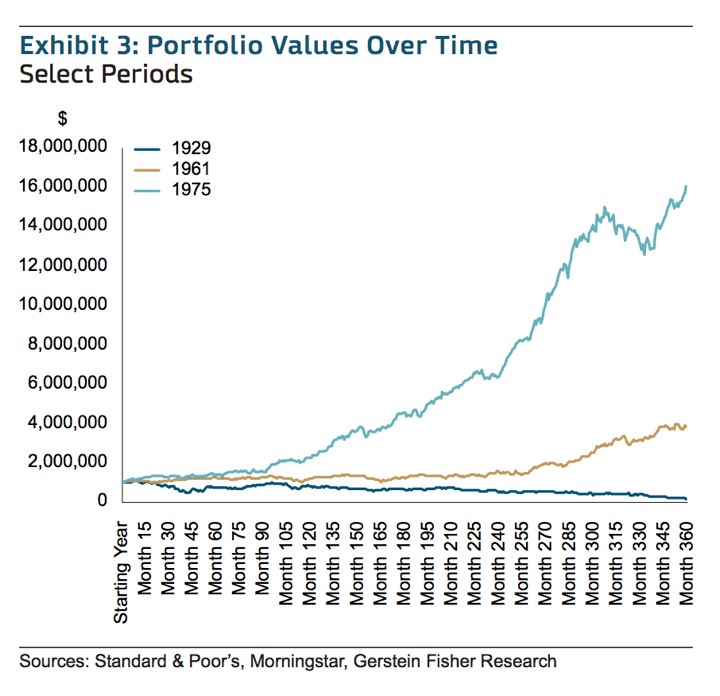
Planning for the future with 50% stocks and 50% bonds is tricky! The chart below shows how widely a portfolio’s value can vary depending on your start date. The model portfolio is 50% broad US stocks and 50% US bonds. Here’s what $1,000,000 starting in 1929 vs. 1961 vs. 1975 would have performed with a 4% withdrawal rate and 3% annual inflation:

In Exhibit 3, we can see the vast difference a starting year can make, comparing the portfolio values over time of a portfolio where we assume a 4% withdrawal rate and 3% annual inflation but begin in three very different periods. In the worst case, retirement begins in 1929, on the eve of the Great Depression; in 1961, retirement begins in an “average” period with moderate market returns; and in 1975, we have a 30-year period of exceptionally good returns overall, fueled by falling interest rates and by missing the 2008-2009 Global Financial Crisis.

These may be extremes, but they are extremes that happened to real people and could certain happen again.

A difference of 1% withdrawal rate can be huge over a 30 year retirement. Here’s the difference between a 3% initial withdrawal rate (then adjusted upwards with inflation) and a 4% initial withdrawal rate (then adjusted upwards with inflation) during a period that contained high inflation (1965-1995). Starting out at withdrawing $30,000 a year on a $1,000,000 portfolio would have been just fine, but withdrawing $40,000 a year would have been disastrous.

To examine what a “worst case scenario” regarding inflation might look like, we examine one of the highest inflation periods in modern US history – a retirement starting in 1966 and ending in 1995, which experienced multiple years of double-digit inflation in the mid- to late-1970s. Even a 4% initial withdrawal rate isn’t sustainable given the rapid increase in inflation (the portfolio is expected to meet an annual withdrawal of nearly $200,000 by the end of the 30-year period), exhausting the portfolio in roughly 25 years.

Here’s the 1965-1995 period highlighted from the historical inflation chart. I noticed that the inflation wasn’t sky-high the entire time, but it was elevated over a long-enough period.

The main takeaway from the paper was that the 4% rule does work most of the time, but watch out for periods of high inflation. Don’t blindly take out 4% a year when inflation is high and your portfolio performance is low. The 4% rule may be something like 95% effective historically, but being flexible with your withdrawals will prevent complete disaster even if you are in the bad luck 5%.

Best Interest Rates on Cash – December 2022 Update

Here’s my monthly roundup of the best interest rates on cash as of December 2022, roughly sorted from shortest to longest maturities. We all need some safe assets for cash reserves or portfolio stability, and there are often lesser-known opportunities available to individual investors. Check out my Ultimate Rate-Chaser Calculator to see how much extra interest you’d earn by moving money between accounts. Rates listed are available to everyone nationwide. Rates checked as of 12/4/2022.

TL;DR: 5% on up to $10,000 from fintech. 5% APY on up to $100k via a 7-month promo CD. 4% APY available on liquid savings. 1-year CD at 4.71% APY. 5-year CD at 4.75% APY. Compare against Treasury bills and bonds at every maturity (12-month near 4.69%). 6.89% Savings I Bonds still available if you haven’t maxed out 2022 limits.

Fintech accounts
Available only to individual investors, fintech companies often pay higher-than-market rates in order to achieve fast short-term growth (often using venture capital). “Fintech” is usually a software layer on top of a partner bank’s FDIC insurance.

  • 5% on up to $10,000. Juno now pays 5% on all cash deposits up to $10,000 and 3% on cash deposits from $10,001 up to $250,000. $50 direct deposit bonus. Please see my Juno review for details.
  • 4.00% APY on $6,000 with no direct deposit requirement. Current offers 4% APY on up to $6,000 total ($2,000 each on three savings pods). No direct deposit required. $50 referral bonus for new members with $200+ direct deposit with promo code JENNIFEP185. Please see my Current app review for details.
  • 4.00% APY on up to $250,000, but requires direct deposit and credit card spend. Currently a waitlist for new applicants. The top tier requires you to maintain positive cashflow in the checking account each month, $500 in total monthly direct deposits, and $500 in credit card purchases each month. Existing customers will get up to 4% APY through April 2023, with requirements waived through March 2023. Please see my updated HM Bradley review for details.

High-yield savings accounts
Since the huge megabanks STILL pay essentially no interest, I think every should have a separate, no-fee online savings account to accompany your existing checking account. The interest rates on savings accounts can drop at any time, so I list the top rates as well as competitive rates from banks with a history of competitive rates. Some banks will bait you with a temporary top rate and then lower the rates in the hopes that you are too lazy to leave.

  • The leapfrogging to be the temporary “top” rate continues. All America/Redneck Bank is at 4% APY for balances up to $75,000 ($500 to open, no min balance). Republic Bank of Chicago has a Digital Money Market account at 4.00% APY ($2,500 minimum to open and avoid monthly fee, new money only).
  • SoFi Bank is now up to 3.25% APY + up to $275 new account bonus with direct deposit. You must maintain a direct deposit of any amount each month for the higher APY. SoFi has their own bank charter now so no longer a fintech by my definition. See details at $25 + $250 SoFi Money new account and deposit bonus.
  • There are several other established high-yield savings accounts that aren’t a top rate, but historically do keep it relatively competitive for those that don’t want to keep switching banks.

Short-term guaranteed rates (1 year and under)
A common question is what to do with a big pile of cash that you’re waiting to deploy shortly (plan to buy a house soon, just sold your house, just sold your business, legal settlement, inheritance). My usual advice is to keep things simple and take your time. If not a savings account, then put it in a flexible short-term CD under the FDIC limits until you have a plan.

  • No Penalty CDs offer a fixed interest rate that can never go down, but you can still take out your money (once) without any fees if you want to use it elsewhere. CIT Bank has a 11-month No Penalty CD at 3.65% APY with a $1,000 minimum deposit. Ally Bank has a 11-month No Penalty CD at 3.30% APY for all balance tiers. Marcus has a 13-month No Penalty CD at 3.05% APY with a $500 minimum deposit. You may wish to open multiple CDs in smaller increments for more flexibility.
  • My eBanc has a 12-month certificate at 4.71% APY. $5,000 minimum. Early withdrawal penalty is 90 days of interest.
  • Andrews FCU has a special 7-month certificate at 5.00% APY (offer ends 12/14). $1,000 min, $100k max. Anyone can join this credit union with a ACC membership, and ACC membership is free with promo code “Andrews”. My previous application experience.

Money market mutual funds + Ultra-short bond ETFs*
Many brokerage firms that pay out very little interest on their default cash sweep funds (and keep the difference for themselves). * Money market mutual funds are regulated, but ultimately not FDIC-insured, so I would still stick with highly reputable firms. I am including a few ultra-short bond ETFs as they may be your best cash alternative in a brokerage account, but they may experience short-term losses.

  • Vanguard Federal Money Market Fund is the default sweep option for Vanguard brokerage accounts, which has an SEC yield of 3.70%. Odds are this is much higher than your own broker’s default cash sweep interest rate.
  • Vanguard Ultra-Short-Term Bond Fund currently pays 4.32% SEC yield ($3,000 min) and 4.42% SEC Yield ($50,000 min). The average duration is ~1 year, so there is some term interest rate risk.
  • The PIMCO Enhanced Short Maturity Active Bond ETF (MINT) has a 4.21% SEC yield and the iShares Short Maturity Bond ETF (NEAR) has a 4.31% SEC yield while holding a portfolio of investment-grade bonds with an average duration of ~6 months.

Treasury Bills and Ultra-short Treasury ETFs
Another option is to buy individual Treasury bills which come in a variety of maturities from 4-weeks to 52-weeks and are fully backed by the US government. You can also invest in ETFs that hold a rotating basket of short-term Treasury Bills for you, while charging a small management fee for doing so. T-bill interest is exempt from state and local income taxes.

  • You can build your own T-Bill ladder at TreasuryDirect.gov or via a brokerage account with a bond desk like Vanguard and Fidelity. Here are the current Treasury Bill rates. As of 12/2/2022, a new 4-week T-Bill had the equivalent of 3.81% annualized interest and a 52-week T-Bill had the equivalent of 4.69% annualized interest.
  • The iShares 0-3 Month Treasury Bond ETF (SGOV) has a 3.52% SEC yield and effective duration of 0.10 years. SPDR Bloomberg Barclays 1-3 Month T-Bill ETF (BIL) has a 3.47% SEC yield and effective duration of 0.08 years.

US Savings Bonds
Series I Savings Bonds offer rates that are linked to inflation and backed by the US government. You must hold them for at least a year. If you redeem them within 5 years there is a penalty of the last 3 months of interest. The annual purchase limit for electronic I bonds is $10,000 per Social Security Number, available online at TreasuryDirect.gov. You can also buy an additional $5,000 in paper I bonds using your tax refund with IRS Form 8888.

  • “I Bonds” bought between November 2022 and April 2023 will earn a 6.89% rate for the first six months. The rate of the subsequent 6-month period will be based on inflation again. More on Savings Bonds here.
  • In mid-April 2023, the CPI will be announced and you will have a short period where you will have a very close estimate of the rate for the next 12 months. I will have another post up at that time.
  • See below about EE Bonds as a potential long-term bond alternative.

Prepaid Cards with Attached Savings Accounts
A small subset of prepaid debit cards have an “attached” FDIC-insured savings account with exceptionally high interest rates. The negatives are that balances are severely capped, and there are many fees that you must be careful to avoid (lest they eat up your interest). There is a long list of previous offers that have already disappeared with little notice. I don’t personally recommend nor use any of these anymore, as I feel the work required and the fees charged if you mess up exceeds any small potential benefit.

  • Mango Money pays 6% APY on up to $2,500, if you manage to jump through several hoops. Requirements include $1,500+ in “signature” purchases and a minimum balance of $25.00 at the end of the month.
  • NetSpend Prepaid pays 5% APY on up to $1,000 but be warned that there is also a $5.95 monthly maintenance fee if you don’t maintain regular monthly activity.

Rewards checking accounts
These unique checking accounts pay above-average interest rates, but with unique risks. You have to jump through certain hoops which usually involve 10+ debit card purchases each cycle, a certain number of ACH/direct deposits, and/or a certain number of logins per month. If you make a mistake (or they judge that you did) you risk earning zero interest for that month. Some folks don’t mind the extra work and attention required, while others would rather not bother. Rates can also drop suddenly, leaving a “bait-and-switch” feeling.

  • All America/Redneck Bank pays 4.25% APY on up to $15,000 if you make 10 debit card purchases each monthly cycle with online statements.
  • The Bank of Denver pays 4.00% APY on up to $15,000 if you make 12 debit card purchases of $5+ each, receive only online statements, and make at least 1 ACH credit or debit transaction per statement cycle. Thanks to reader Bill for the updated info.
  • Presidential Bank pays 3.75% APY on balances between $500 and up to $25,000 (3.00% APY above that) if you maintain a $500+ direct deposit and at least 7 electronic withdrawals per month (ATM, POS, ACH and Billpay counts).
  • Find a locally-restricted rewards checking account at DepositAccounts.

Certificates of deposit (greater than 1 year)
CDs offer higher rates, but come with an early withdrawal penalty. By finding a bank CD with a reasonable early withdrawal penalty, you can enjoy higher rates but maintain access in a true emergency. Alternatively, consider building a CD ladder of different maturity lengths (ex. 1/2/3/4/5-years) such that you have access to part of the ladder each year, but your blended interest rate is higher than a savings account. When one CD matures, use that money to buy another 5-year CD to keep the ladder going. Some CDs also offer “add-ons” where you can deposit more funds if rates drop.

  • Bread Financial has a 5-year certificate at 4.75% APY ($1,500 min), 4-year at 4.65% APY, 3-year at 4.50% APY, 2-year at 4.50% APY, and 1-year at 4.50% APY. The early withdrawal penalty for the 5-year is 365 days of interest.
  • Department Of Commerce Federal Credit Union has a 5-year certificate at 4.70% APY ($500 min), 4-year at 4.59% APY, 3-year at 4.57% APY, 2-year at 4.61% APY, and 1-year at 4.40% APY. The early withdrawal penalty for the 5-year is 180 days of interest. Anyone can join this credit union through a $5 membership in the American Consumer Council (ACC). Enter ACC membership number on the online application.
  • You can buy certificates of deposit via the bond desks of Vanguard and Fidelity. You may need an account to see the rates. These “brokered CDs” offer FDIC insurance and easy laddering, but they don’t come with predictable early withdrawal penalties. Right now, I see a 5-year CD at 4.85% (non-callable). Be wary of higher rates from callable CDs, which means they can call back your CD if rates drop later.

Longer-term Instruments
I’d use these with caution due to increased interest rate risk, but I still track them to see the rest of the current yield curve.

  • Willing to lock up your money for 10 years? You can buy long-term certificates of deposit via the bond desks of Vanguard and Fidelity. These “brokered CDs” offer FDIC insurance, but they don’t come with predictable early withdrawal penalties. You might find something that pays more than your other brokerage cash and Treasury options. Right now, I see a 10-year CDs at 5.25% (non-callable) vs. 3.56% for a 10-year Treasury. Watch out for higher rates from callable CDs where they can call your CD back if interest rates drop.
  • How about two decades? Series EE Savings Bonds are not indexed to inflation, but they have a unique guarantee that the value will double in value in 20 years, which equals a guaranteed return of 3.5% a year. However, if you don’t hold for that long, you’ll be stuck with the normal rate currently 2.10%. As of 12/2/2022, the 20-year Treasury Bond rate was 3.79%.

All rates were checked as of 12/4/2022.

Historical Inflation Chart: 10-Year Rolling Average 1872-2022

Advisor Perspectives has a nice chart of 150 years of historical inflation (1872-2022). I appreciate that it includes both the short-term monthly inflation numbers as well as the 10-year rolling average over this long period of time.

A few basic observations:

  • From a long-term perspective, there have been many large sharp spikes in inflation throughout the entire period. Inflation has been a persistently recurring concern.
  • From roughly 1872-1940, there were extreme swings between both high inflation and high deflation. Of course, this was also when the dollar was (mostly) on the gold standard.
  • From roughly 1950 onward, the rolling 10-year average for inflation has still varied from ~2% to ~9% annually. Given our current low 10-year average, inflation could continue to be elevated for many years and not look out of place on this chart.

My primary takeaway is to always stay mindful of long-term inflation risk. I don’t know what inflation will be next month or next year, but I am confident that it’s coming sooner or later. Some applications (my opinion):

  • The 30-year fixed rate mortgage continues to be a great inflation hedge. (Even at high interest rates, that might soon result in lower prices.) As long as you lock in a monthly payment that you can comfortably afford and plan to stay a while, your monthly mortgage payment will only effectively get cheaper over time as inflation eats away at it. If rates drop, you can refinance. If rates rise, you can keep it forever and even rent the property out if you move, as high rates means inflation likely boosted rents while your mortgage payment stayed the same.
  • On the flip side, according to Macrotrends, the a 30-year Treasury bond yielded only 1% a year back in 2020. Long-term nominal bonds became a popular portfolio diversifier while rates were dropping (performance chasing), but in reality they became a ticking inflation bomb. I’m still avoiding long-term nominal bonds today.
  • A lifetime annuity has definite upsides, but inflation will eat away at the spending power over what could be 30 years. Maybe you’ll get older and spend less each year anyway, but I’d still maintain other assets (like stocks) to hedge that inflation risk. I like single premium immediate annuities as a possible tool for retirement income, but not as the only or primary tool.
  • TIPS are complex yet intriguing. I’m still not sure what the best play is right now, but I am happy to keep holding them as part of my bond portfolio. I’m leaning towards moving away from ETFs and more towards a ladder of individual bonds, especially if the real rates on long-term TIPS go any higher.