Archives for June 2021

Unifimoney App Review: Up to $1,000 Bitcoin Bonus Details

Unifimoney is a new “money super app” which promises to help manage all of your assets in a single mobile app. I should start by mentioning that the app is currently iPhone/iOS only. Here’s a quick rundown at what it includes:

  • High-yield checking account. Allpoint ATM network, Billpay, Remote Check Deposit, 0.20% APY. FDIC insurance through UMB Bank.
  • Cash back credit card. Launching later this year with “target” 1.5-2% cash back rewards.
  • Self-directed brokerage account. $0 commission stock trades. SIPC-insured through broker-dealer DriveWealth.
  • Crypto and precious metals trading account. Bitcoin + 30 others, gold, silver. Uses Gemini trust, regulated and reputable crypto custodians, same as the BlockFi promo.
  • Roboadvisor. 0.15% annual advisory fee. SEC-registered RIA.

That’s a pretty impressive bundle out of the gate, especially considering that most other companies start with one thing and then add on other features. For example, Robinhood started with free stock trades, then tried to add on high-yield checking. Ally Bank went many years before buying the brokerage firm TradeKing and renaming it Ally Invest. Unifimoney seems to have put a lot of different parts together and jumped through all the regulatory hoops, but will it work as a user-friendly package?

New user bonus details (Up to $1,000 Bitcoin). First, they need to attract some customers to try it out. I like trying out new apps, but a good bonus is always appreciated. They have a tiered bonus, starting with a $25 bitcoin bonus after depositing $1,000, going all the way up to a $1,000 bonus for a $100,000 deposit. Here is the full chart:

Here’s how those bonuses break down in terms of annualized return. Note some have a 30-day holding period and some have a 90-day holding period.

  • $25 BTC bonus for holding $1,000 for 30 days works out to the equivalent of 30% APY.
  • $100 BTC bonus for holding $10,000 for 30 days works out to the equivalent of 12% APY.
  • $250 BTC bonus for holding $20,000 for 90 days works out to the equivalent of 5% APY.
  • $500 BTC bonus for holding $50,000 for 90 days works out to the equivalent of 4% APY.
  • $1,000 BTC bonus for holding $100,000 for 90 days works out to the equivalent of 4% APY.

So far, those numbers are pretty good, and comparable to the transfer bonuses from many brokerages on the high end. If you kept $100,000 in a 0.50% APY savings account, you’d only have $500 after an entire year.

Here are the steps to earn that bonus (taken straight from their site):

  • Open a new Unifimoney account.
  • Deposit the minimum amount based on the tiers in the chart above between $1,000 and $100,000+ within 14 days of account opening.
  • To qualify, hold that same minimum amount in combined deposits/assets in the account for 30 days for Tiers 1-2 and 90 days for Tiers 3-5.
  • Your Bitcoin reward (shown in the tiers above) will be paid into your Unifimoney Crypto account within 14 days of qualifying.
  • Bitcoin Rewards are inclusive of transaction fees and calculated at the rate of Bitcoin at the time of purchase (see details in terms and conditions below)

Here is an important detail below about funding. I always fund using a push from my online savings account anyway (usually Ally Bank), but I’ve heard many complaints about push/pull from within a startup bank. At least here they tell you the limit upfront.

For single funding transactions greater than $10,000 we recommend these funds are pushed to your Unifimoney account from your existing bank either via ACH or Wire Transfer. Funding transactions initiated within the app are restricted to a maximum $10,000.

Sign-up process details. You will need to have the following things handy at account opening:

  • Cell phone number
  • US Citizens: Photo ID and SSN. Non-US Citizens: Passport and SSN.
  • Address listed on Photo ID should match your current mailing address.
  • Account and routing number for funding bank account. You’ll need to fund with at least $100 initially, and you can add the rest to reach your desired bonus tier above within the next 14 days.

Tip: If you are deep into the account opening process and go off to find your photo ID and your phone goes to “sleep”, it will look like you have to start everything over again. Simply tap on “Login” and type in your phone number, and it should let you resume the application from where you left off.

Bottom line. Unifimoney is an ambitious new fintech with a banking/credit card/stock trading/portfolio management/crypto/gold all rolled into one app. They have a new user bonus of up to $1000 in Bitcoin, depending on how much you deposit. I’ll update this review after I have a chance to play around with the various parts.

Target Deal Days 2021: 5% Off Gift Cards 6/16-6/19

In an amazing coincidence, Target is having their Target Deal Days from June 20-22, overlapping with Amazon Prime Day. The tagline is “3 days of spellbinding savings with no membership fees”. New deals will be added every day, with the following 5% gift card discount beforehand:
From June 16–19, Target GiftCards are 5% off on Target.com (Target Circle offer valid online only. $500 limit. Terms & conditions apply). For even more discounts every day, join our free loyalty program Target Circle and reach for your Target RedCard. Let the savings begin!

The 5% discount is not as good as the 10% off in previous years, but the $500 purchase limit is higher. I’ll try to update this post with any specific deals of interest that are announced.

Sample Household Budget For Early Retirement: 85% Savings Rate!

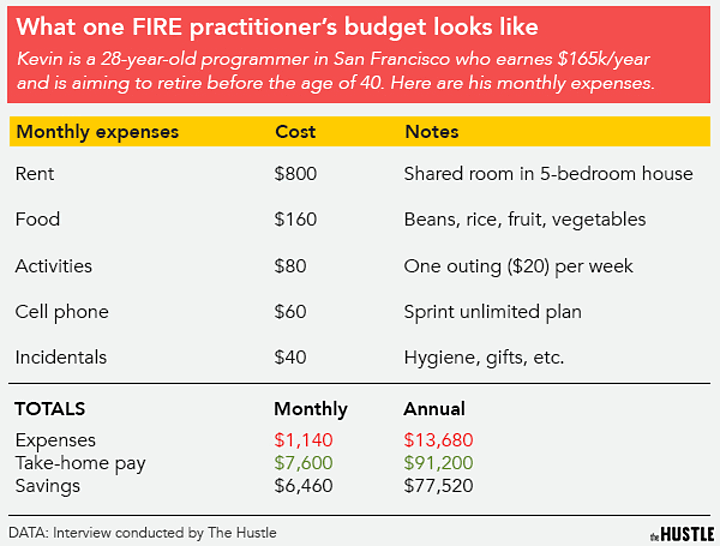
The Hustle has an article on 30-year-old early retirees and it serves as a quick introduction to the concept of FIRE (Financial Independence Retire Early). For the most part, it profiles young tech workers and engineers with very aggressive savings rates. Here is the budget of a 28-year-old computer programmer in San Francisco who saves 85% of his take-home pay (over 91% of gross pay):

At first glance, isn’t the budget missing a few lines? Health insurance? Paid by employer, I assume. Transportation? No need for a car in the city, I assume. Utilities? I guess renting a room in a 5-bedroom can become quite a deal when splitting things that many ways.

On the other hand, how does $165,000 gross salary end up as only $91,000 take-home pay, even in California? His true saving rate might be even higher than stated.

Let’s forget the details. He makes a big salary, and spends very little. That’s all you really need to know. I don’t question the overall spending numbers because I also lived on less than $20,000 a year as a 20-something single person in a budget apartment shared with a roommate. Even that 165k income is simply about average for a tech worker, per Statista:

(If you are prone to salary envy, don’t poke around the tech worker salary comparison site Levels.fyi.)

I’m happy for Kevin, but is frugality only for the rich? No, I don’t think that is a fair statement. Now that I am older, I can estimate the income of my parents and can appreciate the lengths that they went to in order to manage our family without going into debt. You have to to believe that you can make a difference. I hate the suggestion that there is no point in trying, and that we have to wait for the politicians to save us.

Now, I would agree if you are a household that is earning significantly over the median income, then yes, you have the power to quickly build a pile of money that is big enough to change your life. “Financial freedom within 10 years is for the rich” isn’t quite as catchy. A positive aspect of the FIRE movement is that it is showing people an alternative way. You don’t have to save 85% of your income, but you should realize what you are giving up if you’re just spending it all.

My overall message? Personal finance still matters. You can make a difference. You can raise your income. You can prioritize your spending. I avoid the acronym FIRE acronym because the words are confusing for too many people. The vast majority are not going to “retire” completely from paid work in their 30s or 40s (even if they technically could). However, you can still read about the examples of others in order to find inspiration. Take what works for you, and leave the rest.

The fact is, if you are able to use your saved money in order to lead a life with less stress and more meaning, then you are winning the game as far as I am concerned. Different job/same place, same job/different place, less hours, more flexible hours, better hours, there are countless possibilities to improve your daily life.

Feedburner E-mail Newsletter Service Ending: Working on Replacement

Hi everyone, some quick blog maintenance stuff: My current provider (Feedburner) is shutting down as of July 2021.

Free Updates via E-mail
If you’d like to be automatically sent an e-mail when a new post is published (roughly every weekday), please enter your e-mail address in the form below. I’ll never use your email address for any other purpose, and you can unsubscribe at any time.

Best Interest Rates on Cash – Monthly Update June 2021

Here’s my monthly roundup of the best interest rates on cash as of June 2021, roughly sorted from shortest to longest maturities. I try to find lesser-known opportunities to improve your yield while keeping your principal FDIC-insured or equivalent. Check out my Ultimate Rate-Chaser Calculator to see how much extra interest you’d earn by moving money between accounts. Rates listed are available to everyone nationwide. Rates checked as of 6/2/2021.

Fintech accounts
Available only to individual investors, fintech companies oftentimes pay higher-than-market rates in order to achieve fast short-term growth (often using venture capital). I define “fintech” as a software layer on top of a different bank’s FDIC insurance. These do NOT require a certain number debit card purchases per month. Although I do use some of these after doing my own due diligence, read about the Beam app for potential pitfalls and best practices.

  • 3% APY on up to $100,000. The top rate is 3% APY for April through June 2021, and they have not indicated any upcoming rate drop. HM Bradley requires a recurring direct deposit every month and a savings rate of at least 20%. See my HM Bradley review.
  • 3% APY on 10% of direct deposits + 1% APY on $25,000. One Finance lets you earn 3% APY on “auto-save” deposits (up to 10% of your direct deposit, up to $1,000 per month). Separately, they also pay 1% APY on up to another $25,000 with direct deposit. New customer $50 bonus via referral. See my One Finance review.
  • 3% APY on up to $15,000. Porte requires a one-time direct deposit of $1,000+ to open a savings account. New customer $50 bonus via referral. See my Porte review.
  • 1.20% APY on up to $50,000. OnJuno recently updated their rate tiers, while keeping their promise to existing customers a grandfathered rate. If you don’t maintain a $500 direct deposit each month, you’ll still earn 1.20% on up to $5k. See my updated OnJuno review.

High-yield savings accounts
While the huge megabanks pay essentially no interest, it’s easy to open a new “piggy-back” savings account and simply move some funds over from your existing checking account. The interest rates on savings accounts can drop at any time, so I list the top rates as well as competitive rates from banks with a history of competitive rates. Some banks will bait you with a temporary top rate and then lower the rates in the hopes that you are too lazy to leave.

  • T-Mobile Money is still at 1.00% APY with no minimum balance requirements. The main focus is on the 4% APY on your first $3,000 of balances as a qualifying T-mobile customer plus other hoops, but the lesser-known perk is the 1% APY for everyone. Thanks to the readers who helped me understand this. There are several other established high-yield savings accounts at closer to 0.50% APY.

Short-term guaranteed rates (1 year and under)
A common question is what to do with a big pile of cash that you’re waiting to deploy shortly (just sold your house, just sold your business, legal settlement, inheritance). My usual advice is to keep things simple and take your time. If not a savings account, then put it in a flexible short-term CD under the FDIC limits until you have a plan.

  • No Penalty CDs offer a fixed interest rate that can never go down, but you can still take out your money (once) without any fees if you want to use it elsewhere. Marcus has a 7-month No Penalty CD at 0.45% APY with a $500 minimum deposit. AARP members can get an 8-month CD at 0.55% APY. Ally Bank has a 11-month No Penalty CD at 0.50% APY for all balance tiers. CIT Bank has a 11-month No Penalty CD at 0.30% APY with a $1,000 minimum deposit. You may wish to open multiple CDs in smaller increments for more flexibility.
  • Lafayette Federal Credit Union has a 12-month CD at 0.80% APY ($500 min). Early withdrawal penalty is 6 months of interest. Anyone can join this credit union via partner organization ($10 one-time fee).

Money market mutual funds + Ultra-short bond ETFs
Many brokerage firms that pay out very little interest on their default cash sweep funds (and keep the difference for themselves). Unfortunately, money market fund rates are very low across the board right now. Ultra-short bond funds are another possible alternative, but they are NOT FDIC-insured and may experience short-term losses at times. These numbers are just for reference, not a recommendation.

  • The default sweep option is the Vanguard Federal Money Market Fund which has an SEC yield of 0.01%. Vanguard Cash Reserves Federal Money Market Fund (formerly Prime Money Market) currently pays 0.01% SEC yield.
  • Vanguard Ultra-Short-Term Bond Fund currently pays 0.31% SEC yield ($3,000 min) and 0.41% SEC Yield ($50,000 min). The average duration is ~1 year, so your principal may vary a little bit.
  • The PIMCO Enhanced Short Maturity Active Bond ETF (MINT) has a 0.24% SEC yield and the iShares Short Maturity Bond ETF (NEAR) has a 0.36% SEC yield while holding a portfolio of investment-grade bonds with an average duration of ~6 months.

Treasury Bills and Ultra-short Treasury ETFs
Another option is to buy individual Treasury bills which come in a variety of maturities from 4-weeks to 52-weeks. You can also invest in ETFs that hold a rotating basket of short-term Treasury Bills for you, while charging a small management fee for doing so. T-bill interest is exempt from state and local income taxes. Right now, this section isn’t very interesting as T-Bills are yielding close to zero!

  • You can build your own T-Bill ladder at TreasuryDirect.gov or via a brokerage account with a bond desk like Vanguard and Fidelity. Here are the current Treasury Bill rates. As of 6/2/2021, a new 4-week T-Bill had the equivalent of 0.01% annualized interest and a 52-week T-Bill had the equivalent of 0.05% annualized interest.
  • The Goldman Sachs Access Treasury 0-1 Year ETF (GBIL) has a -0.08% SEC yield and the SPDR Bloomberg Barclays 1-3 Month T-Bill ETF (BIL) has a -0.12% (!) SEC yield. GBIL appears to have a slightly longer average maturity than BIL.

US Savings Bonds
Series I Savings Bonds offer rates that are linked to inflation and backed by the US government. You must hold them for at least a year. If you redeem them within 5 years there is a penalty of the last 3 months of interest. The annual purchase limit is $10,000 per Social Security Number, available online at TreasuryDirect.gov. You can also buy an additional $5,000 in paper I bonds using your tax refund with IRS Form 8888.

  • “I Bonds” bought between May 2021 and October 2021 will earn a 3.54% rate for the first six months. The rate of the subsequent 6-month period will be based on inflation again. More info here.
  • In mid-October 2021, the CPI will be announced and you will have a short period where you will have a very close estimate of the rate for the next 12 months. I will have another post up at that time.
  • See below about EE Bonds as a potential long-term bond alternative.

Prepaid Cards with Attached Savings Accounts
A small subset of prepaid debit cards have an “attached” FDIC-insured savings account with exceptionally high interest rates. The negatives are that balances are severely capped, and there are many fees that you must be careful to avoid (lest they eat up your interest). There is a long list of previous offers that have already disappeared with little notice. I don’t personally recommend nor use any of these anymore, as I feel the work required and risk of messing up exceeds any small potential benefit.

  • Mango Money pays 6% APY on up to $2,500, if you manage to jump through several hoops. Requirements include $1,500+ in “signature” purchases and a minimum balance of $25.00 at the end of the month.

Rewards checking accounts
These unique checking accounts pay above-average interest rates, but with unique risks. You have to jump through certain hoops which usually involve 10+ debit card purchases each cycle, a certain number of ACH/direct deposits, and/or a certain number of logins per month. If you make a mistake (or they judge that you did) you risk earning zero interest for that month. Some folks don’t mind the extra work and attention required, while others would rather not bother. Rates can also drop suddenly, leaving a “bait-and-switch” feeling.

  • The Bank of Denver pays 2.00% APY on up to $25,000 if you make 12 debit card purchases of $5+ each, receive only online statements, and make at least 1 ACH credit or debit transaction per statement cycle. The rate recently dropped. If you meet those qualifications, you can also link a Kasasa savings account that pays 1.00% APY on up to $50k. Thanks to reader Bill for the updated info.
  • Devon Bank has a Kasasa Checking paying 2.50% APY on up to $10,000, plus a Kasasa savings account paying 2.50% APY on up to $10,000 (and 0.85% APY on up to $50,000). You’ll need at least 12 debit transactions of $3+ and other requirements every month.
  • Presidential Bank pays 2.25% APY on balances up to $25,000, if you maintain a $500+ direct deposit and at least 7 electronic withdrawals per month (ATM, POS, ACH and Billpay counts).
  • Evansville Teachers Federal Credit Union pays 3.30% APY on up to $20,000. You’ll need at least 15 debit transactions and other requirements every month.
  • Lake Michigan Credit Union pays 3.00% APY on up to $15,000. You’ll need at least 10 debit transactions and other requirements every month.
  • Find a locally-restricted rewards checking account at DepositAccounts.

Certificates of deposit (greater than 1 year)
CDs offer higher rates, but come with an early withdrawal penalty. By finding a bank CD with a reasonable early withdrawal penalty, you can enjoy higher rates but maintain access in a true emergency. Alternatively, consider building a CD ladder of different maturity lengths (ex. 1/2/3/4/5-years) such that you have access to part of the ladder each year, but your blended interest rate is higher than a savings account. When one CD matures, use that money to buy another 5-year CD to keep the ladder going. Some CDs also offer “add-ons” where you can deposit more funds if rates drop.

  • NASA Federal Credit Union has a special 49-month Share Certificate at 1.40% APY ($10,000 min). Early withdrawal penalty is 1 year of interest. Anyone can join this credit union by joining the National Space Society (free). Note that NASA FCU may perform a hard credit check as part of new member application.
  • Abound Credit Union has a 59-month Share Certificate at 1.30% APY ($500 min) and a special 37-month Share Certificate at 1.15% APY ($500 min). Early withdrawal penalty is 1 year of interest (and only with the consent of the credit union, so be aware). Anyone can join this credit union via partner organization ($10 one-time fee).
  • Lafayette Federal Credit Union has a 5-year CD at 1.26% APY ($500 min). Early withdrawal penalty is 6 months of interest. Anyone can join this credit union via partner organization ($10 one-time fee).
  • You can buy certificates of deposit via the bond desks of Vanguard and Fidelity. You may need an account to see the rates. These “brokered CDs” offer FDIC insurance and easy laddering, but they don’t come with predictable early withdrawal penalties. Right now, I don’t see anything available at a 5-year maturity. Be wary of higher rates from callable CDs listed by Fidelity.

Longer-term Instruments
I’d use these with caution due to increased interest rate risk, but I still track them to see the rest of the current yield curve.

  • Willing to lock up your money for 10 years? You can buy long-term certificates of deposit via the bond desks of Vanguard and Fidelity. These “brokered CDs” offer FDIC insurance, but they don’t come with predictable early withdrawal penalties. You might find something that pays more than your other brokerage cash and Treasury options. Right now, I see a 10-year CD at 1.80% APY vs. 1.59% for a 10-year Treasury. Watch out for higher rates from callable CDs from Fidelity.
  • How about two decades? Series EE Savings Bonds are not indexed to inflation, but they have a unique guarantee that the value will double in value in 20 years, which equals a guaranteed return of 3.5% a year. However, if you don’t hold for that long, you’ll be stuck with the normal rate which is quite low (currently 0.10%). I view this as a huge early withdrawal penalty. But if holding for 20 years isn’t an issue, it can also serve as a hedge against prolonged deflation during that time. Purchase limit is $10,000 each calendar year for each Social Security Number. As of 6/2/2021, the 20-year Treasury Bond rate was 2.21%.

All rates were checked as of 6/2/2021.