Archives for January 2021

Walmart Plus: Get $75+ Back on $98 Annual Membership Fee

Walmart+ membership gets you the following perks:

  • Free next-day and 2-day shipping from Walmart.com (no minimum purchase).
  • Free same-day delivery of cold Groceries & more from your local Walmart ($35 minimum purchase). Where available.
  • Scan & Go in-store. Use the Walmart app to scan barcodes as you shop in-store and skip the cashier line.
  • Save 5 cents per gallon on fuel at over 2,000 Walmart, Murphy USA and Murphy Express fuel stations. You also get to access member pricing at Sam’s Club fuel stations.

There is a free 15-day trial, and the membership retail price is $98 per year (or $12.95 per month). Right now, there are two ways to save over 75% off that $98 annual membership:

Swagbucks $75+ back. Search for “Walmart+” on the Swagbucks rewards site, and you’ll see they are offering 7,500 Swagbucks on a paid annual subscription, plus 250 Swagbucks on your first Walmart+ purchase. Purchase must be made with in 21 days of starting your Walmart+ Trial. Cash Back will post within 60 days. There is also a $10 new member bonus via Swagbucks referral link.

7,500 Swagbucks can be redeemed for at least $75 in Amazon gift cards (or similar).
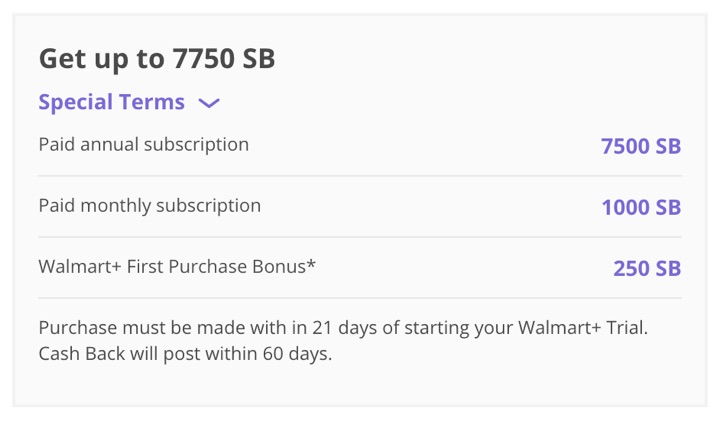
MyPoints $75+ back. Search for “Walmart+” on the MyPoints rewards site, and you’ll see they are offering 12,000 points on a paid annual subscription, plus 500 Swagbucks on your first Walmart+ purchase. Purchase must be made with in 21 days of starting your Walmart+ Trial. Cash Back will post within 60 days. There is also a $10 new member bonus via MyPoints referral link.

12,000 MyPoints can be redeemed for at least $75 in Amazon gift cards (or similar).

Both Swagbucks and Mypoints are now owned by the same parent company, and I have cashed out of both without issues recently. (They also recently acquired Upromise.)
Best ETFs For Each Asset Class – DFA Alternatives for Small, Value, International, Emerging Markets

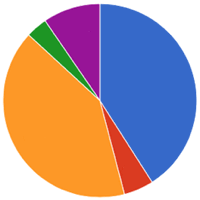
Some investors like to break down their investments into several different asset and sub-asset classes. For example, here is a pie chart showing the Ultimate Buy-and-Hold Portfolio recommended by Paul Merriman. You don’t need to hold every one of these asset classes, this is just an example with a lot of “slices”.

What is the best ETF to buy for each asset class? These days, there are multiple ETFs for nearly every sub-asset class or factor. The best ETF can depend on multiple factors, for example whether you buy it in a tax-deferred or taxable account. Established providers include Vanguard, iShares, Schwab, SPDR, and Invesco. (If you are planning to juggle this many ETFs, consider the automatic rebalancing “pie” feature of the brokerage firm M1 Finance.)

In the past, I have referred to this ETF list at Altruist Financial Advisors. As advisors affiliated with Dimensional Fund Advisors (DFA), they are able to use DFA mutual funds to build portfolios for their clients. Unfortunately, DFA mutual funds are not available to the public, and so we have to look for the best alternatives. The page is updated every so often.

Recently, I have found this ETF list at PaulMerriman.com. In 2021, Merriman started recommending a new provider of ETFs called Avantis, which was born when several DFA employees split off and formed their own company. Here is part of his rationale:

What’s changed is the inclusion of the five Avantis funds (AVUS, AVUV, AVDE, AVDV and AVEM). Avantis is relatively new to the ETF space, having been introduced a little over a year ago. The company was founded by former DFA employees and follows a philosophy very consistent with the design of Paul’s portfolios. Over the course of the past year, their funds have matured to where we decided it was time to include them in our evaluation.

Here are the recommended Avantis ETFs:

  • Avantis US Equity ETF (AVUS)
  • Avantis US Small Cap Value ETF (AVUV)
  • Avantis International Equity ETF (AVDE)
  • Avantis International Small Cap Value ETF (AVDV)
  • Avantis Emerging Markets Equity ETF (AVEM)

DFA recently announced that they are also expanding into ETFs, which can be bought and sold by the general public in any brokerage account. These ETFs just started trading in late 2020:

  • Dimensional US Core Equity Market ETF (DFAU)
  • Dimensional International Core Equity Market ETF (DFAI)
  • Dimensional Emerging Core Equity Market ETF (DFAE)

My own portfolio has only a little bit of this added complexity, with a goal of adding some extra exposure to asset classes with a relatively long history of high risk-adjusted returns. These are interesting developments if you also invest in this way, but I don’t necessarily recommend you do so, as I also agree with Merriman in this regard:

In the end, it’s probably more important that you have an investment strategy you believe in and can stick with than that you have exactly the right funds for that strategy.

Do your research, and find an investment strategy that fits with your psychological temperament and investment beliefs. Being able to “keep the faith” and stick with your strategy through the inevitable ups and downs is the most important thing. For example, even if dividend income investing isn’t academic-theory-optimal, it may be psychologically-optimal for many people and has successfully funded many comfortable retirements. For many other people, the best option is something that they can set-and-forget. Accordingly, many people can create a comfortable retirement with a simple-yet-powerful Vanguard Target Date Retirement fund.

How Robinhood Really Makes Money, and Why It No Longer Matters

While it seems that Robinhood and Gamestop are officially the new gambling version of a multiplayer online video game (CNBC, BI, Bloomberg), this story reminded me of this past Matt Levine article which is my favorite detailed-yet-understandable explanation of how Robinhood makes money. There have been many similar attempts to explain their business model, but this felt the most balanced. Even the footnotes are educational.

For example, he explains how the biggest brokers like TD Ameritrade used to handle payment for order flow, which you could equate to a discount on the stock price (“price improvement”):

“We’ll buy stock for you, you’ll pay us $5 to do it, we’ll get a discount on the stock and we’ll pass on 80% of the discount to you.”

Compare this with how Robinhood chose to do handle payment for order flow:

“We’ll buy stock for you, you won’t pay us to do it, we’ll get a discount on the stock and we’ll pass on 20% of the discount to you.”

Robinhood also happens to get paid more for their order flow than other brokerage firms. I’ve also explored this question back in 2018: Does Robinhood Brokerage Make Money in Shady or Questionable Ways? My basic conclusions were that:

  • Robinhood would be breaking the law if they broke the SEC rule of National Best Bid and Offer (NBBO) that requires brokers provide the best available bid and ask prices when buying and selling securities for customers. They wouldn’t do that, would they?
  • The order flow from Robinhood is probably more valuable because it is from small, retail investors (“dumb money”).

Well, it turns out that:

If you don’t read Matt Levine’s entire explanation, here is the bottom line: Robinhood customers were essentially being charged an extra roughly 3 to 5 cents a share through poorer execution prices. If you only traded a few shares, then you still basically paid nothing. If you traded 100 shares, that might add up to $3 to $5 total. Roughly breakeven. If you traded 1,000 shares, that might add up to $30 to $50 total. For some people, Robinhood’s “free trades” were a better deal. For others, Robinhood’s “free trades” were a much worse deal.

Supposedly, Robinhood doesn’t do this anymore and satisfies NBBO again. But it still shows the general way in which Robinhood makes money today. High-frequency trading firms pay somewhat higher prices for the trading flows from Robinhood users, and Robinhood keeps as much of that money as possible while still barely satisfying NBBO. Perhaps a smaller number on the order of a half-penny a share. Other firms like Fidelity proudly boast of how they do better than NBBO (“price improvement” again), which is also a quiet dig at Robinhood.

[Fidelity’s] price improvement can save investors $18.53 on average for a 1,000-share equity order, compared to the industry average of $4.25.

All this no longer matters because Robinhood is no longer the sweet spot for newbie traders. People like to make fun of the Robinhood name because in a way they secretly stole from the “poor” average traders and sold their orders to the “rich”. However, they also forced everyone from Fidelity to Schwab to all offer commission-free trades. Robinhood did deliver something to us common folk!

The important difference is that firms like Fidelity and Schwab still have wealthy clients that demand phone numbers with helpful humans that answer after only a few rings. Meanwhile, Robinhood only provides an overwhelmed e-mail address than can take days or weeks to finally address your problems.

When Robinhood first came on the scene, they were the new sweet spot for cheap trades for small balances. However, now that free trades are everywhere, the sweet spot in my opinion has now shifted to something like a Fidelity or Schwab account. You get total commission costs either equal to or lower than Robinhood, plus better customer service from more knowledgable reps. If you still prefer a trendy new app over a stuffy old broker, check out my Big List of Free Stocks For New Commission-Free Brokerage Apps. Most of them have a phone number, and they’ll be less busy. (WeBull, M1 Finance, and Firstrade for sure have phone numbers.)

Money and Happiness: Happiness Keeps Increasing Past $75,000 a Year

Did you know there was an iPhone app called Track Your Happiness? The app basically does what the name suggests:

A few times a day, you’ll get a notification and be asked some questions about your experience at that moment. The idea is that by measuring your experience at many individual moments, you’ll get an accurate picture of your life and the determinants of your happiness.

After collecting over 1.7 million data points from 30,000+ app users, here is the research paper Experienced well-being rises with income, even above $75,000 per year by Matt Killingsworth, published in the Proceedings of the National Academy of Sciences (PNAS). Thanks to reader Al for the tip. Taken from the “Significance” section:

Past research has found that experienced well-being does not increase above incomes of $75,000/y. This finding has been the focus of substantial attention from researchers and the general public, yet is based on a dataset with a measure of experienced well-being that may or may not be indicative of actual emotional experience (retrospective, dichotomous reports). Here, over one million real-time reports of experienced well-being from a large US sample show evidence that experienced well-being rises linearly with log income, with an equally steep slope above $80,000 as below it. This suggests that higher incomes may still have potential to improve people’s day-to-day well-being, rather than having already reached a plateau for many people in wealthy countries.

Here is a chart from the paper that illustrates how “experienced well-being” keeps increasing with log(income).

Why do I keep making log in bold? Because even though it was a long time ago, I still remember something about logarithms! The only two charts in the paper emphasize the nice line before and after the $75,000 income marker. This might confuse a quick reader to think that happiness keeps increasing linearly with income. In reality, here is a graphic (source) that shows the difference between rising linearly with n vs log(n). The relationship between happiness as income increases looks like the red line below.

If you read the entire paper, this is addressed (emphasis mine):

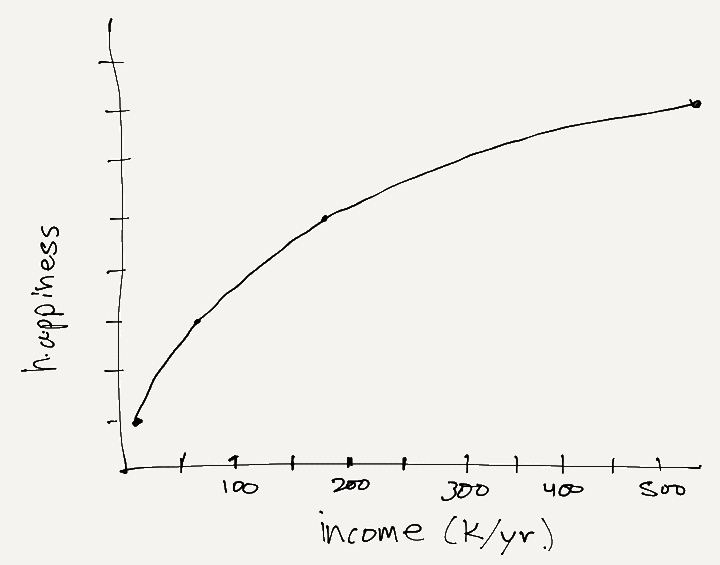
When interpreting these results, it bears repeating that well-being rose approximately linearly with log(income), not raw income. This means that two households earning $20,000 and $60,000, respectively, would be expected to exhibit the same difference in well-being as two households earning $60,000 and $180,000, respectively. The logarithmic relationship implies that marginal dollars do matter less the more one earns, while proportional differences in income have a constant association with well-being regardless of income.

In order to match the amount of happiness increase from $20,000/yr to $60,000/yr income, you would have to go from $60,000 to $180,000 year, or then $180,000 to $540,000 a year, and so on. Here a quick sketch that I made of this (gives me a reason to use my new $34 knockoff Apple pencil).

That… sounds pretty reasonable, doesn’t it? Happiness increases with money quickly at lower incomes, and as your income grows the incremental increases are smaller (but still goes up a bit). If you make $150,000 a year now, getting a $25,000 annual raise will still make you little happier, but nearly as much as someone earning $50,000 a year now.

If the past research said that you got zero additional happiness past $75,000 year, that would have been the surprising thing. If happiness forever increased directly in proportion with income, that also would have been surprising.

How Fintech Bank Apps like Chime Make Money: Debit Card and ATM Fees

An uncomfortable fact of personal finance is that you don’t necessarily “pay for what you get”. When a bank offers “Free Checking”, it means “we won’t charge you a monthly fee but we’ll get our money from overdraft charges, ATM fees, and more”. For example, US banks charged their customers over $11 billion in overdraft charges in 2019. Many people had zero overdrafts, while 80% of the overdraft fees were paid by just 9% of account holders. A minority of users often ends up subsidizing the perks for everyone else. This extends to everything from no-annual-fee credit cards to free-trade stock brokers.

Fintech banks like Chime are growing in popularity with their lower cost structure and user-friendly apps. Chime doesn’t charge overdraft fees at all! But despite their claim of “no hidden bank fees” and heavy use of emojis, these are still profit-seeking businesses. This Axios article provides some interesting numbers:

  • Chime made an average of $208 per user per year (annual gross revenue) as of June 2020.
  • The majority of Chime’s revenue was through debit card interchange fees. Chime does not offer any cash back on its debit card. Whenever you use their debit card, Chime keeps whatever transaction fees it generates. Given that other debit card programs offer up to 1% cash back, I can only estimate that Chime can end up making a little more than 1% of purchases overall.*
  • ~20% of Chime’s revenue was from their $2.50 fees for every out-of-network ATM cash withdrawal. This fee in on top of whatever is charged to you by the ATM owner itself. According to the article, Chime only pays about 10 cents to the ATM owner and the rest is profit.

This is not to criticize Chime, as they provide a useful and valuable service to many people who might otherwise not qualify for a traditional bank account, all without charging monthly fees. A lot of people basically use Chime to get their electronic direct deposit as opposed to the traditional paper check, and then spend it right away. Chime’s business model is well-suited for that customer, who previously may have paid a check-cashing service. I have an account with Chime myself (my review + $75 easy bonus) and I can understand why they have become so popular.

My point is that understanding how financial services make money can help you adjust your behavior and/or comparison shop. For banking apps, watch out for overdraft charges and ATM fees adding up despite no monthly fees, as well as spending too much on debit cards when you could be earning better rewards elsewhere. For credit cards, don’t focus on earning frequent flier miles when your debt balance is growing exponentially at 18% interest. For brokerage accounts, those free trades are partially offset by paying nearly no interest on your idle cash.

* Large banks have their debit card interchange fees regulated, but Chime (Stride Bank) is on the exempt list of smaller issuers. Durbin fee limits only apply to large banks with $10 billion in assets and above. The Federal Reserve shows average fee is 1.4% for exempt transactions and 0.54% for covered transactions for debit cards. But both Bancorp and Stride Bank (the two banks behind Chime) are on the exempt list of smaller bank issuers.

Coursera: Free Courses 2021 New Year Promotion

Online education site Coursera is offering a Learn a New Skill for Free in 2021 promotion with selected courses free until January 31, 2021. Here are a couple that are related to finance:

For example, you should see the $49 normal price adjusted to zero if you enroll in one of the courses above after visiting the promo link.

Alliant CU Ultimate Opportunity Savings Review – $100 Bonus

Alliant Credit Union, one of the top 10 largest US credit unions by assets, has teamed up with Suze Orman to promote their new Ultimate Opportunity Savings account. The interest rate of 0.55% APY and structure appears to be the same as their existing High-Rate Savings account, just with an added $100 cash bonus if you deposit at least $100 a month for 12 consecutive months. Unfortunately, it is open to new Alliant CU members only. Thanks to reader Bill for the tip.

Note that the fine print also states that you must have at least $1,200 in your account at the end of the period (you can’t have withdrawn it after the deposits).

The $100 bonus is automatically deposited into The Ultimate Opportunity Savings Account after you’ve successfully made a monthly deposit of $100 or more for 12 consecutive months. To qualify for the bonus, you must keep a minimum balance of $100 in your savings account, and have $1,200 (or more) in your account at the end of the 12-month period.1

There is no minimum balance required, but you must accept paperless statements to avoid a monthly fee.

Bonus math. In terms of equivalent interest rate, earning an extra $100 of interest for a $100 monthly deposit is roughly 16% APY, so definitely better than any other non-bonus savings account out there. (Without the bonus, this account would earn less than 4 bucks!) Add in the normal 0.55% APY, and your total APY is ~16.5% APY. It’s much less exciting for bigger deposits, but this can still be a pretty good incentive if you want to start building up an emergency fund.

Alliant CU membership eligibility. Credit unions are supposed to be a cooperative non-profit that serves a specific community, but Alliant is pretty much open to anyone nationwide. If you start the online membership application, it will walk you through their various eligibility options. Here are their membership groups:

Any employee or retiree of a Qualifying Company.
Any member of a Qualifying Organization.
Any immediate family member of an existing Alliant member.
Anyone who lives or works in a Qualifying Chicagoland Community.
Anyone who is a member of the Foster Care to Success charity group.

You’ll find that it only costs $5 to join Foster Care to Success, and Alliant will pay that fee on your behalf!

Other potential member perks. Alliant has a good checking account product and their savings account rates have been historically pretty competitive. Like many other credit unions, they also offer competitive rates on auto loans on both new and used cars.

They also have a 2.5% cashback credit card, but there is a $10,000 monthly cap on purchases plus a $99 annual fee after the first year. After that first year, you’ll need to spend at least $19,800 annually (average $1,650 monthly) and less than $10,000 per month to exceed to do better than a 2% cash back card.

Bottom line. If you’ve been meaning to join a credit union and/or start a new savings/emergency fund for the new year, this $100 bonus might be a nice incentive to reach the modest savings goal of $100 per month.

Stimulus 2nd Round, Unemployment, FSA Changes, PPP Loans 2nd Draw

I know I’m a bit late on this, but after reading several media articles, here again is my curated collection of highlights and perhaps overlooked items that might be worthy of additional research.

Second round of Economic Impact Payments. Many people have already received this direct deposited to their bank accounts, up to $600 per taxpayer ($1,200 for married filing joint) plus $600 per qualifying child under age 17. If have questions, try using the IRS Get My Payment tool.

The amount starts getting phased out at $75,000 AGI for most single filers and $150,000 AGI for most married joint filers. Here is a graphical chart per Tax Foundation:

If you made too much according to your 2019 income, but your income in 2020 was actually low enough, you will be able to claim the rebate when you file your taxes. If you qualified based on your 2019 AGI but your 2020 ended up too high, you get to keep the payment; there is no clawback.

Unemployment benefits expanded again. The new COVID-19 relief package extends certain unemployment benefit programs for 11 weeks, including an unemployment supplement of $300 a week for many people from December 26, 2020 to March 14, 2021. It also increases the maximum number of weeks of benefits to 50 from 39 for many people. Certain self-employed workers will also see an addition $100 per week benefit.

Charitable Deductions. In 2020, you were able to deduct $300 in charitable (cash-only) donations, even if you used the standard deductions. In 2021, this deduction was extended and increased to $300 for single and up to $600 for married filing joint, again even if you use the standard deduction.

Healthcare FSA, Dependent Care FSAs. If you didn’t use up all your “use-it-or-lose-it” FSA funds in 2020, the new law allows your employer the option of carrying over unused balances for an additional 12 months (through the end of 2021). For Dependent Care FSAs, the age limit was also increased from 12 to 13 (since those 2020 funds may have been for your former 12-year-old). Check with your HR department and/or benefits manager.

PPP Forgivable Loan, 2nd Draw. The new COVID-19 relief package clarifies that businesses can still deduct expenses paid with forgiven PPP loans. (Typically, forgiven debt is considered taxable income, but forgiven PPP loans are specifically marked as NOT taxable income.)

Certain small business owners can now apply for a second draw of forgivable PPP loans (up to $2 million). Applying for the first round does not prevent you from applying for the second round. Second-draw loans are limited to businesses with fewer than 300 employees and at least a 25 percent drop in gross receipts in a 2020 quarter compared to the same quarter in 2019. (If this is your first time taking a loan, there is no requirement for the drop in gross receipts.) Businesses taking a PPP loan may now also be eligible for the Employee Retention Tax Credit (ERTC).

Sources: WSJ Article, Tax Foundation, IRS.gov

Big List of Free Consumer Data Reports (2/2): See Your Confidential Rental History, Insurance, Retail, & Employment Data

magUpdated for 2021. Here is the second part of my big list of free consumer reports from over 50 different reporting agencies. The first part included your credit, banking, and subprime lending-related information. This part includes your housing, insurance, and employment history. You can request a free copy every 12 months of what these databases have stored about you and are telling prospective landlords, insurers, or employers.

Again, you may not need to check all of these, and many may not even have a file on you anyway. But for example if you are a renter then you’d want to make sure your rental history is clean and correct, or if were applying for life insurance you might check your medical reports.

Based on my situation, I have checked the following reports out of the ones listed below – CLUE Auto, CLUE Property, MIB.com, Milliman IntelliScript.

Rental History

Realpage (LeasingDesk) Consumer Report. Provides tenant screening through their LeasingDesk product, including “the industry’s largest rental payment history database.”

CoreLogic SafeRent. SafeRent provides both tenant and employment screening data, including information regarding landlord tenant and criminal public court records. One free report every 12 months.

Experian RentBureau Rental History Report. “Every 24 hours, Experian RentBureau receives updated rental payment history data from property owners/managers, electronic rent payment services and collection companies and makes that information available immediately to the multifamily industry through our resident screening partners.”

First Advantage Resident History Report. Tenant and employment background checks. One free report every 12 months.

Contemporary Information Corp. CIC provides background checks on prospective tenants and/or employees and contractors for landlords and management companies. Keep records of any rental evictions.

Tenant Data. Provides tenant history reports, including any reported damages, unpaid balances, evictions, lease violations, noise complaints, or unauthorized pets.

Screening Reports, Inc. A national provider of background screening service to the multi-family housing industry.

TransUnion Rental Screening Solutions. SmartMove provides tenant credit, eviction, and background checks.

  • MySmartMove.com FAQ page
  • SmartMove will disclose the contents of a criminal and/or credit report retained by SmartMove to an individual who requests a copy of their report. To verify your identity and obtain a copy of your report(s) or dispute any information within that report, please contact customer service at 866-775-0961.

Auto and Property Insurance

C.L.U.E. Personal Property Report. A division of LexisNexis, CLUE stands for Comprehensive Loss Underwriting Exchange, which collects information that is used to calculate your insurance premiums. This report provides a seven year history of losses associated with an individual and his/her personal property. Includes date of loss, loss type, and amount paid along with general information such as policy number, claim number and insurance company name. This also means you can find out about previous claims on the house you are currently renting or recently bought, even if they weren’t made by you.

C.L.U.E. Auto Report. This report provides a seven year history of automobile insurance losses associated with an individual. Includes date of loss, loss type, and amount paid along with general information such as policy number, claim number and insurance company name.

A-PLUS Loss History Reports, subsidiary of Verisk. ISO stands for Insurance Services Office, A-PLUS stands for Automated Property Loss Underwriting System. Auto and property loss claim history.

Drivers History. Owned by TransUnion. Collects driving violations.

Insurance Information Exchange (IIX), subsidiary of Verisk. Provide reports including your motor vehicle records and driver history, including any traffic violations or related criminal history. May require proof of adverse action to obtain free report.

Utilities

National Consumer Telecom and Utilities Exchange. NCTUE tracks when people don’t pay their phone, cable, or utility bills. One free report every 12 months.

Retail

The Retail Equation. Tracks product return and exchange abuse at retail merchants.

Gaming

VIP Preferred. Tracks consumer data regarding check-cashing at casinos.

Medical History

MIB (previously known as Medical Information Bureau). Run by 470 insurance companies with a “primary mission of detecting and deterring fraud that may occur in the course of obtaining life, health, disability income, critical illness, and long-term care insurance.” They record information of “underwriting significance” like medical conditions or hazardous activities. If you have not applied for individually underwritten life, health, or disability income insurance during the preceding seven year period, then you probably don’t have a record.

Milliman IntelliScript. Tracks your prescription drug purchase history. “Milliman IntelliScript will have prescription information about you only if you authorized the release of your medical records to an insurance company and that company requested that we gather a report on you.”

Employment History

The following companies all offer background screening services for employers. Most will not have any information about you unless you authorized a potential employer to run a background check on you (probably during the application process). Some will not provide you information unless there was adverse action. Otherwise, you can get one free copy every 12 months.

The Work Number (division of Equifax). They also keep historical income records.

Accurate Background, Inc.

  • AccurateBackground.com “You may contact our Client Services team at 800.216.8024, or send an email to customer_service@accurate.com. Please include your full name and the search reference ID, if available.”
  • 800-216-8024

American Databank, LLC.

Backgroundchecks.com.

Checkr

EmpInfo

  • EmpInfo.com report request page (scroll down to FCRA section).
  • Generally won’t have a report on everyone, only for people specifically requested by an employer.
  • 800-274-9694

First Advantage Background Check. Tenant and employment background checks. One free report every 12 months.

HireRight, recently merged with General Information Services (GIS)

Info Cubic.

IntelliCorp

OPENonline

Pre-employ

Professional Screening & Information, Inc.

Sterling (acquired EmployeeScreenIQ)

PeopleFacts

Truework

Reminder: Also see Part 1: Big List of Free Consumer Reports with Your Credit, Banking, and Payday Lending Data.

Sources: ConsumerFinance.gov, FTC.gov, Wikipedia

Best Interest Rates on Cash – January 2021

Here’s my monthly roundup of the best interest rates on cash for January 2021, roughly sorted from shortest to longest maturities. I track these rates because I keep 12 months of expenses as a cash cushion and there are many lesser-known opportunities to improve your yield while still being FDIC-insured or equivalent. Check out my Ultimate Rate-Chaser Calculator to see how much extra interest you’d earn by moving money between accounts. Rates listed are available to everyone nationwide. Rates checked as of 1/6/2021.

Fintech accounts
Available only to individual investors, fintech accounts oftentimes pay higher-than-market rates in order to achieve high short-term growth. I will define “fintech” as an app software layer on top of a different bank’s FDIC insurance backbone. You should read about the story of the Beam app for potential pitfalls and best practices. Below are some current options with decent balance limits:

  • 3% APY on up to $100,000. New customers should be happy to see the top rate staying at 3% APY for January through March 2021. HM Bradley requires a recurring direct deposit every month and a saving rate of at least 20%. See my HM Bradley review.
  • 3% APY on 10% of direct deposits. One Finance lets you earn 3% APY on auto-save deposits (up to 10% of your direct deposit, up to $1,000 per month). See my One Finance review.
  • 3% APY on up to $15,000. Porte requires a one-time direct deposit of $1,000+ to open a savings account. See my Porte review.
  • 2.15% APY on up to $5k/$30k. Limited-time offer of free membership to their higher balance tier for 6 months with direct deposit. See my OnJuno review.

High-yield savings accounts
While the huge megabanks pay essentially no interest, it’s easy to open a new “piggy-back” savings account and simply move some funds over from your existing checking account. The interest rates on savings accounts can drop at any time, so I list the top rates as well as competitive rates from banks with a history of competitive rates. Some banks will bait you with a temporary top rate and then lower the rates in the hopes that you are too lazy to leave.

  • T-Mobile Money has the top rate at the moment at 1.00% APY with no minimum balance requirements. The main focus is on the 4% APY on your first $3,000 of balances as a qualifying T-mobile customer plus other hoops, but the lesser-known perk is the 1% APY for everyone. Thanks to the readers who helped me understand this. There are several other established high-yield savings accounts at closer to 0.50% APY for now.

Short-term guaranteed rates (1 year and under)
A common question is what to do with a big pile of cash that you’re waiting to deploy shortly (just sold your house, just sold your business, legal settlement, inheritance). My usual advice is to keep things simple and take your time. If not a savings account, then put it in a flexible short-term CD under the FDIC limits until you have a plan.

  • No Penalty CDs offer a fixed interest rate that can never go down, but you can still take out your money (once) without any fees if you want to use it elsewhere. Marcus has a 7-month No Penalty CD at 0.45% APY with a $500 minimum deposit. AARP members can get an 8-month CD at 0.55% APY. Ally Bank has a 11-month No Penalty CD at 0.50% APY for all balance tiers. CIT Bank has a 11-month No Penalty CD at 0.30% APY with a $1,000 minimum deposit. You may wish to open multiple CDs in smaller increments for more flexibility.
  • CommunityWide Federal Credit Union has a 12-month CD at 0.80% APY ($1,000 min). Early withdrawal penalty depends on how early you withdraw. Anyone can join this credit union via partner organization ($5 one-time fee).

Money market mutual funds + Ultra-short bond ETFs
If you like to keep cash in a brokerage account, beware that many brokers pay out very little interest on their default cash sweep funds (and keep the difference for themselves). The following money market and ultra-short bond funds are NOT FDIC-insured and thus come with a possibility of principal loss, but may be a good option if you have idle cash and cheap/free commissions.

  • The default sweep option is the Vanguard Federal Money Market Fund which has an SEC yield of 0.02%. Vanguard Cash Reserves Federal Money Market Fund (formerly Prime Money Market) currently pays 0.02% SEC yield.
  • Vanguard Ultra-Short-Term Bond Fund currently pays 0.49% SEC yield ($3,000 min) and 0.59% SEC Yield ($50,000 min). The average duration is ~1 year, so there is more interest rate risk.
  • The PIMCO Enhanced Short Maturity Active Bond ETF (MINT) has a 0.28% SEC yield and the iShares Short Maturity Bond ETF (NEAR) has a 0.50% SEC yield while holding a portfolio of investment-grade bonds with an average duration of ~6 months. Note that there was a sudden, temporary drop in net asset value during the March 2020 market stress.

Treasury Bills and Ultra-short Treasury ETFs
Another option is to buy individual Treasury bills which come in a variety of maturities from 4-weeks to 52-weeks. You can also invest in ETFs that hold a rotating basket of short-term Treasury Bills for you, while charging a small management fee for doing so. T-bill interest is exempt from state and local income taxes. Right now, this section isn’t very interesting as T-Bills are yielding close to zero!

  • You can build your own T-Bill ladder at TreasuryDirect.gov or via a brokerage account with a bond desk like Vanguard and Fidelity. Here are the current Treasury Bill rates. As of 1/6/2020, a new 4-week T-Bill had the equivalent of 0.09% annualized interest and a 52-week T-Bill had the equivalent of 0.11% annualized interest.
  • The Goldman Sachs Access Treasury 0-1 Year ETF (GBIL) has a -0.01% SEC yield and the SPDR Bloomberg Barclays 1-3 Month T-Bill ETF (BIL) has a -0.06% (!) SEC yield. GBIL appears to have a slightly longer average maturity than BIL.

US Savings Bonds
Series I Savings Bonds offer rates that are linked to inflation and backed by the US government. You must hold them for at least a year. If you redeem them within 5 years there is a penalty of the last 3 months of interest. The annual purchase limit is $10,000 per Social Security Number, available online at TreasuryDirect.gov. You can also buy an additional $5,000 in paper I bonds using your tax refund with IRS Form 8888.

  • “I Bonds” bought between November 2020 and April 2021 will earn a 1.68% rate for the first six months. The rate of the subsequent 6-month period will be based on inflation again. More info here.
  • In mid-April 2021, the CPI will be announced and you will have a short period where you will have a very close estimate of the rate for the next 12 months. I will have another post up at that time.
  • See below about EE Bonds as a potential long-term bond alternative.

Prepaid Cards with Attached Savings Accounts
A small subset of prepaid debit cards have an “attached” FDIC-insured savings account with exceptionally high interest rates. The negatives are that balances are severely capped, and there are many fees that you must be careful to avoid (lest they eat up your interest). Some folks don’t mind the extra work and attention required, while others do. There is a long list of previous offers that have already disappeared with little notice. I don’t personally recommend nor use any of these anymore.

  • One of the few notable cards left in this category is Mango Money at 6% APY on up to $2,500, along with several hoops to jump through. Requirements include $1,500+ in “signature” purchases and a minimum balance of $25.00 at the end of the month.

Rewards checking accounts
These unique checking accounts pay above-average interest rates, but with unique risks. You have to jump through certain hoops which usually involve 10+ debit card purchases each cycle, and if you make a mistake you won’t earn any interest for that month. Some folks don’t mind the extra work and attention required, while others would rather not bother. Rates can also drop suddenly, leaving a “bait-and-switch” feeling.

  • Consumers Credit Union Free Rewards Checking (my review) still offers up to 4.09% APY on balances up to $10,000 if you make $500+ in ACH deposits, 12 debit card “signature” purchases, and spend $1,000 on their credit card each month. The Bank of Denver has a Free Kasasa Cash Checking offering 2.50% APY on balances up to $25,000 if you make 12 debit card purchases and at least 1 ACH credit or debit transaction per statement cycle. (BoD now says debit transactions must be $5 minimum each and must reflect “normal, day-to-day spending behavior”.) If you meet those qualifications, you can also link a savings account that pays 1.50% APY on up to $50k. Thanks to reader Bill for the updated info. Presidential Bank has another competitive offering. Find a locally-restricted rewards checking account at DepositAccounts.

Certificates of deposit (greater than 1 year)
CDs offer higher rates, but come with an early withdrawal penalty. By finding a bank CD with a reasonable early withdrawal penalty, you can enjoy higher rates but maintain access in a true emergency. Alternatively, consider building a CD ladder of different maturity lengths (ex. 1/2/3/4/5-years) such that you have access to part of the ladder each year, but your blended interest rate is higher than a savings account. When one CD matures, use that money to buy another 5-year CD to keep the ladder going. Some CDs also offer “add-ons” where you can deposit more funds if rates drop.

  • Affinity Plus Federal Credit Union has a 5-year certificate at 1.50% APY ($500 minimum). Early withdrawal penalty is 1 year of interest. 4-year at 1.20% APY, and 3-year at 0.95% APY ($500 minimum). Anyone can join this credit union via partner organization ($25 one-time fee).
  • Hiway Federal Credit Union has a 5-year certificate at 1.35% APY ($25k minimum) and 1.25% APY with a $10,000 minimum. Early withdrawal penalty is 1 year of interest. 4-year at 1.20% APY, and 3-year at 1.10% APY ($25k minimum). Anyone can join this credit union via partner organization ($10 one-time fee).
  • You can buy certificates of deposit via the bond desks of Vanguard and Fidelity. You may need an account to see the rates. These “brokered CDs” offer FDIC insurance and easy laddering, but they don’t come with predictable early withdrawal penalties. I see nothing special right now, but it might still pay more than your other brokerage cash and Treasury options. Be wary of higher rates from callable CDs listed by Fidelity.

Longer-term Instruments
I’d use these with caution due to increased interest rate risk, but I still track them to see the rest of the current yield curve.

  • Willing to lock up your money for 10 years? You can buy long-term certificates of deposit via the bond desks of Vanguard and Fidelity. These “brokered CDs” offer FDIC insurance, but they don’t come with predictable early withdrawal penalties. You might find something that pays more than your other brokerage cash and Treasury options. Watch out for higher rates from callable CDs from Fidelity.
  • How about two decades? Series EE Savings Bonds are not indexed to inflation, but they have a unique guarantee that the value will double in value in 20 years, which equals a guaranteed return of 3.5% a year. However, if you don’t hold for that long, you’ll be stuck with the normal rate which is quite low (currently 0.10%). I view this as a huge early withdrawal penalty. But if holding for 20 years isn’t an issue, it can also serve as a hedge against prolonged deflation during that time. Purchase limit is $10,000 each calendar year for each Social Security Number. As of 1/6/2021, the 20-year Treasury Bond rate was 1.60%.

All rates were checked as of 1/6/2021.

What If You Invested $10,000 Every Year For the Last 10 Years? 2021 Edition

Instead of focusing only on what happened in 2020, how about stepping back and taking the longer view? How would a slow-and-steady investor have done over the last decade? Most successful savers invest money each year over a long period of time, these days often into a target-date fund (TDF). You may not find yourself buying Bugattis with Bitcoin, but we should not take for granted the ability for everyday folks to own a basket of successful businesses for tiny fees. Don’t pass up the opportunity right in front of you.

Target date funds. The Vanguard Target Retirement 2045 Fund is an all-in-one fund that is low-cost, highly diversified, and available both inside many employer retirement plans and to anyone that funds an IRA. During the early accumulation phase, this fund holds 90% stocks (both US and international) and 10% bonds (investment-grade domestic and international). It is a solid default choice in a world of mediocre, overpriced options. These “simple” funds have made substantial wealth for millions of investors.

The power of consistent, tax-advantaged investing. For the last decade, the maximum allowable annual contribution to a Traditional or Roth IRA has been roughly $5,000 per person. The maximum allowable annual contribution for a 401k, 403b, or TSP plan has been over $10,000 per person. If you have a household income of $67,000, then $10,000 is right at the 15% savings rate mark. Therefore, I’m going to use $10,000 as a benchmark amount. This round number also makes it easy to multiply the results as needed to match your own situation. Save $5,000 a year? Halve the result. Save $20,000 a year? Double the numbers, and so on.

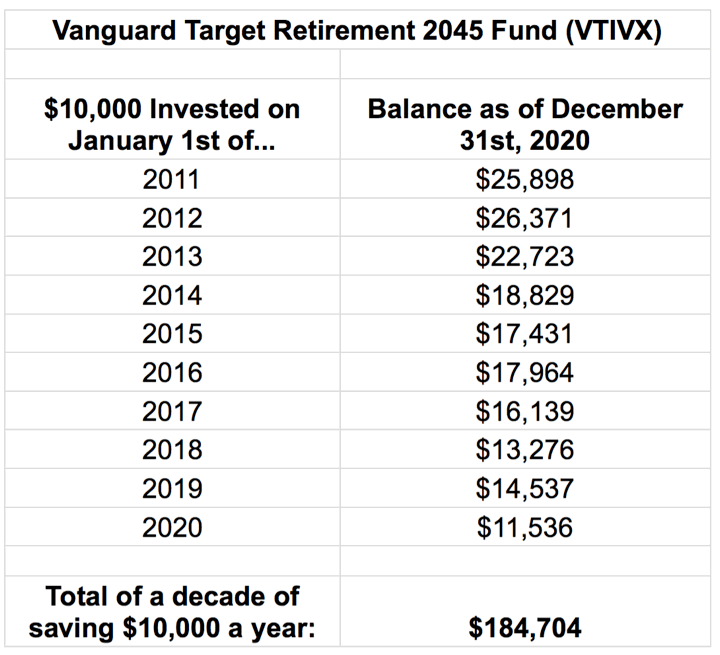
The real-world payoff from a decade of saving $833 a month. What would have happened if you put $10,000 a year into the Vanguard Target Retirement 2045 Fund, every year, for the past 10 years? You’d have put in $100,000 over time, but in more manageable increments. With the interactive tools at Morningstar and a Google spreadsheet, we get this:

Investing $10,000 every year for the last decade would have resulted in a total balance of $184,000. That breaks down to $100k in contributions + $84k investment growth.

Extended edition: 15 years of real-world savings. What would have happened if you put $10,000 a year into the Vanguard Target Retirement 2045 Fund, every year, for the past 15 years instead? (Now $150,000 total.) Here are the extended return numbers:

Investing $10,000 every year for the last decade and a half would have resulted in a total balance of $324,000. That breaks down to $150k in contributions + $175k investment growth. Your gains are now officially more than what you initially invested.

Real-world path to becoming a 401(k) millionaire. Not theoretical numbers from a calculator! Are you a dual-income household that can put away more? If you were a couple that both maxed out their 401k and IRAs at roughly $20k each or $40k total per year for 10 years, you would have a total balance of over $735,000. You would be 3/4 of the way to millionaire status after a decade. That breaks down to $400k in contributions + $335k investment growth.

If you did this for the last 15 years, you would be a 401(k) millionaire household. If you started when you were 30 years old, your account statement would show a balance just shy of $1,300,000 by the age of 45. (This doesn’t include the 401k company match, which is how many people reach millionaire status even faster.)

Timing still matters, but not as much as you might think due to the dollar-cost averaging and longer time horizon. Yes, the last decade has been a great run for US stock markets. But Vanguard Target funds also own a lot of international stocks, which haven’t been nearly as hot and have maintained lower valuations. More importantly, you can’t control that part. You have much more control over how much you save. Here are my previous “saving for a decade” posts:

Work on improving your career skills (or start your own business), save a big chunk of your income, and then invest it in productive assets. Keep calm and repeat. The only “secret” here is consistency. We have maxed out both IRA and the 401k salary deferral limits nearly every year since 2004. No inheritances, no special access to a hedge fund, no stock-picking skill. You can build serious wealth with something as accessible and boring as the Vanguard Target Retirement fund.

Free National Emerald Club Executive Elite Upgrade (Extended Through 2023)

Back again for 2021, possibly good through 2023! Emerald Club is the loyalty program for National Car Rental that includes a unique “Emerald Aisle” where you can walk up and pick any car in that aisle based on your tier. The base Emerald tier (anyone can sign up and join this for free) may only mean picking between a Nissan Altima or a Hyundai Elantra, but it’s still a bit of fun as I like cars.

I’ve been doing this multiple years, but American Express has brought back a promotion with a free upgrade to Emerald Executive Elite status, which is the highest tier – one above Emerald Executive and two tiers above plain Emerald Club. The “Executive Emerald Aisle” includes a wider choice of nicer cars including SUVs and large sedans (while still paying only the midsize rate) and faster rewards accrual (1 free rental day after 5 rental credits). I was able to extend my existing account, but you may have to sign up for a fresh new account (or sign up your spouse/partner as the 2nd driver is free). The form doesn’t appear to ask for an American Express number. They will change your Contract ID and you should allow that, but you can always change it back later if you want.

Here is my Emerald Executive Elite status extended to February 2023:

In addition, if you enroll a new account through the promotion and also pay for your first rental with any American Express card, they will credit you with five Emerald Club Credits. Remember, 5 credits is enough for a free car rental already with Executive Elite status. Essentially, you get a free rental day after your first rental if paid with AmEx.

Enroll in National’s Emerald Club® by clicking the Executive Elite Enrollment button below, between 10/9/2020 – 2/28/2021, and automatically advance to Emerald Club Executive Elite status. After enrolling, pay for your first rental with any American Express® Card and earn five Emerald Club Credits toward a future rental day.

Status match. Once you obtain your status and/or membership kit, you can also ask for a status match with Hertz, Avis (request via email), or Enterprise. The worst thing they can say is no.

Changing your Contract ID. When you make a new reservation, there is a section for “Account Number / Coupons”. After signing up for this, it may say “AMEX EE” but you can remove it and change to whatever you wish. (You may need to keep it for 5 credit promo above.) Some discount car rental sites like AutoSlash.com will help you find and apply alternative coupons and contract ID discounts. My local credit union membership also lets me use a contract ID that sometimes offers the lowest rate.